特朗普又力挺加密行业:希望剩余的所有比特币都是“美国制造”!

jin10Опубліковано о 2024-06-12Востаннє оновлено о 2024-06-12

共和党总统候选人特朗普周二表示,他希望所有剩余的比特币都在美国生产,并重申这将有助于美国成为能源大国。

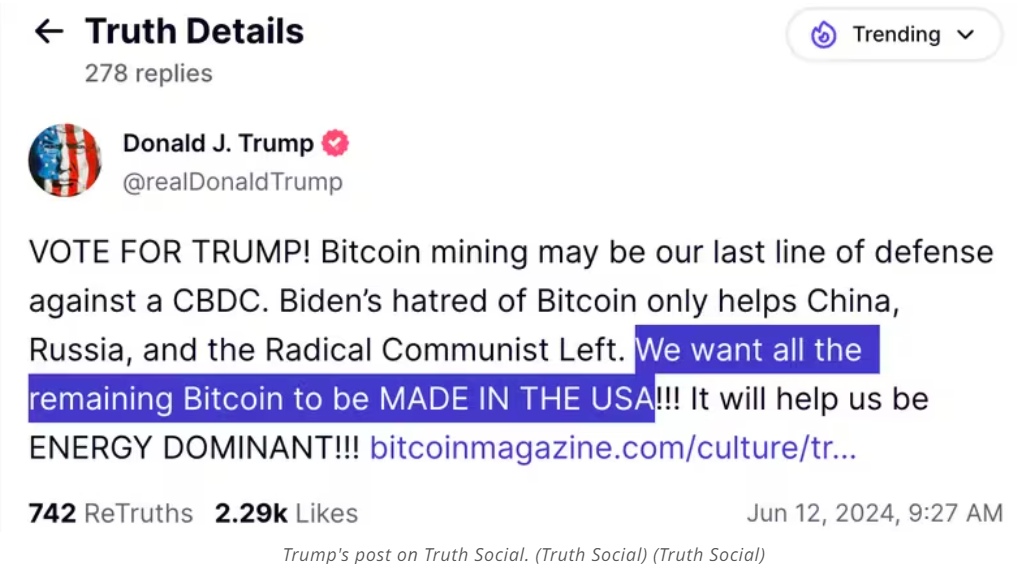
特朗普深夜在社交媒体平台Truth Social发帖称, “比特币挖矿可能是我们对抗CBDC(央行数字货币)的最后一道防线......我们希望所有剩余的比特币都在美国制造!!!这将帮助我们在能源领域占据主导地位。”
特朗普的言论可能表明他希望看到更多美国公司利用当地资源进行比特币挖矿。数据显示,目前的挖矿活动活跃的国家是中国、中亚国家、萨尔瓦多和德国等一些欧洲国家。据Coingecko称,比特币的供应上限为2100万枚,预计将在2140年之前开采完毕。截至目前,90%的供应量已被开采。

周二早些时候,特朗普与在纳斯达克上市的比特币挖矿公司CleanSpark Inc.和Riot Platforms的高管会面。

CleanSpark执行主席马修·舒尔茨(Matthew Schultz)透露,数名比特币矿工于周二晚在海湖庄园与特朗普会面。舒尔茨表示,特朗普告诉与会者,他热爱并了解加密货币,并补充说比特币矿工有助于稳定电网的能源供应。舒尔茨补充说,特朗普表示,他将在白宫为矿工发声。

特朗普对加密货币的态度与之前形成鲜明对比。他在担任总统期间对加密货币行业持怀疑态度,这一点众所周知。2019年,他直言自己“不喜欢”加密货币。他说,比特币等资产“不是货币”,波动性极高,而且“凭空而来”,他批评它们可能助长贩毒等“非法行为”,甚至提议制定法规,要求公司收集有关加密钱包持有人身份的信息。

然而,这位前总统最近几周在竞选活动中越来越多地强调比特币和其他数字资产,以此来吸引新选民。他听取了特斯拉CEO马斯克的建议,并在最近的一次自由党大会上承诺将为被定罪的丝绸之路(Silk Road)在线市场创始人罗斯·乌布里希(Ross Ulbricht)减刑。他还成为了首位接受加密货币捐赠的美国总统候选人。

特朗普与加密货币行业高官密切接触之际,加密货币矿工正因气候变化及其对当地电网的影响等一系列问题而饱受批评。民主党一直在带头加强对比特币矿工能源消耗和碳排放的审查。

特朗普借此将矛头指向拜登。他的竞选团队高级顾问Brian Hughes表示:“加密货币创新者和其他科技行业人士正受到拜登和民主党的攻击。拜登通过加强监管和提高税收来抑制创新,而特朗普则准备鼓励美国在这一领域和其他新兴技术领域发挥领导作用。”

与此同时,加密货币行业正在努力支持被视为支持数字资产的总统候选人,包括向Fairshake“超级政治行动委员会”(Super PAC)提供越来越多的捐款。

据悉,Palantir公司顾问Jacob Helberg在上周参加了特朗普于硅谷的筹款会议后透露,特朗普明确表示,拜登和美国证券交易委员会主席Gary Gensler针对加密货币的打击政策,将在他上任后的一小时内终止。


Пов'язані матеріали

The War Without a Unified Name: The Domestic Tech Giants' World Model Landscape

The article outlines the diverse and fragmented landscape of "World Models" in China's tech industry, where major players are pursuing similar goals under different names like world foundational models, physical AI, or integrated within autonomous driving and embodied intelligence systems. The core aim is to enable AI to create an internal, dynamic environment for simulation, reasoning, and learning, reducing reliance on infinite real-world data. This "data engine" allows for unlimited generation, experimentation, and iteration. The report categorizes the approaches of different companies: * **Internet Giants:** Alibaba is developing models for linguistic, virtual, and physical worlds (Qwen-AgentWorld, HappyOyster, Qwen-RobotWorld). Tencent's HY-World focuses on 3D, game, and social scenarios. ByteDance leverages its vast video data for a potential "digital twin" model. Huawei integrates its model into industrial applications like smart cars and robotics without separately branding it. Baidu embeds world model capabilities within its Apollo autonomous driving and Ernie systems. * **Automakers:** Companies like NIO, Li Auto, XPeng, and Geely are using world models as virtual "driving schools" and "testing grounds." They generate complex scenarios (e.g., rain, snow) to train and validate autonomous driving systems in simulation, aiming for more capable and safer AI drivers. * **Autonomous Driving Suppliers:** Firms such as Momenta, Horizon Robotics, Haomo.ai, and DeepRoute.ai are building the underlying "world engines." They focus on large-scale video generation for simulation, reinforcement learning, and enhancing end-to-end autonomous driving models, often integrating these capabilities into commercial products. While startups bring focus and innovation, they face challenges like limited data, compute resources, and deployment channels. Large companies possess these advantages and are rapidly transitioning world models from research projects into core business infrastructure powering products in vehicles, games, and industry. The conclusion is that world models represent an evolution and convergence of existing AI fields into crucial industrial infrastructure, moving the competition from simply building a model to effectively deploying it to understand and interact with the physical world.

marsbit10 хв тому

The War Without a Unified Name: The Domestic Tech Giants' World Model Landscape

marsbit10 хв тому

The Crypto Industry Enters the 'Show Me' Era: Vision Alone Is No Longer Enough

The crypto industry has entered a "Show Me" era, where grand visions and white papers are no longer sufficient to gain traction. This shift is driven by increased skepticism, high-profile bad actors, and notably, the serious entry of traditional finance (TradFi) institutions like BlackRock, Fidelity, and JPMorgan Chase, which are launching real, scaled products such as tokenized funds and blockchain-based settlement. This raises the bar for what constitutes a credible project. The communication dynamic has fundamentally changed. The focus is no longer on "what you are building" but on "what you have built and who is using it." Startups must now provide a "proof stack": verifiable data like mainnet transaction volume and active wallets, genuine partnerships with signed contracts, and evidence of organic product-market fit from real users, not just investors. Announcements must be backed by concrete, chain-verifiable evidence. For communication strategies, this means leading with proven facts and hard data—even if modest—rather than speculative narratives. A compelling story must be grounded in demonstrated results. While vision remains important, the balance has inverted from 80% vision/20% substance to the opposite. This higher threshold ultimately benefits builders with genuine traction, filtering out noise and allowing their real signals to stand out clearly. The "Show Me" era is a permanent maturation, demanding that communication strategies prove value, not just promise it.

链捕手41 хв тому

The Crypto Industry Enters the 'Show Me' Era: Vision Alone Is No Longer Enough

链捕手41 хв тому

Meta Follows the Trend into Prediction Markets: Can It Avoid Repeating the Failure of the Metaverse?

Meta, the tech giant behind Facebook, has reportedly formed a team to develop "Arena," a new application focused on prediction markets. Users would use platform points to place bets on outcomes in politics, sports, and global events. This move follows Meta's massive, nearly $900 billion, losses from its heavily-invested metaverse division, Reality Labs. The prediction market industry is already showing strong demand, with leading platforms like Kalshi and Polymarket facilitating hundreds of billions in annual volume. Meta, with its 3.56 billion daily active users across its apps, possesses the unprecedented scale to bring this niche activity to a mainstream audience, similar to its past success in cloning features like Stories and Reels. However, Arena faces significant hurdles. Meta plans to start with a points-based system to avoid strict financial regulations, but this may dilute the core incentive of accurate prediction that real-money markets provide. More critically, Meta enters the space with a major trust deficit stemming from its past regulatory battles, notably the failed Libra/Diem stablecoin project, and its controversial history with political content and misinformation. The prediction market sector itself is under increasing regulatory scrutiny, with recent CFTC actions including fines and the first-ever insider trading case. While Meta's vast user base offers a unique opportunity to expand the market, its success hinges on navigating complex regulations and rebuilding the credibility necessary for a platform dealing with sensitive topics like elections. The outcome could range from Meta dramatically growing the industry to Arena becoming a high-profile regulatory target before it can scale.

Foresight News58 хв тому

Meta Follows the Trend into Prediction Markets: Can It Avoid Repeating the Failure of the Metaverse?

Foresight News58 хв тому

Торгівля

Спот
Ф'ючерси
活动图片