Bitlayer Research:OP-DLC 2大道至简

Odaily星球日报Опубліковано о 2024-06-03Востаннє оновлено о 2024-06-03

Анотація

OP-DLC将乐观挑战机制引入到CET中,确保错误的CET不被结算,且相应的恶意预言机损失质押;确保正确的CET被执行,且预言机质押解锁并获得手续费。该方式能够抵抗任意攻击,具有简单美。

原文标题:《Bitlayer Core Technology: DLC and Its Optimization Considerations》

原文作者:mutourend & lynndell, Bitlayer Research Group
Bitlayer Research:OP-DLC 2大道至简

1.引言

Discreet Log Contract (DLC) 是由麻省理工学院的 Tadge Dryja 在 2018 年提出的一种基于预言机的合约执行框架。DLC 允许两方根据预定义的条件进行有条件支付。双方预先确定可能的结果并进行预签名,并在预言机签署结果时使用这些预签名来执行支付。因此,DLC 在保证比特币存款安全的同时,实现了新的去中心化金融应用。

上一篇文章《DLC 原理解析及其优化思考》总结了 DLC 在隐私保护、复杂合约、资产风险低等方面的优势,也分析了 DLC 存在密钥风险、去中心化信任风险、串谋风险等问题,并将去中心化预言机、门限签名、乐观挑战机制等引入 DLC,解决其应面临的各种问题。由于 DLC 中涉及预言机、Alice 和 Bob 三个参与方,不同参与方之间串谋攻击穷举是相对复杂的,导致预防策略也是相对复杂度的。复杂的防御策略不是完美的,不符合大道至简,缺少简洁美。

在比特币中,任意参与方的任意行为均需要通过 UTXO 实现。因此,使用共识机制确保 UTXO 正确,则能够抵抗任意攻击。类似,在 DLC 中,任意参与方的任意行为均需要通过 CET(Contract Execution Transaction)实现。因此,使用乐观挑战机制确保 CET 正确,则能够抵抗任意攻击。具体而言,预言机质押2B TC 后,则能够签署 CET。在 CET 中添加乐观挑战机制。如果 CET 不被挑战,或成功应对挑战,则 CET 正确,能够完成结算,预言机解除质押且获得手续费;如果 Oracle 试图作恶,则任何人都可成功挑战,该 CET 将无法结算,预言机损失质押金且该预言机无法再对同一 CET 签名。符合大道至简,具有简洁美。

2.DLC 原理

Alice 和 Bob 签署对赌协议:投注第ξ个区块的哈希值是奇数或偶数。如果是奇数,则 Alice 赢得游戏,可提取资产;如果是偶数,则 Bob 赢得游戏,可提取资产。使用 DLC,通过预言机传递第ξ个区块信息构造条件签名使得正确的获胜方赢得所有资产。

椭圆曲线生成元为 G,阶为 q。预言机、Alice 和 Bob 各自的密钥对分别为(z, Z), (x, X), (y, Y)。

注资交易(链上): Alice 和 Bob 一起创建一笔注资交易,各自将 10 BTC 锁在一个 2-of-2 的多签输出(一个公钥 X 属于 Alice,一个公钥 Y 属于 Bob)。

构建 CET(链下):Alice 和 Bob 创建 CET 1 和 CET 2 ,用于花费注资交易。

预言机计算承诺 R = k · G,然后计算 S 和 S'

S := R - hash(OddNumber, R) · Z

S' := R - hash(EvenNumber, R) · Z

则 Alice 和 Bob 对应的新公钥如下:

PK^{Alice} := X + S

PK^{Bob} := Y + S'.

结算(链下->链上):当第ξ个区块成功生成,则预言机根据该区块的哈希值,签署对应的 CET 1 或 CET 2 。

如果哈希为奇数,则预言机如下签署 s

s := k - hash(OddNumber, R) z

广播 CET 1 。

如果哈希为偶数,则预言机签署 s'

s' := k - hash(EvenNumber, R) z

广播 CET 2 。

提币(链上):如果预言机广播 CET 1 ,则 Alice 可以计算出新私钥,并花费锁定的 20 个 BTC

sk^{Alice} = x + s

如果预言机广播 CET 2 ,则 Bob 可以计算出新私钥,并花费锁定的 20 个 BTC

sk^{Bob} = y + s'

Bitlayer 研究组发现:上述过程中,任意行为均需要通过 CET 实现。因此,仅需要使用乐观挑战机制确保 CET 正确,则能够抵抗任意攻击。错误的 CET 会被挑战,不被执行,而正确的 CET 会被执行。此外,预言机需要为恶意行为付出代价即可。

待挑战程序为 f(t),则应该如下构建 CET

s = k - hash(f(t), R) z.

假设,真实情况为第ξ个区块的哈希值是奇数 odd,即 f(ξ) = OddNumber,预言机应该签署 CET 1 

s := k - hash(OddNumber, R) z.

但是,预言机作恶,将函数值修改为 Even,签署了 CET 2 :

s' := k - hash(EvenNumber, R) z.

因此,任意用户均可根据 f(ξ) ≠ OddNumber.挫败该恶意行为。

3.OP-DLC 2 

OP-DLC 包括以下 5 个规定:

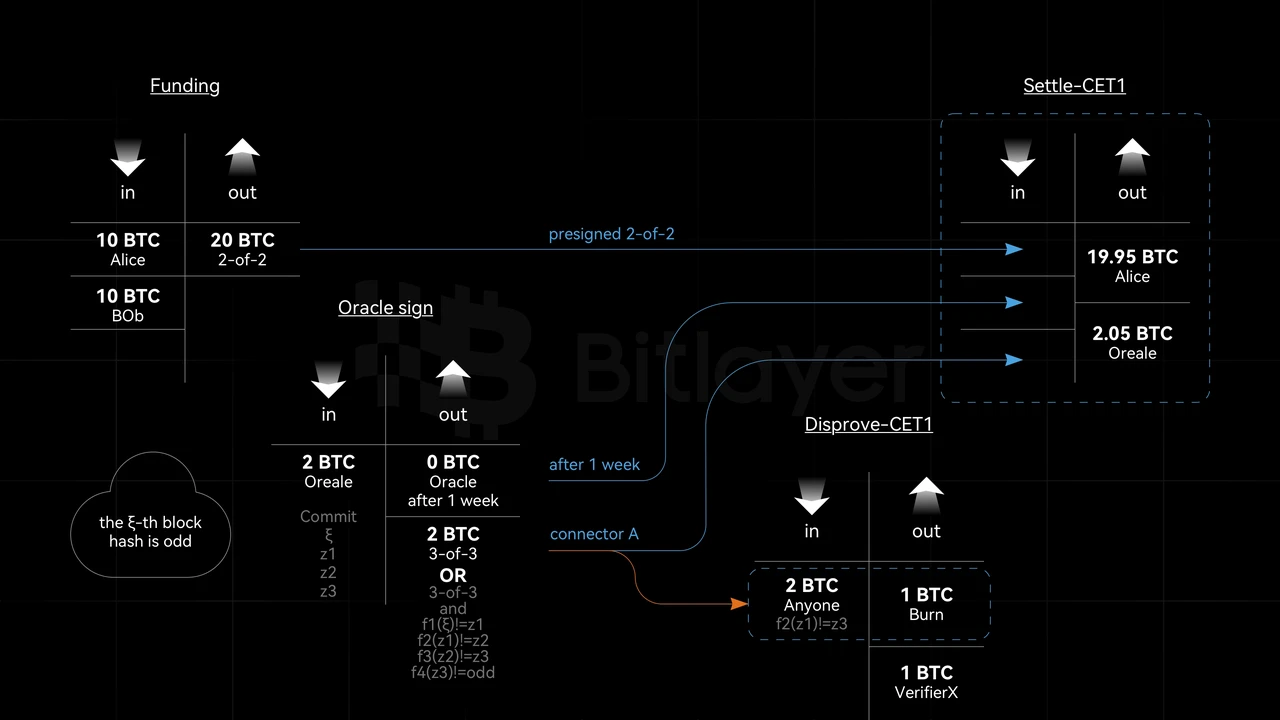
  • 预言机由一个联盟组成,联盟中有 n 个参与方,任意成员之一均可签署 CET。质押2B TC,预言机才能发布签名赚手续费。如果某个成员作恶,则损失质押。其他成员可继续签署 CET,确保用户能够出金。Alice 和 Bob 也可成为预言机,可真正的做到只相信自己,信任最小化。

  • 如果预言机作恶,修改结果,则必然导致 f 1(ξ) ≠ z 1, f 2(z 1) ≠ z 2 的情况出现。因此,任意参与方均可发起挑战,即进行 Disprove-CET 1 交易。

  • 如果预言机诚实签署 CET,则任意参与方均不能发起有效的 Disprove 交易。1 周后,CET 可正确结算。此外,预言机获得 0.05 BTC 奖励,作为其质押的2B TC 1 周资金占用以及诚实签署 CET 的手续费。

  • 任意参与方均能够对 Oracle_sign 发起挑战:

    若 Oracle_sign 诚实,则无法发起 Disprove-CET 1 交易, 1 周后执行 CET 结算。此外,预言机质押解锁,并获得手续费;

    若 Oracle_sign 不诚实,即任何人成功发起了 Disprove-CET 1 交易,成功花费了 connector A output,则该预言机的该签名无效,损失所质押的2B TC,且未来该预言机均不可再对该 DLC 合约发起相同结果的签名,因依赖该 connector A output 的 Settle-CET 1 将永久失效。

  • OP-DLC 中的挑战是 Permissionless 的,即任意参与方均可监督 OP-DLC 内的合约是否正确执行。因此,实现了对预言机的信任最小化。与闪电网络相比,Alice 和 Bob 也可离线。因为预言机只有诚实签名才会结算 CET,而作恶的预言机会被被任何人挑战和惩罚。
Bitlayer Research:OP-DLC 2大道至简

优点:

  • 对资产控制度高,只信任自己:Alice 和 Bob 均可以成为预言机,签署 CET。乐观挑战机制会挫败错误的 CET,所以无法作恶。因此,OP-DLC 可做到用户只相信自己。在 BitVM 中,用户需要作为 Operator,并必须参与后续所有的入金,才能做到只信任自己。如果用户作为 Operator 只参与 BitVM 单个 UTXO 入金,该 UTXO 可被任意其它(n-1)个 Operator 合法报销,则该用户未来的出金,将仍需信任其它 Operator 会垫付。BitVM Operator 的报销权限锁定在各单个入金 UTXO 上。

  • 资金利用率高:若用户只信任自己,需要的资金量不一样。OP-DLC 中用户依赖自己出金,不需要用等量资金垫付;而 BitVM 中,用户需要等量资金垫付,然后报销。这带来了更大的资金压力。

  • 能签字的预言机需在 OP-DLC 入金时确定,但用户自己也可成为预言机,可自己给自己签。

缺点:

  • 出金时间需 1 周:本质上 OP-DLC 和 BitVM 的资金时间成本都是存在且等量的。OP-DLC 出金需经过挑战期才能拿到资金;如果 BitVM 依赖用户自己垫付,则等量垫付资金也需经过挑战期才能成功报销。如果 BitVM 依赖其它 Operator 垫付快速出金,则意味着需给 Operator 等量资金的资金时间成本作为手续费。

  • 需要预签的签名数量增长较快,与 CET 数量呈线性关系。需要尽可能多的 CET,才能枚举所有的提币结果。

4.结论

OP-DLC 将乐观挑战机制引入到 CET 中,确保错误的 CET 不被结算,且相应的恶意预言机损失质押;确保正确的 CET 被执行,且预言机质押解锁并获得手续费。该方式能够抵抗任意攻击,具有简单美。

参考文献

Трендові криптовалюти

Пов'язані матеріали

Without It, There Would Be No ImageNet... Now It's Gone

Amazon is shutting down its crowdsourcing platform, Mechanical Turk (MTurk), on September 30th, ending a 21-year run. Launched in 2005, MTurk connected businesses with a global online workforce to perform small, repetitive tasks—known as Human Intelligence Tasks (HITs)—that were easy for humans but difficult for computers at the time. At its peak, it hosted over 500,000 workers worldwide. MTurk played a pivotal, though often unseen, role in the rise of modern AI. Its most famous contribution was to the creation of the ImageNet dataset. In the late 2000s, researcher Fei-Fei Li and her team faced the monumental challenge of manually sorting and labeling millions of internet images to build a large-scale visual database for training AI. They turned to MTurk, distributing the work to nearly 50,000 workers from 167 countries. This "human-in-the-loop" effort made the massive ImageNet project feasible. ImageNet, in turn, became the foundational benchmark for the 2012 ImageNet Large Scale Visual Recognition Challenge. The victory of Geoffrey Hinton and his students' deep convolutional neural network, AlexNet, on this dataset dramatically demonstrated the power of deep learning, catalyzing the AI revolution that followed. Now, MTurk is closing. The platform has declined as the very AI it helped build has become capable of automating the simple tasks it once provided. Furthermore, the AI industry's data needs have evolved, shifting towards more specialized expertise for model tuning and evaluation, served by newer platforms. Ironically, some studies suggest MTurk workers themselves began using AI tools like ChatGPT to complete tasks, adding a layer of automation to the "artificial artificial intelligence" service. The shutdown marks the end of an era where human effort, distributed globally via the internet, laid the crucial groundwork for the intelligent machines of today.

marsbit14 хв тому

Without It, There Would Be No ImageNet... Now It's Gone

marsbit14 хв тому

Bill Gates' Latest Long-Form Article: The Real Trouble with AI is That We Aren't Ready

Bill Gates' latest essay, "The turbulent AI era is here. The choices we make now are critical," warns that society is unprepared for the profound social and economic transition AI will bring. While optimistic about AI's long-term potential in healthcare, education, and other fields, Gates focuses on the "transition period" over the next 10-20 years. He argues this transition differs from past technological shifts like the Industrial Revolution because AI automates cognitive labor itself, potentially reducing the total number of future jobs. Risks like enhanced cyber-attacks and social disruption are already emerging, not distant future threats. A key concern is "low-cost intelligence substitution," where AI performs defined tasks cheaper than humans, gradually thinning workforces. Gates introduces the concept of "Human Reserved" jobs—roles like nursing or delivering serious medical news—where human judgment and empathy should remain central, even if AI is technically capable. To manage the transition, he calls for new governance, stronger social safety nets, retraining, and international cooperation, especially between the US and China. Crucially, he proposes taxing AI usage and robots to slow displacement and fund social programs. The core dilemma Gates presents is that AI could become humanity's "greatest equalizer" or its "worst source of injustice," depending on whether its immense productivity gains are broadly shared or concentrate wealth and power. The fundamental challenge is not just advancing the technology, but adapting our social and economic systems to it.

marsbit29 хв тому

Bill Gates' Latest Long-Form Article: The Real Trouble with AI is That We Aren't Ready

marsbit29 хв тому

Just Now, Anthropic Unveils Physical MCP: Claude Begins Controlling the Real World

Anthropic has announced the Model Hardware Standard (MHS), a new standard enabling AI agents like Claude to safely control physical devices. Building on the Model Context Protocol (MCP), MHS standardizes communication between AI agents and hardware such as microscopes, robotic arms, and lasers, marking a significant step for AI from the digital into the physical world. Developed in collaboration with HHMI Janelia Research Campus, MHS uses standardized drivers to translate basic commands (e.g., read, write) into a format any programmable device can understand. This drastically reduces integration time from weeks to hours or minutes and allows agents to discover and operate new devices using natural language tags that describe machine properties and safety limits. Agents can control devices via MCP, command-line interfaces, or APIs. They can sequence operations, monitor results, adjust parameters in real-time, and generate deterministic scripts for long-running tasks. Early tests show Claude interacting with hardware exploratively, like a scientist, learning to calibrate a laser and scripting the process. Early adopters and partners include AWS, Automata, Danaher, Doosan Robotics, and Tecan, who are integrating MHS support into their platforms. While promising, challenges remain: Claude's physical reasoning is limited, requiring expert oversight, and MHS currently only works with programmable hardware. Anthropic plans further refinements and broader device support before open-sourcing the standard.

marsbit1 год тому

Just Now, Anthropic Unveils Physical MCP: Claude Begins Controlling the Real World

marsbit1 год тому

History's Only Asset with a 100% Win Rate After 4 Years of Holding

**Title: The Only Asset with a 100% Win Rate Over Any 4-Year Holding Period** This article analyzes which major, freely-tradable assets have historically never produced a nominal loss over any rolling 4-year holding window. It concludes that only two distinct categories achieve this: ultra-low-risk contractual assets and Bitcoin. Among traditional risk assets, none maintain a perfect 4-year record. The S&P 500 had negative 4-year periods (e.g., 1929-1932: -64.8%). The Nasdaq 100 fell roughly 60% from 2000-2003. Gold saw a ~47.7% loss from 1981-1984. US real estate declined about 23.3% from 2007-2010. Even long-term US Treasury bonds (e.g., 2021-2024: -19.8%) and corporate bonds can produce 4-year losses due to interest rate and market price risks. In contrast, the first category achieving 100% nominal success includes assets like rolling 3-month US Treasury Bills, 4-year certificates of deposit (CDs), and US Treasuries held to maturity within 4 years. Their "guarantee" stems from contractual obligations and credit backing (e.g., FDIC insurance, US sovereign promise), not price appreciation. The sole exception in the high-risk category is Bitcoin. Analysis of daily data from 2010-2026 across 4,419 rolling 4-year windows shows a 100% positive return rate. The worst 4-year period (April 2021 to April 2025) still yielded a +32.6% total return (~7.3% CAGR). This record is unique because Bitcoin has no issuer, promises no cash flows, and has endured severe drawdowns (70-90%), yet its market price has always recovered within a 4-year span. The key distinction is the source of the "100%": contractual assets offer known, low nominal returns, while Bitcoin's record stems purely from historical price appreciation despite extreme volatility. The article suggests that for Bitcoin, the ability to hold for 4+ years is more critical than active trading strategies.

marsbit1 год тому

History's Only Asset with a 100% Win Rate After 4 Years of Holding

marsbit1 год тому

How One Article Moved 45 Billion: The Collapse of a 25-Year-Old 'AI Stock Guru'

This article details the dramatic rise and near-collapse of a hedge fund built by Leopold Aschenbrenner, a 24-year-old former OpenAI researcher. The fund, named Situational Awareness, amassed $45 billion in assets within two years. Its explosive growth stemmed from Aschenbrenner's influential 165-page manifesto predicting AGI's arrival by 2027 and his high-profile Silicon Valley connections. The fund employed an extremely aggressive strategy: high concentration and 400% leverage to bet long on AI infrastructure stocks while shorting legacy software firms. In July, this structure backfired when both sides of the trade reversed simultaneously—AI stocks plunged while shorted stocks rallied—triggering massive losses that nearly wiped out all equity. Major player Jane Street reportedly lost billions. The fund's leveraged public portfolio was ultimately sold at a discount to Citadel. The SEC is now investigating banks like Goldman Sachs for their role in facilitating the fund's high-leverage trades. The article compares this to past blow-ups like Archegos, highlighting systemic failures in risk management where the pursuit of short-term profits overrode due diligence. It questions whether such risky leverage concentrated in the AI sector, currently at record highs, poses a broader systemic threat. Ironically, Aschenbrenner, who studied AI safety at OpenAI, designed a fund structure prone to uncontrolled failure. Days after the crisis, he reportedly raised another $400 million for new investments.

marsbit1 год тому

How One Article Moved 45 Billion: The Collapse of a 25-Year-Old 'AI Stock Guru'

marsbit1 год тому

Торгівля

Спот

Популярні статті

Як купити OP

Ласкаво просимо до HTX.com! Ми зробили покупку Optimism (OP) простою та зручною. Дотримуйтесь нашої покрокової інструкції, щоб розпочати свою криптовалютну подорож.Крок 1: Створіть обліковий запис на HTXВикористовуйте свою електронну пошту або номер телефону, щоб зареєструвати обліковий запис на HTX безплатно. Пройдіть безпроблемну реєстрацію й отримайте доступ до всіх функцій.ЗареєструватисьКрок 2: Перейдіть до розділу Купити крипту і виберіть спосіб оплатиКредитна/дебетова картка: використовуйте вашу картку Visa або Mastercard, щоб миттєво купити Optimism (OP).Баланс: використовуйте кошти з балансу вашого рахунку HTX для безперешкодної торгівлі.Треті особи: ми додали популярні способи оплати, такі як Google Pay та Apple Pay, щоб підвищити зручність.P2P: Торгуйте безпосередньо з іншими користувачами на HTX.Позабіржова торгівля (OTC): ми пропонуємо індивідуальні послуги та конкурентні обмінні курси для трейдерів.Крок 3: Зберігайте свої Optimism (OP)Після придбання Optimism (OP) збережіть його у своєму обліковому записі на HTX. Крім того, ви можете відправити його в інше місце за допомогою блокчейн-переказу або використовувати його для торгівлі іншими криптовалютами.Крок 4: Торгівля Optimism (OP)Легко торгуйте Optimism (OP) на спотовому ринку HTX. Просто увійдіть до свого облікового запису, виберіть торгову пару, укладайте угоди та спостерігайте за ними в режимі реального часу. Ми пропонуємо зручний досвід як для початківців, так і для досвідчених трейдерів.

623 переглядів усьогоОпубліковано 2024.12.12Оновлено 2026.06.02

Як купити OP

Обговорення

Ласкаво просимо до спільноти HTX. Тут ви можете бути в курсі останніх подій розвитку платформи та отримати доступ до професійної ринкової інформації. Нижче представлені думки користувачів щодо ціни OP (OP).

活动图片