2026 Prediction Market: The Seven Differentiated Strategies for New Players to Break Through

marsbitОпубліковано о 2026-02-12Востаннє оновлено о 2026-02-12

Анотація

By 2026, the prediction market landscape is expected to become highly competitive, with new entrants leveraging differentiation to capture market share. Established platforms, while holding liquidity and regulatory advantages, are often burdened by technical debt, creating opportunities for agile newcomers. Differentiation can be achieved across seven key dimensions: 1. **Product Quality**: Superior UX, API stability, transparent fees, and diverse order types. 2. **Asset Variety**: Offering exclusive markets, especially in underserved niches. 3. **Capital Efficiency**: Utilizing yield-bearing collateral and innovative margin mechanisms. 4. **Oracle & Settlement**: Enhancing reliability with hybrid or AI-driven oracles for new markets. 5. **Liquidity Provision**: Incentivizing market makers or adopting pooled liquidity models. 6. **Regulatory Compliance**: Tapping into restricted markets via localized licensing. 7. **Strategic Focus**: Choosing between horizontal (infrastructure-focused) or vertical (end-to-end user experience) approaches. Success will hinge on excelling in one or more of these areas to challenge incumbents.

Author: Jake Nyquist, Founder of Hook Protocol

Compiled by: Blockchain Knight

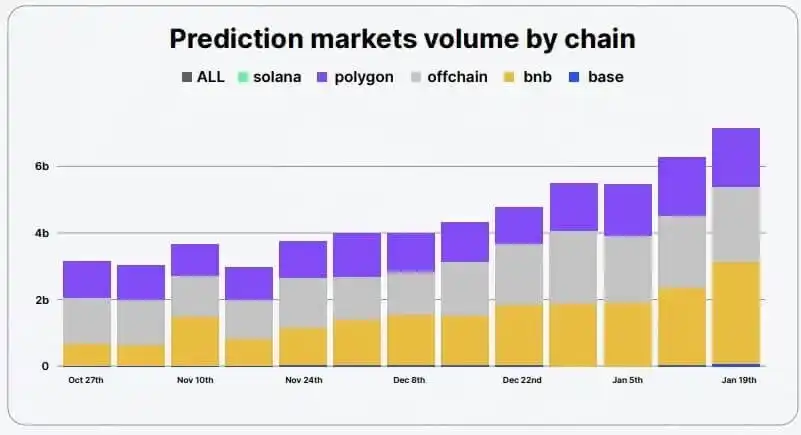
In 2026, major institutions are launching new prediction markets.

From the competitive battles of the past five years between NFTs and perpetual contract exchanges, we have learned that differentiated products can quickly capture market share.

Although leading platforms currently hold advantages in liquidity and regulation, they are burdened with heavy technical debt, making it difficult to respond flexibly to new players.

So how should newcomers compete? In my view, the core of differentiation in prediction markets revolves around seven dimensions:

1. Product Quality

Founding teams can differentiate in areas such as front-end user experience, API stability, development documentation, market structure, and fee mechanisms.

Currently, many established platforms have obvious shortcomings: unreasonable tier settings, opaque fee rules, slow and unstable APIs, and limited order types.

A high-quality product experience, especially services for API-based programmatic traders, is itself a lasting core advantage, enabling a platform to hold its ground even against competitors with stronger channel capabilities.

3. Capital Efficiency

Capital efficiency determines how effectively traders can use their collateral. Currently, there are two key levers:

First, yield-bearing collateral: Instead of letting idle funds earn only treasury yields, platforms can offer higher returns, similar to Lighter supporting LP deposits as collateral or HyENA's USDC-margined perpetual contract model.

Second, margin mechanisms. Due to gap risk, the value of leverage in prediction markets is generally underestimated. However, platforms can offer limited leverage for continuous markets or implement portfolio margin for hedging positions.

Exchanges can also subsidize lending pools or act as market-making counterparties to internalize gap risk, rather than passing losses on to users.

4. Oracles and Market Settlement

Oracle reliability remains a systemic weakness in the industry. Settlement delays and incorrect outcomes significantly amplify trading risks.

Beyond improving stability, platforms can implement innovative oracle mechanisms: human-machine hybrid systems, zero-knowledge proof-based solutions, AI-driven oracles like Context, etc., to unlock new markets that traditional oracles cannot support.

5. Liquidity Provision

Exchanges cannot survive without liquidity. Viable approaches include: paying to onboard professional market makers, using token incentives to encourage ordinary users to provide liquidity, and adopting Hyperliquid's HLP aggregated liquidity model.
Some platforms can also fully internalize liquidity, emulating FTX's model of relying on Alameda as an internal trading team.

6. Regulatory Compliance

Kalshi, with its US regulatory approval, has achieved embedded distribution through Robinhood and Coinbase, capturing retail traffic that Polymarket cannot reach.

There are still numerous jurisdictions and regulatory frameworks available for exploration. Compliant prediction markets can unlock similar channels, such as adapting to US state gambling regulations.

7. Vertical Strategy vs. Horizontal Strategy

Horizontal Strategy: Similar to Hyperliquid in the perpetual contracts space, focusing on building top-tier underlying trading infrastructure, inviting third parties to build front-ends and vertical scenarios, and encouraging ecosystem builders to add markets and develop revenue-generating front-ends (e.g., Phantom) through proposals.

Vertical Strategy: Exemplified by Lighter, which controls the front-end, launches mobile apps, and creates an end-to-end user experience, focusing on integrated experiences and direct user connections.

Polymarket's resistance to deeply embedded partnerships, contrasted with Kalshi's open attitude, is a clear reflection of the trade-offs between these two strategies.


Пов'язані питання

QAccording to the article, what are the seven key dimensions for differentiation in the prediction market competition?

AThe seven key dimensions are: 1. Product Quality, 2. Asset Types and Market Selection, 3. Capital Efficiency, 4. Oracles and Market Settlement, 5. Liquidity Provision, 6. Regulatory Compliance, and 7. Vertical Strategy vs. Horizontal Strategy.

QHow can new prediction market exchanges compete with established platforms that have liquidity and regulatory advantages?

ANew players can compete by focusing on product differentiation, such as superior user experience, stable APIs, better documentation, unique market offerings, innovative capital efficiency mechanisms, reliable oracles, creative liquidity solutions, navigating different regulatory frameworks, and adopting a focused vertical or horizontal strategy.

QWhat two core methods are mentioned for improving capital efficiency in prediction markets?

AThe two core methods are: 1. Interest-bearing collateral, which allows idle funds to earn higher yields, and 2. Margin mechanisms, which can provide limited leverage for continuous markets or portfolio margin for hedged positions.

QWhat is the difference between a horizontal strategy and a vertical strategy for a prediction market platform, as described in the article?

AA horizontal strategy, like Hyperliquid's, focuses on building top-tier underlying trading infrastructure and inviting third parties to build front-ends and verticals. A vertical strategy, like Lighter's, involves controlling the front-end, launching mobile apps, and crafting a full user experience to connect directly with users.

QWhich platform is cited as an example of using regulatory compliance to gain access to retail traffic unavailable to competitors like Polymarket?

AKalshi is cited as the example, as it leveraged its US compliance credentials to achieve embedded distribution with platforms like Robinhood and Coinbase.

Пов'язані матеріали

Dalio's Latest Warning: Don't Get Carried Away by AI, Real Returns on US Stocks in the Next 5-10 Years Could Be -5% to -10%

Ray Dalio, founder of Bridgewater Associates, warns investors against excessive concentration in AI stocks. He argues the current market, dominated by a few AI giants, mirrors historical patterns where revolutionary new technologies lead to high risk, volatility, and uncertainty. While acknowledging AI's transformative potential, Dalio emphasizes that most investors fail at this stage of the cycle by over-concentrating in a handful of leading companies. He cites inherent risks: companies cannot accurately forecast investment needs or external shocks (e.g., monetary policy, geopolitics, taxes), face potential disruption from future technologies and international competition (notably from China), and experience significant price swings. Dalio's core advice is diversification, calling it his "Holy Grail of Investing." He presents a mathematical case that a well-diversified portfolio of 15-20 uncorrelated, good bets offers a superior risk-adjusted return compared to a concentrated position. Dalio also offers a cautious outlook, suggesting U.S. stocks may deliver real returns of -5% to -10% over the next 5-10 years based on valuation and bubble indicators. He concludes that in the face of high uncertainty, the prudent strategy is not to avoid betting entirely, but to avoid large, concentrated bets where one lacks sufficient informational edge. Instead, investors should build a strategically balanced, diversified portfolio.

marsbit48 хв тому

Dalio's Latest Warning: Don't Get Carried Away by AI, Real Returns on US Stocks in the Next 5-10 Years Could Be -5% to -10%

marsbit48 хв тому

Rain Valuation Approaches $20 Billion: The Battle for U-Cards Extends to Rewards Systems

Rain, a stablecoin payments infrastructure company, is shifting the competitive focus for U Cards from simple issuance to user retention and repeated usage. On June 15, Rain launched "Rain Rewards," an embedded loyalty program capability within its card-issuing infrastructure. This allows partner businesses—like fintech platforms and neobanks—to configure branded loyalty points, earning rules, redemptions, and merchant promotions directly within their card products. The system, built from the 2025 acquisition of Uptop, ensures points are only issued upon final transaction settlement, preventing liabilities from refunds. Trials, such as with Avalanche Card, reportedly boosted spending by 25% among enrolled users. Founded by Farooq Malik and Charles Yoo-Naut, Rain evolved from a tool for managing Web3 company expenses into a full-stack enterprise platform. It is a Principal Member of Visa and Mastercard, enabling partners to issue stablecoin-backed cards and wallets while leveraging traditional payment networks. Notably, the popular U Card Plasma One is issued by Rain under Visa's authority. Rain also integrates with Visa's stablecoin settlement pilot, using USDC for network settlement. Rain's rapid funding reflects growing institutional interest in stablecoin payment infrastructure. It raised a $245 million Series A in March 2025, a $58 million Series B in August 2025, and a $250 million Series C in January of this year, reaching a $19.5 billion valuation. Annualized transaction volume exceeds $3 billion, serving over 200 partners including Western Union and Nuvei. Beyond cards, Rain is expanding into programmable payments. Its June 2026 "Agent Control Layer" allows businesses to set spending rules—like merchant categories, amounts, and frequency—for AI agents before transactions occur. This positions Rain not as a single product but as an operating system for stablecoin payments, handling everything from card issuance and wallet management to rewards, on/off-ramps, and automated compliance. The goal is to enable seamless, often invisible, real-world spending of on-chain assets.

Foresight News52 хв тому

Rain Valuation Approaches $20 Billion: The Battle for U-Cards Extends to Rewards Systems

Foresight News52 хв тому

Google TPU Shipments Revised Up by 50%

Recent industry research indicates a significant upward revision in the shipments of Google's TPU (Tensor Processing Unit) chips. Previous expectations for 2027 were set at around 10 million units, but new estimates now point to 15 million units, a 50% increase. This substantial boost directly translates to higher demand across the entire supporting supply chain. Google's TPU clusters utilize a standardized all-optical interconnect architecture. Consequently, key hardware components are deeply integrated and scaled in fixed ratios with the chips. The 15 million TPU target will drive corresponding demand increases for NPO optical engines (roughly a 1:1 match), 1.6T optical modules, OCS optical switches, high-end server power supplies, fiber optics & MPO connectors, and liquid cooling solutions. Among these, liquid cooling is highlighted as the sector experiencing the most significant transformation and offering the most stable potential for excess returns. As next-generation TPU chips reach power levels where traditional air cooling is insufficient, liquid cooling becomes essential. 2026 is forecasted as the first year of substantial adoption for Google's liquid cooling solutions. This shift, coupled with delivery and capacity bottlenecks faced by incumbent overseas manufacturers, is creating a prime window for domestic Chinese suppliers to enter and secure Google's core supply chain. The market size for Google-specific liquid cooling is projected to potentially triple from a baseline of hundreds of billions to around 300 billion units by 2028. The logic for the fiber optic sector is also being rewritten. Once considered a cyclical commodity tied to telecom operator procurement, fiber is now a strategic and scarce resource for AI Data Centers (AIDC). A severe supply-demand imbalance, driven by the long lead time for preform production (18-24 months) and surging demand from cloud giants, is supporting strong performance. Chinese fiber manufacturers are well-positioned to capture a significant share of global AIDC demand, with exports potentially reaching 200-300 million core kilometers in 2026. Overall, the investment focus within the AI computing industry is shifting from pure "chip performance speculation" towards the more certain incremental growth in computing infrastructure and its supporting ecosystem. The upward revision in Google TPU shipments, along with the potential for further doubling by 2028, is seen as solidifying performance visibility for the entire supporting supply chain over the next two years.

marsbit2 год тому

Google TPU Shipments Revised Up by 50%

marsbit2 год тому

Торгівля

Спот
Ф'ючерси
活动图片