2026 Neo Bank Outlook: Superform, Veera, Tria - The Three Titans Compete, Who Will Become the Alipay of the Crypto World?

marsbitОпубліковано о 2026-01-08Востаннє оновлено о 2026-01-08

Анотація

By 2026, the onchain neobanking sector is rapidly evolving, with Superform, Veera, and Tria emerging as key players. These platforms combine DeFi functionality with traditional banking UX, enabling users to spend crypto seamlessly without CEXs while retaining self-custody. Superform focuses on yield optimization, automating cross-chain deposits to vaults across 7+ chains, boasting $144M TVL and 300% growth in six months. Veera, with 4M users across 108 countries, targets emerging markets with a browser-to-bank model, offering staking, rewards, and upcoming debit cards. Tria excels in chain abstraction, enabling frictionless spending with $1M daily transaction volume and $20M ARR, abstracting gas fees and cross-chain complexities. Risks include unsustainable yield subsidies, regulatory uncertainty (e.g., KYC requirements), and competition from MetaMask. Tria is poised for mainstream adoption due to its UX, Veera for emerging market dominance, and Superform for sustainable institutional growth. Together, they represent a new category of non-custodial financial super apps, driving crypto toward everyday usability.

Author:Mesh

Compiled by: Deep Tide TechFlow

January 6, 2026

I've been tracking the "wallet to bank" development trend for several months now, and honestly, the pace of progress is astonishing.

By the end of 2025, three projects reached significant transaction volume milestones, achieving what Metamask could not: converting your cryptocurrency into real spending power without touching a centralized exchange (CEX). Superform, Veera, and Tria are no longer just crypto wallets; they are building actual banks.

The data speaks for itself. By last November, Tria's daily transaction volume had reached $1 million, with over 150,000 users and an Annualized Run Rate (ARR) of approximately $20 million. Veera expanded to 108 countries, reaching 4 million users. And Superform's Total Value Locked (TVL) surged 300% in just six months, reaching $144 million.

This isn't the so-called DeFi 2.0 hype. This is an infrastructure shift that everyone saw coming, but no one expected it to arrive this quickly.

Let's dive into an analysis of these three projects, along with other potential challengers worth watching.

What is an Onchain Neobank?

Let me break it down for you, as this term is often used loosely.

An Onchain Neobank combines three elements that have traditionally been difficult to merge:

  1. The Power of DeFi: Includes yield optimization, staking, and cross-chain swaps.
  2. The User Experience of Traditional Banking: Such as a card you can use at Starbucks, instant payments, and cashback rewards.
  3. Blockchain Abstraction: Users don't need to deal with Gas fees, cross-chain bridge interfaces, or network switching complexities.

How is it different from Revolut or Coinbase? You control your private keys! How is it different from Metamask? You can spend crypto as easily as fiat, without worrying about which chain your USDC is on.

Simply put, this is the change that comes when DeFi protocols realize that average users don't want to manually bridge assets across chains or calculate Gas fees. They just want a card they can swipe.

One of the Three Titans

@superformxyz caught my attention around mid-2025, when their primary target users were still institutional investors. Now, they position themselves as the "savings account" for onchain finance.

What are they doing?

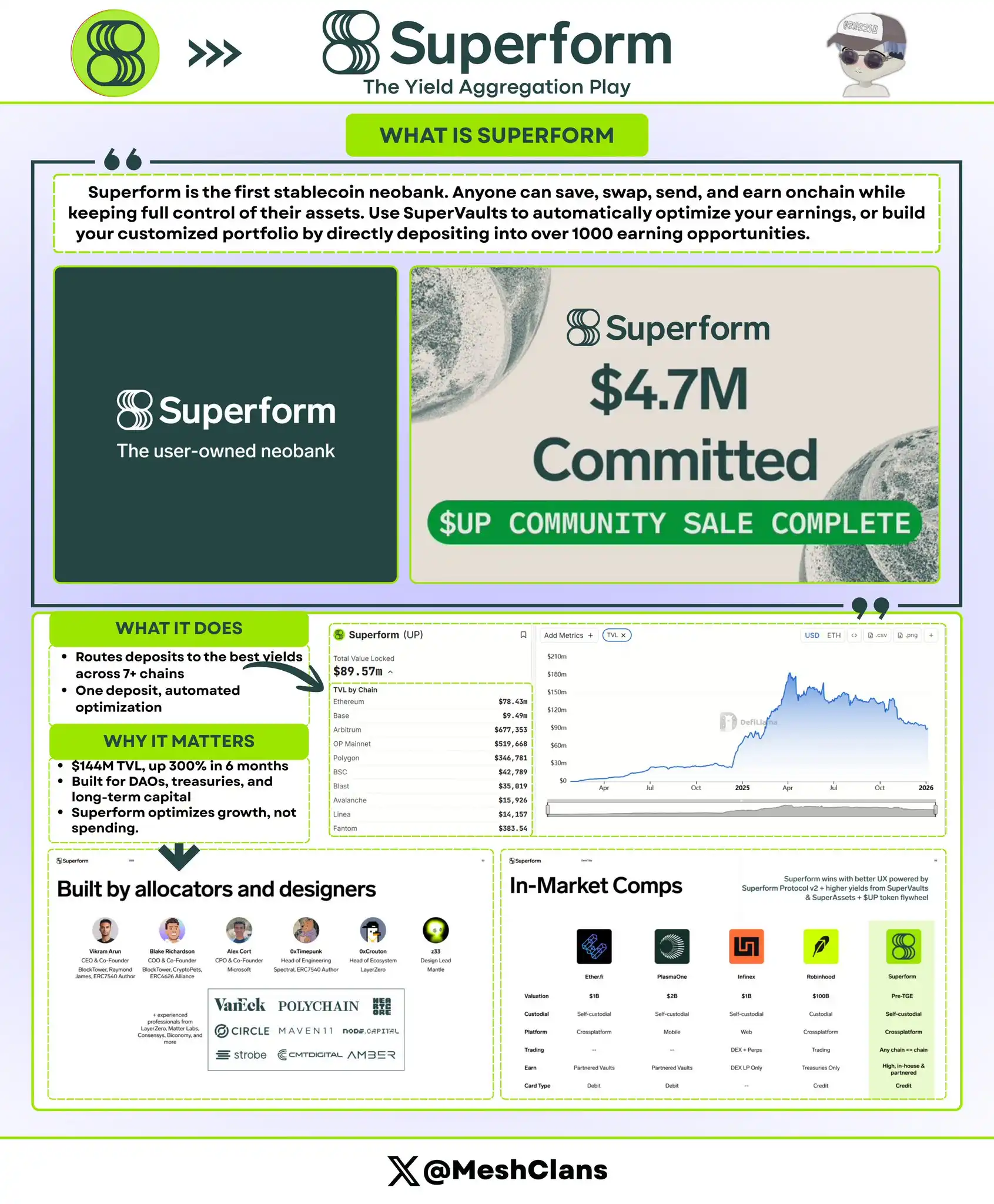
Superform's core function is to automatically route your funds to high-yield vaults across 7+ chains. You simply deposit USDC, and Superform finds the best Annual Percentage Yield (APY) for you, whether it's from Aave, Curve, or some protocol-specific yield farm you've never even heard of.

Data Performance (as of end-2025):

  • Total Value Locked (TVL): $144 million (300% growth in 6 months)
  • Funding: $12.9 million total across Seed, Strategic, and Public rounds
  • Fully Diluted Valuation (FDV): ~$90 million

Why is it important?

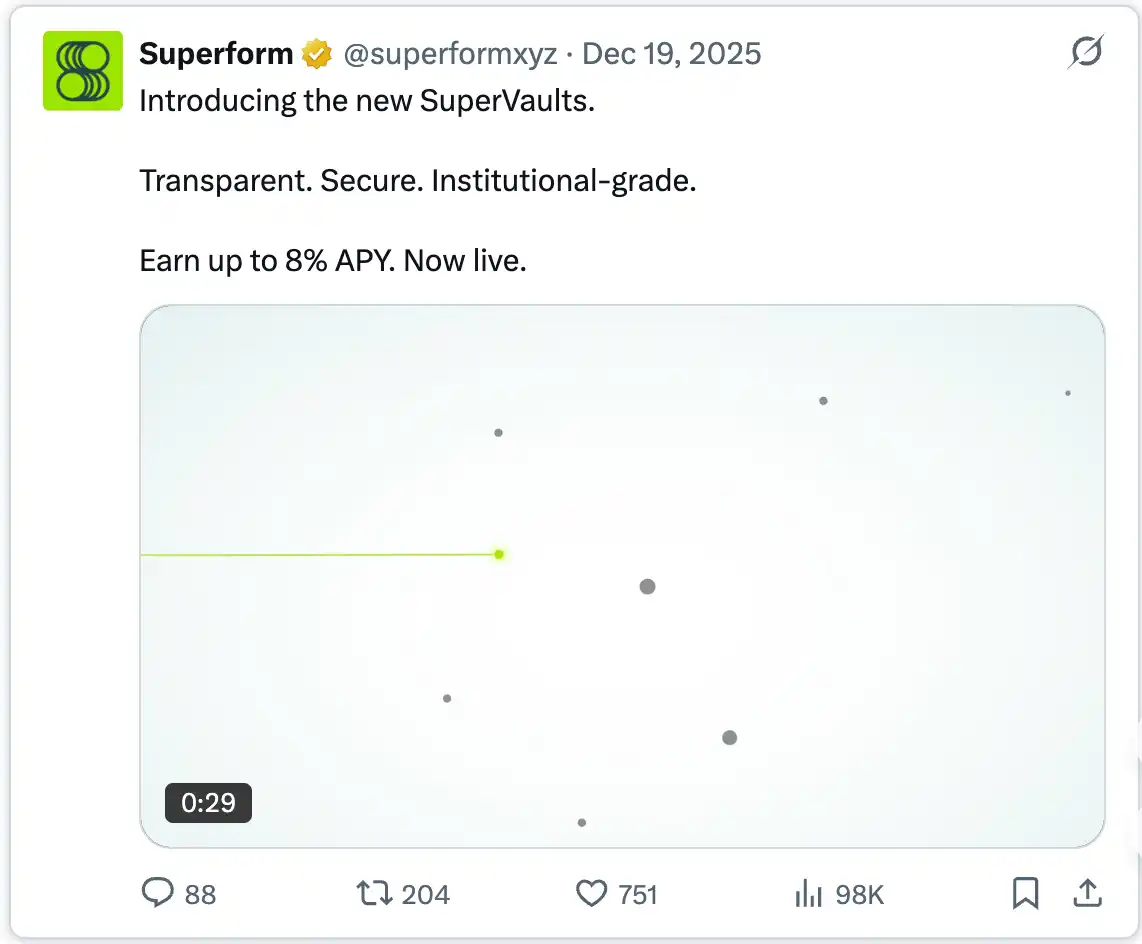
Superform's SuperVaults v2 launch in Q4 2025 was a game-changer. The "Cross-Chain Instant Deposit" feature allows users to deposit funds on Base, and Superform deploys them to a vault on Arbitrum in the background. No manual bridging, no waiting for confirmations, everything happens automatically.

Previously, yield optimization required significant expertise—tracking APYs, calculating Gas fees, timing bridges. Superform simplifies this to a "one-click" operation.
What makes it different?

Superform isn't trying to be your spending app; it's positioned as the savings backend layer for onchain finance. Unlike Tria's focus on capital flow efficiency, Superform is more concerned with efficient capital growth.

Additionally, Superform offers institutional-grade security (audited by Zellic and Omniscia), making it a "safe money" option. Many DAOs and protocol treasuries park capital here, which speaks volumes about the market's trust.
Veera's Trajectory is Fascinating

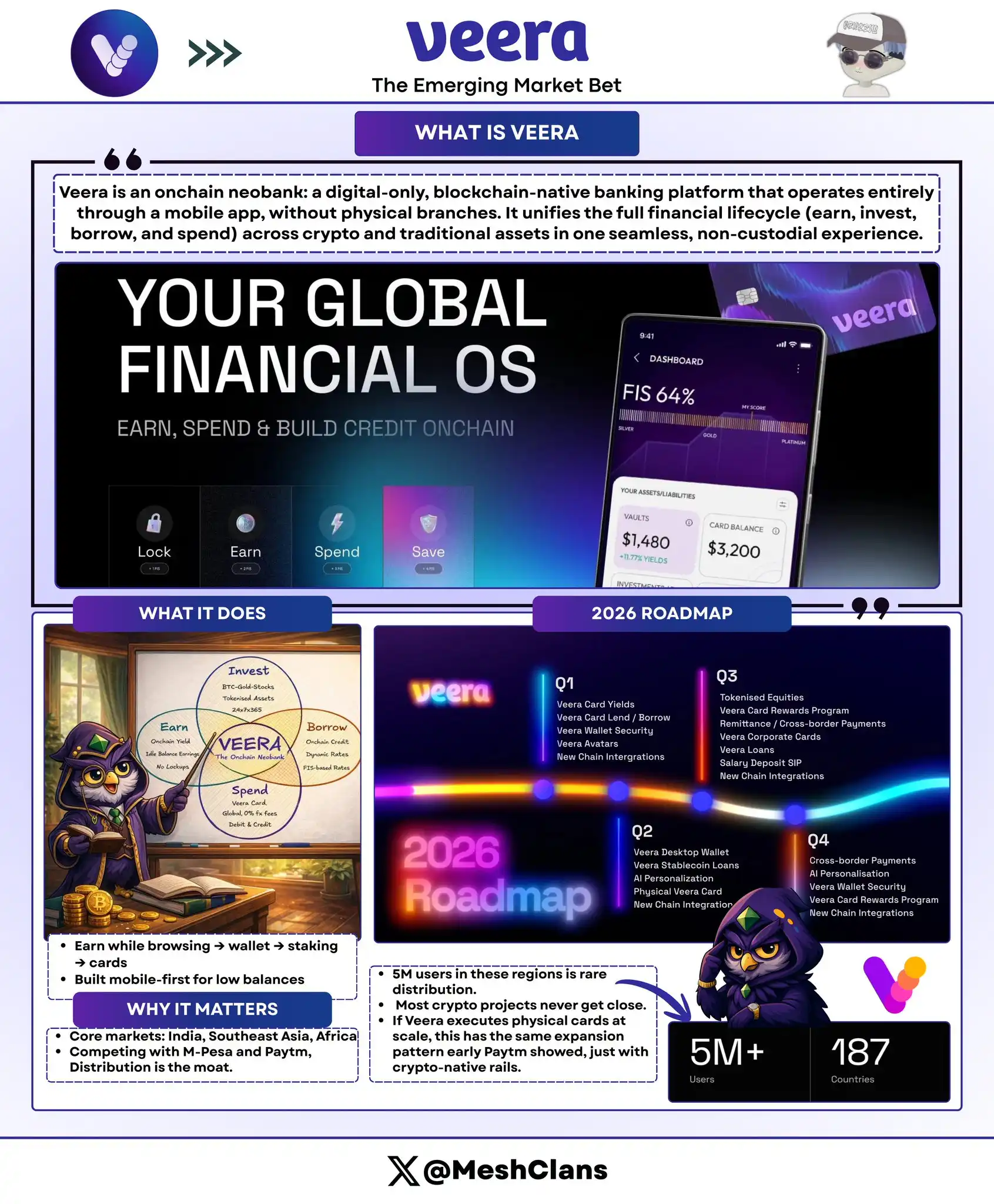
@On_Veera's growth path is very interesting. Starting as a rewards browser (similar to the Brave model), it evolved into a full financial operating system. It now boasts over 4 million users, active in emerging markets largely overlooked by Western VCs.

Basic Info:

  • User Base: Over 4 million users across 108 countries
  • Funding: $6 million Seed round from Ayon Capital in February 2024
  • Core Markets: India, Southeast Asia, Africa

Product Evolution:

The initial Veera was just a "browse-to-earn crypto" rewards browser. It has now developed into:

  • Browser RewardsWalletStaking/YieldPayment Card (Q1 2026)Credit Features (Q1 2026)

Their Q2 2026 roadmap also includes a physical debit card and desktop wallet. Their product iteration speed is rapid.

Why does Veera have the makings of a giant?

Traditional banks won't serve users in remote India with only $50 in savings, and companies like Revolut rarely enter most of Africa. Veera solves the distribution problem by meeting user needs: mobile-first, low-balance friendly, and deeply integrated into the daily browsing experience.

Their growth logic is clever: users earn small crypto rewards for normal browsing, then discover they can earn yield through staking or spend via a payment card. The onboarding has almost no friction because users immediately perceive value.

Competitive Angle:

Veera isn't competing with Coinbase; it's competing with local fintechs like Paytm, MTN Mobile Money, and M-Pesa in markets where crypto adoption is rapidly growing but infrastructure is weak.
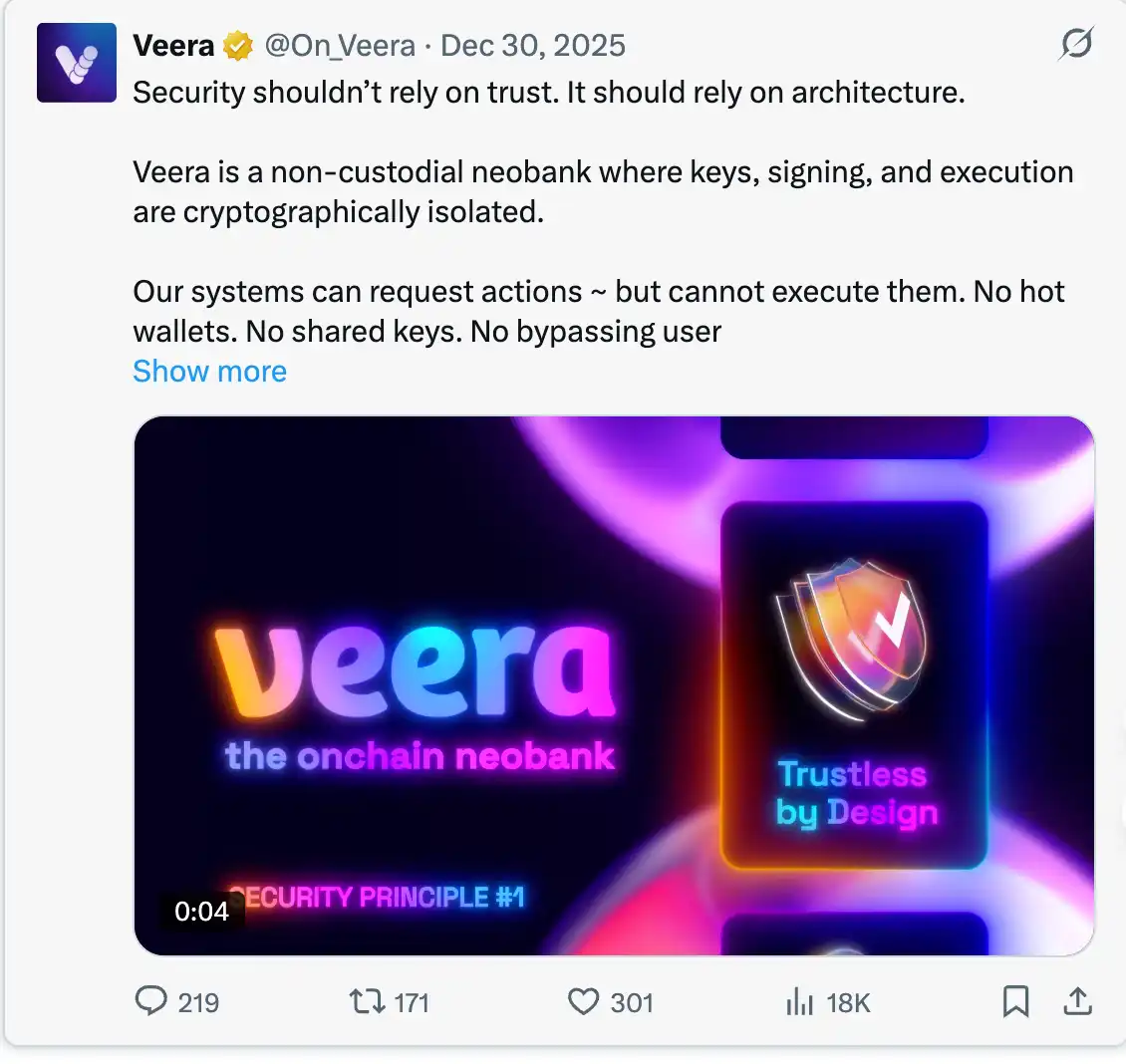
4 million users in these markets is what most crypto projects dream of. If they execute the physical card launch in Q2, they could scale like Paytm did.
Tria: The Winner in Chain Abstraction

@useTria is one project I actually downloaded and tested in Beta. Its user experience is different and refreshing.

Current Data (Early 2026):

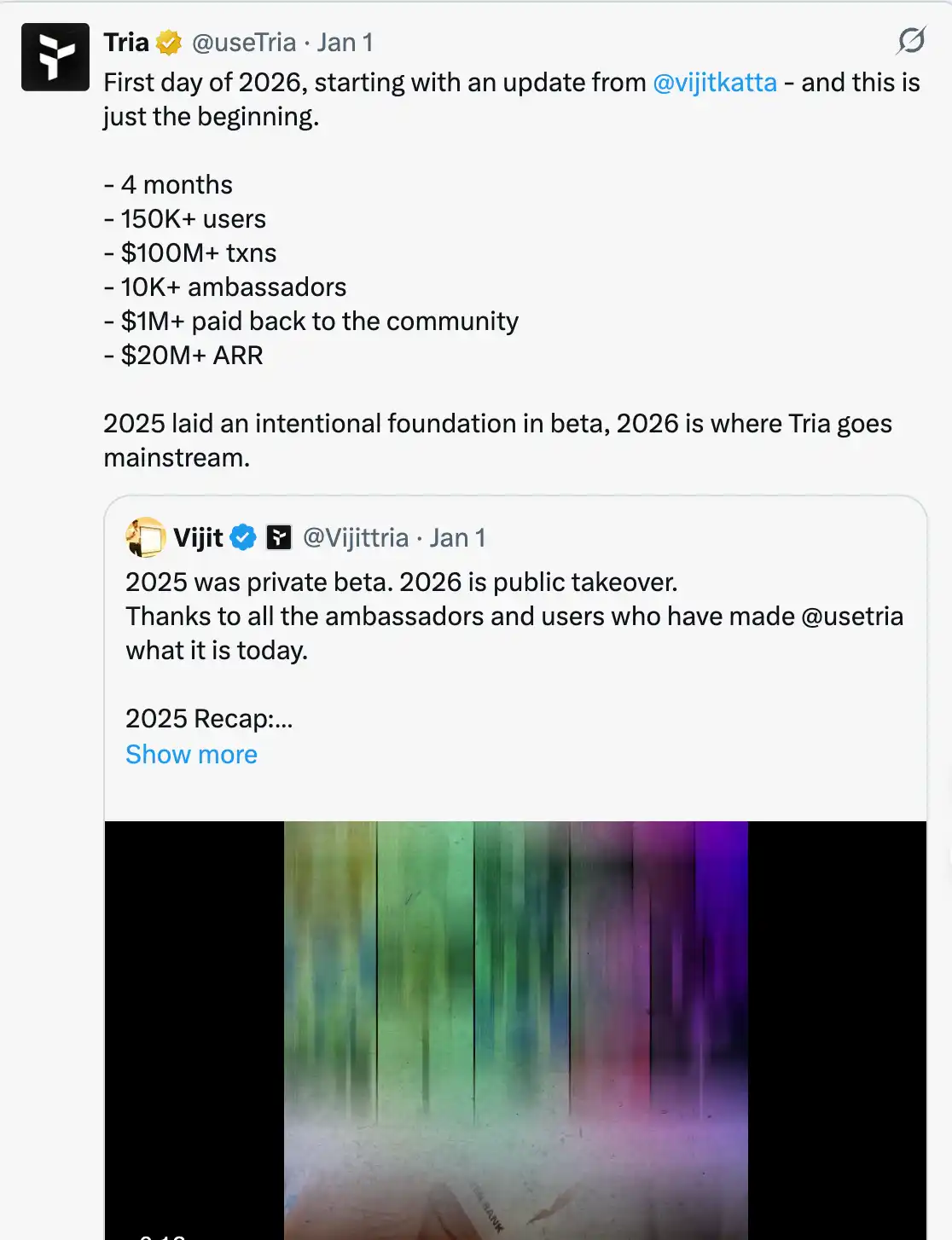
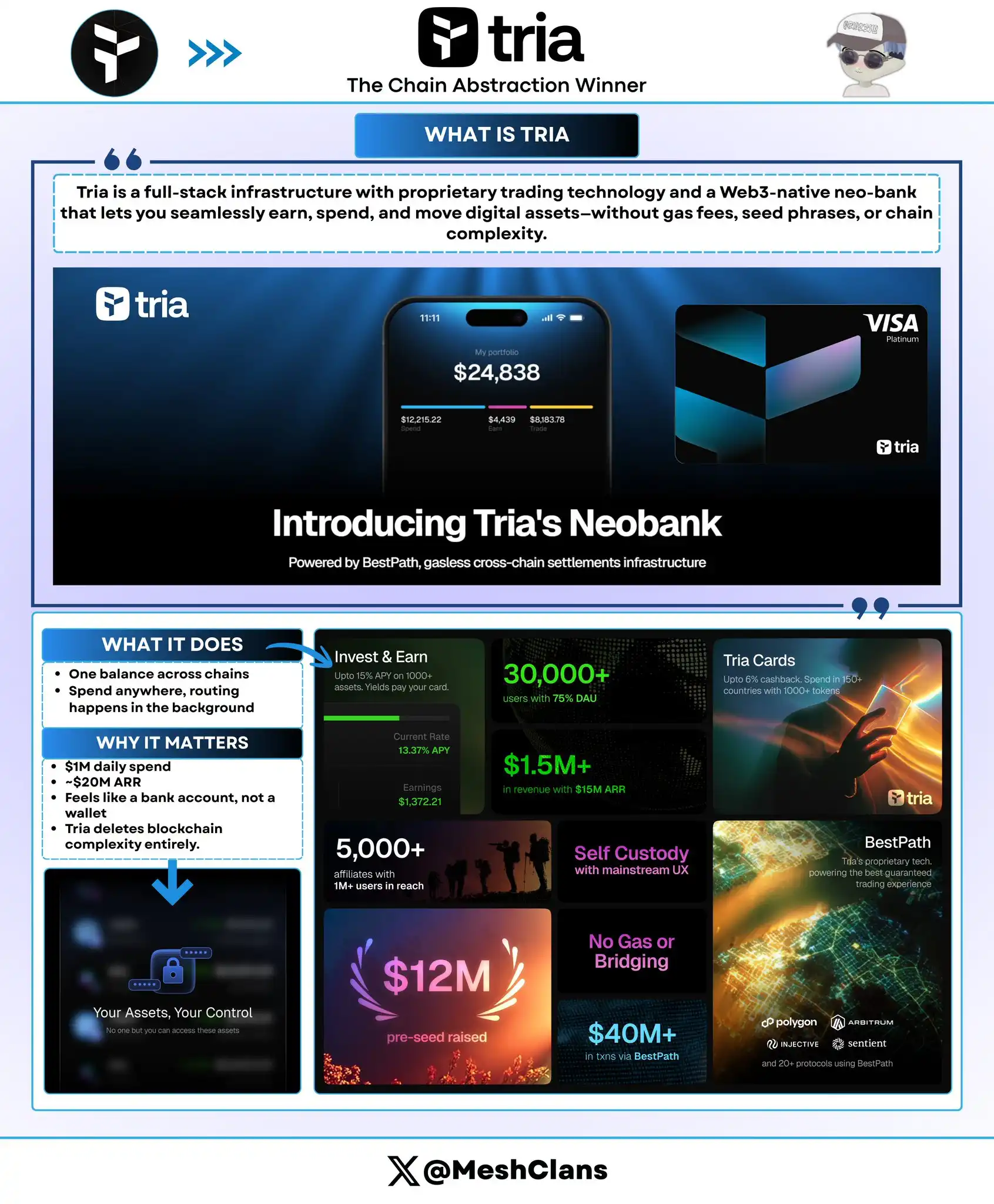
  • Active Users: Over 150,000
  • Beta Transaction Volume: Over $20 million
  • Daily Spending: Broke $1 million in November 2025
  • Annualized Run Rate (ARR): ~$20 million
  • Funding: $12 million raised in October 2025
  • Fully Diluted Valuation (FDV): Valuation between $100M - $200M

How does it work?

Tria's "Unchained" infrastructure makes blockchain complexity completely invisible. Users maintain one unified balance across multiple chains. When you spend, Tria's "BestPath" engine:

  1. Checks your assets on various chains;
  2. Finds the best liquidity path;
  3. Executes the swap or cross-chain operation in the background;
  4. Completes the payment in seconds.

The user experience is seamless: open the app, tap to pay, done. All blockchain complexity is automated away.

Tria's Christmas campaign, Triasmas (their holiday loyalty program), proved that native crypto rewards can rival traditional credit card points. People actually used it for daily spending and got cashback. This shows Tria has found product-market fit.

Why is it important?

Chain abstraction is key to making crypto usable for normal people. Other solutions always make users think about networks, Gas fees, bridges. Tria removes that friction entirely.

$1 million in daily spending validates real consumer demand. This isn't yield farming or speculation; it's real spending—coffee, groceries, bills. Over 150k users and $20M ARR suggest this is more than just beta hype.
Positioning:

In the current crypto landscape, Tria is the closest thing to a traditional bank account. It wins on speed and simplicity, not by flaunting blockchain complexity. This makes it the best candidate for mainstream users, though power users might want more control.
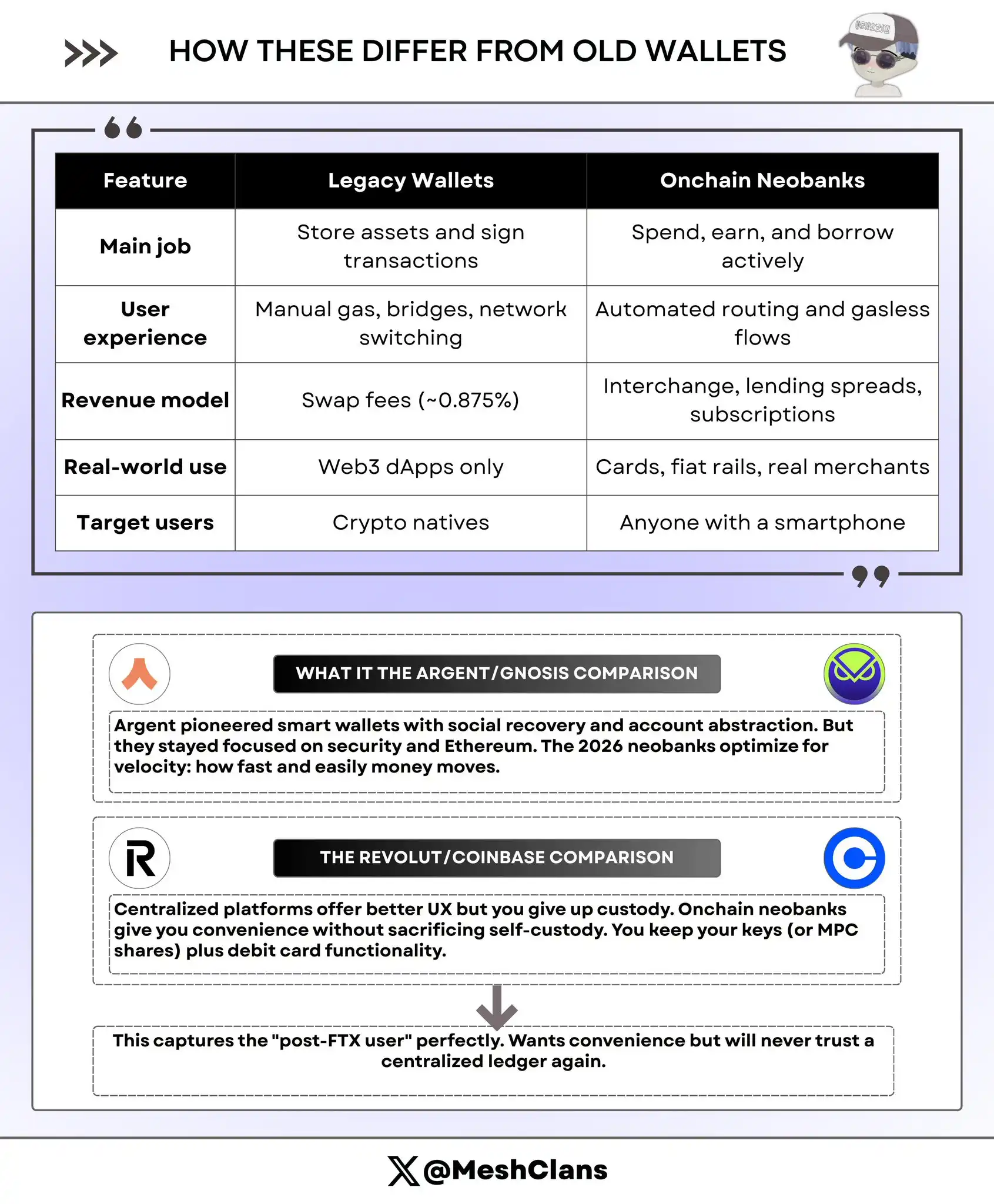
Comparison with Argent and Gnosis:

Argent pioneered smart wallets with social recovery and account abstraction. However, Argent has remained security-focused and Ethereum-centric. The 2026 onchain neobanks focus on the speed and ease of moving money—how to make capital flow faster and easier.

Comparison with Revolut and Coinbase:

Centralized platforms (like Revolut, Coinbase) offer better UX but require sacrificing custody. Onchain neobanks offer the same convenience without sacrificing self-custody. Users keep their keys (or MPC shares) while having debit card functionality.
Beyond the Three Titans

ether.fi: The Titan's Pivot

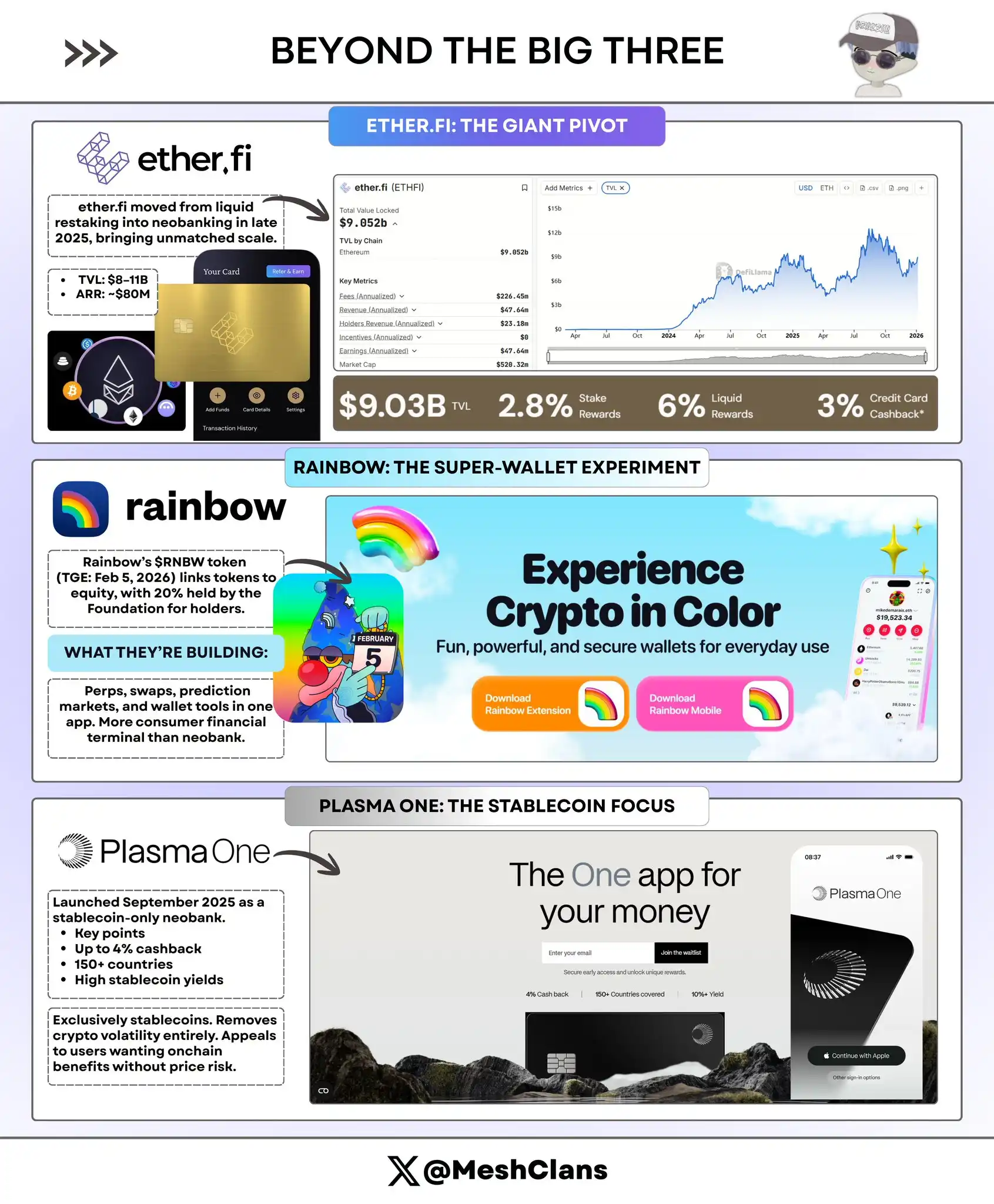
@ether_fi started as a liquid restaking protocol, but by late 2025, it pivoted heavily into the onchain banking space, on a completely different scale.

Data Performance (Late 2025 / Early 2026):

  • Total Value Locked (TVL): $8B - $11B
  • Annualized Run Rate (ARR): $80 million
  • Product: Cash Card, 3% crypto cashback

Innovation Highlight:

ether.fi's Cash Card lets users borrow against their restaked ETH (eETH) at ~4% APR without unlocking staked assets. This means users continue earning restaking rewards while accessing liquidity for spending.

This model cleanly solves the liquidity problem for yield farmers.

With $8B-$11B TVL, ether.fi is the "Chase Bank" of onchain neobanks. Its scale and liquidity can support serious consumer lending, making it a force in the industry.

Challenge:

Pivoting from DeFi infra to consumer banking isn't easy. ether.fi has capital but lacks Tria's UX polish or Veera's distribution. Execution matters more than TVL here.

Rainbow: The Super-App Experiment

Rainbow is launching its $RNBW token (TGE) on February 5, 2026, with an interesting structure: the Rainbow Foundation will hold 20% of the company's equity to reward token holders.

What are they building?

Rainbow is developing an all-in-one mobile interface including Perps, Swaps, Prediction Markets, and wallet functions. It's more of a consumer "Bloomberg Terminal" than a traditional neobank.

Equity-Token Link:

This equity-linked token structure is an experiment. If successful, other projects may rush to copy it. If it fails, it could be a classic case of over-promising.

Risk:

The risk of feature bloat is high. Trying to do everything might make the product unfocused, struggling to compete with best-in-class single-function apps. The upcoming February TGE will reveal if the market values the equity-link model or sees it as a marketing gimmick.

Plasma One: The Stablecoin-First Contender

Plasma One launched in September 2025, positioning itself as the "first stablecoin-native neobank".

Product Features:

  • 4% cashback
  • Available in 150+ countries
  • High yield on stablecoin balances

Unique Positioning:

Plasma One focuses solely on stablecoins, removing crypto price volatility entirely. This appeals to users who want onchain benefits without price risk.

Core Issue:

The "first stablecoin-native" positioning is more of a marketing angle than a real moat. Any competitor can easily add a stablecoin-only mode. Success will come down to execution, not positioning.
Risks Worth Watching

Sustainability of Yields

Let's be real. High returns like Veera's browser rewards and 15% APYs are mostly subsidized by VC funding and token emissions.

Remember the 20% UST rates from Anchor? We all know how that ended—with the collapse of the entire Terra ecosystem.

The 2026 onchain neobank space faces a core question: what happens when the subsidies run out?

Sustainable onchain banks need real revenue sources: card transaction fees, lending spreads, subscription models. Projects inflating APY by burning token reserves might not survive until the next funding round.

Tria's $20M ARR provides a template: real revenue from real transactions, not token incentives.

Watch for: Projects being transparent about revenue sources, clearly distinguishing organic income from token subsidies. If they aren't transparent, that says something.

Regulatory Uncertainty

2025 discussions around the Stablecoin Act created much uncertainty. If US regulations require self-custody "banks" to implement KYC, the industry could see a major split:

  • Compliant Hybrids (with institutional backing and regulatory infrastructure) will thrive in the US market.
  • Pure Self-Custody Apps (like Tria, Superform) might be forced to geo-block US users or add compliance layers, potentially breaking their core value proposition.

Europe's MiCA regulations in 2024-2025 provided some clarity. Clear rules help legitimate projects but raise the barrier to entry.

Key Question: Can these protocols adapt to regulation while keeping their decentralized core intact?

The Metamask Threat

Metamask has 30 million MAUs and immense brand recognition. For Veera or Tria to reach 10 million users, they need to be significantly better than Metamask, not just marginally.

Chain abstraction is a feature, not a moat. Metamask could launch gasless transactions and unified balances within six months. If that happens, the competitive edge of onchain banks shrinks to payment cards and yield optimization.

Defenses:

  • Tria's Play: Payment networks (hard to copy quickly).
  • Superform's Play: Yield optimization algorithms (more sustainable).
  • Veera's Play: Focus on markets Metamask ignores (geographic moat).

Time will tell who wins.

2026 Outlook

Most Likely to Hit 1M DAU First: Tria

Tria's UX is already polished. $1M daily spending and 150k+ users show strong consumer demand. If the rumored Q1 Mastercard payment network integration happens, Tria could run away with it.

Chain abstraction matters most to mainstream users who don't care about blockchain. They just want to buy coffee with crypto, not understand the tech.

$20M ARR suggests Tria has found real product-market fit, not just beta hype.

Safest for Sustained Growth: Superform

Yield optimization survives every market cycle. Even if consumer-facing neobanks struggle, institutional users (DAOs, protocols, treasuries) will still park capital in optimized vaults.

Superform's focus on "safe money" means lower volatility and more stable growth. Less "sexy," but highly sustainable.

Most Likely Dark Horse: Veera

4 million users in India and Southeast Asia is a distribution most crypto projects can't touch. If Veera executes the physical card launch in Q2, it could become the "Paytm" of crypto.

It achieved massive scale in markets Western VCs largely ignore. The upside is huge.

Most Likely Acquisition Target: ether.fi

$8B-$11B TVL and $80M ARR make ether.fi a prime acquisition target for Coinbase, Kraken, or TradFi banks looking to enter crypto. Expect consolidation by end-2026, as giants choose to buy proven infrastructure rather than build from scratch.

What These Onchain Banks Share

These three projects are essentially building a new kind of financial super-app: combining DeFi's power with everyday banking UX, all self-custodied and onchain.

Common DNA:

  1. Non-Custodial Core: Users control keys and assets, avoiding freeze/confiscation risks of centralized platforms.
  2. Unified Operating System: Yield, spend, trade across chains in one app, vs. traditional wallets requiring constant dApp switching.
  3. Focus on Mass Adoption: Replaced "read 47 docs on liquidity pools" with "earn more, do less".
  4. Timing is Right: These projects emerged in late 2025, marking the next phase post-"DeFi 2.0". Better L2s, account abstraction, and real-world spending needs converged.

Different Paths, Same Goal

  • Superform: Yield optimization & institutional-grade infra
  • Veera: Global credit & yield OS
  • Tria: Consumer payments & spending

Together, these projects are building a new category. People are starting to see "onchain neobanks" as an industry, not just individual projects. This narrative momentum matters for funding, partnerships, and market mindshare.

Final Take

Self-custody is becoming convenient. These three projects represent different paths to solving the same problem: making crypto as easy as traditional banking, while keeping self-custody at the core.

Who will dominate?

Likely, all three will thrive, serving different user segments. The crypto economy is vast enough for multiple financial operating systems.

The real challenge: can they cross the chasm from crypto-natives to mainstream adoption?

Late 2025 data suggests yes:

  • Tria: $20M ARR
  • Veera: 4M users
  • Superform: $1.44B TVL

These numbers suggest sustainable growth, not just speculative hype.

2026 will be the year this space proves its potential.

Трендові криптовалюти

Пов'язані питання

QWhat are the three leading on-chain neobanks mentioned in the article, and what are their core focuses?

AThe three leading on-chain neobanks are Superform, Veera, and Tria. Superform focuses on yield optimization and institutional-grade infrastructure, acting as a 'savings account' for on-chain finance. Veera is building a global credit and yield operating system, targeting emerging markets. Tria is a consumer-facing platform for payments and spending, prioritizing chain abstraction for a seamless user experience.

QAccording to the article, what key metric suggests Tria has found genuine product-market fit?

AThe key metric is Tria's Annual Recurring Revenue (ARR) of approximately $20 million. This revenue, derived from real transactions rather than token incentives, indicates strong consumer demand and validates that the platform has moved beyond beta hype to achieve sustainable product-market fit.

QWhat major risk do on-chain neobanks face regarding the sustainability of their high yields, as highlighted in the article?

AThe major risk is that high yields, like Veera's 15% APY, are often subsidized by venture capital funding and token emissions. The article compares this to the unsustainable 20% UST yield offered by Anchor Protocol before the Terra collapse. Sustainable neobanks need real revenue sources like card transaction fees, lending spreads, and subscription models instead of relying on burning token reserves.

QHow does the article differentiate the target market and growth strategy of Veera from its competitors?

AVeera's strategy focuses on growth in emerging markets (India, Southeast Asia, Africa) that are often overlooked by Western VCs and underserved by traditional banks and fintechs like Revolut. It acquired over 4 million users through a low-friction, mobile-first onboarding process that starts with a 'browse-to-earn' rewards model, gradually introducing users to staking, yield, and eventually payment cards.

QWhat is the core technological innovation that Tria's 'Unchained' infrastructure provides, and why is it important for mainstream adoption?

ATria's core innovation is chain abstraction, which makes blockchain complexity completely invisible to the user. Its 'BestPath' engine automatically checks assets across multiple chains, finds the best liquidity path, and executes swaps or cross-chain operations in the background within seconds for a payment. This is crucial for mainstream adoption because it allows users to spend crypto as easily as fiat without needing to understand gas fees, bridges, or network switching.

Пов'язані матеріали

After Three Consecutive Quarters of Decline, Can the Crypto Market Find a Window for Stabilization in Q3?

The cryptocurrency market has just concluded its worst-performing quarter since 2022, with total capitalization dropping 12.6% to $2.1 trillion. All core metrics indicate capital is leaving the sector, not just rotating within it. Bitcoin fell 14.2% and Ethereum dropped 25.4% in Q2, breaking their previous correlation with US tech stocks. A key driver is the reversal in US spot Bitcoin ETF flows, which saw a net outflow of approximately $4.67 billion in Q2, including a record monthly outflow near $4.5 billion in June. While recent data suggests long-term holders are accumulating again, sustained ETF outflows mean continued selling pressure. Market focus is now singularly on the Federal Reserve. The upcoming July FOMC meeting is seen as the most critical event for Q3. A dovish signal could support Bitcoin reclaiming a $68,000-$84,000 range, while a hawkish stance might establish a new trading band around $50,000-$56,000. Additionally, regulatory uncertainty persists, with the progress of the crucial *CLARITY Act* stalling in the Senate, reducing its perceived 2026 passage probability to 40-45%. Despite the broad downturn, a few sectors showed growth. Prediction markets saw nominal volume surge 48.7% year-over-year to $113.8 billion, and tokenized collectibles transaction volume rose 143% quarterly to $1.4 billion. The Real-World Asset (RWA) tokenization sector also continued steady growth, now representing ~$28.1 billion in on-chain value. The market's foundation for an extreme crash appears limited, with Bitcoin price hovering near its 200-week moving average. However, the trading paradigm has shifted from narrative-driven speculation to decisions based on price action, policy developments, and interest rate expectations, making a broad sentiment-driven rally unlikely in the near term.

marsbit17 год тому

After Three Consecutive Quarters of Decline, Can the Crypto Market Find a Window for Stabilization in Q3?

marsbit17 год тому

BIT Trading Moment: BTC Still Suppressed by Weekly 200 EMA, Rejection May Restart Decline; Storage and Semiconductors that Surged Last Night Begin Falling in Evening Trading

**Crypto & Stock Market Wrap: Bitcoin Tests Resistance, Stocks Retreat After AI Surge** Bitcoin consolidates around $66,000, facing key resistance near $68,000—an area seen as a major psychological and technical hurdle where previous rallies have failed. Analysts note the cryptocurrency is caught between its 200-week moving average (~$63,333) and 200-week EMA (~$68,328). A clear break above $68k is needed to signal a stronger bullish trend, while a rejection could lead to a retest of $63k support. Market sentiment remains cautious, with low futures open interest pointing to a low-liquidity rebound rather than a full bull market. Bitcoin spot ETFs saw another $203 million inflow. US stock futures pointed lower after a strong Tuesday session led by a massive rebound in semiconductors and memory stocks. The rally was fueled by renewed optimism about AI-driven hardware demand, with Micron, SanDisk, and SK Hynix surging. However, those gains reversed in pre-market trading. Super Micro Computer (SMCI) soared over 20% after hours on strong guidance and a record backlog. Other standouts included Rocket Lab and nuclear energy plays Oklo and X-Energy. Rising oil prices (Brent above $91) and climbing Treasury yields (10-year near 4.64%), however, are reigniting inflation concerns and acting as a headwind for equities. In Asia, markets were mixed. South Korea's KOSPI pared early gains to close slightly higher as semiconductor stocks like SK Hynix gave back initial surges. Japan's Nikkei edged lower as the yen hit a fresh 38-year low against the dollar, raising fears of potential market intervention. Key events to watch include the Samsung Galaxy launch, AMD's AI event, and a slew of major tech earnings from Alphabet, Tesla, and IBM after the close on Wednesday, followed by the ECB meeting and Intel's earnings on Thursday.

marsbit17 год тому

BIT Trading Moment: BTC Still Suppressed by Weekly 200 EMA, Rejection May Restart Decline; Storage and Semiconductors that Surged Last Night Begin Falling in Evening Trading

marsbit17 год тому

Former CFTC Chairman, Circle President Tarbert: Preaching Long-Termism While Cashing Out $30 Million Himself

Former CFTC Chairman and Circle President Heath Tarbert has consistently advocated for a long-term vision in public, urging patience from investors as Circle’s stock price has fallen significantly from its peak. However, it has been revealed that since Circle’s IPO, Tarbert has continuously sold his CRCL shares through pre-arranged trading plans, cashing out approximately $30 million, without making any public market purchases. This contrast between his public messaging and personal actions has drawn criticism. Tarbert joined Circle in July 2023 as Chief Legal Officer, leveraging his regulatory experience to help guide the company through its IPO and expansion. Despite promoting stablecoins as long-term infrastructure, he established a 10b5-1 trading plan just before Circle went public, leading to substantial stock sales over the following year. In March 2026, he initiated another plan to sell more shares. His career trajectory highlights a pattern of moving between high-level regulatory roles and influential positions in the financial sector. After resigning as CFTC Chairman in early 2021, he joined Citadel Securities as Chief Legal Officer just 27 days later, during a period of intense regulatory scrutiny for the firm. He later joined Circle, aiding its efforts to navigate regulatory challenges for its public listing. While Tarbert's expertise in policy and compliance is valuable to companies like Circle, his actions—advocating long-term confidence while personally divesting—raise questions about the alignment between his public statements and his private financial decisions, leaving investors who followed his advice to bear the market risks.

marsbit18 год тому

Former CFTC Chairman, Circle President Tarbert: Preaching Long-Termism While Cashing Out $30 Million Himself

marsbit18 год тому

Gate Research Institute: The 'Wall Street-ization' Wave of Crypto Financial Products – Competition or Integration?

The article titled "Gate Research Institute: Are Crypto Financial Products Sparking a 'Wall Street' Wave—Competition or Convergence?" explores the evolving relationship between the crypto ecosystem and traditional finance (TradFi). The piece begins by reflecting on Bitcoin's original 2009 vision of decentralization, disintermediation, and moving away from banks. It then contrasts this with the 2024 landscape, where key crypto assets like Bitcoin are increasingly held through Wall Street products like ETFs issued by giants like BlackRock. The article questions whether this signifies that TradFi is systematically taking over the rights to issue, price, custody, and distribute crypto financial assets. The core argument is that this is not a zero-sum takeover but rather a bidirectional convergence where each side addresses the other's weaknesses. Crypto offers 24/7 global markets, programmable settlement, and open access but lacks compliant channels, institutional-grade custody, deep fiat liquidity, and mainstream distribution. TradFi possesses these but is constrained by legacy systems, limited operating hours, and slow settlement. Two primary convergence paths are highlighted: * **Path A (CEX to TradFi):** Exemplified by Gate, which has progressed from offering tokenized stocks and CFDs to providing direct, real stock trading (US, Hong Kong, South Korea) within its platform, using USDT. * **Path B (TradFi to Crypto):** Exemplified by Robinhood, which has integrated crypto trading, acquired exchanges like Bitstamp, and is moving traditional assets like stocks onto the blockchain via tokenization and its own Layer 2. Both paths are ultimately competing to become the next-generation, unified financial account—a "super account" where users can seamlessly trade cryptocurrencies, stocks, ETFs, RWA (Real World Assets), and tokenized treasury products in one interface. The growth of RWA and tokenized treasuries (e.g., BlackRock's BUIDL) is presented as the asset-layer fusion, providing stable, yield-bearing assets on-chain and acting as a bridge between the two worlds. In conclusion, the "Wall Street-ization" of crypto is framed as a mutual transformation. Decentralized ideals persist in the protocol layer, while at the application layer, a more efficient, global, and accessible unified capital market is emerging from this convergence. The future competition lies not between crypto exchanges and stockbrokers, but between platforms vying to offer the most comprehensive asset coverage, liquidity, and user experience within a single account.

marsbit18 год тому

Gate Research Institute: The 'Wall Street-ization' Wave of Crypto Financial Products – Competition or Integration?

marsbit18 год тому

Торгівля

Спот

Популярні статті

Що таке $BANK

Bank AI: Революційний крок у майбутнє банківської справи Вступ В епоху, що характеризується швидкими технологічними змінами, Bank AI знаходиться на перетині штучного інтелекту (ШІ) та банківських послуг. Цей інноваційний проєкт прагне переосмислити фінансовий ландшафт, підвищуючи ефективність роботи, заходи безпеки та досвід клієнтів завдяки потужності ШІ. Розпочинаючи дослідження Bank AI, ми заглибимося в суть проєкту, його операційні динаміки, історичний контекст і значущі етапи. Що таке Bank AI? У своїй основі Bank AI представляє собою трансформаційну ініціативу, спрямовану на інтеграцію штучного інтелекту в різні банківські операції. Цей проєкт використовує можливості ШІ для автоматизації процесів, покращення протоколів управління ризиками та підвищення взаємодії з клієнтами через персоналізовані послуги. Основні цілі Bank AI включають: Автоматизація банківських функцій: Використовуючи технології ШІ, Bank AI прагне автоматизувати рутинні завдання, зменшуючи навантаження на людські ресурси та підвищуючи ефективність. Покращене управління ризиками: Проєкт використовує алгоритми ШІ для прогнозування та виявлення ризиків, тим самим зміцнюючи заходи безпеки проти шахрайства та інших загроз. Персоналізація банківських послуг: Bank AI зосереджується на пропозиції індивідуальних фінансових продуктів і послуг, аналізуючи дані і поведінку клієнтів. Покращення досвіду клієнтів: Впровадження рішень на основі ШІ, таких як чат-боти та віртуальні асистенти, має на меті забезпечити користувачам більш природну взаємодію, революціонізуючи спосіб, яким клієнти спілкуються з банками. З цими цілями Bank AI займає важливу роль в робленні банківської справи більш ефективною, безпечною та орієнтованою на користувача. Хто є творцем Bank AI? Деталі стосовно творця Bank AI залишаються невідомими. Таким чином, жодна конкретна особа або організація не були ідентифіковані в доступній інформації. Анонімність навколо створення проєкту піднімає питання, але це не зменшує його амбітного бачення та цілей. Хто є інвесторами Bank AI? Аналогічно творцеві проєкту, конкретна інформація стосовно інвесторів або організацій, що підтримують Bank AI, не була розкрито. Без цієї інформації важко окреслити фінансову підтримку та інституційну підтримку, які могли б сприяти розвитку проєкту. Тим не менше, важливість наявності міцної інвестиційної бази є вирішальною для забезпечення розвитку в такій інноваційній сфері. Як працює Bank AI? Bank AI функціонує на кількох інноваційних фронтах, фокусуючись на унікальних факторах, які відрізняють його від традиційних банківських структур. Нижче наведено ключові операційні характеристики: Автоматизація: Застосовуючи алгоритми машинного навчання, Bank AI автоматизує різні ручні процеси в банках. Це призводить до зниження операційних витрат і дозволяє працівникам перенаправити свої зусилля на більш стратегічні завдання. Покращене управління ризиками: Інтеграція ШІ в практики управління ризиками забезпечує банки інструментами для точного прогнозування потенційних загроз, таких як шахрайство, забезпечуючи при цьому безпеку інформації і активів клієнтів. Індивідуальні фінансові рекомендації: Завдяки безперервному навчанню з інтерaktionen з клієнтами, системи ШІ розвивають тонке розуміння потреб користувачів, що дозволяє їм пропонувати персоналізовані поради щодо фінансових рішень. Покращені взаємодії з клієнтами: Використовуючи чат-ботів і віртуальних асистентів на базі ШІ, Bank AI дозволяє створити більш залучений досвід для клієнтів, дозволяючи користувачам швидше отримувати відповіді на свої запитання, зменшуючи час очікування та підвищуючи рівень задоволеності. Разом ці операційні характеристики позиціонують Bank AI як піонера в банківському секторі, встановлюючи нові стандарти для надання послуг і операційної досконалості. Хронологія Bank AI Для розуміння траєкторії Bank AI необхідно ознайомитися з його історичним контекстом. Нижче наведено хронологію, що підкреслює важливі етапи та розробки: Ранні 2010-ті: Концептуалізація інтеграції ШІ в банківські послуги почала привертати увагу, коли банківські установи визнали потенційні переваги. 2018: Відбулося помітне збільшення впровадження технологій ШІ, коли банки почали використовувати інструменти ШІ, такі як чат-боти для базового обслуговування клієнтів та системи управління ризиками для покращення безпеки. 2023: Софістикація ШІ продовжувала розвиватися, з введенням генеративного ШІ для більш складних завдань, таких як обробка документів і аналіз інвестицій в реальному часі. Цей рік став важливим стрибком у можливостях, які забезпечує технологія ШІ для банків. 2024-актуальний статус: Станом на цей рік, Bank AI знаходиться на зростаючій траєкторії, з постійними дослідженнями та розробками, які готові подальше покращити можливості в банківських операціях. Продовження дослідження застосувань ШІ натякає на захоплюючі події, які ще попереду. Ключові моменти про Bank AI Інтеграція ШІ в банківську справу: Bank AI зосереджується на прийнятті штучного інтелекту для оптимізації банківських процесів та покращення досвіду користувачів. Автоматизація та фокус на управлінні ризиками: Проєкт сильного підкреслює ці сфери, прагнучи зshift тягар рутинних завдань, водночас підвищуючи безпеку через прогнозну аналітику. Персоналізовані банківські рішення: Завдяки використанню даних клієнтів, Bank AI забезпечує персоналізовані банківські послуги, що відповідають потребам окремих користувачів. Прихильність до розвитку: Bank AI залишається відданим постійним дослідженням і розробкам, що забезпечують його адаптацію та постійну актуальність у міру того, як технології продовжують розвиватися. Висновок Підсумовуючи, Bank AI є важливим кроком вперед у банківській індустрії, використовуючи штучний інтелект для переформатування операційних парадигм, підвищення безпеки та сприяння задоволеності клієнтів. Незважаючи на прогалини в інформації щодо творця та інвесторів, чіткі цілі і функціональні механізми Bank AI забезпечують міцну основу для його подальшої еволюції. Оскільки технологія ШІ продовжує розвиватися та інтегруватися в банківський сектор, Bank AI має всі шанси суттєво вплинути на майбутнє фінансових послуг, покращуючи спосіб, яким ми розуміємо та взаємодіємо з банківською справою.

173 переглядів усьогоОпубліковано 2024.04.06Оновлено 2024.12.03

Що таке $BANK

Як купити BANK

Ласкаво просимо до HTX.com! Ми зробили покупку Lorenzo Protocol (BANK) простою та зручною. Дотримуйтесь нашої покрокової інструкції, щоб розпочати свою криптовалютну подорож.Крок 1: Створіть обліковий запис на HTXВикористовуйте свою електронну пошту або номер телефону, щоб зареєструвати обліковий запис на HTX безплатно. Пройдіть безпроблемну реєстрацію й отримайте доступ до всіх функцій.ЗареєструватисьКрок 2: Перейдіть до розділу Купити крипту і виберіть спосіб оплатиКредитна/дебетова картка: використовуйте вашу картку Visa або Mastercard, щоб миттєво купити Lorenzo Protocol (BANK).Баланс: використовуйте кошти з балансу вашого рахунку HTX для безперешкодної торгівлі.Треті особи: ми додали популярні способи оплати, такі як Google Pay та Apple Pay, щоб підвищити зручність.P2P: Торгуйте безпосередньо з іншими користувачами на HTX.Позабіржова торгівля (OTC): ми пропонуємо індивідуальні послуги та конкурентні обмінні курси для трейдерів.Крок 3: Зберігайте свої Lorenzo Protocol (BANK)Після придбання Lorenzo Protocol (BANK) збережіть його у своєму обліковому записі на HTX. Крім того, ви можете відправити його в інше місце за допомогою блокчейн-переказу або використовувати його для торгівлі іншими криптовалютами.Крок 4: Торгівля Lorenzo Protocol (BANK)Легко торгуйте Lorenzo Protocol (BANK) на спотовому ринку HTX. Просто увійдіть до свого облікового запису, виберіть торгову пару, укладайте угоди та спостерігайте за ними в режимі реального часу. Ми пропонуємо зручний досвід як для початківців, так і для досвідчених трейдерів.

734 переглядів усьогоОпубліковано 2025.05.09Оновлено 2026.06.02

Як купити BANK

Обговорення

Ласкаво просимо до спільноти HTX. Тут ви можете бути в курсі останніх подій розвитку платформи та отримати доступ до професійної ринкової інформації. Нижче представлені думки користувачів щодо ціни BANK (BANK).

活动图片