2026 Crypto Industry Investor Relations and Token Transparency Status Report

marsbitОпубліковано о 2026-04-16Востаннє оновлено о 2026-04-16

Анотація

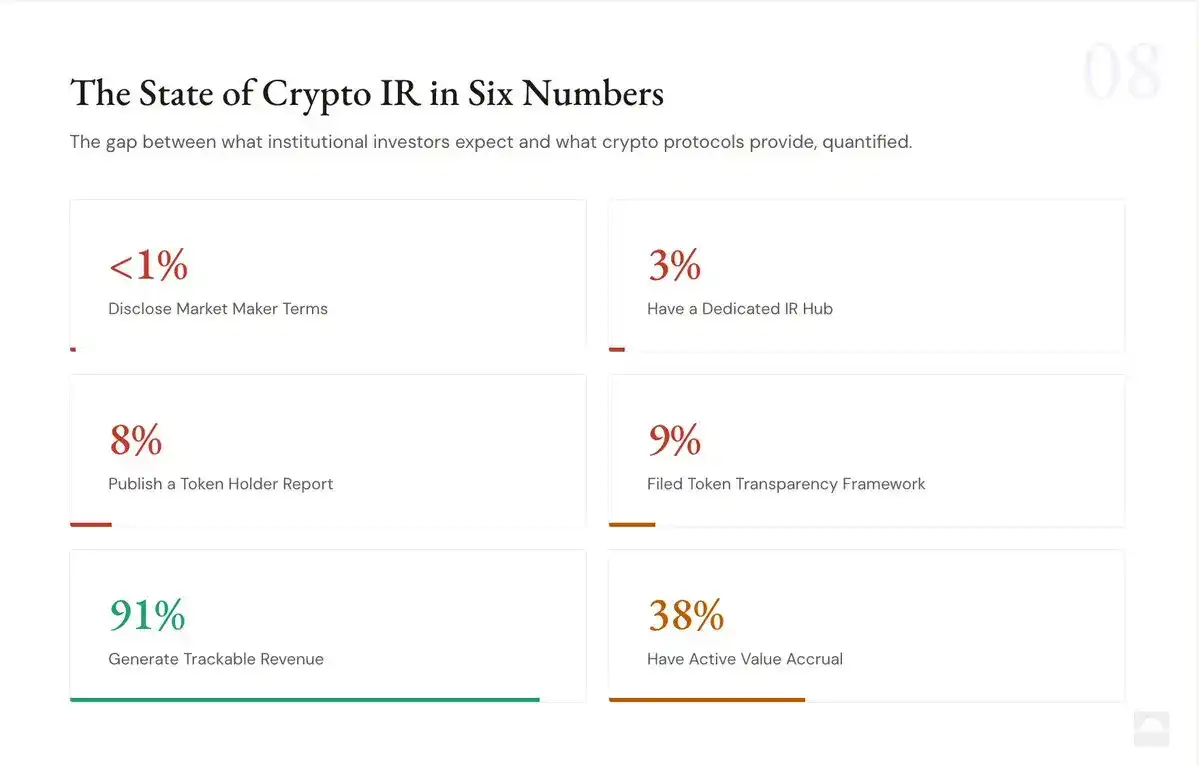
The 2026 Crypto Investor Relations & Token Transparency Report by Novora analyzes over 150 protocols across major sectors. Key findings reveal a severe transparency gap: less than 1% disclose market maker terms, only 3% have dedicated IR hubs, and just 9% submitted the Blockworks Token Transparency Framework. While 91% of protocols have accessible revenue data, the communication infrastructure to present this to investors is largely absent. Additionally, 62% of tokens offer only governance rights with no active value capture mechanisms. The report concludes that while raw data is available on-chain and via third-party platforms, the critical "translation layer" for institutional adoption is missing. Protocols investing in IR infrastructure now are positioned to gain a significant advantage.

Author: Connor King, Founder of Novora

Compiled by: Hu Tao, ChainCatcher

Last month, we released our "Does Investor Relations Matter in Crypto?" This is the follow-up. We expanded the initial dataset of 53 protocols to over 150 protocols, covering all major sectors: DEX, lending, perpetuals, liquid staking, L1, L2, bridges, DePIN, AI, stablecoins, infrastructure, and CEX tokens. The fully diluted valuation (FDV) of the protocols ranges from $40 million to $45 billion.

We checked 15 binary, verifiable indicators for each protocol: Does the protocol disclose this information? Yes/No. Each data point was cross-verified through public sources: Artemis, Tokenterminal, Blockworks, Dune, DefiLlama.

Here's what we found:
Less than 1% of market makers disclose their market maker terms.

50 protocols. Billions in daily trading volume combined. But only one protocol publicly disclosed information about its market making arrangements.

Market makers set the terms for token trading. These agreements often include token lending, option structures, and performance incentives that directly impact price discovery. In traditional markets, such material agreements are disclosed. But in crypto, every market participant is trading in the dark.

Meteora was the only protocol in the dataset that disclosed its market making arrangements through its 2025 Token Holder Annual Report. One out of over 150.

This is the most impactful transparency gap in the industry.
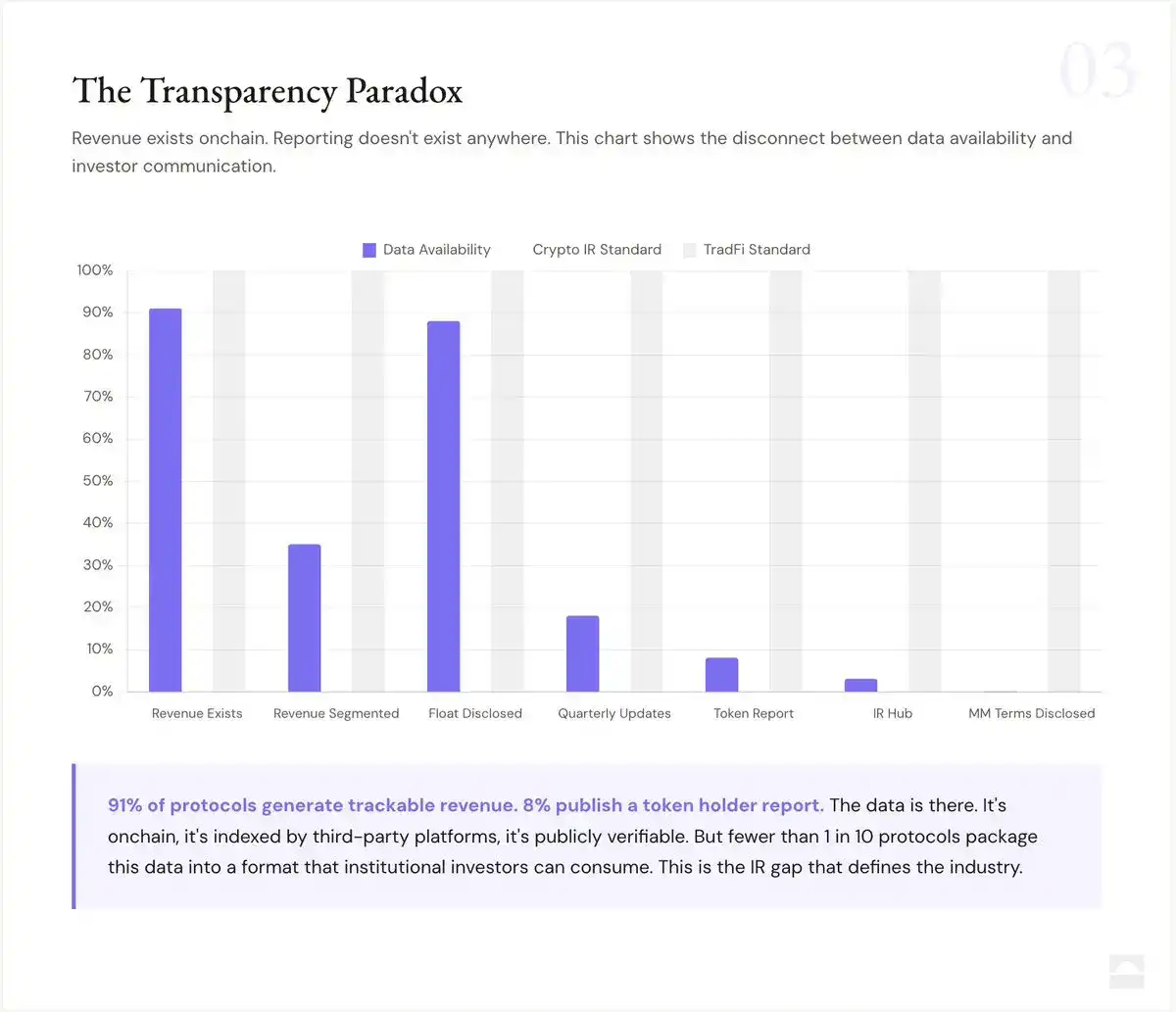
91% have revenue data. 3% have an Investor Relations hub.

Nearly every protocol in this audit publicly provides revenue data, either through third-party platforms or their own data dashboards. The raw data exists.

But only 3% have built a dedicated Investor Relations hub that consolidates this data into an investor-facing experience. The exceptions include Meteora, Jito, Jupiter, Raydium, MetaDAO. Every other protocol scatters information across blogs, governance forums, X threads, and third-party platforms. There is no centralized, institutional-grade investor experience. The gap isn't data availability, it's communication infrastructure.
9% submitted the Blockworks TTF

The Blockworks Token Transparency Framework was submitted to the U.S. SEC in June 2025, covering 18 disclosure standards across supply, distribution, financials, and market structure, backed by Pantera, L1D, and Theia. Out of the 150+ protocols reviewed, only 13 submitted the framework: Jito, Jupiter, Raydium, Morpho, Aerodrome, MetaDAO, Maple, dYdX, Euler, Marinade, EtherFi, Gains Network, and Meteora.

This is a material improvement from zero submissions. But the submission rate dropped from 25% in the initial 53 protocols to 9% at 150+. The original dataset was skewed towards early TTF-adopting DeFi protocols. With a broader sample, the picture is clearer: the vast majority of the market is not opting in. Zero L1s, zero L2s, zero infrastructure protocols submitted the framework. The framework exists. More protocols should use it.

38% have active value accrual, 62% return nothing

We used a broad definition of "active value accrual": Does the protocol have at least one live mechanism that directs economic value directly to token holders (excluding governance rights)? Across 150+ protocols, we identified six distinct models:

  • Direct fee sharing (JUP, DYDX, GMX)
  • Buyback and burn (HYPE, RAY, MET)
  • Staking revenue share (PENDLE, AAVE, ETHFI)
  • Conditional buybacks (LDO)
  • ve-model epoch distribution (AERO)
  • Governance-only, no economic rights (MORPHO, LINK, ARB)
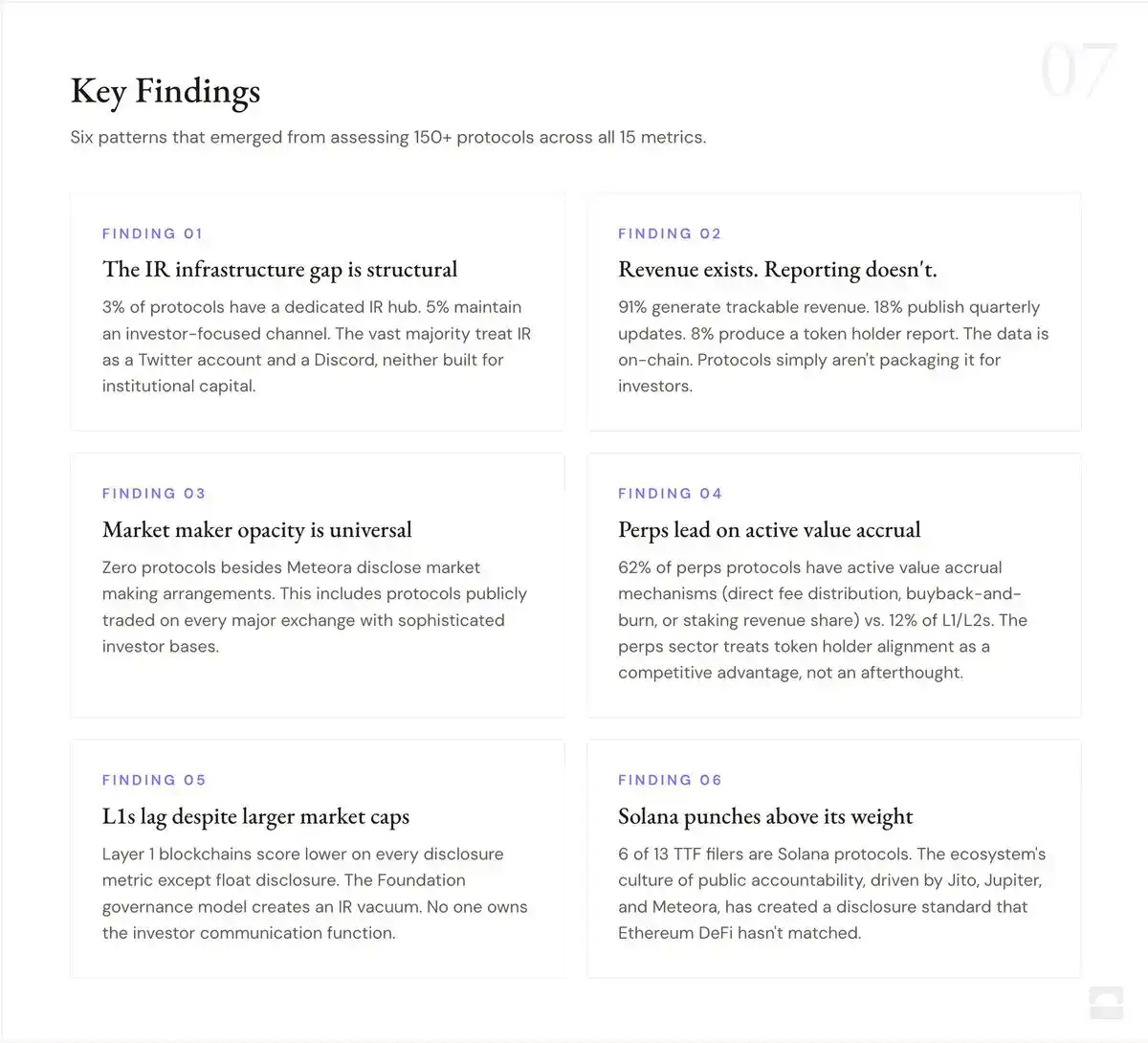
62% of protocols fall into the last category – governance-only tokens with no value accrual, including some of the largest market cap projects in the industry. Sector differences are stark: 62% of Perpetuals protocols have active value accrual, versus just 12% of L1/L2 tokens. Perpetuals treat token holder alignment as a competitive advantage. L1 foundations have not yet done the same. A deep dive into which models actually work is coming next week.

The data layer is built, the communication layer is not

We checked five major third-party platforms: Token Terminal, Dune Analytics, Artemis, DefiLlama, and Blockworks Research. The first four platforms each cover 85-95% of the dataset. 72% of protocols appear on 4 or more platforms. Every protocol in the audit appears on at least one platform. The raw data infrastructure for institutional analysis is largely built. What's missing is the interpretation, packaging, and communication layer that turns data into investable narratives.

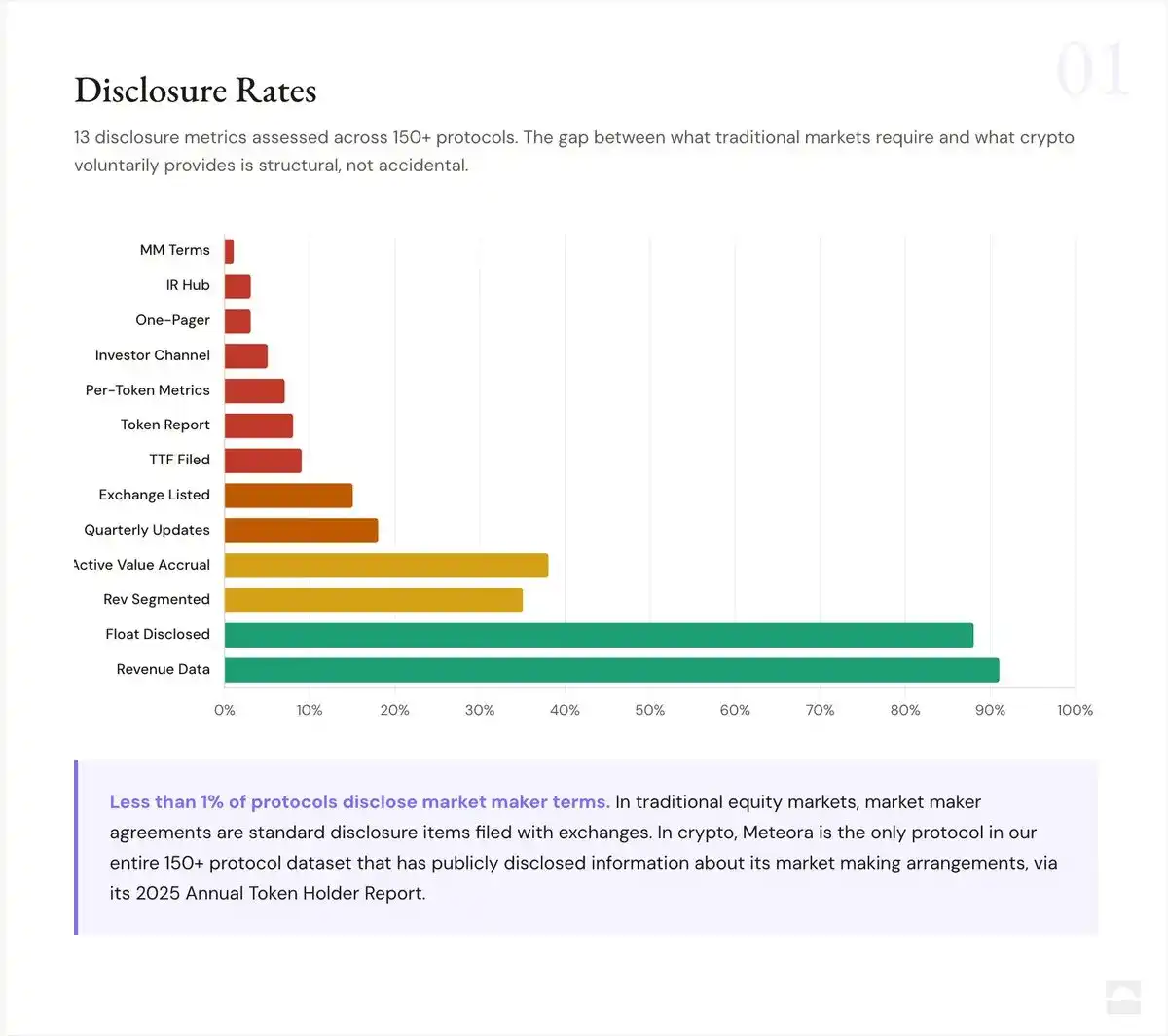
The full disclosure breakdown for 150+ protocols is as follows:

<1% —— Disclose Market Maker Terms
3% —— Dedicated IR Hub
3% —— Provide a One-Pager
5% —— Dedicated Investor Channel
7% —— Publish Single-Token Metrics
8% —— Token Holder Reports
9% —— Submitted TTF
15% —— Disclose Exchange Listings
18% —— Quarterly Updates
35% —— Disaggregated Revenue Disclosure
38% —— Active Value Accrual
88% —— Disclose Circulating Supply
91% —— Revenue Data Available

What this means

The thesis from "Does Investor Relations Matter in Crypto?" holds. The data is even more sobering with the sample size expanded to 150+. Crypto protocols aren't hiding the fundamentals, they're failing to present them. The raw inputs for fundamental analysis exist on-chain and on third-party platforms, but the "translation layer and IR infrastructure that turns data into institutional confidence barely exists. Only 3% have an IR hub, <1% disclose market maker terms, and 91% of the market has not adopted the only available standardized disclosure framework.

The opportunity for protocols is clear: the cost of building IR infrastructure is negligible relative to capital markets upside. Protocols investing in this now will be the first to earn the trust of institutional allocators. The full interactive report with all 150+ protocols is live now:
http://novora.co/research/ir-transparency-2026.html

Next week, we will release the comparative report for this series: "Which Token Value Accrual Model Works?". That report will break down the six token value accrual mechanisms we identified, their empirical performance, and what this means for token classification and institutional adoption.


Пов'язані питання

QWhat percentage of the 150+ crypto protocols studied publicly disclose their market maker arrangements?

ALess than 1% (only one protocol, Meteora, disclosed this information).

QAccording to the report, what is the state of data availability versus communication infrastructure for investor relations in crypto?

AThe data layer is built (91% of protocols have revenue data available on third-party platforms), but the communication layer is not (only 3% have a dedicated IR hub to present this data effectively).

QHow many of the protocols analyzed had submitted the Blockworks Token Transparency Framework (TTF)?

A9% (13 out of the 150+ protocols).

QWhat percentage of the protocols were found to have 'active value capture' mechanisms for token holders?

A38% of the protocols had active value capture, while 62% offered only governance rights with no economic value returned to holders.

QWhat is identified as the most significant transparency gap in the crypto industry within the report?

AThe disclosure of market maker terms, as it is a critical agreement that directly impacts price discovery and is standard in traditional markets, yet is almost entirely undisclosed in crypto.

Пов'язані матеріали

KOL's Perspective: Why Is SOL Set to Rise from This Point?

**Summary: Why SOL is Positioned for Growth at This Level** The article argues that SOL is poised for an upward move from its current price point, citing several key factors. Primarily, SOL has just broken out of a 4-month consolidation phase. This breakout signals a return of risk appetite to the broader crypto market, as SOL is seen as a key indicator of overall crypto health. The token's ownership has reportedly shifted from short-term traders and tourists to long-term accumulators, leading to low volume. Any meaningful increase in trading activity could thus trigger significant upward momentum. Fundamental strengths include strong institutional adoption, integration with DeFi and RWAs (Real-World Assets), and the potential benefits from the Clarity Act. Despite its high volatility—having dropped 70% from its all-time high but still up 12x from its bear market low—SOL is highlighted as one of the few tokens from the last cycle to reach new highs. It boasts a robust ecosystem of applications, users, and protocols. Future catalysts include the expected influx of AI developers following the Miami Accelerate conference, which focused on AI on Solana. Furthermore, Solana is positioned as the premier chain for memecoin activity, a trend expected to continue and drive network usage and fees. The article concludes that recent price action reflects a healthy transfer to long-term holders, setting the stage for growth.

marsbit42 хв тому

KOL's Perspective: Why Is SOL Set to Rise from This Point?

marsbit42 хв тому

Those Pre-Bitcoin PoW Protocols Have Recently Been Reimplemented

This article details a recent surge in replicating pre-Bitcoin Proof-of-Work (PoW) protocols, specifically focusing on Hal Finney's 2004 RPOW (Reusable Proofs of Work). Within five days in May 2026, multiple independent builders in the Bitcoin/cypherpunk community launched projects inspired by this early electronic cash proposal. The initiative began with Fred Krueger's `rpow2.com`, a centralized but auditable system that replaced RPOW's original IBM 4758 hardware with Ed25519 signatures. Initially a faithful replica, it later adopted Bitcoin-like features (21M supply cap, difficulty adjustment) and a controversial 5.24% founder allocation. This sparked rapid forks, including `rpow4.com` which incorporated full Bitcoin parameters, a prediction market (`rpowmarket.com`), and a DEX (`rpow2swap.com`). Concurrently, Mike In Space created a prototype of Wei Dai's 1998 b-money proposal (`b-money.replit.app`), pushing the historical exploration even further back. The article contrasts these centralized, server-dependent experiments with Bitcoin's core innovation of decentralized, trustless consensus. It also highlights a parallel development: the `HASH` project on Ethereum, which uses smart contract hooks to enable a purely fair-launch, browser-mineable PoW token with 0% allocations to team or VCs. The collective activity is framed as a meme-driven, educational exploration of cypherpunk history rather than a serious financial movement, with all projects heavily disclaiming any investment value.

marsbit47 хв тому

Those Pre-Bitcoin PoW Protocols Have Recently Been Reimplemented

marsbit47 хв тому

South Korean Exchanges 'Battle' Regulators, Challenging the Boundaries of Enforcement and Legislation

South Korea's cryptocurrency industry is engaged in a rare, direct confrontation with regulators. The Financial Intelligence Unit (FIU), the primary anti-money laundering (AML) watchdog, has recently imposed heavy penalties on major exchanges like Upbit and Bithumb for alleged violations involving unregistered overseas VASPs and AML procedures. However, exchanges are now actively challenging these actions in court and through industry associations. In a significant shift, the Seoul Administrative Court ruled in favor of Upbit's operator, Dunamu, overturning part of an FIU-ordered business suspension. The court found the FIU's penalty criteria and justification insufficiently clear. Similarly, the court suspended the enforcement of a six-month business suspension against Bithumb pending a final ruling, citing potential irreversible harm to the exchange. Beyond legal battles, the industry is contesting proposed legislative amendments. The Digital Asset eXchange Alliance (DAXA) strongly opposes a draft rule that would mandate Suspicious Transaction Reports (STRs) for all crypto transfers over 10 million KRW (~$6,800). DAXA argues this "poison pill" clause violates legal principles and would overwhelm the STR system, increasing reports from 63,000 to an estimated 5.45 million annually for major exchanges, thereby crippling effective AML monitoring. This conflict highlights a structural tension in South Korea's crypto governance: comprehensive digital asset laws are still developing, while regulators rely heavily on AML enforcement. The industry's move from passive compliance to active legal and legislative challenges signifies a new phase, pressing for clearer rules and more proportionate enforcement. While short-term disputes may intensify, this clash could ultimately lead to a more mature and sustainable regulatory framework for South Korea's vibrant crypto market.

marsbit1 год тому

South Korean Exchanges 'Battle' Regulators, Challenging the Boundaries of Enforcement and Legislation

marsbit1 год тому

After 50x Storage Surge, Justin Sun Always Looks to the Next Decade

Sun Yuchen, known for his controversial stunts like a $30 million lunch with Warren Buffett (canceled due to a kidney stone) and eating a $6.2 million duct-taped banana, is often overshadowed by a significant fact: his decade-long track record of spotting major investment trends. In 2016, he famously advised young people to invest in Bitcoin, Nvidia, Tesla, and Tencent instead of buying property. A hypothetical $20,000 investment in Nvidia and Tesla from that list would now be worth over 50 million RMB. His latest major call was on November 6, 2025, predicting a "50x storage opportunity" tied to the AI boom, which materialized with Sandisk's stock surging nearly 50-fold by 2026. Looking ahead, Sun now focuses on the next frontier: Physical AI. He identifies four key areas: 1. **Embodied AI/Robotics**: He sees this reaching its "iPhone moment," with companies like UBTech and Galaxy General leading in commercialization. 2. **Drones**: Viewed as the first commercially viable form of Physical AI, revolutionizing sectors from warfare (e.g., AeroVironment's Switchblade) to logistics. 3. **Spatial Computing**: Beyond VR, it's about AI understanding physical space, a foundational technology for robotics and autonomous systems, exemplified by Apple's Vision Pro. 4. **Space Exploration**: After a 2025 suborbital flight with Blue Origin, Sun advocates for space as the ultimate frontier, discussing blockchain's potential role in space asset management and data transactions. His investment philosophy involves betting on entire, inevitable trends rather than single companies. For robotics, he sees Tesla (the body/manufacturer) and Nvidia (the brain/AI platform) as complementary plays. In defense drones, he highlights companies making tanks obsolete (AeroVironment) and those augmenting fighter jets (Kratos). For space, he participated in Blue Origin's flight and anticipates SpaceX's potential IPO to redefine the sector's valuation. Sun Yuchen's vision frames the next two decades not as a revolution in information flow (like the internet), but in the fundamental operation of the physical world through AI-powered robots, autonomous systems, and spatial intelligence, ultimately extending human and AI activity into space. While many still focus on conventional assets, he continues to look toward the next technological horizon.

marsbit2 год тому

After 50x Storage Surge, Justin Sun Always Looks to the Next Decade

marsbit2 год тому

Торгівля

Спот
Ф'ючерси
活动图片