2026 Crypto Industry Investor Relations and Token Transparency Status Report

marsbitОпубліковано о 2026-04-16Востаннє оновлено о 2026-04-16

Анотація

The 2026 Crypto Investor Relations & Token Transparency Report by Novora analyzes over 150 protocols across major sectors. Key findings reveal a severe transparency gap: less than 1% disclose market maker terms, only 3% have dedicated IR hubs, and just 9% submitted the Blockworks Token Transparency Framework. While 91% of protocols have accessible revenue data, the communication infrastructure to present this to investors is largely absent. Additionally, 62% of tokens offer only governance rights with no active value capture mechanisms. The report concludes that while raw data is available on-chain and via third-party platforms, the critical "translation layer" for institutional adoption is missing. Protocols investing in IR infrastructure now are positioned to gain a significant advantage.

Author: Connor King, Founder of Novora

Compiled by: Hu Tao, ChainCatcher

Last month, we released our "Does Investor Relations Matter in Crypto?" This is the follow-up. We expanded the initial dataset of 53 protocols to over 150 protocols, covering all major sectors: DEX, lending, perpetuals, liquid staking, L1, L2, bridges, DePIN, AI, stablecoins, infrastructure, and CEX tokens. The fully diluted valuation (FDV) of the protocols ranges from $40 million to $45 billion.

We checked 15 binary, verifiable indicators for each protocol: Does the protocol disclose this information? Yes/No. Each data point was cross-verified through public sources: Artemis, Tokenterminal, Blockworks, Dune, DefiLlama.

Here's what we found:
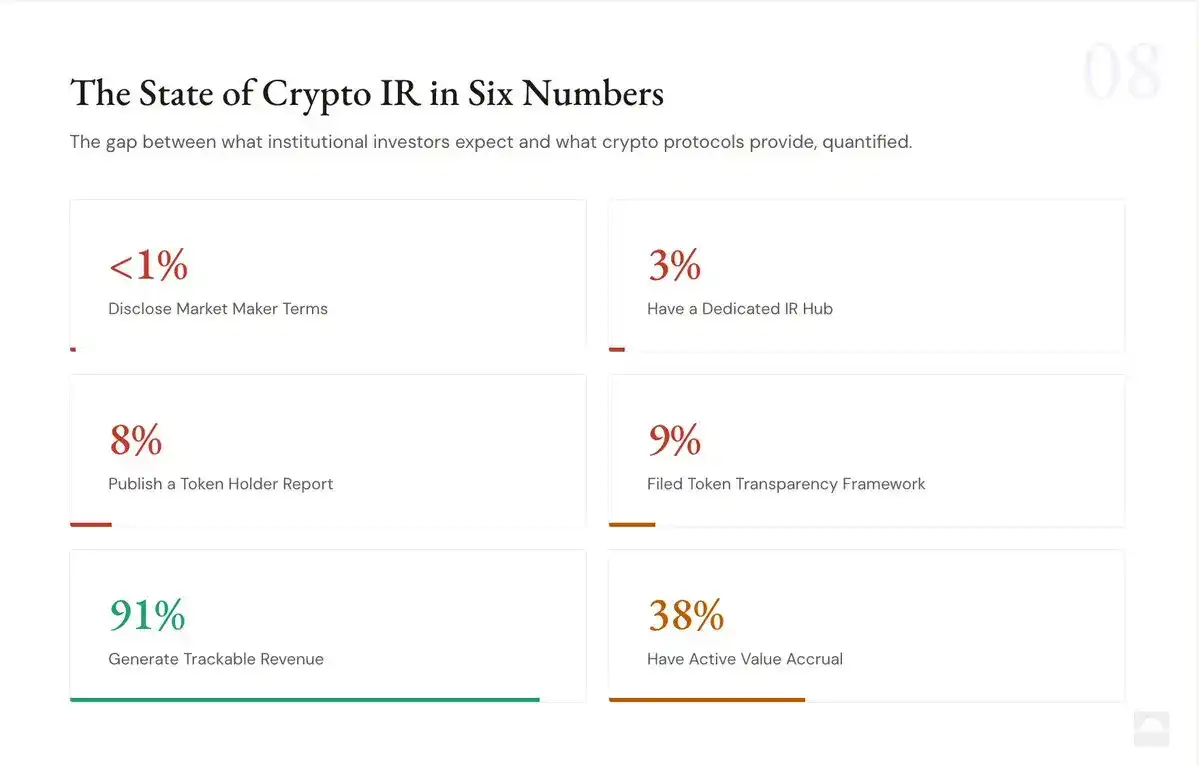
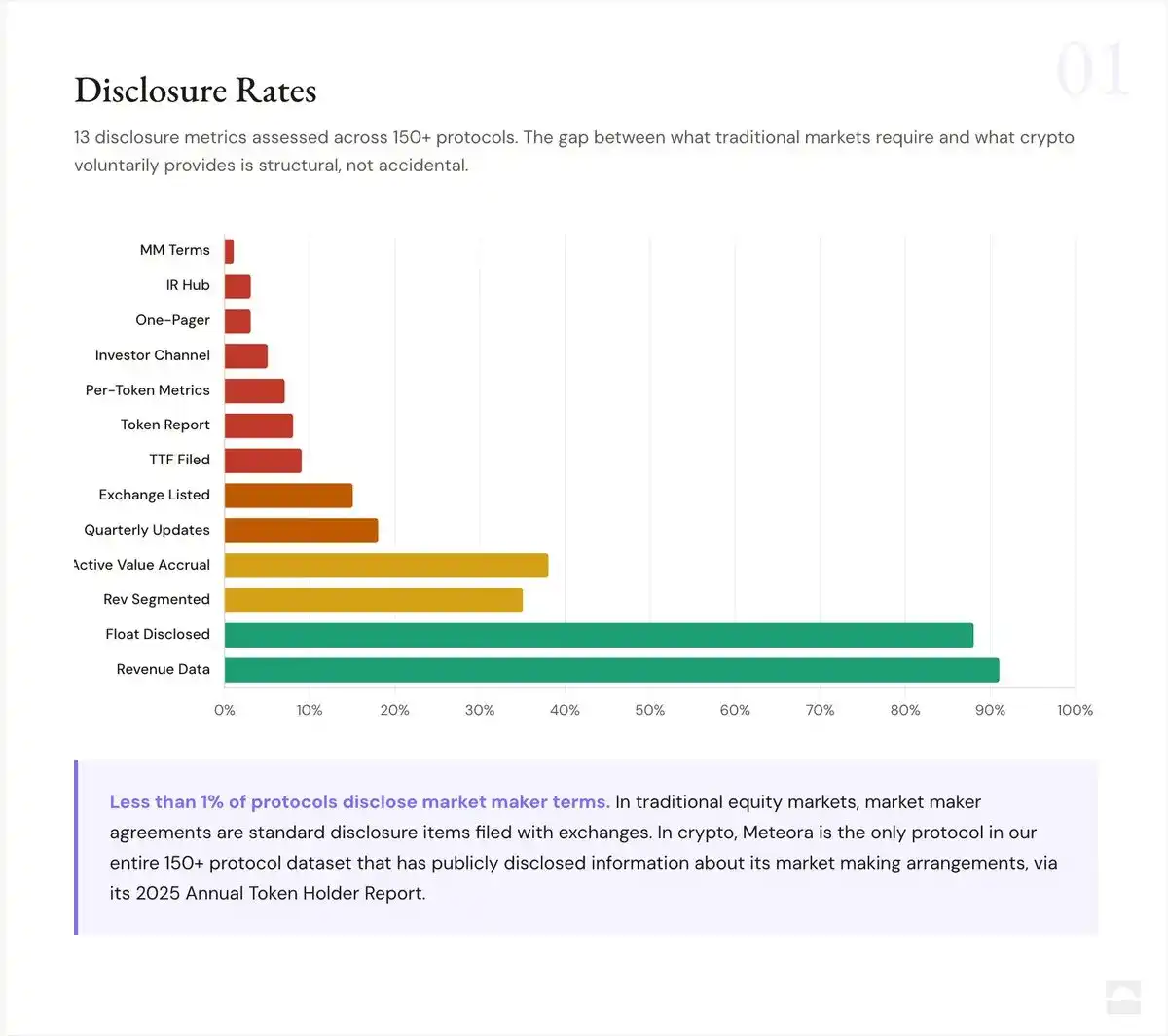
Less than 1% of market makers disclose their market maker terms.

50 protocols. Billions in daily trading volume combined. But only one protocol publicly disclosed information about its market making arrangements.

Market makers set the terms for token trading. These agreements often include token lending, option structures, and performance incentives that directly impact price discovery. In traditional markets, such material agreements are disclosed. But in crypto, every market participant is trading in the dark.

Meteora was the only protocol in the dataset that disclosed its market making arrangements through its 2025 Token Holder Annual Report. One out of over 150.

This is the most impactful transparency gap in the industry.
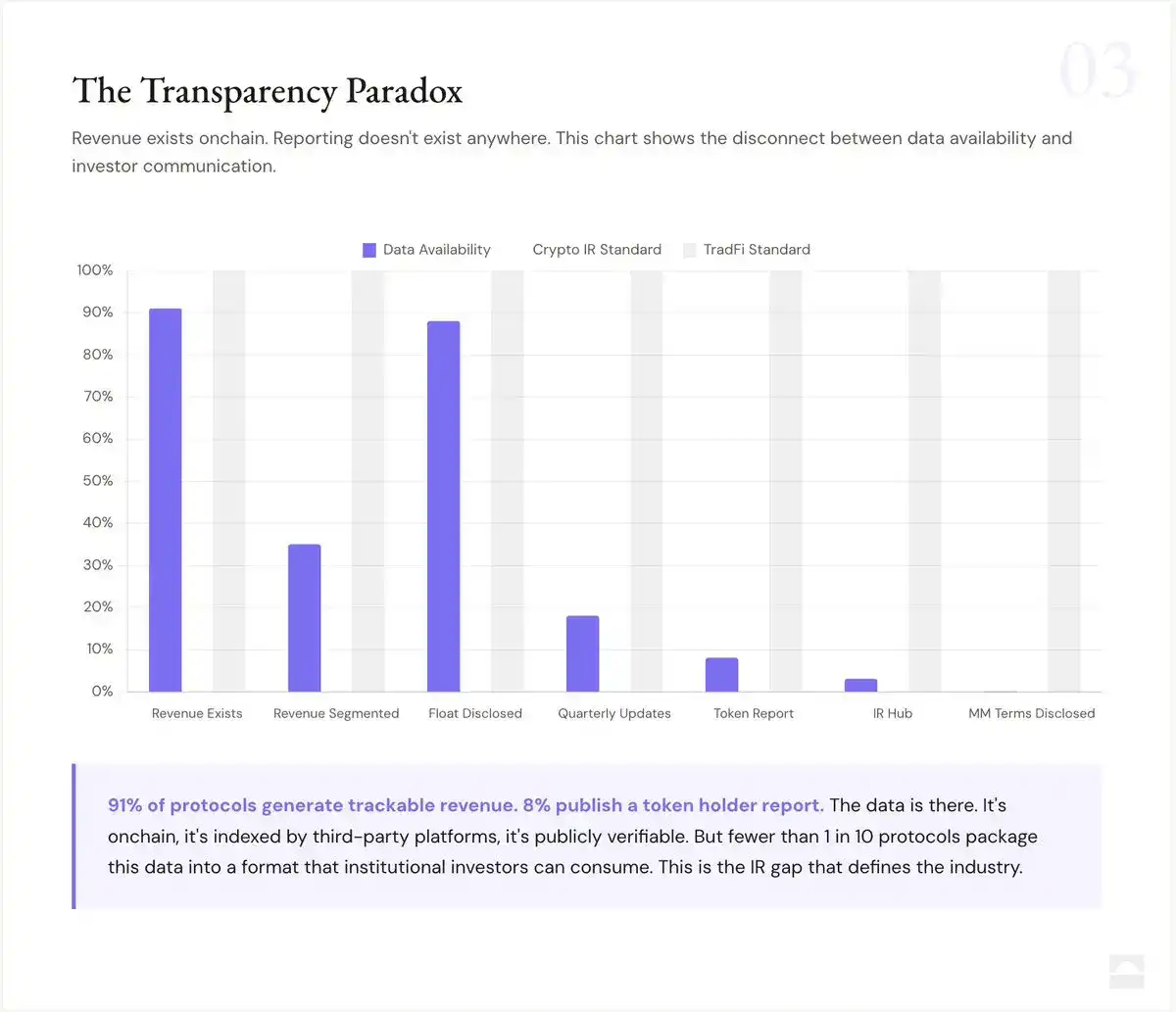
91% have revenue data. 3% have an Investor Relations hub.

Nearly every protocol in this audit publicly provides revenue data, either through third-party platforms or their own data dashboards. The raw data exists.

But only 3% have built a dedicated Investor Relations hub that consolidates this data into an investor-facing experience. The exceptions include Meteora, Jito, Jupiter, Raydium, MetaDAO. Every other protocol scatters information across blogs, governance forums, X threads, and third-party platforms. There is no centralized, institutional-grade investor experience. The gap isn't data availability, it's communication infrastructure.
9% submitted the Blockworks TTF

The Blockworks Token Transparency Framework was submitted to the U.S. SEC in June 2025, covering 18 disclosure standards across supply, distribution, financials, and market structure, backed by Pantera, L1D, and Theia. Out of the 150+ protocols reviewed, only 13 submitted the framework: Jito, Jupiter, Raydium, Morpho, Aerodrome, MetaDAO, Maple, dYdX, Euler, Marinade, EtherFi, Gains Network, and Meteora.

This is a material improvement from zero submissions. But the submission rate dropped from 25% in the initial 53 protocols to 9% at 150+. The original dataset was skewed towards early TTF-adopting DeFi protocols. With a broader sample, the picture is clearer: the vast majority of the market is not opting in. Zero L1s, zero L2s, zero infrastructure protocols submitted the framework. The framework exists. More protocols should use it.

38% have active value accrual, 62% return nothing

We used a broad definition of "active value accrual": Does the protocol have at least one live mechanism that directs economic value directly to token holders (excluding governance rights)? Across 150+ protocols, we identified six distinct models:

  • Direct fee sharing (JUP, DYDX, GMX)
  • Buyback and burn (HYPE, RAY, MET)
  • Staking revenue share (PENDLE, AAVE, ETHFI)
  • Conditional buybacks (LDO)
  • ve-model epoch distribution (AERO)
  • Governance-only, no economic rights (MORPHO, LINK, ARB)
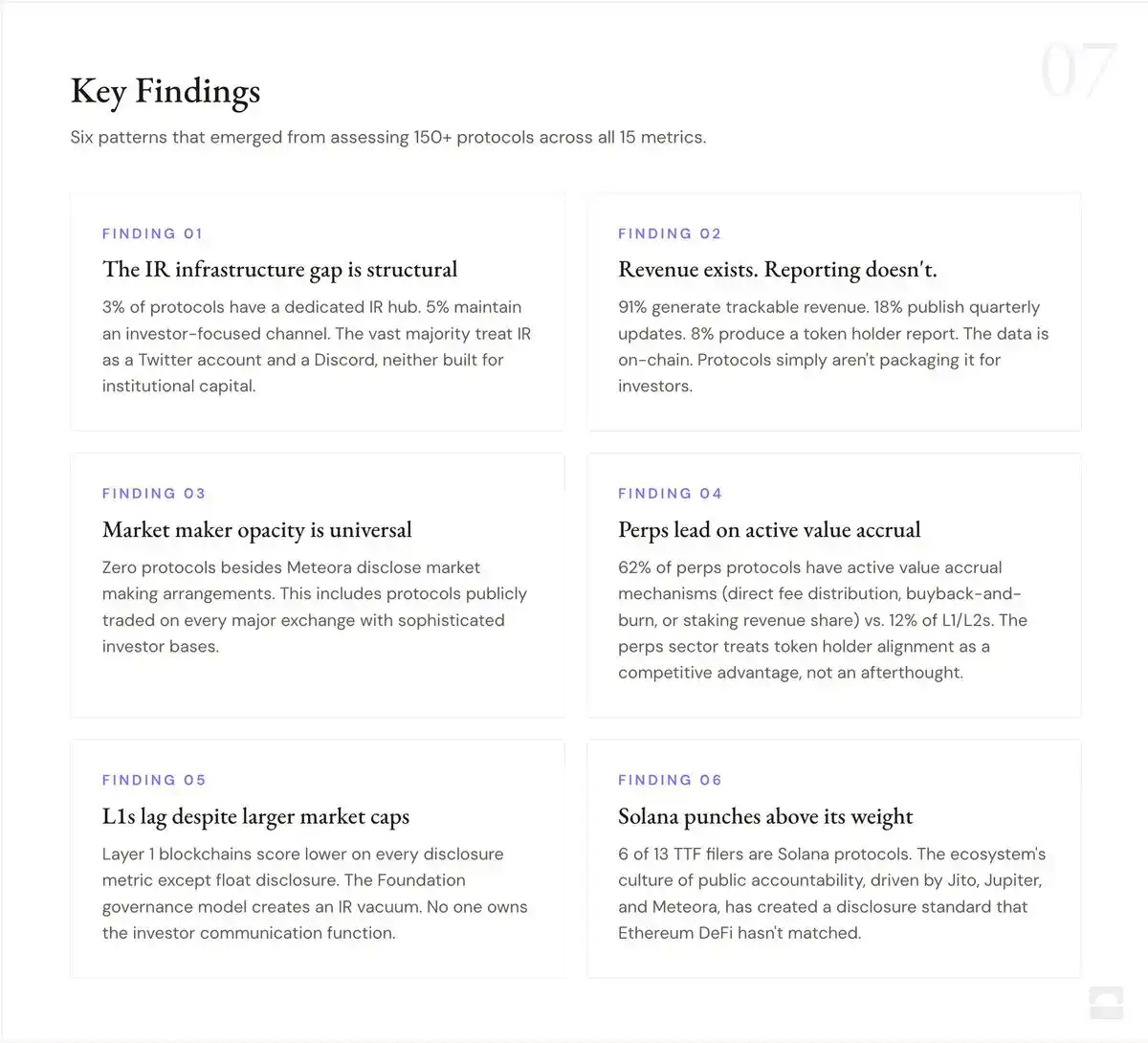
62% of protocols fall into the last category – governance-only tokens with no value accrual, including some of the largest market cap projects in the industry. Sector differences are stark: 62% of Perpetuals protocols have active value accrual, versus just 12% of L1/L2 tokens. Perpetuals treat token holder alignment as a competitive advantage. L1 foundations have not yet done the same. A deep dive into which models actually work is coming next week.

The data layer is built, the communication layer is not

We checked five major third-party platforms: Token Terminal, Dune Analytics, Artemis, DefiLlama, and Blockworks Research. The first four platforms each cover 85-95% of the dataset. 72% of protocols appear on 4 or more platforms. Every protocol in the audit appears on at least one platform. The raw data infrastructure for institutional analysis is largely built. What's missing is the interpretation, packaging, and communication layer that turns data into investable narratives.

The full disclosure breakdown for 150+ protocols is as follows:

<1% —— Disclose Market Maker Terms
3% —— Dedicated IR Hub
3% —— Provide a One-Pager
5% —— Dedicated Investor Channel
7% —— Publish Single-Token Metrics
8% —— Token Holder Reports
9% —— Submitted TTF
15% —— Disclose Exchange Listings
18% —— Quarterly Updates
35% —— Disaggregated Revenue Disclosure
38% —— Active Value Accrual
88% —— Disclose Circulating Supply
91% —— Revenue Data Available

What this means

The thesis from "Does Investor Relations Matter in Crypto?" holds. The data is even more sobering with the sample size expanded to 150+. Crypto protocols aren't hiding the fundamentals, they're failing to present them. The raw inputs for fundamental analysis exist on-chain and on third-party platforms, but the "translation layer and IR infrastructure that turns data into institutional confidence barely exists. Only 3% have an IR hub, <1% disclose market maker terms, and 91% of the market has not adopted the only available standardized disclosure framework.

The opportunity for protocols is clear: the cost of building IR infrastructure is negligible relative to capital markets upside. Protocols investing in this now will be the first to earn the trust of institutional allocators. The full interactive report with all 150+ protocols is live now:
http://novora.co/research/ir-transparency-2026.html

Next week, we will release the comparative report for this series: "Which Token Value Accrual Model Works?". That report will break down the six token value accrual mechanisms we identified, their empirical performance, and what this means for token classification and institutional adoption.


Пов'язані питання

QWhat percentage of the 150+ crypto protocols studied publicly disclose their market maker arrangements?

ALess than 1% (only one protocol, Meteora, disclosed this information).

QAccording to the report, what is the state of data availability versus communication infrastructure for investor relations in crypto?

AThe data layer is built (91% of protocols have revenue data available on third-party platforms), but the communication layer is not (only 3% have a dedicated IR hub to present this data effectively).

QHow many of the protocols analyzed had submitted the Blockworks Token Transparency Framework (TTF)?

A9% (13 out of the 150+ protocols).

QWhat percentage of the protocols were found to have 'active value capture' mechanisms for token holders?

A38% of the protocols had active value capture, while 62% offered only governance rights with no economic value returned to holders.

QWhat is identified as the most significant transparency gap in the crypto industry within the report?

AThe disclosure of market maker terms, as it is a critical agreement that directly impacts price discovery and is standard in traditional markets, yet is almost entirely undisclosed in crypto.

Пов'язані матеріали

Must-Watch Events Next Week|CLARITY Act Could Face Senate Vote; SpaceX, Circle to Report Earnings (8.3-8.9)

**Summary: Key Events and Developments to Watch (August 3-9)** The upcoming week is marked by significant financial disclosures, key legislative deadlines, and notable product updates. **Major Financial Events:** Several companies are scheduled to release their Q2 2026 earnings. American Bitcoin (ABTC) will report on August 3, followed by SpaceX and Hut 8 Mining Corp. on August 4, and Circle on August 5. Notably, a significant portion of SpaceX shares (up to 12% of total shares) will be unlocked on August 6 following their earnings release. **Key Legislative Deadline:** The U.S. Senate faces an August 7 deadline to secure 60 votes for the CLARITY Act, a bipartisan bill aiming to establish a federal regulatory framework for cryptocurrencies. The Senate may hold a full vote on the bill during the week. **Economic Data:** The U.S. July Non-Farm Payrolls report will be released on August 7, providing crucial labor market data. **Technology & Product Updates:** * **Shutdowns:** DeFi portfolio tracker Zapper and wallet app Ctrl Wallet will cease operations on August 3. * **Upgrades:** LayerZero will deprecate its v1 relayers on August 3. XRP Ledger's new version 3.3.0, featuring five new functions, is expected next week. * **AI:** Elon Musk announced that the advanced Grok 4.6 AI model is set for release around August 7. * **Bitcoin:** The BIP-110 forced signaling for a potential Bitcoin network change is scheduled to begin around August 8. **Other Notable Events:** Chinese robotics firm Unitree Tech has set its preliminary price inquiry for its IPO for August 5. South Korean exchange Upbit will delist AQT and AERGO tokens on August 3.

marsbit18 хв тому

Must-Watch Events Next Week|CLARITY Act Could Face Senate Vote; SpaceX, Circle to Report Earnings (8.3-8.9)

marsbit18 хв тому

Stocks Are Plummeting More Sharply Than Cryptocurrencies. Where Has the Money Gone?

Stock Markets Plunge Deeper Than Cryptocurrencies: Where Did the Money Go? In late July, Seoul's Kospi index triggered circuit breakers for two consecutive days, plummeting over 40% from its June high. The collapse was led by heavyweight stocks like SK Hynix, whose record profits still disappointed investors, and devastating leveraged ETFs, with one major product losing over 83% of its value. This signaled a global, forced deleveraging targeting the most crowded trades. Interestingly, while stocks exhibited extreme volatility akin to crypto markets, Bitcoin rose nearly 15% in July after a prior steep drop. Analysis shows the money fleeing equities did not flow into Bitcoin. Instead, Bitcoin had already absorbed its sell-off in May-June, when U.S. spot Bitcoin ETFs saw historic outflows. The true safe-haven beneficiary was gold, whose price rose over 20% year-on-year, highlighting a decoupling between Bitcoin and gold as "digital gold." The sell-off was a targeted unwinding of leveraged positions in tech and semiconductors, accelerated by broker-dealer risk management and shifts in the AI narrative, including new competition from Chinese memory chipmakers. The retreat path was clear: from high-valuation tech stocks to cash and U.S. Treasuries, then to gold. For Bitcoin to attract sustained institutional inflows, conditions like eased global liquidity pressure, a "soft-landing" Fed rate cut, and U.S. regulatory clarity via legislation like the stalled CLARITY Act are needed. Currently, Bitcoin is not a safe haven but an already-cleared asset. Its low correlation with tech stocks, however, makes it a potential diversification play for institutional portfolios once the storm passes. The money isn't here yet, but the positioning is underway.

marsbit18 хв тому

Stocks Are Plummeting More Sharply Than Cryptocurrencies. Where Has the Money Gone?

marsbit18 хв тому

In Conversation with Ray Dalio: We Are Currently in an AI Bubble, with 1% of My Portfolio in Bitcoin

Ray Dalio, founder of Bridgewater Associates, warns in an interview that the current AI boom shows classic bubble characteristics, which could lead to significant economic downturns as seen in past cycles like 1929 or 2000. He explains that speculative enthusiasm, fueled by debt and overvaluation, often precedes a crash when rising rates or taxation force asset sales, causing widespread losses and recession. Dalio also outlines his "Big Cycle" theory, describing an approximate 80-year pattern where widening wealth gaps, massive government deficits, and shifting geopolitical power (like China's rise) create internal conflict and global instability. He emphasizes that we are in a late-cycle, transitional phase where traditional powers like the US and UK face decline. For personal wealth protection, Dalio advises diversification beyond cash into assets like stocks, bonds, real estate, and particularly gold, which he prefers over Bitcoin. While he holds about 1% of his portfolio in Bitcoin as a non-printable hard asset, he views gold as more secure from technological or governmental threats. Regarding AI's impact, Dalio believes it will disproportionately benefit capital owners, worsening inequality by replacing both physical and cognitive labor. He suggests that human intuition and emotional intelligence, combined with AI, will be key for future workers. On taxation, Dalio argues that wealth taxes are impractical and risk triggering asset sell-offs, reducing productive investment. He points to the UK as a cautionary example of debt, low productivity, and political strife. Geopolitically, Dalio foresees a more regionalized world, with the US showing weakness in prolonged conflicts like with Iran, akin to past imperial declines. The ideal outcome, he suggests, is coexisting powerful blocs (e.g., Americas, China-Asia Pacific) without major war.

marsbit4 год тому

In Conversation with Ray Dalio: We Are Currently in an AI Bubble, with 1% of My Portfolio in Bitcoin

marsbit4 год тому

Daily 7.2 Trillion KRW: Foreign Capital's Record Net Buying on Friday! Wall Street Says Headwinds for Korean Stock Fund Flows Have Subsided

South Korean stock market sees a dramatic shift in fund flows. On July 31, foreign investors made a record net purchase of approximately KRW 7.2 trillion in KOSPI stocks, marking a fundamental reversal from the persistent large-scale net outflows seen in previous months. This contributed to a significant narrowing of foreign net selling in July to KRW 9.8 trillion, down sharply from KRW 48.4 trillion in June and KRW 44.5 trillion in May. Simultaneously, domestic institutional pressure eased. South Korean pension funds and asset managers turned to a net buying position in July, purchasing KRW 1.0 trillion worth of KOSPI shares, contrasting with net sales in May and June. Market volatility is expected to be dampened by new financial regulations. Effective July 31, the Financial Services Commission tightened access for retail investors to single-stock leveraged ETFs by raising the minimum cash deposit requirement. Trading volumes for these products subsequently dropped to about 50% of their monthly average. Citigroup Research maintains its year-end KOSPI target of 10,000 points. The firm cites several supportive factors: the substantial easing of headwinds from capital outflows, a robust fundamental outlook for the semiconductor sector, historically low market valuations, strong economic fundamentals, and the potential for policy support from financial authorities if needed.

marsbit4 год тому

Daily 7.2 Trillion KRW: Foreign Capital's Record Net Buying on Friday! Wall Street Says Headwinds for Korean Stock Fund Flows Have Subsided

marsbit4 год тому

Торгівля

Спот
活动图片




