2026 Crypto Financing Reshuffle: Gaming and DePIN Are Dead, Two Prediction Market Deals Gobble Up 18% of Yearly Funding

marsbitОпубліковано о 2026-05-09Востаннє оновлено о 2026-05-09

Анотація

Crypto Funding Shakeup in 2026: Gaming & DePIN Fade, Prediction Markets Dominate Analysis of crypto funding from January 1 to May 6, 2026, reveals a major sectoral shift. The industry raised $8.65 billion across 305 deals. However, a March surge to $4.57 billion was largely due to two mega-deals: BVNK's $1.8 billion acquisition and a $1 billion raise by Kalshi. Excluding these, monthly funding is a sluggish ~$1 billion. Capital concentration is extreme. The Payments ($3.74B) and Consumer ($2.48B) sectors absorbed 72% of all funds. Within Consumer, prediction markets were dominant: Kalshi's $1B and Polymarket's $600M raises together accounted for 18% of the year's total, surpassing all 47 DeFi deals combined ($1.06B). In contrast, Gaming and DePIN sectors saw funding nearly vanish. A strategic pivot is underway. Merger & Acquisition (M&A) activity reached 48 deals, nearly matching the 57 seed-stage rounds. This indicates capital is increasingly flowing toward acquiring established leaders rather than betting on new ideas. The most active investors so far in 2026 are Coinbase Ventures (18 deals), Tether (13 deals), Animoca Brands (11 deals), and GSR (11 deals). Notably, a16z's pace has slowed significantly compared to its 2021-2026 average.

Author: Memento Research

Compilation: TechFlow Deep Tides

Deep Tides Intro: Crypto financing data from the first four months of 2026 reveals a brutal reality: funding for the gaming and DePIN sectors has nearly dried up, while Kalshi and Polymarket, two prediction market companies, have taken more money than all DeFi projects combined for the entire year. More alarmingly, the number of M&A deals has caught up with seed rounds, indicating that capital is shifting from betting on new ideas to acquiring existing industry leaders.

Financing Overview: The March Surge Was Just an Illusion

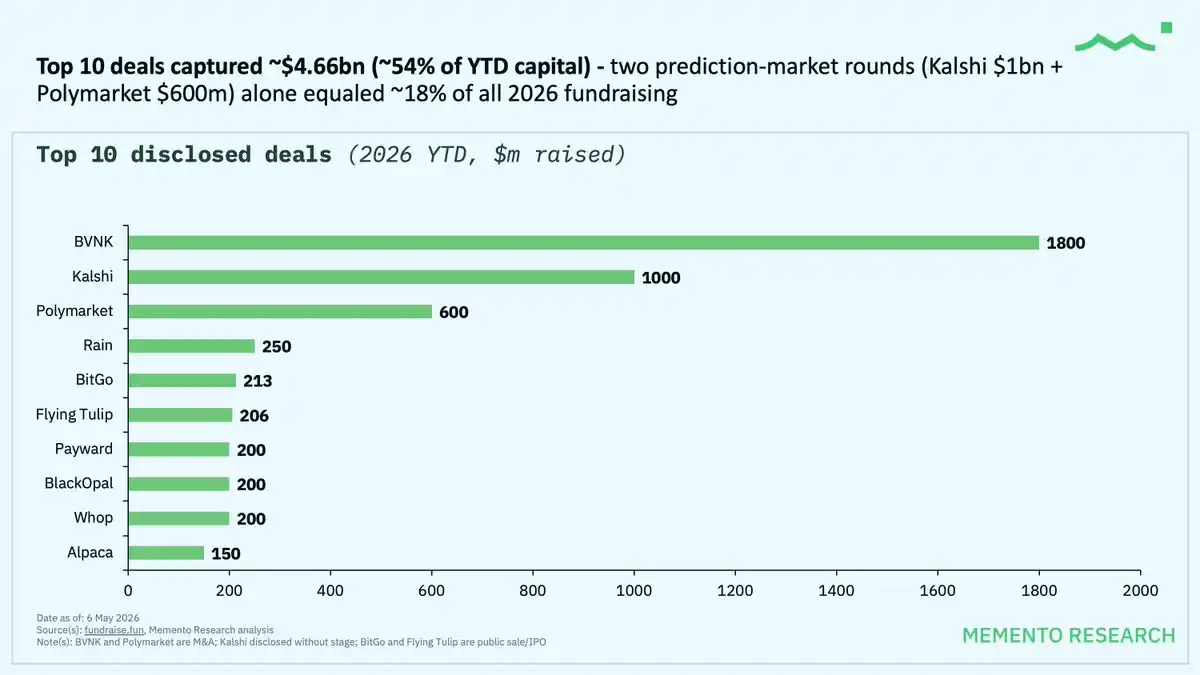
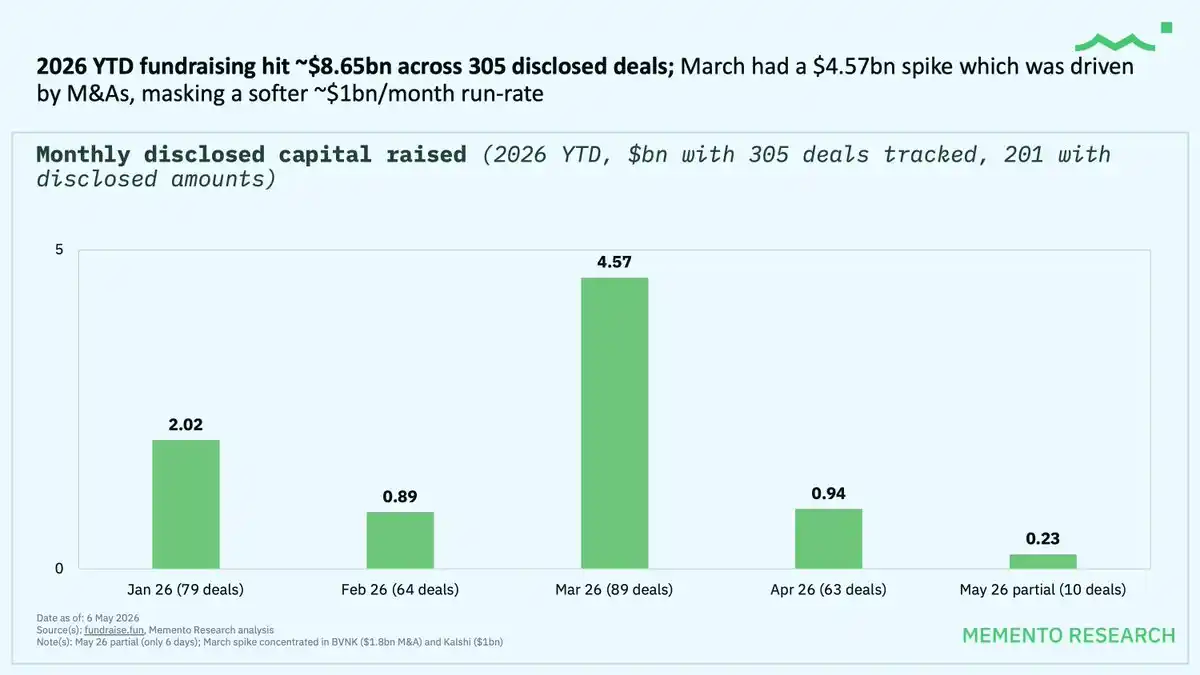
From January 1 to May 6, 2026, the crypto industry completed 305 financing rounds, totaling $8.65 billion. However, the "surge" of $4.57 billion in March was essentially just two mega M&A deals: BVNK's $1.8 billion and Kalshi's $1 billion.

Excluding these two, the real financing pace is about $1 billion per month, which is even weaker than at the end of 2025.

Fund Flow: Payments and Consumer Gobble Up 72%

By sector:

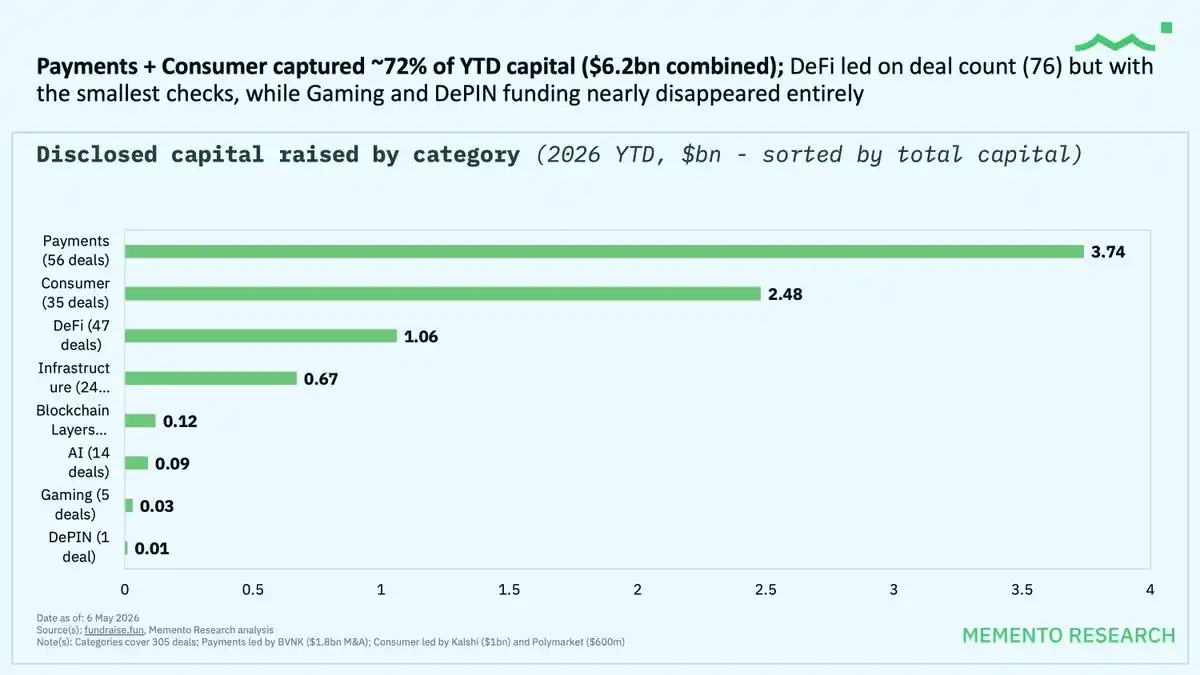
Payments: $3.74 billion (56 deals)

Consumer: $2.48 billion (35 deals)

DeFi: $1.06 billion (47 deals, the highest number of transactions)

The payments and consumer sectors together account for 72% of the year's funding. Financing for gaming and DePIN has almost vanished.

Prediction Markets Dominate the Consumer Sector

The two prediction market companies accounted for 18% of the year's total funding:

Kalshi: $1 billion

Polymarket: $600 million

These two deals total $1.6 billion, exceeding the combined total of all 47 DeFi financing rounds.

M&A Becomes Mainstream

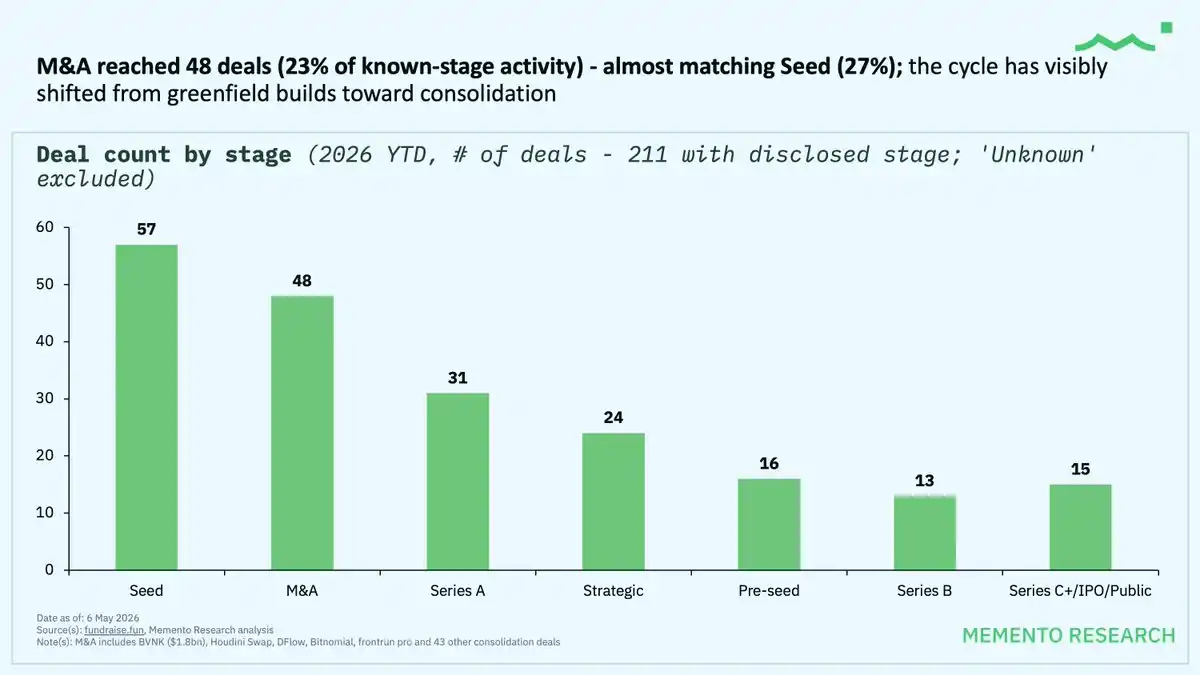
M&A deals reached 48 (23% of known-stage transactions), almost on par with 57 seed rounds (27%). This cycle has shifted from the early stage of investing in new ideas to acquiring industry leaders.
Investor Rankings Reshuffled

Most active funds in 2026:

Coinbase Ventures: 18 deals (Ranked 2nd during 2021-26)

Tether: 13 deals (New top lead investor)

Animoca Brands: 11 deals (Ranked 1st during 2021-26)

GSR: 11 deals

a16z: 7 deals (Significantly down from ~200 deals during 2021-26)

Пов'язані питання

QWhat were the two major M&A deals that dominated the funding figures for March 2026, and what were their values?

AThe two major M&A deals were BVNK, which raised $1.8 billion, and Kalshi, which raised $1 billion.

QWhich two sectors accounted for 72% of total funding in early 2026, and what were the respective funding amounts?

AThe Payments and Consumer sectors accounted for 72% of total funding. Payments raised $3.74 billion across 56 deals, while Consumer raised $2.48 billion across 35 deals.

QHow much funding did the prediction market companies Kalshi and Polymarket receive collectively, and what percentage of the year's total funds does this represent?

AKalshi and Polymarket collectively received $1.6 billion in funding, which represents 18% of the total funds raised in early 2026.

QWhat significant trend is highlighted by the number of M&A transactions (48) nearly matching the number of seed rounds (57) in early 2026?

AThe trend highlights a market shift where capital is moving away from funding new ideas (seed-stage investments) and towards acquiring existing market leaders (M&A).

QAccording to the article, which were the most active investment funds in early 2026 by number of deals?

AThe most active funds were Coinbase Ventures with 18 deals, Tether with 13 deals, and Animoca Brands and GSR with 11 deals each.

Пов'язані матеріали

SpaceX, OpenAI, Anthropic: The Three AI Giants Racing for IPO, Which One Is Worth Betting On?

SpaceX, OpenAI, and Anthropic are poised for historic IPOs within weeks, potentially raising a combined $180 billion—a sum exceeding the entire internet bubble's fundraising. The hosts of the Limitless Podcast argue this isn't just individual company financing but an unprecedented capital concentration for AI infrastructure, driven by an insatiable need for compute, data centers, power, and chips. SpaceX's IPO is notable for reportedly changing market index rules to allow faster inclusion, potentially funneling trillions in passive retirement funds into its stock, despite its unproven space-based data center business model. In contrast, Anthropic demonstrates explosive growth, with ARR reportedly hitting $45 billion and approaching profitability, fueled by strong enterprise adoption of products like Claude Code. Google's separate $80 billion raise highlights the immense capital pressure, even for giants. The discussion acknowledges bubble risks but leans optimistic. The hosts contend the massive spending is building essential physical infrastructure for the next technological era. A key bottleneck isn't capital but the real-world limits of chip manufacturing and construction speed. As long as demand for AI compute outstrips supply, this investment cycle represents a foundational build-out rather than a purely financial bubble. All three companies are seen as foundational bets on the future, with Anthropic often cited as the most immediately compelling due to its proven revenue trajectory.

marsbit2 год тому

SpaceX, OpenAI, Anthropic: The Three AI Giants Racing for IPO, Which One Is Worth Betting On?

marsbit2 год тому

From 'Old Guys' to 'New Favorites': How AI Is Revaluing Old Infrastructure from Dell to Nokia?

From "Vintage Tech" to "New AI Darlings": How AI Revalues Old Infrastructure One year ago, tech giants like Dell, Nokia, Cisco, and Western Data were seen as slow-growth, low-valuation stories, far from the AI spotlight dominated by players like Nvidia. Now, these legacy tech stocks are gaining market attention, sparking debate on whether this is genuine industry revaluation or a temporary narrative. As AI moves from model parameters to real-world data centers, the market is recognizing companies with proven delivery and infrastructure capabilities. This shift marks a change in the AI investment thesis: from pure model and GPU focus to the complex systems engineering required for deployment. Companies like Dell, HPE, and Corning are being revalued not for being "sexy" AI innovators, but for their decades of accumulated expertise in supply chains, enterprise delivery, and infrastructure—assets that have become critical in the AI buildout phase. The revaluation is unfolding across three key infrastructure lines: 1. **Servers & System Integration:** Dell and HPE are emerging as crucial system integrators or "general contractors" for AI data centers, translating GPU orders into complete, deployable server racks integrated with power, cooling, and networking. 2. **Networking & Connectivity:** AI's scale demands robust high-speed connections. Corning (fiber optics), Nokia (AI-RAN, 6G), and Cisco (data center switches) are gaining importance for enabling efficient data transfer within and between AI clusters. 3. **Storage:** Beyond high-speed memory (HBM/DRAM), the AI data explosion is driving demand for high-capacity hard drives (HDDs) from companies like Western Digital and Seagate to handle training data, logs, and cold storage cost-effectively. For this revaluation to be substantive and not just a narrative, three criteria are key: 1) Concrete AI-related order and revenue growth (e.g., Dell's AI server sales), 2) Upward revisions to company financial guidance, and 3) Sustainable improvements in profit quality, not just top-line revenue spikes. In essence, AI's transition to a real construction phase is re-pricing "old assets" against "new demand." The opportunity, however, is selective. Only those legacy firms that are demonstrably integrated into the capital expenditure chains of data center and enterprise AI deployment are likely to experience a true "logic re-rating" rather than just a temporary valuation bounce.

marsbit2 год тому

From 'Old Guys' to 'New Favorites': How AI Is Revaluing Old Infrastructure from Dell to Nokia?

marsbit2 год тому

Торгівля

Спот
Ф'ючерси
活动图片