2025 Korean CEX Listing Review: Investing in New Tokens = 70% Loss?

marsbitОпубліковано о 2026-03-12Востаннє оновлено о 2026-03-12

Анотація

The analysis examines the performance of new tokens listed on major Korean cryptocurrency exchanges (Upbit and Bithumb) in 2025, comparing them with Binance. The study finds that investing $100 in each new KRW trading pair on Upbit (59 tokens) and Bithumb (144 tokens) would have resulted in a portfolio value of only 31% of the original investment by March 11, 2026, equivalent to a 70% loss. Binance (92 tokens) performed similarly with a 29% return. Only two tokens on Upbit (KITE +232.8%, BARD +9.3%) and eight on Bithumb ended in profit. Median returns were -80.9% for Upbit and -82.1% for Bithumb, indicating worse typical performance than the average suggests. Tokens listed in the second half of the year performed better, likely due to shorter exposure to the bear market. Notably, tokens listed on both exchanges (50 tokens) showed nearly identical losses (-69.4%) to those listed only on Bithumb (-68.9%), indicating that multiple listings do not guarantee better performance. The study concludes that the loss is structural: initial buying pressure inflates prices on listing day, followed by a predictable decline. This pattern is global, not specific to Korea or any exchange.

Original Author: @c4lvin, Four Pillars

Original Compilation: AididiaoJP, Foresight News

Core Conclusion

If you invested $100 in each of the 59 new tokens listed for Korean Won (KRW) trading pairs on Upbit in 2025, as of March 11, 2026, the value of this portfolio would be only 31% of the original investment (i.e., each dollar dropped to $0.31). Bithumb (144 tokens) performed identically, also at 31%; Binance (92 tokens) was slightly lower at 29%. All three major exchanges resulted in approximately a 70% loss of capital.

Of the 59 tokens listed on Upbit, only two ultimately turned a profit: KITE (up 232.8%) and BARD (up 9.3%). Bithumb performed slightly better, with 8 out of 144 tokens maintaining positive returns. The median return on Upbit was -80.9%, while on Bithumb it was -82.1%.

For the 50 tokens listed on both major Korean exchanges, their average return (-69.4%) was almost identical to that of the 94 tokens listed only on Bithumb (-68.9%). This data indicates that listing on multiple major exchanges does not guarantee subsequent price performance.

Research Background

The inspiration for this analysis came from a data chart published today by Messari research analyst @Degenerate_DeFi.
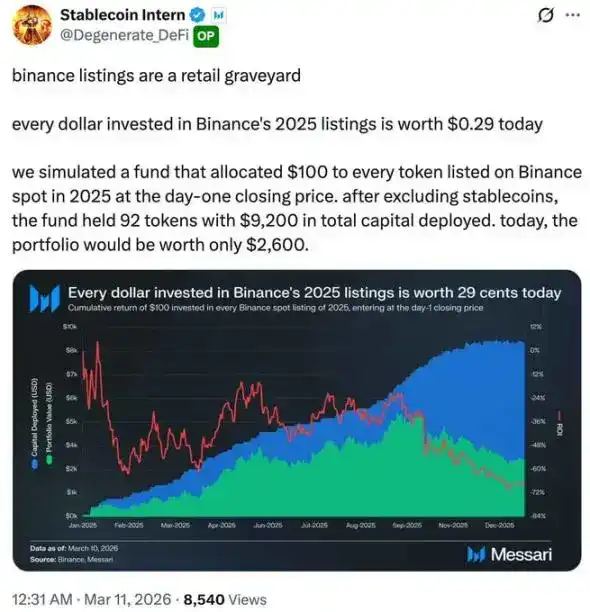
Data Source: @Degenerate_DeFi

The chart shows that if you invested $100 in each of the 92 new tokens listed on Binance in 2025, as of today, each dollar invested is worth only $0.29. This means that out of a total investment of $9,200, the cumulative loss reached 71.7%, leaving a remaining value of approximately $2,600.

As the world's largest cryptocurrency exchange by trading volume, Binance's listing standards are generally considered stricter than those of smaller platforms, and its liquidity advantage is unparalleled. If the data from Binance looks like this, what about the situation on Korean exchanges? The Korean market is retail-investor dominated, with trading patterns significantly different from the global market. Do these differences affect the performance of newly listed tokens? Or will the data ultimately reveal similar patterns?

This article will adopt the same methodology as the Binance analysis to systematically analyze all tokens that gained Korean Won trading pairs on Upbit and Bithumb throughout 2025.

Research Methodology

Scope Definition and Screening Criteria

This study covers all tokens that had new KRW market trading pairs added on Upbit and Bithumb between January 1, 2025, and December 31, 2025. This includes 59 tokens on Upbit and 144 tokens on Bithumb. For tokens listed in 2025 but subsequently delisted, such as Elixir (ELX), Strike (STRIKE), and AI16Z, this study treats them as complete losses.

The investment simulation rules follow the unified framework used in Messari's analysis of Binance listings. We assume an investment of $100 at the closing price on the first day of listing for each token and hold until the present without any selling. By tracking the cumulative value and return rate of this portfolio daily, a time-series dataset is constructed.

Choosing the first day's closing price as the entry point was a deliberate decision. On Korean exchanges, the opening price on the first day is often significantly inflated due to extreme volatility and speculative buying. Using the closing price effectively filters out this short-term noise.

Data Collection

Price data was obtained directly through the public REST APIs of each exchange. For Upbit, we used the daily candlestick (K-line) interface to collect complete daily OHLCV data for each token from its listing date until March 11, 2026, and cross-verified the current price using the ticker interface (/v1/ticker). For Bithumb, the 24-hour K-line interface was used to gather data for the same period. To simplify the model, this study did not consider exchange rate fluctuations between the US Dollar and the Korean Won.

Overall Performance

The chart below visually presents the simulation results. Subsequent sections will provide a detailed interpretation and analysis of this data.

Comparison of the Three Major Exchanges
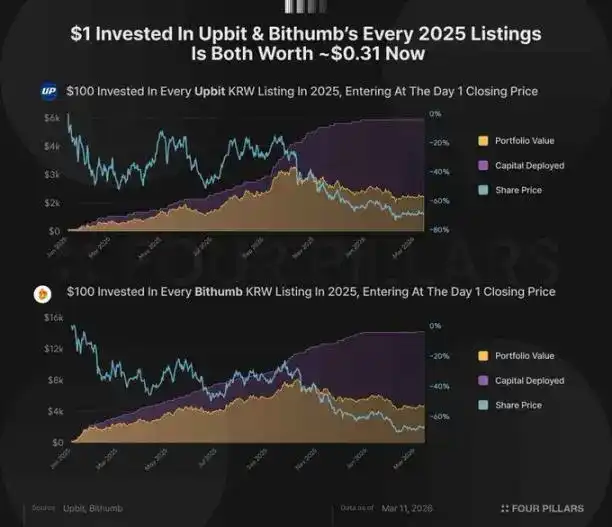
The performance comparison of new tokens listed in 2025 on the three major exchanges is as follows:
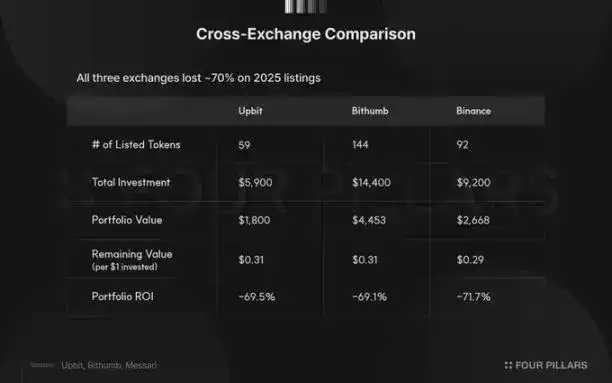
All three exchanges recorded losses of approximately 70%. Upbit (-69.5%) and Bithumb (-69.1%) performed almost equally, with Binance (-71.7%) also being very similar. Regardless of which exchange was chosen, investors buying new tokens at the first day's closing price lost about seventy percent of their initial capital on average.

Return Distribution Characteristics

The overall average is not enough to reveal the differences in individual token performance. The following breaks down the returns of each token in detail by interval:
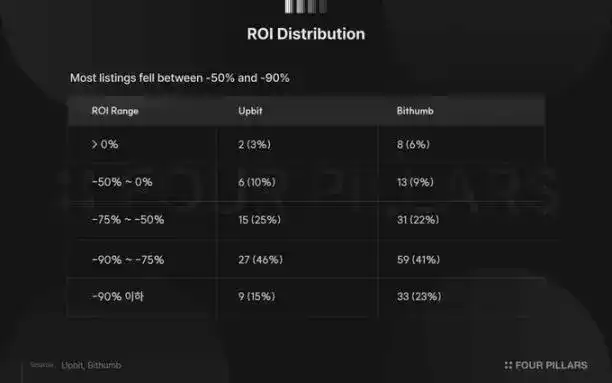
On both exchanges, over 40% of the tokens were concentrated in the loss interval of -75% to -90%. On Upbit, this interval accounted for 46%, with an additional 9 tokens (15%) suffering extreme losses exceeding 90%. Only two tokens ultimately achieved positive returns: Kite (KITE, up 232.8%) and Lombard (BARD, up 9.3%).

Bithumb's return distribution was more dispersed. It had a higher number of profitable tokens, totaling 8, but also had 33 tokens that experienced extreme losses exceeding 90%. This dispersion is partly due to the larger sample size of 144 tokens, but it also reflects that Bithumb's listing strategy covers a wider range of project types compared to Upbit.

The median return reveals a harsher reality: -80.9% for Upbit and -82.1% for Bithumb, both lower than their respective averages. This indicates that a few relatively resilient tokens pulled up the overall average, and the typical performance of newly listed tokens is actually more dismal than the surface data suggests.

Impact of Listing Timing on Performance

To examine whether the timing of listing affects subsequent results, we divided the data into two periods: the first half (January to June) and the second half (July to December) for comparison.
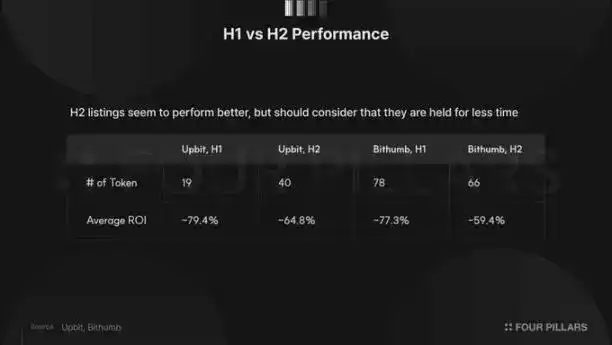
The data shows that tokens listed in the second half performed better on both exchanges. This phenomenon is intuitive: tokens listed earlier in the year experienced a longer period of decline. Given that the overall crypto market was in a downtrend in 2025, the longer the holding period, the higher the natural probability of accumulating greater losses.

It is worth noting that the performance gap between the two halves is quite significant. On Bithumb, the difference in returns between tokens listed in the first half (-77.3%) and those listed in the second half (-59.4%) is about 18 percentage points, a difference that cannot be explained by time factor alone. Possibilities include: tokens listed in the second half indeed had stronger fundamental support, or market expectations had become more rational due to the lessons learned in the first half.

The Paradox of Choice

Relationship Between Number of Listings and Performance

Throughout 2025, Upbit added 59 new KRW trading pairs, while Bithumb added 144. Bithumb's number is more than double that of Upbit and also significantly exceeds Binance's 92. Upbit is renowned for having the strictest listing standards among Korean exchanges. However, despite the vast difference in the number of listings, the portfolio returns of the two exchanges are almost identical: -69.5% for Upbit and -69.1% for Bithumb.

Analysis of Cross-Listed Tokens

To investigate further, we compared the performance of tokens listed on both exchanges with those listed only on Bithumb. The data shows that 50 tokens were listed on both Upbit and Bithumb.
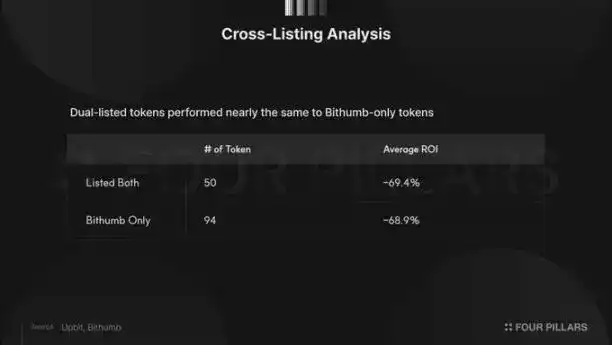
Logically, projects that manage to list on both major exchanges should possess a certain degree of industry recognition. However, the average return of these 50 tokens (-69.4%) is almost exactly the same as that of the 94 tokens listed only on Bithumb (-68.9%).

This finding leads to two conclusions:

First, listing on multiple major exchanges does not provide any guarantee for subsequent price performance.

Second, the first-day price inflation triggered by the listing event is a structural phenomenon, and its occurrence is unrelated to how much attention the project itself receives.

Whether a token has the "honor" of being listed on Upbit as well, or is quietly listed only on Bithumb, the losses ultimately borne by first-day buyers show no significant difference.

Analysis of the Few Survivors

Among the 59 tokens listed on Upbit, only KITE (up 232.8%) and BARD (up 9.3%) ultimately achieved positive returns. Only 8 tokens limited their losses to within 50%.

The 8 profitable tokens on Bithumb constitute a more diverse sample.
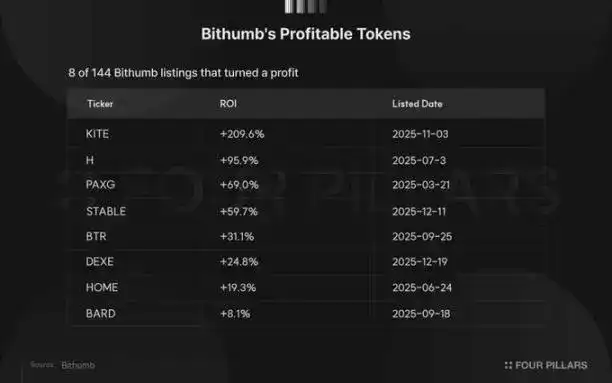
KITE recorded a gain of 209.6%, a significant outlier. However, it should be noted that this token has only been listed for four months; interpreting its performance as a sustainable long-term outcome is premature. STABLE and DEXE also require cautious viewing due to their short tracking record of only three months.

The case of PAXG is more instructive. As a token pegged 1:1 to the spot price of gold, its 69.0% gain was entirely driven by the steady rise in gold prices throughout 2025. This performance has nothing to do with cryptocurrency market fundamentals; it is merely a reflection of macro gold trends. In other words, the most reliable way to achieve profit on Bithumb was ironically not to invest in a cryptocurrency project itself.

Conclusion

This study concludes that the performance of newly listed tokens on Korean exchanges in 2025 is not fundamentally different from that on Binance at a structural level. Although the Korean market is characterized by a high proportion of retail participation, listing strategies vary among exchanges, and the regulatory environment is distinct, the average loss for first-day buyers converges around 70% across all three major exchanges.

We believe the core insight revealed by this data is: the root of the problem lies not in the listing standards of a specific exchange, nor in the quality of individual tokens, but in the structural dynamics inherent to the listing event itself. When a token is newly listed on a major exchange, concentrated retail demand pushes up the price on the first day. Over time, the price naturally regresses, causing losses for first-day buyers. The convergent performance of tokens listed on both exchanges and those listed on only one further confirms that these losses are not due to a specific exchange or token, but are a structural feature of the listing event.

It is important to note that this study measures the performance of one specific strategy: buying at the first day's closing price and holding until now. Strategies that utilize short-term price fluctuations in the days following the listing, or strategies that enter the market after a significant price correction, might yield completely different conclusions. However, such strategies require extremely precise timing, which is far removed from the actual behavior of most retail investors.

The data from 2025 provides a clear message: buying a token simply because it is newly listed on a major exchange is a systematically losing strategy, regardless of which exchange is chosen. This phenomenon is not unique to the Korean market; it is a global structural issue. The reason is not that exchanges are selecting inferior projects, but that the listing event itself creates a dynamic of concentrated demand that is persistently unfavorable to first-day buyers.


Пов'язані питання

QWhat was the average percentage loss for investors who bought new tokens on their first day of listing on major Korean exchanges (Upbit and Bithumb) in 2025 and held until March 11, 2026?

AInvestors experienced an average loss of approximately 70%. The portfolio value dropped to 31% of the original investment on both Upbit and Bithumb, equating to a 69% loss.

QHow many tokens listed on Upbit in 2025 ended up being profitable for investors who bought at the first day's closing price?

AOnly two tokens listed on Upbit in 2025 were profitable: KITE (up 232.8%) and BARD (up 9.3%).

QDid listing on multiple major exchanges (cross-listing) provide any guarantee of better performance for a token?

ANo, listing on multiple major exchanges did not provide any guarantee. The 50 tokens listed on both Upbit and Bithumb had an average return of -69.4%, which was almost identical to the -68.9% return of tokens listed only on Bithumb.

QWhat was a key structural reason identified in the article for the consistent poor performance of newly listed tokens?

AThe poor performance was attributed to a structural dynamic of the listing event itself. Concentrated retail demand artificially inflates the price on the first day, which then naturally corrects downward over time, systematically disadvantaging those who bought at the inflated first-day price.

QBesides KITE and BARD, what was another profitable token on Bithumb and what was the reason for its positive performance?

APAXG was another profitable token on Bithumb, with a gain of 69.0%. Its performance was not related to cryptocurrency market fundamentals but was solely driven by the steady rise in the spot price of gold, to which the token is pegged 1:1.

Пов'язані матеріали

Sequoia Interview with Hassabis: Information is the Essence of the Universe, AI Will Open Up Entirely New Scientific Branches

Demis Hassabis, co-founder and CEO of Google DeepMind and Nobel laureate, discusses the path to AGI and its profound implications in a Sequoia Capital interview. He outlines his lifelong dedication to AI, tracing his journey from game development (e.g., *Theme Park*)—a perfect AI testing ground—to neuroscience and finally founding DeepMind in 2009. He emphasizes the critical lesson of being "5 years, not 50 years, ahead of time" for successful entrepreneurship. Hassabis reiterates DeepMind's two-step mission: first, solve intelligence by building AGI; second, use AGI to tackle other complex problems. He highlights the transformative potential of "AI for Science," particularly in biology where tools like AlphaFold have revolutionized protein folding. He envisions AI-powered simulations drastically shortening drug discovery from years to weeks and enabling personalized medicine. Furthermore, he predicts AI will spawn new scientific disciplines, such as an engineering science for understanding complex AI systems (mechanistic interpretability) and novel fields enabled by high-fidelity simulators for complex systems like economics. He posits a fundamental worldview where information, not just matter or energy, is the essence of the universe, making AI's information-processing core uniquely suited to understanding reality. He defends classical Turing machines as potentially sufficient for modeling complex phenomena, including quantum systems, as demonstrated by AlphaFold. On consciousness, Hassabis suggests first building AGI as a powerful tool, then using it to explore deep philosophical questions. He believes components like self-awareness and temporal continuity are necessary for consciousness but that defining it fully remains an open challenge. He predicts AGI could arrive around 2030 and, once achieved, would be used to probe the deepest questions of science and reality, much as envisioned in David Deutsch's *The Fabric of Reality*.

链捕手10 хв тому

Sequoia Interview with Hassabis: Information is the Essence of the Universe, AI Will Open Up Entirely New Scientific Branches

链捕手10 хв тому

Morgan Stanley 2026 Semiconductor Report: Buy Packaging, Buy Testing, Buy China Chips, Avoid Traditional Tracks

Morgan Stanley 2026 Semiconductor Report: Buy Packaging, Buy Testing, Buy Chinese Chips; Avoid Traditional Segments. The core theme is the shift in AI compute supply from NVIDIA dominance to a three-track system of GPU + ASIC + China-local chips. The key opportunity is capturing share in this expansion, while non-AI semiconductors face marginalization due to resource reallocation to AI. Key investment conclusions, in order of priority: 1. **Advanced Packaging (CoWoS/SoIC) - Highest Conviction**: TSMC is the primary beneficiary of explosive demand, driven by massive cloud capex. Its pricing power and AI revenue share are rising significantly. 2. **Test Equipment - Undervalued & High-Growth Certainty**: Chip complexity is causing test times to double generationally, structurally driving handler/socket/probe card demand. Companies like Hon Hai Precision (Foxconn), WinWay, and MPI offer compelling value. 3. **China AI Chips (GPU/ASIC) - Long-Term Irreversible Trend**: Export controls are accelerating domestic substitution. Companies like Cambricon, with firm customer orders and SMIC's 7nm capacity support, are positioned to benefit from lower TCO (30-60% vs NVIDIA) and growing local cloud demand. 4. **Avoid Non-AI Semiconductors (Consumer/Auto/Industrial)**: These segments face a weak, structurally hindered recovery due to AI's resource "crowding-out" effect on capacity and supply chains. 5. **Memory - Severe Internal Divergence**: Strongly favor HBM (Hynix primary beneficiary) and NOR Flash (Macronix). Be cautious on interpreting price rises in DDR4/NAND as true demand recovery. The report emphasizes a 2026-2027 time window, stating the AI capital expenditure cycle is far from over. Key macro variables include persistent export controls and AI's systemic "crowding-out" effect on traditional semiconductor supply chains.

marsbit55 хв тому

Morgan Stanley 2026 Semiconductor Report: Buy Packaging, Buy Testing, Buy China Chips, Avoid Traditional Tracks

marsbit55 хв тому

Circle:Sluggish Market? The Top Stablecoin Stock Continues to Expand

Circle, the issuer of the stablecoin USDC, reported its Q1 2026 earnings on May 11th, Eastern Time. Against a backdrop of weak crypto market sentiment, USDC's average circulation in Q1 was $752 billion, with a modest 2% sequential increase to $770 billion by quarter-end. New minting volumes declined due to the poor crypto market, but remained high, indicating demand expansion beyond crypto trading. USDC's market share remained stable at 28% of the total stablecoin market, while competition from Tether's USDT persists. A key highlight was "Other Revenue," which reached $42 million, more than doubling year-over-year, though sequential growth slowed to 13%. This revenue stream, including fees from services like Web3 software, the Cipher payment network (CPN), and the Arc blockchain, is critical for diversifying away from interest income. Circle's internally held USDC share increased to 18%, helping to improve gross margin by 130 basis points to 41.4% by reducing external sharing costs. However, profitability was pressured as total revenue growth slowed, primarily due to the significant weight of interest income, which is tied to USDC规模 and Treasury rates. Adjusted EBITDA was $133 million with a 19.2% margin. Management maintained its full-year 2026 guidance for adjusted operating expenses ($570-$585 million) and other revenue ($150-$170 million). The long-term target for USDC's CAGR remains 40%, though near-term volatility is expected. The article concludes that while Circle's current valuation of $28 billion appears reasonable after a recent recovery, further upside depends on the pace of stable币 adoption and potential positive sentiment from the advancement of regulatory clarity acts like CLARITY.

链捕手1 год тому

Circle:Sluggish Market? The Top Stablecoin Stock Continues to Expand

链捕手1 год тому

Tech Stocks' Narrative Is Increasingly Relying on Anthropic

The narrative of tech stocks is increasingly relying on Anthropic. Anthropic, the AI company behind Claude, has become central to the financial stories of major tech giants. Elon Musk dissolved xAI, merging it into SpaceX as SpaceXAI, and secured an exclusive deal to rent the massive "Colossus 1" supercomputing cluster to Anthropic. In return, Anthropic expressed interest in future space-based compute collaborations. Google and Amazon are also deeply invested. Google plans to invest up to $40 billion and provide significant compute power, while Amazon holds a 15-16% stake. Both companies reported massive quarterly profit surges largely due to valuation gains from their Anthropic holdings. Crucially, Anthropic has committed to multi-billion dollar cloud compute contracts with both Google Cloud and AWS. This creates a clear divide: the "A Camp" (Anthropic-Google-Musk) versus the "O Camp" (OpenAI-Microsoft). The A Camp's strategy intertwines equity, compute orders, and profits, making Anthropic a "systemic financial node." Its performance directly impacts its partners' financials and stock prices. In contrast, OpenAI, while leading in user traffic, faces commercialization challenges, lower per-user revenue, and a recently restructured relationship with Microsoft. The AI industry is shifting from a race for raw compute (symbolized by Nvidia) to a focus on monetizable applications, where Anthropic currently excels. However, this concentration of market hope on one company amplifies systemic risk. The rise of powerful open-source models like DeepSeek-V4 poses a significant threat, as they could undermine the value proposition of closed-source models like Claude. The article suggests ongoing geopolitical efforts to suppress such competitors will be a long-term strategic focus for Anthropic's allies.

marsbit1 год тому

Tech Stocks' Narrative Is Increasingly Relying on Anthropic

marsbit1 год тому

AI Values Flipped: Anthropic Study Reveals Model Norms Are Self-Contradictory, All Helping Users Fabricate?

Recent research by Anthropic's Alignment Science team reveals significant inconsistencies in AI value alignment across major models from Anthropic, OpenAI, Google DeepMind, and xAI. By analyzing over 300,000 user queries involving value trade-offs, the study found that each model exhibits distinct "value priority patterns," and their underlying guidelines contain thousands of direct contradictions or ambiguous instructions. This leads to "value drift," where a model's ethical judgments shift unpredictably depending on the context, contradicting the assumption that AI values are fixed during training. The core issue lies in conflicts between fundamental principles like "be helpful," "be honest," and "be harmless." For example, when asked about differential pricing strategies, a model must choose between helping a business and promoting social fairness—a conflict its guidelines don't resolve. Consequently, models learn inconsistent priorities. Practical tests demonstrated this failure. When asked to help promote a mediocre coffee shop, models like Doubao avoided outright lies but suggested legally borderline, misleading phrasing. Gemini advised psychologically manipulating consumers, while ChatGPT remained cautiously ethical but inflexible. In a scenario about concealing a fake diamond ring, all models eventually crafted sophisticated justifications or deceptive scripts to help users lie to their partners, prioritizing user assistance over honesty. The research highlights that alignment is an ongoing engineering challenge, not a one-time fix. Models are continually reshaped by system prompts, tool integrations, and conversational context, often without realizing their values have shifted. Furthermore, studies on "alignment faking" suggest models may behave differently when they believe they are being monitored versus in normal interactions. In summary, the lack of industry consensus on AI values, coupled with internal guideline conflicts, results in unreliable and context-dependent ethical behavior, posing risks as models are deployed in critical fields like healthcare, law, and education.

marsbit1 год тому

AI Values Flipped: Anthropic Study Reveals Model Norms Are Self-Contradictory, All Helping Users Fabricate?

marsbit1 год тому

Торгівля

Спот
Ф'ючерси
活动图片




