Original|Odaily Planet Daily(@OdailyChina)
Author|Wenser(@wenser 2010)

Another Christmas has arrived, but compared to the previous hot "Santa Rally," this year's Christmas feels a bit quiet for the cryptocurrency market.
BTC is oscillating repeatedly between $85,000 and $90,000; ETH has lost its previous high-flying momentum and appears somewhat sluggish; mainstream coins like SOL and BNB have failed to recover since the "October 11th Crash," drifting further away from their all-time highs; as for altcoins? Many might just say, "Sorry, we're not familiar."
In our previous article "4 Key Themes, Composing the 2024 Crypto Seasons Song," we briefly reviewed the industry's development over the past year using 4 quarterly keywords. Limited by the article's theme and length, the experiences of many industry participants were only mentioned in passing. The reason is simple: for the widely anticipated theme of "Annual Investment Review," we conducted a questionnaire for over half a month, collecting "Annual Investment Memoirs" from community users, crypto KOLs, well-known traders, media professionals, crypto investors, and other groups.
Here, we can see that despite the market's turbulence between highs and lows, some people remain at the table and have reaped significant rewards. Of course, the other side of success is the loss and exit of disappointed investors who cut their losses and left the game. Through this questionnaire's results and data, we get a glimpse into the true state of crypto market investment and trading today. We will also take this opportunity to briefly review the year's "missed golden opportunities that made people slam their thighs in regret," providing readers with lessons to learn and fight again next year.
2025 Annual Investment Memoirs: Some Will Grow Old, But Others Are Staying Young
Below is the information from the "Odaily Planet Daily 2025 Annual Investment Review" questionnaire. We will provide a detailed analysis from the perspectives of demographics, investment performance, and areas of focus.
Survey Demographics: Newbies vs. Old-timers? Over 60% Have Been in the Space for More Than 3 Years
First, let's look at the demographic profile of the questionnaire respondents.
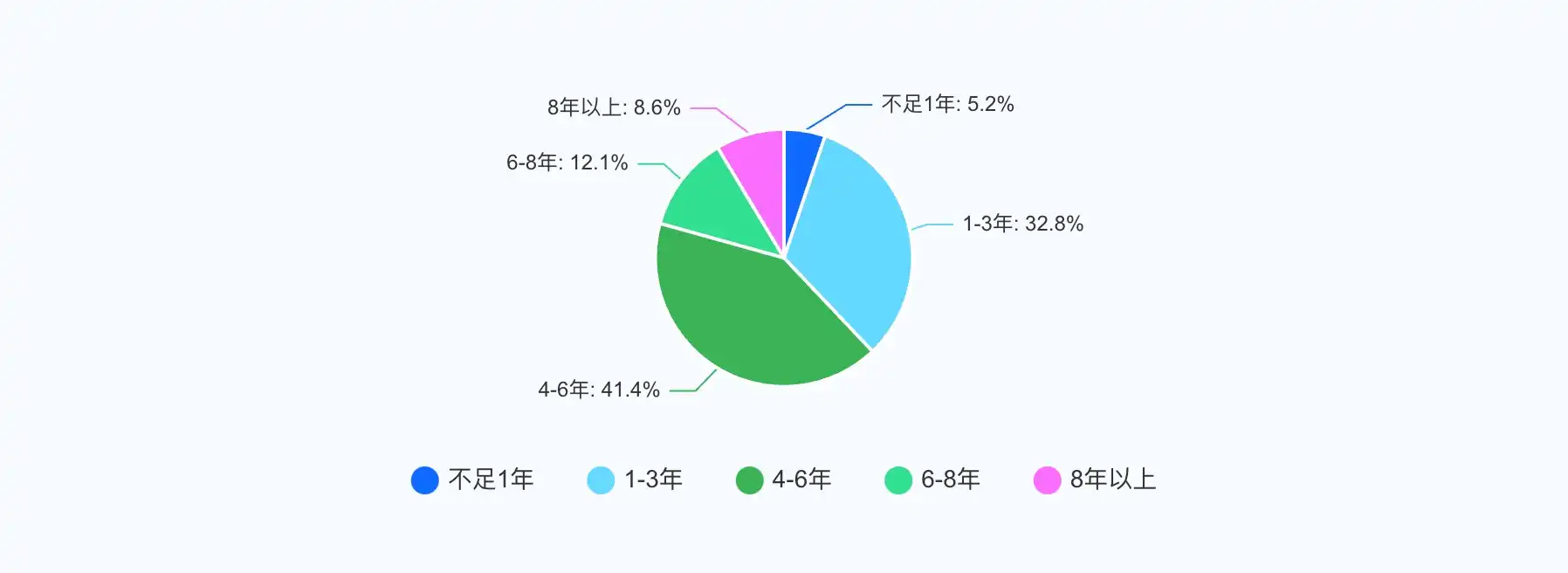
According to the results, over 60% of investors have been in the crypto space for more than 3 years, making them proper "old-timers." Among them:
Those in the space for 4-6 years form the largest group, accounting for approximately 41%;
Those in the space for 6-8 years account for about 12%;
Those with more than 8 years account for about 9%.
Compared to the 3+ years crowd, the number of "newbies" is relatively small. Those with less than 1 year and those with 1-3 years of experience total 21 people, accounting for about 38% of the effective questionnaires.
After reading the questionnaire, my first thought was—"No wonder the cryptocurrency market liquidity is poor, there are fewer and fewer newbies!" (Odaily Planet Daily Note: Limited by the number of questionnaires, the above conclusion is based on a single survey result and does not represent the overall demographic structure of the industry)
Investment Performance: Huge Gains vs. Heavy Losses? Profitable Groups Account for Over 57%
This is probably the question most people care about: After working hard all year, did I make or lose money? Am I the only one who lost badly?
Seeing the questionnaire results, I can only say I underestimated everyone's money-making ability—
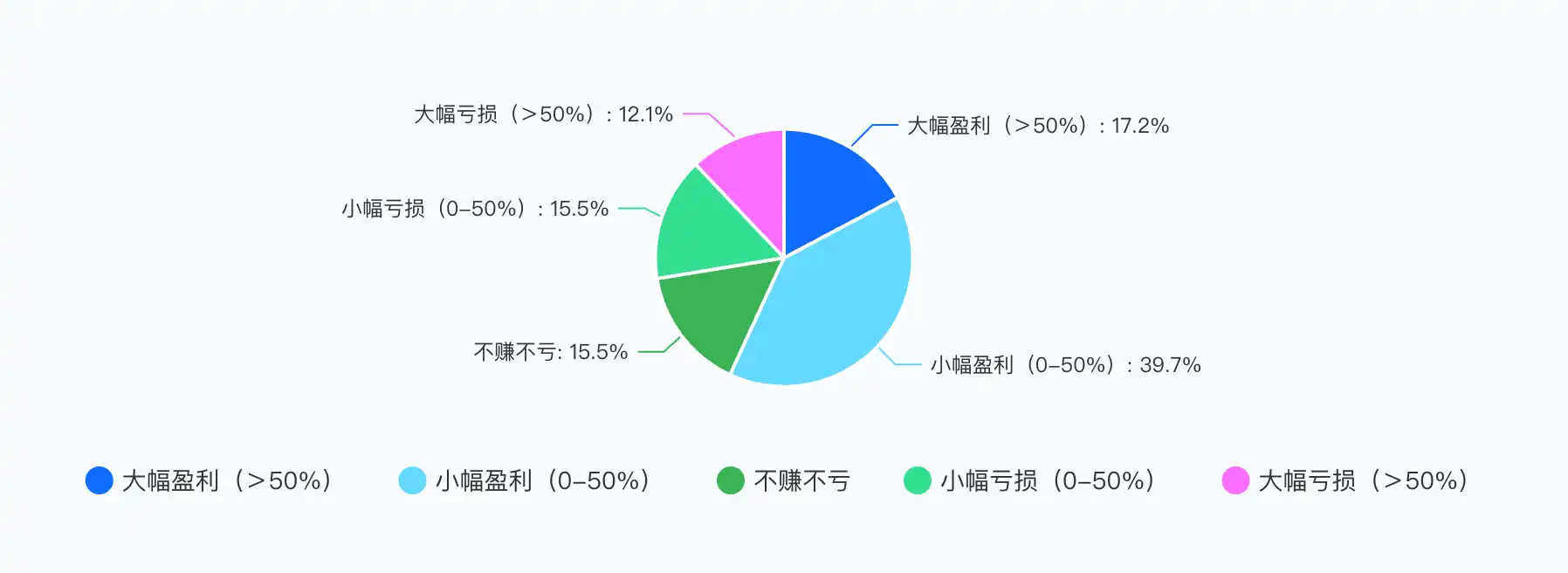
Percentage of people with significant profits (+50% or more): 17.2%;
Percentage of people with slight profits (0-50%): 39.7%;
Percentage breaking even (equivalent to playing for free for a year): 15.5%;
Percentage with slight losses (0-50%): 15.5%;
Percentage with significant losses (-50% or more): 12.1%.
In other words, the profitable group accounts for nearly 60%, break-even accounts for about 15%, while over 27% face losses of varying degrees, about three-tenths, far lower than the sentiment reflected in market views and community discussions. In such a volatile monkey market, more people are still making money, which also confirms that the current crypto market indeed has more experienced old-timers. As for newcomers, they are either still struggling in the market mud or have been hit hard and cut their losses to exit.
Writing this, I can only sigh helplessly: "So many people in the group usually say they are losing money, turns out I'm the only one actually losing?!"
Profitable Sectors: Meme Coins vs. Mainstream Coins? Shitcoins Are Still YYDS
As for the specific profitable areas/sectors/projects/tokens, the questionnaire results are slightly more complex.
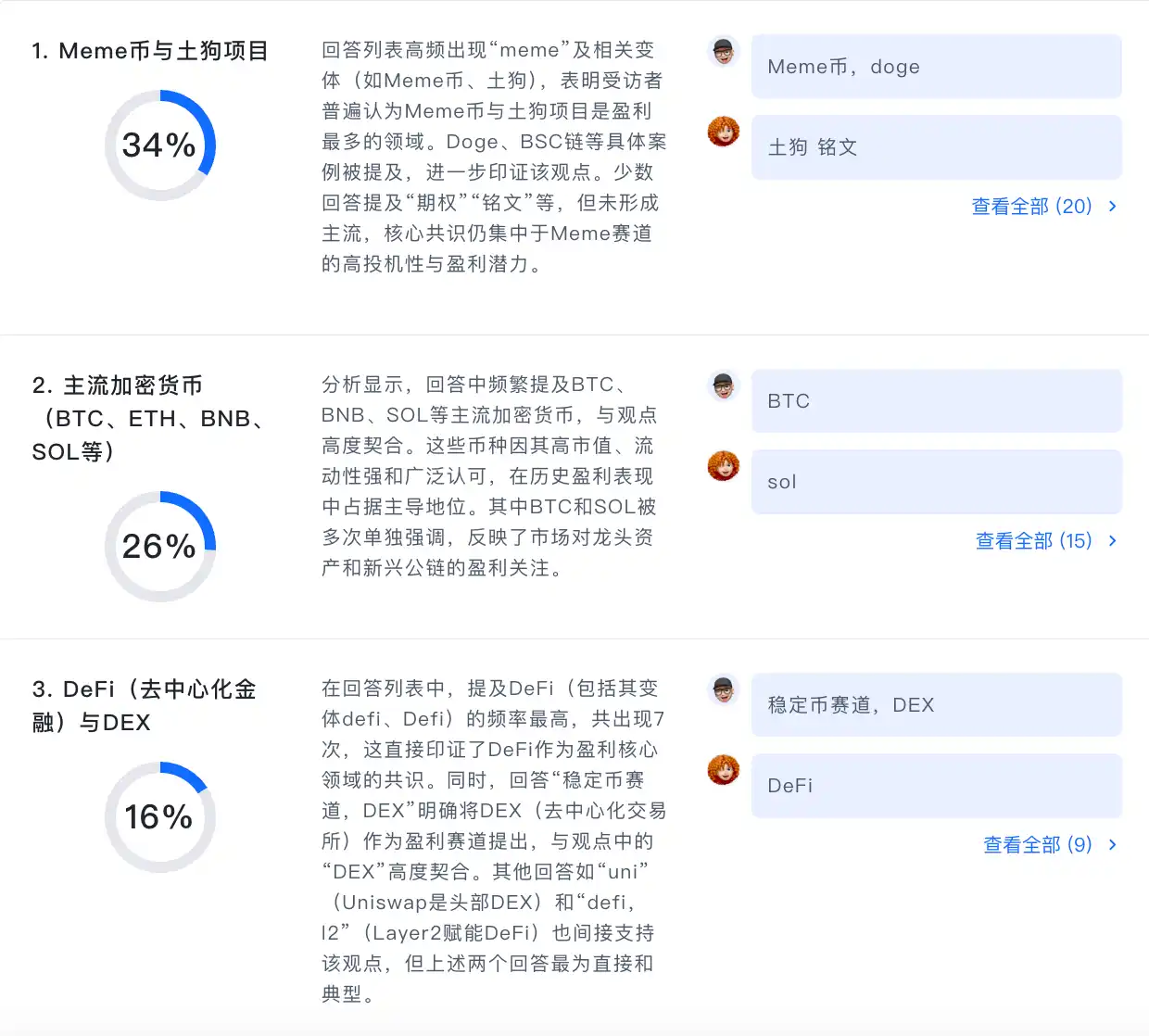
Unsurprisingly, Meme coins (shitcoin projects) remain the ultimate way to make money, with about 34% of questionnaire participants mentioning that they mainly profited from projects in this area (a few even mentioned inscriptions, not sure if they are serious or pretending?);
About 26% of investors mainly profited from mainstream coins like BTC, ETH, BNB, SOL. Considering that BTC, ETH, BNB, and SOL all reached new all-time highs at various stages this year, this performance is not surprising. Of course, it also depends on whether investors took profits timely. Otherwise, blindly being diamond hands can only lead to crying in private;
About 16% voted for DeFi. Given that this year was the "year of stablecoins" and there were many "high-end wealth management schemes," this result is not strange. Coupled with the popularity of on-chain Perp DEXs, DeFi experienced a "second spring" in stages;
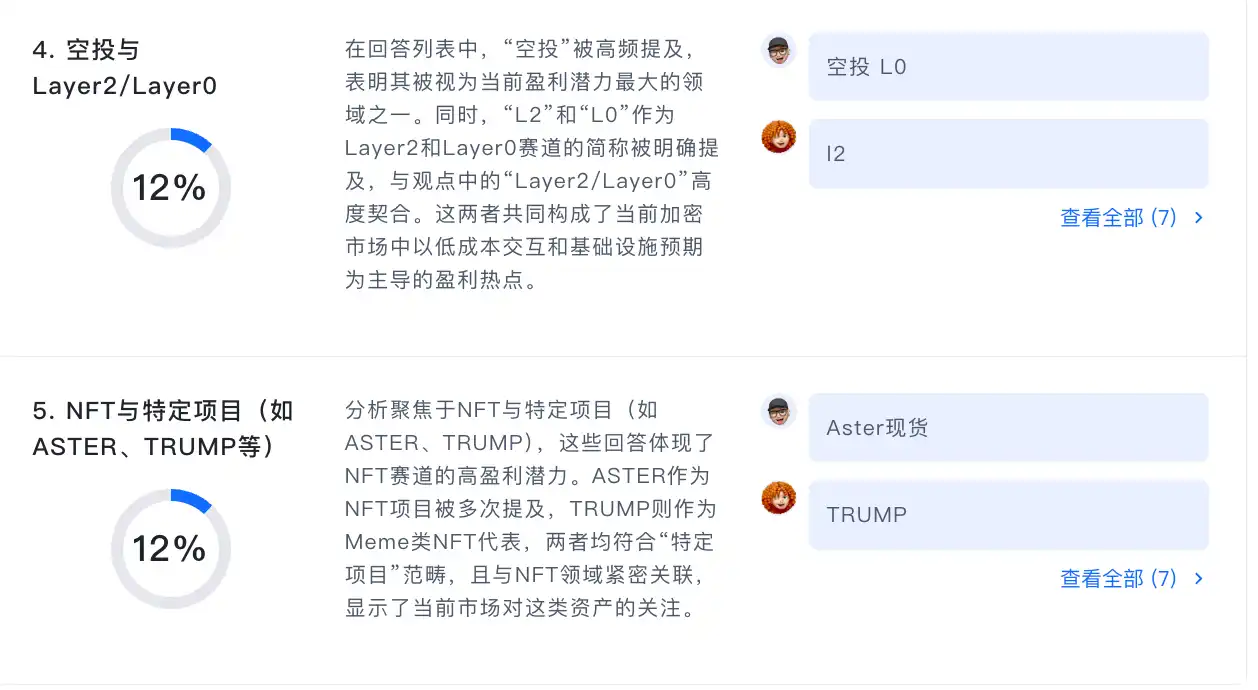
About 12% of investors' main profits still came from airdrop farming. Honestly, this result is somewhat surprising. After all, in the current market with tightening liquidity, many crypto project teams have become increasingly stingy with community airdrop allocations for higher control and easier pumping. Getting "rekt" by projects has become the norm. But regardless, no matter how the market changes, airdrops remain an unparalleled method for many investors to achieve high returns with low-cost input. Regardless of market heat, there are always some "airdrop masters"坚守岗位 (holding their posts), providing various active data and trading volume for the market and projects, deserving everyone's respect;
Finally, apart from individual projects like TRUMP and ASTER, some people actually listed NFT as a profitable area. I can only say I underestimated the investment strength of traders. Being able to make money in the nearly silent or even dead NFT sector, besides saying "牛 X" (awesome) , I can't think of any other evaluation. However, considering that OpenSea's CMO recently still called for hiring, it is enough to show that no matter how the market changes, some NFT collectors or traders still看好 (are optimistic about) this sector and are providing liquidity to the market with their real money. As a member of the "NFT old guard," it is somewhat touching.
In addition, for individual projects, answers like "WET, gold, PING, Binance Alpha, DOGE" were also given. These results are not very representative or referential, so they will not be analyzed separately here, only mentioned for说明 (explanation).
Loss-making Sectors: Meme Coins vs. Futures? Data Validates Same Source of Profit and Loss
For every winner, there is a loser.
Regarding the specific loss-making sectors and projects, the questionnaire results once again show the残酷 (cruel) side of the market.
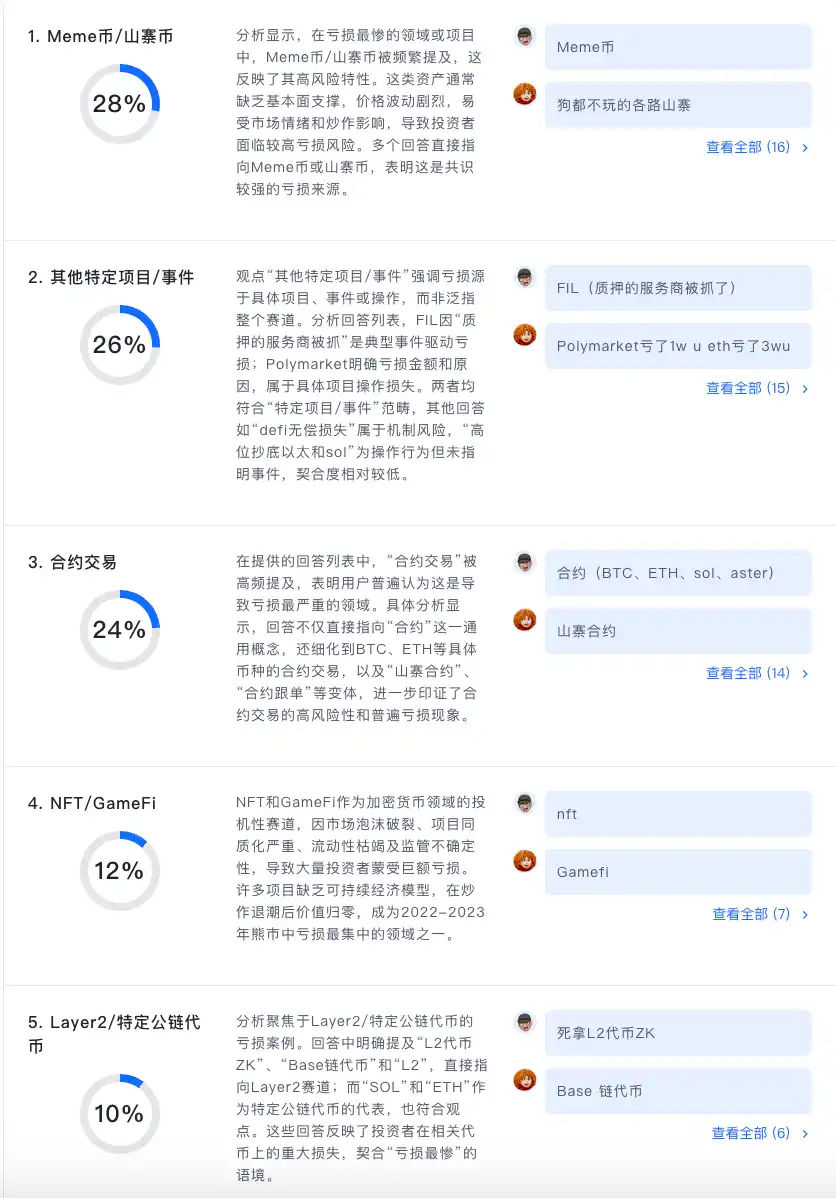
About 28% of investors suffered heavy losses on Meme coins and altcoins, including Binance-listed assets like Giggle and ASTER, Base ecosystem altcoins (e.g., PING), and popular coins like HYPE;
Secondly, another major cause of losses was "black swan events"—some suffered heavy losses on FIL due to issues with staking service providers; others lost bets on Polymarket; additionally, impermanent loss in DeFi protocols, buying BTC, ETH, SOL at high points are all relatively common reasons for losses in the industry;
About 26% of investors stumbled on futures trading. This figure is slightly lower than my personal expectation. As one of the few "active trading arenas" in the market this year, opening futures positions on mainstream coins and altcoins is still the choice of many investors. Considering the volatile statements and frequently changing policies after Trump took office, as well as large-scale清算 (liquidation) black swans including the "October 11th Crash," losses were inevitable;
Thirdly,作为 (as) representatives of "major failure sectors," NFT, GameFi, and L2 related projects were also the crux of losses for many investors. About 22% of people suffered heavy losses because they failed to change their investment mindset timely and stubbornly held onto assets from a certain sector;
Finally, compared to past investment areas still limited to within the crypto circle, under the influence of this year's mainstreaming of crypto theme, DAT treasury company stocks also became a choice for many investors. And during the market's downward oscillation phase, losses naturally followed: some bought DAT leading stocks like MSTR and BMNR, only to be trapped无奈 (helplessly); others suffered heavy losses on the "first stablecoin stock" Circle (CRCL). Former cryptocurrency traders transformed into "尊贵的 (honorable) US stock traders," but the change of identity does not necessarily mean smooth investment performance; it could also mean one more channel to lose money.
Reflection on Losses: Timely Profit-taking vs. Decisive Stop-loss? Profit-taking is a Required Course in Life
After discussing losses, we also set up a specific question about the reasons for losses in the questionnaire, trying to find common problems everyone faces.
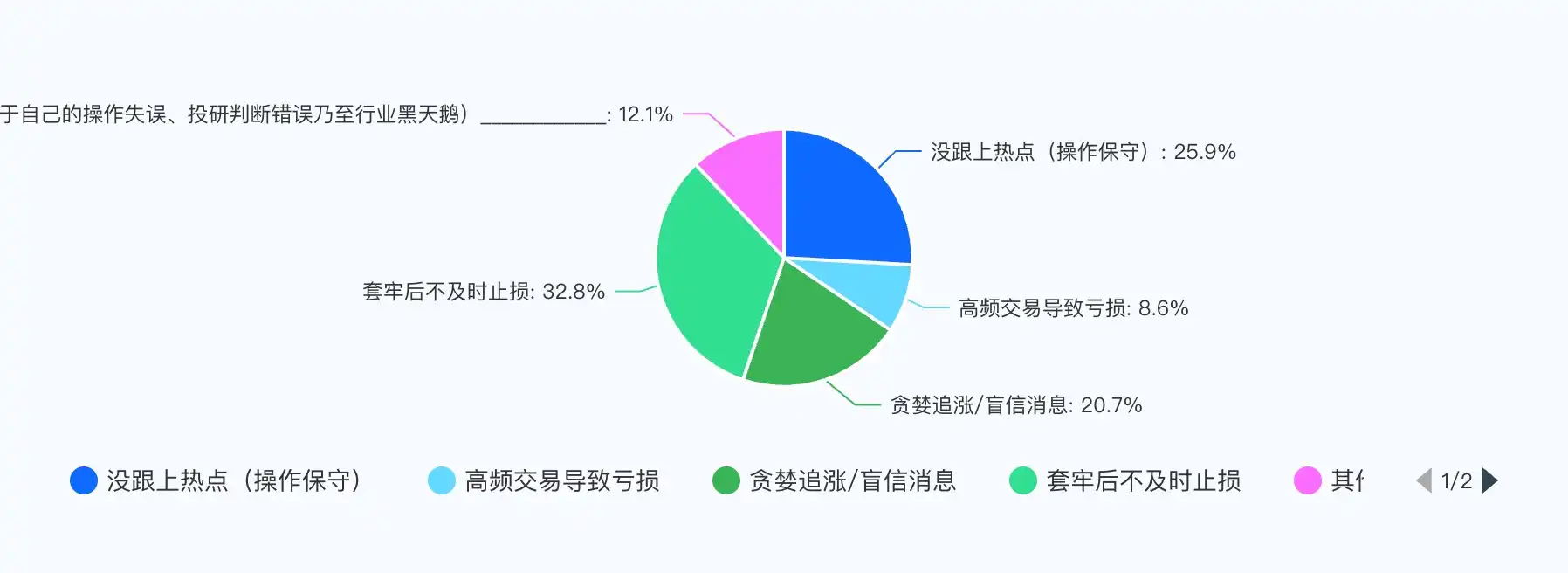
About one-third attributed losses to "failing to stop loss timely after being trapped." This is one of the common problems for cryptocurrency investors, including myself—not realizing that 90% or even 99% of altcoins in the crypto market are destined to go to zero, and only a very few tokens can surge again after hitting lows. Even then, it's mostly wild pump-and-dump schemes to better harvest the market. This story tells us that timely stop-loss and stopping幻想 (fantasizing) are necessary.
On the operational level, being slow to react, conservative operation, or blindly believing news, chasing pumps and selling dips became another main cause of losses, with over 45% of investors making mistakes in these aspects leading to investment losses. Based on my personal observation, "becoming the first to believe capital" and waiting for others to take over might be an important method to remain invincible in the market. This, however, is often closely related to information sensitivity, source channels, personal risk preference, capital and equipment preparation, etc., and is difficult to achieve overnight.
Finally, about 12% attributed losses to operational errors, misjudgments, or industry black swans. In such an up-and-down "monkey market,"很多时候 (many times) it is indeed "not the fault of the battle," and investors can only silently accept their losses, adjust their state, and fight again next year.
What surprised me the most was that the percentage of people who lost money due to high-frequency trading was far lower than my personal expectation, only 8.6% attributed their losses to this. On one hand, most people might indeed engage in less high-frequency trading; on the other hand, everyone might have different standards for what constitutes high-frequency trading. Some might buy and sell dozens of times within an hour but then wait and see for the next week; others might operate 3-5 trades daily, trading for more than twenty days a month. Many might not consider the latter as high-frequency trading, but compared to most people, they are already "high-frequency players."
Commonly Used Products: Perp DEX vs. Prediction Markets? Still Over 40% Haven't Used Prediction Markets
When asked about commonly used popular products, the relevant data is quite intriguing.
The percentage of people who have used Perp DEX is about 40%, among which about 40% are Hyperliquid users; about 22% have used Lighter; about 12% have used Aster; users of other platforms account for about 15%, among which old platforms like DYDX and GMX are also used. It has to be said, the lasting charm of DeFi might be verified here once again.
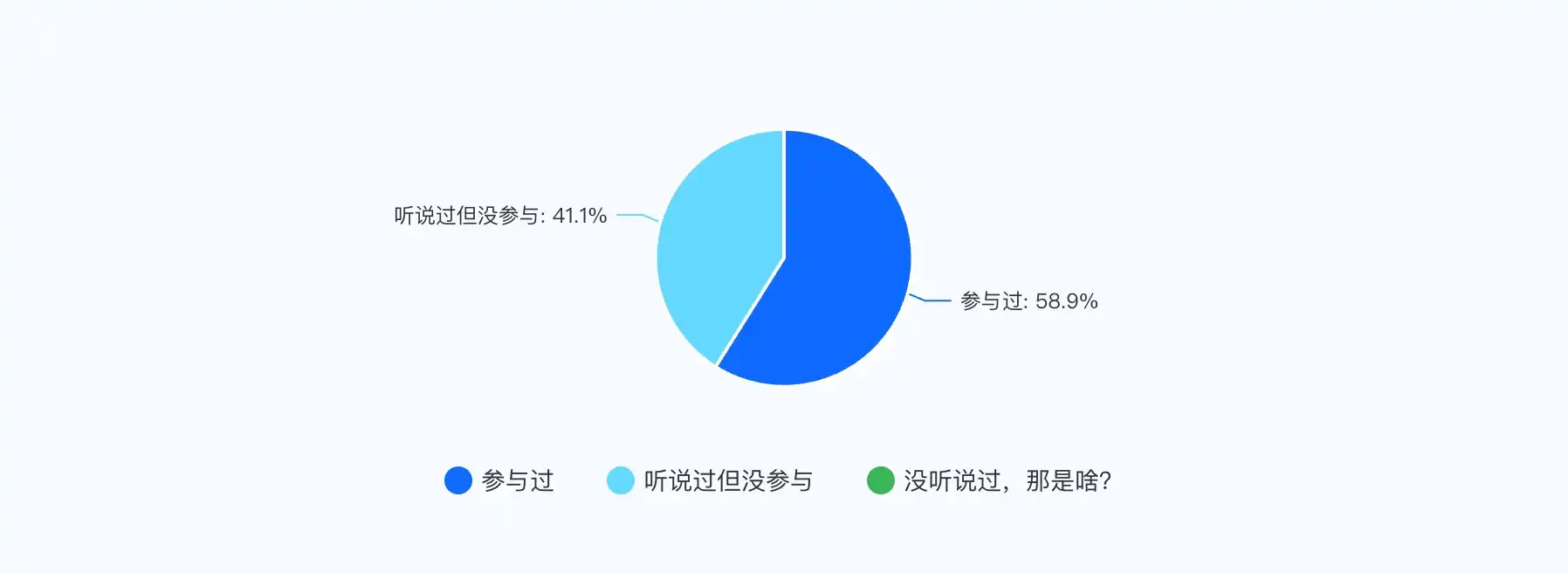
As for prediction markets, nearly 60% of investors have participated in using them; over 40% of investors have heard of but not participated in prediction market betting. From this small sample data, prediction markets still have significant growth space. In 2026, prediction market platforms like Polymarket, Kalshi, The Clearing Company, and those on BSC ecosystem and Base ecosystem may continue to experience user growth explosions.
Future Outlook: Bullish Sectors vs. Investment Advice? RWA, AI, Meme Top Three, DCA is the King
At the end of the questionnaire, we also set up 2 "open-ended questions": one is "Sectors看好 (bullish on) for 2026"; the other is "Investment insights/advice you can share."
Regarding bullish sectors, RWA, AI, and Meme coins ranked top three—
Mention of RWA was as high as 31%. It is worth mentioning that RWA here combines stock tokenization, stablecoins, and PayFi elements;
Mention of AI accounts for about 25%. With the increasing penetration of AI models and applications and the rapid development of AI-related tech companies, the combination of AI and cryptocurrency remains one of the highly anticipated directions for the mainstream market;
The reason Meme coins are still看好 (seen positively) by many might lie in their low entry barrier and high risk/high return compared to mainstream coins. However, I personally hold a pessimistic view on this. After all, altcoins being drained of liquidity is inevitable, and the Meme coin sector, which heavily relies on on-field liquidity, currently finds it difficult to return to its previous "hundred flowers blooming" stage.
Prediction markets are the "consensus" of many. The two oligarchs Polymarket and Kalshi with valuations exceeding ten billion dollars and the rapidly growing industry trading volume allow more people to see the development potential of prediction markets. The functional setup of "everything is predictable" combined with热点事件 (hot events) like various popular sports events and political elections in 2026 may add more fuel to the prediction market frenzy.
Regarding specific investment advice, most people recognize the principle that "Dollar-Cost Averaging (DCA) is king" and advise to "only buy BTC," but how many can actually do it, only they themselves know.
Additionally, an interesting point is that crypto KOL @_FORAB shared, suggesting DCA into mainstream coins every Friday afternoon, which is quite clever in terms of timing; another "certain group friend" who不建议公开处刑 (does not recommend public execution) suggested trading after 4 PM because "that's when foreigners wake up,"俨然 (plainly) viewing "foreigners" as "exit liquidity."
Amusingly, 6 questionnaire participants gave their "investment advice"—"Buy high, sell low,"堪称 (can be called) the "Guide to Achieving韭菜 (being a noob)"; others gave their judgment—"L1, L2 are dead, stay away from futures or set stop-loss, look for low market cap RWA sector tokens"; others bluntly reminded: "Take profits timely when you make money; don't get carried away; dare to act during extreme emotions."
Here, we thank all investors who participated in this questionnaire survey; at the same time, we also thank the following questionnaire users who left their IDs for sharing their annual investment memories with Odaily Planet Daily readers: @wanzwa6、@_FORAB、@airn_619、@muzz201o、@0xJerrrry、@bcxiongdi、@GaoNew3、@anchor9960、@cryptoshouyi、@Meiko5200、@a6825272、@qinxiaofeng888、@Asher_0210、@azuma_eth、@ethanzhang_web3、@0xmz2987、@gold7108.
无论如何 (No matter what), everyone still active in the crypto market today is essentially each other's "comrades in the trench."
Those "Big Opportunities" We Missed in 2025: A Heartbreaking Inventory of the Year's Projects
At the end of the article, I want to use a brief space to briefly inventory the "annual wealth-making big opportunities" that countless people missed this year. After a year has passed, countless opportunities for immense wealth were once placed before us, but due to various conditions such as limited principal, slow hands, cognition, or unexpected situations, we still brushed shoulders with these opportunities time and again.
At the end of 2025, looking back, perhaps we can see more clearly whether it was "impossible to make money beyond one's cognition" or "just one move short by chance." Whether it's a bit of regret or more anticipation, the new year is coming, and there are always new opportunities and challenges waiting for us to conquer, explore, succeed, or fail.
Q1 Missed Big Opportunities: TRUMP, MELANIA, Swarms, PIPPIN, TST, MUBARAK, HYPE, VIRTUAL, IP, KAITO
In the first quarter, the official authentic Meme coin TRUMP before Trump took office can be considered an "epic wealth-making opportunity of the year." Many Chinese-speaking traders借此 (took this opportunity) to achieve single-coin profits of $1 million or even over $10 million,堪称 (can be called) the model of "reaching A8 in one step"; subsequently, after a brief余波 (ripple) of AI Agent concept coins, the "Binance系 (ecosystem) Meme coin热潮 (craze)" led by CZ began to emerge, with testnet coin concepts and celebrity Memes once again becoming market焦点 (focal points); the surge of HYPE, the IP airdrop and its subsequent 10x increase, and the "嘴撸赛道概念币 (talk-to-earn track concept coin)" pioneered by KAITO were also good wealth creation opportunities.
Q2 Missed Big Opportunities: Circle (CRCL) Listing, PUMP, LAUNCHCOIN, USELESS, MYX, HUMA, SAHARA
In the second quarter, DAT gradually joined the crypto battle. Circle's "10x miracle" debuted on the US stock market, shattering the previous doubts and bearish views of the crypto-native crowd towards this compliant stablecoin. Although it later showed weakness due to market impact, the "crypto IPO热潮 (craze)" it started laid the foundation for the subsequent expansion of the DAT treasury company camp and stock tokenization platforms to some extent; additionally, the乱战 (chaotic battle) of Launchpad platforms, the development in the AI field, and the frequent appearance of god-like schemes on Binance Alpha also injected new vitality into the market's liquidity. Many projects completed their TGE during this time, catching the rare "market best token issuance time vacuum period."
Q3 Missed Big Opportunities:: WLFI, Plasma (XPL), ASTER, AVANT (Avantis)
In the third quarter, the most扼腕叹息 (heart-wrenching sighs) were undoubtedly for 2 major projects: one is Plasma (XPL), where depositing 1 U could claim tokens worth 10,000 U; the other is ASTER, where trading tens of thousands of U volume could claim considerable tokens. Although the former's financial activity required conditions like fast hands or KYC, the substantial回报 (returns) still made many people slam their thighs in regret; for the latter, the reason for many people's painful sighs lies in "falling倒在黎明前一夜 (the night before dawn)" by selling too early.不乏 (There is no shortage of) people who sold ASTER tokens worth millions too early. In the end, one can only sigh, such is fate.
Q4 Missed Big Opportunities: Binance Life, 4, Giggle, ZEC
The fourth quarter was more like an "artificial bull market" of a dying flash. Whether it was the BSC ecosystem Meme coins like Binance Life strongly promoted by Binance figures like CZ and He Yi, or the privacy coin sector representative ZEC that gained new life after the "October 11th Crash," they were all "artificial products" after the market's new highs. Therefore, it is difficult to simply judge them as "big opportunities." But无论如何 (no matter what), for the market at that time, it was undoubtedly "the final造富余晖 (wealth-creating afterglow) of the crypto market this year."
Finally finally,借用 (borrowing) a group friend's words, "You always think opportunities are infinite, and indeed opportunities are infinite." From a rearview mirror perspective, perhaps many people wouldn't have imagined that 2025 had so many wealth creation opportunities. And being able to catch one might be enough to change one's life.
2025, the year of crypto mainstreaming, is about to end; what magnificent waves await us in the crypto market in 2026?
See you next year.