2025 Crypto Industry Workplace Survey: 70% Earn Less Than $4,000 Monthly, N+1 Severance Becomes a Distant Hope

深潮Опубліковано о 2025-12-26Востаннє оновлено о 2025-12-26

Анотація

2025 Crypto Industry Workplace Survey: 70% Earn Under $4K Monthly, N+1 Compensation a Luxury Based on 506 survey responses, a report reveals the stark realities of the crypto industry, contrasting sharply with common perceptions of wealth. Over 70% of respondents earn a monthly salary below $4,000, with overall compensation lower than in developed regions. A quarter of workers are in a "pay-to-work" situation, reporting an overall net loss. Nearly half have experienced layoffs, and most did not receive standard severance packages like N+1. Despite the challenging conditions, over 80% plan to remain in the industry. Key attractions include remote work flexibility, with nearly 70% of companies offering remote options, and reasonable working hours, as 80% work 40-50 hours per week. The most desired employers are Binance, OKX, and Coinbase. The most cited high-earning professions are traders and KOLs. The primary pressures include product growth, market volatility, and job insecurity. For most, the target retirement fund is between $1 million to $5 million. Overall, the average job satisfaction rating was 3.51/5, reflecting a mix of frustration with compensation and appreciation for flexibility.

Author: Deep Tide TechFlow

While Xiaohongshu (Little Red Book) continues to glorify the "get-rich-quick myths" and "six-figure annual salaries" of Web3, what is the true state of the crypto industry?

Through 506 survey questionnaires, we engaged in a candid conversation with industry practitioners. The results were surprising, even somewhat brutal: This is not a land paved with gold. Over 70% of respondents earn less than $4,000 per month, a figure generally lower than in developed regions like Europe and the US. Even a quarter of respondents are in a state of "paying to work," experiencing overall losses. There is also a lack of proper safeguards; nearly half have experienced layoffs, and most did not receive N+1 severance compensation.

Yet, despite this, over 80% choose to stay. Is it because of the freedom of remote work enjoyed by 70%? Or is it because of the shared dream of "retiring with $5 million"?

In this report, we attempt to look beyond the cold data to reveal the most authentic anxieties, desires, and survival strategies of Web3 workers.

This content is the questionnaire results section of the "Web3 Recruitment & Job Hunting 2025 Year-End Review: Who's Making Money, Who's Paying to Work?" Full report available at:

https://www.techflowpost.com/article/detail_29702.html

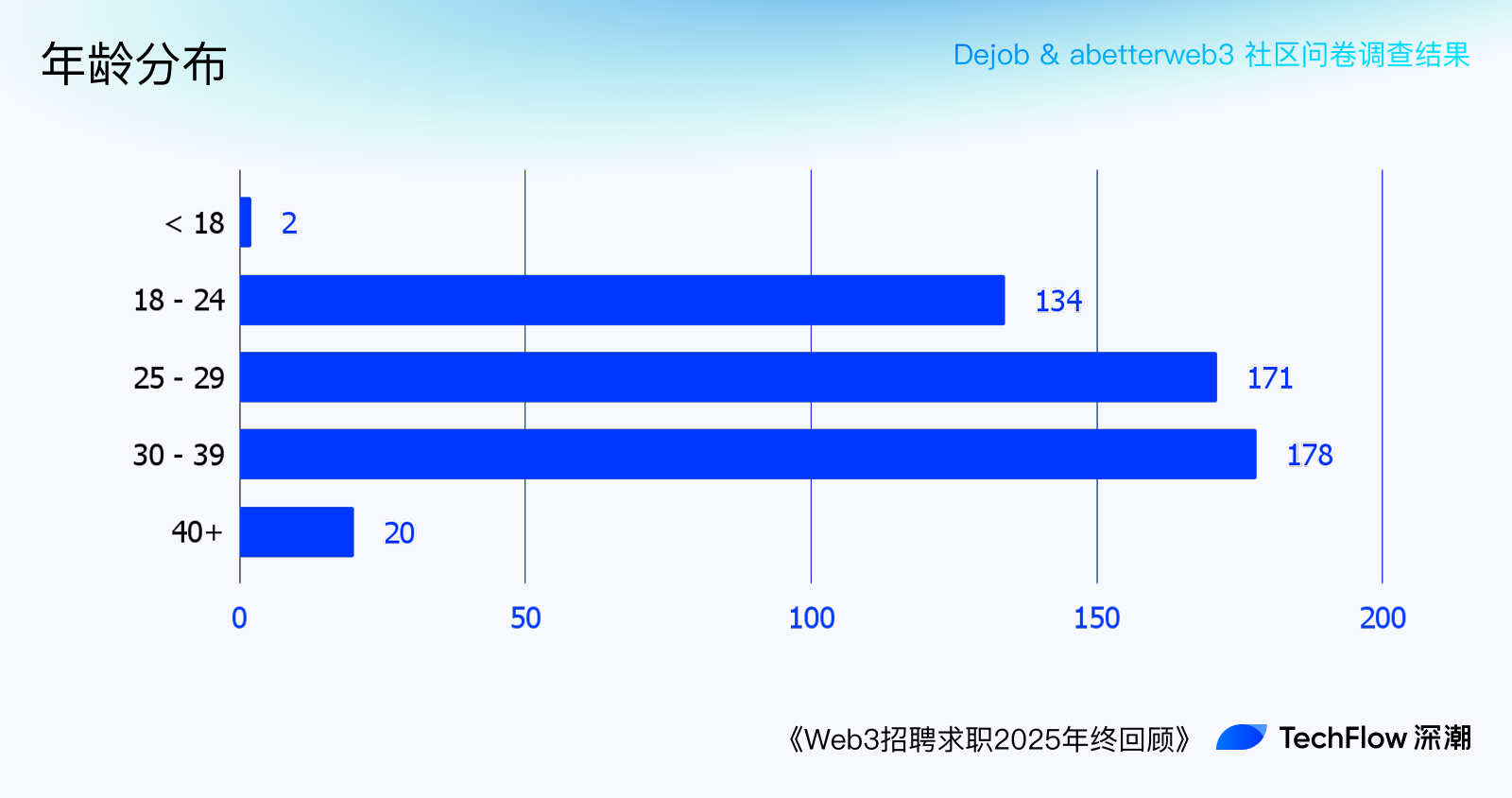
Regarding age distribution, the main workforce aged 18-29 is indeed the majority, but middle-aged practitioners (>30 years old) are also quite numerous. This might be related to the less severe "age 35 ceiling" in the Web3 industry. Compared to internet companies, Web3 companies value experience, capability, and efficiency more, with many hoping that seasoned professionals can quickly build products "ready to use."
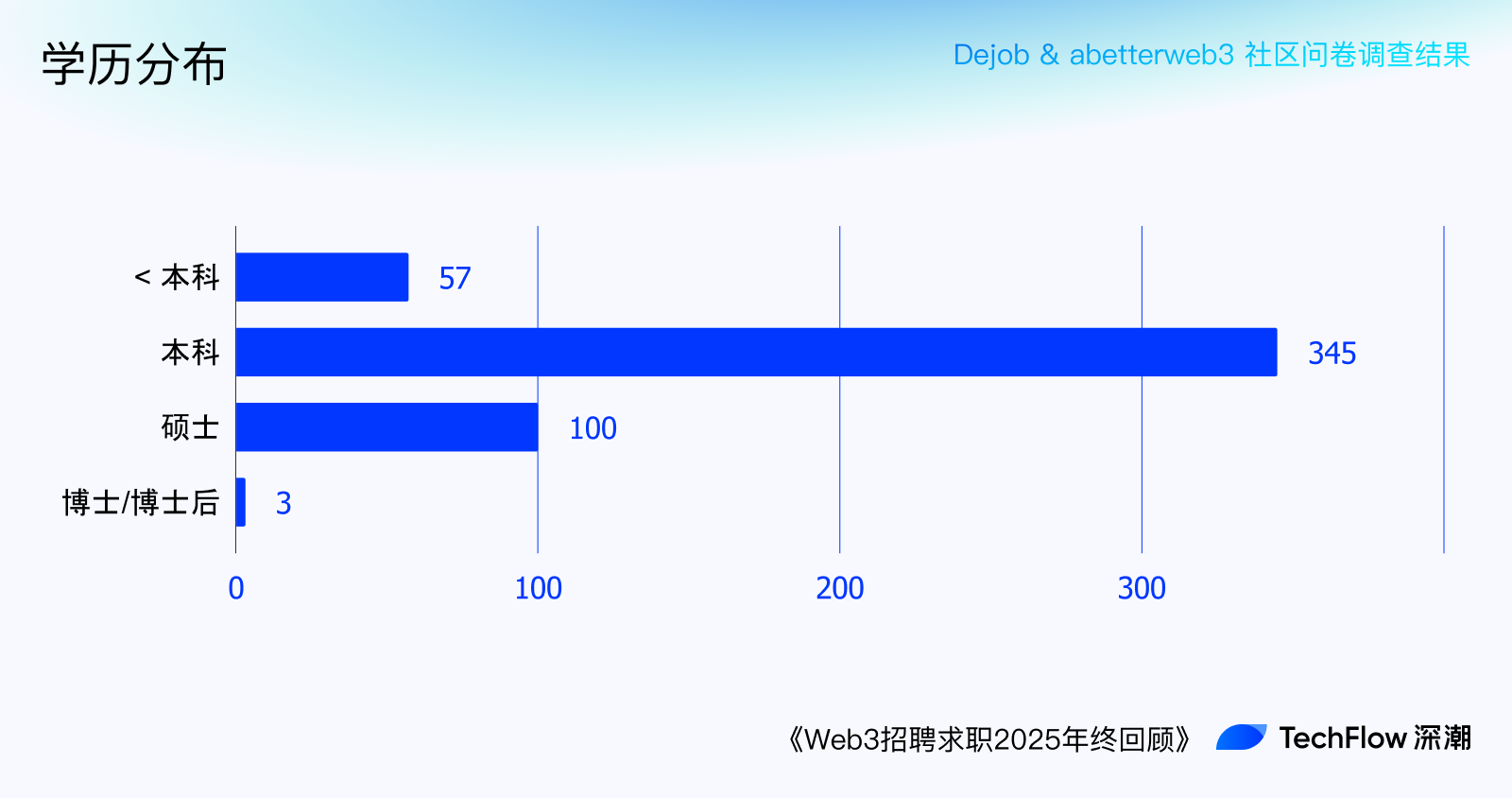
The distribution of educational backgrounds is largely consistent with the earlier talent data statistics, predominantly undergraduate degrees. There are individuals with less than a bachelor's degree as well as master's and PhD holders, though the proportion of postgraduates is not high.
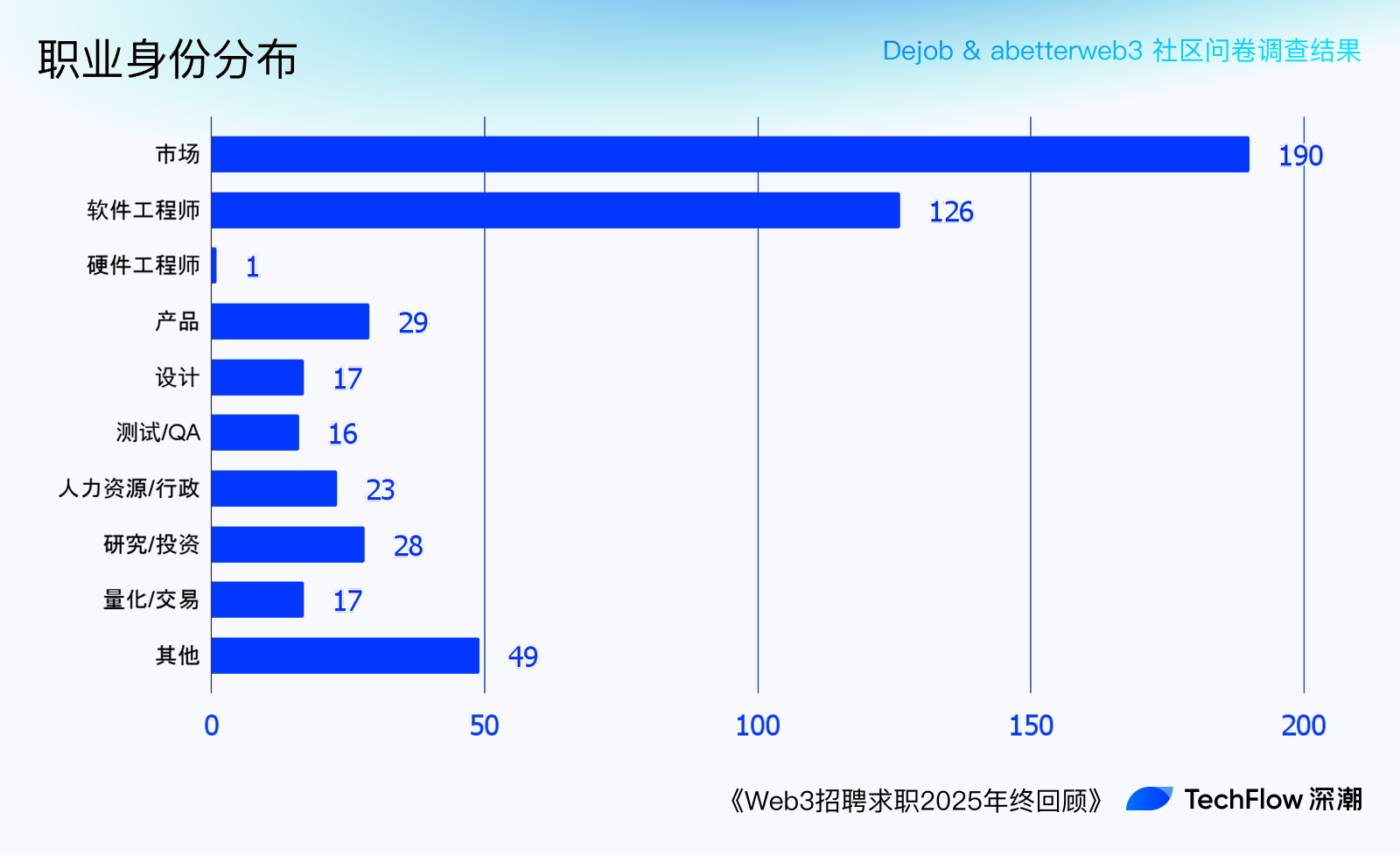
In terms of professional roles, the largest group is in market-related functions (Operations/BD/Customer Service, etc.), followed by developers (Frontend/Backend/Smart Contracts/Blockchain, etc.). These are followed by Product, Human Resources, Investment Research, Design, Trading, etc. Among the "Other" submissions, common entries were Risk Control & Security, KOLs, etc.
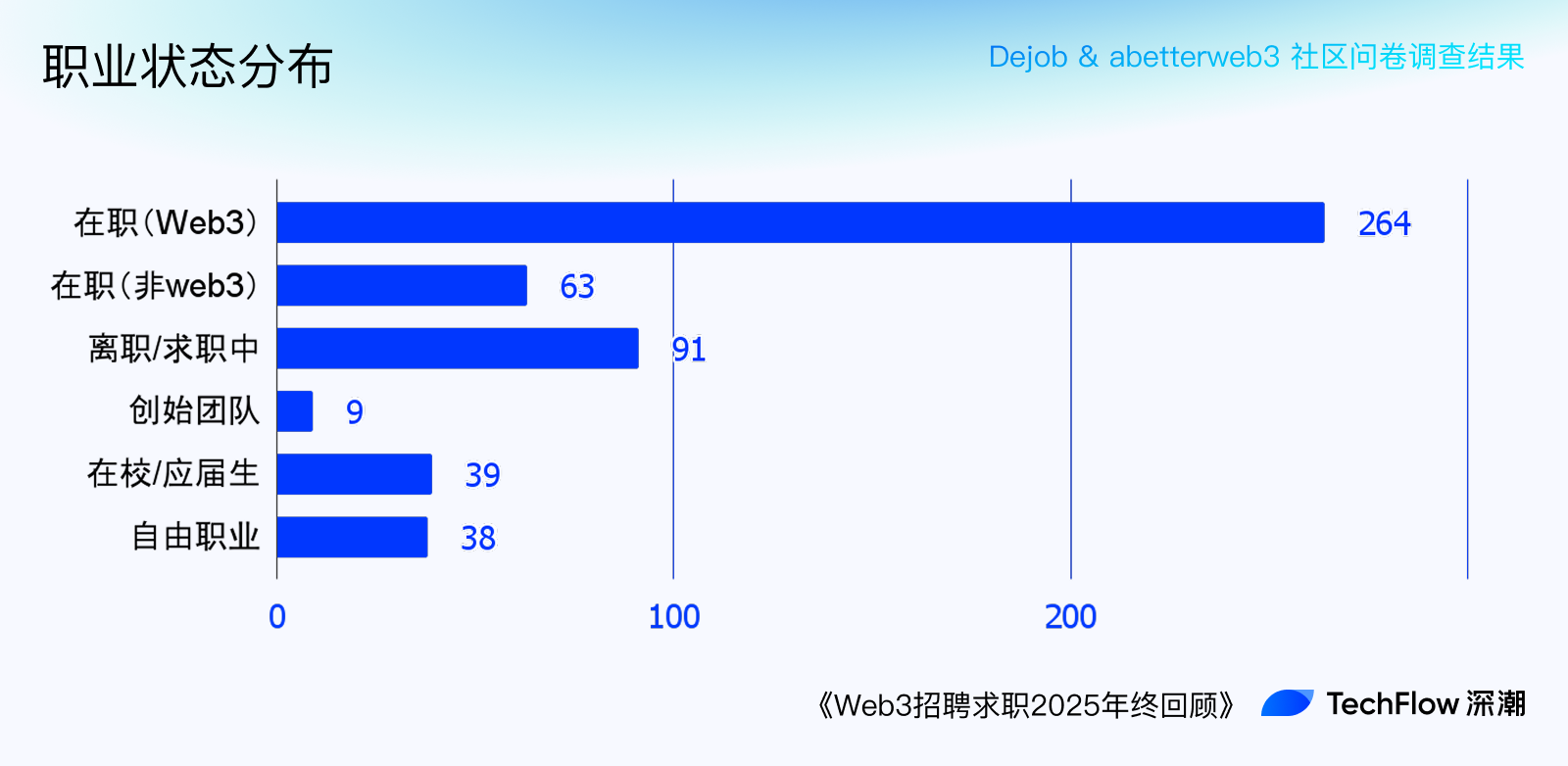
Regarding employment status, only 52% of respondents are employed in Web3. Over 30% are in a more flexible life situation. This indicates, on one hand, that market conditions affecting company headcount (HC) have impacted many; on the other hand, it might be because certain unique business models in Web3 (like being a KOL or trader) have made a regular job less necessary for generating cash flow for some individuals.
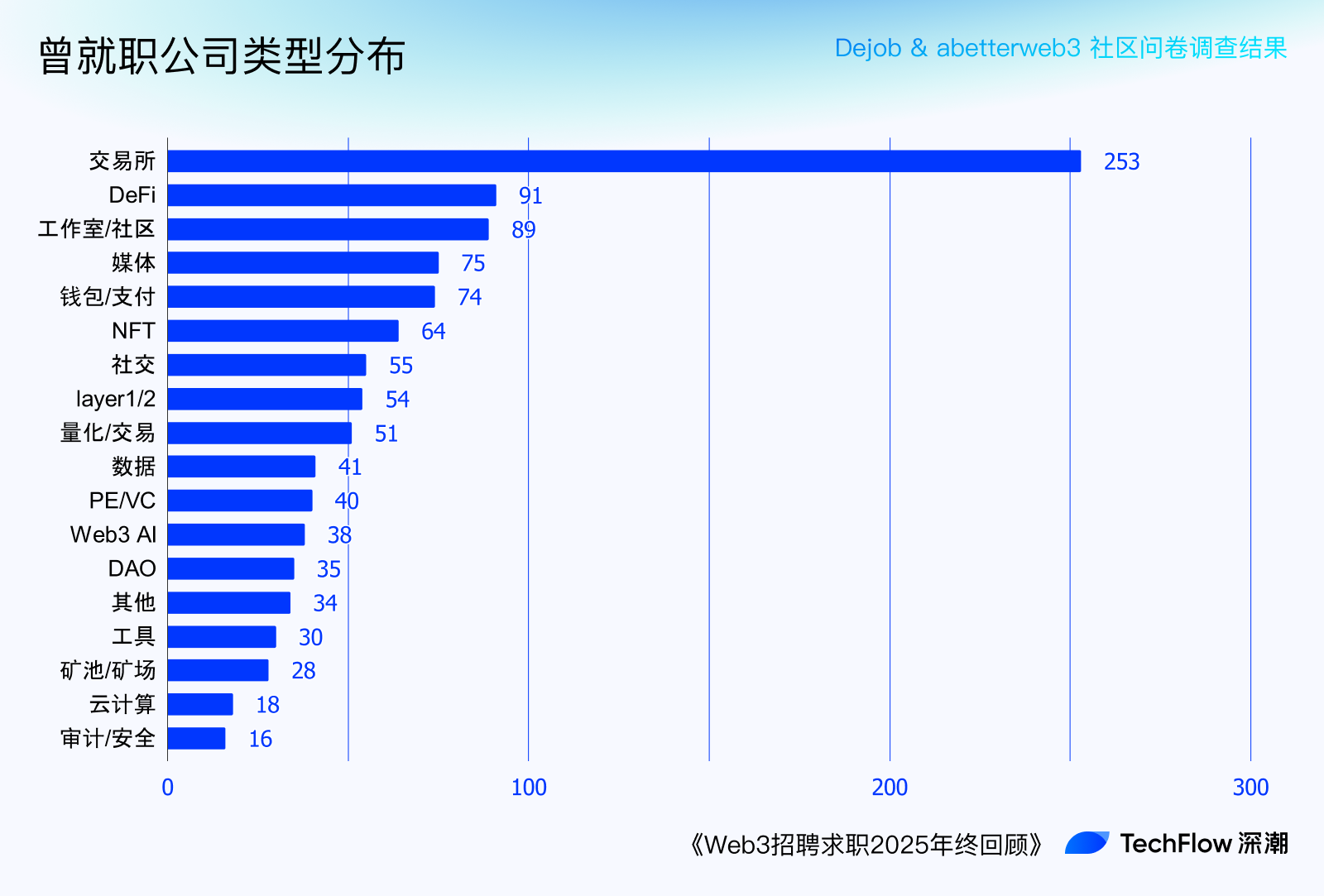
Over half of the submissions indicated having worked at an exchange, followed by studios/communities, DeFi, media, wallets, and other common business types. Both talent and job providers converge with absolute Matthew Effect intensity towards exchanges. This also reflects, to some extent, the current industry dilemma: apart from exchanges, the revenue-generating capabilities of most other business models generally decrease from C-end -> tools -> infrastructure.
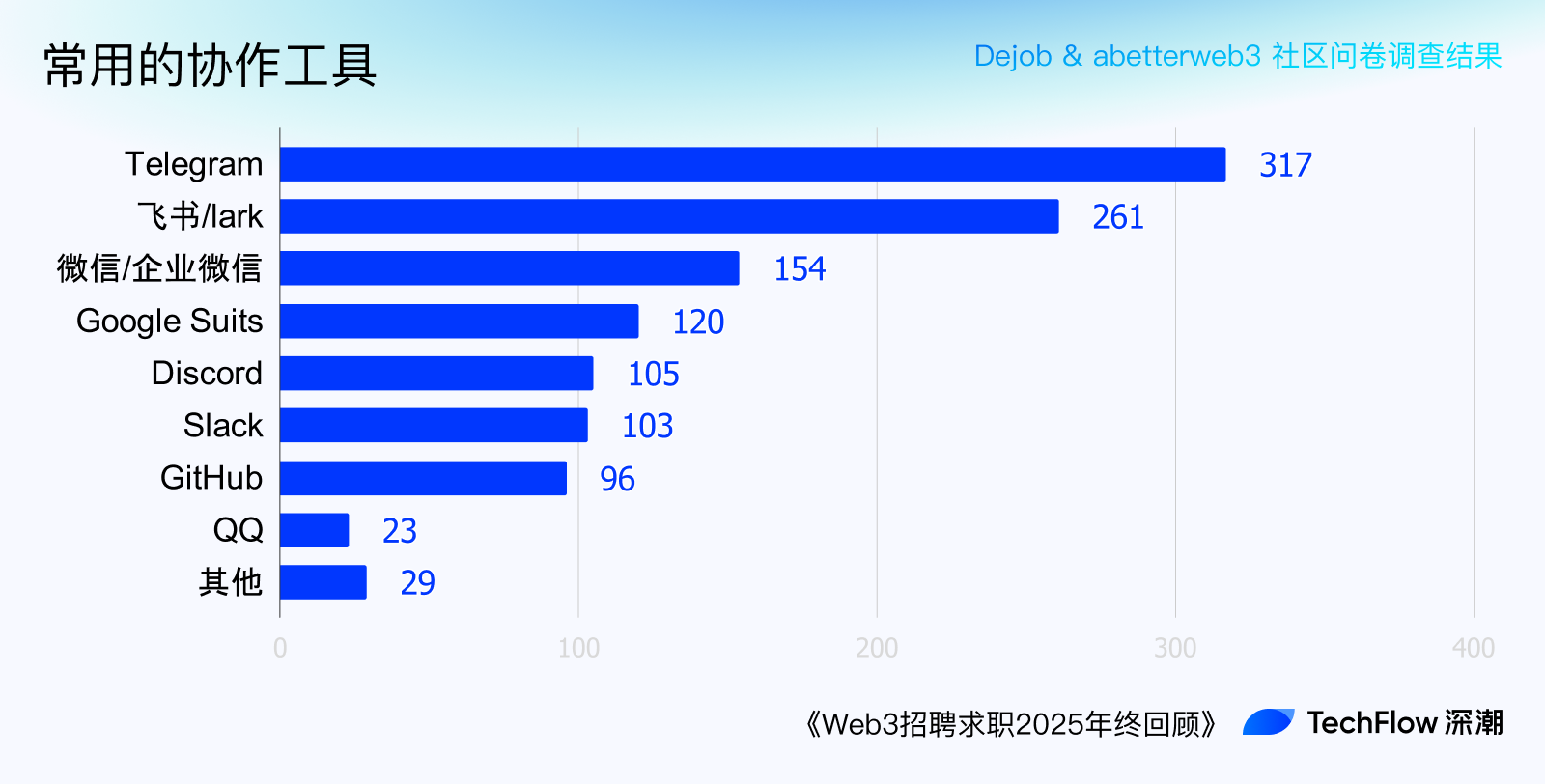
Regarding remote collaboration tools, as this survey took place within a Chinese-language vertical Web3 recruitment community, Telegram is favored by most companies for its confidentiality and usability, followed by mainstream domestic tools like Feishu and WeChat, and finally tools commonly used by foreign companies like Google Suites, Discord, Slack, etc.
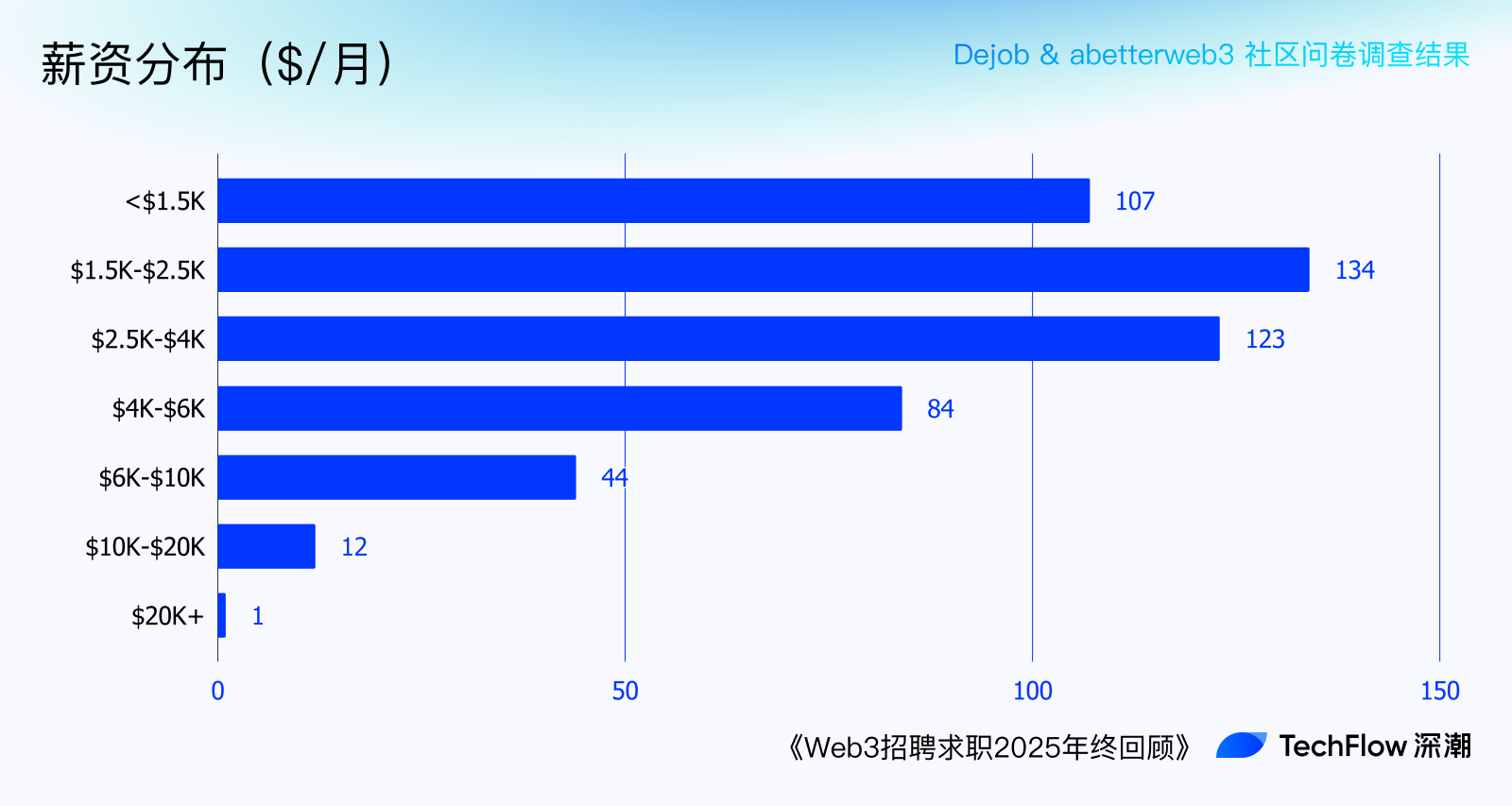
In terms of income levels, contrary to the external myths of immense wealth, most Web3 workers' incomes are not only lower than those in most top internet companies but also severely lacking in long-term incentives (tokens/equity), year-end bonuses, and layoff compensation.

Over 70% have a monthly salary of less than $4,000 (approx. RMB 28,000). The frequently mentioned monthly salary of $10,000 on Xiaohongshu is a rarity.
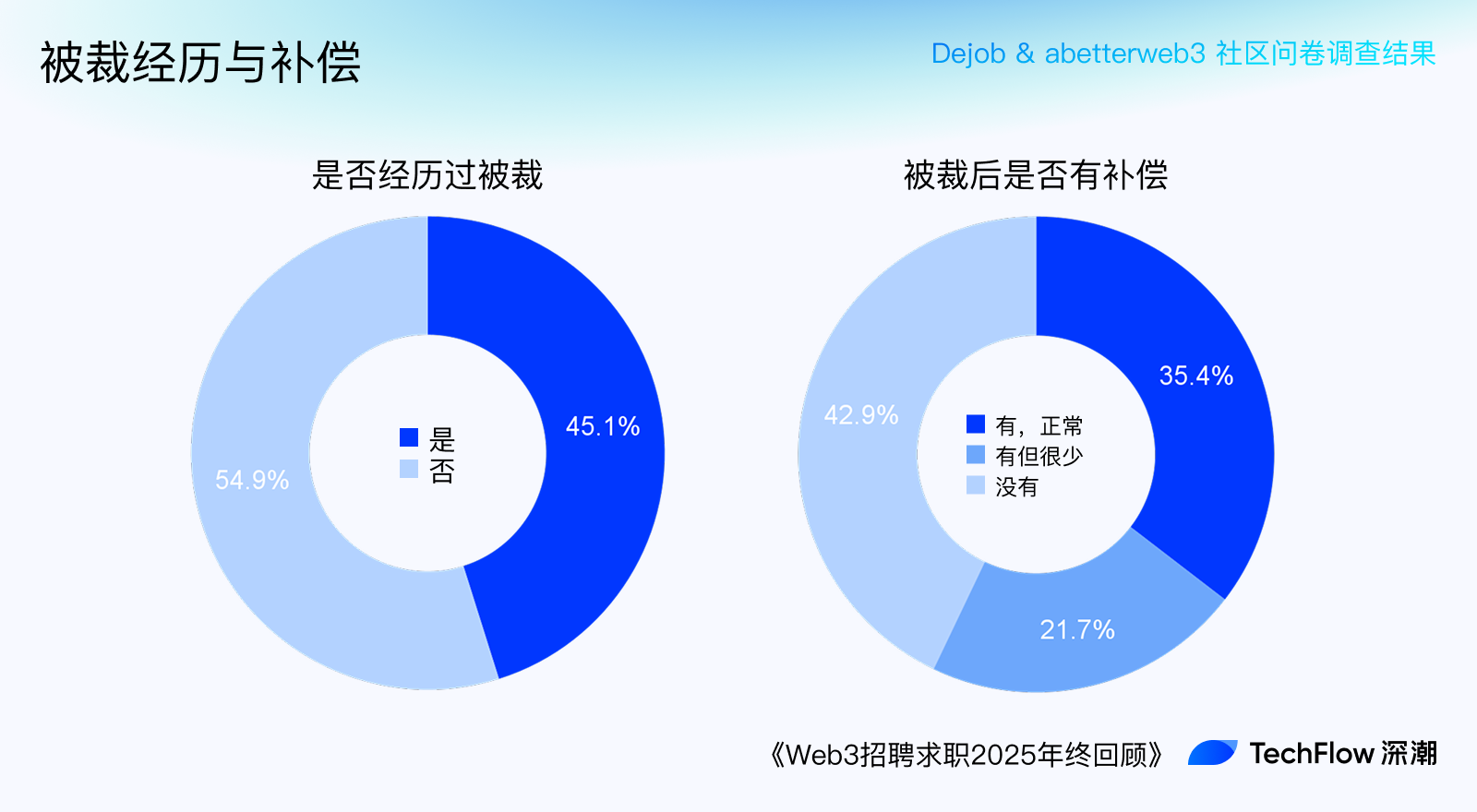
Close to half have experienced layoffs, and 40% of those laid off reported receiving no compensation. 21% said that even if they received compensation, it fell far short of the legal standard (e.g., N+1).
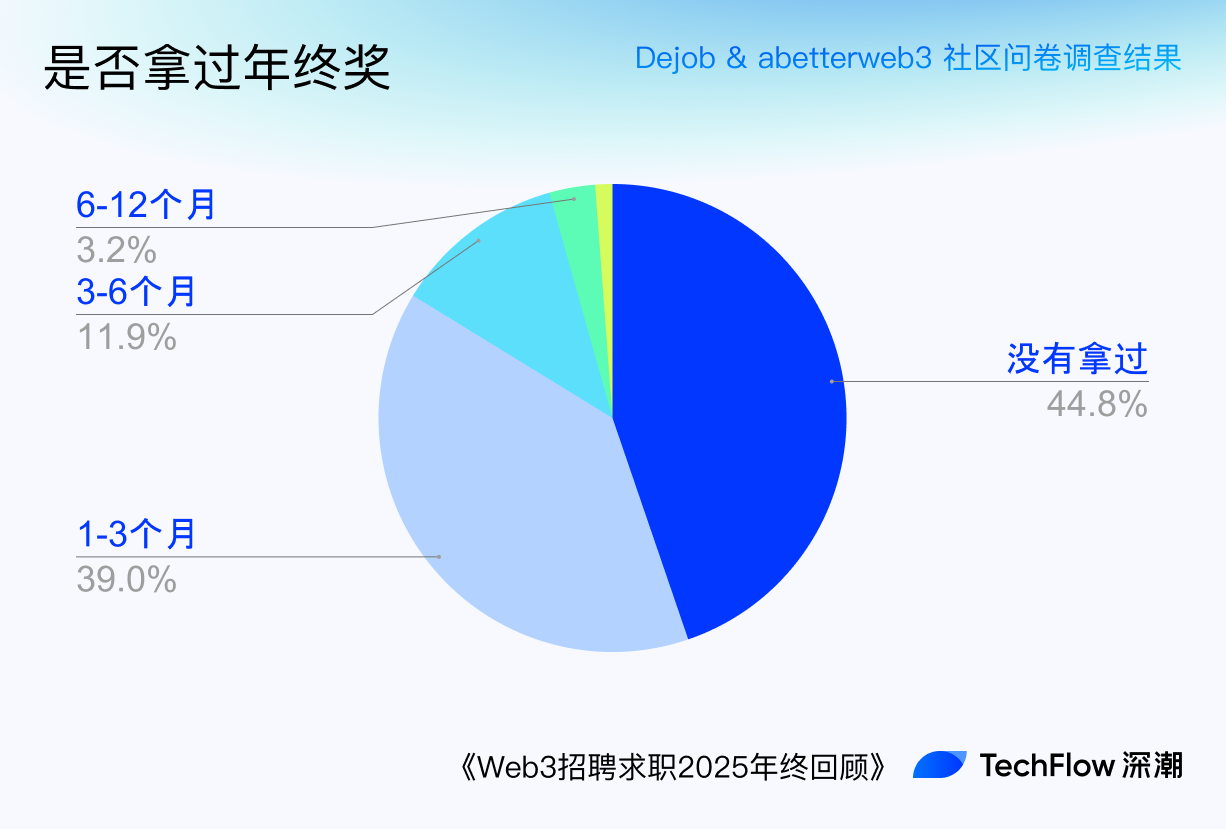
Nearly half reported not receiving a year-end bonus; even among those who did, it was generally 1-3 months' salary, basically on par with most internet companies outside the Web3 industry.
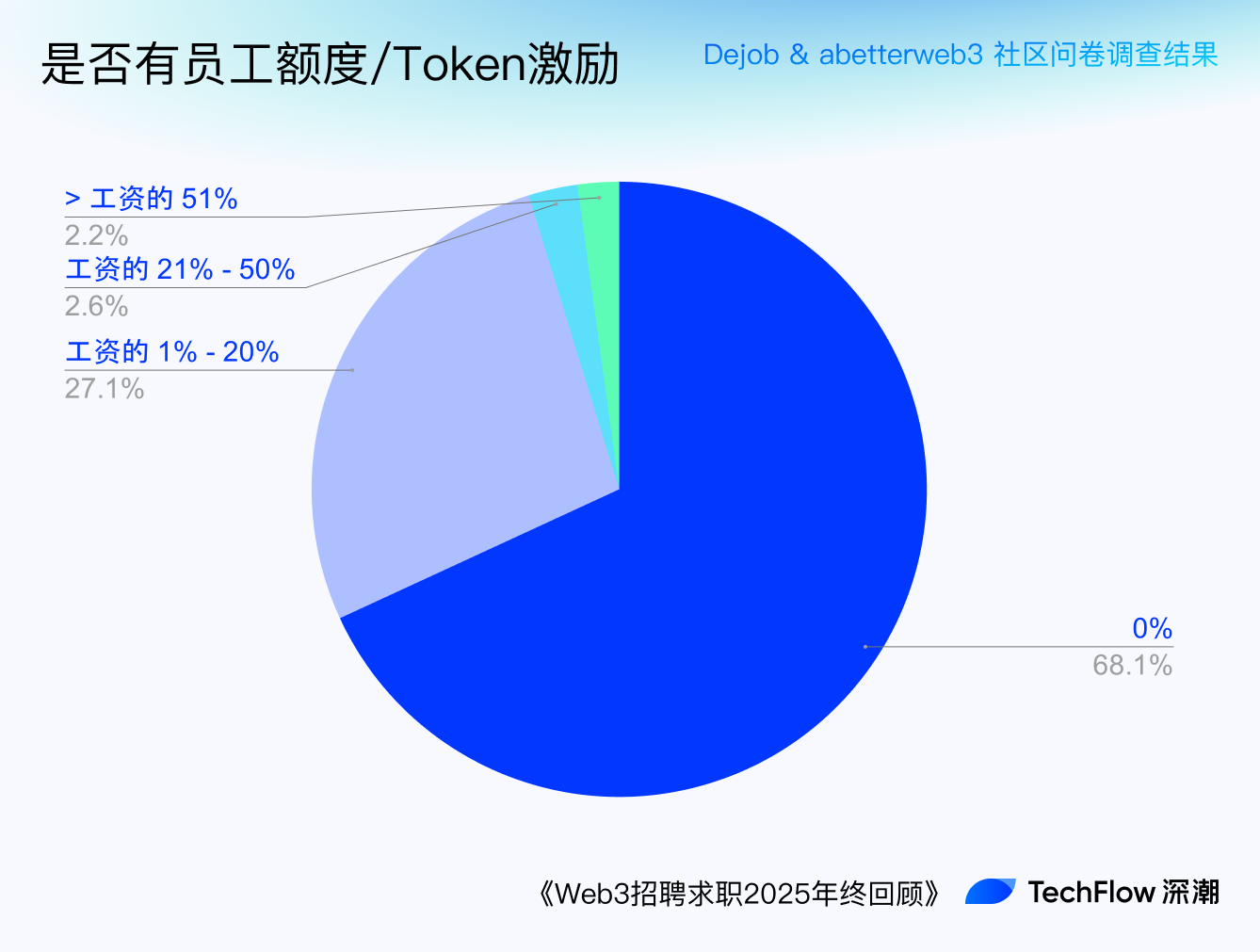
Regarding the well-known "upward channel" of token/equity incentives, nearly 70% of practitioners reported never having received any. Even among those who did, very few received incentives exceeding 20% of their salary.
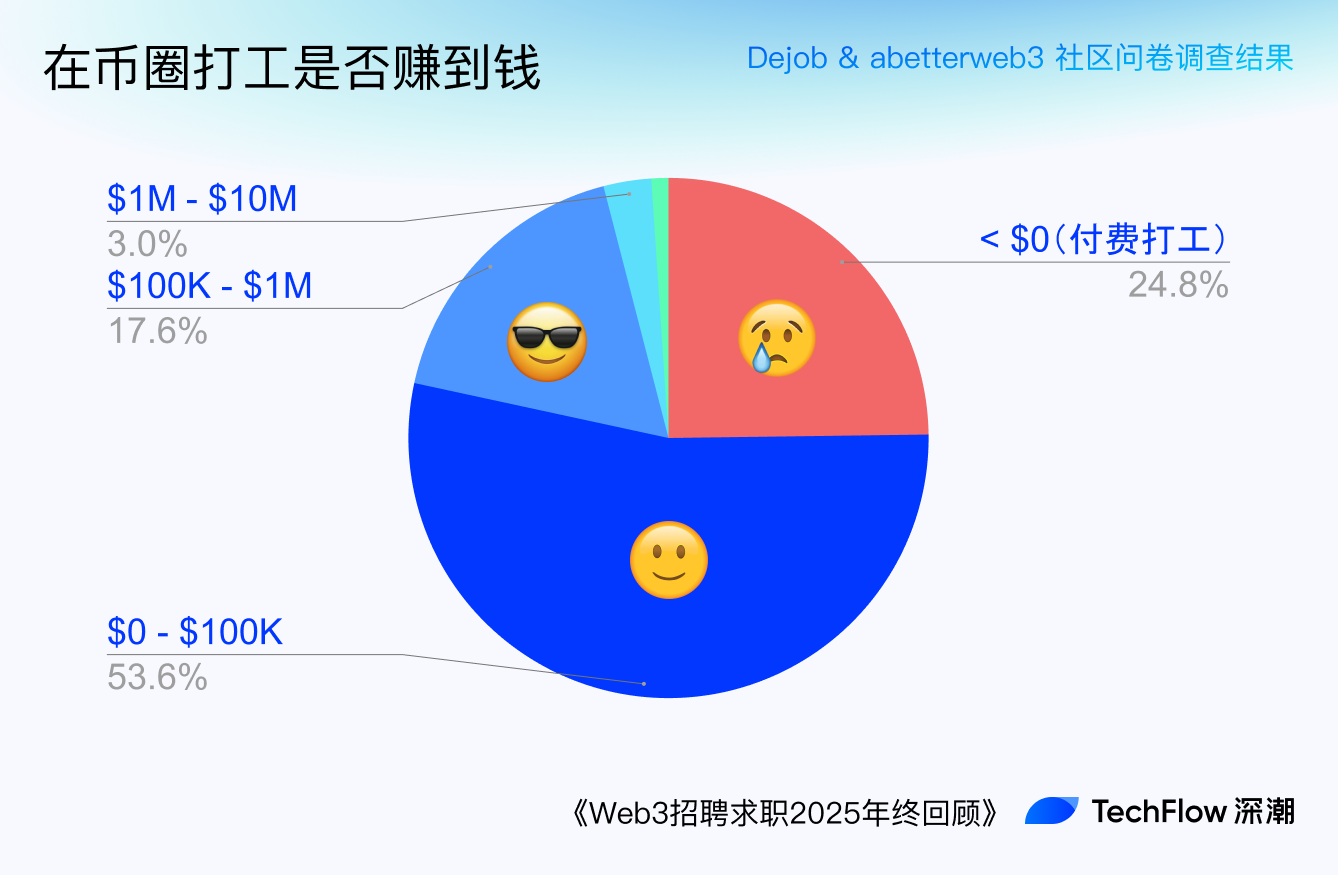
Remarkably, a quarter of respondents reported an overall net wealth loss since entering the crypto space, effectively "paying to work." Other respondents mostly accumulated wealth around $100K (approx. RMB 700,000).
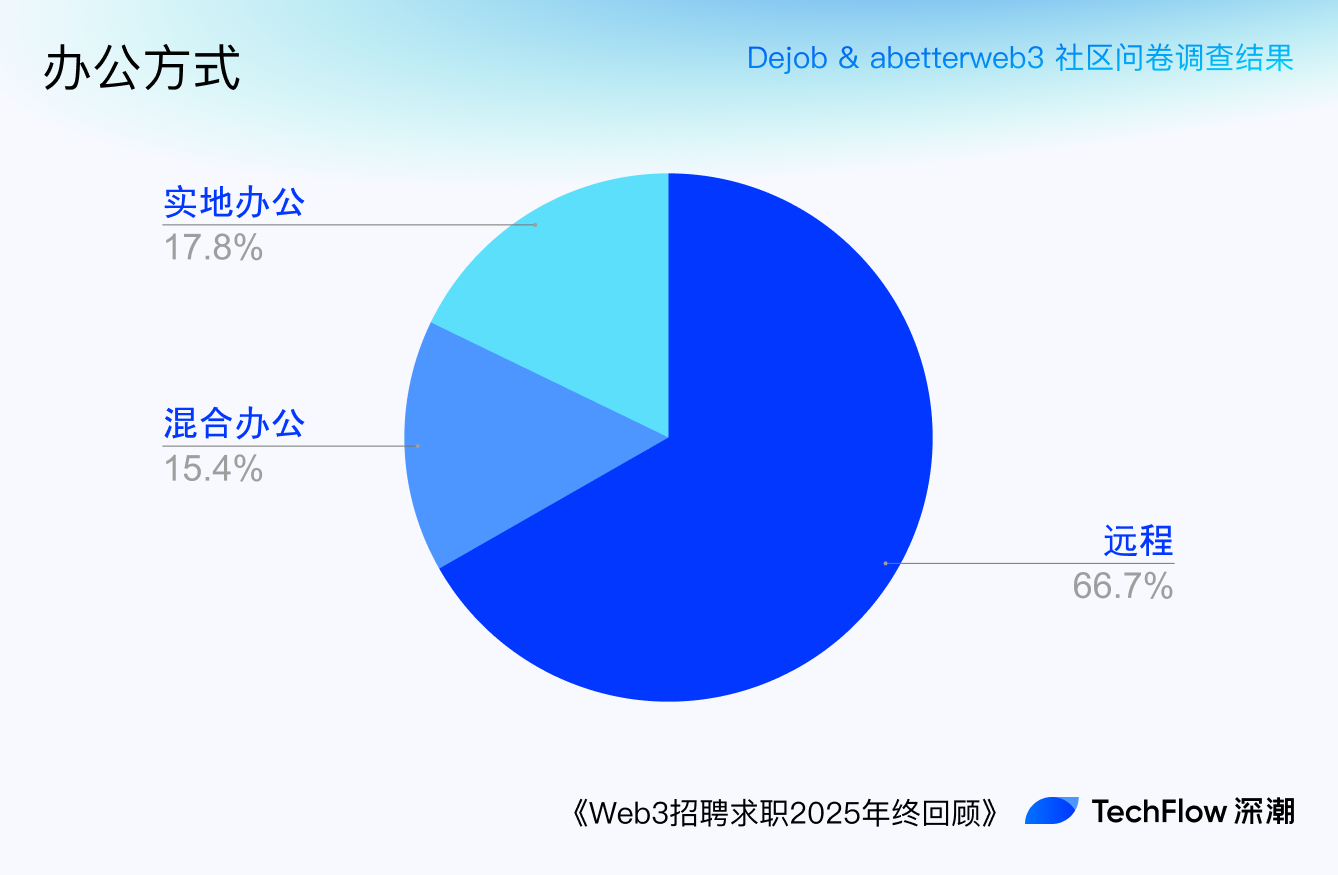
However, on the flip side of this seemingly hopeless income landscape, Web3's strong remote work culture offers a significant breath of fresh air for many workers. Nearly 70% of respondents indicated their company supports remote work, with another 15% supporting hybrid work (i.e.,虽然有办公室 but not mandatory attendance, or work-from-home allowed several days a week).
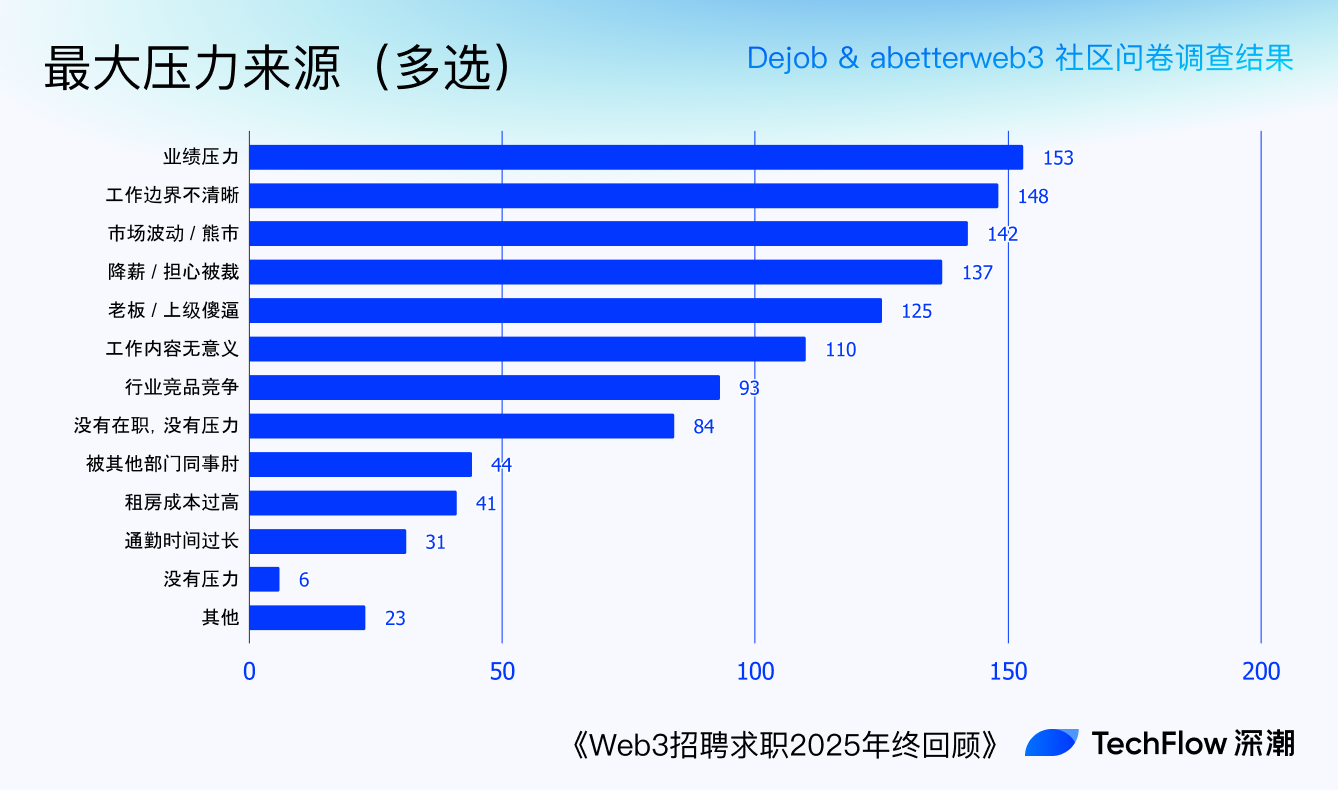
Remote work does alleviate some of the pain of being an employee. In the "biggest source of stress" question, 31 submissions chose "excessively long commute." Other top stress sources were product growth, work boundaries, market volatility, fear of being laid off, and having a foolish boss (老板傻逼).
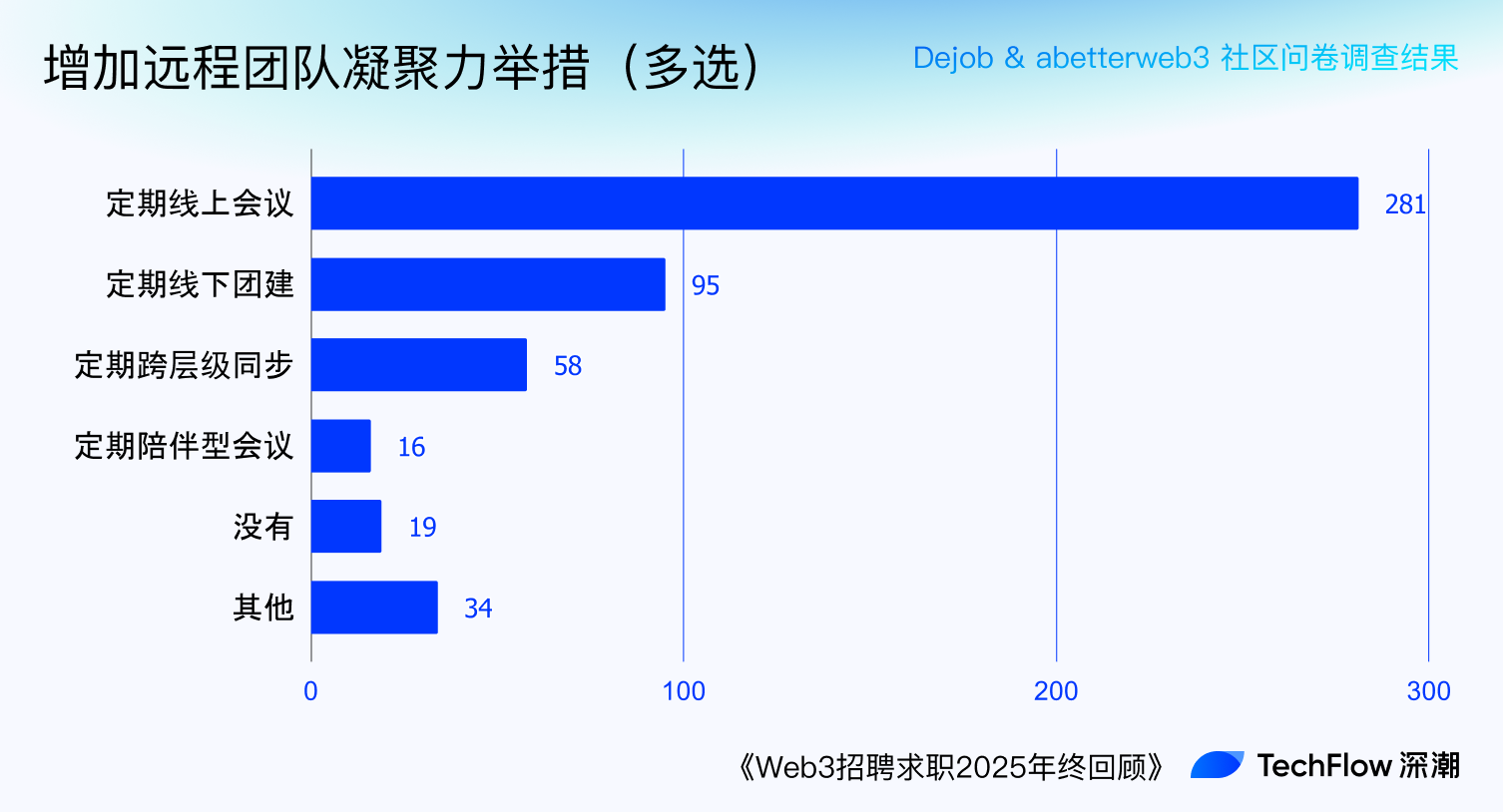
To maintain employees' mental health as social creatures, many companies have adopted measures to maintain team cohesion.
Under the combined effect of low income and instability, many choose to hold multiple jobs. 20% of respondents reported having side hustles. This also indirectly reflects the tech-oriented culture of most Web3 companies: as long as problems are solved and capabilities are sufficient, they generally do not interfere with employees' lifestyles or income sources.
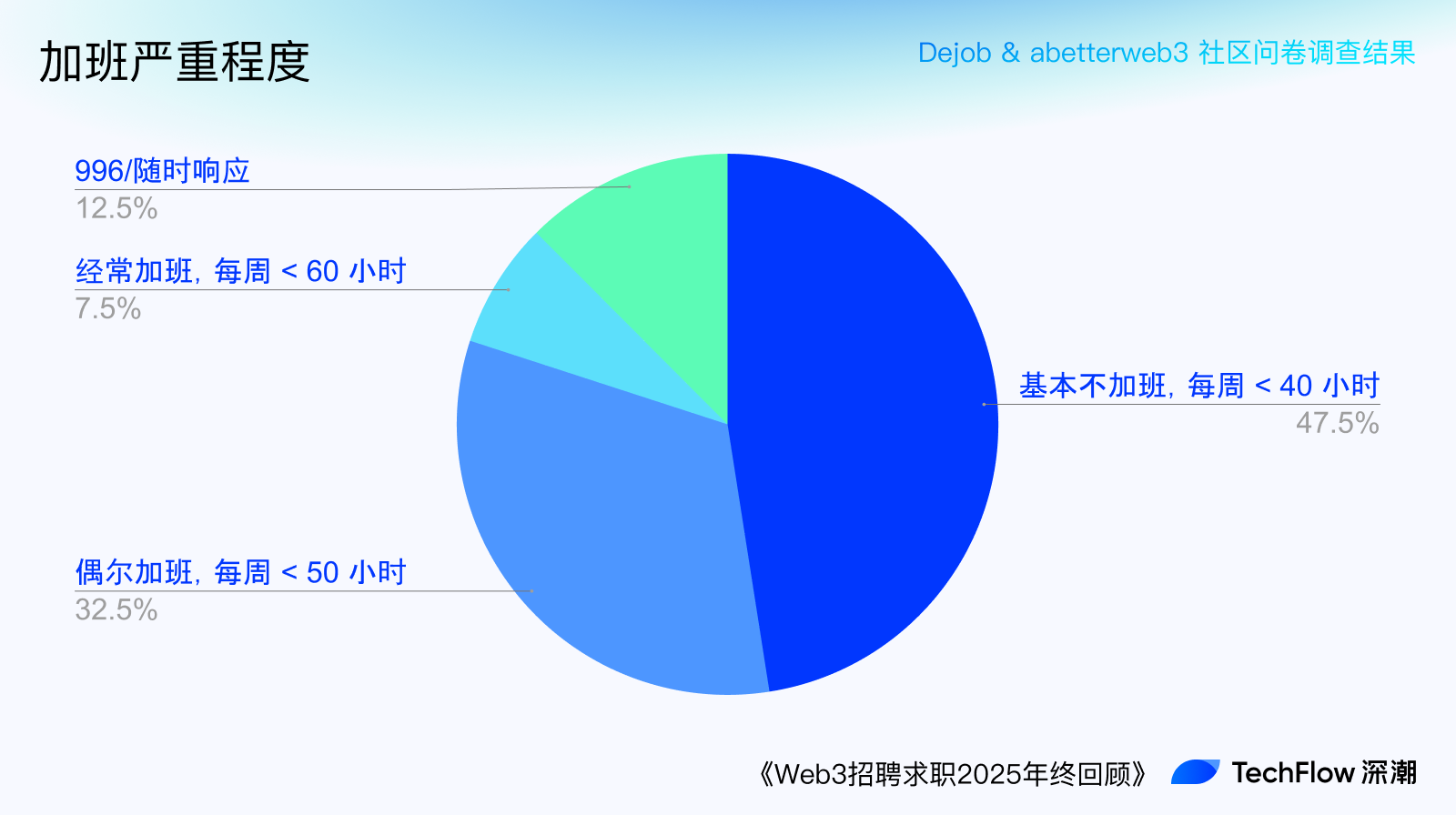
Regarding overtime intensity, 80% work approximately 40-50 hours per week. Thus, Web3 overtime seems less intense than many 996/007 sweatshops in web2.
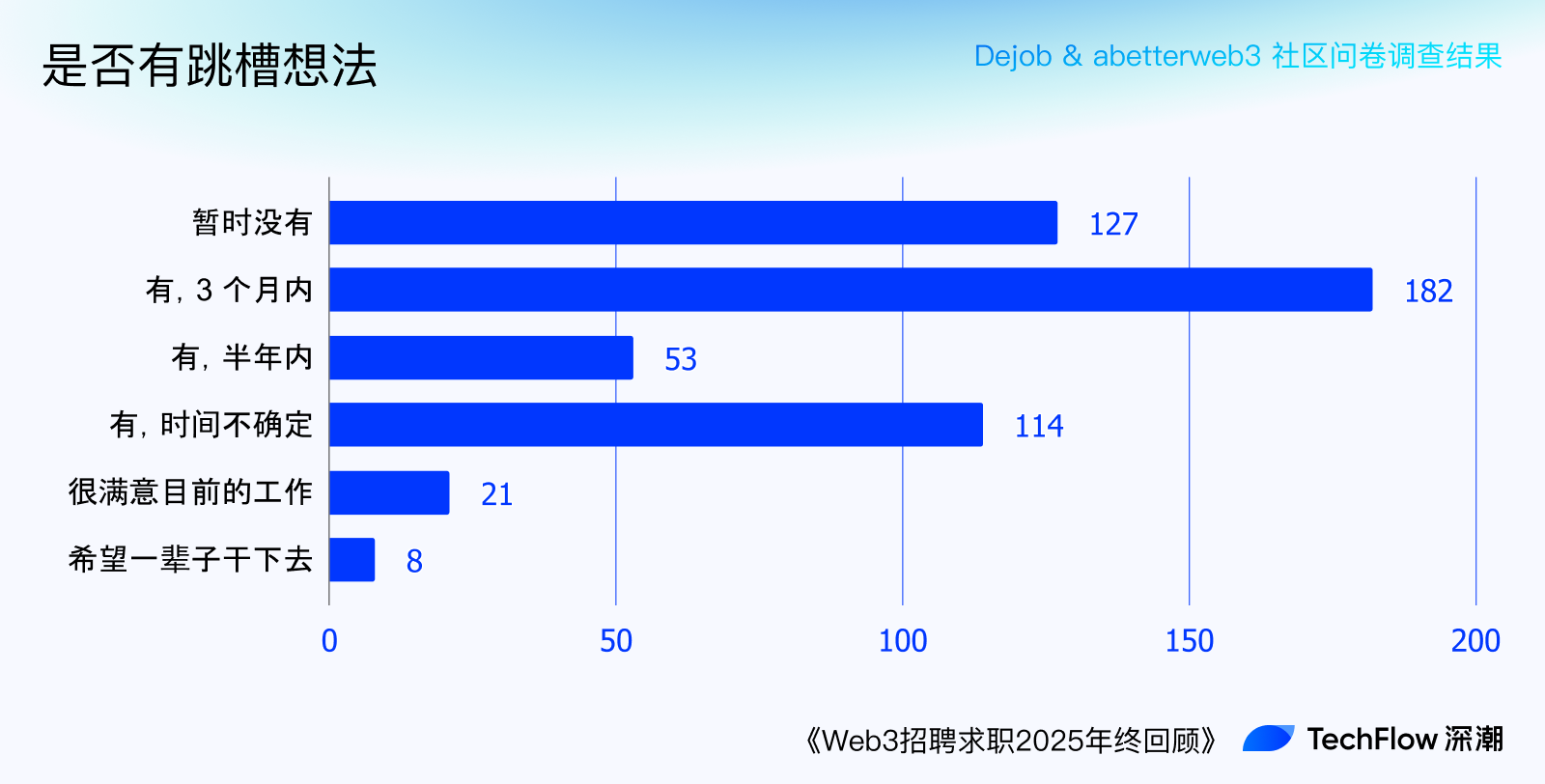
Regarding job hopping, over half want to change companies, with 30% planning to do so within 3-6 months. But about a quarter are satisfied with their current situation, and 8 respondents even identified a "dream company they hope to work for forever."
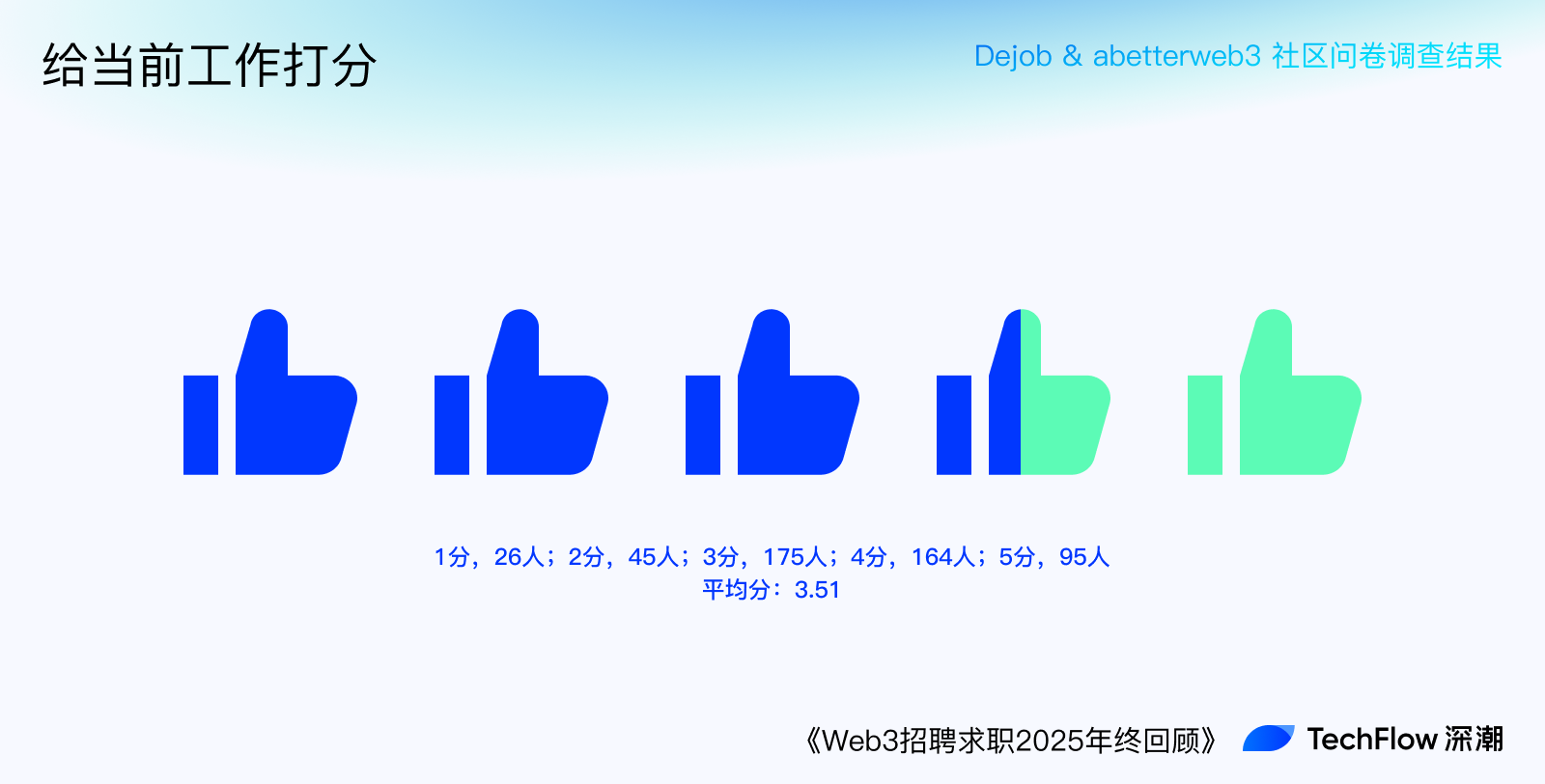
Considering factors like reasonable hours, remote work options, and side hustle tolerance, many rate their current job positively. The average score given in the job rating section was 3.51.
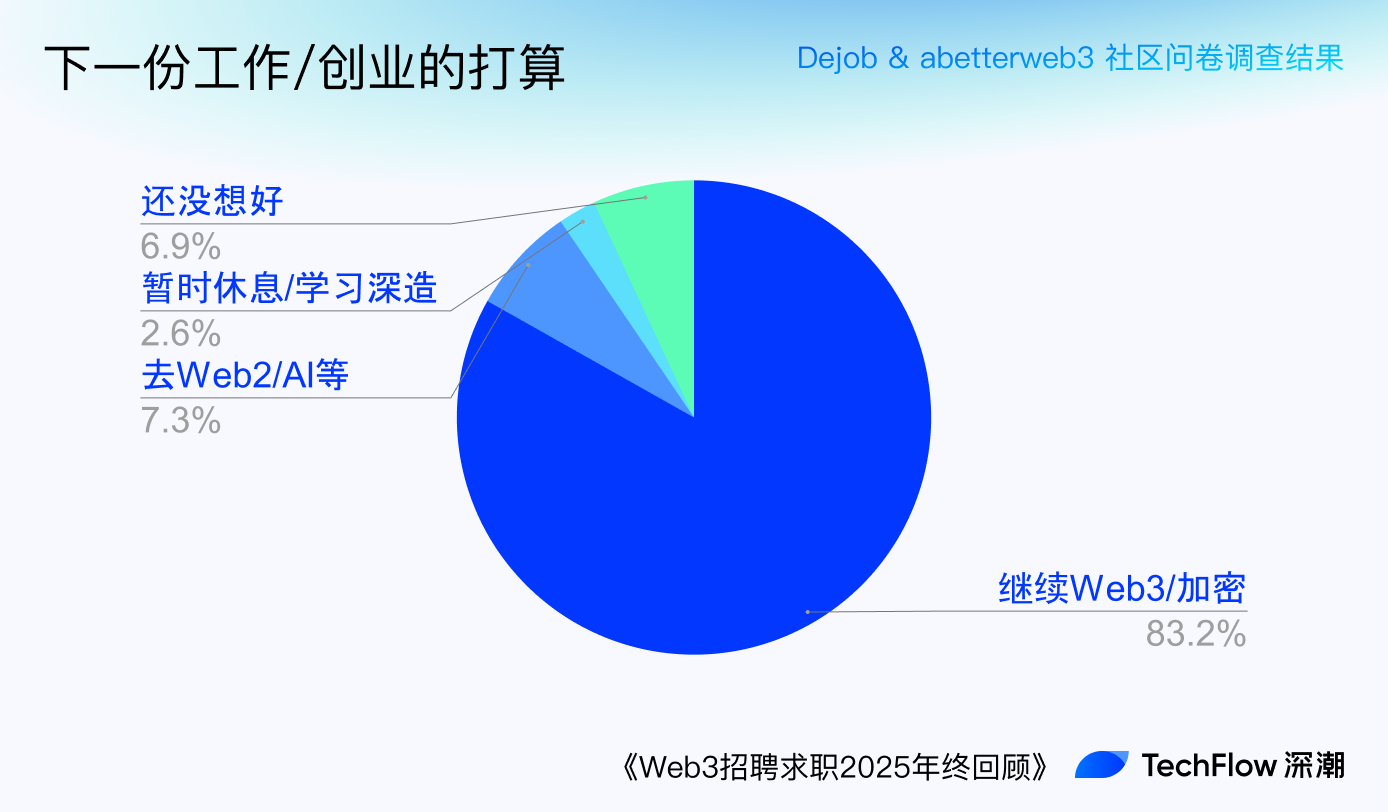
When asked if their next job would still be in the crypto space, over 80% chose to stay, while 7% chose to leave.
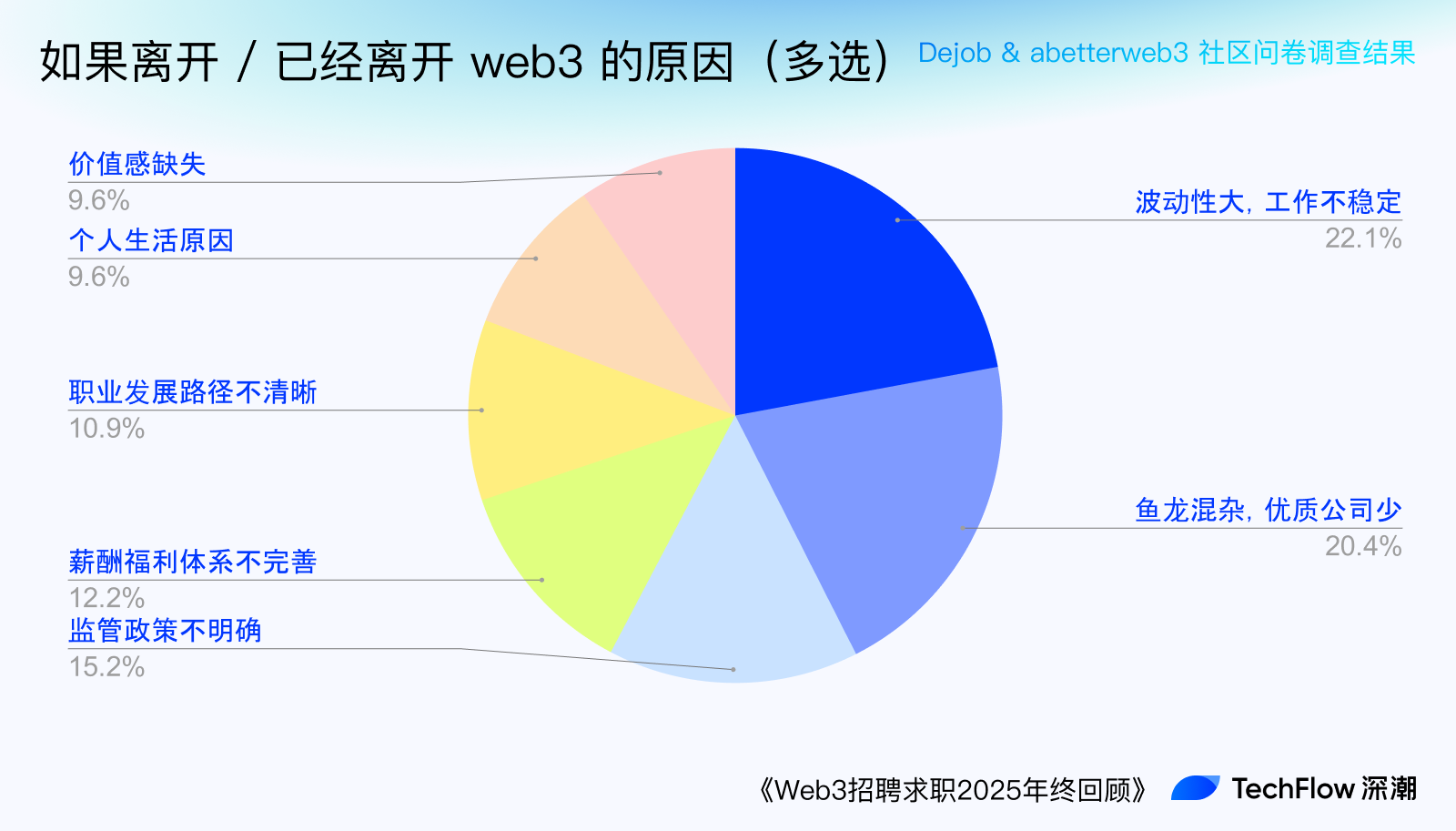
The choices for reasons to leave reflect the cold, harsh reality at the industry's core.
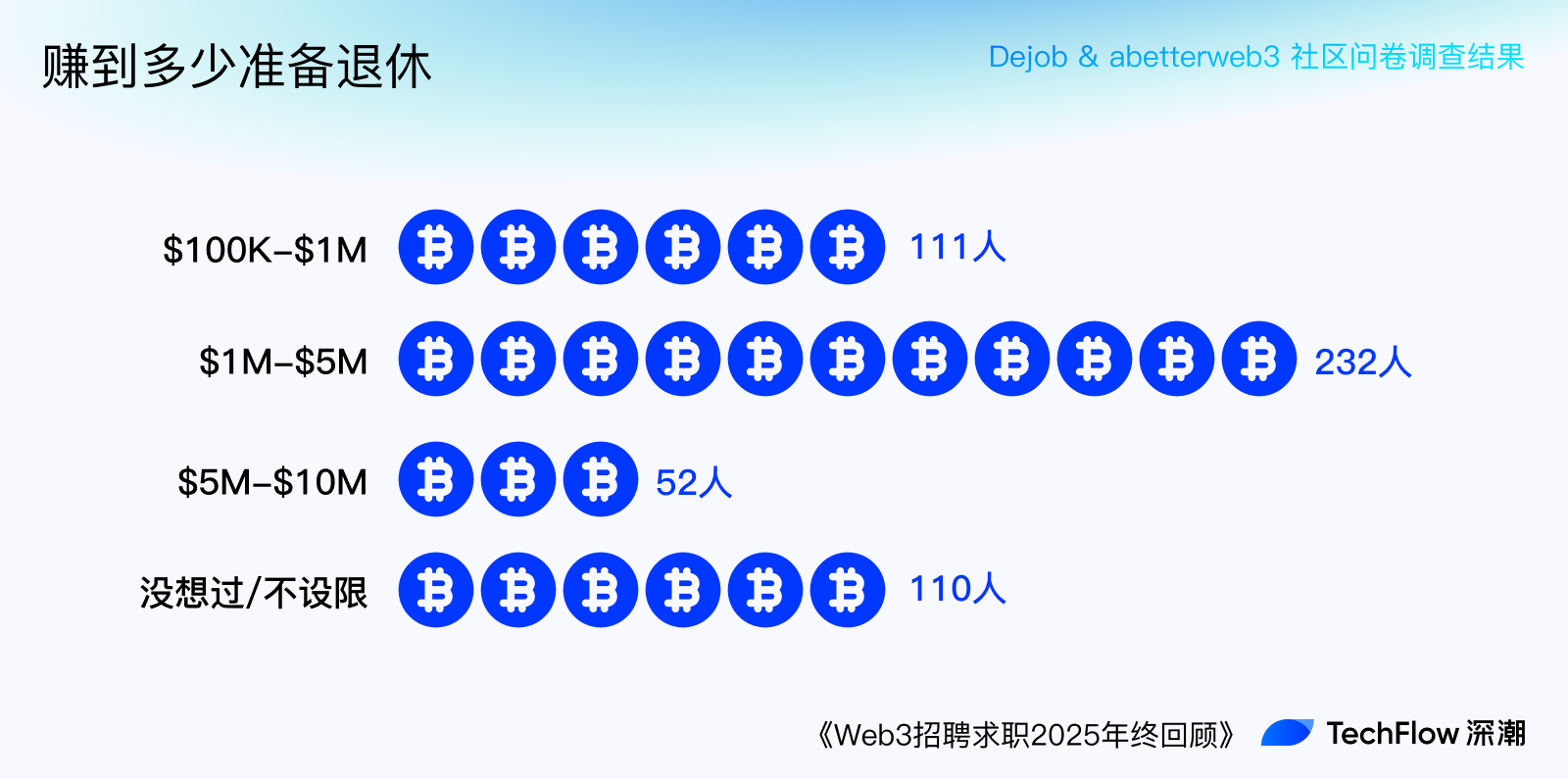
But all this preparation is for early retirement. When asked "What level of wealth would make you consider resigning?", the vast majority chose $1M - $5M (approx. RMB 7 million ~ 35 million). This might indeed be the upper limit of wealth attainable through salaried work for one person. However, 20% chose "no limit," reflecting confidence in their own abilities.
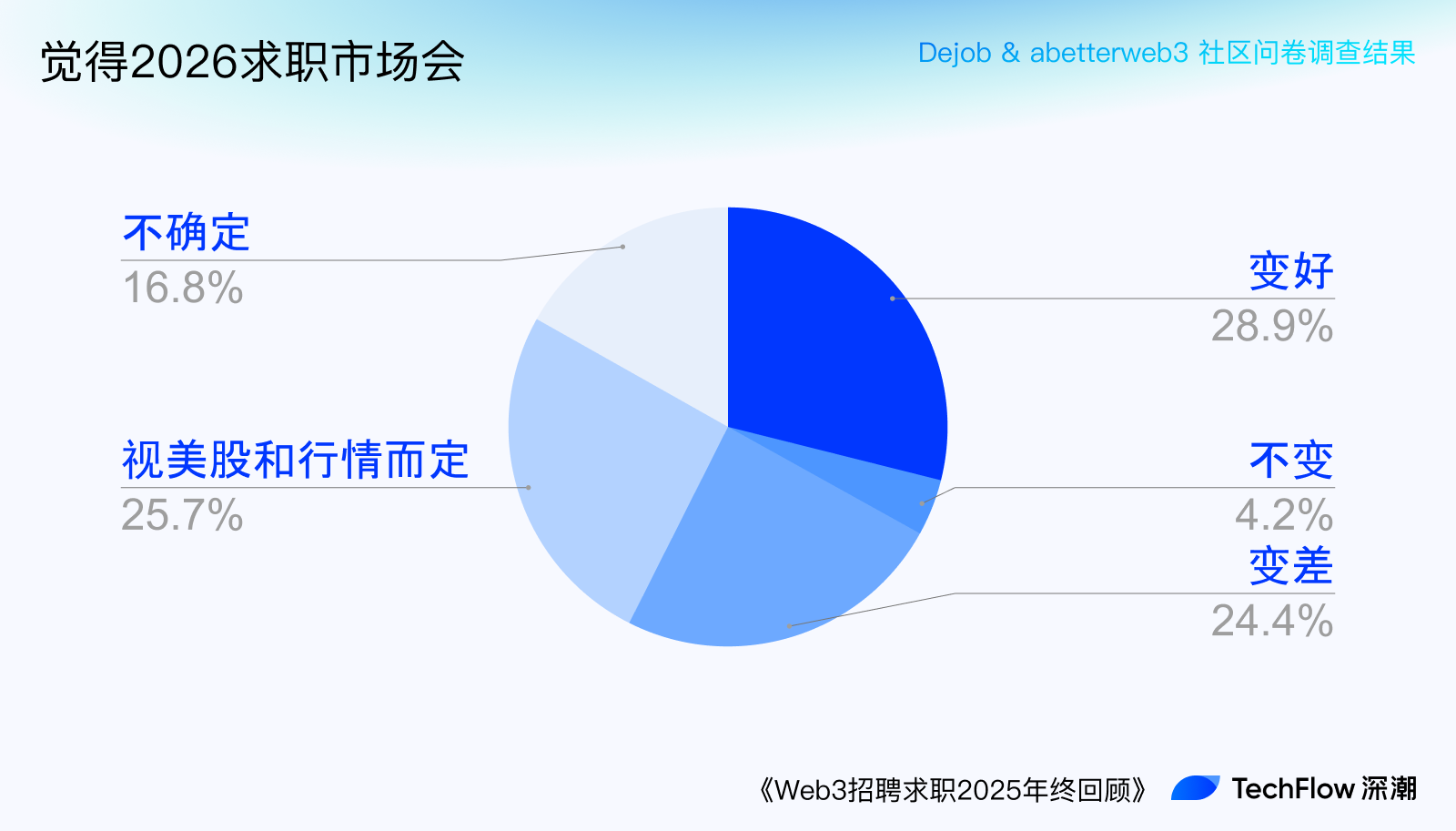
Regarding optimism about the 2026 job market, only 28% believe it will improve, with most being pessimistic or taking a wait-and-see attitude.
Truth Session 👀

Beyond the above questions, we added a few optional ones to gather some practitioners' most candid views on current industry companies (for entertainment purposes only).

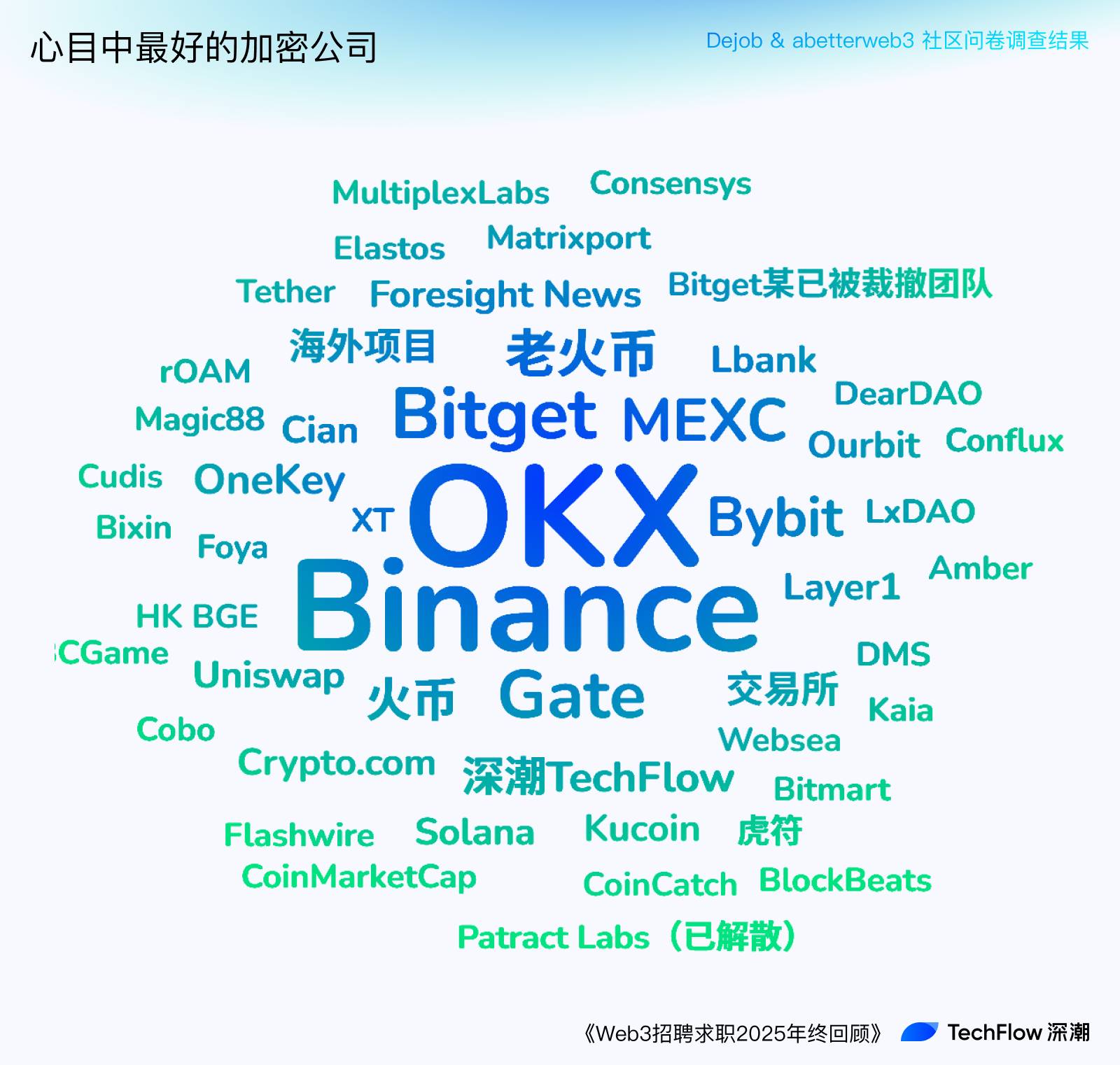
In the question "The best crypto company in your opinion", the top ten companies were:

  • OKX (26), Binance (23), Bitget (10), Gate (9), MEXC (7), Bybit (6), Old Huobi (5), Huobi (4), Deep Tide TechFlow (3), OneKey (3)

Surprisingly, some already dissolved teams were mentioned, like Huobi from the Li Lin era, a since-disbanded team at Bitget, the dissolved Consensus Lab, etc. Perhaps dream companies are worth remembering for a lifetime.
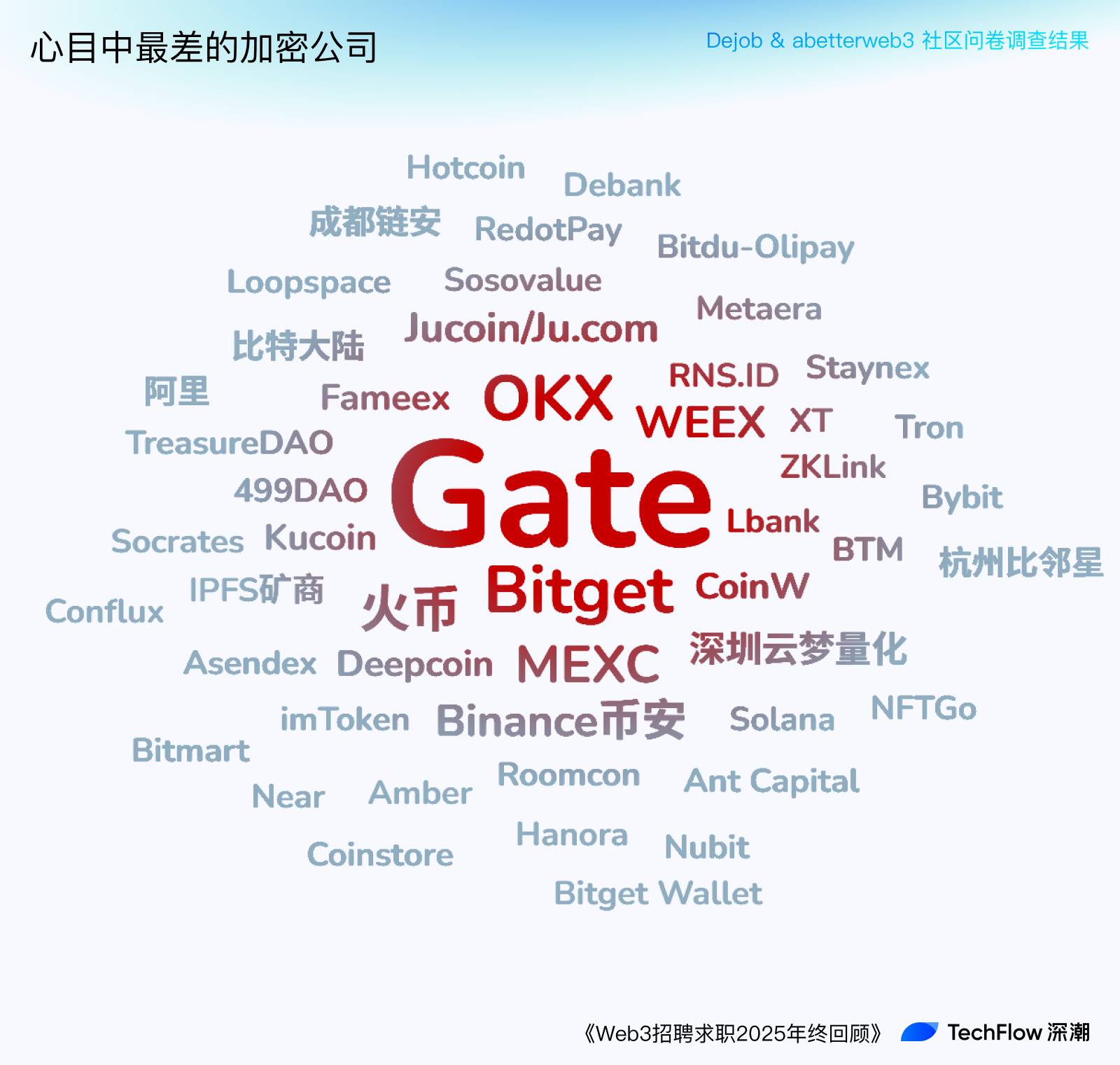
In the question "The worst crypto company in your opinion", the top ten companies were:

  • Gate (43), Bitget (13), OKX (12), MEXC (8), Huobi (7), Binance (5), WEEX (5), CoinW (2), Kucoin (2), Lbank (1)

Some exchanges appear on both the best and worst lists. This might indicate that exchanges are vast entities with complex structures, and the experience of working in different departments under different leaders can be worlds apart.
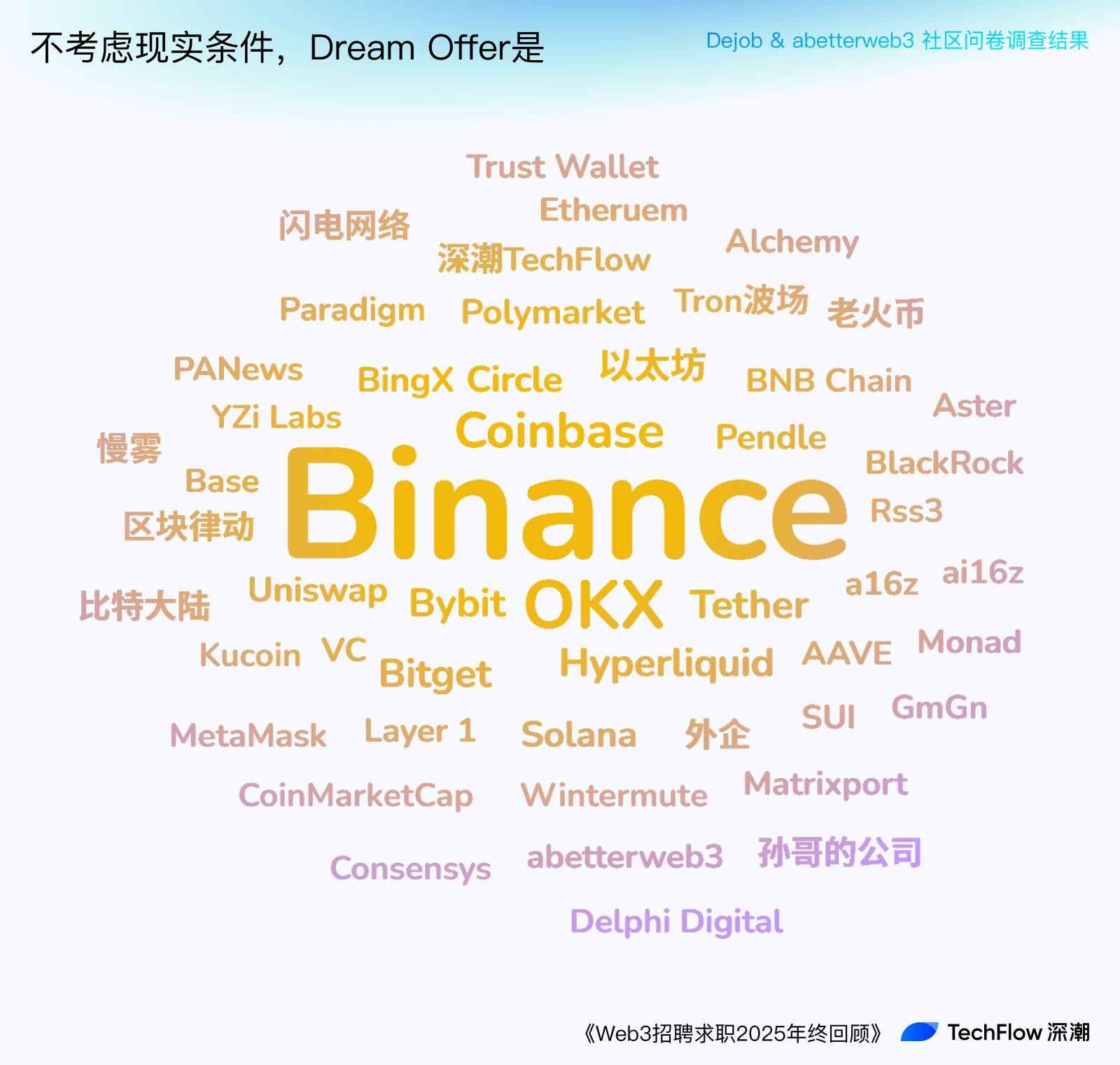
In the question "Disregarding practical constraints, which company would you most want to work for?", the top ten companies were:

  • Binance (177), OKX (50), Coinbase (25), Hyperliquid (11), Bybit (11), Bitget (10), Tether (10), Circle (6), Solana (5), Ethereum (5)

Binance, as the industry leader, unsurprisingly tops the list. As the "Tencent of the crypto circle," Binance holds prestige both externally and as a golden resume booster within the industry,名副其实地扶持个人职业生涯 (living up to its name in fostering personal careers). The chain's new star Hyperliquid, as a non-exchange entity, made the top 10, reflecting its strong community and people's desire for non-exchange products. Besides top exchanges, names of foreign companies/overseas infrastructure significantly increased in these answers, also reflecting, in a way, most job seekers' positive view of foreign companies and disappointment with Chinese teams.
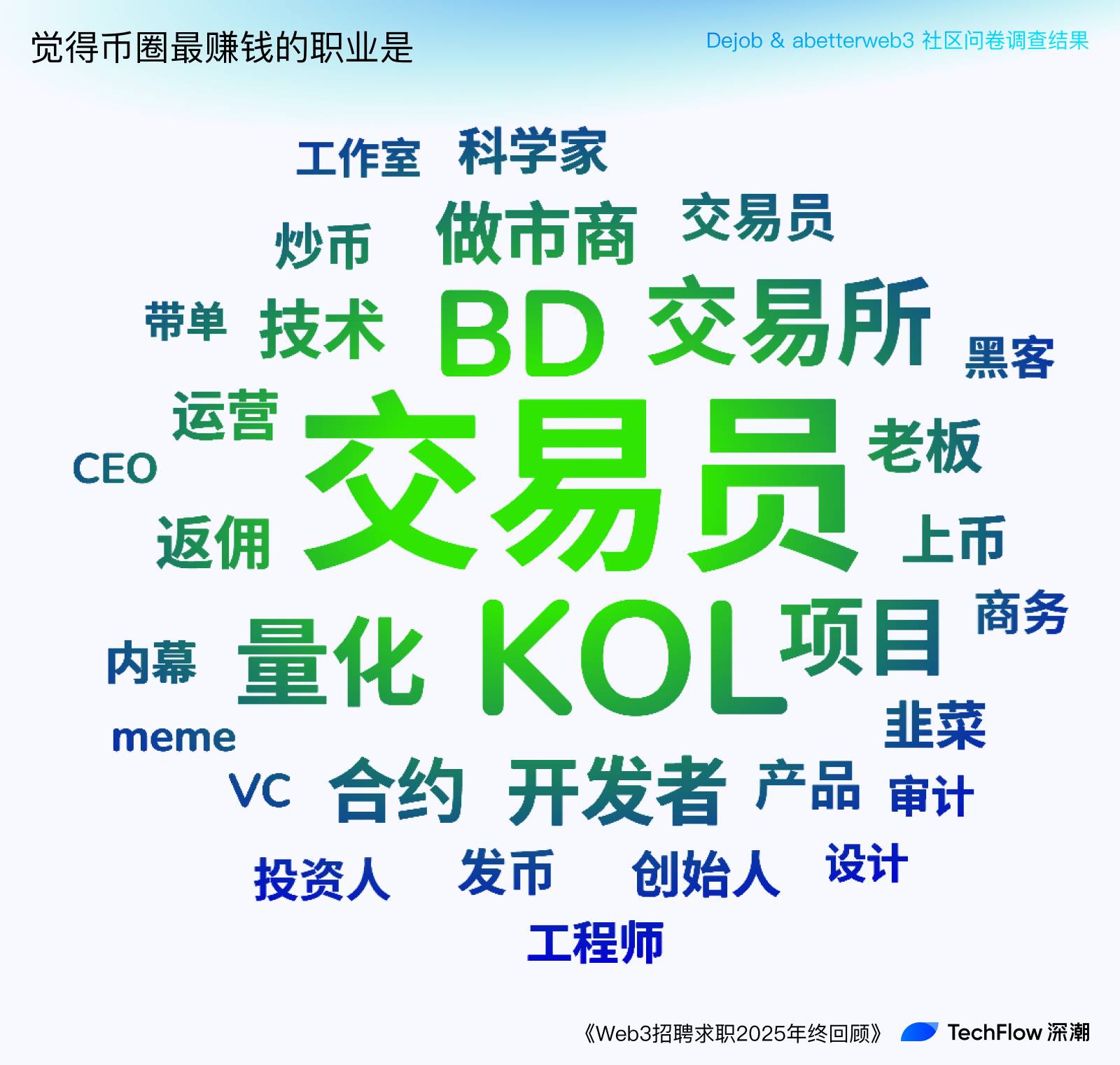
In the question "Which profession do you think is the most profitable in crypto?", high-frequency keywords included:

  • Trader (85), KOL (68), BD (Business Development) (47), Exchange (32), Quant (Quantitative Trading) (32), Project (方) (27), Developer (20), Futures (合约) (17), Market Maker (16), Technology (14)

Traders rank first, likely because the erratic market of recent years made many realize that no matter the company or role, it might not compare to directly participating in the market博弈 (gaming); KOLs follow closely, likely because they have the opportunity to access project tokens, possess informational advantages, or can directly influence specific assets for profit. Pure technical roles远离市场 (away from the market) were also mentioned, perhaps because in the eyes of most non-developers, "technology" is an indispensable part for a "super individual" to achieve a breakthrough.
Пов'язані питання

QWhat percentage of surveyed crypto industry workers earn less than $4000 per month?

AOver 70% of surveyed crypto industry workers earn less than $4000 per month.

QWhat is the most common type of company where crypto professionals have worked, according to the survey?

AExchanges are the most common type of company, with over half of the respondents having worked at one.

QDespite the low pay, what key benefit leads over 80% of respondents to choose to stay in the crypto industry?

AA key benefit is the prevalence of remote work, with nearly 70% of companies supporting it, offering greater flexibility.

QWhat was the most frequently cited 'most profitable profession' in the crypto space according to the survey's 'heart-to-heart' section?

ATrader was cited as the most profitable profession, followed by KOL (Key Opinion Leader).

QWhat fraction of respondents reported being in a 'pay-to-work' state, meaning their overall wealth accumulation in crypto is negative?

AA quarter (25%) of the respondents reported being in a 'pay-to-work' state with negative overall wealth accumulation.

Пов'язані матеріали

Fed's Internal Doves Flock to Hawkish Stance, Warsh's Debut "Between a Rock and a Hard Place"

U.S. Federal Reserve officials who previously advocated for rate cuts, including Governor Christopher Waller, have recently shifted their stance, with many now not ruling out the possibility of future rate hikes. This sets a challenging stage for new Fed Chair Kevin Warsh's first policy meeting. Appointed by President Trump based on his dovish views, Warsh now faces a committee where the debate has pivoted from "when to cut" to "whether to hike," driven by persistent inflation above 3%, a strong labor market, and supply-side pressures from AI infrastructure demands and geopolitical tensions. Key figures illustrate the shift. Governor Waller, once concerned about employment, now says data has pushed him toward considering rate increases. Even moderate voices like Governor Lisa Cook, while expecting inflation to ease, have indicated readiness to hike if it fails to do so. Long-time hawks such as regional Fed presidents Beth Hammack, Lorie Logan, and Neel Kashkari have grown more vocal, arguing that the real policy rate is effectively falling and that action may soon be needed. The upcoming Fed meeting is expected to keep rates steady but will likely remove the "easing bias" from its statement, signaling a neutral stance between cuts and hikes. The quarterly "dot plot" is anticipated to show most officials projecting no cuts this year, with some potentially indicating hikes. Chair Warsh, a critic of the Fed's reliance on forward guidance like the dot plot, must navigate communicating this pivot using tools he has questioned, all while steering policy in a direction counter to the preferences of the president who appointed him. The consensus suggests the Fed's next move could well be a rate increase.

marsbit3 хв тому

Fed's Internal Doves Flock to Hawkish Stance, Warsh's Debut "Between a Rock and a Hard Place"

marsbit3 хв тому

The Trillion-Yuan Market Cap 'Yi Zhong Tian': Who is the True Value King?

The article analyzes the three leading Chinese optical module companies, collectively nicknamed "Yi Zhong Tian": Xinyisheng, Zhongji Innolight, and TFC Optical Communication. It evaluates their "cost-performance" not by current stock price, but through three lenses: PEG ratio (growth vs. valuation), earnings quality, and premium/discount for certainty. Xinyisheng shows the most attractive PEG ratio and high profitability, but its valuation reflects discounts for risks like high customer concentration and reliance on overseas markets. Zhongji Innolight, the most expensive, commands a premium for its market leadership, dominant share in key products like 800G/1.6T modules, and higher earnings certainty, though it faces geopolitical risks. TFC Optical, as an upstream component supplier ("water seller"), has the highest gross margin and bets on the long-term CPO/NPO architecture trend, but trades at a high valuation with more stable, less explosive growth. The core argument is that while these companies dominate module assembly, the true profit pool and technological moat lie upstream in laser and switch chips, currently controlled by U.S. firms like Lumentum and Coherent. The long-term "cost-performance" for these Chinese leaders hinges on whether the domestic industry, exemplified by companies like Yuanjie Technology, can successfully move up the value chain into high-power laser chips. Otherwise, their high growth may remain confined to the lower-margin assembly segment.

marsbit13 хв тому

The Trillion-Yuan Market Cap 'Yi Zhong Tian': Who is the True Value King?

marsbit13 хв тому

Has the Crypto Market Bottomed? Here's What Institutions Think

The crypto market is in a period of significant debate, with leading institutions offering differing views on whether a bottom has been reached. Three prominent firms have published detailed analyses: * **Galaxy Digital** argues Bitcoin has **not yet bottomed**. Their analysis of 13 historical indicators across six dimensions (valuation, profit-taking, miner pressure, etc.) shows only four are fully met. They project a potential bottom range between $30k and $54k. * **NYDIG** states a bottom is **possible but not likely**. While metrics are close to historic bear market extremes, they note the absence of a classic panic-selling event. They also suggest increased institutional adoption may have structurally altered the market cycle, potentially leading to a shallower downturn. * **Standard Chartered Bank** asserts the **bottom has already occurred** at around $59k. They cite two key factors: potential US-Iran diplomatic progress and the anticipated SpaceX IPO, which they believe absorbed capital and caused ETF selling pressure that is now subsiding. They forecast a year-end price target of $100k. Despite the surface-level disagreement, the reports share critical common ground more valuable for long-term investors: 1. All three believe the market bottom will form **within this year**. 2. All agree the current price is **closer to the bottom than to previous highs**. 3. All maintain a **bullish long-term outlook** for Bitcoin and a new cycle. The core takeaway is that while the exact bottom price ($40k, $50k, or $60k) is debated, the consensus is that a bottom is imminent. For long-term holders, the primary focus should not be pinpointing the absolute low, but on the future potential for prices to reach $100k, $200k, or higher. The fundamental thesis for Bitcoin—sovereign debt accumulation, inflation, declining trust in centralized institutions, global digitization, and improved accessibility—remains intact and is arguably strengthening. The overall landscape is viewed as more favorable than in previous crypto winters.

marsbit23 хв тому

Has the Crypto Market Bottomed? Here's What Institutions Think

marsbit23 хв тому

The 'Chip' Challenge and Breakthroughs in China's Optical Industry Chain

China's Photonics Industry: Bottlenecks and Breakthroughs In the global AI race, computing chips dominate the narrative, but the underlying bottleneck increasingly defining the scale of AI clusters is light—or more specifically, optical connectivity. Optical modules, which translate electrical signals to light and vice versa, are crucial for connecting thousands of GPUs in AI data centers, preventing data congestion and ensuring efficient model training. High-speed modules (800G, 1.6T) are now standard, with performance hinging on advanced DSP (Digital Signal Processor) chips. This is where a critical dependency lies. Two US giants—Marvell and Broadcom—collectively dominate over 90% of the high-end DSP chip market. Chinese optical module leaders like Zhongji Innolight and Eoptolink rely on these chips to manufacture modules for overseas AI customers, primarily in North America. While this creates a supply chain vulnerability, complete decoupling is difficult. Marvell derives over half its revenue from Greater China, and the US firms depend on Chinese partners for chip packaging and optical components. The risk from laser chips (e.g., from Lumentum), another key component, is considered more manageable due to multiple global suppliers and faster progress in domestic alternatives from companies like YOFC and Accelink. To mitigate risks, China's industry is pursuing a multi-pronged strategy: diversifying supply chains and locking in long-term orders; fostering a domestic market ecosystem to adopt homegrown DSPs from firms like Huawei HiSilicon and CETC; accelerating R&D in high-speed DSPs and advanced packaging; and investing in next-gen technologies like silicon photonics and Co-Packaged Optics (CPO) to reduce reliance on discrete DSPs. The ultimate solution lies not in short-term博弈 but in persistent advancement of domestic high-end chip R&D and manufacturing. While challenges remain in performance, certification, and ecosystem building, China's vast domestic market and manufacturing base provide a crucial buffer, buying time for the industry to achieve greater technological independence.

marsbit37 хв тому

The 'Chip' Challenge and Breakthroughs in China's Optical Industry Chain

marsbit37 хв тому

Behind SpaceX's $2 Trillion Market Cap: Why Does Musk Always Have the Next Move Planned?

On June 12th, SpaceX debuted on the Nasdaq, reaching a valuation that briefly touched $2 trillion. This marked the culmination of a 24-year journey from its founding in 2002, driven by Elon Musk's frustration at the high cost of buying rockets. The company's path was defined by early failures, with its first three Falcon 1 launches ending in explosions before a successful 2008 flight opened the era of commercial spaceflight. Key to its model was a fixed-price NASA contract, incentivizing cost reduction. SpaceX mastered rocket reusability, first achieving a Falcon 9 landing in 2015, which drastically cut launch costs. This enabled its profitable Starlink satellite internet constellation, envisioned years before reusability was proven, to create an internal market for frequent launches. Similarly, the next-generation Starship rocket was in development long before its first flight, with its business case evolving from Mars colonization to supporting the emerging concept of in-orbit data centers for AI—a story now central to its valuation. The company's recent IPO, a reversal of its long-standing "no IPO" stance, is funding this ambitious "space-based compute" vision. While major tech players like Google, Blue Origin, and others are investing heavily, significant technical and cost hurdles remain. Ultimately, SpaceX's history is one of creating its own demand: first with Starlink and now with space-based AI compute, betting that its next rocket will enable its next giant market.

marsbit40 хв тому

Behind SpaceX's $2 Trillion Market Cap: Why Does Musk Always Have the Next Move Planned?

marsbit40 хв тому

Торгівля

Спот
Ф'ючерси

Популярні статті

Що таке ATWO

I. Вступ до проектуArena Two - це децентралізована інтерактивна платформа, яка дозволяє фанатам грати активну, токенізовану роль у результатах подій в реальному часі. На відміну від традиційних моделей трансляції, які зменшують фанатів до пасивних глядачів, Arena Two використовує технологію блокчейн, щоб дозволити фанатам безпосередньо голосувати в реальному часі та впливати на результати на полі.II. Інформація про токенНазва токена: ATWO(Arena Two)III. Пов'язані посиланняВебсайт:https://arenatwo.com/Експлорери:https://basescan.org/token/0x499D35eBE6cEe9B2Ac35Fd003fcBbeeB9CFc7B32Twitter:https://x.com/arenatwoXПримітка: Вступ до проекту взято з матеріалів, опублікованих або наданих офіційною командою проекту, які є лише для довідки і не є інвестиційною порадою. HTX не несе відповідальності за будь-які прямі або непрямі збитки, що виникають внаслідок цього.

340 переглядів усьогоОпубліковано 2026.05.18Оновлено 2026.06.02

Що таке ATWO

Як купити ATWO

Ласкаво просимо до HTX.com! Ми зробили покупку Arena Two (ATWO) простою та зручною. Дотримуйтесь нашої покрокової інструкції, щоб розпочати свою криптовалютну подорож.Крок 1: Створіть обліковий запис на HTXВикористовуйте свою електронну пошту або номер телефону, щоб зареєструвати обліковий запис на HTX безплатно. Пройдіть безпроблемну реєстрацію й отримайте доступ до всіх функцій.ЗареєструватисьКрок 2: Перейдіть до розділу Купити крипту і виберіть спосіб оплатиКредитна/дебетова картка: використовуйте вашу картку Visa або Mastercard, щоб миттєво купити Arena Two (ATWO).Баланс: використовуйте кошти з балансу вашого рахунку HTX для безперешкодної торгівлі.Треті особи: ми додали популярні способи оплати, такі як Google Pay та Apple Pay, щоб підвищити зручність.P2P: Торгуйте безпосередньо з іншими користувачами на HTX.Позабіржова торгівля (OTC): ми пропонуємо індивідуальні послуги та конкурентні обмінні курси для трейдерів.Крок 3: Зберігайте свої Arena Two (ATWO)Після придбання Arena Two (ATWO) збережіть його у своєму обліковому записі на HTX. Крім того, ви можете відправити його в інше місце за допомогою блокчейн-переказу або використовувати його для торгівлі іншими криптовалютами.Крок 4: Торгівля Arena Two (ATWO)Легко торгуйте Arena Two (ATWO) на спотовому ринку HTX. Просто увійдіть до свого облікового запису, виберіть торгову пару, укладайте угоди та спостерігайте за ними в режимі реального часу. Ми пропонуємо зручний досвід як для початківців, так і для досвідчених трейдерів.

240 переглядів усьогоОпубліковано 2026.05.18Оновлено 2026.06.02

Як купити ATWO

Що таке ZEST

I. Вступ до проектуПротокол Zest - це протокол кредитування Bitcoin, який дозволяє постачальникам ліквідності Bitcoin отримувати дохід у Bitcoin через професійно керовані кредитні пулли.II. Інформація про токенНазва токена: ZEST (Протокол Zest)III. Пов'язані посиланняВебсайт:https://www.zestprotocol.com/Експлорери:https://bscscan.com/token/0x5506599c722389a60580b5213ea1da60d64754a1Twitter:https://twitter.com/ZestProtocolПримітка: Вступ до проекту взято з матеріалів, опублікованих або наданих офіційною командою проекту, які є лише для довідки і не є інвестиційною порадою. HTX не несе відповідальності за будь-які прямі або непрямі збитки, що виникають внаслідок цього.

197 переглядів усьогоОпубліковано 2026.05.19Оновлено 2026.06.02

Що таке ZEST

Обговорення

Ласкаво просимо до спільноти HTX. Тут ви можете бути в курсі останніх подій розвитку платформи та отримати доступ до професійної ринкової інформації. Нижче представлені думки користувачів щодо ціни A (A).

活动图片