投机热潮即将落幕?比特币正“闪烁”多个看跌信号!

金十Опубліковано о 2024-03-01Востаннє оновлено о 2024-03-01

摩根大通策略师表示,使比特币进一步上涨的最令人期待的催化剂之一,最终可能会压低这一最大加密货币的价格

这一催化剂便是比特币的“减半”事件,指矿工产出新区块后所获得的奖励大约每隔四年减半一次。这意味着减产后,每挖出一个区块,其对应的比特币奖励都只有减半前的奖励的一半。

目前,比特币已经进行了三次“减半”,分别发生在2012年11月、2016年7月和2020年5月。第四次比特币减半时间预计将发生在2024年5月。届时,比特币产量将会由现在的6.25枚减半到3.125枚。

结合1月份批准的比特币现货ETF的需求飙升,倡导者称这将导致供应短缺。比特币今年上涨了约45%,至62000美元左右。

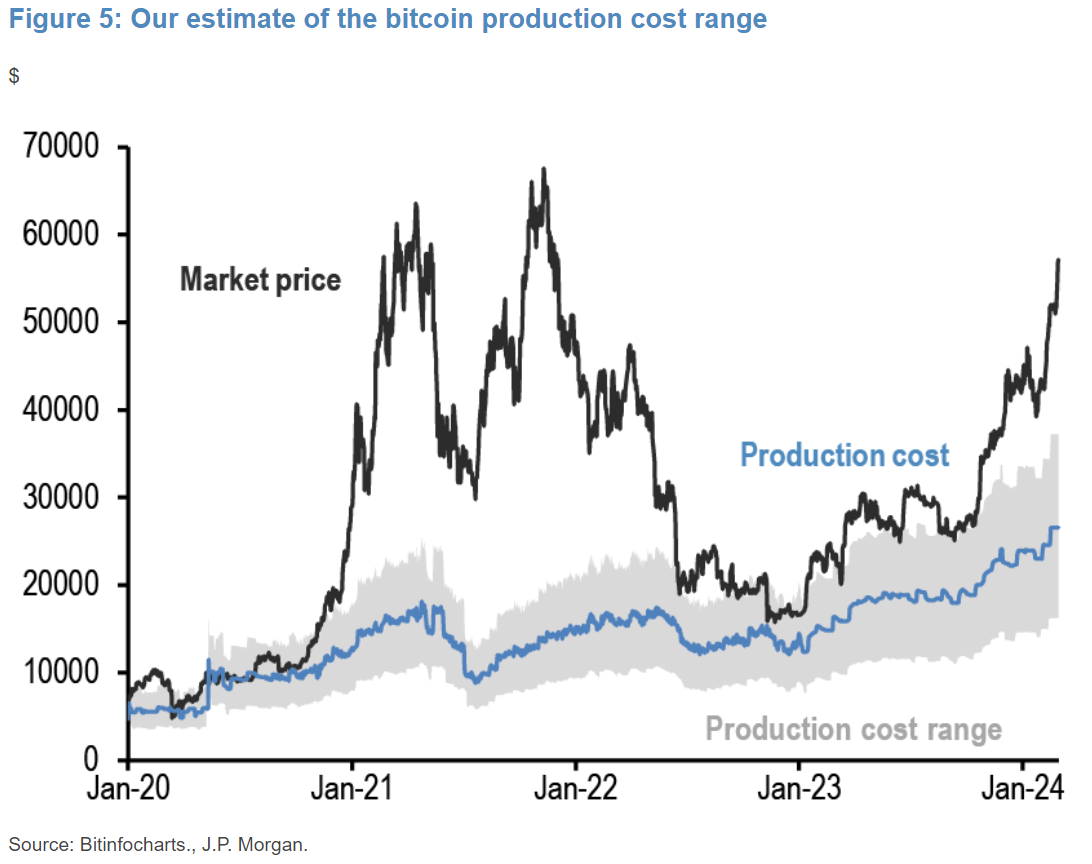
从历史上看,比特币的价格在“减半”之后会上涨,是因为所谓的矿工生产成本是该资产价格的下限。摩根大通的策略师表示,比特币的平均生产成本目前为26500美元,简单来算,“减半”后这一成本将翻番,至53000美元

然而,随着挖矿难度的增加,一些小型矿工被将迫退出,挖矿难度可能比最初估计的低20%,从而降低了生产成本。摩根大通策略师们周四写道,由于比特币的这一下限支撑下降,投资者可能会在4月后看到比特币价格回落至4.2万美元

摩根大通预计比特币的“生产成本”不会随着“减半”而翻倍

摩根大通策略师的预测基于两个关键假设。

首先,“减半”后,矿工的电力成本估计平均为每千瓦时5美分,这可能因地点和规模而异。

其次,随着比特币挖矿在4月份之后变得更加能源密集型,一些挖矿效率低且难以获得资金的生产商将退出市场,因为他们的生产成本超过了盈利能力,这将使哈希率(衡量该行业总挖矿能力的指标)下降约20%。

注:哈希率是挖矿的关键指标,指计算机进行哈希运算的速度。哈希率提高则会增加矿工成功挖掘交易区块并获得区块奖励的机会。

摩根大通策略师们写道:

“这20%的下降将使哈希率更接近历史趋势,将有效地将我们估计的生产成本范围的中值削减到4.2万美元。这也是我们设想的,一旦比特币减半引发的乐观情绪在4月后消退,比特币价格会走向的水平。”

不过,摩根大通策略师也指出,如果比特币的价格保持在高位,哈希值的下降可能不会成为现实。在上市矿商在2022年获得了更多的市场份额之后,第二年比特币价格的上涨吸引了较小的矿商重返该行业,因为效率较低的矿商也能有利可图。

随着越来越多的人通过新的比特币现货ETF投资比特币,继续吸引新的投资者,比特币价格的上涨可能会让规模较小的矿商即使在4月份供应减少后仍能保持盈利。

比特币闪烁多重看跌信号

一些交易员已经开始警告,称比特币现在这种惊人的增长速度是不可持续的

Galaxy Digital创始人Michael Novogratz在接受采访时表示,比特币最近的价格上涨已经使价格达到了“非常泡沫的水平”。他预计,在价格恢复攀升之前,会出现一次“回调”。

周四,比特币一度上涨5.12%,至63649美元,之后几乎没有变化。

此前的回调是在前一天动荡的交易时段之后发生的。比特币在周三飙升至63968美元的高位,之后在暴跌中回吐了大部分涨幅,跌至59000美元以下。

市场上的担忧是,比特币现货ETF的大幅资金流入是否导致公开市场上可供购买的比特币供应不足?根据Glassnode的数据,超过一半的流通比特币在两年多的时间里没有变化。

数字资产平台FRNT Financial首席执行官Stephane Ouellette等人表示,这种担忧可能被夸大了因为短期投资者已经开始抛售头寸。他表示,“加密货币从现在到全面牛市还有很长一段路要走,但对市场因流动性危机而崩溃的担忧似乎并不一定是真的。”

但可以肯定的是,比特币的上涨势头确实可能会停滞,甚至回调。根据CryptoQuant的数据,短期比特币持有者(指那些可能经常交易比特币的人,而不是长期投资者)的未实现利润率在最近的大幅拉升后处于极端水平。

这家研究公司在周四发布的消息中说,目前短期投资者的利润率在45%左右,任何高于40%的利润率都表明价格可能出现回调。

与此同时,在比特币永续期货中开设新的多头头寸的成本已十分高昂,这是比特币可能即将放缓的另一个迹象。

根据CryptoQuant的数据,比特币永续期货的融资利率处于2021年4月以来的最高水平。“从历史上看,当开设新多头头寸的成本过高时,比特币价格往往会暂停或经历一次调整,”该研究公司表示。

Пов'язані матеріали

Idle Macs Can Also Make Money? An Overview of Eigen Labs' Decentralized AI Inference Network Darkbloom

AI inference is becoming a crucial layer of internet infrastructure, yet it remains largely dependent on costly, capacity-limited centralized systems with potential security risks. Meanwhile, millions of powerful computers sit idle globally. Eigen Labs' Darkbloom network aims to utilize this idle capacity by enabling distributed AI inference on Mac computers, specifically those with Apple Silicon chips. Darkbloom's architecture consists of three components: users who send inference requests, a coordinator (operated by Eigen Labs) that routes these requests, and providers (Mac owners) whose machines run the models and return outputs without being able to see the request content. The system prioritizes privacy through a hardened provider process, software integrity checks, and hardware-supported attestation based on Apple's security architecture to ensure verifiable privacy. Economically, Darkbloom differs from traditional models. It leverages existing hardware, with marginal costs primarily driven by electricity, allowing it to offer pricing roughly 50% lower than major API aggregators. Providers keep 100% of the inference revenue, and the project does not rely on token subsidies; earnings come solely from real AI inference demand. However, early-stage earnings are modest, with top providers currently earning under $6 per day, influenced by factors like hardware specs, uptime, and network demand. The network currently supports models like Google's Gemma 4 and OpenAI's GPT-OSS via OpenRouter. To participate as a provider, users need an Apple Silicon Mac running macOS 14 or later, must install the Darkbloom provider software, and keep the machine online with a stable internet connection.

marsbit12 хв тому

Idle Macs Can Also Make Money? An Overview of Eigen Labs' Decentralized AI Inference Network Darkbloom

marsbit12 хв тому

Which Crypto Sectors Have Been "Eaten" by AI Agents?

The article examines which crypto sectors have been increasingly dominated by AI Agents and which remain human-centric. In certain high-speed, efficiency-driven areas, AI Agents have taken clear control. This includes derivatives/perpetuals trading, where bots outperform humans significantly (e.g., a contest showed 0% of AI Agents were liquidated vs. 43% of humans), arbitrage/MEV extraction, and yield optimization (with ~68% of new DeFi protocols in Q1 2026 featuring autonomous AI Agents). Spot trading and portfolio optimization are also seeing heavy Agent adoption. However, the shift is not universal. In "battleground" sectors, both Agents and humans coexist. In prediction markets, Agents dominate short-term arbitrage, but humans still outperform in long-term, nuanced judgment calls. In DeFi lending, while liquidation is automated, core deposit/borrow decisions remain largely human-driven. Sectors still firmly led by human activity include stablecoin payments and card-based spending (driven by real-world economic activity and remittances) and wallets, which serve as the crucial human-verification and approval layer. The rise of Agents increases the need for robust human-Agent verification layers. Projects like World/AgentKit, t54, Self Protocol, and Kite AI are building infrastructure to create trust, security, and accountability by binding Agents to verified human identities. In conclusion, while AI Agents have decisively "eaten" speed and optimization-focused crypto sectors, human judgment, trust, and real-world context remain dominant in areas that create broad economic value, such as payments and identity. The future likely involves a symbiotic relationship where Agents require human verification and oversight to operate effectively.

Foresight News18 хв тому

Which Crypto Sectors Have Been "Eaten" by AI Agents?

Foresight News18 хв тому

After Rising 11 Times in a Year, Micron's Earnings Report Becomes a Stress Test for the AI Memory Market

**Micron's Upcoming Earnings: A Crucial Test for the AI Memory Rally** Investors in AI memory stocks face a critical moment on June 24th, when Micron Technology reports quarterly earnings. The stock, having surged approximately 11-fold from $103 to $1,134 over the past year, carries immense market expectations. Wall Street consensus forecasts a staggering ~932% year-over-year jump in EPS to around $19.72 and ~270% revenue growth to ~$345 billion, largely driven by sold-out HBM (High Bandwidth Memory) capacity through 2026. Analysts have aggressively revised estimates upward over the last 90 days, with EPS expectations rising 68%. This creates a high bar: even strong results risk a sell-off if they fail to meet these elevated projections. Notably, price forecasts from institutions like Citi (predicting ~200% DRAM price increases in 2026) are already among the most bullish on Wall Street, not conservative. The key metric to watch is gross margin, guided to a record ~81%. Such peak profitability raises questions about sustainability in the historically cyclical memory sector. While management has signaled continued strength, the stock's direction post-earnings will likely hinge more on forward guidance for the next quarter and details on HBM capacity expansion for 2027, rather than the already-anticipated stellar past results. The report represents a major pressure test for the high-flying AI memory trade.

marsbit22 хв тому

After Rising 11 Times in a Year, Micron's Earnings Report Becomes a Stress Test for the AI Memory Market

marsbit22 хв тому

Торгівля

Спот
Ф'ючерси
活动图片