$200 Million Investment in MrBeast's Company: Top Creator MrBeast Becomes Tom Lee's Trump Card

marsbitОпубліковано о 2026-01-18Востаннє оновлено о 2026-01-18

Анотація

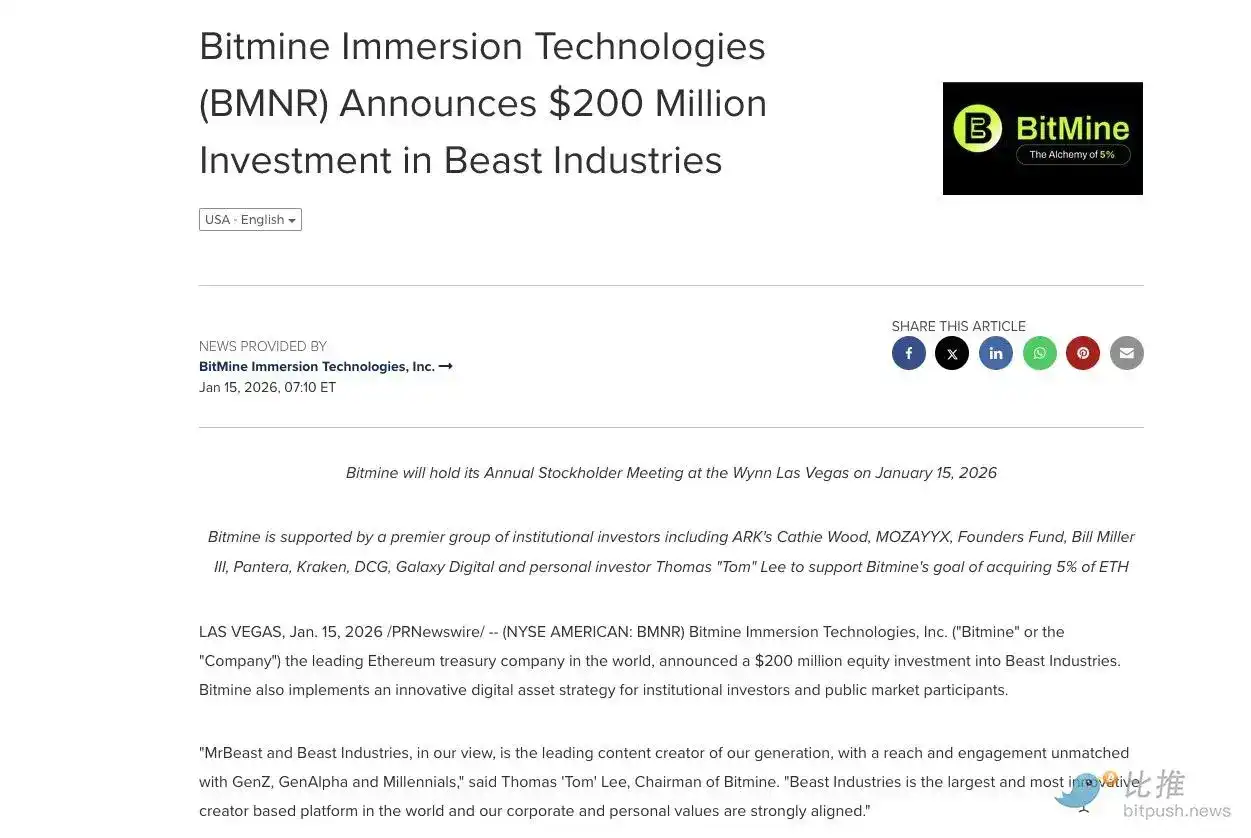
Investment firm BitMine Immersion Technologies (BMNR), led by Wall Street analyst Tom Lee, has announced a $200 million investment into Beast Industries, the parent company of top YouTube creator MrBeast (Jimmy Donaldson). The deal signals a strategic move toward integrating decentralized finance (DeFi) into Beast Industries’ upcoming financial services platform. MrBeast, with over 460 million subscribers and 100 billion views, has built a massive media empire through high-cost, high-impact videos, often spending $3–5 million per video. Despite annual revenues of around $400 million, his content business operates with thin margins. His profitable venture, Feastables—a chocolate brand with $250 million in annual sales—provides a stable cash flow and retail presence. MrBeast has openly discussed his “cash-poor” status, reinvesting nearly all earnings back into content and expansion. His approach prioritizes growth and audience retention over short-term profitability. The partnership with Tom Lee and BMNR suggests a deeper foray into financial infrastructure, potentially involving DeFi solutions for payments, programmable accounts, and decentralized asset management. This move could redefine the relationship between creators, audiences, and financial ecosystems—though it also carries risks regarding user trust and regulatory complexity. At 27, MrBeast continues to leverage his unprecedented influence to explore new frontiers, now entering the world of crypto and decentralize...

Author: Seed.eth

$200 million—that's the figure just announced.

BitMine Immersion Technologies (BMNR), chaired by Wall Street's renowned analyst Tom Lee, has declared an investment in Beast Industries, the parent company of global top creator MrBeast. Meanwhile, Beast Industries mentioned in its official statement that the company will explore how to "integrate DeFi into the upcoming financial services platform" in the future.
At first glance, this seems like another familiar crossover: traditional finance, crypto, internet fame, entrepreneurship. On one side is the YouTube霸主 with over 400 million cumulative global subscribers, whose videos can algorithmically boost visibility; on the other is Wall Street's top analyst, adept at weaving grand blockchain narratives into balance sheets. It all seems perfectly logical.

MrBeast's Journey

Looking back at MrBeast's early videos, it's hard to connect them to today's Beast Industries, valued at $5 billion.
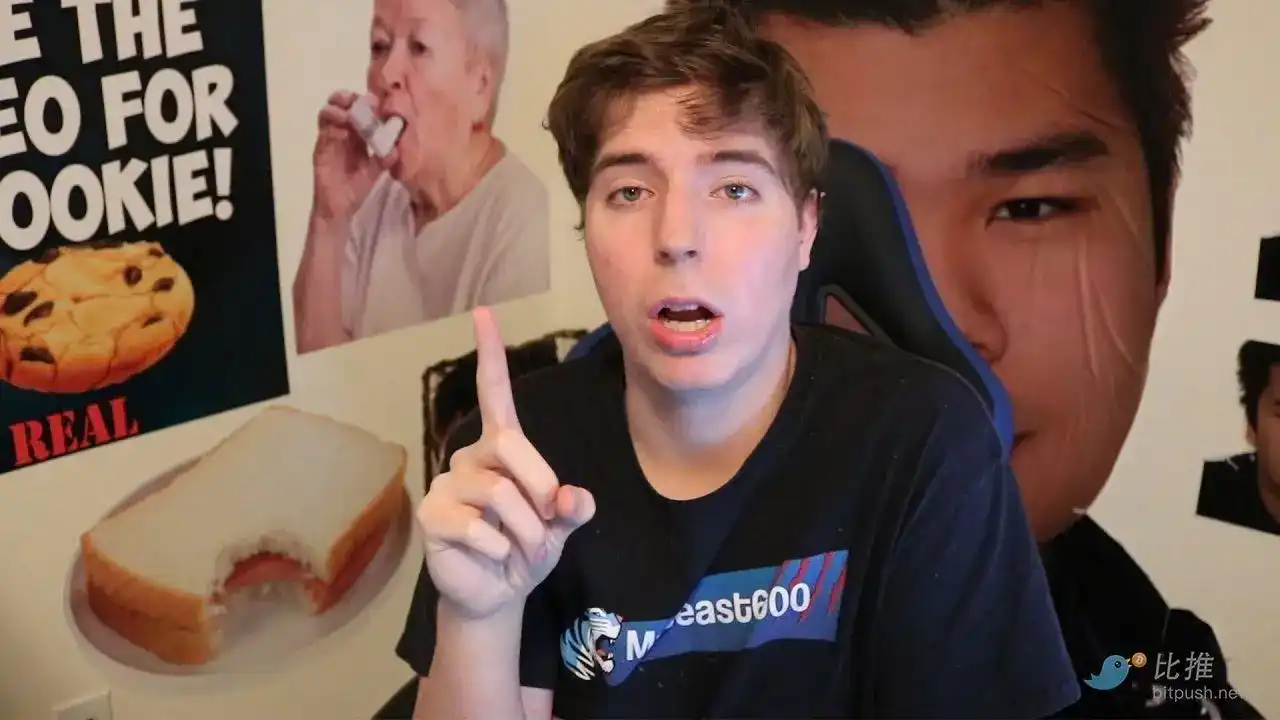
In 2017, shortly after graduating high school, Jimmy Donaldson uploaded a video of himself counting continuously for 44 hours—"Counting to 100,000 Challenge!" The content was almost childishly simple: no plot, no editing, just one person repeating numbers into the camera. Yet, it became the turning point of his content career.

He was not yet 19, with only about 13,000 channel subscribers. After release, the video quickly surpassed a million views, becoming the first globally viral case.

Reflecting on that period in later interviews, he once said:

"I wasn't really trying to go viral; I just wanted to know if the outcome would be different if I devoted all my time to something no one else was willing to do."

Jimmy Donaldson succeeded in building his audience, evolving into the MrBeast we know today. More importantly, from that moment, he developed an almost obsessive belief: attention isn't a gift of talent but something earned through investment and endurance.

Treating YouTube as a Business, Not a Creative Platform

Many creators, after gaining fame, choose to "play it safe": reduce risk, increase efficiency, turn content into stable cash flow.

MrBeast chose the opposite path.

He has repeatedly emphasized in multiple interviews:

"Basically, all the money I make goes into the next video."

This is the core of his business model.

By 2024, his main channel had over 460 million subscribers, with total video views exceeding 100 billion. But behind this lies extremely high costs:

  • Production costs for top videos often range from $3–5 million;
  • Some large-scale challenges or charity projects can exceed $10 million;
  • His Prime Video show "Beast Games" was described by himself as "completely out of control" in production, and he admitted in an interview: losses reached tens of millions of dollars.

He didn't express regret when saying this:

"If I don't do this, viewers will watch someone else.

At this level, you can't win while trying to save money."

This statement can almost serve as the key to understanding Beast Industries.

Beast Industries: $400 Million in Annual Revenue, But Thin Profits

By 2024, MrBeast consolidated all operations under Beast Industries.

Public information shows this company has far exceeded the scope of "creator side hustles":

  • Annual revenue exceeds $400 million;
  • Business spans content production, FMCG retail, licensed merchandise, tool-based products;
  • After the latest funding round, market expectations place its valuation around $5 billion.

But it's not easy.

MrBeast's YouTube main channel and Beast Games bring massive exposure but consume almost all profits.
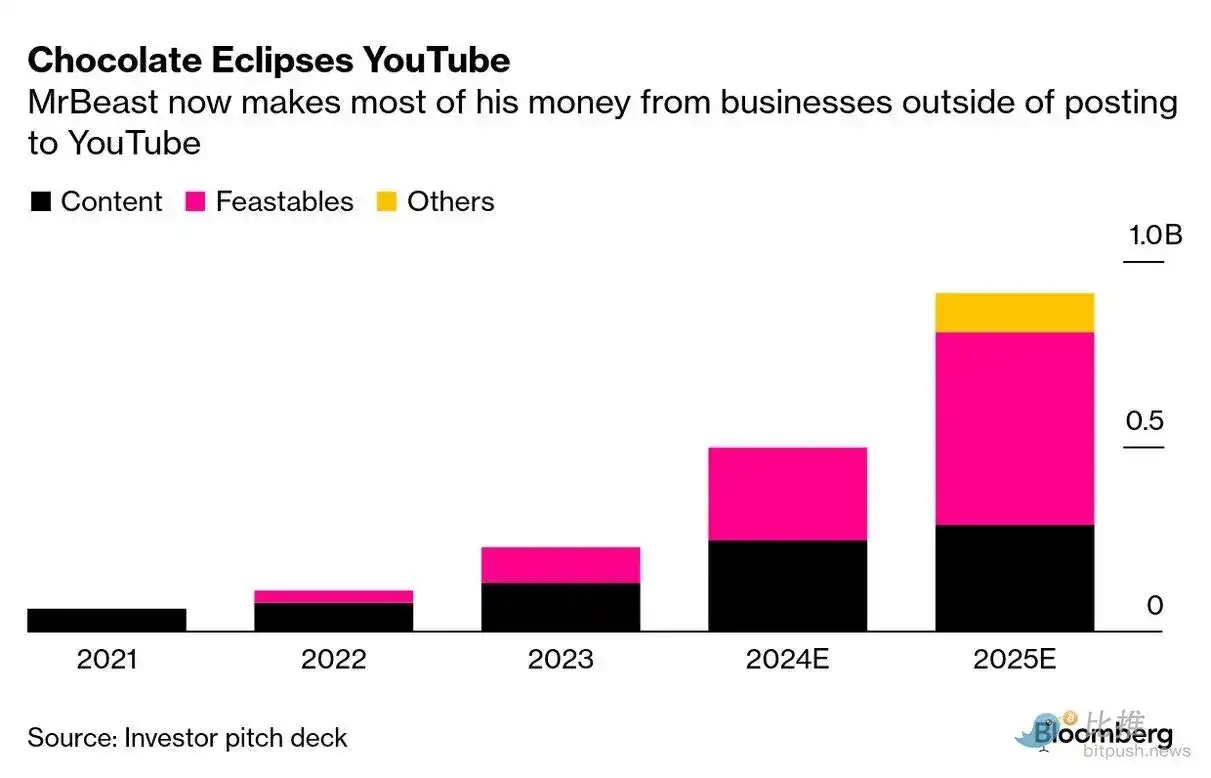
In stark contrast is his chocolate brand, Feastables. Public data shows Feastables generated about $250 million in sales in 2024, contributing over $20 million in profit. This marked Beast Industries' first stable, replicable cash flow business. By late 2025, Feastables had entered over 30,000 physical retail stores across North America (including Walmart, Target, 7-Eleven, etc.), covering the U.S., Canada, and Mexico, significantly boosting offline sales capabilities.

MrBeast has often stated that video production costs are rising, even "increasingly hard to break even." Yet he continues investing heavily in content, seeing it not just as video production costs but as purchasing traffic for the entire business ecosystem.

The core barrier of the chocolate business isn't production but reach. While other brands spend huge sums on ads, he just needs to release a video. Whether the video itself is profitable becomes less important, as long as Feastables keeps selling, the business loop sustains.

"I'm Actually Broke"

In early 2026, MrBeast revealed in a Wall Street Journal interview that he's broke, sparking discussion:

"I'm basically in a 'negative cash' state right now. They all say I'm a billionaire, but there's not much money in my bank account."

This wasn't "humblebragging" but a natural result of his business model.

MrBeast's wealth is highly concentrated in unlisted equity; though he holds just over 50% of Beast Industries, the company continues expanding, hardly paying dividends; he personally avoids keeping cash.

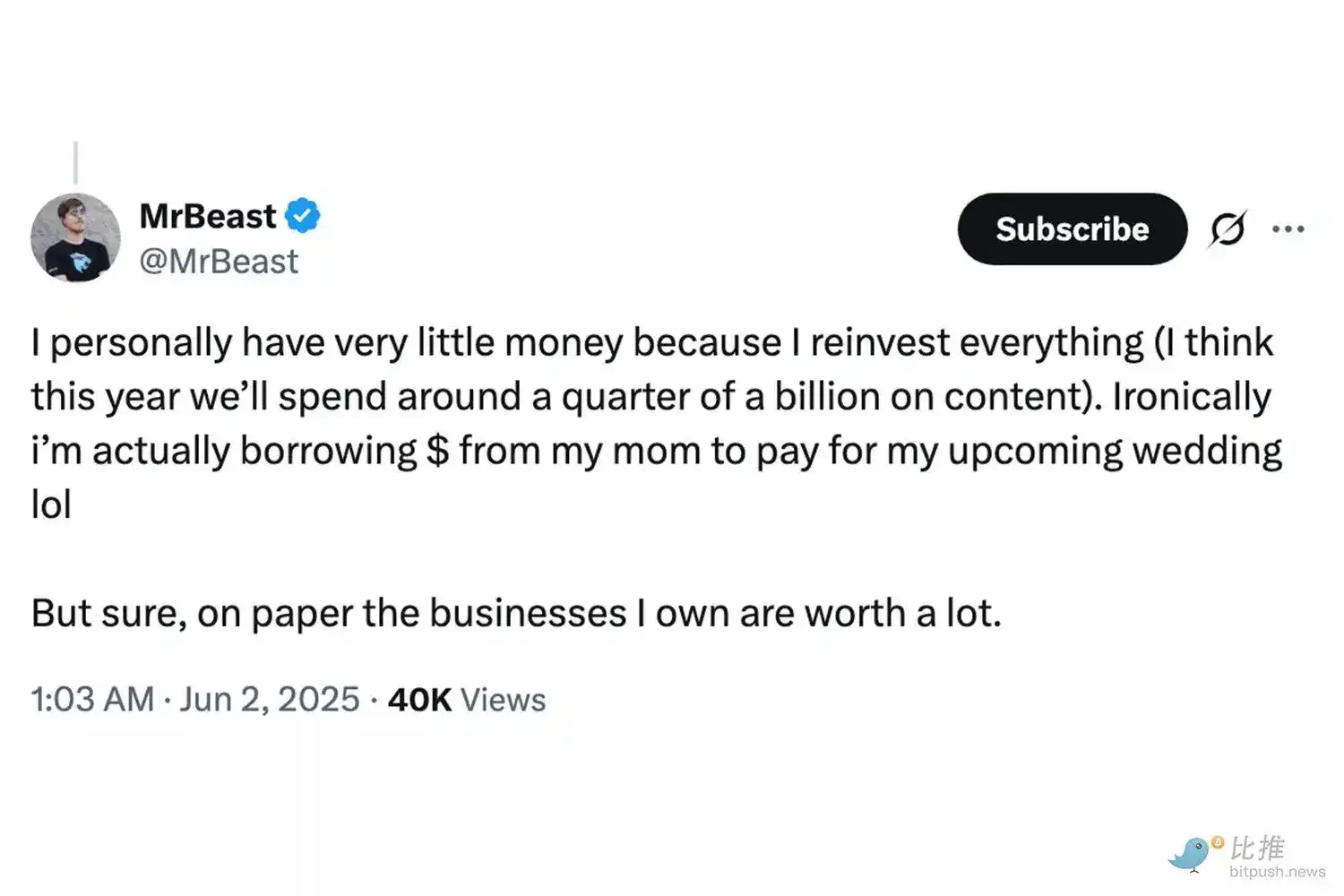
In June 2025, he admitted on social media that he'd spent all his savings on video production, even borrowing money from his mother to pay for his wedding.
As he later explained more bluntly:

"I don't check my bank account—it affects my decision-making."

And the sectors he invests in extend far beyond content and consumer goods.

In fact, during the 2021 NFT boom, on-chain records show he purchased and traded multiple CryptoPunks, some sold for 120 ETH each (then worth hundreds of thousands of dollars).
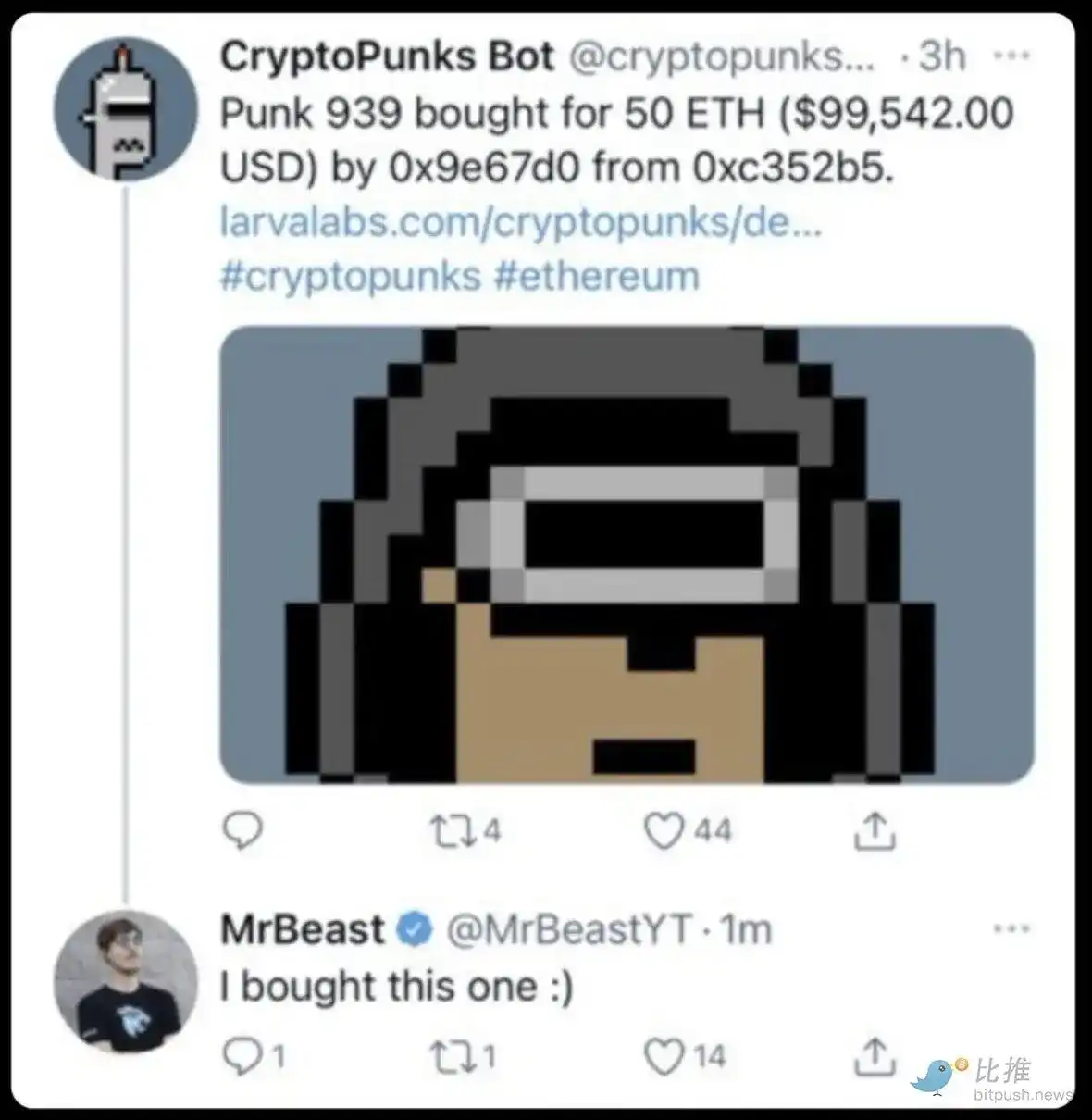
However, as the market corrected, his attitude became cautious.

The real turning point came when the "MrBeast" business model itself reached a critical juncture.

When someone controls a top global traffic gateway but remains in a state of high investment, cash strain, and expansion reliant on funding, finance is no longer just an investment option but essential infrastructure to rebuild.

Internally, Beast Industries has increasingly focused on one question: How to make users not just "watch content, buy products," but enter a long-term, stable, sustainable economic relationship?

This is precisely the direction traditional internet platforms have long attempted: payments, accounts, credit systems. At this juncture, the emergence of Tom Lee and BitMine Immersion (BMNR) steers this path toward more structural possibilities.

Partnering with Tom Lee to Build a DeFi Foundation

On Wall Street, Tom Lee has always played the role of "narrative architect." From early explanations of Bitcoin's value logic to emphasizing Ethereum's strategic role in corporate balance sheets, he excels at translating tech trends into financial language. BMNR's investment in Beast Industries isn't chasing influencer hype but betting on a programmable future for attention gateways.

So, what exactly does DeFi mean here?

Current public information is extremely restrained: no token issuance, no yield promises, no fan-exclusive financial products. But the phrase "integrating DeFi into the financial services platform" points to several possibilities:

- Lower-cost payment and settlement layer;

- Programmable account systems for creators and fans;

- Asset recording and equity structures based on decentralized mechanisms.

The imagination is vast, but real challenges are clear. In today's market, whether native DeFi projects or traditional institutions exploring transitions, most haven't truly established sustainable models. If they can't find a differentiated path in this fierce competition, the complexity of financial operations might erode his core capital accumulated over years: fan loyalty and trust. After all, he has repeatedly stated:

"If one day what I do harms my audience, I'd rather do nothing."

This statement will likely be tested repeatedly in every future financialization attempt.

So, when the world's strongest attention machine seriously starts constructing financial infrastructure, will it become the next-generation platform or an "overly bold" crossover?

The answer won't come quickly.

But one thing he understands better than anyone: the greatest capital isn't past glory but the right to "start over."

After all, he's only 27.

Пов'язані питання

QWhat is the amount of investment BitMine Immersion Technologies (BMNR) announced to put into Beast Industries, and who is the chairman of BMNR?

ABitMine Immersion Technologies (BMNR) announced a $200 million investment into Beast Industries. The chairman of BMNR is Tom Lee, a well-known Wall Street analyst.

QWhat is the core philosophy behind MrBeast's (Jimmy Donaldson) business model regarding revenue and content investment?

AThe core philosophy of MrBeast's business model is to reinvest almost all the money he earns back into the next video. He believes that at his level, you cannot win while trying to save money, and constant high investment is necessary to maintain audience attention.

QWhich business under Beast Industries provided stable and replicable cash flow in 2024, and what was its approximate profit?

AThe chocolate brand Feastables under Beast Industries provided stable and replicable cash flow in 2024. It had sales of approximately $250 million and contributed over $20 million in profit.

QWhy did MrBeast describe himself as being in a 'negative cash' state despite his company's high valuation?

AMrBeast described himself as being in a 'negative cash' state because his wealth is highly concentrated in the non-liquid equity of his privately held company, Beast Industries. The company reinvests almost all its profits for expansion and does not issue dividends, and he personally chooses not to retain much cash, even borrowing money for personal expenses like his wedding.

QWhat potential applications of DeFi (Decentralized Finance) are suggested for Beast Industries' future financial services platform according to the article?

AThe article suggests that Beast Industries' future financial services platform could explore DeFi for a lower-cost payment and settlement layer, a programmable account system for creators and fans, and an asset recording and equity structure based on decentralized mechanisms.

Пов'язані матеріали

Must-Watch Events Next Week|CLARITY Act Could Face Senate Vote; SpaceX, Circle to Report Earnings (8.3-8.9)

**Summary: Key Events and Developments to Watch (August 3-9)** The upcoming week is marked by significant financial disclosures, key legislative deadlines, and notable product updates. **Major Financial Events:** Several companies are scheduled to release their Q2 2026 earnings. American Bitcoin (ABTC) will report on August 3, followed by SpaceX and Hut 8 Mining Corp. on August 4, and Circle on August 5. Notably, a significant portion of SpaceX shares (up to 12% of total shares) will be unlocked on August 6 following their earnings release. **Key Legislative Deadline:** The U.S. Senate faces an August 7 deadline to secure 60 votes for the CLARITY Act, a bipartisan bill aiming to establish a federal regulatory framework for cryptocurrencies. The Senate may hold a full vote on the bill during the week. **Economic Data:** The U.S. July Non-Farm Payrolls report will be released on August 7, providing crucial labor market data. **Technology & Product Updates:** * **Shutdowns:** DeFi portfolio tracker Zapper and wallet app Ctrl Wallet will cease operations on August 3. * **Upgrades:** LayerZero will deprecate its v1 relayers on August 3. XRP Ledger's new version 3.3.0, featuring five new functions, is expected next week. * **AI:** Elon Musk announced that the advanced Grok 4.6 AI model is set for release around August 7. * **Bitcoin:** The BIP-110 forced signaling for a potential Bitcoin network change is scheduled to begin around August 8. **Other Notable Events:** Chinese robotics firm Unitree Tech has set its preliminary price inquiry for its IPO for August 5. South Korean exchange Upbit will delist AQT and AERGO tokens on August 3.

marsbit1 год тому

Must-Watch Events Next Week|CLARITY Act Could Face Senate Vote; SpaceX, Circle to Report Earnings (8.3-8.9)

marsbit1 год тому

Stocks Are Plummeting More Sharply Than Cryptocurrencies. Where Has the Money Gone?

Stock Markets Plunge Deeper Than Cryptocurrencies: Where Did the Money Go? In late July, Seoul's Kospi index triggered circuit breakers for two consecutive days, plummeting over 40% from its June high. The collapse was led by heavyweight stocks like SK Hynix, whose record profits still disappointed investors, and devastating leveraged ETFs, with one major product losing over 83% of its value. This signaled a global, forced deleveraging targeting the most crowded trades. Interestingly, while stocks exhibited extreme volatility akin to crypto markets, Bitcoin rose nearly 15% in July after a prior steep drop. Analysis shows the money fleeing equities did not flow into Bitcoin. Instead, Bitcoin had already absorbed its sell-off in May-June, when U.S. spot Bitcoin ETFs saw historic outflows. The true safe-haven beneficiary was gold, whose price rose over 20% year-on-year, highlighting a decoupling between Bitcoin and gold as "digital gold." The sell-off was a targeted unwinding of leveraged positions in tech and semiconductors, accelerated by broker-dealer risk management and shifts in the AI narrative, including new competition from Chinese memory chipmakers. The retreat path was clear: from high-valuation tech stocks to cash and U.S. Treasuries, then to gold. For Bitcoin to attract sustained institutional inflows, conditions like eased global liquidity pressure, a "soft-landing" Fed rate cut, and U.S. regulatory clarity via legislation like the stalled CLARITY Act are needed. Currently, Bitcoin is not a safe haven but an already-cleared asset. Its low correlation with tech stocks, however, makes it a potential diversification play for institutional portfolios once the storm passes. The money isn't here yet, but the positioning is underway.

marsbit1 год тому

Stocks Are Plummeting More Sharply Than Cryptocurrencies. Where Has the Money Gone?

marsbit1 год тому

In Conversation with Ray Dalio: We Are Currently in an AI Bubble, with 1% of My Portfolio in Bitcoin

Ray Dalio, founder of Bridgewater Associates, warns in an interview that the current AI boom shows classic bubble characteristics, which could lead to significant economic downturns as seen in past cycles like 1929 or 2000. He explains that speculative enthusiasm, fueled by debt and overvaluation, often precedes a crash when rising rates or taxation force asset sales, causing widespread losses and recession. Dalio also outlines his "Big Cycle" theory, describing an approximate 80-year pattern where widening wealth gaps, massive government deficits, and shifting geopolitical power (like China's rise) create internal conflict and global instability. He emphasizes that we are in a late-cycle, transitional phase where traditional powers like the US and UK face decline. For personal wealth protection, Dalio advises diversification beyond cash into assets like stocks, bonds, real estate, and particularly gold, which he prefers over Bitcoin. While he holds about 1% of his portfolio in Bitcoin as a non-printable hard asset, he views gold as more secure from technological or governmental threats. Regarding AI's impact, Dalio believes it will disproportionately benefit capital owners, worsening inequality by replacing both physical and cognitive labor. He suggests that human intuition and emotional intelligence, combined with AI, will be key for future workers. On taxation, Dalio argues that wealth taxes are impractical and risk triggering asset sell-offs, reducing productive investment. He points to the UK as a cautionary example of debt, low productivity, and political strife. Geopolitically, Dalio foresees a more regionalized world, with the US showing weakness in prolonged conflicts like with Iran, akin to past imperial declines. The ideal outcome, he suggests, is coexisting powerful blocs (e.g., Americas, China-Asia Pacific) without major war.

marsbit4 год тому

In Conversation with Ray Dalio: We Are Currently in an AI Bubble, with 1% of My Portfolio in Bitcoin

marsbit4 год тому

Торгівля

Спот
活动图片





