2-Year Return of 225x? Uncovering Mysterious Researcher Serenity's AI 'Choke Point' Investment Strategy

链捕手Опубліковано о 2026-05-27Востаннє оновлено о 2026-05-27

Анотація

"2 Years, 225x Returns? Decoding Serenity's AI 'Chokepoint' Investment Strategy" This article profiles Serenity (formerly AleaBito on Reddit's WallStreetBets), a pseudonymous researcher known for exceptional returns by applying a "Chokepoint Theory" to AI investments. His methodology involves a bottom-up, reverse-engineering approach of the AI hardware supply chain. He identifies critical, irreplaceable physical bottlenecks (chokepoints) that could cripple entire AI systems if disrupted, bypassing Wall Street's top-down focus on major tech firms. Key examples include pinpointing essential suppliers in the emerging Silicon Photonics and Co-Packaged Optics (CPO) sector—components vital for next-generation AI data center interconnects—such as niche companies providing external laser sources, molecular beam epitaxy equipment, or ultra-pure raw materials. Similarly, he highlights geopolitical "chokepoints" in the humanoid robotics supply chain, where key hardware components and rare earth elements are concentrated in Asia. Serenity validates his investment theses through rigorous adversarial AI debates before publication. He leverages institutional blind spots, directing a sophisticated network of retail followers toward undervalued, under-covered micro-cap stocks across global exchanges, driving significant price movements in names like Sivers ($SIVE), Soitec, and Raspberry Pi ($RPI). While presenting a powerful framework for finding critical system dependencies, the strategy...

Author:BruceBlue , FormerBing Ventures GP

How did the mysterious researcher Serenity achieve over 225 times the return in 2 years?

Using the Checkpoint Theory to identify the irreplaceable physical switches in the AI era.

Employing a bottom-up supply chain reverse engineering mindset to pinpoint the choke points.

Before making any investment hypothesis, engage in fierce debates with various AI models to uncover potential flaws and limitations, comparable to a top-tier investment committee.
Foreword

Over the past few months, if you've been following the secondary market for AI infrastructure, it has been hard to miss a name: Serenity @aleabitoreddit
Aformer trader permanently banned by Reddit's WallStreetBets (WSB), he switched platforms, adopted an anime female avatar, and amassed over 300,000 followers in less than a year. One of his tweets can cause a FTSE 250 constituent stock to surge nearly 90% in two days, his research is cited by Bloomberg and Reuters, and some hedge funds engage in his copytrade.

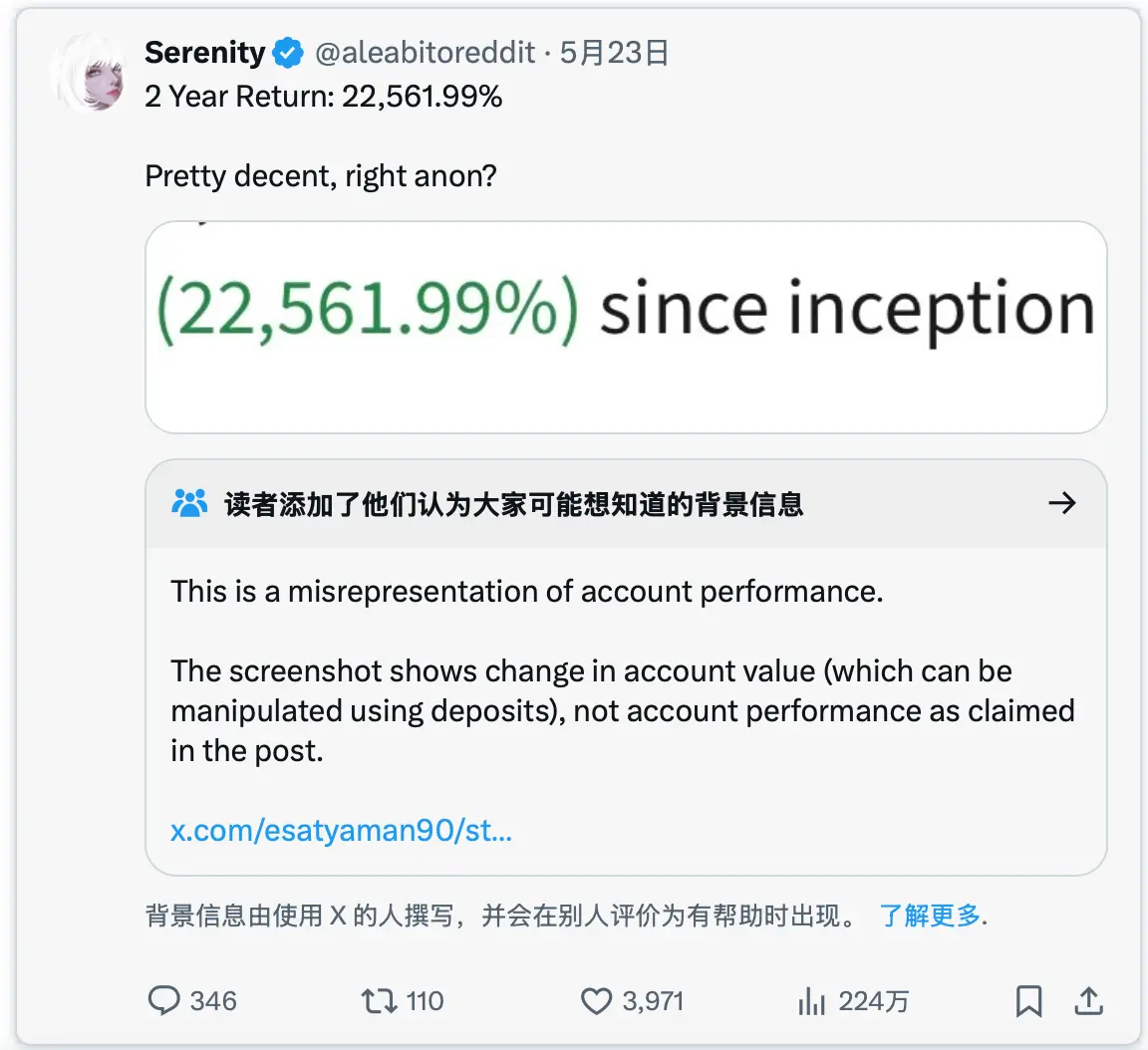
The market marvels at his reported 22,561.99% return over the past two years, or questions his unverifiable background: "former AI research scientist," "Nature paper author," "RISC-V Foundation member," even claiming to have declined an offer to lead Nvidia's AI team around 2018 when its stock price was about $6.
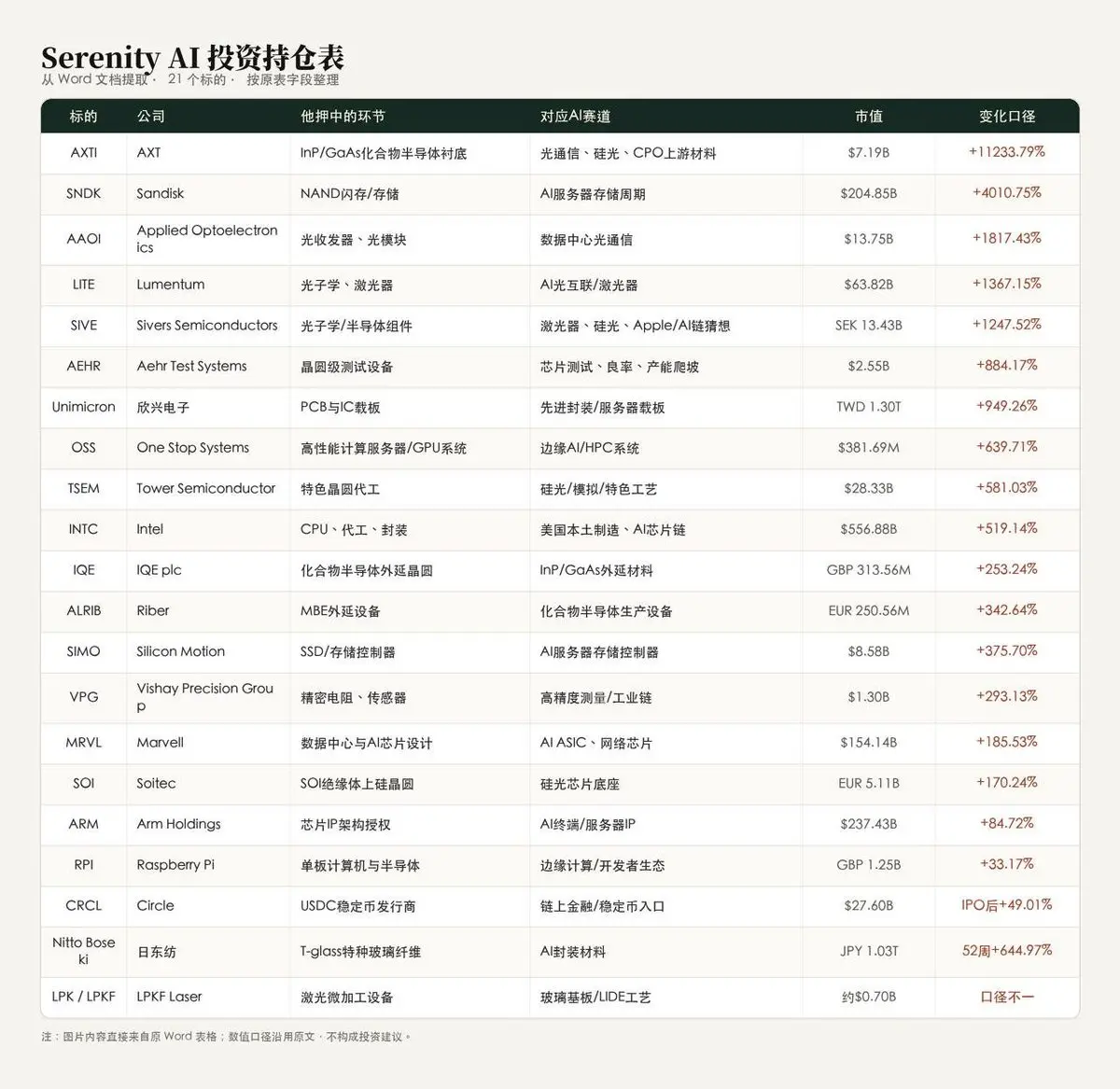
Serenity's AI Portfolio

But what truly matters isn't those dazzling numbers, nor whether he actually published in Nature.

What truly matters is this: He provides a paradigm for reverse engineering the AI era and executes violent arbitrage on information asymmetry within Wall Street's institutional blind spots.

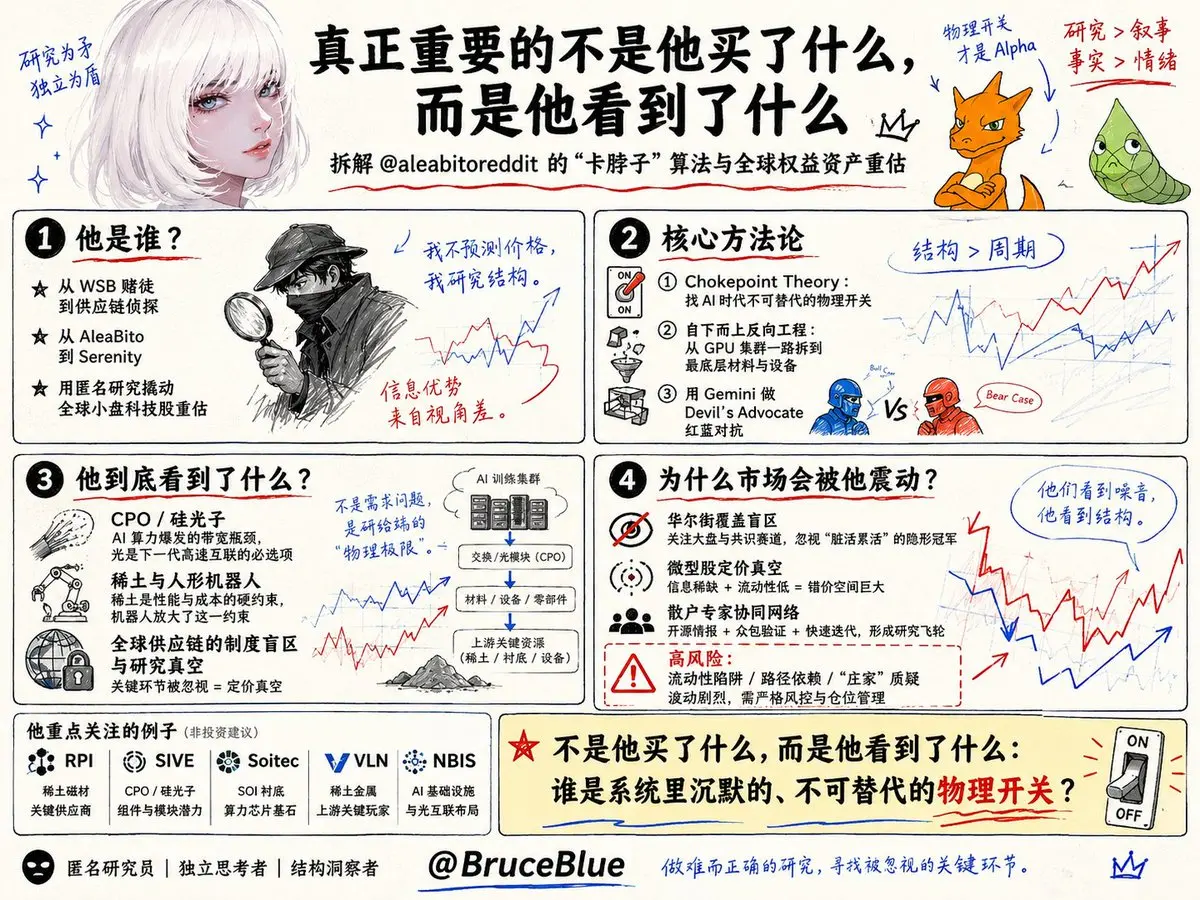
The core of this paradigm is what he calls Chokepoint Theory (Supply Chain Bottleneck Theory).

From WSB Gambler to Supply Chain Detective: An Identity Transformation

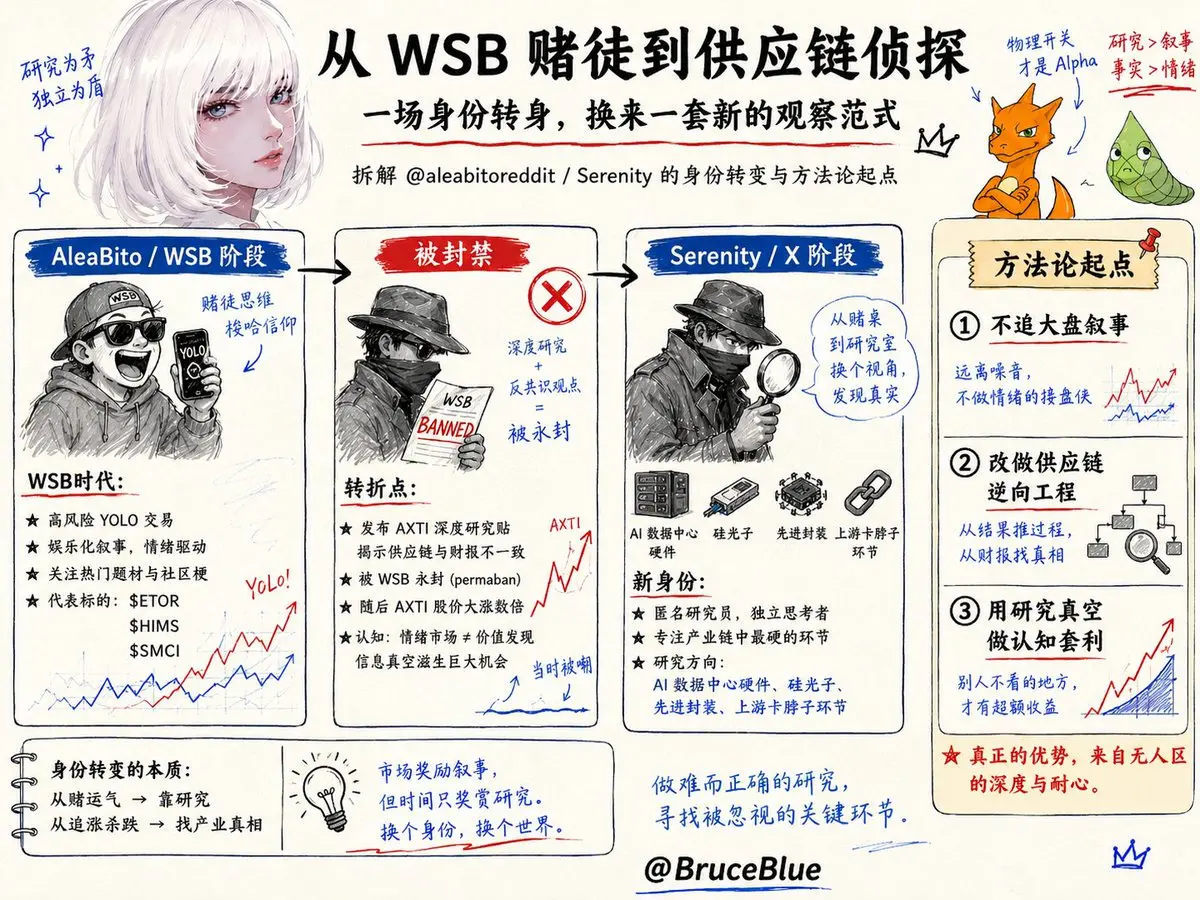
First, some background. His story began in early 2022 on the famous retail trader subreddit r/wallstreetbets (WSB).

The account then was named AleaBito, bearing the distinct colors of a WSB retail trader, keen on high-leverage, high-risk, and highly entertaining options and IPO plays. He once made a $175,000 single-sided options "YOLO" trade during the eToro ($ETOR) IPO based on the mock logic that its technical chart resembled "Bluefin Tuna Toro." In trading Hims & Hers Health $HIMS, he allocated a $100,000 position based on the "Gym Bro Formation." He also accurately predicted Super Micro Computer $SMCI would break $120 when its stock was near lows, based on developments in liquid cooling technology.

┌────────────────────────────────────────────────────────────────────────┐

│ @aleabitoreddit / Serenity's Evolution Path

├────────────────────────────────────────────────────────────────────────┤

│ Reddit Stage (Pre-2022) : AleaBito

│ Style: Hardcore financial analysis combined with highly entertaining "WSB retail" narrative, preference for high-risk "YOLO"

│ Feats:$ETOR (Tuna Toro), $HIMS (Gym Bro), $SMCI (Low-point prediction of $120 breakout)

│ X Platform Stage (2022-Present) : Serenity

│ Style: Focus on AI data center hardware, silicon photonics, advanced packaging; "bottom-up" supply chain reverse engineering

│ Feats:$RPI, $SIVE, Soitec, $VLN, $NBIS

└────────────────────────────────────────────────────────────────────────┘

The turning point occurred in early 2022. He posted a deep fundamental research report on AXT, Inc. $AXTI, a compound semiconductor substrate manufacturer, on WSB. At the time, $AXTI had a market cap of just $200 million, with a stock price around $12. The report's professional nature clashed with the forum's speculative atmosphere, leading moderators to permanently ban the account on grounds of "deliberate influence" and "pump-and-dump."

Subsequently, $AXTI soared to $70 driven by surging demand for compound semiconductors and optoelectronic substrates, resulting in over 1000% paper gains, becoming the researcher's "defining battle." This ban directly prompted the migration to X, and after renaming to "Serenity," the investment focus was completely locked onto "choke point" segments of semiconductor core hardware and the precision supply chain.
Core Framework: Finding the "Strait of Hormuz" of the AI Era

The vast majority of Wall Street sell-side institutions look at AI from a top-down perspective. They stare at Nvidia, Microsoft, Google, calculating guidance for trillion-dollar Capex, engaging in fierce mathematical modeling games around next quarter's revenue.

Serenity's perspective is bottom-up. He employs a supply chain reverse engineering model.

Using Nvidia's H100, B200, and other GPU supercomputing clusters as the physical origin, he deconstructs layer by layer downwards until uncovering ultra-micro components or raw materials at the physical level that are irreplaceable and monopolized by one or a very few companies. These extremely niche segments operate silently outside the spotlight of trillion-dollar market caps. Yet, if a supply disruption occurs, the entire downstream AI industry cluster faces physical paralysis.

He calls these nodes "Choke Points," likening them to the Strait of Hormuz controlling global oil passageways, or the indispensable yet unnoticed shiso leaf in high-end Ginza kaiseki cuisine.

  • Integration of Physical and Geographic Coordinate Maps

Serenity constructs a precise global semiconductor choke point physical and geopolitical map. This map spans US, Taiwanese, European, and Japanese stocks, integrating the geographic coordinates of production facilities, technical patent barriers, geopolitical risks, and national export control policies for each niche giant in the supply chain. When new geopolitical conflicts, export bans, or earnings reports emerge, he can quickly locate specific physical nodes on the supply chain map and execute high-conviction directional bets using his concentrated stock positions.

  • Adversarial AI Argumentation Testing

Before formally publishing any investment hypothesis, Serenity has a unique "red team/blue team" argumentation process. He inputs research drafts into different large language models, commanding the AI to play the role of an extremely demanding "Devil's Advocate," specifically picking out flaws, technical physical limitations, alternative threats, and potential valuation biases in his investment logic. Only after passing multiple rounds of technical and logical interrogation by AI does he publicly release the report.

The Physical Barriers of Silicon Photonics and Co-Packaged Optics (CPO)

Within Serenity's supply chain map, the physical evolution of data center AI computing power infrastructure is his core investment theme.
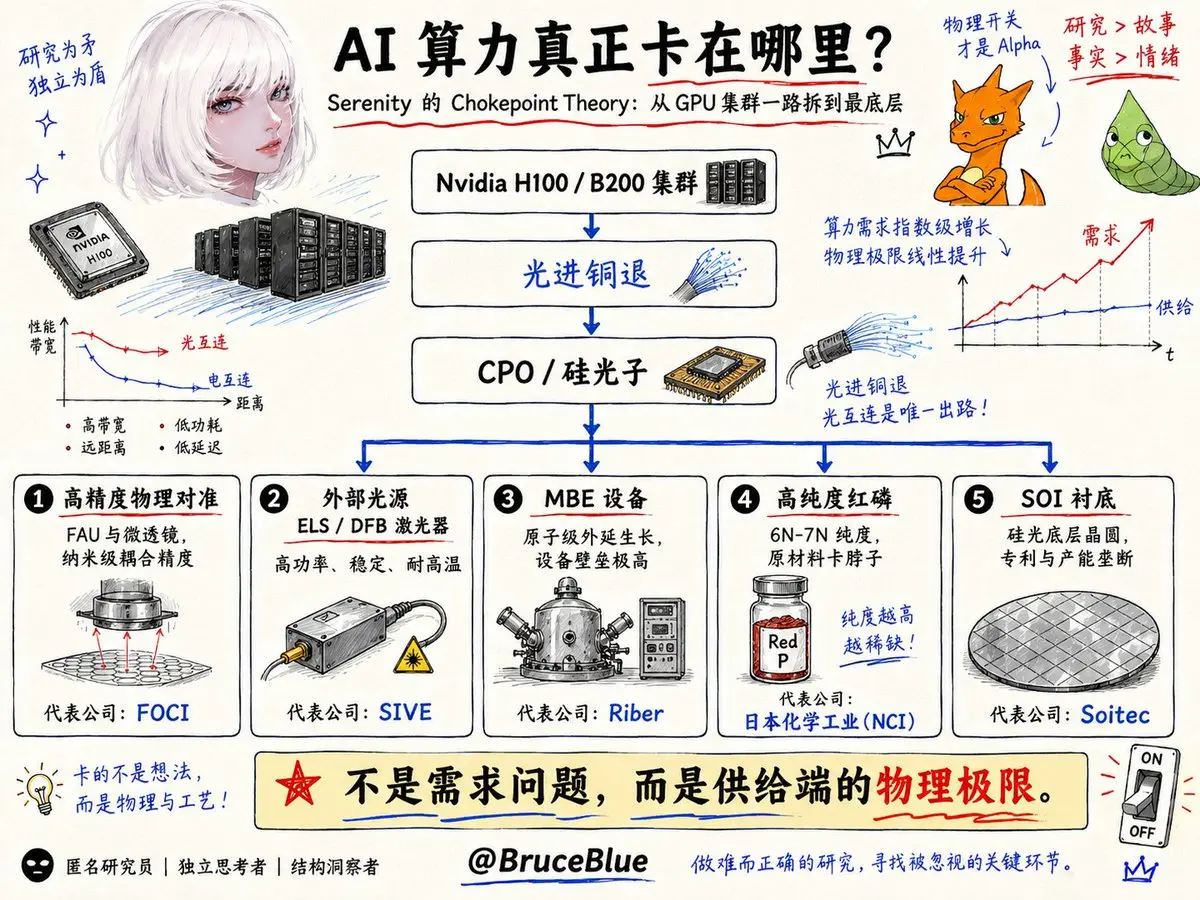
As large language model parameters grow exponentially, the interconnection of ten-thousand, hundred-thousand, or even million-card GPU clusters becomes the physical bottleneck for computing power scaling. At extremely high data throughput rates, traditional copper interconnects face insurmountable physical limits: high-frequency electrical signals in copper suffer from high attenuation, uncontrollable electromagnetic interference, and high power consumption and heat dissipation burdens.

To break this "copper wall," the process of converting electrical signals to optical signals for high-bandwidth, low-latency transmission—"optics in, copper out"—has become an inevitable path in AI infrastructure construction. The forefront of this physical layer revolution is the "Co-Packaged Optics" (CPO) architecture led by giants like TSMC and Nvidia.

The core idea of CPO is integrating the electro-optical conversion chip directly with the core computing chip on the same multi-chip packaging substrate, shortening the electrical signal transmission distance within the package to the millimeter level. Serenity focuses on five major "choke point" technical and physical barriers in this revolutionary architecture:

Serenity's CPO (Co-Packaged Optics) Reverse Engineering Diagram:

Nvidia H100/B200 Clusters (10k-card interconnection demand)

Optics in, Copper out (Breaking copper cable physical limits: attenuation, power, heat)

┌────────────────────────────────────────────────────────────────────────┐

│ Five Physical Barriers of Silicon Photonics & CPO (Choke Points)

│ 1. High-precision Physical Alignment: Fiber Array Unit (FAU) & Micro-lenses

│ → $FOCI (Browave, Taiwan): Indispensable physical choke point status

│ 2. External Light Source (ELS) & High-Power Continuous Wave (CW) DFB Laser

│ → $SIVE (Sivers, Sweden): Extremely scarce physical asset for 1.6T LRO/CPO

│ 3. Molecular Beam Epitaxy (MBE) Equipment Barrier

│ → $ALRIB (Riber, France): Global monopolist, "choking the capacity neck" of epitaxy vendors

│ 4. High-Purity Red Phosphorus Raw Material (Purity 6N-7N, i.e., 99.9999%+)

│ → NCI (Nippon Chemical Industrial, Japan): Monopolized by very few specialty chemical giants

│ 5. Underlying Wafer: Silicon-on-Insulator (SOI) Substrate Material

│ → Soitec (France): Smart-Cut patent, absolute global technology and capacity monopolist

└────────────────────────────────────────────────────────────────────────┘

  • High-precision Physical Alignment Barrier

Since the optical waveguide dimensions inside silicon photonic chips are typically sub-micron, this requires nano-level physical alignment between the external fiber and the waveguide. Any tiny misalignment leads to severe "optical coupling loss." Serenity was the first in the English-speaking world to systematically anchor Browave (FOCI, 3363.TW), a stock highly focused on by Taiwanese retail investors, to the evolution of global CPO technology.

  • External Light Source (ELS) and High-Power Continuous Wave DFB Laser Barrier

Silicon, as an indirect bandgap semiconductor, cannot achieve efficient light emission under electrical injection. CPO architecture must rely on independent external light sources to provide high-power continuous wave laser. This laser must maintain single longitudinal mode operation in the high-temperature, high-pressure data center environment, with extremely high process requirements. Sweden-listed Sivers Semiconductors $SIVE, due to possessing relevant technology, becomes an extremely scarce physical asset in the CPO external light source supply chain.

  • Molecular Beam Epitaxy (MBE) Equipment Barrier

In the growth of epitaxial wafers for high-power lasers and other compound semiconductors, the core physical process is Molecular Beam Epitaxy (MBE), which allows for atomic-level precision growth of ultra-thin crystalline films. Serenity pinpointed the absolute monopolist of global MBE equipment: French listed company Riber $ALRIB.

  • High-Purity Red Phosphorus Raw Material Barrier

Compound semiconductor (e.g., indium phosphide substrate) manufacturing requires extremely stringent raw material purity. Serenity's reverse engineering leads to the most fundamental chemical element: high-purity red phosphorus (purity 99.9999%+). Capacity is almost entirely monopolized by a very few Japanese giants like Nippon Chemical Industrial Co., Ltd. (NCI). If supply is disrupted, downstream production halts entirely.

  • Silicon-on-Insulator (SOI) Substrate Material Barrier

Silicon photonic chips require SOI wafers as the underlying substrate. French company Soitec, with its exclusively invented Smart-Cut technology, holds absolute global technology and capacity monopoly in the silicon photonics SOI wafer market; even a giant like Japan's Shin-Etsu Chemical must pay it patent licensing fees.

The Geopolitical Game of "Physical Switches" in Humanoid Robots and Rare Earth Resources

In 2026, Serenity further horizontally expanded his "choke point" map to the geopolitical game involving humanoid robots and rare earth elements.

  • Supply Chain Tearing Between Software "Brain" and Hardware "Body"

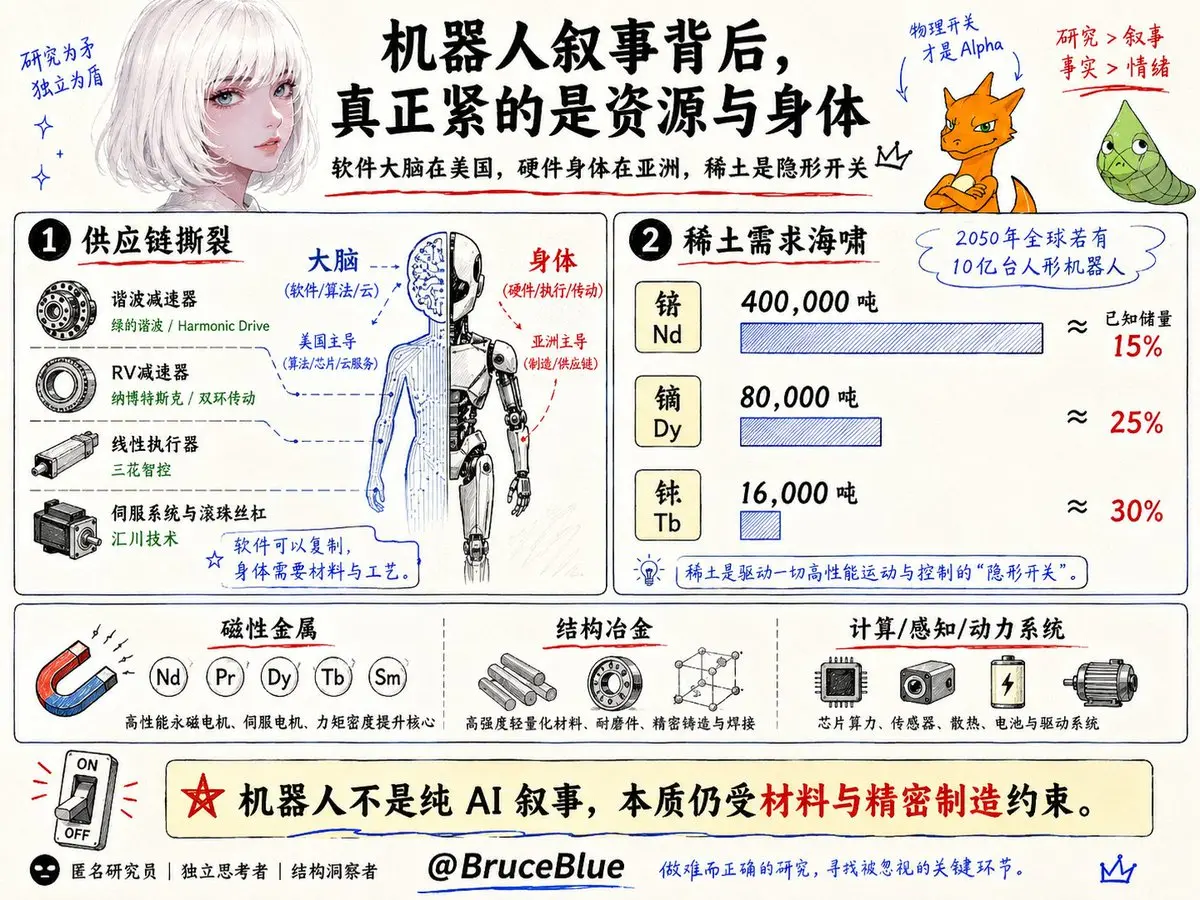
Most market discussions about Tesla Optimus focus on AI algorithms and large models, overlooking a fatal physical reality: the US is losing the hardware and material manufacturing race for humanoid robots.

The humanoid robot's "brain" remains in the US, but the "body" components responsible for movement (joints, actuators, reducers, etc.) are almost entirely in the hands of Asian manufacturers:

  • Harmonic Reducers: Leader Harmonious Drive Systems (China), Harmonic Drive (Japan)

  • RV Reducers: Nabtesco (Japan), Sihuan Transmission (China)

  • Linear Actuators: Sanhua Intelligent Controls (China)

  • Servo Systems & Ball Screws: Inovance Technology (China)

To reduce costs, US robotics companies have already signed long-term contracts with these Chinese and Japanese component giants. This high dependence means that hardware supply chains face physical shutdown if geopolitical friction occurs.

  • Rare Earth "Demand Tsunami" and the Morgan Stanley Model

Serenity cites Morgan Stanley's demand forecasting model for quantitative extrapolation: if global humanoid robot stock reaches 1 billion units by 2050, its consumption of core rare earth resources will cause a catastrophic "demand tsunami":

  • Neodymium (Nd): Cumulative consumption ~400,000 tons (15% of global known reserves)

  • Dysprosium (Dy): Cumulative consumption ~80,000 tons (25% of global known reserves)

  • Terbium (Tb): Cumulative consumption ~16,000 tons (30% of global known reserves)

These are physical necessities for maintaining permanent magnet motor demagnetization resistance at high temperatures. Serenity emphasizes that if Western capital wants to ensure supply chain security, it must direct tens of billions in heavy capital towards rebuilding a local rare earth refining ecosystem.

Based on this, he lists three physical sectors that must be closely monitored:

  • Magnetic Metals: Light rare earths (Nd, Pr), heavy rare earths (Dy, Tb), specialty magnets (Sm, Co).

  • Structural Metallurgy: Precision gear materials (Ti, V, Mo), high-strength steel additives (Nb, Cr, Ni, Mn), wear-resistant elements (Ce, La).

  • Computing, Perception & Power Systems: Advanced semiconductors (Ga, Ge), batteries & wiring (each unit consumes 2kg Li, 3kg graphite, 6.5kg Cu).
Core Case Studies and Empirical Performance Evaluation

Through keen capture of technical barriers and commercialization inflection points, Serenity has successfully unearthed and led the value revaluation of multiple classic small-to-mid cap technology stocks across different global capital markets.
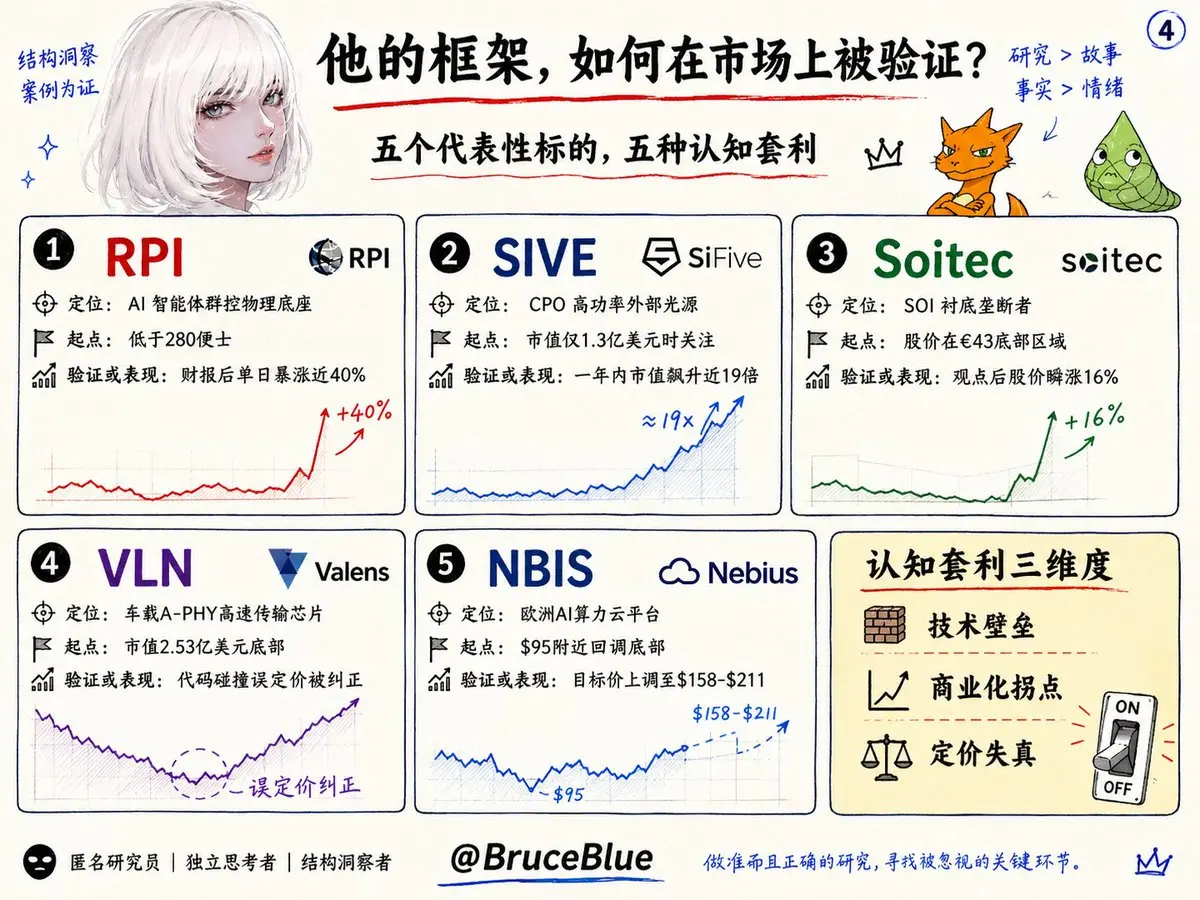
┌────────────────────────────────────────────────────────────────────────┐

│ Serenity Core Investment Picks & Empirical Performance Validation

├────────────────────────────────────────────────────────────────────────┤

│ $RPI (Raspberry Pi) | LSE UK

│ Positioning: Physical base for AI agent swarm control

│ Starting Point: Price below 280 pence (IPO price)

│ Validation: March 2026 annual report disclosed strong profit growth, chip unit sales up 47%, confirming its role as AI base logic

│ Performance: Single-day surge of nearly 40% on earnings, rebounded over 60% from lows

│ $SIVE (Sivers) | Stockholm Sweden

│ Positioning: Core supplier of high-power external light source DFB lasers for silicon photonics CPO

│ Starting Point: Market cap only $130 million when recommended

│ Validation: Secured strategic cooperation with Jabil, received $6.6M support from US CHIPS Act

│ Performance: Market cap soared nearly 19x within a year after recommendation (now over $2.3B)

│ Soitec | Euronext Paris France

│ Positioning: Global patent and capacity absolute monopolist for key silicon photonics SOI substrate material

│ Starting Point: Stock price in bottom area around €43

│ Validation: Listed as a Class 1 exclusive material standard by TSMC and Nvidia

│ Performance: European market stock price instantly surged 16% the day his view was published

│ $VLN (Valens) | NYSE USA

│ Positioning: Automotive A-PHY high-speed transmission chips

│ Starting Point: Market cap $253 million bottom (recommended with $93.5M net cash, zero debt, ~60-62% gross margin guidance)

│ Validation: Pointed out mispricing due to code collision error in scanners

│ Performance: Guided market's mine-sweeping revaluation of this asset by pointing out the "code collision" bug

│ $NBIS (Nebius Group) | NASDAQ USA

│ Positioning: Europe's largest AI GPU/Rubin computing cluster cloud service provider

│ Starting Point: Pullback bottom area around $95

│ Validation: Holding $3.7B net cash (end-2025), backlog of unexecuted contracts nearing $50B

│ Performance: Back on high-growth trajectory, analyst target price raised to $158-$211

└────────────────────────────────────────────────────────────────────────┘

Deep Analysis: Three Dimensions of Cognitive Arbitrage

  • Raspberry Pi$RPI : Relative Value Game Model

When the market viewed Raspberry Pi as a declining educational component maker, Serenity captured a dramatic shift in the AI developer ecosystem: numerous startups rushed to buy Raspberry Pis as physically isolated bases for deploying "AI agent swarm control systems." If buying Apple Mac Minis, such hoarding would be negligible in Apple's $3.7 trillion market cap; but for Raspberry Pi with a market cap of just £500 million, this is a transformative boost.

  • Valens Semiconductor$VLN : Information Arbitrage on Quantitative Code Collision

$VLN had $93.5 million net cash on the books, zero debt, ~60-62% gross margin guidance, secured Mercedes front-end design wins, yet its market cap was only $253 million. Serenity discovered a physical bug: mainstream global quantitative stock screeners had a "ticker code collision error," confusing data for $VLN with energy stock $VLO on the Toronto Exchange, causing key metrics to be severely distorted. He precisely listed the deviations, guiding funds to a "mine-sweeping" revaluation.

  • Nebius Group$NBIS : Deep Bottom Capture Amid Mechanical Panic

As a leading European AI-dedicated cloud service provider, $NBIS saw its stock price plummet to $95 due to mechanical hedging pressure from early-stage complex convertible bond share conversions. Serenity pointed out this was "mechanical panic from non-fundamental factors." At $95, the market gave this company, with 2026 revenue guidance of $30-34 billion (nearly 6x growth) and holding billions in net cash, an utterly absurd discount.

Retail Capital Synergy and Potential Structural Risks

  • Expert Retailer Synergy Network

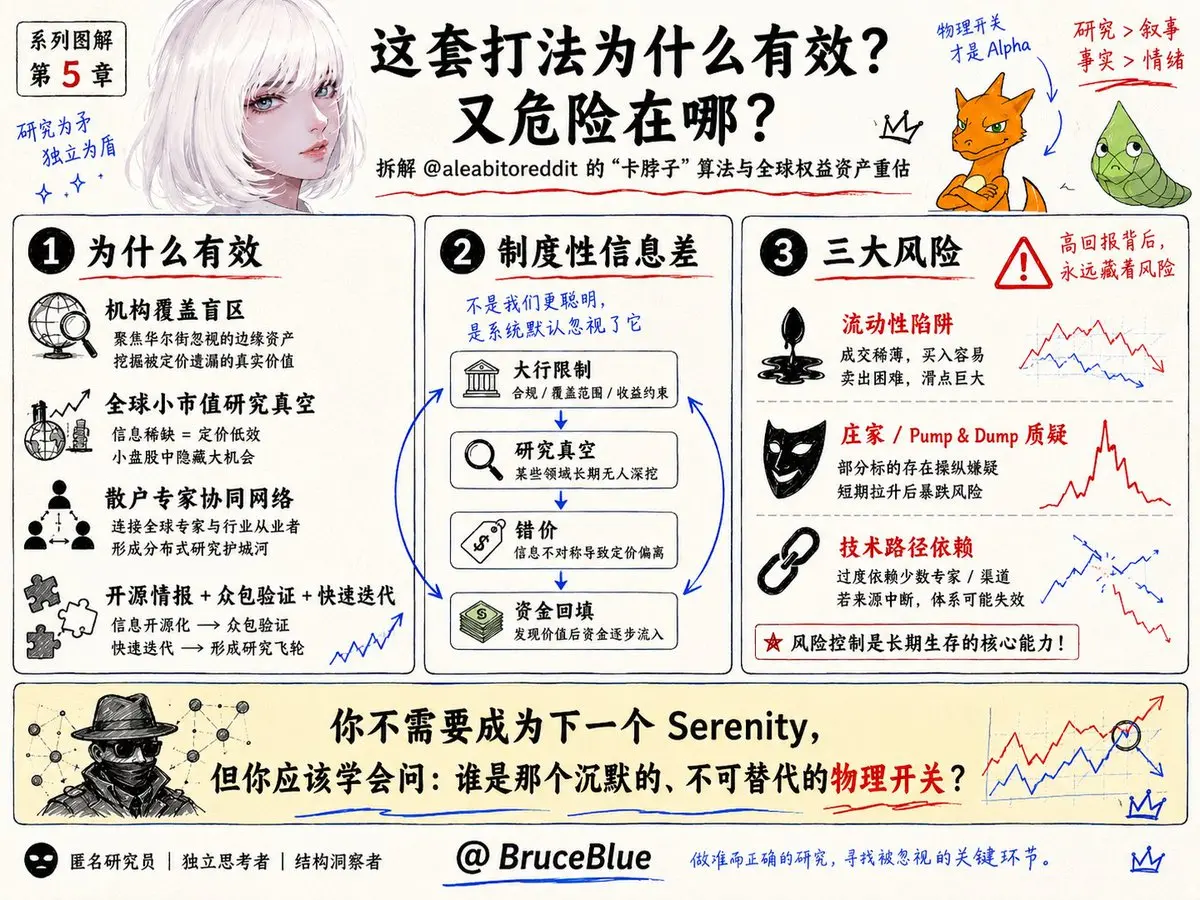
In Serenity's framework, retail traders are no longer mere "dumb money" providing liquidity or blindly following trends but are reshaped into an "Expert Retailer Synergy Network." Traditional WSB relies on short-term options gamma squeezes or emotional memes to drive surges. In contrast, Serenity's completely free, technically high-threshold hardcore analysis subjects followers to a deep "intellectual filtration."

This highly specialized capital synergy enables them to rapidly form combined force in multiple extremely illiquid, remote micro-cap markets that Wall Street banks cannot cover, completing pricing dominance over core assets.

  • Institutional Blind Spots and Information Arbitrage

Analysts at large institutions are constrained by internal compliance, minimum market cap thresholds (e.g., not covering below $1B), and regional specialization (US equity analysts don't write on Sweden or Taiwan). This creates huge research vacuums in the global supply chain. As a completely anonymous independent researcher, Serenity ignores market cap and geographic barriers, directly guiding global long capital to violently refill these vacuums.

  • Structural Risks and Potential Game Dilemmas

However, blindly following this strategy comes with unavoidable fatal risks:

  • Liquidity Traps and Stampede Risk: Micro-cap stocks have extremely low daily trading volume. They surge instantly when the retail synergy rushes in; once technology implementation falls short of expectations, the extremely narrow exit channel leads to severe stampedes.

  • Polarized Public Opinion and "Market Manipulator" Allegations: Veteran shorts sharply criticize it as essentially a "pump and dump with high-IQ academic packaging." Its game characteristics of using massive public voice to attract retail to lift the price keep it long exposed to the shadow of compliance allegations.

  • "Fatal Minefield" of Physical Technology Single-Path Dependency: All of Serenity's core positions are built on the assumptions that "CPO is the only physical evolution path" and "humanoid robots will see a billion-unit explosion." This is a high-stakes gamble. If Nvidia finds CPO has insurmountable engineering dead ends and shifts to advanced thin-film copper cables, or if the West fails to rebuild rare earth separation chains, his entire supply chain empire built on silicon photonics, SOI, MBE equipment, and heavy rare earths could be physically dismantled in an instant.

Conclusion: Using Geek Depth to Beat Financial Breadth

Following Serenity isn't about getting a get-rich-quick stock ticker, but about acquiring an analytical framework that breaks consensus.

In this era of information overload, the most common mistake retail investors make is trying to compete with institutions on the speed of information acquisition or trading macro data that's already fully priced. Serenity demonstrates another possibility: using reverse engineering to deconstruct systems, using AI as a "Devil's Advocate" to challenge one's own logic, to find the truly controlling, silent gears of system operation.

You don't need to be the next Serenity. You don't need to buy any stock he buys.

But you should learn to ask a question like he does:

In this system, who is the silent, irreplaceable physical switch?

If you can answer that question, you already have one more perspective than 99% of market participants. The rest is just waiting for the market to catch up to your cognition.

Disclaimer:

This article does not constitute any investment advice.

All background information about Serenity himself is self-reported and unverified by third parties.

His past performance is not indicative of future results.

Conduct independent research before making any investment decisions.

NFA. DYOR.

Пов'язані питання

QWhat is the core investment framework that researcher Serenity uses to identify opportunities in the AI era, as described in the article?

ASerenity's core framework is the 'Chokepoint Theory' or '供应链瓶颈理论' (Supply Chain Bottleneck Theory). It involves a bottom-up, supply chain reverse engineering approach to identify critical, non-replaceable physical components or raw materials (the 'choke points') that are monopolized by a few companies. If these points are disrupted, the entire downstream AI industry cluster faces physical paralysis.

QAccording to the article, what is a unique step in Serenity's research process before publishing an investment thesis?

ABefore publishing any investment hypothesis, Serenity subjects his research drafts to a unique 'red-blue team' adversarial AI argumentation test. He inputs the drafts into different large language models, commanding the AI to act as a highly critical 'Devil's Advocate' to identify logical flaws, technical physical limitations, threats from alternative solutions, and potential valuation biases. He only publishes the report after it withstands multiple rounds of this AI-driven technical and logical cross-examination.

QWhat are the five major physical barriers (or 'choke points') identified in the Silicon Photonics and Co-Packaged Optics (CPO) supply chain?

AThe five major physical barriers in the Silicon Photonics and CPO supply chain are: 1. High-precision physical alignment (e.g., Fiber Array Units, micro-lenses, represented by FOCI), 2. External Light Source (ELS) and high-power Continuous Wave DFB lasers (represented by Sivers Semiconductors, $SIVE), 3. Molecular Beam Epitaxy (MBE) equipment barrier (represented by Riber, $ALRIB), 4. High-purity red phosphorus raw material (99.9999%+ purity, monopolized by Japanese chemical giants like NCI), and 5. Underlying Silicon-On-Insulator (SOI) wafer substrate material (dominated by Soitec with its Smart-Cut patent).

QWhat key risk does the article highlight regarding the humanoid robot supply chain for the United States?

AThe article highlights that the United States is at risk of losing the hardware and materials manufacturing race for humanoid robots. While the AI 'brain' (software and algorithms) remains in the US, critical 'body' components like joints, actuators, and reducers are almost entirely controlled by Asian manufacturers (e.g., Harmonic Drive in Japan,绿的谐波 in China, Nabtesco in Japan). This creates a dangerous dependency, meaning any geopolitical friction could lead to a physical shutdown of the hardware supply chain for US robot companies.

QWhat are some of the structural risks associated with following Serenity's investment strategy, as mentioned in the conclusion?

AKey structural risks include: 1. Liquidity traps and stampede risk in micro-cap stocks with low daily trading volumes, 2. Intense polarization of public opinion and accusations of being a sophisticated 'pump and dump' scheme, 3. Fatal reliance on a single physical technology path. If the foundational assumptions fail (e.g., if CPO faces insurmountable engineering hurdles or if the predicted mass adoption of humanoid robots doesn't materialize), the entire investment thesis built on related supply chains (silicon photonics, SOI, MBE, rare earths) could collapse physically and financially.

Пов'язані матеріали

Agentized OS: It's Not About AI, It's About the Foundation

The Agentic OS: Beyond AI, It's About the Foundational Stack In 2026, major operating systems like Android, iOS, HarmonyOS, and Windows are entering the "Agentic" era, integrating proactive AI assistants deeply into the system layer. However, the real competition lies not in the flashy AI features showcased at events, but in the three-layer foundational stack that enables them: the system-level AI Runtime, proprietary/controllable chips, and the on-device/cloud model matrix. The AI Runtime acts as the central scheduler, managing model inference, resource allocation, and exposing capabilities to apps. Controllable chips (e.g., Apple Silicon, Google Tensor, Huawei Kirin) are crucial for deep hardware-software co-optimization, determining the efficiency and experience limits of on-device Agents. The on-device/cloud model matrix provides the "intelligence," with proprietary, chip-optimized small models (like Gemini Nano, Apple's ~3B model) handling daily tasks locally for low latency, privacy, and reliability, while cloud models tackle complex requests. Deep synergy between these three layers enables key Agent differentiators: ultra-low latency and power efficiency, genuine "on-device first" privacy, access to system-level personal context across apps, and reliable performance as a system service even offline. OS vendors with strong integration across this stack (like Apple, Google, and Huawei) build a deeper moat. Beyond this core stack, long-term competitiveness depends on variables like structured App integration (e.g., App Intents/AppFunctions) for reliable multi-step workflows, and robust privacy frameworks that build user trust. This shift towards Agentic OS extends beyond phones and PCs to IoT, cars, and XR glasses via existing multi-device ecosystems. The race is won not in a keynote, but through generations of meticulously co-developed chips, models, and system software.

marsbit1 год тому

Agentized OS: It's Not About AI, It's About the Foundation

marsbit1 год тому

Why Sam Altman's 'Water and Electricity Theory' Sparks Copyright Controversy

OpenAI CEO Sam Altman's recent statement that "intelligence will become a utility like electricity or water" has sparked significant controversy, primarily around copyright issues and the nature of AI development. While positioning AI as a utility serves as a compelling narrative for infrastructure investors, critics argue the analogy is flawed in three key areas. First, there's a fundamental "property gap." Traditional utilities like water and power create new, physical infrastructure from scratch. In contrast, major AI models are trained by reorganizing vast amounts of existing human-created content—books, articles, code, etc.—often scraped from the web without explicit permission or compensation to creators. This "free acquisition, paid resale" model is seen by many as ethically problematic. Second, there's a "pricing gap." True public utilities are typically regulated to ensure universal service with non-discriminatory, cost-plus pricing. AI's token-based pricing, however, involves significant price discrimination (e.g., output tokens costing much more than input tokens) and is designed for revenue maximization, not equitable access. Third, a "governance gap" exists. Utilities operate under public oversight, while AI pricing and development are currently controlled by a few private companies. Furthermore, the industry's own shift toward buying licensed training data (e.g., deals with Reddit or news publishers) undermines its previous legal reliance on "fair use" for freely scraped data. In conclusion, while AI is indeed becoming a foundational technology, calling it a public utility remains contentious. The title requires not just scale and a pay-per-use model, but also credible solutions for data provenance, equitable pricing, and public governance.

marsbit1 год тому

Why Sam Altman's 'Water and Electricity Theory' Sparks Copyright Controversy

marsbit1 год тому

Торгівля

Спот
Ф'ючерси

Популярні статті

Що таке $S$

Розуміння SPERO: Комплексний огляд Вступ до SPERO Оскільки ландшафт інновацій продовжує еволюціонувати, виникнення технологій web3 та криптовалютних проектів відіграє ключову роль у формуванні цифрового майбутнього. Один з проектів, який привернув увагу в цій динамічній сфері, — це SPERO, позначений як SPERO,$$s$. Ця стаття має на меті зібрати та представити детальну інформацію про SPERO, щоб допомогти ентузіастам та інвесторам зрозуміти його основи, цілі та інновації в рамках web3 та крипто-сектору. Що таке SPERO,$$s$? SPERO,$$s$ — це унікальний проект у криптопросторі, який прагне використати принципи децентралізації та технології блокчейн для створення екосистеми, що сприяє залученню, корисності та фінансовій інклюзії. Проект розроблений для полегшення взаємодії між користувачами новими способами, надаючи їм інноваційні фінансові рішення та послуги. У своїй основі SPERO,$$s$ прагне надати можливості індивідам, забезпечуючи інструменти та платформи, які покращують користувацький досвід у криптовалютному просторі. Це включає в себе можливість більш гнучких методів транзакцій, сприяння ініціативам, що підтримуються спільнотою, та створення шляхів для фінансових можливостей через децентралізовані додатки (dApps). Основна концепція SPERO,$$s$ обертається навколо інклюзивності, прагнучи зменшити розриви в традиційній фінансовій системі, використовуючи переваги технології блокчейн. Хто є творцем SPERO,$$s$? Особистість творця SPERO,$$s$ залишається дещо невідомою, оскільки є обмежені публічно доступні ресурси, що надають детальну інформацію про його засновників. Ця відсутність прозорості може бути наслідком зобов'язання проекту до децентралізації — етики, яку багато проектів web3 поділяють, ставлячи колективні внески вище за індивідуальне визнання. Зосереджуючи обговорення навколо спільноти та її колективних цілей, SPERO,$$s$ втілює суть наділення без виділення конкретних осіб. Таким чином, розуміння етики та місії SPERO є більш важливим, ніж ідентифікація єдиного творця. Хто є інвесторами SPERO,$$s$? SPERO,$$s$ підтримується різноманітними інвесторами, починаючи від венчурних капіталістів до ангельських інвесторів, які прагнуть сприяти інноваціям у крипто-секторі. Зосередження цих інвесторів зазвичай узгоджується з місією SPERO — пріоритет надається проектам, які обіцяють технологічний прогрес у суспільстві, фінансову інклюзію та децентралізоване управління. Ці інвесторські фонди зазвичай зацікавлені в проектах, які не лише пропонують інноваційні продукти, але й позитивно впливають на спільноту блокчейн та її екосистеми. Підтримка з боку цих інвесторів підкріплює SPERO,$$s$ як значного конкурента в швидко змінюваній сфері крипто-проектів. Як працює SPERO,$$s$? SPERO,$$s$ використовує багатогранну структуру, яка відрізняє його від традиційних криптовалютних проектів. Ось деякі ключові особливості, які підкреслюють його унікальність та інноваційність: Децентралізоване управління: SPERO,$$s$ інтегрує моделі децентралізованого управління, надаючи користувачам можливість активно брати участь у процесах прийняття рішень щодо майбутнього проекту. Цей підхід сприяє відчуттю власності та відповідальності серед членів спільноти. Корисність токена: SPERO,$$s$ використовує свій власний криптовалютний токен, розроблений для виконання різних функцій в екосистемі. Ці токени дозволяють здійснювати транзакції, отримувати винагороди та полегшувати послуги, що пропонуються на платформі, підвищуючи загальну залученість та корисність. Шарова архітектура: Технічна архітектура SPERO,$$s$ підтримує модульність та масштабованість, що дозволяє безперешкодно інтегрувати додаткові функції та додатки в міру розвитку проекту. Ця адаптивність є надзвичайно важливою для збереження актуальності в постійно змінюваному крипто-ландшафті. Залучення спільноти: Проект підкреслює ініціативи, що підтримуються спільнотою, використовуючи механізми, які стимулюють співпрацю та зворотний зв'язок. Підтримуючи сильну спільноту, SPERO,$$s$ може краще задовольняти потреби користувачів та адаптуватися до ринкових тенденцій. Фокус на інклюзію: Пропонуючи низькі комісії за транзакції та зручні інтерфейси, SPERO,$$s$ прагне залучити різноманітну базу користувачів, включаючи осіб, які раніше не брали участі в крипто-просторі. Це зобов'язання до інклюзії узгоджується з його загальною місією наділення через доступність. Хронологія SPERO,$$s$ Розуміння історії проекту надає важливі уявлення про його розвиток та етапи. Нижче наведено пропоновану хронологію, що відображає значні події в еволюції SPERO,$$s$: Етап концептуалізації та ідеації: Початкові ідеї, що стали основою SPERO,$$s$, були сформовані, тісно пов'язані з принципами децентралізації та фокусом на спільноті в індустрії блокчейн. Запуск білого паперу проекту: Після концептуального етапу був випущений комплексний білий папір, що детально описує бачення, цілі та технологічну інфраструктуру SPERO,$$s$, щоб залучити інтерес та зворотний зв'язок від спільноти. Створення спільноти та ранні залучення: Активні зусилля були спрямовані на створення спільноти ранніх прихильників та потенційних інвесторів, що полегшило обговорення цілей проекту та отримання підтримки. Подія генерації токенів: SPERO,$$s$ провів подію генерації токенів (TGE) для розподілу своїх рідних токенів серед ранніх прихильників та встановлення початкової ліквідності в екосистемі. Запуск початкового dApp: Перший децентралізований додаток (dApp), пов'язаний з SPERO,$$s$, став доступним, дозволяючи користувачам взаємодіяти з основними функціями платформи. Постійний розвиток та партнерства: Безперервні оновлення та вдосконалення пропозицій проекту, включаючи стратегічні партнерства з іншими учасниками блокчейн-простору, сформували SPERO,$$s$ у конкурентоспроможного та еволюціонуючого гравця на крипто-ринку. Висновок SPERO,$$s$ є свідченням потенціалу web3 та криптовалют для революціонізації фінансових систем та наділення індивідів. Завдяки зобов'язанню до децентралізованого управління, залучення спільноти та інноваційно спроектованих функцій, він прокладає шлях до більш інклюзивного фінансового ландшафту. Як і з будь-якими інвестиціями в швидко змінюваному крипто-просторі, потенційним інвесторам та користувачам рекомендується ретельно досліджувати та обдумано взаємодіяти з поточними подіями в SPERO,$$s$. Проект демонструє інноваційний дух крипто-індустрії, запрошуючи до подальшого дослідження його численних можливостей. Хоча подорож SPERO,$$s$ ще триває, його основні принципи можуть справді вплинути на майбутнє того, як ми взаємодіємо з технологією, фінансами та один з одним у взаємопов'язаних цифрових екосистемах.

73 переглядів усьогоОпубліковано 2024.12.17Оновлено 2024.12.17

Що таке $S$

Що таке AGENT S

Агент S: Майбутнє автономної взаємодії в Web3 Вступ У постійно змінюваному ландшафті Web3 та криптовалюти інновації постійно переосмислюють, як люди взаємодіють з цифровими платформами. Один з таких новаторських проектів, Агент S, обіцяє революціонізувати взаємодію людини з комп'ютером через свою відкриту агентну структуру. Прокладаючи шлях для автономних взаємодій, Агент S прагне спростити складні завдання, пропонуючи трансформаційні застосування в штучному інтелекті (ШІ). Це детальне дослідження заглиблюється в складності проекту, його унікальні особливості та наслідки для сфери криптовалюти. Що таке Агент S? Агент S є революційною відкритою агентною структурою, спеціально розробленою для вирішення трьох основних викликів в автоматизації комп'ютерних завдань: Набуття специфічних знань у галузі: Структура інтелектуально навчається з різних зовнішніх джерел знань та внутрішнього досвіду. Цей подвійний підхід дозволяє їй створити багатий репозиторій специфічних знань у галузі, покращуючи її продуктивність у виконанні завдань. Планування на довгих горизонтах завдань: Агент S використовує планування з підкріпленням досвіду, стратегічний підхід, який полегшує ефективний розподіл та виконання складних завдань. Ця функція значно підвищує її здатність ефективно та результативно управляти кількома підзавданнями. Обробка динамічних, неоднорідних інтерфейсів: Проект представляє Інтерфейс Агент-Комп'ютер (ACI), інноваційне рішення, яке покращує взаємодію між агентами та користувачами. Використовуючи багатомодальні великі мовні моделі (MLLMs), Агент S може безперешкодно орієнтуватися та маніпулювати різноманітними графічними інтерфейсами користувача. Завдяки цим новаторським функціям Агент S надає надійну структуру, яка вирішує складнощі, пов'язані з автоматизацією людської взаємодії з машинами, прокладаючи шлях для численних застосувань у ШІ та за його межами. Хто є творцем Агент S? Хоча концепція Агент S є фундаментально новаторською, конкретна інформація про його творця залишається невідомою. Творець наразі невідомий, що підкреслює або початкову стадію проекту, або стратегічний вибір зберегти засновників у таємниці. Незважаючи на анонімність, акцент залишається на можливостях та потенціалі структури. Хто є інвесторами Агент S? Оскільки Агент S є відносно новим у криптографічній екосистемі, детальна інформація про його інвесторів та фінансових спонсорів не задокументована. Відсутність публічно доступних відомостей про інвестиційні фонди або організації, що підтримують проект, викликає питання щодо його фінансової структури та дорожньої карти розвитку. Розуміння підтримки є критично важливим для оцінки стійкості проекту та потенційного впливу на ринок. Як працює Агент S? В основі Агент S лежить передова технологія, яка дозволяє йому ефективно функціонувати в різних умовах. Його операційна модель побудована навколо кількох ключових функцій: Взаємодія з комп'ютером, подібна до людської: Структура пропонує розширене планування ШІ, прагнучи зробити взаємодії з комп'ютерами більш інтуїтивними. Імітуючи людську поведінку при виконанні завдань, вона обіцяє підвищити досвід користувачів. Наративна пам'ять: Використовується для використання високорівневого досвіду, Агент S використовує наративну пам'ять для відстеження історій завдань, тим самим покращуючи свої процеси прийняття рішень. Епізодична пам'ять: Ця функція надає користувачам покрокові інструкції, дозволяючи структурі пропонувати контекстуальну підтримку в міру виконання завдань. Підтримка OpenACI: Завдяки можливості працювати локально, Агент S дозволяє користувачам зберігати контроль над своїми взаємодіями та робочими процесами, узгоджуючи з децентралізованою етикою Web3. Легка інтеграція з зовнішніми API: Його універсальність і сумісність з різними платформами ШІ забезпечують те, що Агент S може безперешкодно вписатися в існуючі технологічні екосистеми, роблячи його привабливим вибором для розробників та організацій. Ці функціональні можливості колективно сприяють унікальному положенню Агент S у крипто-просторі, оскільки він автоматизує складні, багатоступеневі завдання з мінімальним втручанням людини. У міру розвитку проекту його потенційні застосування в Web3 можуть переосмислити, як відбуваються цифрові взаємодії. Хронологія Агент S Розробка та етапи Агент S можуть бути узагальнені в хронології, яка підкреслює його значні події: 27 вересня 2024 року: Концепція Агент S була представлена в комплексній науковій статті під назвою “Відкрита агентна структура, яка використовує комп'ютери як людина”, що демонструє основи проекту. 10 жовтня 2024 року: Наукова стаття була опублікована на arXiv, пропонуючи детальне дослідження структури та її оцінки продуктивності на основі бенчмарку OSWorld. 12 жовтня 2024 року: Було випущено відеопрезентацію, що надає візуальне уявлення про можливості та особливості Агент S, ще більше залучаючи потенційних користувачів та інвесторів. Ці маркери в хронології не лише ілюструють прогрес Агент S, але й вказують на його прихильність до прозорості та залучення громади. Ключові моменти про Агент S У міру розвитку структури Агент S кілька ключових характеристик виділяються, підкреслюючи її новаторський характер та потенціал: Інноваційна структура: Розроблена для забезпечення інтуїтивного використання комп'ютерів, подібного до людської взаємодії, Агент S пропонує новий підхід до автоматизації завдань. Автономна взаємодія: Здатність автономно взаємодіяти з комп'ютерами через GUI означає стрибок до більш інтелектуальних та ефективних обчислювальних рішень. Автоматизація складних завдань: Завдяки своїй надійній методології він може автоматизувати складні, багатоступеневі завдання, роблячи процеси швидшими та менш схильними до помилок. Безперервне вдосконалення: Механізми навчання дозволяють Агенту S покращуватися на основі минулого досвіду, постійно підвищуючи свою продуктивність та ефективність. Універсальність: Його адаптивність до різних операційних середовищ, таких як OSWorld та WindowsAgentArena, забезпечує його здатність служити широкому спектру застосувань. Оскільки Агент S займає своє місце в ландшафті Web3 та криптовалюти, його потенціал покращити можливості взаємодії та автоматизувати процеси означає значний прогрес у технологіях ШІ. Завдяки своїй інноваційній структурі Агент S є прикладом майбутнього цифрових взаємодій, обіцяючи більш безперешкодний та ефективний досвід для користувачів у різних галузях. Висновок Агент S представляє собою сміливий крок вперед у поєднанні ШІ та Web3, з можливістю переосмислити, як ми взаємодіємо з технологією. Хоча проект все ще на ранніх стадіях, можливості для його застосування є величезними та переконливими. Завдяки своїй комплексній структурі, що вирішує критичні виклики, Агент S прагне вивести автономні взаємодії на передній план цифрового досвіду. У міру того, як ми заглиблюємося в сфери криптовалюти та децентралізації, проекти, подібні до Агент S, безсумнівно, відіграватимуть ключову роль у формуванні майбутнього технологій та співпраці людини з комп'ютером.

659 переглядів усьогоОпубліковано 2025.01.14Оновлено 2025.01.14

Що таке AGENT S

Як купити S

Ласкаво просимо до HTX.com! Ми зробили покупку Sonic (S) простою та зручною. Дотримуйтесь нашої покрокової інструкції, щоб розпочати свою криптовалютну подорож.Крок 1: Створіть обліковий запис на HTXВикористовуйте свою електронну пошту або номер телефону, щоб зареєструвати обліковий запис на HTX безплатно. Пройдіть безпроблемну реєстрацію й отримайте доступ до всіх функцій.ЗареєструватисьКрок 2: Перейдіть до розділу Купити крипту і виберіть спосіб оплатиКредитна/дебетова картка: використовуйте вашу картку Visa або Mastercard, щоб миттєво купити Sonic (S).Баланс: використовуйте кошти з балансу вашого рахунку HTX для безперешкодної торгівлі.Треті особи: ми додали популярні способи оплати, такі як Google Pay та Apple Pay, щоб підвищити зручність.P2P: Торгуйте безпосередньо з іншими користувачами на HTX.Позабіржова торгівля (OTC): ми пропонуємо індивідуальні послуги та конкурентні обмінні курси для трейдерів.Крок 3: Зберігайте свої Sonic (S)Після придбання Sonic (S) збережіть його у своєму обліковому записі на HTX. Крім того, ви можете відправити його в інше місце за допомогою блокчейн-переказу або використовувати його для торгівлі іншими криптовалютами.Крок 4: Торгівля Sonic (S)Легко торгуйте Sonic (S) на спотовому ринку HTX. Просто увійдіть до свого облікового запису, виберіть торгову пару, укладайте угоди та спостерігайте за ними в режимі реального часу. Ми пропонуємо зручний досвід як для початківців, так і для досвідчених трейдерів.

1.5k переглядів усьогоОпубліковано 2025.01.15Оновлено 2025.03.21

Як купити S

Обговорення

Ласкаво просимо до спільноти HTX. Тут ви можете бути в курсі останніх подій розвитку платформи та отримати доступ до професійної ринкової інформації. Нижче представлені думки користувачів щодо ціни S (S).

活动图片