Crypto Political Operation Targets California's Katie Porter by Undermining Her Base

CoinDeskPolicyОпубліковано о 2024-02-27Востаннє оновлено о 2024-02-28

Анотація

A leading industry super PAC, Fairshake, is appealing directly to young crypto holders in Porter's state to reject the congresswoman's Senate bid

  • Fairshake is trying to throttle the Senate campaign of a California progressive, Rep. Katie Porter, before she can make it to the general election there.
  • The super PAC is seeking to convince the young, crypto-owning voters in her base to go a different direction, hoping to avoid an ally of crypto critic Elizabeth Warren being added to the Senate.

A leading crypto industry political operation, Fairshake, is trying to ensure that the U.S. Senate doesn't get a twin for its chief Washington antagonist Sen. Elizabeth Warren (D-Mass.) by trying to cut the legs from under U.S. Rep. Katie Porter (D-Calif.) in the 11th hour of her state's primary-election battle.

22.7K

Porter, a prominent progressive lawmaker in the mold of Warren, left her swing-district seat to pursue California's Senate opening left by the death of Sen. Dianne Feinstein.

She's a relatively young candidate whose base is youthful, which is a similar demographic with the kind of people who gravitate toward an interest in crypto. Fairshake – a political action committee (PAC) that's raised tens of millions from the digital assets sector – is devoting some of the millions it's staked on defeating Porter to directly beseeching crypto owners to pick somebody else.

Advertisement
Advertisement

“This is a critical voter block which Katie Porter must win to advance," Josh Vlasto, a spokesman for Fairshake, told CoinDesk. "We are making sure the 8 million crypto owners in California – who are disproportionately young voters who support Democrats – know about her hostility toward the technology and how that would hurt American jobs."

The group is putting out targeted ads on social media to get to those voters, Vlasto said.

Unlike Warren, Porter hasn't yet been a loud voice against the crypto industry, apart from criticism of the crypto mining sector's energy usage. But she's been an ally of Warren, and if she were placed on the Senate Banking Committee, she could team up with the Massachusetts lawmaker.

Fairshake is targeting crypto voters with direct ads on social media. (Fairshake)

Fairshake has taken in nearly $90 million in crypto industry donations, including a recent $4.9 million from Tyler and Cameron Winklevoss. The PAC said it's spent more than $6 million to oppose Porter.

The super PAC targeted the congresswoman previously with ads that suggested she took money from corporate donors, but her campaign called those assertions "a scheme to mislead voters," and said that this was an example of "billionaires and corporate special interests using misinformation to rig our elections." A fact check by the Sacramento Bee agreed the earlier ads were misleading.

Advertisement
Advertisement

Polling in the California election shows Porter in a fight for second place in a primary system in which the top two candidates – no matter which party – advance to the general election. In this case, it's the leading Republican, Steve Garvey, that Porter would likely need to overtake by next week if she's going to be on that final ballot. U.S. Rep. Adam Schiff (D-Calif.) has maintained the lead throughout the race.

The March 5 primary is a life-or-death contest for Porter's congressional career, because she left her hard-won Orange County district and won't have a legislative role if she comes in third. Making up a handful of percentage points in the next week would only give her an opportunity to bridge the gap with Schiff – if he maintains the lead – by November.

Пов'язані матеріали

Why do people like Luke still want to fork Bitcoin despite having no support? BIP-100 has already been declared a failure!

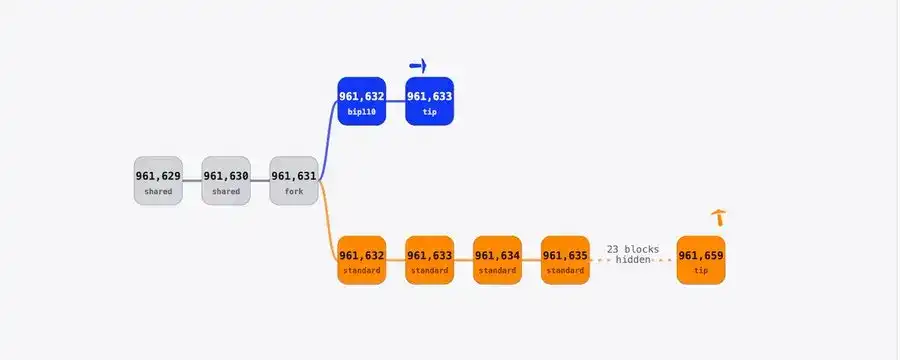
On August 8th, the Bitcoin network experienced a contentious fork triggered by BIP-110, despite the proposal having only 2.53% miner signaling support in the prior period. Led primarily by developer Luke Dashjr and based on his Bitcoin Knots implementation (not merged into Bitcoin Core), this User-Activated Soft Fork (UASF) aimed to impose strict new limits on non-financial data (like Ordinals inscriptions) within blocks to reduce long-term node costs. The fork activated at block height 961632, with BIP-110 nodes rejecting blocks without the required signaling. This created two chains: the dominant original chain continuing normally, and a low-hashrate BIP-110 chain which quickly fell behind. The core conflict is between those viewing block space as a fee market open to all data and those prioritizing Bitcoin as a monetary network, seeking to ban what they see as blockchain "spam." BIP-110's strategy relied on economic nodes (exchanges, wallets) adopting the new rules first, hoping to force miners to follow. However, this has not materialized. The BIP-110 chain now faces severe challenges: extremely slow block times potentially stretching over 1.9 years before its rules would even activate, a lack of broad economic support, and no automatic replay protection. For most users, Bitcoin's main chain operates unchanged. The immediate technical impact is limited to services running BIP-110 software, which now see a different blockchain. The event highlights ongoing ideological disputes within Bitcoin but, given its minimal support, is unlikely to alter the main network's trajectory.

marsbit7 хв тому

Why do people like Luke still want to fork Bitcoin despite having no support? BIP-100 has already been declared a failure!

marsbit7 хв тому

Hardcore Research Report: After a Stunning Debut, A Frame-by-Frame Breakdown of Robinhood Chain's Revenue Potential

**Summary: The Revenue Potential of Robinhood Chain vs. Its Declining Core Crypto Business** A detailed analysis of Robinhood's crypto trajectory reveals a stark contrast: while the company's overall revenue hit a record high of $1.31B in Q2 2026, its crypto-specific business is in sharp decline. Crypto revenue fell 38% year-over-year to $100M, now constituting only 8% of total revenue. Retail crypto trading volume and the share of crypto in customer assets also dropped to multi-year lows. In this context, Robinhood Chain, the company's newly launched Layer 2 blockchain, represents a major strategic bet. Its launch was notably strong, generating $3.6M in Real Economic Value (REV) in July 2026, or 38% of all tracked L2 revenue that month—surpassing established networks like Polygon and Base. However, this early activity was heavily driven by meme coins (51% of spot volume), not the chain's stated focus on Real World Assets (RWAs), which accounted for only 5%. The report argues that Robinhood Chain's infrastructure-layer revenue alone is insufficient to meaningfully revive the crypto division. The entire L2 revenue market is structurally shrinking and too small. Robinhood's clearest monetization path lies at the application layer: 1. **USDG Stablecoin:** Robinhood's native stablecoin could generate significant interest income. At a current $333M supply (assuming a 3.5% yield), it represents ~$10.5M in annualized revenue. Scaling USDG to $1B+ would create a substantial, durable income stream. 2. **Application Distribution:** Robinhood's main app holds immense distribution value. Evidence suggests protocols like Morpho pay for integration, driving significant user deposits. In contrast, distribution via the standalone Robinhood Wallet has shown limited value so far. The known, quantifiable revenue streams from Robinhood Chain (chain REV, USDG interest, shared Lighter fees) total ~$54.8M annualized—only about 14% of Robinhood's annualized crypto revenue. The conclusion is that for Robinhood Chain to become a meaningful growth driver, Robinhood must successfully commercialize its application-layer advantages—primarily by scaling USDG and monetizing its main app's user reach—or use the chain as a funnel into its higher-value traditional products. Based on current data, the chain is not yet a significant contributor to company profits.

marsbit22 хв тому

Hardcore Research Report: After a Stunning Debut, A Frame-by-Frame Breakdown of Robinhood Chain's Revenue Potential

marsbit22 хв тому

Hardcore Research Report: After an Impressive Start, Analyzing Robinhood Chain's Revenue Potential Frame by Frame

Robinhood's crypto business is in steep decline, contributing only 8% of total revenue in Q2 2026 despite the company's overall record performance. Its new Layer 2 blockchain, Robinhood Chain, launched strongly in July, generating $3.6M in Real Economic Value (REV) and capturing 38% of all L2 network revenue that month. However, this early activity is heavily driven by speculative Meme coin trading (51% of spot volume), not the intended Real-World Asset (RWA) use case. While successful as a blockchain, the network's revenue alone is too small to meaningfully impact Robinhood's profits, with known revenue streams annualizing to about $54.8M—just 14% of the crypto segment's annualized revenue. For Robinhood Chain to revitalize the crypto business, Robinhood must monetize beyond infrastructure. The clearest path is scaling its native stablecoin, USDG, to generate interest income from its reserves. Another opportunity lies in commercializing its massive user distribution, particularly through its main app, as evidenced by the successful integration of Morpho. In contrast, distribution via the standalone Robinhood Wallet appears limited. Ultimately, Robinhood Chain may serve more as a user acquisition funnel for higher-value products rather than a major direct revenue line. To become a significant growth driver, Robinhood must successfully expand USDG or effectively monetize its main app's distribution power.

Odaily星球日报28 хв тому

Hardcore Research Report: After an Impressive Start, Analyzing Robinhood Chain's Revenue Potential Frame by Frame

Odaily星球日报28 хв тому

Торгівля

Спот
活动图片