联创损失近千万美元,Ronin又被盗了?

Odaily星球日报Опубліковано о 2024-02-23Востаннє оновлено о 2024-02-23

Анотація

Ronin社区传出疑似被盗消息,带动RON币价短时下跌超10%

2 月 23 日上午,Web3 安全团队 Ancilia.nc 在社交媒体表示,监测到价值超过 3000 ETH 的 RON 被短时间内从 Ronin 桥中提取并存入 Tornado。疑似黑客地址的关联钱包(0x 73、0x 39、0x a 4)在 Tornado 预存了 0.1 ETH,并在相同时间内提取总计 3250 枚 ETH。

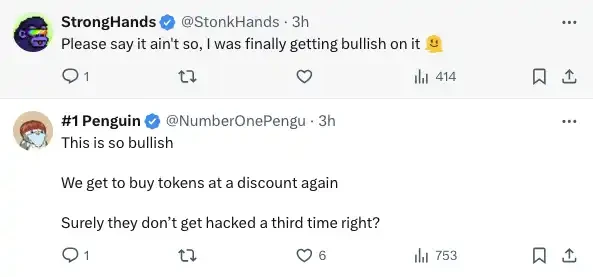
Ronin 又被盗了?社区的反应更多是不敢相信,「我刚刚开始看好他」,还有人调侃「那是不是可以趁低价买入,他们应该不会遭受第三次攻击了」。
联创损失近千万美元,Ronin又被盗了?

消息发酵后,RON 从 3.16 美元的位置断崖式下跌, 10 分钟内下跌至 2.74 美元,跌幅超 13% 。
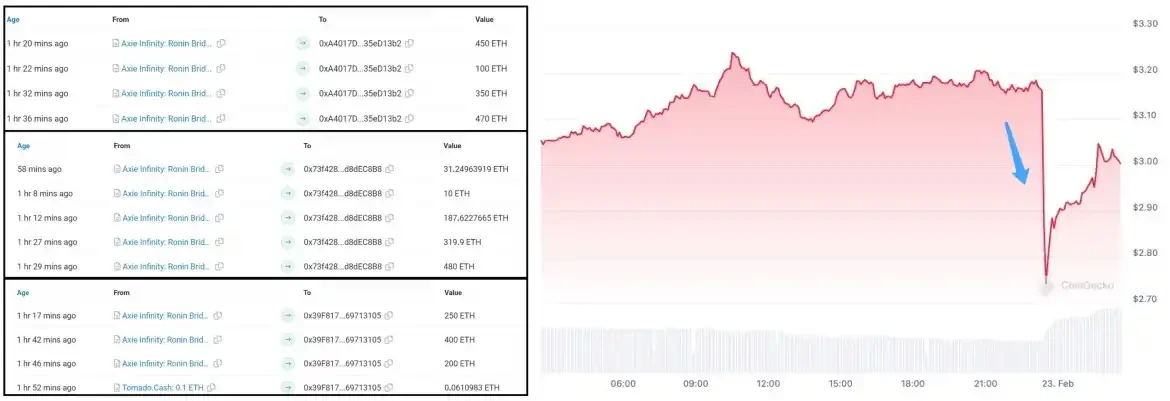
联创损失近千万美元,Ronin又被盗了?

左图源@WazzCrypto

被盗鲸鱼地址是 Axie Infinity 联创

二十分钟后,Ronin 联合创始人 Psycheout 在该条推特下回复表示,Ronin 和跨链桥都没有问题,这只是一个鲸鱼钱包被盗,并通过 Tornado Cash 混走。「Ronin 桥拥有很高的安全性,经过了多次审核,当监测到有大量资产撤走时就会暂停提取」。

Psycheout 还继续追加评论,要求 Ancilia 团队删除推文。
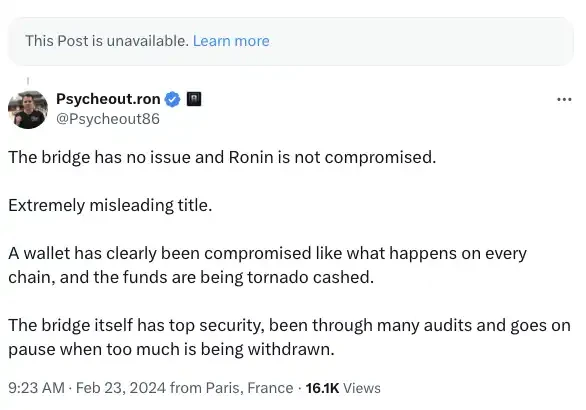
联创损失近千万美元,Ronin又被盗了?

但令社区没想到的是,这位被盗的鲸鱼竟是 Axie Infinity 和 Ronin Network 的联合创始人 Jihoz。

在社区的被盗疑问发出一小时后,Jihoz 发布了一条推文,表示其两个个人地址遭到安全攻击。Jihoz 强调,此次攻击仅限于其个人账户,与 Ronin 链的验证或运营活动无关。同时,泄露的密钥与 Sky Mavis 的运营也没有任何联系。「我想向大家保证,我们对所有链上相关活动都采取了严格的安全措施」。

Pixels 创始人 Luke Barwikowski 和 Ronin 联创 Psycheout,以及 Ronin 社区成员都在 Jihoz 的动态下表示了安慰。此次「被盗乌龙」宣告结束,截止撰稿时,RON 已经回升至 3 美元附近,短时跌幅收窄至 5% 。
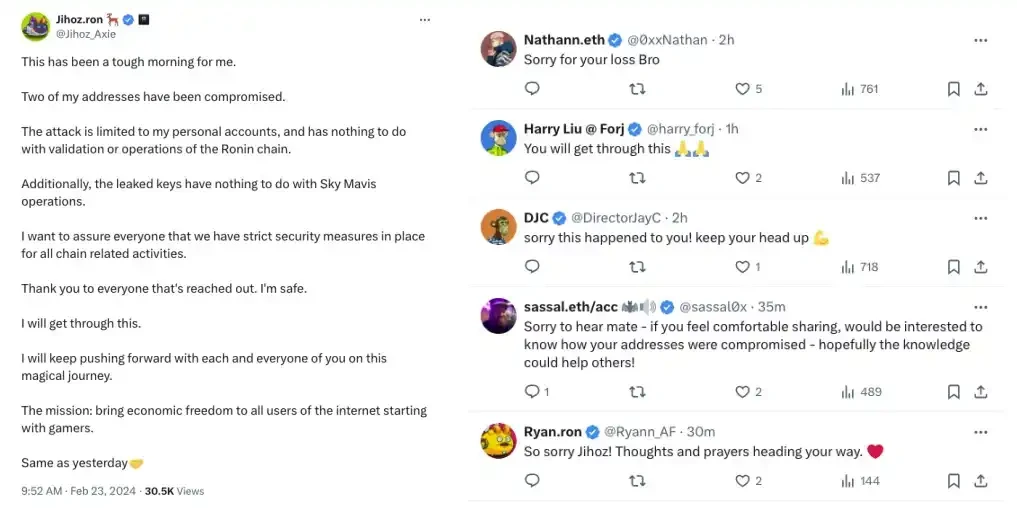
联创损失近千万美元,Ronin又被盗了?

「被盗 PTSD」, 2 年前的 6 亿阴影

其实私钥被盗是常发生的事情, 300 万 RON 的价值体量也不算太大,只占流通量的 0.1% 。上个月,Ripple 陷入被盗 2.13 亿枚 XRP (约合 1.12 亿美元)」危机时,XRP 短时跌近 4% ,而此次 Ronin 事件中的流失资产价值在 1000 万美元左右,却在 10 分钟内引起了 13% 的跌幅?这样的敏感和恐慌情绪很大程度上是源于 2 年前 Ronin 被盗 6 亿的阴影。

2022 年 3 月 23 日,Ronin 网络的九个验证节点中的四个 Ronin 验证器和一个由 Axie DAO 运行的第三方验证器被黑客控制。而 Ronin 官方团队在被黑客攻击 7 日后意识到这个安全漏洞,在这期间攻击者使用被黑的私钥来伪造假提款,从 Ronin 跨链桥中提取了 173, 600 个 ETH 和 2550 万美元的 USDC,价值 6 亿美元。

相关阅读:《Ronin 被盗官方梳理: 6 天前发现漏洞, 5 个私钥被盗

在团队宣布被盗后,RON 在一天内跌去 20% ,并在之后的一个月里持续下跌,缩水 84% 。2022 年的绝大部分时间,RON 的价格都在 1 美元以下。有这样的惨痛经历,在发现 Ronin 上的资产有可疑动向后,社区的第一反应肯定是「Ronin 又被盗了?」

不过此时的 Ronin 已经不同往日,近一年,随着 Ronin 不断完善其基础设施和实力链游 Pixel 的加入,社区目睹了 Ronin 从低谷走向复苏。2 月 9 日,RON 上线 Binance 交易对,在社区眼中,这是 Ronin 生态被资本肯定的信号。

相关阅读:《被盗 6 亿六百天后,Ronin 再登场

除了生态,Ronin 的安全性曾因「被盗金额达 6 亿、黑客攻击 5 日后才发现」这两点而备受社区质疑,但随着 Ronin 近年来将 9 个验证节点增加至 22 个,并在 2023 年 4 月推出委托权益证明 (DPoS) 后,其安全性已经大大提升。截止撰稿时,已经有 1.9 亿枚 RON 参与了质押。


Пов'язані матеріали

Ethereum Is Retracing the Path of the Internet and Linux: No One Yields, and the Neutral Party Ultimately Prevails

This article argues that Ethereum is following the historical path of open, neutral systems like the Internet and Linux, which eventually triumphed over proprietary, centrally-controlled alternatives. Major financial institutions like JPMorgan, Stripe, and Circle are building their own proprietary blockchains or networks (e.g., Tempo, Arc), but will never agree to build on a competitor's controlled infrastructure. This creates the perfect opportunity for Ethereum as the only neutral, credibly neutral settlement layer that no single entity controls. The piece draws parallels to the 1990s, when experts like Bill Gates predicted proprietary networks (from Microsoft, Oracle) would win over the open Internet, and when Sun Microsystems' Unix lost to the open-source "bazaar" development model of Linux. This model, described in Eric Raymond's "The Cathedral and the Bazaar," thrives on permissionless innovation where countless contributors improve the system, outpacing any centralized competitor. Ethereum embodies this through its decentralized development, broad validator distribution, and credible neutrality—rules that are transparent, equally applied, hard to change, and open to all. This has attracted over a million developers and major institutions like Coinbase, BlackRock, and JPMorgan, who choose Ethereum for its security, ecosystem, and sovereignty (the inability of any single party to change the rules). While proprietary chains offer initial speed and control, they inherit the downsides of both centralization and decentralization without the long-term innovation benefits. The article concludes that, just as open systems historically win, Ethereum is poised to become the foundational, neutral settlement layer for global finance.

marsbit3 хв тому

Ethereum Is Retracing the Path of the Internet and Linux: No One Yields, and the Neutral Party Ultimately Prevails

marsbit3 хв тому

Kalshi's Biggest Rival is Not Polymarket

Kalshi's CEO Tarek Mansour has identified the company's primary competitors not as the crypto-based prediction market Polymarket, but as established financial and gaming giants: CME Group, Robinhood, and DraftKings. This reflects a shift in the prediction market landscape, where the 2026 FIFA World Cup is expected to bring massive new trading volume. Traditional platforms are increasingly integrating prediction markets as a feature within their existing ecosystems. Robinhood has seen rapid growth with its prediction markets, contributing significantly to its "other transaction revenue." Similarly, Interactive Brokers (IBKR) integrates contracts from Kalshi and CME Group, while DraftKings and FanDuel (via CME) have launched their own prediction products. This allows these firms to leverage their vast user bases and infrastructure at low marginal cost, turning prediction markets from standalone apps into embedded functionalities. In response, prediction market platforms are evolving along two paths. First, they are expanding into new event categories like sports (e.g., the World Cup) and financial data to reduce reliance on election cycles. Second, they are moving towards becoming infrastructure and liquidity providers for distribution platforms. Kalshi's lead over Polymarket in trading volume is partly attributed to this channel strategy, integrating with brokers like Robinhood, Coinbase, and Webull. However, this strategy faces a challenge as distributors like Robinhood begin building their own in-house prediction market capabilities (e.g., Rothera), potentially threatening the value of pure infrastructure providers. The situation parallels historical tech battles, such as Zoom competing with Microsoft Teams and Google Meet, where embedded features in larger platforms reshape market dynamics. The future of standalone prediction market leaders like Kalshi and Polymarket will depend on their ability to navigate this new competitive landscape dominated by integrated financial and gaming titans.

链捕手10 хв тому

Kalshi's Biggest Rival is Not Polymarket

链捕手10 хв тому

Trends in US Stocks (June 22): Strait of Hormuz Agreement Changes Course, Thursday's PCE and Micron to Determine Chip Sector Direction

U.S. Stock Market Outlook (June 22): Strait of Hormuz Deal Falters, Thursday's PCE & Micron to Set Chip Sector Direction. Geopolitical tensions resurged over the weekend as Iran's IRGC announced the closure of the Strait of Hormuz, and its negotiation team walked out after threats from Trump, pausing U.S.-Iran talks. This renewed risk premium is weighing on U.S. equity futures ahead of the open. Last week's market was driven by chip stocks, with the Philly Semiconductor Index hitting a record high. While the Fed's hawkish tone was overshadowed by initial deal optimism, the S&P 500 gained 0.9% for the week. SpaceX debuted strongly but ended with two down days. Key events this week: The status of U.S.-Iran negotiations remains the immediate variable for oil and energy stocks. Monday sees Marvell and Flex added to the S&P 500. Tuesday's MSCI reclassification could benefit South Korean semiconductors and memory stocks. **Thursday, June 25th, is the critical day**, featuring the May Core PCE report and Micron's earnings. Hotter PCE data could solidify expectations for two 2024 rate hikes, while softer data would rapidly reprice rate cut bets. Micron's report is a key test for the AI narrative; the market will scrutinize its 2027 HBM supply visibility, HBM4 progress, and its position in Nvidia's Vera Rubin supply chain. Nvidia's AGM and a potential OpenAI GPT-5.6 release will make Thursday a pivotal 24 hours for AI. Friday concludes with the Russell reconstitution, elevating small-cap volatility. In summary, last week's gains face a true test. The path hinges on two concurrent threads: geopolitical developments with Iran and the AI narrative defined by Micron's guidance and Nvidia's updates. The chip sector's record highs are vulnerable if Thursday brings hot PCE data and conservative guidance from Micron. Conversely, positive outcomes could reaffirm the AI bull case, making this week's volatility a potential entry window.

marsbit1 год тому

Trends in US Stocks (June 22): Strait of Hormuz Agreement Changes Course, Thursday's PCE and Micron to Determine Chip Sector Direction

marsbit1 год тому

Торгівля

Спот
Ф'ючерси
活动图片