概览区块链版税现状:平均税率约为0.8%,较两年前下降了84%

Odaily星球日报Опубліковано о 2024-01-26Востаннє оновлено о 2024-01-26

Анотація

OpenSea仍在为少数几个项目执行版税,但将于2月29日停止。届时整体版税将降至0.5%附近。

原文作者:NFT 平台Highlight

原文编译:Felix, PANews

要点

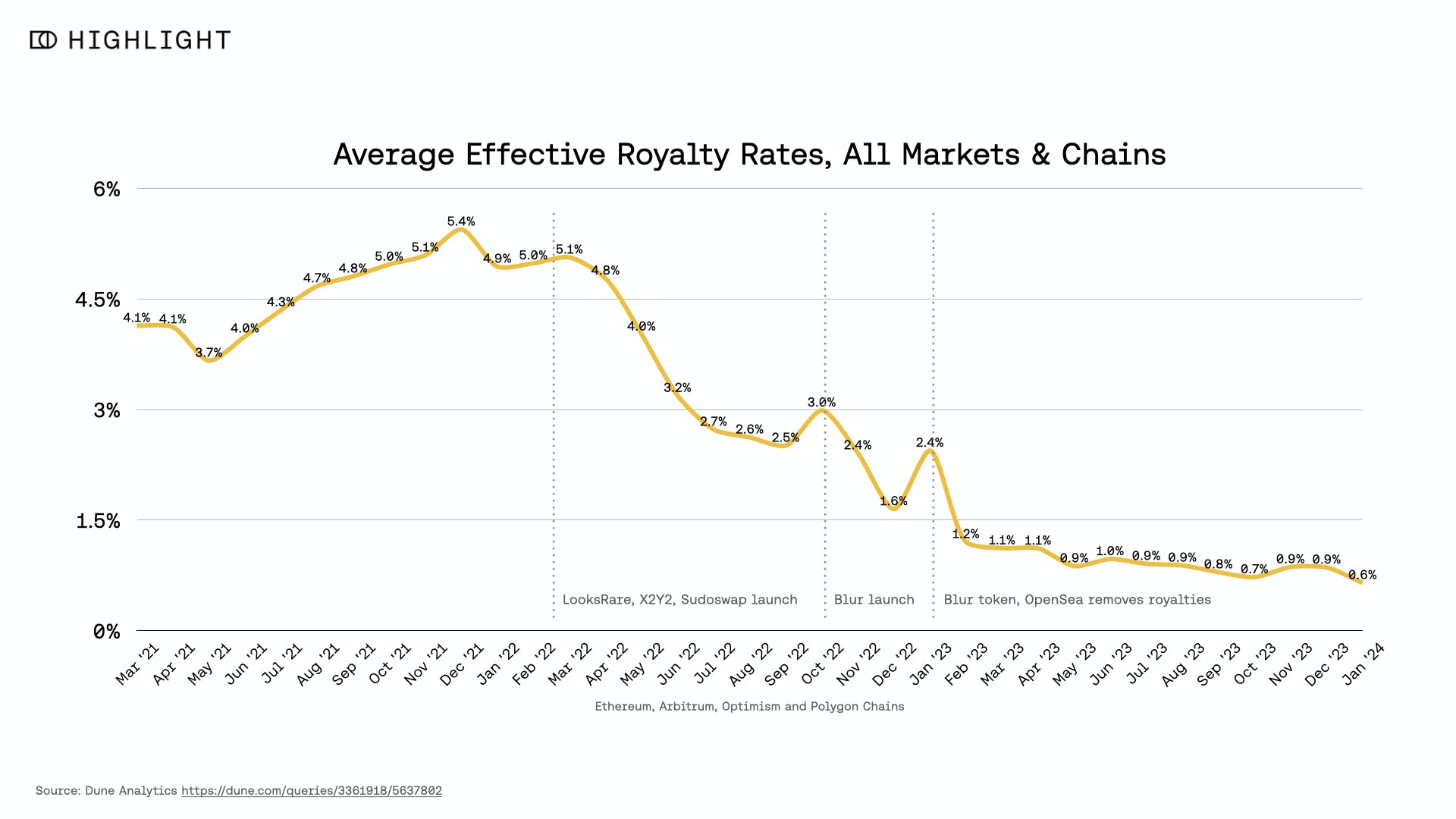
  • 以太坊生态 NFT 的版税在过去两年大幅下降。如今平均税率约为 0.8% ,较两年前的 5% 下降了 84% 。

  • 以 2021 年的税率为基准,仅在 2023 年 12 月,艺术家和创作者减少了约 3700 万美元的收入。

  • OpenSea 仍在为少数几个项目执行版税,但将于 2 月 29 日停止。届时整体版税将降至 0.5% 附近。

  • 艺术品的版税明显高于其他类型的项目,这表明收藏家希望建立一个正向积极的生态系统。

版税曾是区块链艺术争论的焦点,但在过去两年争论渐息。2022 年 1 月 LooksRare 推出,随后X2Y2和 Sudoswap 分别于 3 月和 4 月推出,这些平台要么取消了版税强制执行,要么完全取消了版税。Blur 于 2022 年 10 月推出了无版税市场,并于 2023 年 2 月推出了代币。OpenSea 很快也放弃了版税强制执行。每一事件都在显著且持续地降低版税税率。数据显示,如今费率约为 0.8% ,较几年前的 5% 左右下降了 84% 。
概览区块链版税现状:平均税率约为0.8%,较两年前下降了84%

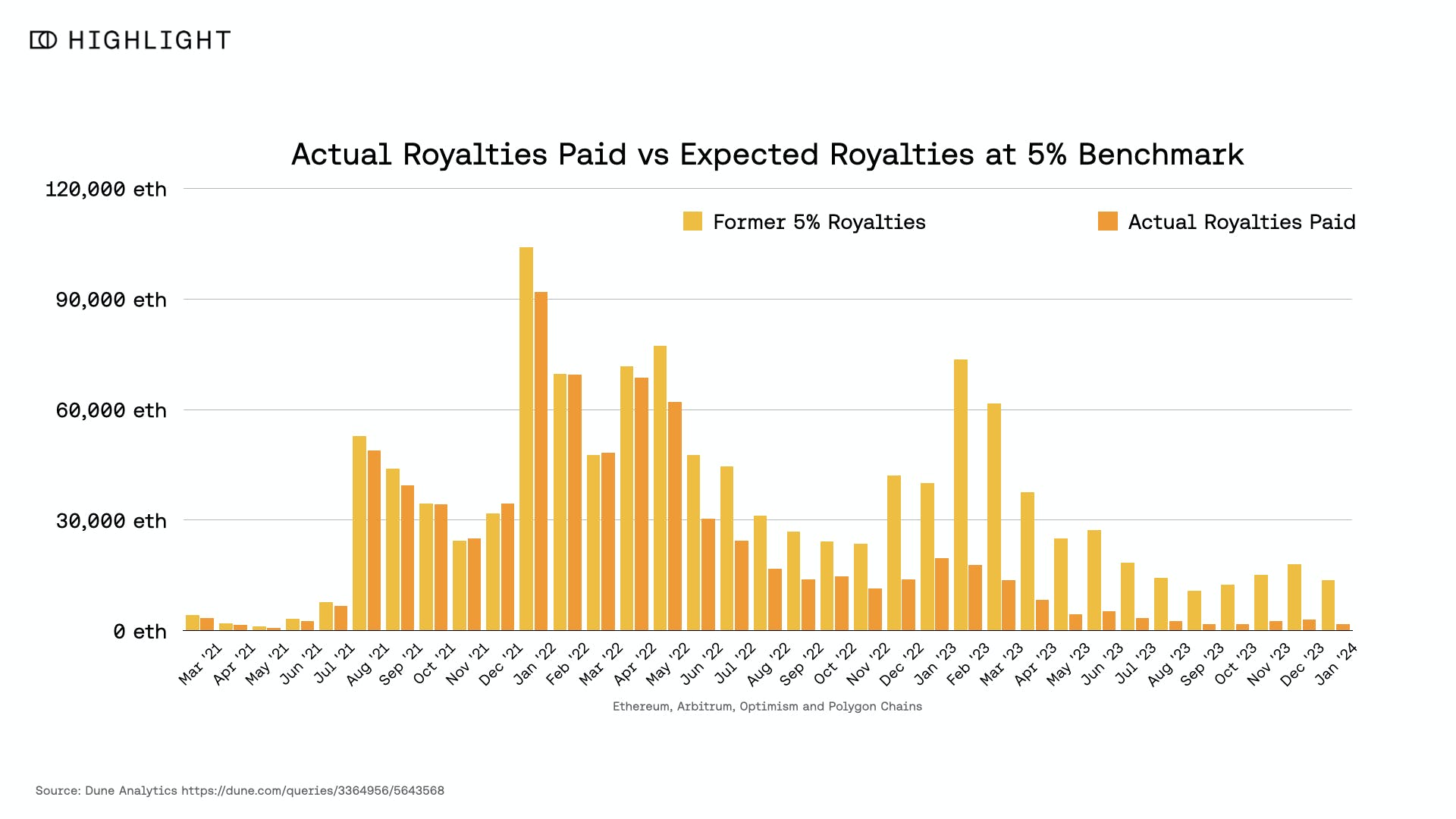
与之前的市场高点相比,整体版税收入大幅下降。2023 年 12 月,向艺术家和创作者支付了大约 3339 枚 ETH(按当前美元汇率计算为 8, 315, 512.38 美元)。与 2022 年 1 月的 91, 982 枚 ETH(按当前美元汇率计算为 229, 418, 744.94 美元)的历史高点相比减少了 96% ,超 2 亿美元。

这些数字令人震惊,但也反映了整体市场趋势。导致这一现象的原因是市场交易量的显著下降,而并非版税降低。即使根据目前的市场条件进行计算,假设 5% 的版税(约是 2021 年的标准),在目前的市场条件下,可以看到创作者和艺术家仅在 2023 年 12 月就减少了约 15, 100 枚 ETH 的收入,相当于 3760 万美元。
概览区块链版税现状:平均税率约为0.8%,较两年前下降了84%

今年 2 月,情况将变得更糟,因为 OpenSea 停止为实施版税强制执行工具(即 Operator Filter)的项目征收版税。

尽管下降趋势明显,但具体情况确实存在一些有趣的变化,主要取决于项目类型。下面将深入研究这些差异,但在深入研究之前,先回顾一下当前的背景。

当下版税市场

虽然 LooksRare、X2Y2和 Sudoswap 等平台在市场变革中发挥了重要作用,导致了版税降低,但如今绝大多数二级市场交易量发生在 OpenSea 和 Blur 上。OpenSea 在 2023 年 2 月取消了版税强制执行,但随后决定对在 2023 年 8 月 31 日之前启用 Operator Filter 或在该日期之前在非以太坊区块链上创建的项目增加强制执行。这意味着,当下一小部分项目保留了 OpenSea 的版税执行。但 OpenSea 将于 2024 年 2 月 29 日停止对所有项目征收版税。在用户体验方面,OpenSea 默认创作者在 UI 中可设置版税。

对于在所有市场上都有版税的 NFT 系列,Blur 将强制执行 0.5% 的最低版税。除此之外,Blur 还允许将版税设置为 0% 。

按项目类型深入探讨

PFPs

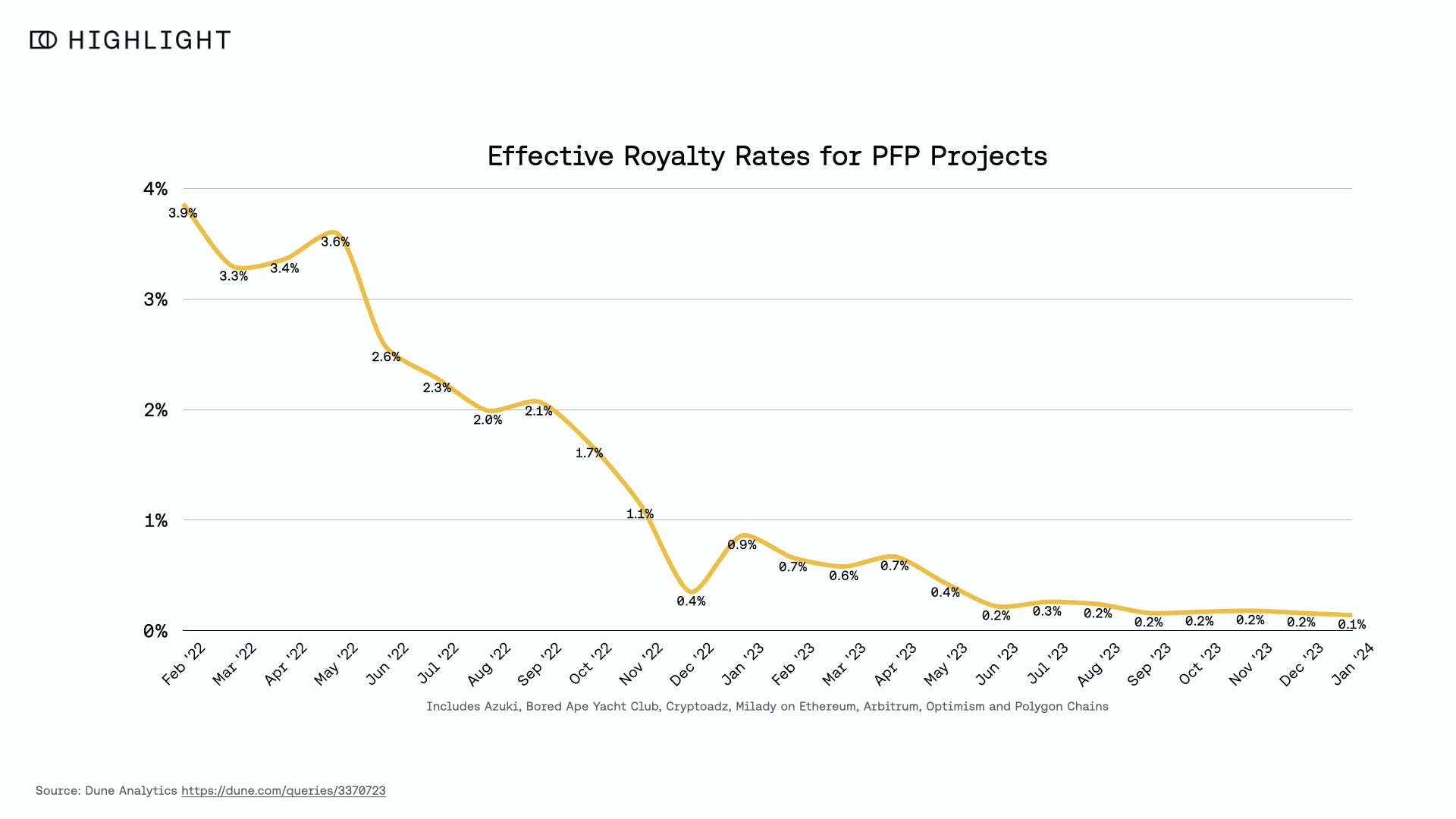
如上所述,版税总体呈下降趋势,但这种变化在 Azuki、Bored Ape Yacht Club、Cryptoadz 和 Milady 等热门 PFP 项目中最为明显。虽然这些项目曾经享有 2.5% -5% 的版税,但现在这些项目的平均版税甚至低于 Blur 的 0.5% 。有几周 Azuki 甚至处于 0.0x%范围内。
概览区块链版税现状:平均税率约为0.8%,较两年前下降了84%

Art

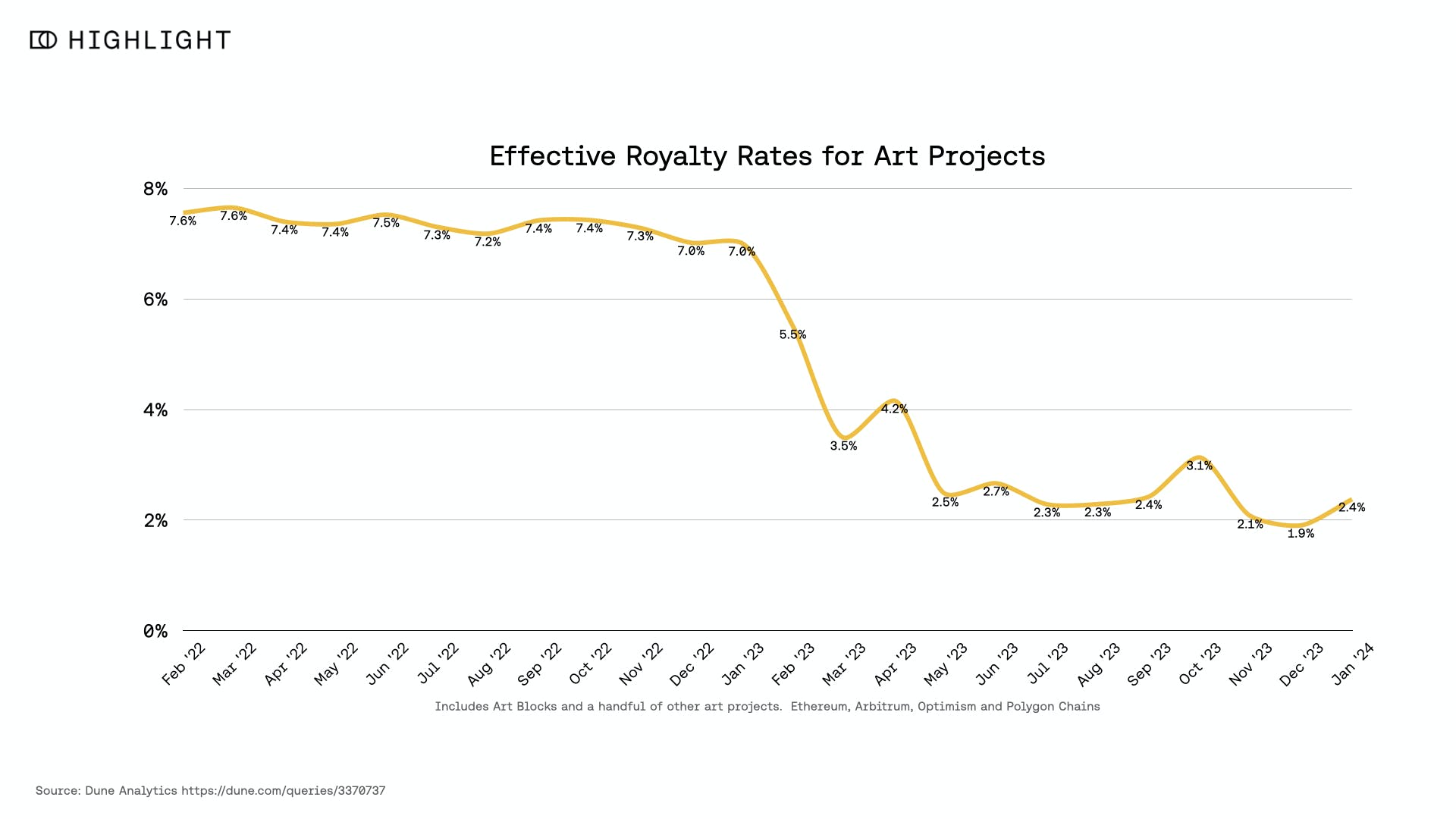
Art 比 PFP 表现得更好。这可能是由于共同的公共规范和代表收藏家支持个别艺术家。可以看到,虽然一些主流 Art 项目(包括几个 Art Blocks 项目)曾经享有比 PFP 更高的版税,但现在徘徊在 1.5% -2.5% 的范围内,有几周甚至更高。
概览区块链版税现状:平均税率约为0.8%,较两年前下降了84%

平台比较

OpenSea 所有项目的版税费率仍然徘徊在 2% 左右。在 Blur 上,这一比率约为 0.4% 。然而,考虑到 2024 年 2 月 OpenSea 将停止为所有项目征收版税,预计这种情况将发生重大变化。

概览区块链版税现状:平均税率约为0.8%,较两年前下降了84%

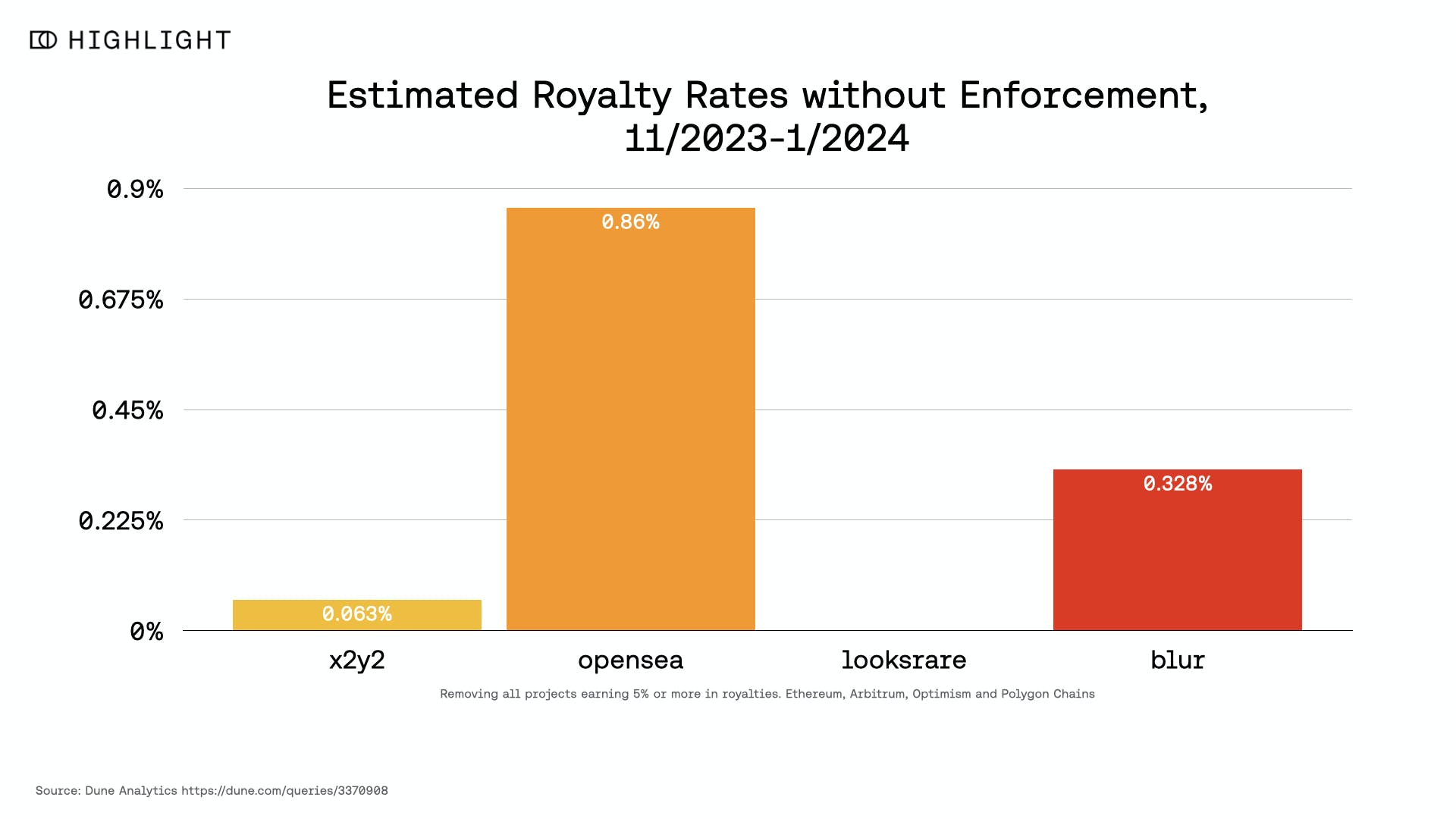
下面的图表显示了不同平台版税费率(不包括超 5% 的项目)。OpenSea 在关闭版税强制执行工具后,平均版税费率下降了一半以上,降至 0.75% 。这有助于了解 OpenSea 在 2 月份取消所有强制执行后的平均版税情况。
概览区块链版税现状:平均税率约为0.8%,较两年前下降了84%

结论

有强烈的迹象表明,收藏家,尤其是艺术收藏家,想要参与到一个积极的生态系统中,并且愿意花费超出创作者要求的钱支持艺术家。NFT 平台 Highlight 认为向艺术家支付的版税提高 2-3 倍是合理的,即提高到 2% 以上。

Пов'язані матеріали

BIT Research: Liquidity is Disappearing, Will Bitcoin Replay the Bottoming Pattern of 2022?

The crypto market is currently in an adjustment phase driven by policy expectations and liquidity shifts. Despite a brief rebound fueled by geopolitical easing and SpaceX's strong IPO performance, unexpectedly hawkish signals from new Fed Chair Kevin Warsh have removed anticipated easing support. Concurrently, stablecoin liquidity is shrinking, with insufficient new capital inflows, pushing the market into a typically quiet summer period. Pricing lacks catalysts for a sustained rally. Daily trading volume has significantly contracted, stablecoin growth has slowed markedly, and the supportive effect of Strategy's (formerly MicroStrategy) STRC preferred stock-financed Bitcoin purchases is fading. Amid policy uncertainty, seasonal weakness, and liquidity contraction, Bitcoin faces near-term downward pressure. Warsh's hawkish pivot and refusal to provide a clear policy outlook have increased risk premiums, historically unfavorable for Bitcoin. Technically, the trend remains bearish below $73,700, with $62,446 as critical support. A break below could accelerate declines, though a prolonged consolidation phase, similar to 2022's bottoming process, is possible. Liquidity is a core constraint. Current daily volume is around $500 billion, roughly 25% of the peak during the July-Oct 2025 rally. The 12-month growth rates for USDT and USDC have fallen to ~20%, with 6-month growth near zero, indicating weak new inflows. Bitcoin ETF and Strategy-driven inflows have also weakened, with a 30-day rolling net outflow. With inflation at 4.2% above the Fed's target, combined hawkish policy, seasonal factors, and liquidity shortages challenge Bitcoin's ability to hold above $60,000. However, this adjustment phase may be forming a cyclical low this summer, potentially setting the stage for the next bull cycle.

marsbit6 хв тому

BIT Research: Liquidity is Disappearing, Will Bitcoin Replay the Bottoming Pattern of 2022?

marsbit6 хв тому

Who Makes the Best Use of Claude Code? The Answer Might Not Be Programmers

Claude Code Usage Report Summary (Based on ~400k sessions) Core Finding: In agentic programming with Claude Code, a clear division of labor has emerged: humans primarily decide *what* to build (planning decisions), while Claude decides *how* to build it (execution decisions). Key Insights: 1. **Effectiveness is not limited to programmers.** In code-generation tasks, success rates for users in non-technical fields (law, finance, management, research) are nearing those of software engineers. What matters most is the user's domain expertise and understanding of the problem to be solved. 2. **Domain expertise drives success and efficiency.** Sessions where users exhibited "expert" proficiency in the task's domain saw verified success rates double compared to "novice" sessions. Experts also delegated more work per instruction, with Claude executing more actions and producing more output. 3. **AI is amplifying, not replacing, domain knowledge.** Claude Code lowers the *implementation* barrier, not the *judgment* barrier. The value of knowing the "what" and "why" is increasing relative to just knowing the "how" to code. 4. **Usage is evolving.** Over a 7-month period (Oct '25 - Apr '26), the share of sessions for debugging halved, while use for software operations, data analysis, and non-code writing roughly doubled. The estimated economic value of typical tasks increased by ~25%. Conclusion: The data suggests coding agents are making programming background less critical for completing technical tasks. However, they reward and amplify deep domain understanding. The ability to successfully direct an AI agent stems more from mastery of a specific field than from coding skill itself. The primary gains come from being competent in a domain; deep specialization adds only marginal additional advantage. This may signal a shift where software creation becomes integrated into various professions.

marsbit41 хв тому

Who Makes the Best Use of Claude Code? The Answer Might Not Be Programmers

marsbit41 хв тому

Торгівля

Спот
Ф'ючерси
活动图片