18 Years Later, Cashtag on X Is Finally "Usable"

marsbitОпубліковано о 2026-04-15Востаннє оновлено о 2026-04-15

Анотація

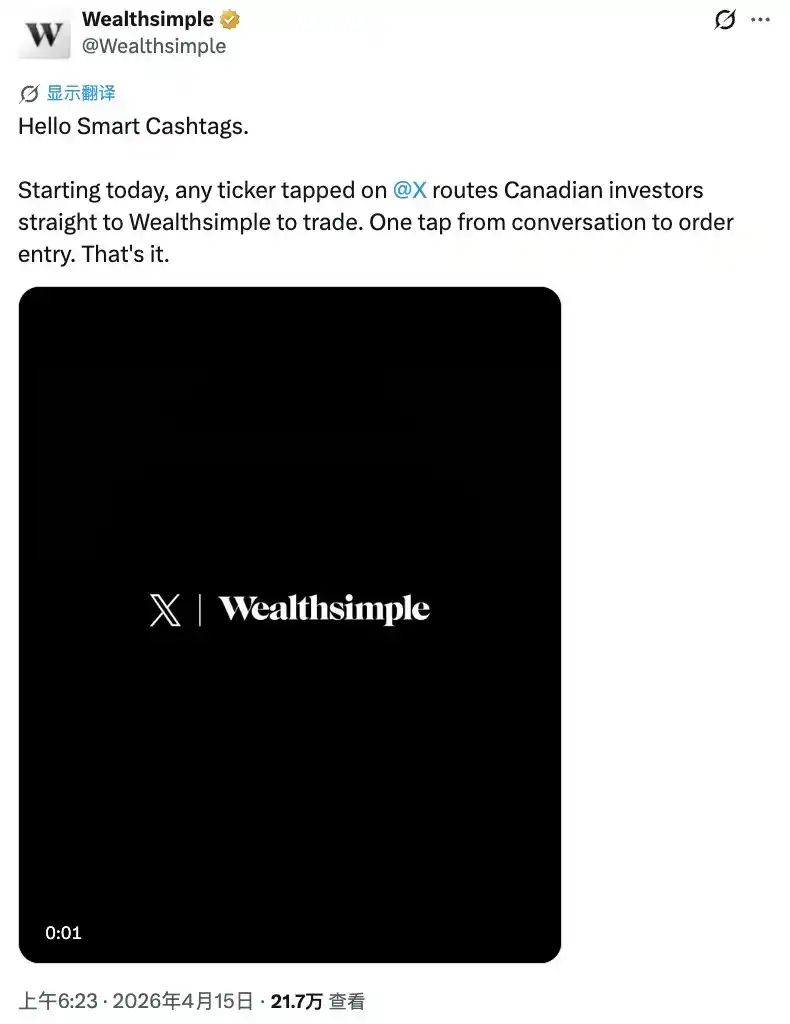
On April 14, X launched the Cashtag feature for iPhone users in the U.S. and Canada, allowing users to click on symbols like $AAPL to view real-time stock charts, historical price trends, and related discussions. In Canada, users can also jump directly to Wealthsimple to execute trades. The feature supports cryptocurrencies like $BTC and $ETH, and even tokens via Solana contract addresses. X positions itself as a "data and discovery layer," not a broker, avoiding direct regulatory scrutiny while streamlining the path from discussion to transaction. The term "Cashtag" was originally coined by Howard Lindzon on StockTwits in 2008, but was adopted by Twitter (now X) in 2012 without attribution. Wealthsimple, chosen as the initial Canadian partner, is the country’s largest online broker with experience in both traditional securities and crypto, despite past controversies like a data breach and a class-action settlement over fee disclosures. The rollout is part of X’s broader financial strategy, building on partnerships with Visa, the announcement of X Money, and a clear regulatory stance. This move integrates social discussion, data, trading, and payment layers, advancing Elon Musk’s vision of an "everything app." Cashtag’s journey from concept to functional tool took 18 years.

On April 14, the X platform launched the Cashtag feature on the iPhone in the United States and Canada. The usage is very simple: type $AAPL in a tweet, and this string of characters becomes a blue clickable link. Click on it, and you will see Apple's real-time stock price chart, price trends over a period of time, and all discussions on X with $AAPL. If you are in Canada, you will also see a button that directly jumps to Wealthsimple to complete the transaction.
What Can Cashtag Do?

It's not just stocks. X's Cashtag also supports cryptocurrencies. You can search for $BTC, $ETH, or directly input the contract address of a token on the Solana chain to find its on-chain data. In other words, this system aims to cover everything from mainstream blue-chip stocks to long-tail meme coins.

X's product lead, Nikita Bier, specifically emphasized at the feature launch: X will not act as a broker and will not directly execute trades. X's positioning is the "data and discovery layer"; it is responsible for presenting information, aggregating discussions, and guiding users. The actual order placement is handed over to third-party brokers to complete.
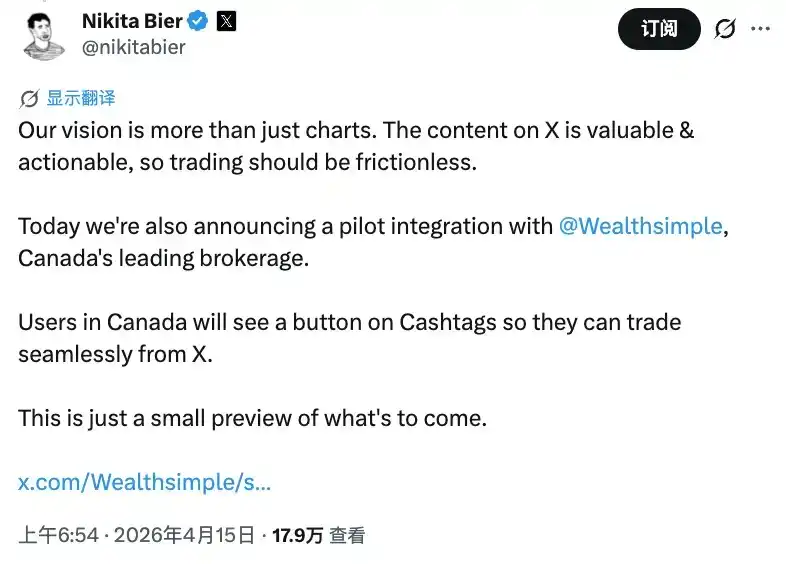
This positioning is crucial. If X were to directly act as a broker, it would need to face the SEC's broker license review, FINRA's compliance requirements, and a series of complex regulatory procedures. By defining itself as a "data layer," X only provides information display, while trade execution happens elsewhere, making the regulatory boundaries much blurrier.

But in terms of user experience, the entire path from seeing a tweet to completing a transaction has been compressed to just a few clicks. This is the first time on the X platform that there is no friction between discussion and action.

Its Origin Is Somewhat Ironic

The term "Cashtag" was not invented by X.

In 2008, a financial analyst and angel investor named Howard Lindzon created StockTwits, a social platform specifically for investors. He introduced symbols like $AAPL on it, using the $ prefix to turn stock tickers into clickable hashtags, allowing retail investors to discuss specific assets and track market sentiment. He named this design: cashtag.
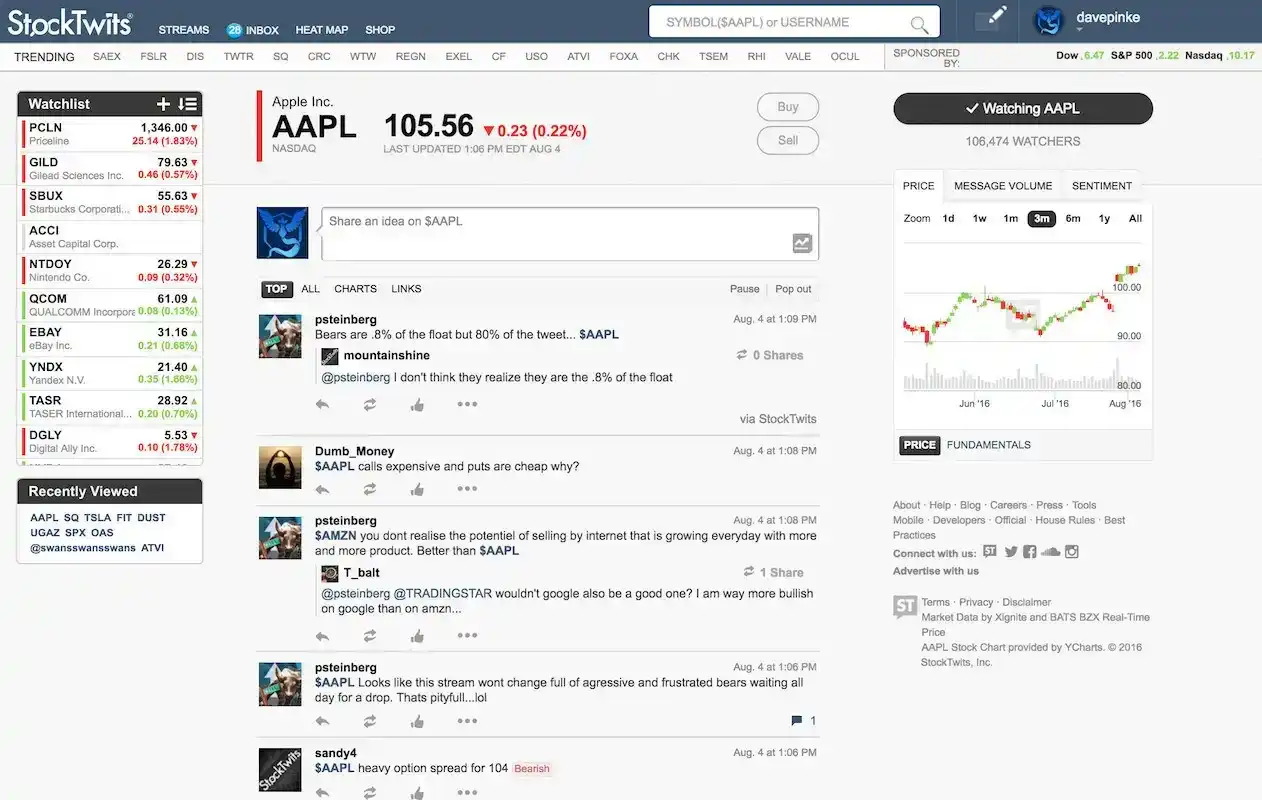
This idea circulated in small circles for four years.

In July 2012, Twitter announced official support for cashtag; $AAPL on Twitter became a blue clickable link. Lindzon publicly expressed "disappointment," saying Twitter had "hijacked" his idea. But he was powerless; cashtag had no copyright, the $ symbol belongs to everyone, and Twitter owed him no explanation.

Over the next dozen years, the two reached a strange balance: StockTwits lived off cashtag, but its traffic was far less than Twitter's. Twitter had the cashtag feature, but on Twitter, it was more like a hashtag than a real financial tool. Clicking on it only led to a topic page—no data, no prices, nothing actionable.

On April 14, 2026, Lindzon posted a tweet on his X homepage advertising the 2026 Cashtag Awards that StockTwits was about to host at the New York Stock Exchange.
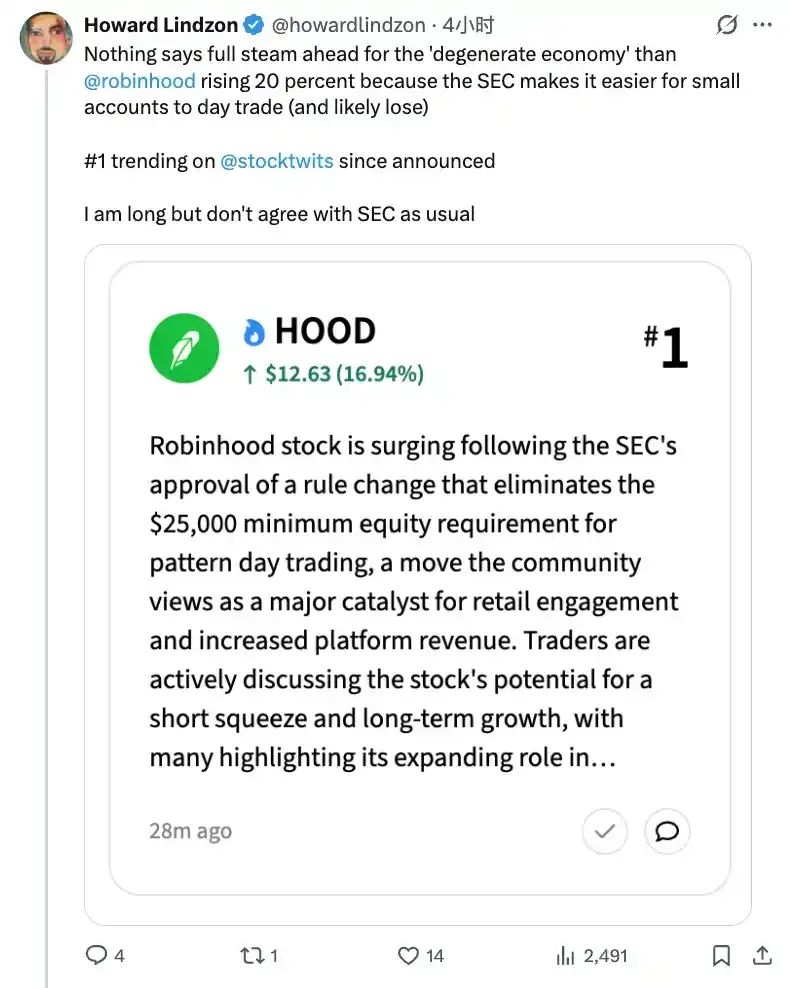
On the same day, the X platform made cashtag truly usable for the first time. Cashtag was invented, appropriated, shelved for over a decade, and then weaponized right under the nose of its inventor, who was still advertising on the opponent's platform.

Why Wealthsimple?

The Cashtag feature was first launched in the US and Canada, but only Canadian users can click on a Cashtag to directly jump to a broker to place an order. The reason is simple: Wealthsimple is a Canadian company, so it's available in Canada. The trading partner for the US market has not yet been announced. But the interesting question is: Why Wealthsimple, and not other Canadian financial institutions?

Wealthsimple is Canada's largest online broker—this is its most direct identity. Founded in 2014, it now manages over CAD 50 billion in assets and has extremely high penetration among young investor demographic in Canada. It holds both traditional securities licenses and digital asset trading permits (Wealthsimple Digital Assets), allowing it to handle both stocks and cryptocurrencies—a condition that X's Cashtag needs to support. This is not something just any institution in Canada can meet.

At the same time, Wealthsimple is also a partner with "a history."

In March 2026, just one month before the partnership with X was announced, the Quebec Superior Court approved a class-action lawsuit settlement against Wealthsimple's crypto business. The cause was its promotion of "zero-commission" trading without clearly explaining to users that it profits from the bid-ask spread. The final settlement was CAD 750,000, averaging about CAD 3.34 per investor. Wealthsimple did not admit any wrongdoing, but the information disclosure issue was already publicly disputed.

Earlier, in 2025, Wealthsimple experienced a data breach. A software package from a trusted third-party supplier was attacked, leading to unauthorized access to some customers' Social Insurance Numbers and account information. Wealthsimple controlled the situation within hours, completing full notification and emergency response. From a crisis management perspective, it did not collapse.

To summarize Wealthsimple's status in one sentence: It has stumbled, but it has gotten back up. It knows where the regulatory boundaries are and has real crisis management experience. For X's new feature, which aims to connect social discussion with trading entry, such a partner, compared to one that hasn't been tested, actually presents more predictable risks.

The real suspense lies in the US market. Robinhood is testing its own social trading feature (Robinhood Social); Coinbase has deeper crypto compliance experience but also more friction with the SEC. Whom X chooses in the US will be the real test of whether this model can succeed.

X's Financial Ambitions, A Timeline Explained in One Chart

The launch of the Cashtag feature marks the assembly of a layered architecture. Looking back at X's actions over the past 16 months, each step falls into a precise position:

January 2025: Partnered with Visa, obtaining the infrastructure for fiat peer-to-peer transfers;

January 2026: Nikita Bier previewed Smart Cashtags, the outline of the financial data layer began to emerge;

February: Proactively clarified "X is not a broker," completing the regulatory separation;

March: X Money officially announced public beta plans, the payment layer surfaced;

April 14: Cashtags launched, simultaneously announcing the Wealthsimple partnership—the data layer and trading layer connected for the first time.
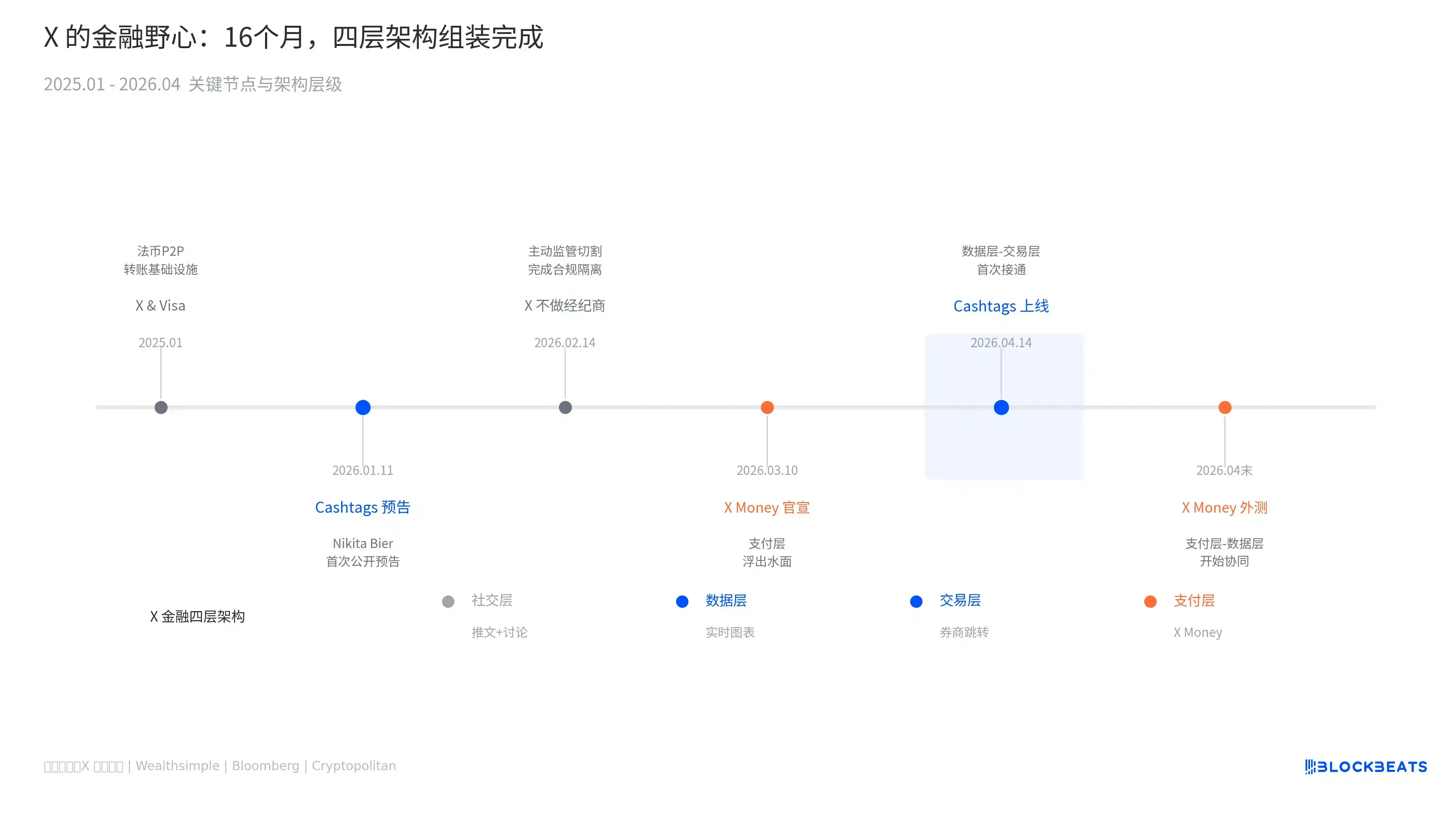
Stack the four layers together: Social layer (tweets + discussions), Data layer (real-time charts), Trading layer (broker jump), Payment layer (X Money P2P transfers + 6% APY yield account). Each layer individually has mature competitors, but combined, no platform has done this before.

This is the most concrete landing of the "everything app" that Elon Musk has been talking about. Starting from attention, it first captures all discussions about money, then step by step transforms these discussions into real capital flows. From Howard Lindzon typing the first $AAPL on StockTwits in 2008 to the X platform today allowing hundreds of millions of users to click this symbol and directly buy stocks, cashtag took 18 years to fulfill its destiny.

Пов'язані питання

QWhat is the Cashtag feature recently launched on X, and how does it work?

AThe Cashtag feature on X allows users to type a dollar sign followed by a stock ticker (e.g., $AAPL) in a post, turning it into a clickable blue link. Clicking the link displays real-time stock price charts, historical price trends, and all related discussions on X. In Canada, it also includes a button to jump directly to Wealthsimple to execute trades.

QWhy did X position itself as a 'data and discovery layer' instead of a broker for the Cashtag feature?

AX positioned itself as a 'data and discovery layer' to avoid the complex compliance requirements and regulatory scrutiny from entities like the SEC and FINRA that come with being a broker. By only providing information and redirecting users to third-party brokers for transactions, X maintains a模糊 regulatory boundary.

QWho originally invented the concept of 'cashtag', and how was it adopted by Twitter (now X)?

AThe concept of 'cashtag' was invented by Howard Lindzon, a financial analyst and angel investor, who created StockTwits in 2008. He used the $ symbol followed by stock tickers to create clickable topic tags for discussions. Twitter (now X) adopted this idea in 2012 without compensation or acknowledgment, as the term 'cashtag' and the $ symbol are not copyrighted.

QWhy did X choose Wealthsimple as its initial trading partner for Cashtag in Canada?

AX chose Wealthsimple because it is Canada's largest online broker, managing over CAD 50 billion in assets, with high penetration among young investors. It holds licenses for both traditional securities and digital asset trading, aligning with X's support for stocks and cryptocurrencies. Additionally, Wealthsimple has experience handling regulatory issues and data breaches, making it a tested partner.

QWhat are the four layers of X's financial ecosystem as outlined in the article, and how do they integrate?

AThe four layers are: 1) Social layer (posts and discussions), 2) Data layer (real-time charts and information), 3) Trading layer (broker redirects for transactions), and 4) Payment layer (X Money P2P transfers and 6% APY yield accounts). Together, they form a comprehensive system that captures financial discussions and converts them into actionable financial activities, unique to X's 'super app' vision.

Пов'язані матеріали

How Many Tokens Away Is Yang Zhilin from the 'Moon Chasing the Light'?

The article explores the intense competition between two leading Chinese AI companies, DeepSeek and Kimi (Moon Dark Side), and the mounting pressure on Yang Zhilin, the founder of Kimi. While DeepSeek re-emerged after 15 months of silence with its powerful V4 model—boasting 1.6 trillion parameters and low-cost, long-context capabilities—Kimi has been focusing on long-context processing and multi-agent systems with its K2.6 model. Yang faces a threefold challenge: technological rivalry, commercialization pressure, and investor expectations. Despite Kimi’s high valuation (reaching $18 billion), its revenue heavily relies on a single product with low paid conversion rates, while DeepSeek’s strategic silence and open-source influence have strengthened its market position and valuation prospects, now targeting over $20 billion. Both companies reflect broader trends in China’s AI ecosystem: Kimi aims for global influence through open-source contributions and agent-based advancements, while DeepSeek prioritizes foundational innovation and hardware independence, notably shifting to Huawei’s chips. Their competition is seen as vital for China’s AI progress, with the gap between top Chinese and U.S. models narrowing to just 2.7% on the Elo rating scale. Ultimately, the article argues that this rivalry, though anxiety-inducing for leaders like Zhilin, is essential for driving innovation and solidifying China’s role in the global AI landscape.

marsbit6 год тому

How Many Tokens Away Is Yang Zhilin from the 'Moon Chasing the Light'?

marsbit6 год тому

TechFlow Intelligence Bureau: ChatGPT Helps Amateur Mathematician Crack 60-Year-Old Problem, CFTC Sues New York Regulator Over Coinbase and Gemini

An amateur mathematician, with the assistance of ChatGPT, has solved a combinatorial mathematics puzzle originally proposed by Hungarian mathematician Paul Erdős in the 1960s. This marks another milestone in AI-aided mathematical research, demonstrating the evolving capabilities of large language models in formal reasoning. In other AI developments, OpenAI introduced a new privacy filter tool for enterprise API usage, automatically screening sensitive data. Meanwhile, the Qwen3.6-27B model achieved 100 tokens per second on a single RTX 5090 GPU using quantization, significantly lowering the cost barrier for local AI deployment. In crypto and Web3, the U.S. CFTC sued New York’s financial regulator, challenging its oversight of Coinbase and Gemini—a first-of-its-kind federal-state regulatory clash. Following a vulnerability, KelpDAO and major DeFi protocols established a recovery fund. Tether froze $344 million in assets linked to Iran’s central bank upon U.S. Treasury request, highlighting the centralized control risks in stablecoins. Separately, Litecoin underwent a 3-hour chain reorganization to undo a privacy-layer exploit. In the U.S., former President Trump invoked the Defense Production Act to address power grid bottlenecks affecting AI data centers and dismissed the entire National Science Board, raising concerns over research independence. A retail trader gained 250% on a $600k Intel options bet amid AI-related speculation. Xiaomi announced its first performance electric vehicle, targeting rivals like Tesla. Meanwhile, iPhone users reported devices automatically reinstalling a hidden app daily, suspected to be MDM-related. A Chinese securities report noted that A-share institutional crowding has reached its second-longest streak since 2007, signaling high valuations and potential style rotation. The day’s developments reflect a dual narrative: AI is enabling unprecedented individual breakthroughs, while centralized power structures—whether governmental or corporate—are becoming more assertive, underscoring that decentralization is as much a political-economic challenge as a technical one.

marsbit6 год тому

TechFlow Intelligence Bureau: ChatGPT Helps Amateur Mathematician Crack 60-Year-Old Problem, CFTC Sues New York Regulator Over Coinbase and Gemini

marsbit6 год тому

Торгівля

Спот
Ф'ючерси
活动图片