VC半年总结:下半年可重点关注工具层投资及

MarsBitОпубліковано о 2023-07-04Востаннє оновлено о 2023-07-04

Анотація

crypto infra仍需关注,但是核心不应注重于此。

注:本文来自@Zixi41620514 推特,MarsBit整理如下:
做一个小的半年度总结,反思和一些我个人认为的机会(仅代表个人观点,不代表机构观点):
2022布局:Questn,Blocksec,Footprint,Xterio,Solv Protocol,Swords and Dungeon,Chainbase
2023布局:风控平台(Almanak),CeFi+DeFi衍生品交易平台(Gravity),去中心化数据标注(QuestLab)
行业变化:
1.北美监管愈发严格,香港对crypto愈发开放。在政策上有较为明显的西落东升,北美投资人开始明显的接受并投资亚太创业团队。
2.新叙事较少,目前的项目围绕着ZK(web3 native),AI(web2 native)等展开。
以Citadel, Fidelity和红杉等为代表的华尔街资本开始打造自己合规交易所EDX,资金市场开始模块化。
4.以Black Rock,Fidelity等为代表的华尔街资本开始提交比特币/加密货币ETF,这是近期市场回暖的重要原因。
市场情况:
1.虽然BTC开始回暖到3W,相对于去年,总体来看市场更沉寂,新方向(ZK/AI)较少,等待新的叙事或者优质项目落地。
2.目前的主要矛盾已经发生了变化。2020-21的主要矛盾是没有优质的infra能够支撑应用,而现在的是没有一个好的方向能够转化web2进场。
3.在crypto infra上,L2/模块化公链还是火热,大资金依旧在布局,并且已经落地,用户体验非常丝滑。
4.在Onboarding User上,依旧围绕游戏展开,但目前开始出现在细分领域转化web2用户进web3的思路,我们已尝试布局(Questn, Xterio, Swords, Questlab)。
5.在Onboarding Developer上,并没有新的故事,而且目前新客户数量较少,且存活率降低。但整体逻辑不变,依旧值得布局(Chainbase)。
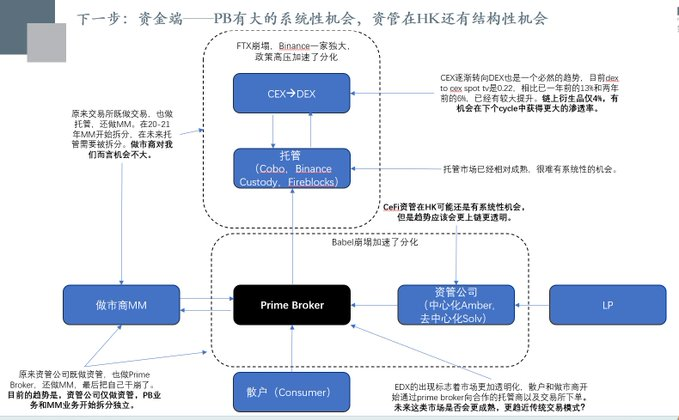
6.在Onboarding Money上,由于FTX倒闭,Binance被监管围攻以及EDX的推出,在Dex,资管,PB上等可能会有大的新机会,下半年可以重点关注于此(Solv, Gravity)。
上半年总结与反思
1.上半年3个deal400+万美金,数量和金额相对于去年有所下滑。这一方面是因为我们更加谨慎;另一方面也是因为市场新叙事较少,很优秀的团队变少,且适合我们投的新叙事更少。
2.今年的风格开始产生变化。去年的deal整体更保守,从blocksec到Almanak,项目偏向于开发者/保守型,这个逻辑在去年大熊市没问题。今年年底宏观加息开始停止,比特币回暖到3W,大机构在资金端动作频繁,我们应该开始布局更有爆发力增长的用户和资金端项目。
下半年推进方向:
1.crypto infra仍需关注,但是核心不应注重于此。
2.在资金端需要重点关注,因为EDX的出现,整体的交易模型会愈发传统,从而给Prime Broker带来的系统性机会。以及HK的CeFi资管等的结构性机会。
3.在用户端需要关注,包括以游戏为主的general转化思路,和细分赛道转化用户的思路是否正确。如果有合适的团队,应该重点考虑布局。
4.在开发端的逻辑依旧正确。虽然方向正确,但转化速度比预想的要慢。目前的问题是没有足够多的用户来支持新项目方创业。开发端项目整体会趋向于平稳,风险相对小
EDX的出现代表了crypto的交易会逐渐向传统的交易所模式转变。即机构/mm/散户通过PB向托管了交易所资金的托管商下单。此外,新加坡监管局MAS于今日也要求交易所需要将资金托管至交易平台。因此PB,HK CeFi,链上衍生品交易所等我还是长期看好
CRYPTO


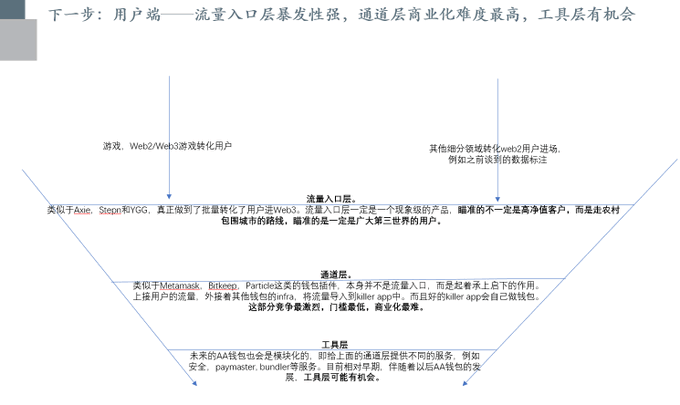
用户的方向可以大体分为3类。流量入口层(axie,stepn等),通道层(各类钱包)以及工具层(aa infra as a service)。流量入口层暴发性强,即从general的游戏+各个细分领域开始转化用户(首选第三世界)。通道层商业化难度最高。在目前通道层极其卷的情况下,工具层有机会跑出。
CRYPTO


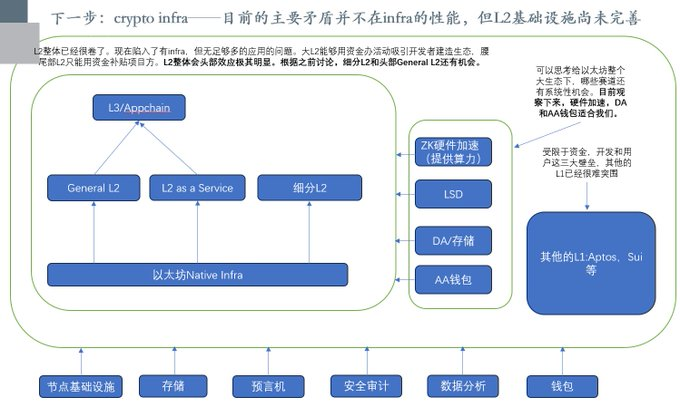
crypto infra的方向现在我觉得很别扭。现在的主要矛盾已经不再是没有好的infra来提供支持大量用户的基础。现在的主要矛盾是压根没有好东西吸引大家入场。但我个人认为垂类L2,以及服务于整个以太坊生态体系的ZK硬件加速(关键是还能服务于Web2大厂),AA钱包(及其infra),DA等还有结构性机会。
CRYPTO

一级市场近期已经越来越无聊了,只能说革命尚未成功,同志仍需努力吧。希望我看好的团队(以及我没投的一些团队其实我也很喜欢)能在24-25年交付一个满意的答卷,给行业以温度,给大家以信心。
Пов'язані матеріали

Blocked Its Own Treasure, WeChat AI Steps Up

Tencent's stock surged over 10% on June 2nd amid reports that WeChat, with 1.43 billion monthly users, is finalizing tests for a native AI Agent. The reported feature, accessible by swiping right from the main interface, allows users to issue commands in natural language. The AI then decomposes tasks and automatically calls upon relevant Mini Programs within WeChat to complete actions like ordering food, booking tickets, or making payments, creating a closed-loop service execution system. This strategic shift follows the internal conflict and subsequent "blocking" of Tencent's standalone AI app, Yuanbao, by WeChat for violating sharing rules during a 2026 Spring Festival promotion. The incident highlighted a lack of internal consensus and exposed the weakness of competing in the standalone AI assistant arena against rivals like ByteDance's Doubao (345M MAU) and Alibaba's Qianwen. The new WeChat AI Agent aims to leverage WeChat's unique assets—its massive user base, standardized Mini Program APIs, WeChat Pay, and identity system—to move from simple content generation to actual task execution. Analysts note this changes the competitive landscape from model benchmarks to which AI can connect to more real-world services. However, success depends on key variables: the capability of Tencent's underlying Hunyuan model, managing massive inference costs, and redesigning incentives for Mini Program developers whose traffic might be bypassed. The move is seen as an attempt to keep user service intent within WeChat's ecosystem as AI begins to redefine how users access services.

marsbit6 хв тому

Blocked Its Own Treasure, WeChat AI Steps Up

marsbit6 хв тому

ByteDance Adopts Arm CPUs, Jensen Huang: So Sad I Didn't Buy Arm

**Summary:** At Computex 2026, Arm CEO Rene Haas announced that ByteDance and Oracle have adopted Arm's self-designed Arm AGI data center CPU. The company expects significant revenue growth from this product, projecting $20 billion in demand for the 2027/2028 fiscal years. Haas noted that restricting AI-capable CPUs from the US to China is nearly impossible due to their widespread applications. Arm's stock has surged dramatically this year, notably rising 16% after NVIDIA's Arm-based Vera CPU and RTX Spark announcements. A highlight was the informal, humorous on-stage conversation between Haas and NVIDIA CEO Jensen Huang. Huang joked about NVIDIA's failed attempt to acquire Arm and playfully lamented selling his Arm shares. Both executives showed a clear sense of camaraderie and shared regret over the missed merger. Key technical topics were discussed: 1. **AI PC Design:** Huang explained NVIDIA's RTX Spark superchip (with a 20-core Arm CPU) is designed for future AI agents that will autonomously run and use tools on PCs, blending local and cloud processing. 2. **Agent vs. OS:** Huang emphasized the operating system remains crucial, as AI agents rely on its APIs and tools to function. 3. **Growth Constraints:** He identified the shift to "useful AI" that generates profitable tokens as a primary driver for immense, almost limitless, computational demand. Haas outlined Arm's strategy across PC and data centers. For PCs, Arm collaborates with partners like NVIDIA and MediaTek, offering its compute subsystem (CSS) for custom SoCs. In data centers, its Arm AGI CPU (built on TSMC's 3nm process) has gained major partners including OpenAI, Meta, and now ByteDance and Oracle. Arm presented a multi-year roadmap for its in-house CPU line. The article concludes that while GPUs dominated the AI training race, the explosion of AI agents is shifting significant focus to CPUs for inference, state management, and tool orchestration. The industry is trending towards vertical integration, with companies like cloud providers designing chips and chip/IP firms offering full solutions, all competing to deliver more efficient computing per watt.

marsbit27 хв тому

ByteDance Adopts Arm CPUs, Jensen Huang: So Sad I Didn't Buy Arm

marsbit27 хв тому

New Wall Street Play: Yen Shorts Still Adding, But Japan Stocks Don't Rely on Carry Trade Unwinding

On June 3rd, USD/JPY hit 160.44, its highest level since July 2024, while the Nikkei 225 surged past 68,000 points. Contrary to popular narratives of an imminent "carry trade unwind" akin to August 2024, data reveals a more complex picture. Speculative net short positions in yen futures have actually increased, reaching -114,667 contracts by late May, suggesting traders are doubling down rather than retreating. Meanwhile, Japan's Finance Ministry conducted its largest-ever single-round FX intervention (11.73 trillion yen) in April-May but failed to hold the 160 yen line. The Nikkei's rally is not driven by carry trade dynamics. Foreign investors are aggressively buying Japanese stocks, with net purchases in 2026 running nearly 16 times higher than 2025 levels. This inflow is concentrated in AI and semiconductor-related stocks like SoftBank and Socionext, fueled by positive sector outlooks, rather than being a flight from unwinding yen shorts. Furthermore, the Nikkei has continued climbing despite the Bank of Japan's (BOJ) rate hikes to 0.75%. This disconnect exists because the current equity boom is fueled by AI-driven foreign investment, not reliant on cheap yen funding. However, this relationship remains fragile. Should the BOJ hike rates further (e.g., to 1.0%) while dollar weakness increases carry trade costs, the trajectories of the yen and Japanese stocks could reconverge, potentially triggering volatility.

marsbit31 хв тому

New Wall Street Play: Yen Shorts Still Adding, But Japan Stocks Don't Rely on Carry Trade Unwinding

marsbit31 хв тому

Broadcom's Q3 Guidance Misses Expectations by $12 Billion, After-Hours Trading Plummets Over 13%, AI Narrative "Cooling"?

On June 3, Broadcom released record Q2 FY26 results with revenue of $22.19B, up 48% YoY, and AI chip sales of $10.8B, up 143%. Adjusted EPS of $2.44 beat estimates. However, its Q3 AI semiconductor revenue guidance of $16B, while up over 200% YoY, fell roughly $1.2B (7%) short of analyst consensus expectations of $17.2B. This miss, coupled with slightly weaker-than-expected software revenue, triggered a severe market reaction. CEO Hock Tan maintained the FY26 AI revenue outlook of over $100B but did not raise it, disappointing investors who had priced in more robust growth. The stock plummeted over 13% in after-hours trading, erasing roughly $270B in market cap. The sell-off extended to peers like Marvell. A key concern for markets, particularly for Chinese optical module suppliers, was Tan's comment that the contribution of AI networking (e.g., Ethernet switches, optical interconnect chips) to AI revenue, currently near 40%, is expected to normalize to around 30% over time, signaling a potential peak in growth for that segment. Despite the guidance shortfall, Tan reiterated that AI demand remains "insatiable" and reaffirmed the long-term target of exceeding $100B in AI revenue by FY27. The reaction highlights the heightened sensitivity and premium valuation placed on AI-exposed stocks, where anything less than stellar guidance can prompt significant profit-taking. The broader question is whether this represents a cooling AI narrative or a correction in overstretched valuations.

marsbit31 хв тому

Broadcom's Q3 Guidance Misses Expectations by $12 Billion, After-Hours Trading Plummets Over 13%, AI Narrative "Cooling"?

marsbit31 хв тому

Торгівля

Спот
Ф'ючерси
活动图片