BTC has bounced back into action again. With a 4.20% surge on the daily chart and a 20.96% surge on the weekly chart, Bitcoin is selling for $30,160.26 at the time of this writing. At one point, the price touched $30,645, sending waves of euphoria across the market.
The upturn is likely to continue over the next few days, as these four factors strongly suggest.
1. BlackRock Bitcoin ETF Revives Optimism in the Market
On June 15, the investment giant BlackRock made a game-changing move by applying for its own Bitcoin ETF (exchange-traded fund) and bringing more enthusiasm to the market. The significance of the event lies in the fact that it comes after a relatively subdued period following the SEC lawsuits and the turmoil that followed.
BlackRock manages nearly $8.5 trillion in assets and has a strong ETF approval record with the SEC. Interestingly, investment management companies Invesco (IVZ) and WisdomTree have reapplied for a spot bitcoin (BTC) ETF, following in the footsteps of BlackRock.
WisdomTree has filed for spot bitcoin ETF h/t @NateGeraci pic.twitter.com/JwXj8rTs2X
— Eric Balchunas (@EricBalchunas) June 20, 2023
Galaxy Digital CEO, Mike Novogratz, is enthusiastic about the potential approval of BlackRock’s ETF application, stating that it would be “the best thing that could happen to $BTC.”
He is not alone in coming out in support of the new trend. Many industry experts and analysts share this optimism. James Edwards from Finder.com, for instance, sees BlackRock’s filing timing as a source of confidence for both Bitcoin as an asset and Coinbase in its ongoing legal tussle with the SEC.
As the SEC’s grip on crypto projects gets stronger, and the crypto landscape becomes more treacherous for projects as well as investors, the daring move by investment firms like BlackRock is a testament to the confidence in crypto assets.
For example, Cathie Wood, the CEO and chief investment officer of ARK Invest, reiterated her bullish stance on Bitcoin and cryptocurrencies in general. She recently added $17 million worth of Coinbase (COIN) shares to her flagship fund, Ark Innovation (ARKK), and is steadfast in her BTC price target of $1 million.
That is not to say there are no dissenting voices against the wave of new ETF filings. According to investor Scott Melker, the involvement of traditional investment companies is a disservice to the original innovators of the crypto industry, who played a significant role in building it. Acknowledging that these filings can drive institutional adoption of cryptocurrencies, Melker argues that they contradict the industry’s ethos.
As expected, the new trend hasn’t just boosted investor confidence in Bitcoin, but also perked up the whole market. The crypto greed and fear index has also taken off over the last few days.
Crypto Fear and Greed Index, Alternative.me
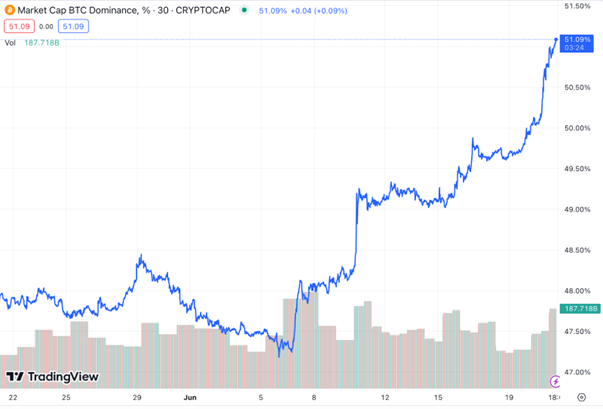
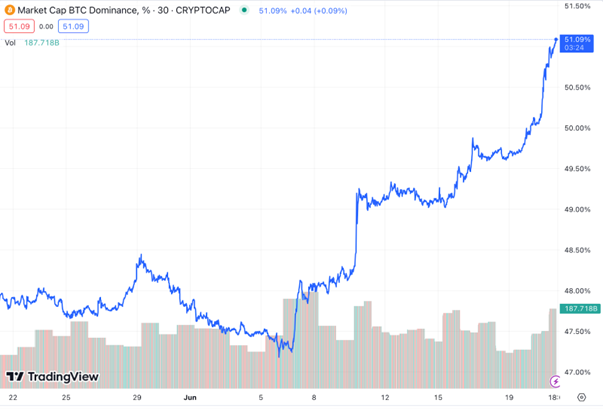
2. Bitcoin Dominance is Above 50%
Bitcoin dominance represents the proportion of the total cryptocurrency market cap that is attributed to Bitcoin. The number stands at around 50% now, with BTC holding $583,967,824,768 of the total $1.18T market cap.
The rise in Bitcoin’s market dominance has multiple underlying reasons. For starters, the SEC’s threat to label many crypto assets as securities has urged investors to move from random altcoins to blue-chip assets like BTC and ETH. They are finding a safe haven in these assets amid all the chaos.
BTC Market Cap Dominance 1-Month, TradingView
BlackRock’s spot ETF application and the series of filings that followed have also sparked a surge in investor interest in Bitcoin, obviously. They injected optimism and excitement into the market, which has been slipping since the SEC lawsuits went public and fear gripped investors.
MicroStrategy co-founder and brazen Bitcoin advocate Michael Saylor predicts that Bitcoin’s market dominance will breach 80% in the future. His wildly ambitious forecast is rooted in despair, however, as he believes that growing regulatory pressures from the SEC will phase out stablecoins and other altcoins from the market soon. It will pave the path for a Bitcoin-centric crypto market with only a handful of other Proof-of-Work tokens.
Regulatory clarity is going to drive #Bitcoin adoption by eliminating the confusion & anxiety that has been holding back institutional investors. Bitcoin dominance will continue to grow as the #Crypto industry rationalizes around $BTC and goes mainstream. pic.twitter.com/Foq4lpderj
— Michael Saylor⚡️ (@saylor) June 13, 2023
3. Bitcoin halving urges investors to hoard BTC
The next Bitcoin halving is scheduled for April 2024. The much-anticipated event is preprogrammed to cut down the BTC supply rate by half every four years. The previous three Bitcoin halvings were held in 2012, 2016, and 2020. Not surprisingly, they were followed by significant price rallies and new all-time highs for BTC.
For example, the most recent halving of May 2020, drove the price of BTC by 276%. The months that lead up to the halving will see the BTC market enter an accumulation phase. The asset is also highly likely to touch its previous high of $69,000 within the next 18 to 24 months. But $50,000 is a realistic goal for BTC this year. An ambitious forecast, on the other hand, is $160,000 by April 2024.
A BTC-Dominant Portfolio will Prove to be Risky
A portfolio concentrated with just one or two assets is not healthy, no matter how ‘blue-chip’ it claims to be. It’s important to remember that although BTC has held the No.1 position in the crypto market for years uncontested, it has not been immune to the ups and downs in the market.
In fact, it is down 56.05% from its all-time high, and it doesn’t look like the value will be reclaimed any time soon. Despite the bullish signals, BTC will undergo multiple downturns in the future. The chances of it hovering under $30,000 for the rest of the year can’t be ruled out, either.
You need a diversified portfolio to maintain a healthy position in the crypto market. While BTC and ETH, among other high-cap cryptocurrencies, should make up the larger share of the portfolio, limiting your portfolio to only one or a few assets, increase your risk exposure. Moreover, they limit your profitability.
To give you a better perspective, the market capitalizations of BTC and ETH, currently standing at $580 billion and $229 billion respectively, suggest that they are already highly saturated. And pushing these assets beyond their capacities will lead to steep crypto crashes. A healthy market is not concentrated on a few projects or assets. We need to allocate funds among diverse projects to fuel the growth of the blockchain and cryptocurrency industries.
Of course, investors will be led by their individual goals rather than the whole market’s. But individual goals favor a diversified portfolio too. People are increasingly plowing money into emerging tokens underpinned by promising projects to make multifold returns from the market in a short space of time.
The overwhelming traffic to the presales of Wall Street Memes, yPredict, Launchpad XYZ, and Ecoterra confirms that the trend is picking up.
Presales Promise Better Returns than BTC and ETH
While it’s true that flimsy tokens will have no room in the crypto market in the future, promising projects continue to draw investor attention. Given that high-cap assets like BTC and ETH can’t give mind-boggling ROI anymore, investors are on the hunt for new cryptocurrencies that can.
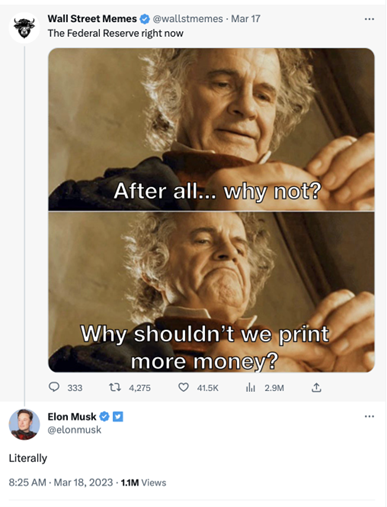
For example, the Wall Street Memes presale is on its way to the $10M milestone at the time of writing. The meteoric presale has as much to do with the meme coin hype as the project’s 1M+ community. Wall Street Memes is one of the most prominent global meme communities on the internet with a massive following of investors and traders. Even Elon Musk has engaged with the community’s hilarious posts.
Earlier in 2021, the community took its dive into the crypto market with the Wall St. Bulls NFT collection that was sold out in 32 minutes. Wall Street Memes meme coins are widely predicted to outperform the NFT collection, potentially with a 30-50X bull run on the token launch.
The sustainability of Wall Street Memes Token (WSM), being a meme coin without a clearly defined utility, raises doubts. But WSM establishes its long-term relevance by allocating an impressive 30% of the total token supply for community rewards. This strategic approach, integrating giveaway and airdrop campaigns, incentivizes investors to hold on to their WSM investments regardless of broader market trends.
The project’s goal is to become more than just a passing crypto trend and secure a solid position on the top-3 meme coin rankings and eventually climb higher. Given that meme coins are explosive and Wall Street Memes presale is moving ahead at a fast pace, investors are stocking up on the token in bulk. It is predicted to sell out ahead of schedule as the demand continues to grow.
Another presale that has drawn massive attention this month is Launchpad XYZ. The project is building a Web 3.0 hub that simplifies access to the crypto market. It features all the tools users need to be successful in the industry, from a Web 3.0 wallet to a trading terminal, DEX, NFT marketplace, presale arena, and play-to-earn library.

The project’s goal is to support users in getting in-depth insights into the Web 3.0 ecosystem and making the right investment decisions. For example, the project uses a single metric called Launchpad XYZ Quotient (LQ) that shows you what’s hot and what’s not in the market. Given that the Web3 market is an intimidating sector for the average person, Launchpad XYZ has high market relevance.