Metaverse Will Be Most Popular Place to Buy, Trade, Store Cryptocurrency, Survey Shows

newsbtcОпубліковано о 2022-04-08Востаннє оновлено о 2022-04-08

Анотація

Nasdaq-listed Agora (NASDAQ: API), a video, voice, and live interactive streaming platform, conducted a survey on the metaverse and published the results Tuesday.

Metaverse Will Be Most Popular Place to Buy, Store, Trade Cryptocurrency, Survey Shows

The metaverse will become the most popular place to buy, sell, and trade cryptocurrency, according to a recent survey. In addition, 70% of respondents agreed that “cryptocurrency and blockchain technology advancements will be critical to shaping the future of the metaverse.”

Survey: Metaverse Will Be the Most Popular Place for Crypto

Nasdaq-listed Agora (NASDAQ: API), a video, voice, and live interactive streaming platform, conducted a survey on the metaverse and published the results Tuesday.

The company asked 300 U.S.-based developers a set of questions “to learn more about what they thought about the metaverse and what we will see in the coming years,” Agora detailed. Developers were surveyed because for them, “the growth of the metaverse allows the development of new communities and allows them to better connect with users,” the company explained.

According to the results:

57% of respondents think that the metaverse will become the most popular place to buy, store and trade cryptocurrency, while 18% disagree and 25% feel neutral.
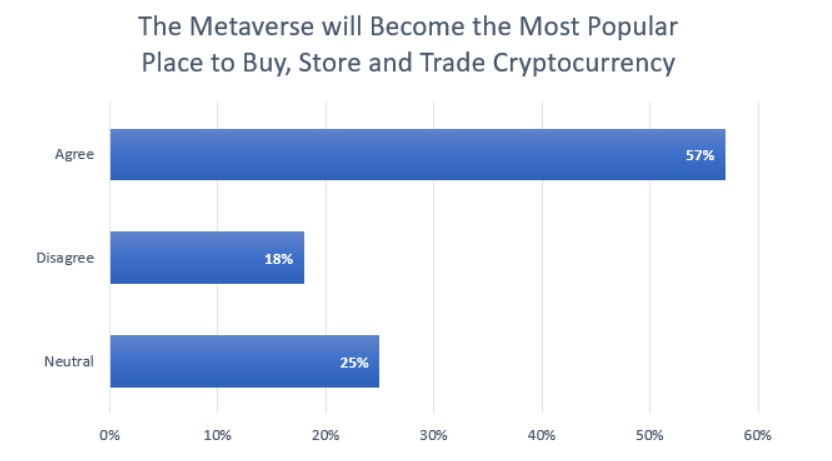
Source: Agora

In addition, 70% agreed that “cryptocurrency and blockchain technology advancements will be critical to shaping the future of the metaverse,” while 9% disagreed.

Regarding non-fungible tokens (NFTs), “The majority of developers are bullish on NFTs and believe they will become the biggest [currency] in the near team,” the survey results note.
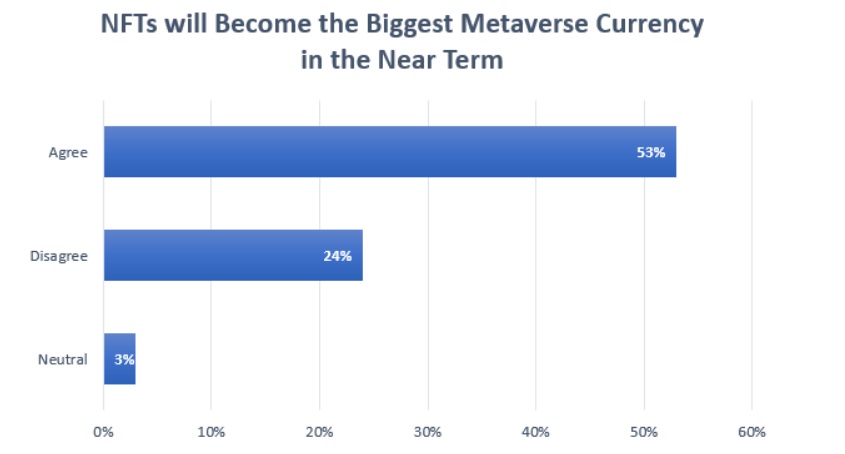
Source: Agora

Survey participants were also asked who they think will own the metaverse. 55% of respondents said Meta (formerly Facebook), 9% said Google, 7% said Microsoft, 6% said Apple, and 5% said Amazon.

Meta recently filed eight trademark applications covering the metaverse and a wide range of crypto services.

A number of analysts have estimated the size of the metaverse. Last month, Citi predicted that the metaverse could be a $13 trillion opportunity with five billion users by the year 2030. Meanwhile, investment banks Goldman Sachs and Morgan Stanley both said the metaverse could be an $8 trillion opportunity.

In February, JPMorgan opened a lounge in Decentraland after stating that “The metaverse will likely infiltrate every sector in some way in the coming years, with the market opportunity estimated at over $1 trillion in yearly revenues.”

Пов'язані матеріали

Hubei State-Owned Assets Achieve the Largest Return in History

After years of anticipation, Yangtze Memory Holdings Co., Ltd. (YMTC) has filed for an IPO on Shanghai's STAR Market, seeking to raise 33 billion yuan—the largest offering in the board's history. This move follows the recent listing of its peer, ChangXin Memory Technologies (CXMT), which reached a market valuation exceeding 4 trillion yuan. Dubbed the "twin stars of domestic memory," both companies, founded in 2016 in Hefei and Wuhan respectively, symbolize China's push for semiconductor self-sufficiency. YMTC's journey began with its predecessor, Wuhan Xinxin, established in 2006. Backed by substantial state investment from Hubei and Wuhan, it evolved into a national memory base. The company achieved key technological breakthroughs, and now ranks as the world's third-largest and China's top NAND Flash manufacturer by sales. Its recent financials are strong, with Q1 2026 revenue of 47.04 billion yuan and net profit of 33.38 billion yuan. Post-IPO, its market value is widely expected to surpass 1 trillion yuan. The potential windfall highlights the success of long-term, patient capital from Hubei's state-owned entities. Key shareholders like Hubei Changsheng, Xintech, and government-backed funds have supported YMTC through years of development. Their collective stake could be worth hundreds of billions after the listing. This model mirrors other successes in Wuhan, such as Huagong Tech, where local state investment during a low point later yielded massive returns. The story reflects a broader national trend of regional transformation through strategic, high-tech investments. Hefei's bet on CXMT, now worth over 3.7 trillion yuan, propelled the city's A-share market cap to 4th nationally, showcasing how a major firm can reshape an entire local industry ecosystem. Similarly, Wuhan's photoelectronics cluster, now worth over 850 billion yuan, aims to become a world-class hub. The takeaway is clear: in the reshuffling of Chinese cities, patient, courageous state investment in core technologies—from memory chips to advanced manufacturing—is proving to be a decisive factor, turning long-term visions into economic reality.

marsbit19 хв тому

Hubei State-Owned Assets Achieve the Largest Return in History

marsbit19 хв тому

The Myth of AI Investment Collapses

"The AI Investment Myth Bursts: The Swift Collapse of a $45 Billion Fund The high-flying hedge fund Situational Awareness (SA), founded by 24-year-old former OpenAI researcher Leopold Aschenbrenner, neared total collapse in late July. Once a Wall Street darling, the fund saw its assets under management rocket from $1.5 billion to $45 billion in under a year, driven by a massively leveraged bet on the AI boom. Its core strategy was a 'Texas hedge'—simultaneously buying stocks seen as AI beneficiaries (like chipmakers) and shorting those deemed AI victims (like certain software firms). In reality, both sides of this trade were dependent on unbroken market confidence in AI. This strategy generated staggering returns, peaking at 439% year-to-date. However, it concealed extreme concentration, high leverage (reportedly 3-to-1), and liquidity risks from illiquid private holdings like Anthropic. When semiconductor stocks corrected sharply in late July, SA's long positions plummeted. Simultaneously, its short bets failed as 'AI victim' stocks rose, causing losses on both sides. The fund faced immediate, massive margin calls. With minutes to spare before a forced liquidation by its prime brokers, SA sold its entire public market portfolio at a discount to Citadel on July 30, narrowly avoiding a market-wide cascade. The fund's value crashed from $45 billion to roughly $10 billion (excluding its remaining Anthropic stake). The episode exposes the systemic risks embedded in the frenzied, highly leveraged chase for AI returns. It serves as a stark reminder of the old Wall Street adage: markets can stay irrational longer than investors can stay solvent. The crisis shifts focus from Aschenbrenner's AI predictions to whether capital markets will continue ignoring such dangerous concentration and leverage in pursuit of the next 'sure thing' narrative."

marsbit20 хв тому

The Myth of AI Investment Collapses

marsbit20 хв тому

Торгівля

Спот
活动图片