Bitcoin price returns to $28,000 level after choppy month

THE BLOCKОпубліковано о 2023-05-30Востаннє оновлено о 2023-05-30

Анотація

As a result of largely bitcoin's efforts, the wider crypto market cap has grown from $1.19 trillion to $1.22 trillion — up 2.6% in the last 24 hours.

QUICK TAKE

•Bitcoin’s price has returned to the $28,000 mark after a few weeks trading at the bottom of its recent range.

•This comes as the U.S. President says a deal has been made regarding the debt ceiling.

The price of bitcoin has risen to $28,000 after trading below this mark for the majority of May.

Since March, bitcoin has been trading in a range between $27,500 and just above $30,000. Since May 10, the coin has been in the lower half of this range, dropping as low as $26,000, according to CoinGecko. Yet a rally in the evening on May 28 has counteracted this.
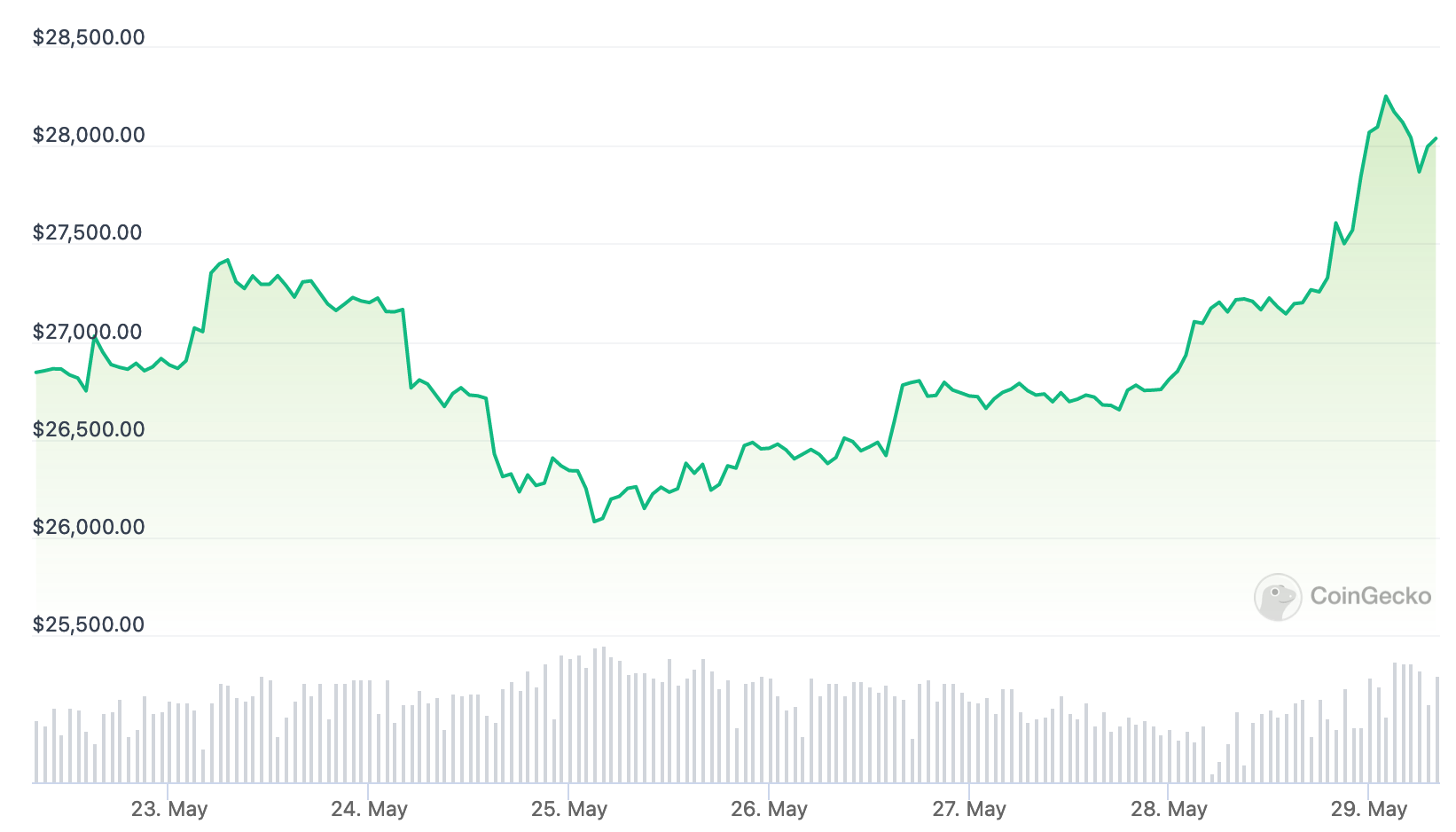
Bitcoin price has steadily built up over the last few days. Image: CoinGecko.

As a result of largely bitcoin's efforts, the wider crypto market cap has grown from $1.19 trillion to $1.22 trillion — up 2.6% in the last 24 hours.

A few coins have followed in bitcoin's progress, with ether and cardano each up 5% and polygon up 9%. Recently hyped memecoin pepe remains flat at around the $0.0000014 mark.

The rising prices follow news that a deal has been made to solve the U.S. debt ceiling problem. The deal will push back the debt ceiling to Jan 1, 2025, according to Reuters. U.S. President Joe Biden said the deal takes the "threat of catastrophic default off the table."

The deal may come as no surprise to Tether CTO Paolo Ardoino, who said on The Block's The Scoop podcast last week that a debt default would be unlikely because of the extreme consequences that it would have.

It may, however, affect former Bitmex CEO Arthur Hayes' planning for the year. He said that the timing would be interesting if this deal was reached in the fall — something that would create a powder keg of a situation. But with a deal already in the works, perhaps this year will be a little less volatile.


Пов'язані матеріали

GPT Designs GPT

OpenAI has unveiled its first custom AI chip, Jalapeño, a move signaling a strategic shift beyond being a mere model company. While many see it as a challenge to NVIDIA, its core aim is to control the entire intelligent production pipeline—from models and chips to data centers and energy. The key driver is the evolving competitive landscape: model advantages are shrinking, while the computational gap in areas like cost-per-token, system throughput, and energy efficiency is becoming the true long-term barrier. Jalapeño is primarily an inference chip, targeting the massive and growing "inference tax"—the daily operational cost of generating tokens for services like ChatGPT and APIs. By designing its own hardware optimized for its specific workloads and future product roadmaps (even using AI to aid the chip design process), OpenAI aims to drastically reduce token generation costs and improve system efficiency. This creates a potential flywheel: better models help design better chips, which lower costs for running next-generation models, supporting more users and products, which in turn provides more data to refine future chips. The strategy mirrors Apple’s integrated approach, building a closed loop where hardware, software, and applications are co-optimized. In the long term, OpenAI is not trying to become the next NVIDIA (a supplier of "shovels" to all AI companies) but to own and operate the entire "mine"—selling the end product of intelligence itself. This move marks OpenAI's ambition to evolve from creating the smartest models to controlling the foundational infrastructure of AI production.

marsbit12 хв тому

GPT Designs GPT

marsbit12 хв тому

Ethereum Foundation Interim Executive Director Speaks Out: What Is Our Mission?

The Ethereum Foundation's core mission is to ensure Ethereum remains a truly permissionless, censorship-resistant, private, and open infrastructure for large-scale, sovereign coordination. The article clarifies the EF's focus and dismisses irrelevant objectives, such as pursuing institutional popularity or short-term speculation. Its core work centers on eliminating systemic weaknesses. This involves fortifying Ethereum across multiple layers—protocol, access, user, and institutional—against exploitation, control, or surveillance. Key initiatives include minimizing harmful MEV and preventing privileged control over transaction flow, making unconditional privacy a foundational default, ensuring staking remains permissionless and decentralized, and strengthening user-facing access points to uphold autonomy. Concurrently, the EF aims to seize strategic opportunities. These include leading the transition to post-quantum cryptography, achieving a fully verifiable protocol stack, establishing Ethereum as private digital cash, integrating user-owned AI agents with personal wallets, and demonstrating that trusted-neutral infrastructure can competitively handle disintermediated coordination at an institutional scale. The article also addresses recent organizational changes, stating that personnel departures were due to strategic realignment, role fit, or natural evolution. It clarifies the approach to spin-outs, emphasizing that external funding will be provided only for work critical to the EF's mission that reduces Ethereum's dependency without creating new risks or mission drift. Ultimately, the EF is committed to building an enduring, neutral system that reshapes global coordination, focusing relentlessly on the principles of censorship resistance, openness, privacy, and sovereignty (CROP).

链捕手54 хв тому

Ethereum Foundation Interim Executive Director Speaks Out: What Is Our Mission?

链捕手54 хв тому

Торгівля

Спот
Ф'ючерси
活动图片