多重宏观利空打击市场,比特币短时跌破26000美元

比推Опубліковано о 2023-05-26Востаннє оновлено о 2023-05-26

Анотація

在经历了近半个月的萎靡盘整之后,受英国通胀数据、最新的联邦公开市场委员会(FOMC) 会议纪要、以及美财长耶伦对美国债务上限僵局的最新警告影响,加密市场进一步回撤。比推终端数据显示,截至发稿时,比特币交易价格跌破26,400 美元,在过去24 小时内下跌约3%,接近5 月12 日以来的最低水平。

在经历了近半个月的萎靡盘整之后,受英国通胀数据、最新的联邦公开市场委员会(FOMC) 会议纪要、以及美财长耶伦对美国债务上限僵局的最新警告影响,加密市场进一步回撤。比推终端数据显示,截至发稿时,比特币交易价格跌破26,400 美元,在过去24 小时内下跌约3%,接近5 月12 日以来的最低水平。

多方面的宏观不确定性

周三早些时候,在英国最新的4 月份消费者价格指数(CPI) 升至6.8%,高于预期的6.2% ,达到1992 年以来的最高点后,加密市场暴跌,令人失望的CPI 意味着英国央行将不得不继续近期的加息政策,这通常会打击加密市场。

最新的联邦公开市场委员会(FOMC) 会议纪要显示,美国央行官员在继续加息问题上存在分歧,这也对提振市场信心毫无帮助。

周三,美国众议院议长Kevin McCarthy表示,债务上限谈判仍悬而未决——距离美国面临违约风险还有八天。他还表示,他相信谈判小组可以在周三取得进展。

5月初至今,市场一直在权衡美国政府债务上限谈判以及持续的加密货币监管和宏观经济不确定性, BTC在低交易量和波动中挣扎,交易价格一直保持在26,500 美元至27,500 美元的范围内。

金融科技平台YouHodler 市场主管Ruslan Lienkha 在其博客文章中表示,“金融市场紧张局势加剧”对股票和数字资产造成了冲击。

Lienkha 写道:“由于对美国可能违约的担忧加剧,美国股指面临抛售压力:当局距离达成某种协议仅剩不到10 天,我们尚未看到这些谈判取得任何进展。所有这些不确定性迫使金融机构重组资产并为可能的违约做准备,这给金融市场的参与者带来了额外的压力。”

加密市场走势跟随美股,Enclave Markets 首席执行官David Wells 对CNBC表示:“尽管加密货币是一个全球市场,但在美国交易时段交易量大幅回升,因此有时大的加密波动是在宏观驱动的大股票波动之后发生的。”

部分分析人士认为,即使美国政府能够在6 月1 日截止日期之前提高债务上限,股票和加密货币等风险资产也可能受到影响,因为新美国国债的发行将耗尽市场的流动性。

例如,据路透社报道,由于投资者将注意力转向短期债务证券,本周美国货币市场基金资产创下5.8 万亿美元的新纪录。固定收益共同基金是企业和市政资金的主要来源,今年迄今已面临6150 亿美元的净流入。

Deribit :隐含交易量仍处于最低水平

加密期货和期权交易所Deribit 首席商务官Luuk Strijers 发推称,价值36 亿美元的比特币和以太坊期权合约将于本周五在Deribit 到期,但由于市场正处于全年最低波动水平之一,因此影响可能微乎其微。

Strijers 表示,看跌期权比率为0.38,未完成的看涨期权可能比看跌期权多两倍半以上。即将到期的期权金额相当可观,但这并不意味着市场有理由恐慌。
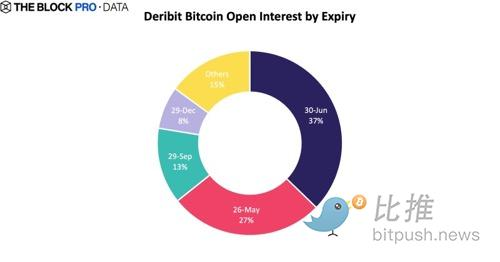
他说:“隐含交易量仍处于最低水平,比特币和以太坊的DVOL(Deribit 比特币波动率指数)为50,而短期交易量甚至更低,但略有攀升,比特币和以太坊的水平相同,这在历史上是罕见的。我们在今年1 月看到了类似的最低隐含波动率( IV )情况,随后出现了大幅飙升”。

BTC 24小时价格图暗示下跌趋势

加密分析师Ann Mugoiri追踪的24小时价格图显示,看跌势头不断增加,比特币价格已经稳步下降。空头成功控制了市场,将BTC/USD 推低至26,106 美元的低点。
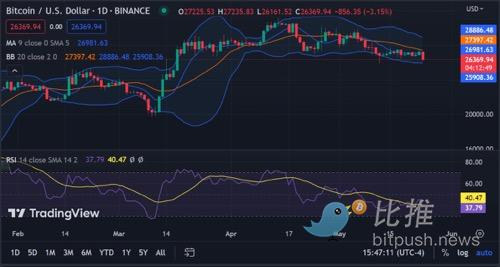
此外, BTC的相对强弱指数(RSI) 值为37.79 并且最近跌破其信号线表明BTC目前处于看跌市场,对于希望利用当前市场状况的投资者来说,这是一个潜在的获利买入机会。布林带也在收窄,表明波动性正在下降并在一定范围内盘整。布林带上轨位于28,886 美元大关,下轨位于25,908 美元。移动平均线指标(MA) 也显示出看跌情绪,因为50 日均线穿过了100 日均线下方。

24 小时比特币价格分析图显示,比特币处于强劲的下跌趋势中,空头主导市场。 BTC/USD已形成一系列较低的高点和较低的低点,表明卖压正在加剧。 Ann Mugoiri认为,如果进一步下跌,则可能会测试26,000 美元的水平,市场继续处于空头控制之中,任何复苏迹象都还有很长的路要走。


Пов'язані матеріали

13 Business Lines Surpass $100 Million in Annualized Revenue, Robinhood Moves Toward a 'Super Financial App'

Robinhood Q2 2026 Earnings: Record Revenue and a Push Towards a "Super Financial App" Robinhood (HOOD) reported strong Q2 2026 results, with net revenue reaching $1.308 billion, up 32% year-over-year, and net income hitting $561 million, a 45% increase. The company now has 13 distinct business lines each generating over $100 million in annualized revenue. Key drivers included a 44% surge in transaction-based revenue to $776 million, led by a more than 10x growth in "event contracts" (prediction markets) and strong performance in stocks and options. User metrics also grew, with funded accounts rising to 28.4 million and total assets under custody reaching $369 billion. The Robinhood Gold subscription service hit a record 4.8 million users. The report highlights a strategic shift for Robinhood. Moving beyond its core as a zero-commission trading platform for retail investors, it is actively building a broader financial ecosystem. This includes expanding into wealth management (Robinhood Strategies), payments (Robinhood Credit Card), and next-generation infrastructure like AI-powered "Agentic Trading" and its own Ethereum Layer 2 blockchain, Robinhood Chain. The company's goal is to evolve from a trading app into a comprehensive "super financial app," offering a one-stop shop for investing, cash management, and future on-chain finance.

Odaily星球日报6 хв тому

13 Business Lines Surpass $100 Million in Annualized Revenue, Robinhood Moves Toward a 'Super Financial App'

Odaily星球日报6 хв тому

13 Business Lines Surpass $100 Million in Annualized Revenue, Robinhood Advances Toward a 'Super Financial App'

On July 30th, Robinhood (HOOD) reported its Q2 2026 financial results, showcasing significant growth with record revenue and profits. The company achieved a net revenue of $1.308 billion, a 32% year-over-year (YoY) increase, and a net income of $561 million, up 45% YoY. This strong performance was driven by robust trading activity and expansion into new financial services. A key highlight was the surge in transaction-based revenue, which rose 44% YoY to $776 million. Notably, income from event contracts (prediction markets) skyrocketed over 10x to $156 million, emerging as a major new growth driver alongside strong gains in stock and options trading. However, crypto trading revenue declined by 38%. Beyond trading, Robinhood is successfully diversifying its revenue streams. User assets grew 32% to $369 billion, and the subscription service Robinhood Gold reached a record 4.8 million users. The company revealed that 13 of its business lines now generate over $100 million in annualized revenue, including its new credit card, prediction markets, and Gold subscriptions. Looking forward, Robinhood is strategically investing in AI and blockchain to build a comprehensive financial ecosystem. It has launched AI-powered "Agentic Trading" and the "Robinhood Chain," a layer-2 blockchain network. The company's vision is evolving from a retail trading platform into a "super financial app" that integrates trading, wealth management, payments, and next-generation digital asset services, though regulatory hurdles remain for some new ventures.

marsbit7 хв тому

13 Business Lines Surpass $100 Million in Annualized Revenue, Robinhood Advances Toward a 'Super Financial App'

marsbit7 хв тому

After R&D Investment Catches Up with the U.S., Is the Sino-U.S. Chip Competition Still Just About Money?

The article examines the significance of recent data showing China's total R&D expenditure, measured by purchasing power parity (PPP), catching up to or slightly surpassing that of the United States in 2024. It argues that while this milestone reflects China's immense capacity to mobilize research resources, the competition in semiconductors now extends far beyond sheer financial input. The analysis highlights key differences: China's R&D is heavily skewed towards experimental development (over 80%), focusing on product engineering and industrialization, whereas the U.S. allocates a proportionally larger share (about 15%) to basic research. Furthermore, leading U.S. semiconductor firms reinvest a significant portion of their substantial global sales revenue into R&D, creating a sustainable commercial innovation cycle that is difficult to replicate. The article emphasizes that semiconductor progress depends on converting R&D into commercially viable products that pass rigorous customer validation and achieve repeat orders, not just on spending levels. It concludes that as China enters the top tier of R&D spenders, the critical challenges shift to improving resource allocation efficiency, fostering long-term basic research, and building effective mechanisms to bridge the gap between laboratory discoveries and reliable, market-ready industrial capabilities.

marsbit1 год тому

After R&D Investment Catches Up with the U.S., Is the Sino-U.S. Chip Competition Still Just About Money?

marsbit1 год тому

Торгівля

Спот
活动图片