How Does Current Bitcoin Rally Compare With Historical Ones?

newsbtcОпубліковано о 2023-05-23Востаннє оновлено о 2023-05-23

Анотація

Here's how the current Bitcoin rally stacks up against the previous ones in terms of the drawdowns it has experienced so far. The Current Bitcoin Rally Has Seen A Peak...

Here’s how the current Bitcoin rally stacks up against the previous ones in terms of the drawdowns it has experienced so far.
The Current Bitcoin Rally Has Seen A Peak Drawdown Of -18.6% So Far
In a recent tweet, the on-chain analytics firm Glassnode compared the latest Bitcoin rally with the ones seen throughout the entire history of the cryptocurrency.
Generally, rallies are compared using metrics like the percentage price uplifts recorded during them or the amount of time that they lasted (which may be measured in terms of the blocks produced, as is done when looking at cycles in terms of halvingsere, however, Glassnode has taken a different approach that provides a new perspective on these rallies.

The comparison basis between the price surges here is the drawdowns that each of them experienced across their spans. Note that these drawdowns aren’t to be confused with the cyclical drawdowns that are used to measure how the price has declined since the bull run top.
The drawdowns in question are the obstacles that the cryptocurrency encountered while the rallies were still ongoing, and are hence, those that the coin eventually managed to overcome.
Here is a chart that shows the degree of drawdowns that each of the historical bull markets experienced, and also where the current rally stands in comparison to them:
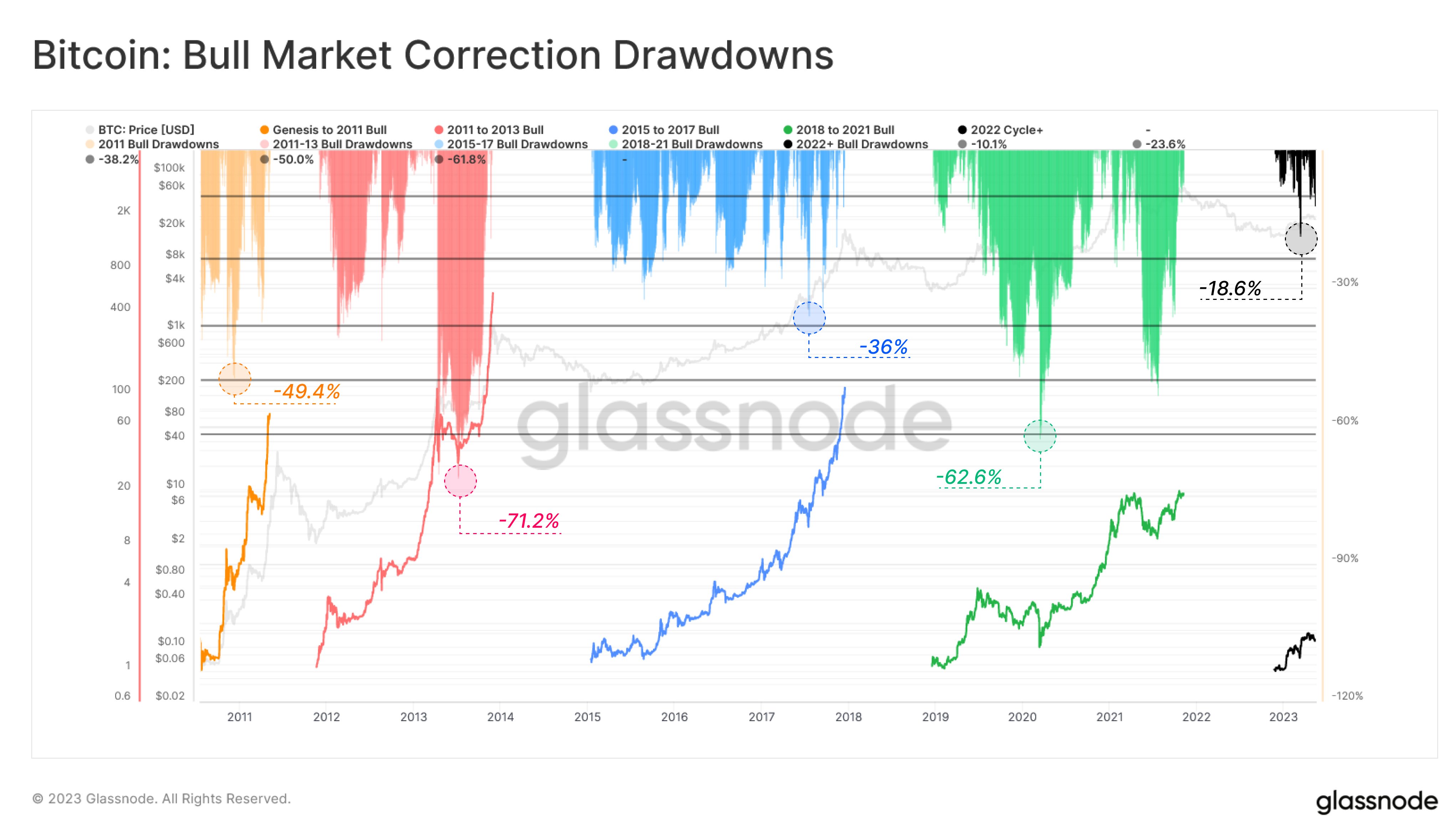
Bitcoin Bull Market Drawdowns


Looks like the value of the metric hasn't been too high for the latest rally so far | Source: Glassnode on Twitter
The five bull rallies here are as follows: genesis to 2011 (the very first rally), 2011-2013, 2015-2017, 2018-2021 (the last rally), and 2022 cycle+ (the ongoing one).
The analytics firm here has taken the bottom of each of the bear markets as the start of the next bull rallies. This means that parts of the cycle that some may not consider as part of the proper bull run are also included.
The main example of this would be the April 2019 rally, which is often considered its own thing but is clubbed with the last Bitcoin bull market in the above chart.
From the graph, it’s visible that the deepest drawdown that occurred during the first bull market measured around -49.4%. The next run, the 2011 to 2013 bull, experienced an even larger obstacle of a -71.2% plunge midway through it.
The next one (2015-2017) then only saw a drawdown of -36%, but the drawdown was again up at -62.6% for the run that followed it (that is, the latest bull market).
So far in the 2022+ Bitcoin bull market (which would only be considered a bull market at all if the November 2022 low was truly the cyclical bottom), the deepest drawdown observed so far is the March 2023 plunge of -18.6%.
Clearly, the drawdown seen in the current rally so far is significantly lesser than what the historical bull markets face. If the pattern of the past runs holds any weight at all, then this would mean that the current bull market should still have more potential to grow.
At the time of writing, Bitcoin is trading around $26,900, down 2% in the last week.

Bitcoin Price Chart


BTC has been moving sideways recently | Source: BTCUSD on TradingView
Featured image from iStock.com, charts from TradingView.com, Glassnode.com


Пов'язані матеріали

Solana Proposals Could Lead to Reduction in Staking Yields to 2.25% and Cut Emissions by $1.5 Billion

Solana is moving towards a stricter monetary model that could lead to a SOL deficit and significantly reduce staking rewards for holders. Two governance proposals drive these changes. SIMD-550, currently under vote, would double Solana's annual disinflation rate from 15% to 30%, accelerating the timeline to reach a final inflation rate of ~1.5% to the first half of 2029. The second, SIMD-553 (already approved), introduces additional token burning tied to computational units used on the network. Together, these measures could reduce SOL emission by an estimated $1.4-$1.5 billion over six years. The immediate impact would be lower staking yields, potentially falling from the current ~5.25% to approximately 4.34% in year one, 3% in year two, and 2.25% by year three. Analyst Matt Mena from 21Shares suggests inflation should be tied to economic metrics to help offset this decline. The changes also raise concerns for validator economics, with some potentially becoming unprofitable as inflation rewards decrease and voting costs may rise. However, the lower passive yield might push a significant portion of the 67.9% staked SOL into Solana's DeFi ecosystem for activities like lending and trading. This shift could boost network fee revenue to compensate for lower inflation rewards. The proposals aim to trade lower yield today for less dilution tomorrow, betting that network growth and usage will make this a worthwhile trade-off for SOL holders.

cryptonews.ru1 год тому

Solana Proposals Could Lead to Reduction in Staking Yields to 2.25% and Cut Emissions by $1.5 Billion

cryptonews.ru1 год тому

Chairman of Olympic Committee detained in Poland over crypto scandal

The Chairman of the Polish Olympic Committee, Radosław Piesiewicz, was detained in Warsaw in connection with a case involving the cryptocurrency exchange Zondacrypto. The detention was carried out on the order of the Katowice National Prosecutor's Office and the Central Bureau for Combating Cybercrime. Piesiewicz denies the allegations, claiming he never had accounts on the exchange or dealt in cryptocurrency, and links the detention to political persecution. He has led the Olympic Committee since 2023 and is also a parliamentarian for the Law and Justice party. The prosecutor's office initiated the case in April 2026 on grounds of fraud and money laundering amounting to approximately 350 million PLN (around €80 million). The investigation found the exchange was used to transfer funds abroad and cash out criminal proceeds, with clients unable to withdraw their assets. A total of 13 people are implicated, including the exchange's founder. Zondacrypto became the general sponsor of the Polish Olympic Committee and team in October 2025, with a contract lasting until 2028. In April 2026, Piesiewicz stated the committee could not terminate the agreement without incurring unaffordable penalties. The investigation revealed Piesiewicz received expensive gifts from exchange representatives, including a €40,000 watch, as well as paid trips to Monaco and Bergamo.

cryptonews.ru1 год тому

Chairman of Olympic Committee detained in Poland over crypto scandal

cryptonews.ru1 год тому

Торгівля

Спот
活动图片