比特币可能会反弹

CoindeskОпубліковано о 2023-04-26Востаннє оновлено о 2023-04-26

Анотація

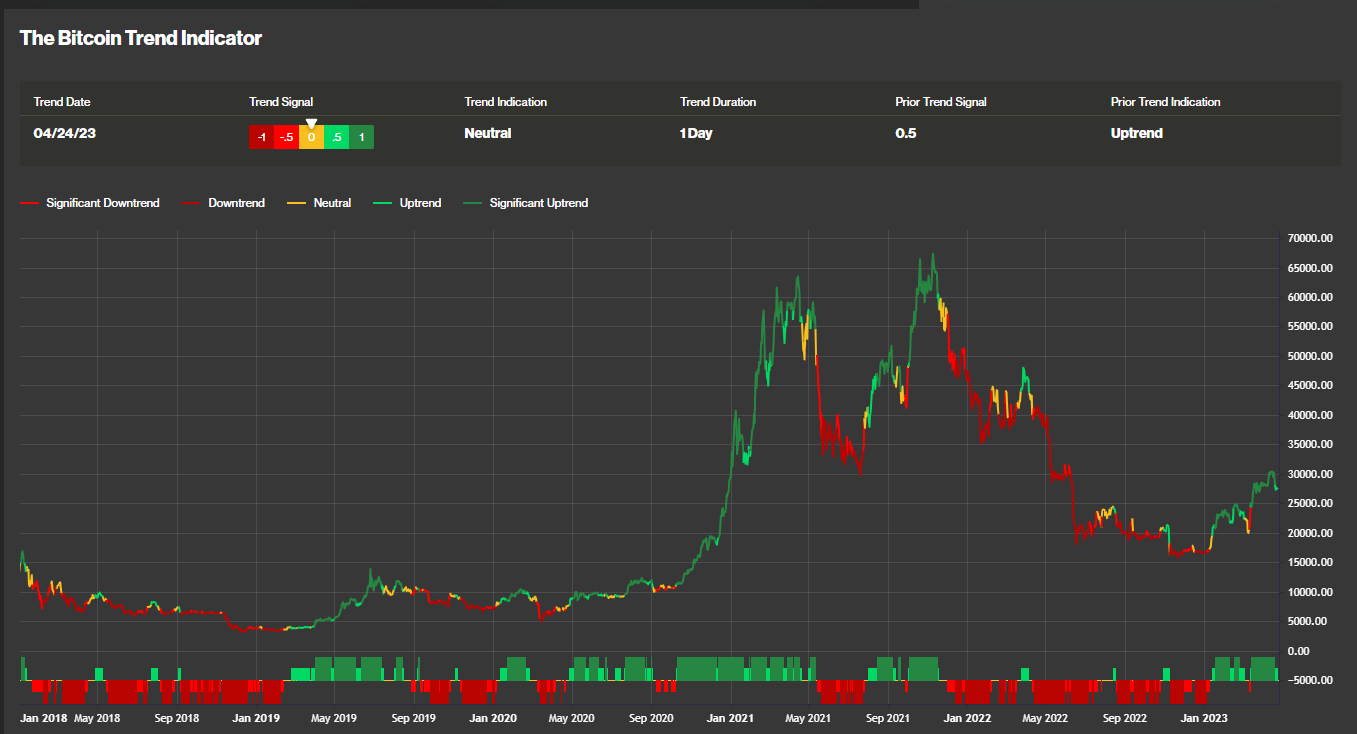
与此同时,CoinDesk 比特币趋势指标从 0.5(上升趋势)下降到 0(中性),进一步凸显了近期价格走势的停顿。

比特币连续第三天的负交易与技术指标一致,表明比特币的价格可能再次上涨,至少在短期内是这样。

比特币 (BTC) 的价格自 4 月 14 日突破 30,000 美元的重要心理关口以来已回撤 9%。以太 (ETH) 在达到 2,100 美元以上的峰值后同期下跌了 14%。

从技术上讲,有几件事很突出:

30,000 美元的价格清楚地表明了阻力。比特币和以太币的支撑或阻力往往集中在大整数附近,因为交易者通常在以 0 或 5 结尾的点下买卖订单。

比特币达到 30,000 美元,与当时布林带的上限保持一致。

比特币的交易区间在开盘价和收盘价之间收缩至 0.0005%,因为它达到了区间上限,这意味着买卖双方对其价格感到满意。

布林带绘制资产的 20 天移动平均线,并计算高于和低于平均线的两个标准差。由于资产价格预计在 98% 的时间里保持在平均水平的两个标准差范围内,因此突破任何一个水平都被认为是值得关注的事件。

在最近的这个案例中,违规行为与可能的心理阻力点同时发生。投资者通常最关心接下来会发生什么。

最近的下跌伴随着预期的势头下降,但它也伴随着向布林带下端的移动而发生。 BTC 的相对强度指数 (RSI) 从 71.54 下降至目前的 42.53,表明势头下降。

从 2015 年 1 月到今天,比特币的 RSI 位于 42 和 45 之间,共 163 次,发生后 30 天的平均表现为 6%。

未来七日表现历来持平,涨幅仅为0.63%。

与此同时,比特币接近其布林带下限引发了一个问题,即价格是会跌破该关口,还是会保持在置信区间内并走高。

鉴于最近的历史,技术分析师可能预计BTC价格将有条不紊地回升至 20 日均线。在技术调整的时刻,比特币的 20 天移动平均线比当前价格高出约 6%。

与此同时,CoinDesk 比特币趋势指标从 0.5(上升趋势)下降到 0(中性),进一步凸显了近期价格走势的停顿。

比特币趋势指标 04/25/23 (CoinDesk)

Пов'язані матеріали

Take a Calm Look at Domestic Lithography Machines: 5 Units Delivered, How Far Are We from Challenging ASML?

This article analyzes recent news about China's domestic DUV lithography machines, advising a measured perspective. A state-backed enterprise plans to deliver about 5 immersion DUV systems this year, with a 2027 target of 20 units, aimed at 28nm processes. While this marks a step from R&D into initial customer validation, the author cautions against over-optimism. The piece clarifies this is DUV, not EUV technology. DUV is crucial but cannot economically solve challenges for advanced nodes like 5nm or below, where EUV is key. The 5-unit volume is minimal compared to ASML's annual output of over 130 such machines. The author highlights unverified claims regarding specs like 90% yield and warns against conflating this news with unconfirmed reports about Shanghai Micro Electronics' production. China's EUV efforts, while progressing with a prototype, remain in early testing, facing significant hurdles in core components like high-precision optics. The analogy of a "DeepSeek moment" is deemed misleading, as lithography involves slow, iterative precision engineering, not rapid software-like breakthroughs. Current progress represents establishing a potential second supply source and gaining vital engineering experience rather than an imminent industry disruption. For investors, the key indicators to watch are formal customer acceptance, stable operational performance, repeat orders, and growth in production volume and component localization. The conclusion is that this is a positive but early-stage development, far from altering the global competitive landscape.

marsbit55 хв тому

Take a Calm Look at Domestic Lithography Machines: 5 Units Delivered, How Far Are We from Challenging ASML?

marsbit55 хв тому

The 800x Golden Dog, "Gacha" Saves NFT Trading

Title: 800x Golden Dog: How 'Gacha' Mechanics Are Rescuing NFT Trading In the past month, the on-chain TCG (Trading Card Game) narrative, centered around "gacha" or loot box mechanics, has emerged as a major crypto-native revenue generator, second only to platforms like Hyperliquid and pump.fun. Recently, this trend hit Ethereum with Fake World Assets (FWA). Within just over a week, FWA generated approximately $1.3 million in revenue, ranking 15th in the past week's crypto app earnings. Its token, $FWA, surged from an initial market cap of ~$47,550 to a peak of ~$38.8 million—an 800x gain. Meanwhile, Collector Cards' token $CARDS declined significantly from its previous highs. FWA, developed by the team behind "PunkStrategy," operates as an NFT gacha system with a built-in token flywheel. Users deposit NFTs paired with ETH as liquidity into pools. Each deposit creates a personal pool; more ETH deposited lowers the chance of the NFT being "won" in a draw. Players spend ETH to "draw" (gacha). If they get an undesirable NFT, they can instantly sell it back to the original depositor at an 85% discount, generating income for the depositor. A 1% fee is taken on each draw and on depositor earnings when an NFT is kept. The key to FWA's momentum is its token $FWA. It cannot be bought directly externally. The primary way to acquire it is by playing the gacha and choosing to receive $FWA (instead of ETH) when selling back an unwanted NFT. This mechanism creates constant buy pressure for $FWA as players engage, especially during its price ascent. Early participants who held $FWA benefited massively from subsequent inflows. This contrasts with projects like Collector Cards, which, despite strong revenues, suffer from perceived low token utility beyond buybacks. In conclusion, while FWA's flywheel design—linking speculative token gains directly to NFT trading activity—has driven rapid growth, its sustainability is questionable. The model relies heavily on continuous $FWA price appreciation to offset the inherent negative expectancy of each draw. When price momentum stalls, activity will likely decline. The case highlights that in crypto markets, pure profitability narratives can be fleeting; understanding the relationship between attention, token buy pressure, and sustainable mechanics is crucial to avoid speculative pitfalls.

marsbit1 год тому
The 800x Golden Dog, "Gacha" Saves NFT Trading

marsbit1 год тому

The Quantum Computing Threat Approaches, Cryptocurrency May Be Exposed to Risks Before Banks

Quantum computing poses a significant threat to all cryptographic systems, including banks and governments, but decentralized cryptocurrencies with public ledgers like Bitcoin are likely the first practical target. Experts warn that a cryptographically relevant quantum computer (CRQC), capable of running Shor's algorithm to break the elliptic curve cryptography securing most crypto wallets, could emerge around 2029. Recent research shows the required quantum resources for such attacks are shrinking dramatically, potentially enabling key extraction in minutes. The core vulnerability for cryptocurrencies is not the cryptography itself—post-quantum standards are being developed—but the slow, decentralized governance required to implement upgrades. Unlike centralized banks that can swiftly transition, Bitcoin needs near-unanimous consensus among its global network, a historically difficult process as seen in past upgrades. Estimates suggest migrating all vulnerable Bitcoin funds could take at least 76 days of dedicated network time, and it must be completed before a CRQC exists to prevent "now-or-never" attacks on exposed keys. The threat is not binary; it begins when a quantum computer can decrypt data before it loses value, not necessarily in real-time. A significant portion of Bitcoin (estimated at millions of coins) already has public keys permanently exposed on-chain, making them vulnerable to eventual "static attacks." While technical solutions exist, the race is against time for decentralized networks to coordinate a defensive transition, serving as an early warning for the broader financial system.

marsbit1 год тому

The Quantum Computing Threat Approaches, Cryptocurrency May Be Exposed to Risks Before Banks

marsbit1 год тому

Торгівля

Спот
活动图片