Analyst Known for Calling Bottoms Forecasts Ethereum (ETH) Rally to All-Time Highs – Here’s His Outlook

dailyhodlОпубліковано о 2023-04-19Востаннє оновлено о 2023-04-19

Анотація

An analyst who correctly called Bitcoin's (BTC) 2018 price floor says Ethereum (ETH) looks poised...

An analyst who correctly called Bitcoin’s (BTC) 2018 price floor says Ethereum (ETH) looks poised to significantly outpace the crypto king en route to its all-time highs.
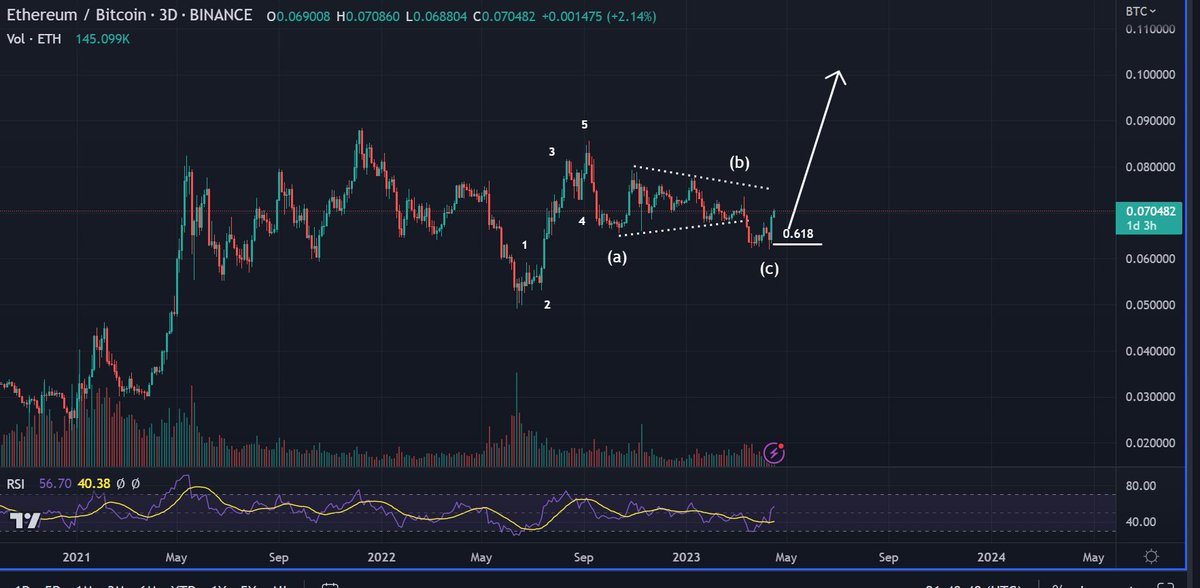
Pseudonymous analyst Smart Contracter tells his 222,400 Twitter followers that he’s keeping an eye on the Ethereum versus Bitcoin pair (ETH/BTC).

According to the crypto strategist, ETH/BTC has likely carved a 2023 low at around 0.062 BTC ($1,879) and may now be in a position to witness a sustained uptrend in the coming months.
“So far ETH/BTC has played out exactly as I had predicted it would over four months ago down to the pico low [at] 0.062 level. The best part is I think it trades well over 0.10 ($3,032) by the end of the year.” 
Image

Source: Smart Contracter/Twitter A bullish ETH/BTC pair indicates that Ethereum is rising in value faster than Bitcoin. At time of writing, the ETH/BTC pair is trading for 0.069 BTC, worth $2,092.
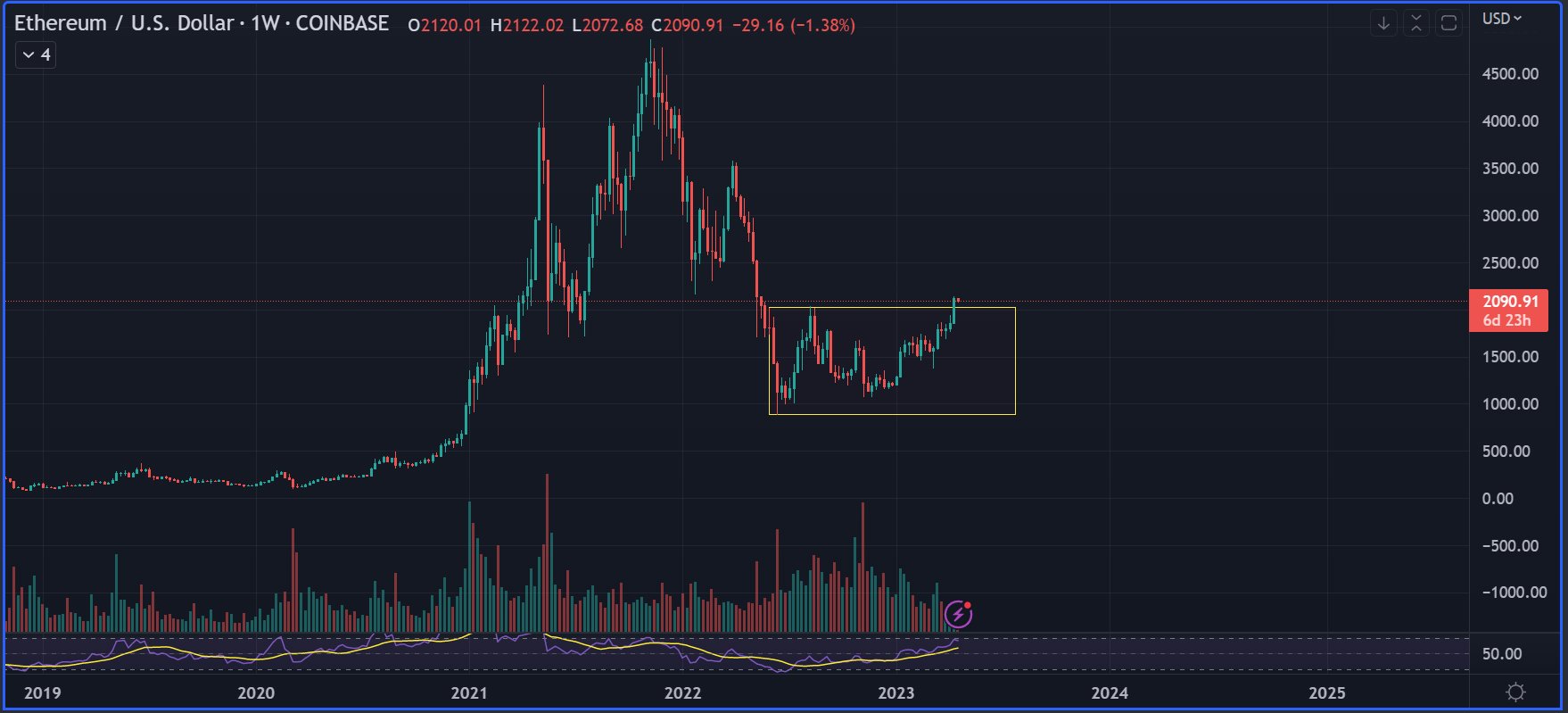
Looking at Ethereum itself, Smart Contracter says the leading altcoin has managed to take out a key resistance level on the weekly chart that has kept ETH bearish for almost a year.
“ETH just had a mega-strong weekly close out of a 300-day range… Time to overcome the PTSD (post-traumatic stress disorder) and get back into the mindset of the good old days.”
Image

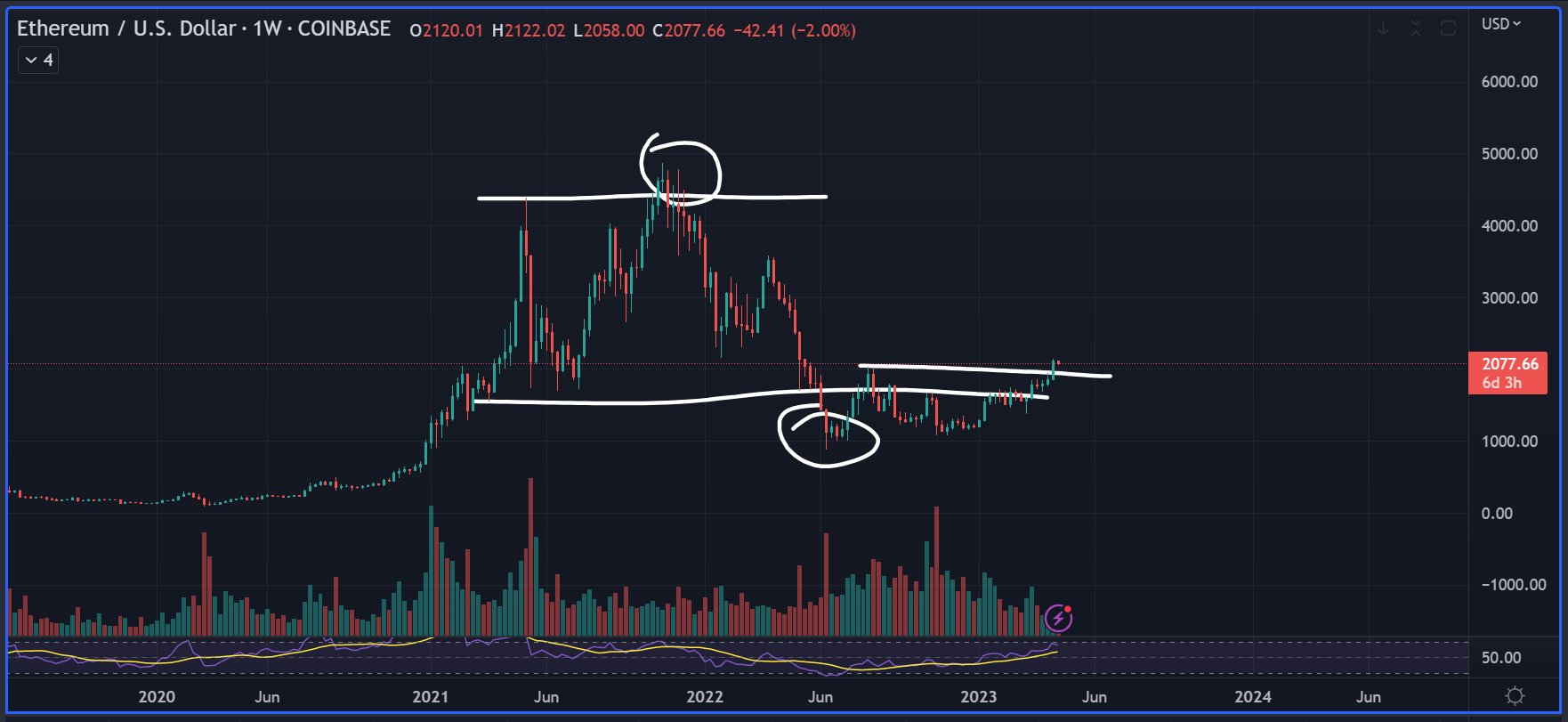
Source: Smart Contracter/Twitter Following Ethereum’s breakout, Smart Contracter thinks that ETH could rally to its all-time high at around $4,800.
“Tell me this thing ain’t going to all-time highs.” 
Image

Source: Smart Contracter/Twitter At time of writing, Ethereum is trading for $2,097.
d Image: Midjourney


Пов'язані матеріали

Unitree Robotics' IPO Hearing Countdown! Dissecting the 'Ice and Fire' in the Prospectus of the 'First Humanoid Robot Stock'

Unitree Robotics, poised to become China's first publicly listed humanoid robot company, is set for its IPO review on the Shanghai Stock Exchange. Its prospectus reveals a company undergoing a rapid transformation. Once primarily a quadruped robot (robodog) maker, humanoids now account for over half of its revenue as of 2025, with the company selling approximately 5,500 units in that year—reportedly the highest global volume. Current demand, however, is heavily concentrated in research and education (74% of humanoid sales), while commercial and consumer use is largely for promotional "display" purposes. Industrial applications remain limited (~9% of sales), though quadruped robots see more mature use in industrial inspections. A key strength is Unitree's vertically integrated model, self-designing and manufacturing critical components like motors and actuators. This has driven manufacturing costs down and pushed gross margins up to nearly 60%—exceptionally high for a hardware company. Financially, revenue surged 335% to about $252 million in 2025, with the company achieving profitability. Its IPO targets a valuation of $6-7 billion, planning to invest nearly half the raised capital into AI model development. This includes funding for Vision-Language-Action (VLA) and World Model + Action (WMA) models, highlighting its strategic focus on building a software "brain" to complement its hardware leadership and secure a long-term competitive edge. The prospectus showcases Unitree's manufacturing prowess and growth but also underscores the early, niche stage of widespread humanoid robot commercialization beyond academia and demonstration.

marsbit44 хв тому

Unitree Robotics' IPO Hearing Countdown! Dissecting the 'Ice and Fire' in the Prospectus of the 'First Humanoid Robot Stock'

marsbit44 хв тому

IOSG: DeFi at Its Most Critical Moment, The Real Vulnerability Lies Not in the Code

In April 2026, a series of major DeFi exploits—targeting Drift Protocol ($285M), KelpDAO ($292M via bridge), and Wasabi Protocol ($4.5M)—revealed a fundamental security crisis. None involved smart contract code vulnerabilities. Instead, losses stemmed from compromised operational foundations: social engineering of multi-signature signers, a single-point-of-failure bridge validator, and stolen admin private keys. This month, where over $625M was stolen across ~30 incidents, marked the collapse of DeFi's core security premise: that rigorous code audits alone ensure safety. The real vulnerabilities lay in trusted operational components—admin keys, governance councils, and bridge configurations—areas audits typically ignore. The KelpDAO incident triggered an asymmetric domino effect: its $2.92B unsupported token mint caused ~$8.5B in outflows from Aave and a $13.2B total DeFi TVL drop in 48 hours, showcasing how one protocol's operational failure can cascade through composable systems. The article argues that most so-called "DeFi" is actually "OpenFi": permissionless and transparent on-chain, but critically reliant on trusted third parties for key operations. This inherent trade-off between decentralization and operational feasibility is often obscured by marketing. The industry's path forward requires honest disclosure of trust assumptions (like L2Beat's framework), treating operational security as a first-class discipline alongside code audits, and designing systems whose risks can be clearly assessed and insured. The April events were not a code security failure but a breakdown in the mental model surrounding it.

marsbit58 хв тому

IOSG: DeFi at Its Most Critical Moment, The Real Vulnerability Lies Not in the Code

marsbit58 хв тому

Торгівля

Спот
Ф'ючерси
活动图片