Analyst Who Called Bitcoin and Crypto Crash Says One Ethereum Competitor Looks Ready To Erupt

Daily HodlОпубліковано о 2022-04-02Востаннє оновлено о 2022-04-02

Анотація

A closely followed crypto analyst who accurately predicted the Bitcoin (BTC) year-end crash is updating...

A closely followed crypto analyst who accurately predicted the Bitcoin (BTC) year-end crash is updating his forecast on several altcoins.
Pseudonymous crypto trader Smart Contracter tells his 205,800 Twitter followers that monthly closes are looking good for a number of projects.
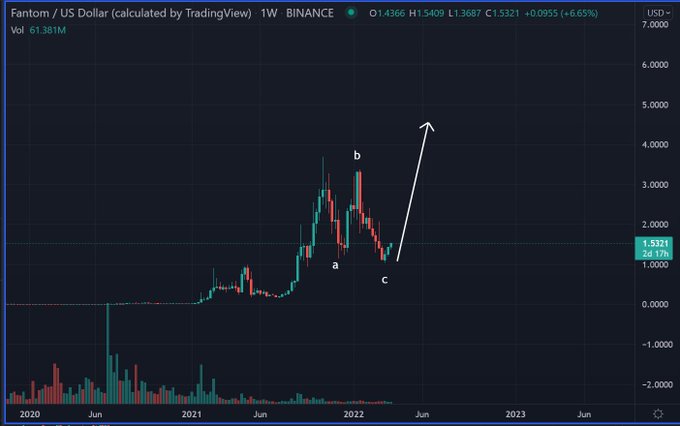
One altcoin on Smart Contracter’s radar is Fantom (FTM), which he says has already completed a corrective A-B-C pattern on the weekly timeframe. The trader predicts an explosive 190% move for the smart contract platform from its current level of $1.55 to a fresh all-time high of around $4.50.
“FTM weekly looking like a big corrective A-B-C from the highs.
Another that I think has a cracking chance of an all-time high this year.”
Image

Source: Smart Contracter/Twitter The trader adds that high-performance blockchain Solana (SOL) is also flashing bullish signals on both the US dollar and Bitcoin pairs.
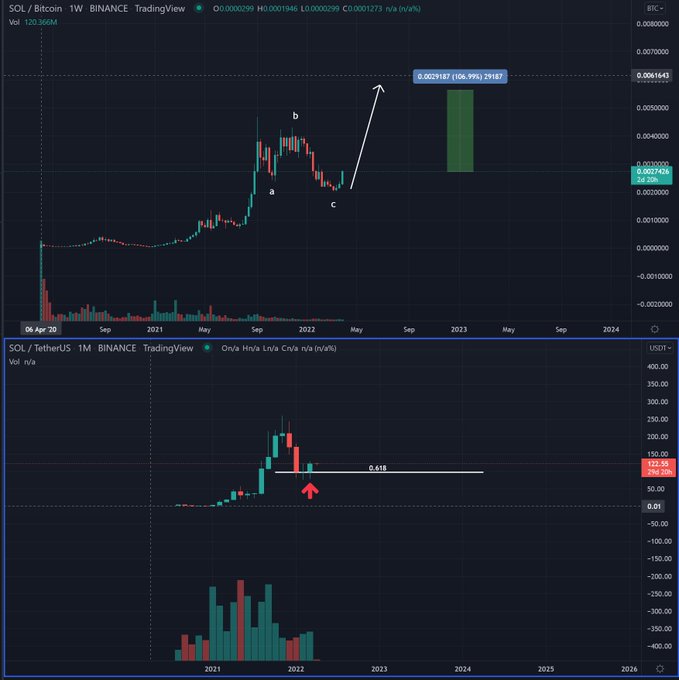
Looking at SOL against the US dollar (SOL/USD), Smart Contracter says the pair is showing a bullish reversal pattern at the bottom of a multi-month downtrend.
“Monthly charts closed today and one of the altcoins I like is Solana (SOL). On the US dollar pair, we have a textbook morning star pattern on the monthly timeframe which occurred dead smack on the 0.618 [Fibonacci retracement level].”
Paired against Bitcoin (SOL/BTC), Smart Contracter says that Solana also completed a three-wave corrective pattern (A-B-C), suggesting that a trend reversal is in sight.
“Also on the Bitcoin pair, the whole structure from the top looks like a clear A-B-C [pattern].”
Image

Source: Smart Contracter/Twitter Smart Contracter relies on the Elliott Wave theory, which predicts future price action by following crowd psychology that tends to manifest in waves. According to the theory, the completion of an A-B-C corrective pattern often leads to a trend reversal.


Пов'язані матеріали

Ethereum Foundation Researcher: Quantum Day Is Approaching, Plans to Complete Quantum-Resistant Migration by 2029

Ethereum Foundation researcher Justin Drake discusses the implications of a recent quantum computing breakthrough by Google’s quantum AI team, which demonstrated a 10x efficiency improvement in Shor’s algorithm against the secp256k1 elliptic curve used in Bitcoin and Ethereum. Notably, Google kept key algorithmic details confidential, using zero-knowledge proofs to verify the result without disclosure—a first in academia. Shortly after, the core optimization was independently reproduced, and an open-source competition (ecdsa.fail) emerged, further improving the algorithm by 8.4%. Meanwhile, startup Oratomic published research suggesting that neutral-atom quantum architectures could break secp256k1 with only 10,000 physical qubits, accelerating the timeline for "Q-Day"—the day quantum computers can break widely used cryptography. Drake estimates a 50% probability of Q-Day by 2032 and a 10% chance by 2030, contrasting with the U.S. government’s more conservative 2035 forecast. He warns against panic but stresses timely migration to post-quantum cryptography. Ethereum plans to complete its migration by 2029, covering consensus, data, and execution layers with hash-based systems. The Foundation is also developing leanVM, a formally verifiable zkVM, and has launched two $1 million initiatives to advance SNARK-friendly cryptography.

foresightnews_api1 хв тому

Ethereum Foundation Researcher: Quantum Day Is Approaching, Plans to Complete Quantum-Resistant Migration by 2029

foresightnews_api1 хв тому

UBS: The Crowdedness of A-Share Tech Stocks Is Far From Reaching Historical Peaks

UBS: A-share tech stocks still far from peak crowding levels A-shares' technology sector has seen a strong rebound, with trading activity hitting record highs, raising concerns about market crowding. However, UBS Securities argues that a key indicator of institutional positioning suggests the current crowding level remains well below historical peaks. While the large-cap tech sector's share of total A-share trading volume and market capitalization have reached historical highs, the overweight ratio of domestic mutual funds in this sector stood at 9.9% in Q1 2026. This is down from 11.6% in Q3 2025 and significantly lower than the historical peak of 14.1% in Q4 2015. It also pales in comparison to the historical peak overweight of 18.7% for the consumer sector. UBS notes that typical cycles from a low to a peak in fund overweighting last about three years, and the current outperformance of the tech/growth style has lasted less than two years since the policy pivot in September 2024. UBS expects A-share earnings recovery to accelerate, providing fundamental support. It forecasts 2026 A-share profit growth to rise to 11% from 3.9% in 2025. Non-financial A-share profits grew 11.8% YoY in Q1 2026, with gross and net profit margins at their highest since 2023. Persistent fund inflows, the expansion of thematic ETFs, and a recovery in private fund issuance are supporting market liquidity. In tactical allocation, UBS favors growth and cyclical styles under its "slow bull" base case, with overweight ratings on six sectors: Electronics (benefiting from semiconductor inventory recovery and AI innovation), Communications (driven by AI computing demand), Machinery (aided by domestic capex recovery), Non-ferrous Metals (due to rising copper/aluminum prices), Chemicals (supported by anti-involution policies), and Electrical Equipment (driven by policy support and AI data center power demand).

marsbit1 год тому

UBS: The Crowdedness of A-Share Tech Stocks Is Far From Reaching Historical Peaks

marsbit1 год тому

Торгівля

Спот
Ф'ючерси
活动图片