The Cardano (ADA) market is showing robustly positive signs of growth. The number of whale wallets on the Cardano network has increased by 1.7% in the last eight days on-chain data reveals.
The Cardano network is birthing new whale wallets
On-chain and technical analyst, Ali Martinez, who first pointed out the data shared that roughly 42 addresses holding 1 million to 10 million ADA were created since March 21.
This is a significant increase if the value of these holdings is taken into consideration Martinez notes in his tweet. He said:
“The uptick may seem insignificant at first glance, but these whales hold between $1.2 million and $12 million in ADA.”
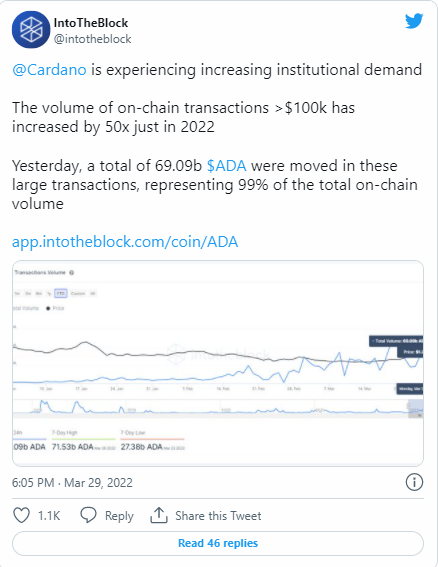
Supporting Martinez’s finding is also data from the crypto analytics and intelligence platform, IntoTheBlock. Per IntoTheBlock’s data, Cardano is currently experiencing increased institutional demand. Whale transactions (transactions greater than $100k) on the Cardano network have increased 50 fold in 2022 alone.
As of yesterday, the Cardano blockchain saw a total transactions volume of $69,09 billion, and 99% of this volume was institutional-level transactions.
Overall, the surge is a positive sign for ADA’s future price action. The price of ADA is already feeling the impact of the increasing whale accumulation.
ADA has been on a bullish streak. In the last week, ADA is up 24% and is currently trading at $1.20. This surge has driven up the assets market cap to over $40 billion. This makes ADA rank as the eighth largest crypto by market cap, ahead of Terra (LUNA) and Solana (SOL).
What has been attracting the whales to Cardano?
Developments going on in the Cardano ecosystem have undoubtedly been the cause of a lot of excitement in the ADA market. Among recent key developments is the launch of Milkomeda, a layer 2 interoperability sidechain of Cardano.
With Milkomeda, EVM compatible tokens can now be bridged over the Cardano blockchain. Milkomeda also offers a developer toolkit for Ethereum’s native programming language, Solidity. The sidechain opens the door for more projects to launch on the Cardano blockchain, and a lot of liquidity to flow into the ADA market.
Equally positive for Cardano is its inclusion in Grayscale’s latest fund, in which it comprises the largest percentage per share. Amidst all these, market participants also expect that following two network upgrades this year, Cardano should attract even more attention and the price of ADA will truly breakout. Crypto Stories View all