10000 Hours of Human Data, Trains the World's First Whole-Body Mobile Manipulation Implicit World-Action Model

marsbitОпубліковано о 2026-07-15Востаннє оновлено о 2026-07-15

Анотація

"Being-M0.7" is the world's first latent world-action model for whole-body mobile manipulation in humanoid robots, developed by Zhi Zai Wu Jie (Beyond Being). Trained on over 10,000 hours of human-centric multimodal data, it aims to overcome key industry challenges: the high cost and scarcity of real robot demonstration data, the computational inefficiency of pixel-level video prediction models, and the lack of full-body coordination in existing approaches. The model is based on a Vision-Motion Mixture-of-Transformers (MoT) architecture, which allows training on a mixture of paired video-motion data, pure video data, and pure motion sequences. A key design is a unified motion representation that bridges human and robot morphology, enabling knowledge transfer from vast human behavioral data to specific robot control. After pre-training on human data, the model is adapted to a real robot (Unitree G1) using a small amount of teleoperated demonstration data via a lightweight "Action Expert" module. This process decouples low-frequency world planning from high-frequency motion control. The model was tested in four challenging real-world demos: fishing a toy fish from water (liquid interaction), retrieving an object using a mirror (visual reasoning), a multi-step pick-and-place task, and obstacle avoidance while carrying a box. In comparative tests against other models, Being-M0.7 showed stronger performance in tasks requiring indirect reasoning and full-body coordination. This...

Over the past two years, the competitive focus in the humanoid robot sector has been shifting from the hardware of the entire machine further to model capabilities.

Manufacturers have been releasing new products intensively, with videos of backflips, dancing, and marathon running frequently dominating social feeds. Behind the fanfare, however, the industry has gradually reached a consensus: what determines the upper limit of a humanoid robot's ability is no longer just its joints and motors. The capacity to understand the environment, predict changes, and coordinate the entire body to complete tasks is becoming the key to achieving generality.

World models, VLA, and humanoid robot foundation models have thus become some of the most important technical directions in this field over the past two years.

Amidst this excitement, three major challenges have remained.

First, the cost of collecting real-world demonstration data for humanoid robots is high. Collection requires synchronous recording of first-person video, proprioceptive data, and executable whole-body commands. Constrained by teleoperation difficulty, safety risks, hardware availability, and environmental diversity, it is difficult to accumulate large-scale, high-quality data in a short time.

Second, many existing world-action models follow the pixel-level video prediction approach, which is computationally expensive, with significant capacity consumed by image details weakly correlated with control. The robot's own rapid movement and viewpoint jitter further amplify visual prediction noise.

Third, many existing solutions still model upper-limb manipulation and lower-body locomotion separately, resulting in insufficient coordination between the upper and lower body and difficulty in supporting natural, fluid whole-body control.

Against this backdrop, Embodied Intelligence company Zhi Zai Wu Jie has released Being-M0.7. This is the world's first Latent World-Action Model (Latent WAM) for whole-body mobile manipulation of humanoid robots, and it is also the industry's first time extending the capabilities of latent world models from desktop dexterous manipulation to whole-body mobile manipulation.
  • Paper Link: https://research.beingbeyond.com/being-m07/being-m07.pdf
  • Project Page: https://research.beingbeyond.com/being-m07

It was pre-trained on over 10,000 hours of human-centric mixed-modal data, then adapted to a specific embodiment using a small amount of real-world demonstration data, and has successfully completed multiple challenging whole-body mobile manipulation tasks on a physical humanoid robot.

From Being-H to Being-M: A Continually Materializing Technical Path

Behind Being-M0.7 lies a technical path that Zhi Zai Wu Jie has steadfastly pursued for years.

This company is one of the earliest embodied intelligence firms globally to bet on the large-scale human video training path, concurrently developing two main model lines: general dexterous manipulation and general mobile dexterous manipulation. It is also the first team in China to launch a natively embodied implicit world-action model.

The core judgment of this path is that real-world robot demonstration data is expensive and scarce, making it difficult to scale continuously like internet text and video. In contrast, humans interact with the physical world from a first-person perspective daily. This vast amount of human behavioral data contains rich priors about scene evolution, object dynamics, and body coordination. Rather than waiting for robot data to slowly accumulate, it is better to first let models learn how the world works from human experience, and then transfer this knowledge to specific robot embodiments.

Being-H0.7, released in April this year, validated the feasibility of this judgment for dexterous manipulation. The model scaled training data to 200,000 hours of human video, achieved an overall first-place ranking globally in 6 international benchmarks, topping 4 of them, and became the first general embodied world model covering seven key dimensions: cross-embodiment, cross-scenario, continuous dynamics, fluids, deformable objects, physical laws, and contextual reasoning.
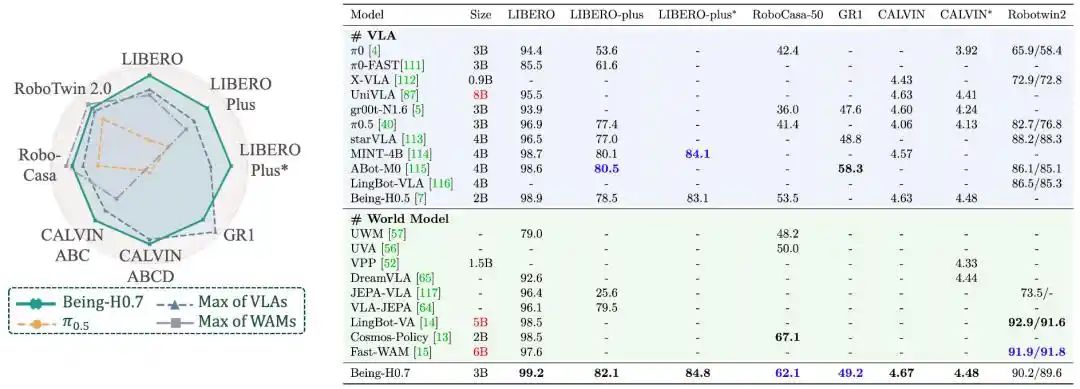
Being-M0.7 is the latest result of this implicit world-action model path.

If the Being-H series answers how hands manipulate the world, Being-M0.7 answers how the entire body coordinates locomotion and task execution in the world. Humanoid robot mobile manipulation (loco-manipulation) requires the model to simultaneously decide where to go, how to orient the body, how to coordinate arms and legs, and how to maintain posture stability. This is a problem highly coupled in both the temporal and body dimensions, and a critical hurdle that general-purpose humanoid robots must overcome.
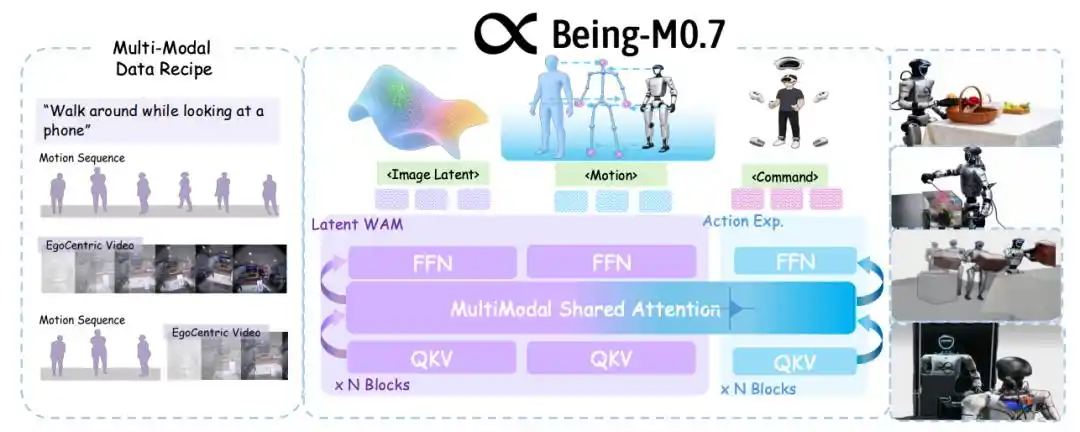
Being-M0.7 is an implicit world-action model. It is first pre-trained on first-person video and human motion data using a Mixture of Transformers (MoT) architecture; then, through action expert post-training, it is adapted for control on robot trajectory data from diverse whole-body manipulation tasks.

Unlike many world models relying on pixel-level video generation, Being-M0.7 predicts future environmental states in a latent space and couples them with a compact whole-body motion representation. Pixel-level prediction is computationally expensive, with much computational power wasted on appearance details weakly related to control. Severe self-motion and viewpoint jitter in the first-person perspective further fill predictions with noise. Latent space prediction focuses modeling capacity on semantic states, object layout, and scene evolution—structural elements truly relevant to control—retaining the essence of a world model anticipating the future while significantly reducing computational overhead.

How Does Physical Understanding Translate into Whole-Body Action?

Whether the model truly possesses whole-body mobile manipulation capabilities ultimately must be tested in real-world scenarios.

Zhi Zai Wu Jie released four real-world demos centered around Being-M0.7, covering four highly challenging scenarios: liquid interaction, mirror reasoning, long-horizon tasks, and obstacle avoidance with occlusion.

These tasks collectively examine one question: Can the robot, based on predictions of the environment and its future changes, continuously generate whole-body actions appropriate to the current scene?.

Fishing in a Fish Tank

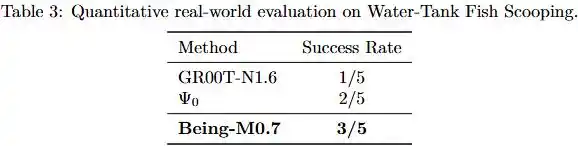
The robot walks to an aquarium and uses a handheld net to scoop a toy fish from the water. Liquids have no fixed shape, flow, exert buoyancy and drag on immersed objects, and water surface refraction causes the visual position of underwater targets to shift. The robot must understand the interaction between water, net, and fish, coordinating its arm to complete a tool-based capture of a dynamic target while visual information is distorted by the water. This task precisely tests future state prediction, tool use, and motion coordination under uncertain object dynamics.

For the fish-scooping segment of the task, Being-M0.7 succeeded in 3 out of 5 tests. In comparison,

was 2/5, while GR00T-N1.6 was 1/5.
Mirror Object Retrieval

A box sits in front of the robot, open only on the back and sides. The item inside is completely invisible from the robot's own perspective; the only clue is the reflection in a mirror ahead. The robot needs to infer the hidden object's position in real 3D space based on the mirrored view, then approach the box and reach in to grab it. This requires the model to understand the spatial relationships and principles of mirror reflection among the mirror, box, and object, converting indirect visual evidence into executable actions under partially observable conditions.

In real-world comparative tests with

and GR00T-N1.6, under two distance settings of 0.5 meters and 1 meter, Being-M0.7 succeeded in 3 out of 5 and 1 out of 5 tests respectively, overall 4/10;

and GR00T both achieved an overall score of 1/10.
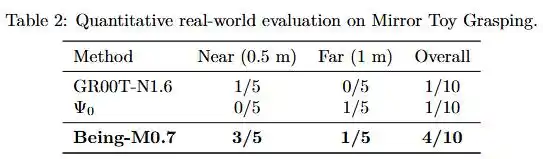
This result indicates that Being-M0.7 demonstrates stronger adaptability in partially observable tasks requiring indirect visual reasoning, whole-body approach, and fine grasping.

Mobile Object Transfer and Retrieval

The robot walks to a table, transfers a baguette from one basket to another, then picks up a bouquet from a basket and turns to leave. The task consists of multiple sub-tasks strung together. The robot needs to continuously switch between walking, grasping, transferring, turning, etc., while maintaining an ongoing understanding of the scene throughout. It tests not just single-grasp success rate, but also state maintenance in long-horizon tasks, object-level spatial reasoning, and whole-body synergy between locomotion and dexterous manipulation.

Box Carrying with Obstacle Avoidance

The robot walks forward carrying a box. When an obstacle appears ahead, it doesn't completely stop to re-plan, but adjusts its body orientation to sidestep through the narrow space between obstacles. Carrying the object partially occludes the first-person view and also alters the robot's load and center of gravity. The model needs to combine prior environmental information with real-time feedback to judge passable areas, adjust walking direction and whole-body posture, while maintaining its own balance and the stability of the carried object. Multi-directional movement, obstacle avoidance, and load-aware manipulation are unified into one closed-loop behavior here.

These demonstrations illustrate that the robot does not execute according to a fixed, open-loop trajectory, but rather continuously generates and corrects whole-body actions by combining current observations, real-time feedback, and predictions of the future.

MoT Architecture and Unified Motion Representation: Solving the Embodiment Data Scarcity Challenge

Supporting the above capabilities is a set of key designs in data and architecture for Being-M0.7.

Humanoid robots need to perform spatial perception via first-person visual information and also output future motion and control commands. High-quality human motion data typically requires motion capture equipment, while first-person paired data where vision and motion are strictly aligned is even scarcer.

If a model can only use data containing both vision and motion, the scale of trainable data would be severely limited. The problem Being-M0.7 solves is precisely how to let paired data, pure video data, and pure motion data all participate in training.

Zhi Zai Wu Jie's choice is the Vision-Motion MoT (Mixture-of-Transformers) architecture. Vision-Motion MoT retains separate modality-specific projection and processing modules for vision and motion, while enabling cross-modal interaction through shared multimodal attention. Visual state changes and continuous motion have different data distributions and need not be forced into identical parameter systems; when both modalities are present, they can exchange information within a shared context.

This allows the model to simultaneously handle three types of data.

For video-motion paired data, the model jointly learns future environmental states and motion trajectories; for pure video data, only the visual branch's training objective is computed; for pure motion data, only the motion branch is trained. Data from different sources jointly constrain the model through the same training objective, without needing to train multiple isolated single-modal systems separately.

From a probabilistic modeling perspective, paired data characterizes the joint relationship between vision and motion, while single-modal data provides marginal constraints for this joint distribution. Even data with incomplete modalities can be incorporated into the same training framework.
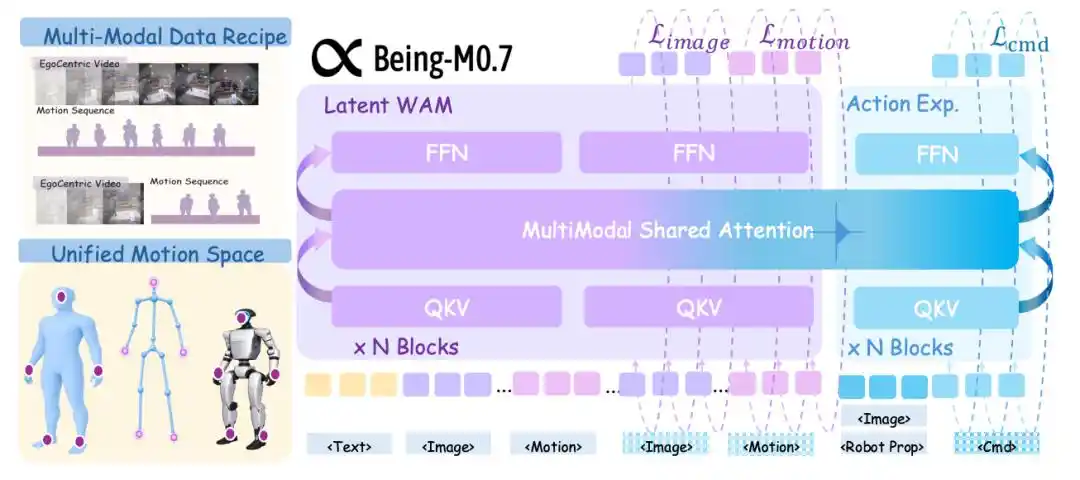
Overview of the Being-M0.7 training framework. Top Left: Pre-training data consists of video-motion paired data, pure video data, and pure motion data. Bottom Left: The research team constructed a unified motion representation shared between humans and humanoid robots, providing richer supervision signals and feedback for training and inference. Right: The overall model architecture of Being-M0.7.

Based on this architecture, the team built a mixed-modal pre-training dataset exceeding 10,000 hours, covering human first-person videos, first-person video-motion paired data, and pure human motion sequences.
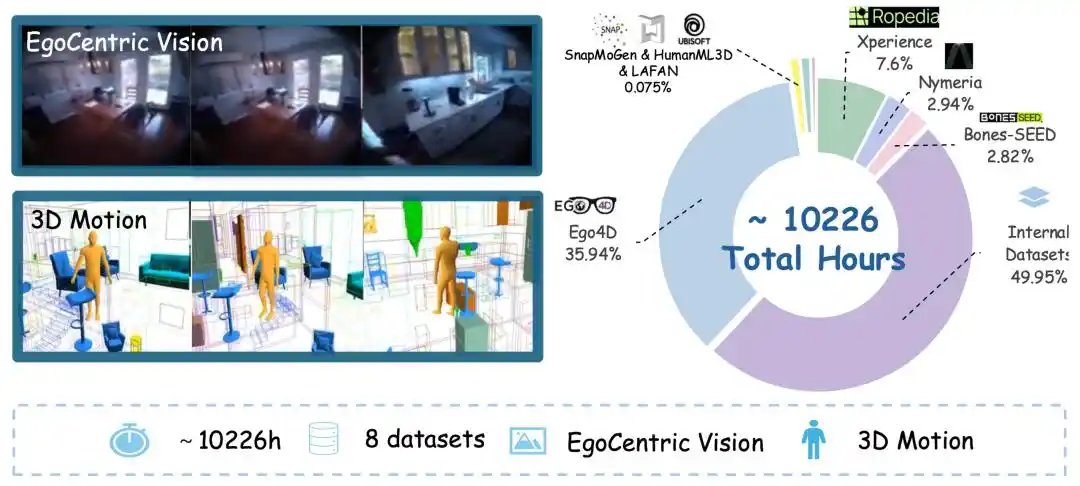
Being-M0.7's Data Recipe. The pre-training corpus is sourced from multiple external public datasets, including Ego4D, Xperience, Nymeria, Bones-SEED, SnapMoGen, HumanML3D, and Lafan1; it also includes internal datasets.

Another key design is the unified motion representation shared between humans and humanoid robots.

Being-M0.7 proposes a unified action representation that transforms human motion data from different sources into a unified representation with the head as the root node, naturally aligning it with first-person vision. Through standardization processes like unifying coordinate systems and removing initial orientation, it reduces distribution differences between datasets and improves cross-source consistency.

Furthermore, Being-M0.7 employs a compact motion representation that retains only the head, both hands, and both feet. While preserving key interaction and contact information, it effectively bridges the morphological gap between humans and robots. This representation not only provides richer supervision signals than action labels for robot post-training but also offers motion-level feedback during inference, supporting whole-body coordinated control.

During pre-training, the model maps images to latent space via a visual encoder and uses the compact unified motion representation. The model is trained with a Flow Matching objective to jointly predict future state changes and motion trajectories based on a short segment of visual-motion history and task instructions.

For real-world robot data collection, the team set up a whole-body teleoperation system based on PICO VR. An operator wears a PICO headset, two ankle trackers, and two handheld controllers. The VR system estimates the human pose in real-time, which is then converted into executable 29-degree-of-freedom whole-body control commands for the Unitree G1 via a whole-body motion controller. While the robot executes actions via teleoperation, it simultaneously records onboard RGB camera first-person view images, proprioception, and motion control commands. This serves as the post-training fine-tuning data for Being-M0.7 on specific tasks.
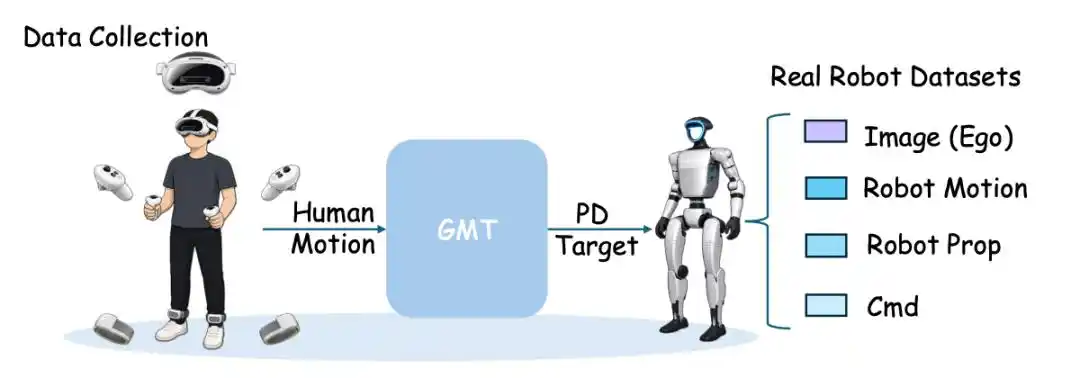
Being-M0.7 real-world robot data collection system. The operator provides whole-body motion commands via VR devices; the system converts human poses into robot control commands and synchronously collects first-person images, proprioception, and motion trajectories.

Since the model has already established visual-motion priors during pre-training, the real-world robot data no longer needs to teach all motion patterns from scratch; it primarily serves two purposes: first, to ground the pre-trained priors into the specific control space of the humanoid robot; second, to learn the low-level control commands and feedback mechanisms required by the real robot. This process is handled by a lightweight Action Expert. The Action Expert reads the intermediate hidden states of the Latent WAM as high-level planning context, then combines them with current visual observations, proprioceptive information, and execution progress to generate action chunks directly executable by the robot.

During inference, the model generates future video-motion plans at a low frequency and converts their intermediate hidden states into reusable policy caches (KV Cache). The unified motion representation not only fuses visual and proprioceptive feedback but also uses the robot's latest motion state to correct the predicted whole-body motion plan, enabling the policy to promptly respond to deviations in body and end-effector motion. The Action Expert then reuses the current KV Cache to continuously generate actions at a high frequency, seamlessly incorporating the latest robot feedback when the cache refreshes. This design decouples low-frequency world planning from high-frequency action control, ensuring real-time performance while keeping the robot consistently guided by both long-term planning and real-time feedback.

A Scalable Fusion Paradigm, Towards More General Embodied Intelligence

The significance of the Vision-Motion MoT architecture extends beyond solving the training problem for Being-M0.7 alone; it establishes a sustainable, extensible multimodal fusion paradigm.

The most direct change from this paradigm occurs at the data level.

Over 10,000 hours of mixed-modal data expand the sources of supervision signals available for training humanoid robot models from expensive, scarce real-world robot demonstrations to vast human behavioral data. Loosening the data bottleneck is a prerequisite for any Scaling Law to hold.

Simultaneously, Being-M0.7 also adjusts the sequence of model learning.

Before being adapted into robot-executable commands, the model first learns visual context, future dynamics, and humanoid kinematic structure from large-scale human-centric data. Subsequently, the Action Expert translates these predictions and motion priors into control commands for the specific robot. In other words, the model first builds the capability to predict future states and body motion, then learns how to act on a specific embodiment. This constitutes a key difference between it and traditional imitation learning schemes that learn action mappings directly from robot demonstrations. The latter often start from "see something, output some action," while Being-M0.7 inserts a layer of joint modeling of future state-motion before action generation.

Moreover, this architecture does not require all newly added data to have complete vision-motion pairing. After cleaning and processing, standalone human video and motion sequences can all be incorporated into the same model. As data scale expands further, this fusion paradigm has the potential to continuously extend the capability frontier.

Placed within the industry's coordinate system, the release of Being-M0.7 perhaps signifies a shift in the competitive logic of humanoid robots.

In recent years, industry attention has focused more on whose robot body is more agile and whose motion demos are more spectacular. As hardware performance continues to improve, whether models can understand scenes, predict changes, and generate coordinated whole-body actions, and whether there exists a scalable data system behind them, will increasingly become the key differentiator.

The development of large language models has already proven that scalable data and a training flywheel often determine how far a technical path can ultimately go. Embodied intelligence stands at a similar critical point: real-world robot data cannot grow rapidly like internet corpora; where else can robots obtain the experience needed for continuous evolution?

From Being-H to Being-M, Zhi Zai Wu Jie's judgment is to let robots first learn about the world from human behavior, then translate this knowledge into actions in the real physical world.

When understanding becomes the prerequisite for action, general-purpose humanoid robots truly step out of the lab narrative and begin their journey towards the physical world of myriad industries.

This article comes from the WeChat public account "Machine Heart" (ID: almosthuman2014), author: Yang Wen


Трендові криптовалюти

Пов'язані питання

QWhat is the core technological innovation of Being-M0.7 as presented in the article?

ABeing-M0.7 is presented as the world's first Latent World-Action Model for humanoid robot whole-body mobile manipulation. Its core innovation lies in predicting future environment states in a latent space and coupling them with compact whole-body motion representations, moving away from computationally expensive pixel-level video prediction. This allows the model to focus on semantically relevant structures for control.

QHow does the Being-M0.7 model address the challenge of scarce robot demonstration data for training?

ABeing-M0.7 addresses data scarcity by being pre-trained on over 10,000 hours of human-centric, mixed-modality data (including paired video-motion, pure video, and pure motion data) using a Vision-Motion Mixture of Transformers architecture. This allows it to learn world dynamics from human experience. It then adapts to a specific robot body using a smaller amount of real robot demonstration data via a lightweight Action Expert module.

QAccording to the article, what are the key advantages of using a latent world model over a pixel-level predictive model for humanoid robots?

AThe key advantages are reduced computational overhead and improved robustness. Pixel-level prediction consumes significant capacity on visual details less relevant to control, and the rapid self-motion and viewpoint jitter of humanoid robots amplify visual prediction noise. Latent space prediction focuses modeling power on semantic states, object layouts, and scene evolution, which are more directly related to control decisions.

QWhat specific capabilities did the real-world robot demos (like "Fish Tank Fishing" and "Mirror Fetch") aim to demonstrate?

AThe demos aimed to demonstrate the model's ability to perform complex whole-body mobile manipulation based on its understanding and prediction of the environment. Specifically: "Fish Tank Fishing" tested future state prediction, tool use, and action coordination under the uncertain dynamics of liquid objects. "Mirror Fetch" tested indirect visual reasoning, spatial understanding of reflections, and precise whole-body approach and grasping in partially observable conditions.

QWhat is the strategic significance of Zhizai Wujie's technological route from Being-H to Being-M, as described in the article?

AThe strategic significance is establishing a scalable path for embodied intelligence by leveraging vast, scalable human behavior data instead of waiting for scarce, expensive robot data to accumulate. The route posits that robots should first learn about the world's operation and body coordination from human experience (pre-training), and then transfer this knowledge to specific robot bodies (adaptation). This approach is seen as key to overcoming data bottlenecks and achieving more general-purpose humanoid robots.

Пов'язані матеріали

Robinhood Chain Launchpad Chaos: NOXA Shuts Down, Uniswap CCA Steps In?

Robinhood Chain, a blockchain focused on tokenized stocks, has seen unexpected early success driven by meme coin speculation. Two weeks after launch, its weekly DEX volume surpassed $3.1 billion, briefly exceeding Solana in daily meme trading. This frenzy centered on launchpads, tools allowing easy meme token creation. The leading platform, NOXA, generated massive fees ($7.66M in a week) and launched the chain's top meme, CASHCAT. However, on July 11, NOXA abruptly suspended new token launches, citing spam, copycat tokens, and infrastructure strain. It pivoted to a history-only interface, redistributing fees to creators. This move sparked "soft rug pull" fears and caused its launched tokens to drop sharply. NOXA's exit left a leadership vacuum among Robinhood's launchpads. Meanwhile, Uniswap officially launched its Continuous Clearing Auctions (CCA) mechanism on the chain. CCA uses a gradual, block-by-block auction to set a fair initial price and automatically creates a locked liquidity pool. Early CCA-launched memes like UNICORN and TRASH have seen high volatility. The situation highlights the trade-offs: CCA reduces front-running risk but may be less suited for fast-paced meme trading, while instant-launch platforms carry higher sniper risk. For Robinhood Chain, the meme-driven activity has successfully bootstrapped initial usage, testing its "meme-first, RWA-later" strategy as it aims to eventually host tokenized real-world assets.

Foresight News46 хв тому

Robinhood Chain Launchpad Chaos: NOXA Shuts Down, Uniswap CCA Steps In?

Foresight News46 хв тому

Торгівля

Спот

Популярні статті

Що таке $S$

Розуміння SPERO: Комплексний огляд Вступ до SPERO Оскільки ландшафт інновацій продовжує еволюціонувати, виникнення технологій web3 та криптовалютних проектів відіграє ключову роль у формуванні цифрового майбутнього. Один з проектів, який привернув увагу в цій динамічній сфері, — це SPERO, позначений як SPERO,$$s$. Ця стаття має на меті зібрати та представити детальну інформацію про SPERO, щоб допомогти ентузіастам та інвесторам зрозуміти його основи, цілі та інновації в рамках web3 та крипто-сектору. Що таке SPERO,$$s$? SPERO,$$s$ — це унікальний проект у криптопросторі, який прагне використати принципи децентралізації та технології блокчейн для створення екосистеми, що сприяє залученню, корисності та фінансовій інклюзії. Проект розроблений для полегшення взаємодії між користувачами новими способами, надаючи їм інноваційні фінансові рішення та послуги. У своїй основі SPERO,$$s$ прагне надати можливості індивідам, забезпечуючи інструменти та платформи, які покращують користувацький досвід у криптовалютному просторі. Це включає в себе можливість більш гнучких методів транзакцій, сприяння ініціативам, що підтримуються спільнотою, та створення шляхів для фінансових можливостей через децентралізовані додатки (dApps). Основна концепція SPERO,$$s$ обертається навколо інклюзивності, прагнучи зменшити розриви в традиційній фінансовій системі, використовуючи переваги технології блокчейн. Хто є творцем SPERO,$$s$? Особистість творця SPERO,$$s$ залишається дещо невідомою, оскільки є обмежені публічно доступні ресурси, що надають детальну інформацію про його засновників. Ця відсутність прозорості може бути наслідком зобов'язання проекту до децентралізації — етики, яку багато проектів web3 поділяють, ставлячи колективні внески вище за індивідуальне визнання. Зосереджуючи обговорення навколо спільноти та її колективних цілей, SPERO,$$s$ втілює суть наділення без виділення конкретних осіб. Таким чином, розуміння етики та місії SPERO є більш важливим, ніж ідентифікація єдиного творця. Хто є інвесторами SPERO,$$s$? SPERO,$$s$ підтримується різноманітними інвесторами, починаючи від венчурних капіталістів до ангельських інвесторів, які прагнуть сприяти інноваціям у крипто-секторі. Зосередження цих інвесторів зазвичай узгоджується з місією SPERO — пріоритет надається проектам, які обіцяють технологічний прогрес у суспільстві, фінансову інклюзію та децентралізоване управління. Ці інвесторські фонди зазвичай зацікавлені в проектах, які не лише пропонують інноваційні продукти, але й позитивно впливають на спільноту блокчейн та її екосистеми. Підтримка з боку цих інвесторів підкріплює SPERO,$$s$ як значного конкурента в швидко змінюваній сфері крипто-проектів. Як працює SPERO,$$s$? SPERO,$$s$ використовує багатогранну структуру, яка відрізняє його від традиційних криптовалютних проектів. Ось деякі ключові особливості, які підкреслюють його унікальність та інноваційність: Децентралізоване управління: SPERO,$$s$ інтегрує моделі децентралізованого управління, надаючи користувачам можливість активно брати участь у процесах прийняття рішень щодо майбутнього проекту. Цей підхід сприяє відчуттю власності та відповідальності серед членів спільноти. Корисність токена: SPERO,$$s$ використовує свій власний криптовалютний токен, розроблений для виконання різних функцій в екосистемі. Ці токени дозволяють здійснювати транзакції, отримувати винагороди та полегшувати послуги, що пропонуються на платформі, підвищуючи загальну залученість та корисність. Шарова архітектура: Технічна архітектура SPERO,$$s$ підтримує модульність та масштабованість, що дозволяє безперешкодно інтегрувати додаткові функції та додатки в міру розвитку проекту. Ця адаптивність є надзвичайно важливою для збереження актуальності в постійно змінюваному крипто-ландшафті. Залучення спільноти: Проект підкреслює ініціативи, що підтримуються спільнотою, використовуючи механізми, які стимулюють співпрацю та зворотний зв'язок. Підтримуючи сильну спільноту, SPERO,$$s$ може краще задовольняти потреби користувачів та адаптуватися до ринкових тенденцій. Фокус на інклюзію: Пропонуючи низькі комісії за транзакції та зручні інтерфейси, SPERO,$$s$ прагне залучити різноманітну базу користувачів, включаючи осіб, які раніше не брали участі в крипто-просторі. Це зобов'язання до інклюзії узгоджується з його загальною місією наділення через доступність. Хронологія SPERO,$$s$ Розуміння історії проекту надає важливі уявлення про його розвиток та етапи. Нижче наведено пропоновану хронологію, що відображає значні події в еволюції SPERO,$$s$: Етап концептуалізації та ідеації: Початкові ідеї, що стали основою SPERO,$$s$, були сформовані, тісно пов'язані з принципами децентралізації та фокусом на спільноті в індустрії блокчейн. Запуск білого паперу проекту: Після концептуального етапу був випущений комплексний білий папір, що детально описує бачення, цілі та технологічну інфраструктуру SPERO,$$s$, щоб залучити інтерес та зворотний зв'язок від спільноти. Створення спільноти та ранні залучення: Активні зусилля були спрямовані на створення спільноти ранніх прихильників та потенційних інвесторів, що полегшило обговорення цілей проекту та отримання підтримки. Подія генерації токенів: SPERO,$$s$ провів подію генерації токенів (TGE) для розподілу своїх рідних токенів серед ранніх прихильників та встановлення початкової ліквідності в екосистемі. Запуск початкового dApp: Перший децентралізований додаток (dApp), пов'язаний з SPERO,$$s$, став доступним, дозволяючи користувачам взаємодіяти з основними функціями платформи. Постійний розвиток та партнерства: Безперервні оновлення та вдосконалення пропозицій проекту, включаючи стратегічні партнерства з іншими учасниками блокчейн-простору, сформували SPERO,$$s$ у конкурентоспроможного та еволюціонуючого гравця на крипто-ринку. Висновок SPERO,$$s$ є свідченням потенціалу web3 та криптовалют для революціонізації фінансових систем та наділення індивідів. Завдяки зобов'язанню до децентралізованого управління, залучення спільноти та інноваційно спроектованих функцій, він прокладає шлях до більш інклюзивного фінансового ландшафту. Як і з будь-якими інвестиціями в швидко змінюваному крипто-просторі, потенційним інвесторам та користувачам рекомендується ретельно досліджувати та обдумано взаємодіяти з поточними подіями в SPERO,$$s$. Проект демонструє інноваційний дух крипто-індустрії, запрошуючи до подальшого дослідження його численних можливостей. Хоча подорож SPERO,$$s$ ще триває, його основні принципи можуть справді вплинути на майбутнє того, як ми взаємодіємо з технологією, фінансами та один з одним у взаємопов'язаних цифрових екосистемах.

129 переглядів усьогоОпубліковано 2024.12.17Оновлено 2024.12.17

Що таке $S$

Що таке AGENT S

Агент S: Майбутнє автономної взаємодії в Web3 Вступ У постійно змінюваному ландшафті Web3 та криптовалюти інновації постійно переосмислюють, як люди взаємодіють з цифровими платформами. Один з таких новаторських проектів, Агент S, обіцяє революціонізувати взаємодію людини з комп'ютером через свою відкриту агентну структуру. Прокладаючи шлях для автономних взаємодій, Агент S прагне спростити складні завдання, пропонуючи трансформаційні застосування в штучному інтелекті (ШІ). Це детальне дослідження заглиблюється в складності проекту, його унікальні особливості та наслідки для сфери криптовалюти. Що таке Агент S? Агент S є революційною відкритою агентною структурою, спеціально розробленою для вирішення трьох основних викликів в автоматизації комп'ютерних завдань: Набуття специфічних знань у галузі: Структура інтелектуально навчається з різних зовнішніх джерел знань та внутрішнього досвіду. Цей подвійний підхід дозволяє їй створити багатий репозиторій специфічних знань у галузі, покращуючи її продуктивність у виконанні завдань. Планування на довгих горизонтах завдань: Агент S використовує планування з підкріпленням досвіду, стратегічний підхід, який полегшує ефективний розподіл та виконання складних завдань. Ця функція значно підвищує її здатність ефективно та результативно управляти кількома підзавданнями. Обробка динамічних, неоднорідних інтерфейсів: Проект представляє Інтерфейс Агент-Комп'ютер (ACI), інноваційне рішення, яке покращує взаємодію між агентами та користувачами. Використовуючи багатомодальні великі мовні моделі (MLLMs), Агент S може безперешкодно орієнтуватися та маніпулювати різноманітними графічними інтерфейсами користувача. Завдяки цим новаторським функціям Агент S надає надійну структуру, яка вирішує складнощі, пов'язані з автоматизацією людської взаємодії з машинами, прокладаючи шлях для численних застосувань у ШІ та за його межами. Хто є творцем Агент S? Хоча концепція Агент S є фундаментально новаторською, конкретна інформація про його творця залишається невідомою. Творець наразі невідомий, що підкреслює або початкову стадію проекту, або стратегічний вибір зберегти засновників у таємниці. Незважаючи на анонімність, акцент залишається на можливостях та потенціалі структури. Хто є інвесторами Агент S? Оскільки Агент S є відносно новим у криптографічній екосистемі, детальна інформація про його інвесторів та фінансових спонсорів не задокументована. Відсутність публічно доступних відомостей про інвестиційні фонди або організації, що підтримують проект, викликає питання щодо його фінансової структури та дорожньої карти розвитку. Розуміння підтримки є критично важливим для оцінки стійкості проекту та потенційного впливу на ринок. Як працює Агент S? В основі Агент S лежить передова технологія, яка дозволяє йому ефективно функціонувати в різних умовах. Його операційна модель побудована навколо кількох ключових функцій: Взаємодія з комп'ютером, подібна до людської: Структура пропонує розширене планування ШІ, прагнучи зробити взаємодії з комп'ютерами більш інтуїтивними. Імітуючи людську поведінку при виконанні завдань, вона обіцяє підвищити досвід користувачів. Наративна пам'ять: Використовується для використання високорівневого досвіду, Агент S використовує наративну пам'ять для відстеження історій завдань, тим самим покращуючи свої процеси прийняття рішень. Епізодична пам'ять: Ця функція надає користувачам покрокові інструкції, дозволяючи структурі пропонувати контекстуальну підтримку в міру виконання завдань. Підтримка OpenACI: Завдяки можливості працювати локально, Агент S дозволяє користувачам зберігати контроль над своїми взаємодіями та робочими процесами, узгоджуючи з децентралізованою етикою Web3. Легка інтеграція з зовнішніми API: Його універсальність і сумісність з різними платформами ШІ забезпечують те, що Агент S може безперешкодно вписатися в існуючі технологічні екосистеми, роблячи його привабливим вибором для розробників та організацій. Ці функціональні можливості колективно сприяють унікальному положенню Агент S у крипто-просторі, оскільки він автоматизує складні, багатоступеневі завдання з мінімальним втручанням людини. У міру розвитку проекту його потенційні застосування в Web3 можуть переосмислити, як відбуваються цифрові взаємодії. Хронологія Агент S Розробка та етапи Агент S можуть бути узагальнені в хронології, яка підкреслює його значні події: 27 вересня 2024 року: Концепція Агент S була представлена в комплексній науковій статті під назвою “Відкрита агентна структура, яка використовує комп'ютери як людина”, що демонструє основи проекту. 10 жовтня 2024 року: Наукова стаття була опублікована на arXiv, пропонуючи детальне дослідження структури та її оцінки продуктивності на основі бенчмарку OSWorld. 12 жовтня 2024 року: Було випущено відеопрезентацію, що надає візуальне уявлення про можливості та особливості Агент S, ще більше залучаючи потенційних користувачів та інвесторів. Ці маркери в хронології не лише ілюструють прогрес Агент S, але й вказують на його прихильність до прозорості та залучення громади. Ключові моменти про Агент S У міру розвитку структури Агент S кілька ключових характеристик виділяються, підкреслюючи її новаторський характер та потенціал: Інноваційна структура: Розроблена для забезпечення інтуїтивного використання комп'ютерів, подібного до людської взаємодії, Агент S пропонує новий підхід до автоматизації завдань. Автономна взаємодія: Здатність автономно взаємодіяти з комп'ютерами через GUI означає стрибок до більш інтелектуальних та ефективних обчислювальних рішень. Автоматизація складних завдань: Завдяки своїй надійній методології він може автоматизувати складні, багатоступеневі завдання, роблячи процеси швидшими та менш схильними до помилок. Безперервне вдосконалення: Механізми навчання дозволяють Агенту S покращуватися на основі минулого досвіду, постійно підвищуючи свою продуктивність та ефективність. Універсальність: Його адаптивність до різних операційних середовищ, таких як OSWorld та WindowsAgentArena, забезпечує його здатність служити широкому спектру застосувань. Оскільки Агент S займає своє місце в ландшафті Web3 та криптовалюти, його потенціал покращити можливості взаємодії та автоматизувати процеси означає значний прогрес у технологіях ШІ. Завдяки своїй інноваційній структурі Агент S є прикладом майбутнього цифрових взаємодій, обіцяючи більш безперешкодний та ефективний досвід для користувачів у різних галузях. Висновок Агент S представляє собою сміливий крок вперед у поєднанні ШІ та Web3, з можливістю переосмислити, як ми взаємодіємо з технологією. Хоча проект все ще на ранніх стадіях, можливості для його застосування є величезними та переконливими. Завдяки своїй комплексній структурі, що вирішує критичні виклики, Агент S прагне вивести автономні взаємодії на передній план цифрового досвіду. У міру того, як ми заглиблюємося в сфери криптовалюти та децентралізації, проекти, подібні до Агент S, безсумнівно, відіграватимуть ключову роль у формуванні майбутнього технологій та співпраці людини з комп'ютером.

752 переглядів усьогоОпубліковано 2025.01.14Оновлено 2025.01.14

Що таке AGENT S

Як купити S

Ласкаво просимо до HTX.com! Ми зробили покупку Sonic (S) простою та зручною. Дотримуйтесь нашої покрокової інструкції, щоб розпочати свою криптовалютну подорож.Крок 1: Створіть обліковий запис на HTXВикористовуйте свою електронну пошту або номер телефону, щоб зареєструвати обліковий запис на HTX безплатно. Пройдіть безпроблемну реєстрацію й отримайте доступ до всіх функцій.ЗареєструватисьКрок 2: Перейдіть до розділу Купити крипту і виберіть спосіб оплатиКредитна/дебетова картка: використовуйте вашу картку Visa або Mastercard, щоб миттєво купити Sonic (S).Баланс: використовуйте кошти з балансу вашого рахунку HTX для безперешкодної торгівлі.Треті особи: ми додали популярні способи оплати, такі як Google Pay та Apple Pay, щоб підвищити зручність.P2P: Торгуйте безпосередньо з іншими користувачами на HTX.Позабіржова торгівля (OTC): ми пропонуємо індивідуальні послуги та конкурентні обмінні курси для трейдерів.Крок 3: Зберігайте свої Sonic (S)Після придбання Sonic (S) збережіть його у своєму обліковому записі на HTX. Крім того, ви можете відправити його в інше місце за допомогою блокчейн-переказу або використовувати його для торгівлі іншими криптовалютами.Крок 4: Торгівля Sonic (S)Легко торгуйте Sonic (S) на спотовому ринку HTX. Просто увійдіть до свого облікового запису, виберіть торгову пару, укладайте угоди та спостерігайте за ними в режимі реального часу. Ми пропонуємо зручний досвід як для початківців, так і для досвідчених трейдерів.

1.6k переглядів усьогоОпубліковано 2025.01.15Оновлено 2026.06.02

Як купити S

Обговорення

Ласкаво просимо до спільноти HTX. Тут ви можете бути в курсі останніх подій розвитку платформи та отримати доступ до професійної ринкової інформації. Нижче представлені думки користувачів щодо ціни S (S).

活动图片