0.7nm Process Chip Emerges, Moore's Law Lives On

marsbitОпубліковано о 2026-06-26Востаннє оновлено о 2026-06-26

Анотація

IBM has unveiled the world's first sub-1-nanometer (0.7nm) chip technology, integrating nearly 100 billion transistors into an area the size of a fingernail. This breakthrough doubles the transistor density of current 2nm chips and promises a 50% performance gain or a 70% improvement in power efficiency. The achievement is powered by IBM's "NanoStack" architecture, a pioneering 3D design featuring vertically stacked nanosheet transistors. This evolution from FinFET and Gate-All-Around (GAA) technologies offers superior electrostatic control. IBM has demonstrated the technology's viability with functional CMOS inverters and a 40% area reduction in SRAM, crucial for AI chip data bandwidth. Addressing the critical power consumption challenges in AI computing, this advancement extends the roadmap for chip miniaturization. While IBM does not manufacture chips itself, it licenses its process technology to partners. The company projects that NanoStack-based chips could enter production within the next five years, potentially sustaining Moore's Law for another decade.

Is Moore's Law saved?

IBM unveiled the world's first 0.7 nanometer chip process node, integrating nearly 100 billion transistors on a chip the size of a fingernail, achieving a density double that of 2nm chips.

Previously, TSMC's most advanced process was 2nm, which had been difficult to advance beyond for years.

NVIDIA CEO Jensen Huang had repeatedly declared Moore's Law dead, but now there is finally a turning point.
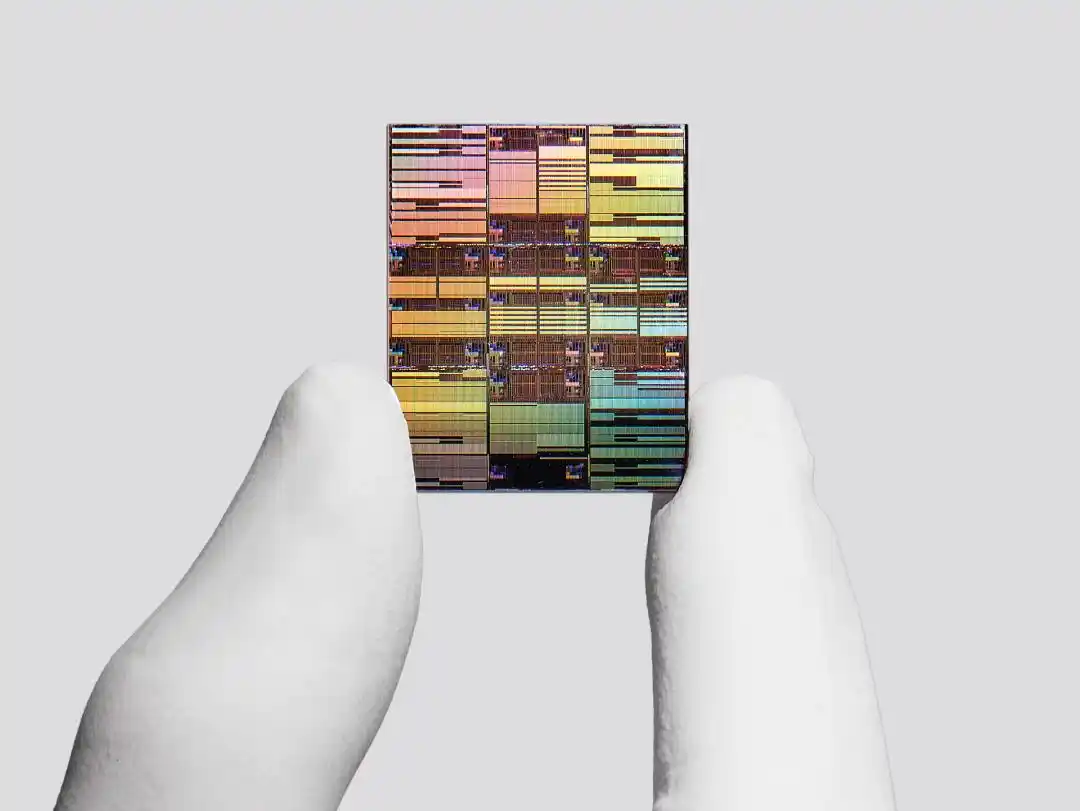
0.7 nanometers, or 7 angstroms, marks the first time human-made transistors have broken through the 1 nanometer threshold, approaching the scale of individual atoms (0.1-0.5 nanometers).

Compared to the 2nm process, it can deliver either a 50% performance improvement or a 70% increase in power efficiency; one or the other.

NanoStack Architecture Arrives

The core of this breakthrough is IBM's "NanoStack" architecture, the industry's first 3D vertically stacked transistor design based on nanosheets.

To understand NanoStack, one must first review the path chip architecture has taken in recent years.

In the 7nm and 10nm era, the mainstream solution was FinFET (Fin Field-Effect Transistor) with the gate wrapping around the channel on three sides to control current. Below 5nm, FinFET's leakage issues became increasingly severe and unsustainable.

In 2017, IBM introduced the Gate-All-Around (GAA) nanosheet technology, where the gate completely surrounds the horizontally stacked nanosheet channel on all four sides, significantly enhancing electrostatic control. This became the technical foundation for its 2nm chip and was subsequently adopted by mainstream manufacturers like TSMC and Samsung.

At the end of 2021, IBM and Samsung jointly announced the VTFET (Vertical-Transport Field-Effect Transistor), which changed the current flow direction from horizontal to vertical. Simulation data showed it could either double performance or reduce power consumption by 85% compared to a similarly sized FinFET solution.

This NanoStack is a further extension of the above roadmap.

Its method is:

Take two wafers with nanosheet transistors, invert one and place it on top of the other, bonding them via an ultrathin dielectric bonding layer to form a vertically interconnected 3D structure. Each layer can use different material combinations, allowing n-type and p-type transistors to be independently optimized without interference.
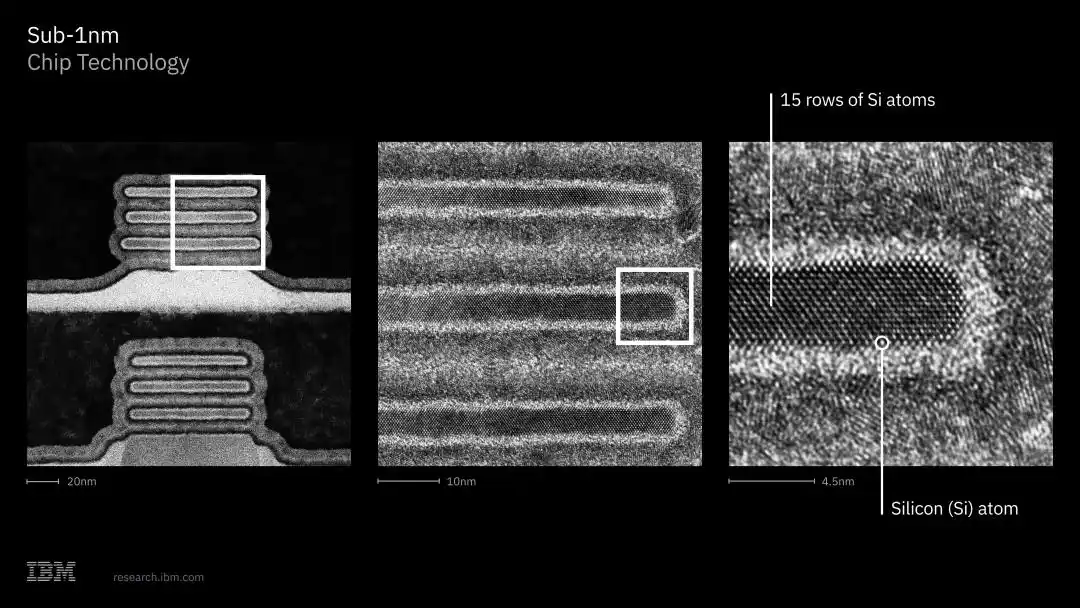
IBM has already completed validation in the lab, demonstrating CMOS integration, dual-channel engineering capabilities, and a fully functional CMOS inverter with switching performance meeting expectations, confirming that this technology can be manufactured and support real computation.

At the VLSI 2026 symposium, IBM further showcased NanoStack's performance on SRAM: a 40% area reduction. SRAM is a core component of on-chip cache, which has long been extremely difficult to scale down. This progress is particularly crucial for the high-bandwidth data pathways required by AI chips.

"Nobody Wants to Pay the Electricity Bill"

Huiming Bu, vice president of chip research at IBM Research, stated: Everyone wants higher performance, but nobody wants to pay the electricity bill.

This is the reality facing the current AI computing power race. The energy consumption of AI chips has evolved from a technical issue to an infrastructure problem, with some data center projects experiencing construction delays due to insufficient power supply.

The 70% power efficiency improvement offered by the 0.7nm technology directly addresses this demand.

However, IBM itself no longer manufactures or sells chips. It develops manufacturing process technologies at its research center in Albany, New York, and then licenses them to chip manufacturers.

Past licensees have included Samsung and the newly formed Japanese semiconductor company Rapidus. Huiming Bu declined to disclose potential customers for the 0.7nm technology.

Regarding competing solutions, the Belgian research institute Imec is advancing another 3D architecture scheme, building transistor structures through layer-by-layer stacking, which has attracted attention from several chip manufacturers.

For mass production, IBM's given timeline is: NanoStack technology could achieve mass production within the next five years at the earliest.

IBM's semiconductor roadmap predicts that with the NanoStack architecture, chip scaling can continue for at least another decade.

References:

[1]https://newsroom.ibm.com/2026-06-25-ibm-debuts-worlds-first-sub-1-nanometer-chip-technology

This article is from the WeChat public account "QbitAI", author: Meng Chen

Трендові криптовалюти

Пов'язані питання

QWhat is the name of the new architecture that enabled IBM's 0.7nm chip breakthrough?

AThe new architecture is called 'NanoStack'. It is the industry's first three-dimensional, vertically stacked transistor design based on nanosheets.

QAccording to the article, what is a key challenge that the improved energy efficiency of the 0.7nm process aims to solve?

AIt aims to address the growing AI compute power consumption, which is evolving from a technical issue into an infrastructure problem. This is because some data center projects face construction delays due to insufficient power supply, and users want higher performance without significantly higher electricity bills.

QHow does IBM's 0.7nm chip compare to a 2nm chip in terms of performance or energy efficiency?

ACompared to a 2nm process, the 0.7nm technology offers a choice: it can provide either a 50% performance improvement or a 70% increase in energy efficiency.

QWhat significant milestone does the 0.7nm (7 Angstrom) transistor represent in semiconductor manufacturing?

AIt represents the first time a human-made transistor has broken the 1-nanometer threshold, bringing its scale close to that of individual atoms (0.1-0.5 nanometers).

QWhat is IBM's estimated timeline for the NanoStack technology to reach mass production?

AIBM's timeline suggests that the NanoStack technology could enter mass production as early as within the next five years.

Пов'язані матеріали

Margin Exhausted, "Brother Huang Li Cheng" Begins Selling Monkeys at a Loss

Taiwanese crypto whale "Machi Big Brother" Jeffrey Huang has been forced to sell his prized Bored Ape Yacht Club (BAYC) NFTs at significant losses to cover mounting losses from a highly leveraged ETH long position on Hyperliquid. Over the past month, Huang sold 34 BAYC NFTs for 326 ETH (approx. $514,000), realizing a loss of 399 ETH (approx. $631,000). The proceeds were transferred to Hyperliquid to replenish margin for his perpetual contract trades. One ape, BAYC #6057, bought for 76.84 ETH four years ago, was sold for just 7.65 ETH, a 90% loss in ETH terms. Huang began his high-leverage (25-40x) ETH long strategy in September 2025 when ETH was around $4,700. While his account once showed over $45 million in unrealized profit, the subsequent crash of ETH to the $1,600 range erased all gains. As of June 26, his cumulative losses on Hyperliquid reached $33.85 million, with over 335 liquidations earning him the community nickname "King of Liquidations." With conventional funds depleted, Huang's once-valuable NFT collection, which at its peak included around 200 BAYCs and was worth tens of millions, has become a lifeline. His remaining ~150 BAYCs, valued at roughly $1.6 million at current floor prices, provide only limited runway for his persistent high-stakes trading. Huang rose to prominence in crypto as a key figure in popularizing BAYC NFTs in Asia during the 2021 bull market. His pivot to perpetual contracts has now led to a cycle where his iconic "monkeys" are being sold to fund a failing trading strategy.

Foresight News36 хв тому

Margin Exhausted, "Brother Huang Li Cheng" Begins Selling Monkeys at a Loss

Foresight News36 хв тому

Quantum Computing Approaches "Q-Day": How Encryption Policy, Investment Logic, and Risk Management Are Reshaping the Landscape

Quantum Computing Nears 'Q-Day': Shaping Encryption Policy, Investment Logic, and Risk Management Quantum technology is increasingly intersecting with cryptocurrency policy and cybersecurity discussions as the potential 'Q-Day'—when quantum computers could break current encryption—approaches. While summer brings fast-paced crypto market dynamics, new U.S. legislation, and AI debates, the emerging dimension is how quantum advancements will reshape the digital asset landscape. The next phase of crypto investment is being shaped by two converging forces: clearer regulatory frameworks and cryptographic evolution driven by quantum computing. Investors stand to benefit from reduced uncertainty, but must also recognize that quantum readiness is becoming a core risk factor. Public blockchains rely on cryptography for security, and sufficiently advanced quantum machines could undermine these foundations. This does not mean imminent network collapse, but investors can no longer dismiss the timeline as irrelevant. Key questions now include whether projects have identified their cryptographic dependencies, formulated migration plans to post-quantum cryptography, and established governance for upgrades. For policymakers, the link is clear. Effective crypto policy must look beyond token classification and disclosure to address the underlying infrastructure. As stablecoins, tokenized assets, and blockchain payments integrate deeper into finance, cryptographic resilience becomes a systemic issue. Failure to prepare could lead to investor losses, operational failures, and legal disputes. Policy should encourage risk disclosure, require major intermediaries to maintain upgrade and response plans, and foster coordination across the ecosystem—rather than impose a single technical fix. The sustainability of cryptocurrencies will increasingly depend on their security infrastructure's ability to adapt to these accelerating technological pressures.

Foresight News1 год тому

Quantum Computing Approaches "Q-Day": How Encryption Policy, Investment Logic, and Risk Management Are Reshaping the Landscape

Foresight News1 год тому

Bitcoin's Five-Wave Adjustment Nears End, Opportunities Emerge in HYPE Support Zone | Invited Analysis

**Bitcoin's Five-Wave Adjustment Nears End, HYPE Support Zone Presents Opportunity | Guest Analysis** This week, Bitcoin (BTC) is in the final stage of a five-wave corrective structure. The formation of 'Endpoint 44' is key: a level above $58,110 suggests a high probability of a technical rebound, leading likely to wide-range consolidation. A break below $58,110 without bullish divergence warrants caution for further downside. Mid-term bearish positions are maintained at 20%, with 30% of capital reserved for short-term scalping opportunities based on predefined support/resistance levels and three scenario-based plans (A/B/C). Simultaneously, HYPE has entered the 55-56 segment of its own five-wave correction from its $76.94 high. If 'Endpoint 56' forms above the prior low (Endpoint 54), creating a double-bottom pattern, a rebound is significantly likely. A light long position (under 30% allocation) can be considered upon stabilization in the support zone. Last week's BTC short-term strategy, guided by proprietary quantitative models, successfully executed two short trades (1x leverage), yielding a total return of approximately 6.21%. The market move validated the prior weekly forecast of a retest towards the $59,100 support. **Core Trading Views Summary:** * **BTC:** Focus on the formation of 'Endpoint 44'. A scenario above $58,110 allows for tentative longs. Key resistances: $60,900-$62,300, ~$65,500, $67,300-$69,500. Key supports: ~$58,100, ~$55,000. * **HYPE:** Monitor the final position of 'Endpoint 56'. Key resistances: ~$65.5, ~$71.5. Key supports: ~$58.5, $52-$54 zone. Strategy favors buying on dips upon stabilization in support areas with confirmed model signals, with strict position control. **Risk Disclaimer:** Financial markets are volatile. All analysis, models, and strategies herein are based on personal technical analysis for journaling purposes only, not investment advice. Trade at your own risk.

Odaily星球日报1 год тому

Bitcoin's Five-Wave Adjustment Nears End, Opportunities Emerge in HYPE Support Zone | Invited Analysis

Odaily星球日报1 год тому

Торгівля

Спот

Популярні статті

Як купити CHIP

Ласкаво просимо до HTX.com! Ми зробили покупку USD.AI (CHIP) простою та зручною. Дотримуйтесь нашої покрокової інструкції, щоб розпочати свою криптовалютну подорож.Крок 1: Створіть обліковий запис на HTXВикористовуйте свою електронну пошту або номер телефону, щоб зареєструвати обліковий запис на HTX безплатно. Пройдіть безпроблемну реєстрацію й отримайте доступ до всіх функцій.ЗареєструватисьКрок 2: Перейдіть до розділу Купити крипту і виберіть спосіб оплатиКредитна/дебетова картка: використовуйте вашу картку Visa або Mastercard, щоб миттєво купити USD.AI (CHIP).Баланс: використовуйте кошти з балансу вашого рахунку HTX для безперешкодної торгівлі.Треті особи: ми додали популярні способи оплати, такі як Google Pay та Apple Pay, щоб підвищити зручність.P2P: Торгуйте безпосередньо з іншими користувачами на HTX.Позабіржова торгівля (OTC): ми пропонуємо індивідуальні послуги та конкурентні обмінні курси для трейдерів.Крок 3: Зберігайте свої USD.AI (CHIP)Після придбання USD.AI (CHIP) збережіть його у своєму обліковому записі на HTX. Крім того, ви можете відправити його в інше місце за допомогою блокчейн-переказу або використовувати його для торгівлі іншими криптовалютами.Крок 4: Торгівля USD.AI (CHIP)Легко торгуйте USD.AI (CHIP) на спотовому ринку HTX. Просто увійдіть до свого облікового запису, виберіть торгову пару, укладайте угоди та спостерігайте за ними в режимі реального часу. Ми пропонуємо зручний досвід як для початківців, так і для досвідчених трейдерів.

398 переглядів усьогоОпубліковано 2026.04.21Оновлено 2026.06.02

Як купити CHIP

Обговорення

Ласкаво просимо до спільноти HTX. Тут ви можете бути в курсі останніх подій розвитку платформи та отримати доступ до професійної ринкової інформації. Нижче представлені думки користувачів щодо ціни CHIP (CHIP).

活动图片