Cardano Closes 264 Million ADA Budget Cycle, IOG Takes Lead

bitcoinistОпубліковано о 2025-08-19Востаннє оновлено о 2025-08-20

Анотація

Cardano’s first full‐cycle ecosystem budget has reached its finish line. On August 19, 2025, Intersect—Cardano’s member-based organization that facilitated the...

Trusted Editorial content, reviewed by leading industry experts and seasoned editors. Ad Disclosure

Cardano’s first full‐cycle ecosystem budget has reached its finish line. On August 19, 2025, Intersect—Cardano’s member-based organization that facilitated the process—announced: “Our ecosystem budget and withdrawal process has now reached its conclusion… DReps have approved ₳264m in ecosystem funding.” In the same statement, Intersect said the pipeline began with 194 proposals submitted through GovTool and the Ekklesia poll, was refined off-chain to 40, and ultimately produced 39 on-chain treasury withdrawals—37 of which cleared the required thresholds.

First Cardano Budget Cycle Closes

Intersect added that “more than 30 vendors have now signed contracts,” with those agreements being published for public review. The live “Intersect Administered Contracts” ledger confirms a growing roster of counterparties and amounts—ranging from the ₳64.3 million “Catalyst 2025” program to infrastructure and tooling efforts such as a ZK bridge and maintenance of key developer libraries. Intersect says additional contracts will be posted in the days ahead “together with the funding of related smart contracts.”

The conclusion caps a months-long governance sequence that combined off-chain deliberation and on-chain ratification. In July, Intersect submitted 39 Treasury Withdrawal governance actions for DRep and Constitutional Committee scrutiny; throughout late July and early August, proposals began surpassing the 67% DRep supermajority threshold that marks passage under CIP-1694’s current regime. Intersect’s development updates documented the first wave of supermajorities and directed participants to follow each proposal’s progression epoch by epoch.

With votes cast and thresholds met, Intersect has outlined what happens next. After a proposal passes, it is ratified at the epoch boundary, then enacted one epoch later, moving funds from the Treasury to designated smart-contract holding addresses. Intersect’s administration team finalizes legal agreements, deploys vendor-specific contracts with milestone schedules, and co-signs them alongside an oversight committee. Intersect’s August guidance emphasized the three-stage sequence—ratification, enactment, administration—and pledged status updates as each vendor’s contract goes live on-chain.

The mechanics behind those disbursements have been built for transparency. Intersect’s knowledge base details an end-to-end flow: withdrawals fund partitioned “Treasury Contracts”; vendors sign written agreements; “Vendor Contracts” encode milestones and payment dates; the oversight committee holds keys to provide checks and balances; and vendors withdraw only as milestones mature. Funds sit effectively in escrow, are auditable on-chain, and unclaimed balances time out back to the Treasury.

To monitor the delivery phase, Intersect points the community to two public dashboards. A Smart Contract dashboard exposes milestone breakdowns, dates, and payment events for each funded project, while a Cardano Treasury dashboard tracks flows from the Treasury into the reserve and project contracts.

The now-published contract catalog provides a first look at how the approved ₳264 million will be administered across core infrastructure, governance tooling, developer experience, and ecosystem programs. Entries include continued development for the AdaStat explorer, ongoing maintenance of PyCardano, and a ZK bridge prototype—illustrating the mix of large-scale programs and targeted technical workstreams that made it through the final on-chain filters.

IOG Takes The Lead

Cardano’s single largest allocation goes to Input Output’s core protocol program. Intersect’s contract ledger lists ₳96,817,080 for the “2025 Input Output Engineering Core Development” proposal, dedicated to “engineering, maintenance, and development services to enhance and secure the Cardano protocol and its core infrastructure,” explicitly framed as delivery of the community-endorsed technical roadmap. A companion research track, “Input Output Research (IOR): Cardano Vision – Work Program 2025,” adds ₳26,840,000 for multi-year research and technology validation.

Intersect also shows two further IOG-administered items—₳5,159,000 to overhaul Project Catalyst’s technical stack and ₳1,300,000 to decentralize the Blockfrost API via a gateway and “Icebreaker” network—bringing Input Output–family contracts to roughly ₳130.1 million, just under half of the approved ₳264 million budget.

Input Output characterizes the engineering mandate as the first community-authorized core development program in Cardano’s history, approved with 73.93% support. In its newsroom statement, IOE says the funded roadmap will advance scalability, developer experience, and interoperability through initiatives including Ouroboros Leios, Hydra, Mithril enhancements, nested transactions, and Project Acropolis—a modular re-architecture of the node—with “faster sync times, lower RAM usage, and reduced operational costs for stake pool operators.”

At press time, ADA traded at $0.92.
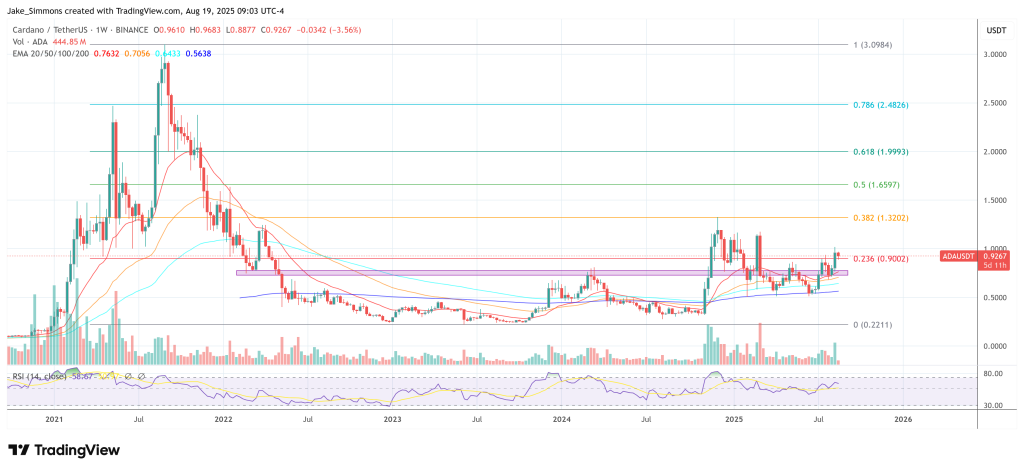
Cardano price
ADA retests key support, 1-week chart | Source: ADAUSDT on TradingView.com
Featured image created with DALL.E, chart from TradingView.com
Editorial Process for bitcoinist is centered on delivering thoroughly researched, accurate, and unbiased content. We uphold strict sourcing standards, and each page undergoes diligent review by our team of top technology experts and seasoned editors. This process ensures the integrity, relevance, and value of our content for our readers.

Jake Simmons has been a Bitcoin enthusiast since 2016. Ever since he heard about Bitcoin, he has been studying the topic every day and trying to share his knowledge with others. His goal is to contribute to Bitcoin's financial revolution, which will replace the fiat money system. Besides BTC and crypto, Jake studied Business Informatics at a university. After graduation in 2017, he has been working in the blockchain and crypto sector. You can follow Jake on Twitter at @realJakeSimmons.

Пов'язані матеріали

Top 10 Promising Emerging Hyperliquid Native Protocols to Watch

Title: A Review of 10 Emerging Native Protocols on Hyperliquid Hyperliquid is evolving beyond perpetual contracts into a comprehensive on-chain financial stack. This article highlights 10 key native protocols driving this growth: 1. **Monetrix**: A yield-optimizing protocol akin to Ethena, aggregating funding rates, HLP rewards, maker rebates, and HIP-3 into a single stablecoin yield. 2. **ROSETTA**: An automated stablecoin yield router, allocating USDC across top protocols (e.g., Felix, Aave, HLP) for optimal returns, factoring in gas and slippage. 3. **papertrade.xyz**: A fair-launched perpetuals protocol offering up to 1000x leverage, no funding rates, no slippage, and fully on-chain, oracle-based execution. 4. **alt.fun**: A launchpad where tokens are paired with leveraged perpetual positions (2x-5x), linking token price to trading activity and underlying position performance. 5. **Ventuals**: Pre-IPO perpetual contracts (built on HIP-3) allowing up to 10x leveraged speculation on valuations of private companies like SpaceX and Stripe. 6. **Liminal**: A delta-neutral yield protocol that captures funding rates via automated short positions and uses generated xTokens (xBTC, etc.) as DeFi collateral. 7. **Melt**: Brings tokenized stocks, commodities, and RWAs to Hyperliquid spot markets, enabling 24/7 trading alongside crypto assets. 8. **Chainsight**: An oracle and data infrastructure protocol providing low-latency (<3s) price feeds, volatility indices, and risk metrics for novel derivatives. 9. **rip.xyz**: Tokenized vault strategies on HyperEVM; its flagship rHYPURR offers liquidity and fractional exposure to a Hypurr NFT basket, priced hourly via NAV. 10. **Markets**: A perpetuals exchange (by Kinetiq) for trading stocks, forex, commodities, bonds, and crypto with up to 50x leverage, using USDH collateral and Kaiko oracles. These protocols form the foundational layer for generating real yield, liquidity, and innovative financial products natively on Hyperliquid.

marsbit42 хв тому

Top 10 Promising Emerging Hyperliquid Native Protocols to Watch

marsbit42 хв тому

Musk Posted a Recruitment Ad for SpaceX, and After Reading the Comments Section, I Understood

On May 20th, SpaceX filed for a landmark IPO with a $1.75 trillion valuation. Shortly after, Elon Musk posted a recruitment call on X, seeking "world-class engineers and physicists" for SpaceX. The application process was starkly simple: email with three bullet points proving "exceptional ability," with real, complex projects as a plus. Musk promised to review qualifying emails himself. The post garnered millions of views and thousands of replies, revealing a spectrum of responses. Most comments, including a highly-upvoted humorous one listing absurd "skills," merely listed credentials or experiences in a conventional, non-differentiating way. This highlighted a key insight: a traditional resume listing degrees and skills often fails to demonstrate true exceptionalism. Effective self-presentation requires "performance efficiency." A standout reply came from an OpenAI engineering lead, who simply stated "codex." This demonstrated that for those who have built significant, recognized products, the product itself becomes the ultimate resume. The article argues that in the AI era, any tangible, shareable output—a tool, research, or online project—serves as a living, self-evident credential more powerful than a list of attributes. However, a twist emerged when applicants found the provided email address non-functional, leading to speculation that the post might also serve as an IPO publicity stunt, projecting an image of aggressive talent acquisition to investors. Ultimately, the episode served as a microcosm: some participate through performance, others through proof of work, while some question the reality of the stage itself. It underscores the enduring challenge of defining and demonstrating value in an age of abundant, yet often superficial, content.

marsbit1 год тому

Musk Posted a Recruitment Ad for SpaceX, and After Reading the Comments Section, I Understood

marsbit1 год тому

Cutting Off OpenAI, Anthropic Acquires the Tool Provider Used by a Quarter of Global Developers

Anthropic has acquired Stainless, a developer tool company that automatically generated official SDKs (Software Development Kits) for AI giants including OpenAI, Anthropic, Meta, and Cloudflare. The deal, reportedly valued at around $300 million, marks a strategic shift for Anthropic as it builds its "AI agent" infrastructure. Stainless acted as a "translator," converting complex API specifications into ready-to-use code libraries for developers. Its tools indirectly reached about a quarter of professional software developers globally. Following the acquisition, Stainless will shut down its public products and its team will join Anthropic to focus on internal platform development, notably for the Claude Platform. Existing SDKs remain with their respective client companies but will no longer receive updates from Stainless. This move is part of Anthropic's broader 18-month strategy to assemble a complete "agent stack." The stack consists of the Claude model at its core, the newly acquired Stainless for standardized API interfaces, and the Model Context Protocol (MCP), an open standard for connecting agents to external tools and data. This contrasts with OpenAI's focus on model generations and consumer-scale compute. Anthropic believes an agent's ultimate utility depends on its ability to connect to external systems. By internalizing the SDK layer and promoting MCP as a connection standard, Anthropic aims to lock in long-term ecosystem advantages and create path dependency, moving beyond the transient lead provided by any single model generation.

marsbit1 год тому

Cutting Off OpenAI, Anthropic Acquires the Tool Provider Used by a Quarter of Global Developers

marsbit1 год тому

Торгівля

Спот
Ф'ючерси

Популярні статті

Як купити ADA

Ласкаво просимо до HTX.com! Ми зробили покупку Cardano (ADA) простою та зручною. Дотримуйтесь нашої покрокової інструкції, щоб розпочати свою криптовалютну подорож.Крок 1: Створіть обліковий запис на HTXВикористовуйте свою електронну пошту або номер телефону, щоб зареєструвати обліковий запис на HTX безплатно. Пройдіть безпроблемну реєстрацію й отримайте доступ до всіх функцій.ЗареєструватисьКрок 2: Перейдіть до розділу Купити крипту і виберіть спосіб оплатиКредитна/дебетова картка: використовуйте вашу картку Visa або Mastercard, щоб миттєво купити Cardano (ADA).Баланс: використовуйте кошти з балансу вашого рахунку HTX для безперешкодної торгівлі.Треті особи: ми додали популярні способи оплати, такі як Google Pay та Apple Pay, щоб підвищити зручність.P2P: Торгуйте безпосередньо з іншими користувачами на HTX.Позабіржова торгівля (OTC): ми пропонуємо індивідуальні послуги та конкурентні обмінні курси для трейдерів.Крок 3: Зберігайте свої Cardano (ADA)Після придбання Cardano (ADA) збережіть його у своєму обліковому записі на HTX. Крім того, ви можете відправити його в інше місце за допомогою блокчейн-переказу або використовувати його для торгівлі іншими криптовалютами.Крок 4: Торгівля Cardano (ADA)Легко торгуйте Cardano (ADA) на спотовому ринку HTX. Просто увійдіть до свого облікового запису, виберіть торгову пару, укладайте угоди та спостерігайте за ними в режимі реального часу. Ми пропонуємо зручний досвід як для початківців, так і для досвідчених трейдерів.

930 переглядів усьогоОпубліковано 2024.12.10Оновлено 2025.03.21

Як купити ADA

Обговорення

Ласкаво просимо до спільноти HTX. Тут ви можете бути в курсі останніх подій розвитку платформи та отримати доступ до професійної ринкової інформації. Нижче представлені думки користувачів щодо ціни ADA (ADA).

活动图片