South Korea Set To Unveil New Stablecoins Framework In October

bitcoinistОпубліковано о 2025-08-19Востаннє оновлено о 2025-08-19

Анотація

South Korea’s financial authority is expected to release the long-awaited regulatory framework next quarter, offering clear guidelines for the issuance...

Trusted Editorial content, reviewed by leading industry experts and seasoned editors. Ad Disclosure

South Korea’s financial authority is expected to release the long-awaited regulatory framework next quarter, offering clear guidelines for the issuance and distribution of won-pegged stablecoins.

Stablecoin Guidelines By October

On Monday, local news media outlets reported that South Korea’s financial regulator, the Financial Services Commission (FSC), is expected to release a bill for a stablecoin pegged to the Korean won (KRW) within two months.

According to MoneyToday, a member of the Democratic Party of Korea (DPK), Park Min-kyu, confirmed that he had “recently received a report from the FSC on the direction of stablecoins,” affirming, “The government’s bill is expected to be submitted to the National Assembly around October.”

The bill is anticipated to be included in the second phase of the Virtual Asset User Protection Act. Notably, the FSC has been working to develop digital assets legislation and shift its regulatory approach for over a year, establishing the Virtual Asset Committee in November to prepare the next phase of its plan and finalize it by the second half of 2025.

The second phase of the Virtual Asset User Protection Act includes regulations on the distribution of digital assets and stablecoins, continuing its efforts to align with global standards. The FSC’s Vice Chairman Kim So-young previously stated that the Korean government was “speeding up efforts” to develop the Korean crypto market while protecting users.

Attention will be focused on the content of the rules, the report affirmed, as the FSC plans to unveil a regulatory framework outlining requirements for issuing won-pegged stablecoins, collateral management, and internal control systems, which have been a concern among both the crypto and banking industries.

The FSC’s Secretary-General warned in January that the regulator needed to address listing standards, how to deal with stablecoins, and how to create rules for the behavior of virtual asset exchanges.

Meanwhile, the banking sector has been studying two legalization scenarios, since it remains unclear whether non-bank entities will be allowed to be stablecoin issuers. Financial institutions have also been considering a business model in which banks establish a joint venture to issue stablecoins.

Stablecoins’ Momentum In South Korea

As the new media outlet noted, institutionalization of won-pegged stablecoins has gained significant attention after President Lee Jae-myung pledged it during his presidential campaign. The electoral promise, which also vowed to address the status of crypto-based exchange-traded funds (ETFs), followed the US’s regulatory shift under the Trump administration and its push for USD-pegged stablecoins, which currently lead the sector.

Previously, the chairman of the South Korea Stock Exchange, Jeong Eun-bo, urged authorities to institutionalize crypto in the country, noting that the Korean market needs to be revitalized to compete with other nations and prevent falling behind international markets.

Over the past two months, multiple bills related to the issuance and distribution of KRW-pegged stablecoins have been introduced in South Korea’s National Assembly. As reported by Bitcoinist, Korea’s ruling and opposition parties proposed rival bills in July to establish the highly anticipated regulatory framework for digital assets pegged to the Korean won.

Member of the Planning and Finance Committee from the Democratic Party, Ahn Do-gil, introduced the “Act on the Issuance and Distribution of Value-Stable Digital Assets,” while member of the Land, Infrastructure, and Transport Committee from the People Power Party (PPP), Kim Eun-hye, proposed the “Act on Payment Innovation Using Value-Fixed Digital Assets.”

Both bills share several similarities, including the assignment of stablecoin oversight to the Financial Services Commission (FSC). However, the two proposed legislation differ in the issue of interest payments, with the PPP’s bill allowing interest payments and the DPK’s bill completely banning interest payments to prevent market disruption.

Min Byung-deok, a member of the National Assembly’s Government Committee, also introduced the “Digital Assets Basic Act” in June, which proposes allowing the issuance of won-pegged stablecoins and establishing a Digital Asset Committee under the direct authority of the president.

Amid the global push for stablecoins, Korean individuals investing in overseas stocks have reportedly shifted from US big tech equities to crypto-linked stocks, with a focus on stablecoin-related companies throughout July, suggesting growing interest in the sector.
stablecoins, bitcoin, btc, btcusdt

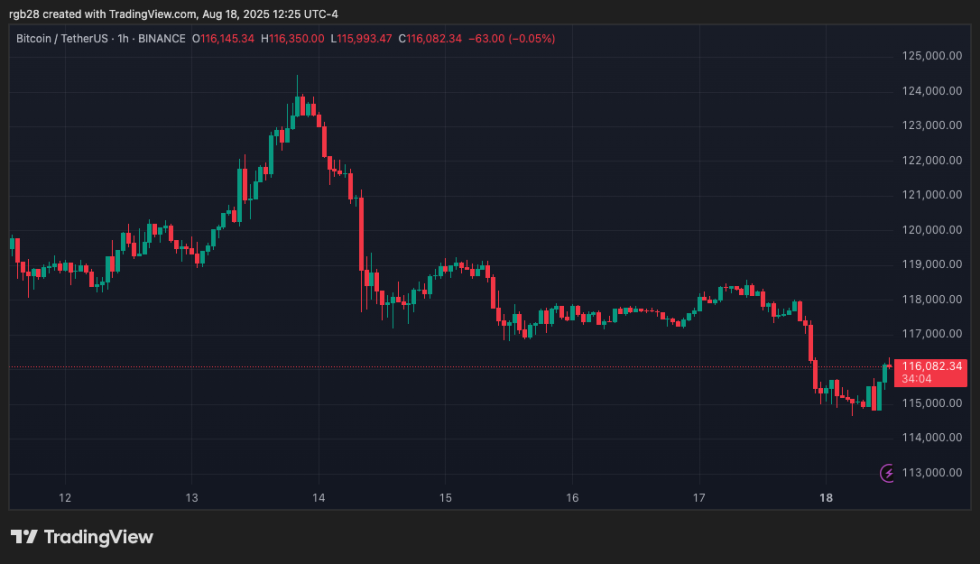
Bitcoin (BTC) trades at $116,082 in the one-week chart. Source: BTCUSDT on TradingView
Featured Image from Unsplash.com, Chart from TradingView.com
Editorial Process for bitcoinist is centered on delivering thoroughly researched, accurate, and unbiased content. We uphold strict sourcing standards, and each page undergoes diligent review by our team of top technology experts and seasoned editors. This process ensures the integrity, relevance, and value of our content for our readers.

Rubmar is a crypto enthusiast who likes learning and improving constantly. She enjoys reporting on the latest news and developments in the crypto industry. Rubmar also enjoys scrapbooking, crafting, simulation games, and watching football.

Пов'язані матеріали

Warsh's First Day in Office, Markets Deliver a 'Wake-up Call': Rate Hike Expected This Year

On his first day in office, newly inaugurated Federal Reserve Chairman Warsh received a stark market warning, with expectations now fully pricing in a 25-basis-point interest rate hike this year. The shift was triggered by hawkish remarks from Fed Governor Waller, who stated that inflation is now the key policy "driver" and that the odds of a hike or cut are evenly split. This sent short-term Treasury yields higher. Waller signaled a significant pivot in his stance, citing disappointing inflation and labor data. He suggested removing "easing bias" language from Fed statements and did not rule out future rate increases if inflation fails to recede, though he noted immediate action isn't warranted without signs of unanchored inflation expectations. Chairman Warsh faces immediate pressure at his first FOMC meeting in June. With the preferred inflation gauge at a three-year high, analysts warn that failing to hike could be interpreted as an implicit easing of policy. The geopolitical situation in the Middle East is adding to existing price pressures. The market's expectation for a hike contrasts sharply with earlier forecasts for multiple cuts. While long-term Treasury yields have been contained by lower energy prices recently, analysts note they remain under structural upward pressure. Warsh's swearing-in at the White House highlights political scrutiny over Fed independence. However, the market has made it clear that inflation is the most urgent challenge, leaving the new chairman little time to settle in.

marsbit3 год тому

Warsh's First Day in Office, Markets Deliver a 'Wake-up Call': Rate Hike Expected This Year

marsbit3 год тому

Has Microsoft Lost Its Way in the AI Race, and Can Copilot Bring It Back on Track?

Microsoft, once seen as an early AI frontrunner due to its investment in OpenAI, is navigating a strategic shift amid increased competition. Its initial reliance on OpenAI’s GPT models has been complicated by OpenAI’s growing ambitions as a direct competitor, rapid advancements from rivals like Claude and Gemini, and the disruptive rise of AI agents, which challenge its traditional SaaS business model. These factors contributed to stock declines and slower-than-expected adoption of its flagship Copilot products. In response, CEO Satya Nadella has taken a hands-on role in product development, signaling the urgency of change. Microsoft is pivoting from a model-centric strategy to a "model-agnostic" enterprise platform approach. It aims to become the foundational layer connecting various AI models—from OpenAI, Anthropic, or its own new "Superintelligence" team—with enterprise workflows, data, security, and cloud services. Recent organizational changes merged consumer and enterprise Copilot teams to accelerate innovation, exemplified by new products like Copilot Tasks and Copilot Cowork. However, this transformation comes at a high cost. Microsoft faces massive capital expenditures, potentially reaching ~$190 billion by 2026, to support AI infrastructure. While its platform strategy shows early signs of traction with growing Azure AI revenue, it must balance startup-like agility with the reliability expected by enterprise clients. The core challenge is no longer being the sole AI winner but defending its position as the essential enterprise software entry point amidst rapid technological commoditization and the shift towards always-on AI agents.

marsbit4 год тому

Has Microsoft Lost Its Way in the AI Race, and Can Copilot Bring It Back on Track?

marsbit4 год тому

Why Haven't Forex Stablecoins Taken Off?

Why FX Stablecoins Never Took Off: A Path Forward via Synthetic FX Despite the explosive growth of stablecoin-powered digital banking, which has seen ~$6B in VC investment and a 24x surge in crypto card spending in under a year, a major limitation persists: these banks are essentially dollar-only accounts. This leaves 95-99% of global accounts, which are denominated in non-USD currencies, underserved. Attempts to create native foreign currency (FX) stablecoins (like EURC) have largely failed, with total FX stablecoin TVL at ~$600M compared to $400B for USD stablecoins—a 700x gap. These FX tokens face critical challenges: fragile pegs due to low liquidity, limited exchange/FinTech acceptance, poor on/off-ramps, complex regional compliance, and a chicken-and-egg adoption problem. The article argues that the solution lies not in competing with entrenched USD stablecoin networks (USDT/USDC), but in adopting a synthetic FX model inspired by traditional finance. Specifically, it advocates for Mark-to-Market Non-Deliverable Forwards (NDFs)—cash-settled FX derivatives that allow users to maintain underlying USD stablecoin holdings while having their account balance and P&L denominated in a foreign currency. This approach offers key advantages: strong oracle-based pegs, retention of deep USD stablecoin liquidity and yield, superior on/off-ramps, scalability to any currency with a reliable feed, and capital efficiency. It mirrors how modern institutional FX markets operate. Primary use cases for on-chain NDFs include: 1. **Digital Banks/Wallets:** Enabling multi-currency accounts for international users without leaving the USD stablecoin ecosystem, boosting deposits and retention. 2. **FX Carry Trade Vaults:** Offering access to sovereign interest rate differentials (e.g., earning yield on BRL) in a more stable and scalable format than crypto-native products like Ethena. 3. **Global Enterprise Payments:** Allowing merchants to receive payments in local currency equivalents while settling in USD stablecoins, similar to services offered by Stripe for fiat. The conclusion is that synthetic FX, not native FX stablecoins, is the viable path to integrating foreign exchange into the growing stablecoin digital banking landscape, potentially unlocking the next phase of institutional DeFi and multi-trillion-dollar global adoption.

链捕手5 год тому

Why Haven't Forex Stablecoins Taken Off?

链捕手5 год тому

Торгівля

Спот
Ф'ючерси
活动图片