ZORA Plunges 95%, Coinbase Finally Admits Creator Coins Failed

Foresight News2026-07-14 tarihinde yayınlandı2026-07-14 tarihinde güncellendi

Özet

On July 13th, Coinbase CEO Brian Armstrong publicly declared the failure of Base network's year-long "content coins" strategy. Initially launched in 2025 via the Zora platform and integrated into Coinbase's wallet as a core feature, the model aimed to turn every social media post into a tradeable token. Each post or creator account would generate 1 billion ERC-20 tokens, with creators receiving an initial allocation. The concept briefly propelled Base to become the largest L2 by new token issuance. However, the model proved unsustainable. These tokens, explicitly not granting ownership or revenue shares, primarily functioned as speculative assets dependent on new buyers. While activity surged in mid-2025—with millions of tokens minted and billions in trading volume—it failed to build lasting user engagement or value. High-profile token launches, including one by Base's official account, experienced extreme volatility, often crashing shortly after spikes. The supporting infrastructure token, ZORA, plummeted approximately 95% from its August 2025 peak, losing nearly $520 million in market capitalization. Armstrong acknowledged the misstep, stating "it didn't work" and that Base had shifted focus earlier in the year toward its core competencies of trading and stablecoin payments. This pivot follows internal criticism that the content coin experiment consumed excessive resources, harmed other Base projects, and ultimately resulted in significant financial losses for participati...


By: ChandlerZ, Foresight News


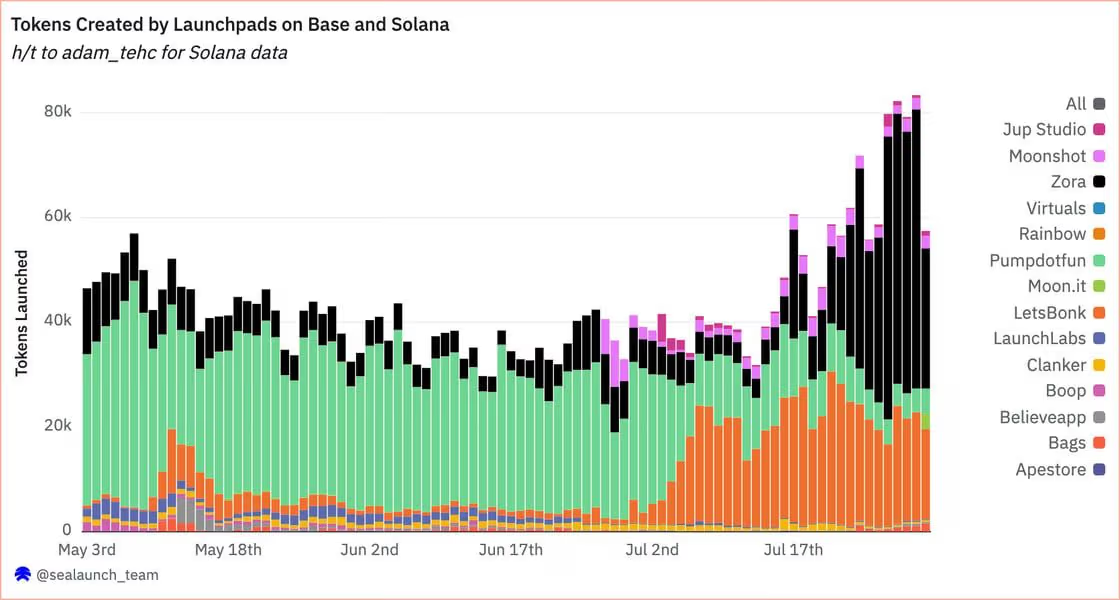
On July 13, Coinbase CEO Brian Armstrong publicly acknowledged on X that the content coins strategy, pursued for over a year on the Base network, had failed. Starting in 2025, Base aggressively promoted content coins through the Zora platform, embedding them as a core feature in its own wallet product. This initially propelled Base to become the L2 chain with the highest volume of new token issuance.
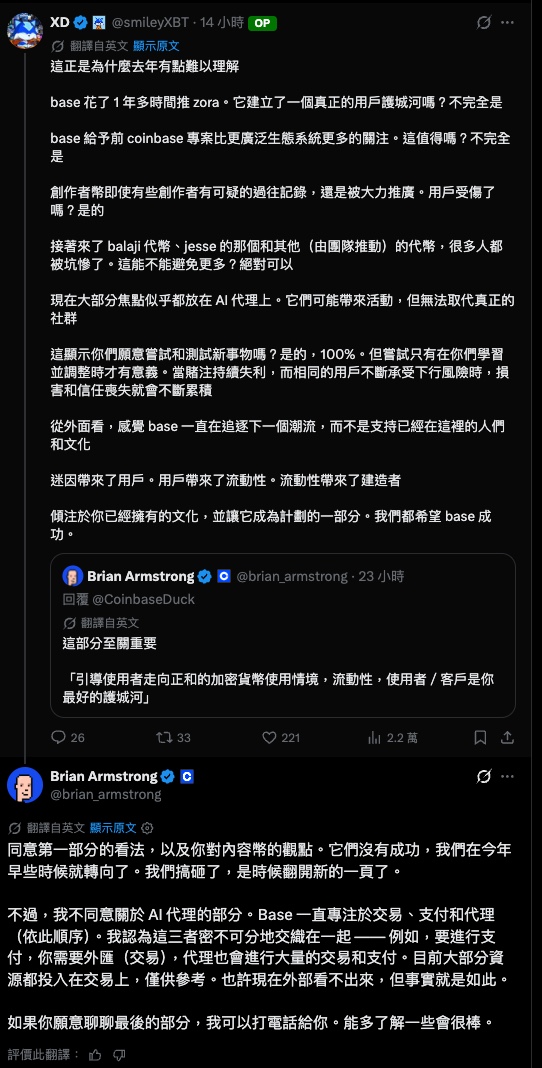


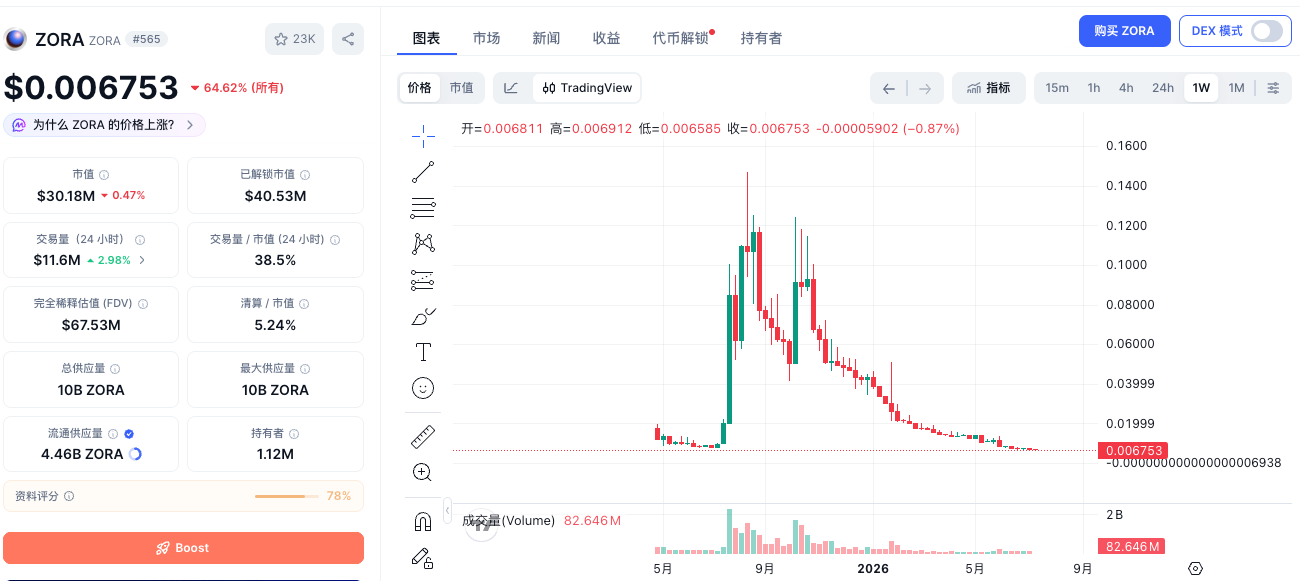
Brian Armstrong stated, "It didn't work, and we pivoted earlier this year. We messed up, time to move on." The ZORA token, which provided the core infrastructure for this experiment, has fallen approximately 95% from its all-time high last August, with its market capitalization shrinking from about $550 million to around $30 million.


From 'Every Post is a Coin' to 'We Messed Up'


Brian Armstrong's statement provides the clearest official characterization of failure for Base's roughly year-long creator token experiment. In July 2025, Coinbase rebranded Coinbase Wallet as the Base App, simultaneously adding social feeds, chat, payments, trading, and app discovery features. When Base opened the app to over 140 countries in December of the same year, it was still defined as an integrated product for social interaction, trading, and payments.


Base's creator economy was powered by underlying tools from the on-chain social platform Zora. A content coin corresponded to a specific post; when a user published an image, video, or text, the system would simultaneously create a freely tradable ERC-20 token. Each content coin had a fixed supply of 1 billion tokens, with the creator receiving 1% (10 million tokens) directly at launch. The token initially had no price; a market price formed on-chain as other users bought in, with subsequent buying and selling determining the market cap and holder profits or losses.
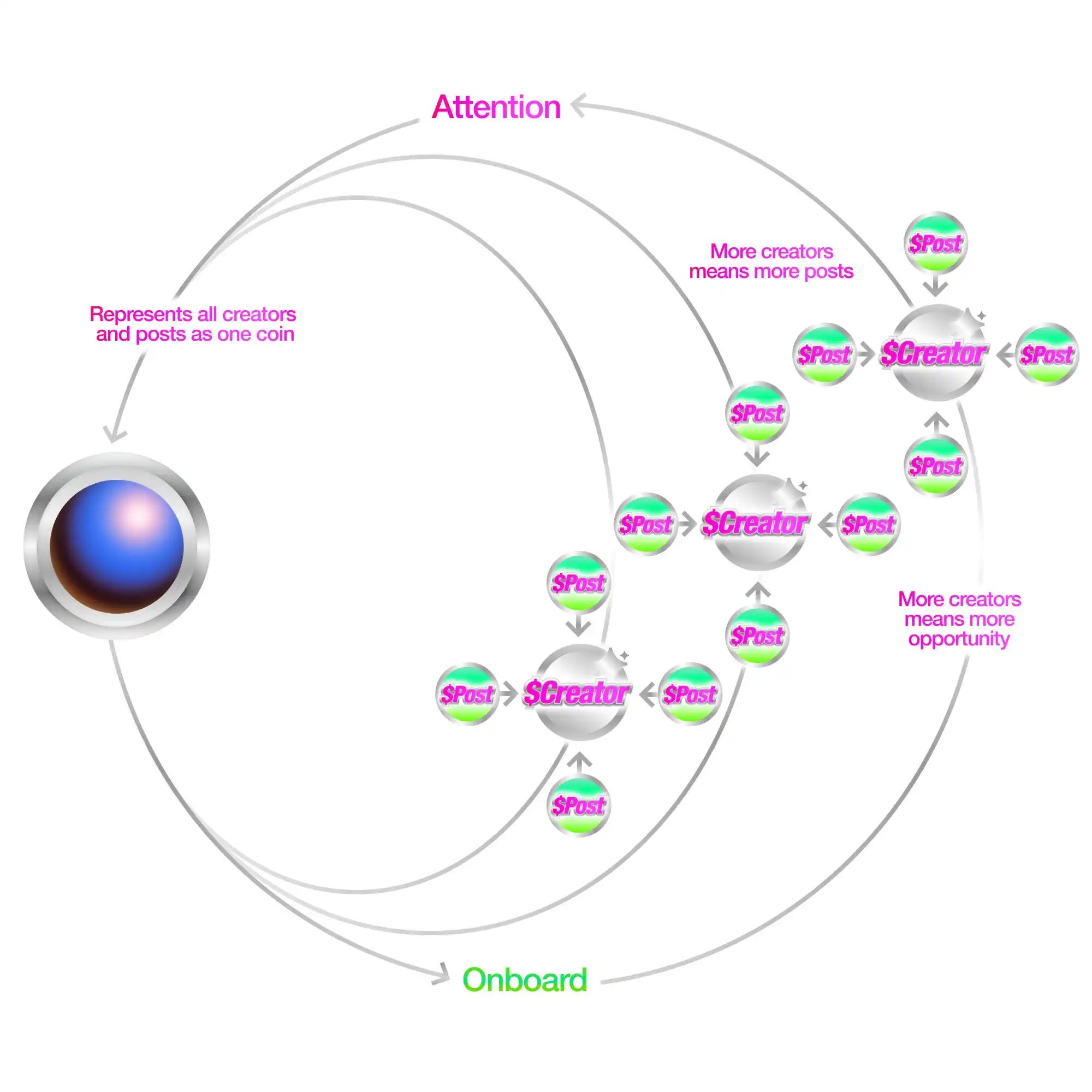


Buyers acquired a token associated with the post, which they could sell to the market at any time. The token did not include copyright to the post, nor did it represent equity in the creator, future revenue, or profit sharing. Zora's terms of service limited its use to entertainment, use, and consumption, requiring users to confirm their purchase was not for equity or profit-sharing purposes. Therefore, a buyer's profit primarily depended on whether later participants were willing to buy at a higher price.


Creator coins used an entire account as the subject, with each Zora account having only one. It also had a supply of 1 billion tokens, with 50% entering the open market and the other 50% vesting linearly to the creator over five years. Content coins published thereafter by that account would be linked to the creator coin. Zora hoped popular content would increase demand for the creator coin. Creators could sell their allocated tokens and also received a share from each transaction fee. Base claimed at the time that this structure could bypass ads, brand partnerships, and follower count thresholds, directly converting attention into trading revenue.


100,000 Tokens Launched in a Day, Trading Didn't Retain Users


Low-cost token issuance quickly inflated Base's surface-level activity. In August 2025, following the relaunch of the Base App, Zora's activity reached an all-time high. Over 1.6 million creator coins were minted, with nearly 3 million unique traders and a total trading volume exceeding $470 million. The price of the ZORA token also rose nearly 5-fold within a month.


In April 2025, after the official Base account published the "Base is for everyone" content via Zora, the system automatically generated a token of the same name. The token surged briefly after launch before plummeting about 95% within hours. Base explained that the official account did not sell the token nor issue it as a formal project, but ordinary users found it difficult to distinguish between a content post, a token issuance, and official endorsement.


Creator Nick Shirley's token later provided a more direct case study. Shirley's investigative video garnered over 100 million views on social media, and Brian Armstrong had publicly promoted it. His creator coin's market cap once reached $15 million before rapidly retreating. Viral spread brought short-term buying pressure but failed to establish sustained demand for the token.


The collaboration between Base and Zora also sparked discontent among ecosystem developers. Some developers felt Base devoted excessive exposure and resources to Zora and creator coins, which neither created stable user moats nor crowded out display opportunities for other Base projects. The community member who questioned Brian Armstrong on July 13 also pointed out that many participants suffered losses as token prices fell.


Defending Content Coins in January, Retreating by February


Brian Armstrong was still defending the model as recently as January of this year. Responding to a former Coinbase engineer's critique of the zero-sum nature of content coins, he argued that buying content coins generated economic value and demand for creator coins. Roughly a month later, the Base App announced the discontinuation of Creator Rewards and removed the social feed powered by Farcaster, shifting the product focus toward tradable assets.


In March, Brian Armstrong admitted in a podcast for the first time that the SocialFi features of the Base App "didn't work that well." Base's subsequently released 2026 strategy placed trading and stablecoin payments at its core. Official disclosures stated that Base processed over $17 trillion in stablecoin transaction volume in 2025, covering 26 local currencies and 17 countries. These figures provided clearer commercial justification for pivoting toward financial infrastructure.


In the same thread, Armstrong rebutted another criticism. @smileyXBT suggested Base's heavy bet on AI agents was repeating the cycle of chasing hype. Armstrong responded that Base's roadmap had always prioritized trading, payments, and AI agents in that order, with most resources currently directed toward trading.


From Base's official coin minting in April 2025 to Armstrong's "we messed up" in July 2026—15 months in between. ZORA's market capitalization evaporated nearly $500 million. Throughout this process, Coinbase doubled down, embedding Zora into its wallet product, encouraging funds to establish creator token indices, and providing platform-level exposure for tokens from insiders.


Coinbase can relegate these 15 months to a concluded product experiment, but the losses in holders' accounts won't disappear with the strategic pivot.


İlgili Sorular

QWhat did Coinbase CEO Brian Armstrong publicly admit on July 13th regarding Base's content coin strategy?

AOn July 13th, Coinbase CEO Brian Armstrong publicly admitted that Base's content token (creator coin) strategy, which had been running for over a year, had failed. He stated, "didn't work, we turned away from it early this year. We fumbled, time to move on."

QWhat was the primary function of the creator/content coins on Base as provided by Zora, and what did they *not* represent?

ACreator/content coins on Base, powered by Zora, functioned primarily as tokens linked to a creator's account or a specific post (like a video or text). They were intended for entertainment, use, and consumption. Crucially, they did NOT represent ownership, equity, future revenue, profit share, or copyright of the creator's work or the specific post.

QAccording to the article, what was a major reason the creator coin experiment failed to create sustainable value?

AA major reason for the failure was the lack of sustainable demand. The model relied heavily on viral moments and speculative buying, where buyers' profits depended primarily on finding new buyers willing to pay a higher price (a zero-sum dynamic). Viral popularity generated short-term spikes but failed to build lasting economic utility or user retention for the tokens.

QHow did the failed experiment impact the ZORA token's value?

AThe ZORA token, which provided the core infrastructure for the creator coin experiment, suffered a massive decline. Its value dropped approximately 95% from its all-time high in August of the previous year, with its market capitalization shrinking from around $550 million to about $30 million.

QWhat is Base's new strategic focus after moving away from the creator coin and SocialFi approach?

AAfter pivoting away from the creator coin/SocialFi strategy, Base's new strategic focus for 2026 centers on core financial infrastructure: trading and stablecoin payments. The company highlighted its significant volume in stablecoin transactions as the business basis for this shift.

İlgili Okumalar

The Verdict in Choi Tae-won's Divorce Case: Revealing the Inheritance Undercurrent Behind SK Hynix's Trillion-Won Empire

SK Group Chairman Chey Tae-won's high-profile divorce case, involving a record 1.38 trillion won settlement, has drawn attention to the succession plans for Korea's second-largest conglomerate, especially its crown jewel, SK hynix. Unlike traditional chaebol scripts centered on the eldest son, Chey's three children from his marriage to former President Roh Tae-woo's daughter, Roh Soh-yeong, are carving distinct, non-traditional paths. Eldest daughter Chey Yun-jung (b. 1989) is seen as the most evident successor. With a scientific and consulting background, she holds executive roles at SK bioscience and SK Inc.'s growth support department, focusing on future strategy and biopharma. Her marriage is to an AI infrastructure entrepreneur, not a traditional business alliance. Second daughter Chey Min-jung (b. 1991) took a unique route, voluntarily serving as a South Korean naval officer, including an anti-piracy deployment. She later worked on policy and strategy for SK hynix in Washington D.C. before co-founding an AI-driven healthcare startup. She married a former U.S. Marine Corps officer, connecting her to U.S. defense and policy circles—networks crucial for a global semiconductor giant. The only son, Chey In-geun (b. 1995), who studied physics like his father, worked briefly at SK E&S before joining McKinsey. Despite fitting the traditional "heir" profile as the eldest son, he remains silent and holds no public position or shares in SK, suggesting the old succession playbook is obsolete. As SK hynix's valuation soars, becoming a geopolitical asset in the AI era, the heirs' legitimacy is no longer automatic. They must prove themselves in fields like AI biotech, global policy, and strategic consulting. Their marriages also reflect new elite networks in tech and defense, not old political alliances. Their inheritance is the complex challenge of navigating a globalized, tech-driven world, not just a corporate throne.

marsbit19 saat önce

The Verdict in Choi Tae-won's Divorce Case: Revealing the Inheritance Undercurrent Behind SK Hynix's Trillion-Won Empire

marsbit19 saat önce

From OpenSea to OpenRouter: Is Alex Atallah Repeating His 'Exit at the Peak' Playbook?

From OpenSea to OpenRouter: Is Alex Atallah Repeating His "Exit at the Peak" Playbook? According to the Wall Street Journal, payments giant Stripe is in talks to acquire the AI model aggregation platform OpenRouter in a potential deal valuing the company near $100 billion. This would mark founder Alex Atallah's second creation of a company reaching a $100 billion valuation, following his co-founding of NFT marketplace OpenSea. OpenRouter, founded just over three years ago, has grown rapidly by acting as a unified gateway for developers to access over 400 AI models. It currently has about 10 million users and processes over 200 trillion tokens monthly. While the platform's annualized revenue is around $50 million, its valuation has skyrocketed from $1.3 billion in March 2026. The potential acquisition by Stripe, a company OpenRouter's founder once likened it to, represents a major expansion into AI infrastructure for the payments leader. This move echoes Atallah's previous timing with OpenSea, where he departed before the NFT market's significant downturn. For OpenRouter, selling now may be strategic. Despite its scale, its business model—charging a 5-5.5% fee on AI inference calls—faces pressure from competition, open-source models, and potential price wars among model providers, limiting its profitability narrative for an IPO. A key asset for potential acquirers like Stripe is OpenRouter's vast repository of real-world AI usage data, which offers unique insights into model performance and developer preferences that are difficult to replicate. Whether this potential deal signifies a new valuation benchmark for AI infrastructure or another market peak signal remains to be seen.

链捕手20 saat önce

From OpenSea to OpenRouter: Is Alex Atallah Repeating His 'Exit at the Peak' Playbook?

链捕手20 saat önce

İşlemler

Spot
活动图片




