Zero Funding Rate? The New Contract Design of HyperEVM That Foreigners Are Talking About

marsbit2026-05-14 tarihinde yayınlandı2026-05-14 tarihinde güncellendi

Özet

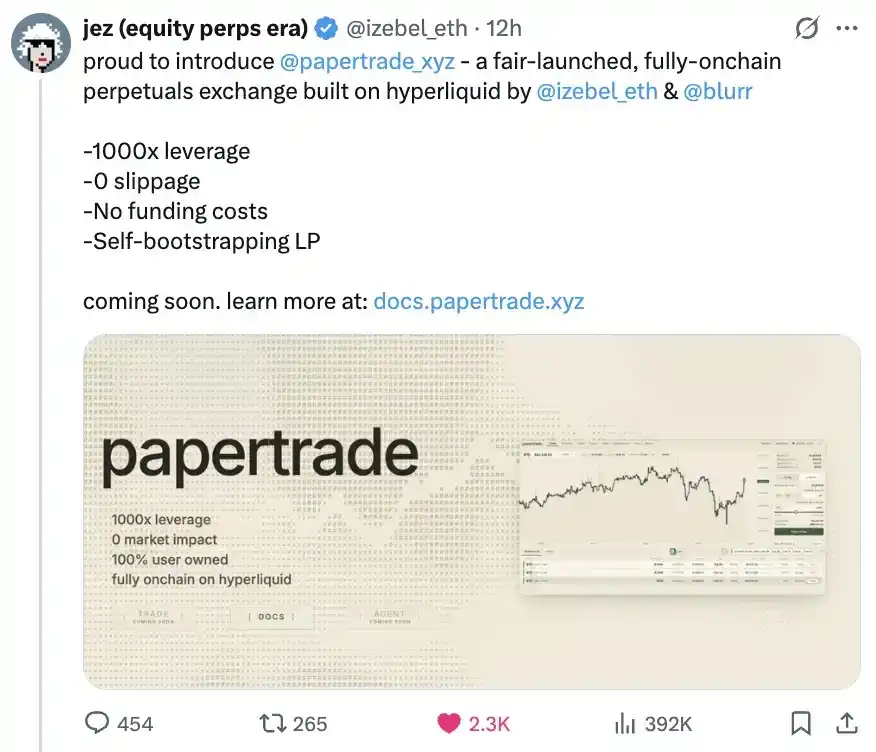
Jez, a prominent crypto trader, announced his new protocol PaperTrade on HyperEVM, sparking significant discussion. PaperTrade is a perpetual DEX with zero fees, no slippage, and no funding rates. The protocol's mechanism draws from the historical "bucket shop" model, where trades are settled directly against a public LP pool based on Hyperliquid's order book prices, without ever interacting with Hyperliquid's matching system. It combines perpetual contracts with P2P lending and DeFi Ponzi elements. User losses go into the LP pool, while a portion of user profits is taken as protocol fees. Crucially, the LP pool is seeded solely by user losses, not external deposits. If a user's profit exceeds the pool's balance, the profit enters an on-chain queue, to be paid out sequentially by subsequent user losses. The protocol mints its PAPER token based on user losses, with a minting rate that decays as the LP pool grows. Staking PAPER yields dividends from protocol fees and excess pool funds above a $5M cap. A key uncertainty is its deployment on HyperEVM. Since PaperTrade essentially uses Hyperliquid as a free oracle, its logic could be replicated on any high-performance chain with an external price feed, potentially offering better performance or incentives. The launch also serves as a stress test for HyperEVM's network capabilities.

Today, crypto trader Jez announced his new protocol, PaperTrade, developed on HyperEVM, sparking heated discussions in the English-speaking crypto community.

Jez is a long-term evangelist for perpetual contracts. He heavily invested in Hyperliquid early on, with his account address ranking high on the airdrop leaderboards of Lighter and Variational. This time, he has taken matters into his own hands, creating a Perp DEX with no fees, no slippage, and no funding rate.
Old-School Gambling House Exiles to the Chain

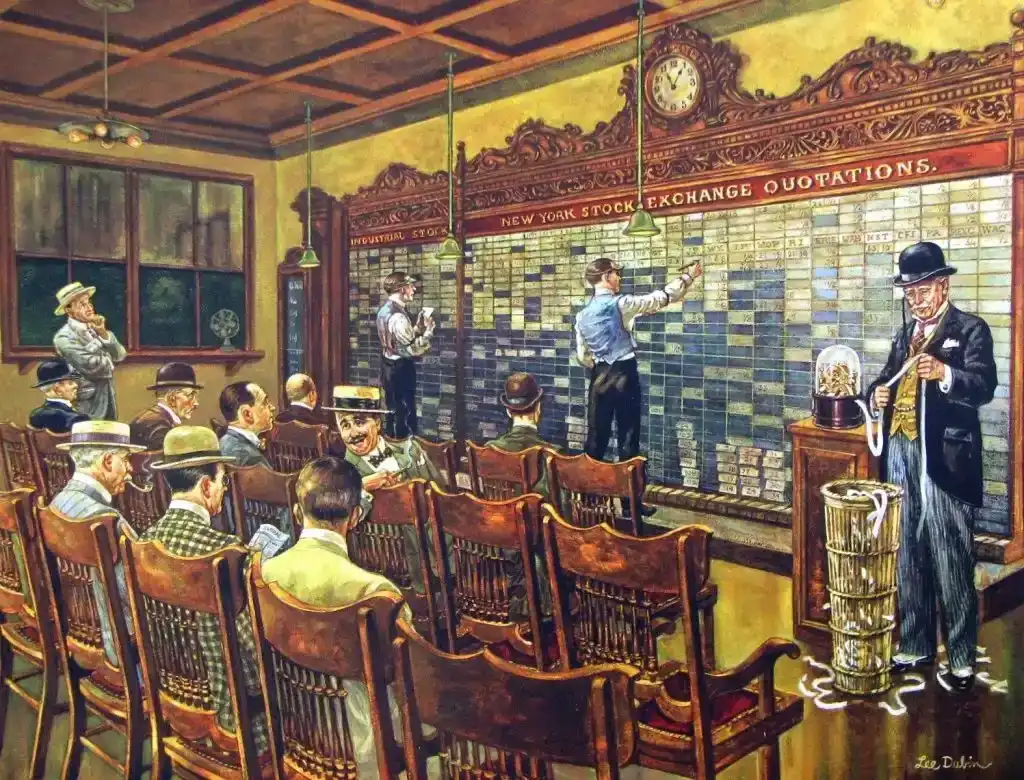
The mechanism of PaperTrade has a notorious predecessor in financial history: the bucket shops in American small towns in the 1900s. These establishments, operating under the guise of securities firms, would chalk up real-time quotes from the New York Stock Exchange behind their counters, but clients' orders never left the shop owner's drawer. Essentially, it was a gamble between the client and the shop owner. This business was outlawed by New York State legislation in 1909 and largely disappeared by the 1920s.
When users open or close a position on PaperTrade, the platform directly reads the order book price from Hyperliquid and settles directly with the public LP pool based on the difference between the opening and closing prices. No orders enter Hyperliquid's matching system during this entire process, and no real perpetual contracts are exchanged. The trading parties are always the user and the LP pool, with no third-party counterparty.

Perpetual Contracts + P2P + DeFi Ponzi

PaperTrade simultaneously borrows models from DeFi mining and P2P lending.

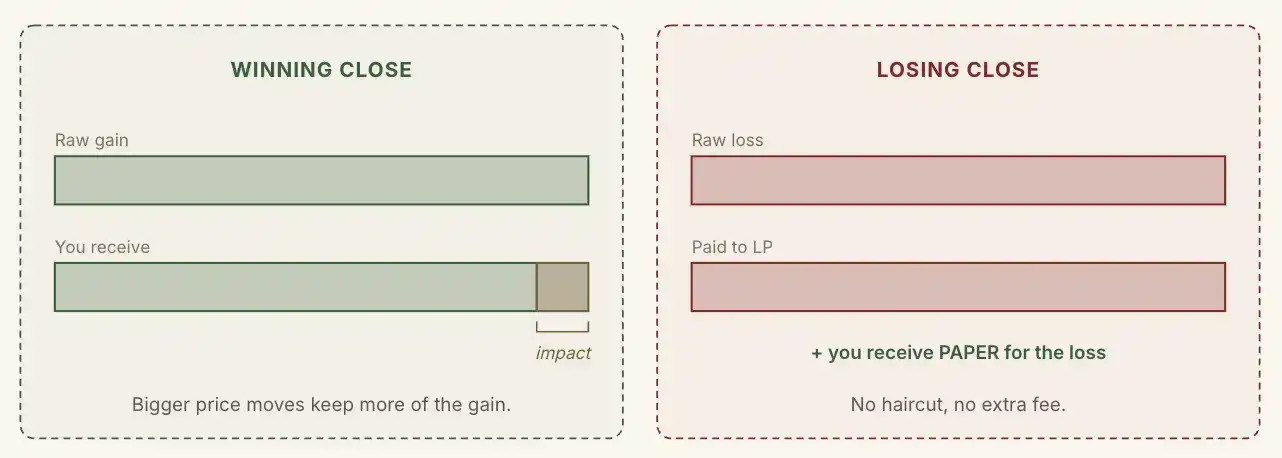
User losses on PaperTrade are placed directly into the protocol's LP pool, while user profits are taxed by the platform. The smaller the price fluctuation, the more profit is taken. In other words, the more users earn, the less the protocol taxes.

Unlike HLP, PaperTrade's LP pool has no team pre-deposit, no VC investment, and does not accept any form of external deposits whatsoever. Its sole source of funds is user-lost margin.

The question arises: if the LP pool only has $100, but a user makes $5,000, how does the protocol pay?

PaperTrade has brought the creditor queue from traditional P2P lending onto the chain.

This $5,000 enters a sequential on-chain queue, waiting for the next losing trade to come in and fill the gap, with payments made in order from the front of the queue. User principal is always returned immediately, only the profit portion is queued.
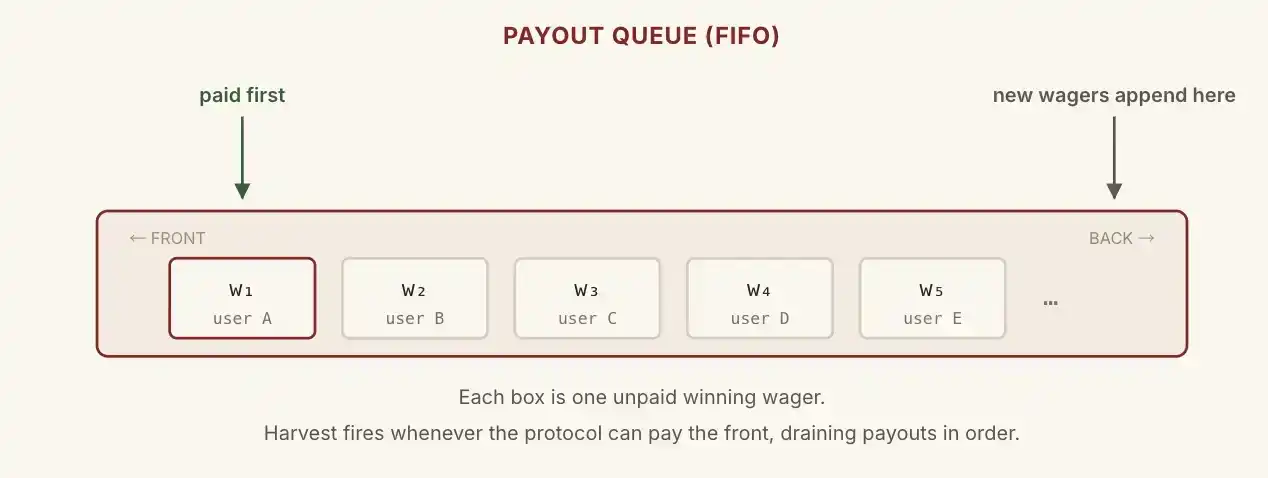
In theory, the LP can be "bankrupt" in stages, but every winner will eventually be paid in full, unless the losses from losers are insufficient to cover the profits the platform owes the winners.

If the story ended here, this project would be doomed to failure. Because if the LP pool runs out of money, it means winners might have to wait a long time in the queue to receive their profits, naturally losing motivation to trade. As traders leave, even losers disappear, and the money the platform owes winners becomes bad debt.

The essence of PaperTrade lies in its token, PAPER.

For every dollar a user loses, the protocol mints a certain amount of PAPER according to a curve.
When the LP balance is below $2 million, the minting ratio is fixed at 100 PAPER per $1 loss; after the LP exceeds $2 million, the rate begins to decay—the higher the LP balance, the less PAPER is minted.
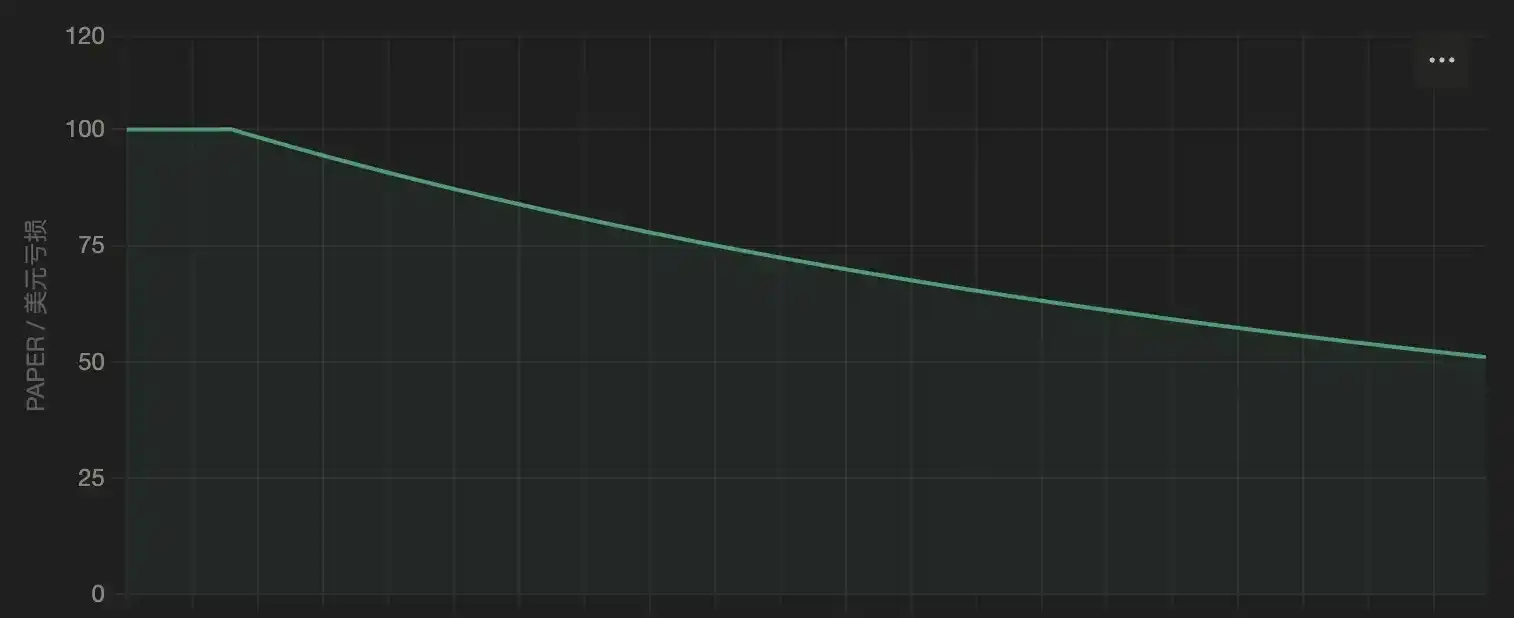
X-axis: Amount of PAPER obtained per unit of loss; Y-axis: LP Balance (each grid represents 1M)

Staking PAPER yields two parts of dividends: first, the protocol's fee income; second, when the balance exceeds $5 million, all excess funds are allocated entirely to stakers.

In other words, the LP pool's scale is designed with a $5 million ceiling. Beyond this size, user losses are fully returned to PAPER holders. This forms a closed loop: "Losers get platform shares, winners take losers' money, the platform taxes winners to subsidize losers."

Therefore, a reasonable participation strategy can be summarized as: betting to lose money to mint PAPER when the LP pool's TVL is low, and staking PAPER to collect dividends when the LP pool's TVL is high.

A Stress Test for HyperEVM

In my opinion, the biggest uncertainty for PaperTrade lies in the HyperEVM on which it is deployed.

PaperTrade merely uses Hyperliquid's quotes as a free, native oracle, with all remaining logic residing in the contracts on HyperEVM.

This means any high-performance chain with similar capabilities could replicate PaperTrade's entire mechanism on its own chain, as long as it is willing to integrate an external price oracle. The replicator could even offer things HyperEVM cannot: lower gas fees, higher TPS, more generous early subsidies, more aggressive token incentives.

During the HyperEVM meme season in Q1 of last year, there was a period of slow on-chain speeds and high gas fees. The launch of PaperTrade is another test for HyperEVM.


İlgili Sorular

QWhat is the key innovation of the new protocol PaperTrade announced on HyperEVM?

AThe key innovation of PaperTrade is its design as a perpetual DEX with zero fees, zero slippage, and zero funding rates. It operates by using Hyperliquid's orderbook as a price oracle and settling trades directly against a public LP pool without actual orders entering Hyperliquid's matching system, creating a peer-to-contract model.

QWhat is the historical inspiration for PaperTrade's mechanism, and why was it considered disreputable?

APaperTrade's mechanism is inspired by the 'bucket shops' of early 1900s America. These were fraudulent operations that posted real stock exchange prices but clients were simply betting against the shop owner, with no real trades ever executed. This practice was banned and died out due to its deceptive and purely gambling-based nature.

QHow does the PaperTrade protocol handle a situation where a user's profit exceeds the current balance of the LP pool?

AWhen a user's profit exceeds the LP pool balance, the profit amount (not the principal) is placed into a sequential on-chain queue. It will be paid out in order as future user losses replenish the pool. This means winners are guaranteed payment over time, provided there are enough subsequent losers to cover the debts.

QWhat is the role of the PAPER token in the PaperTrade ecosystem?

AThe PAPER token is minted when users incur losses on the platform. The minting rate decreases as the LP pool grows. Staking PAPER entitles holders to two types of dividends: a share of the protocol's revenue from profitable trades, and all excess funds in the LP pool once it surpasses a $5 million cap, effectively distributing user losses back to token holders.

QAccording to the article, what is the main challenge or uncertainty facing PaperTrade's implementation?

AThe main uncertainty lies in its deployment on HyperEVM. Since the core logic resides on-chain and merely uses Hyperliquid for price feeds, any high-performance chain with a similar external oracle could replicate the entire mechanism. Competitors could offer lower gas fees, higher TPS, or better incentives, posing a significant challenge to PaperTrade's sustainability on HyperEVM.

İlgili Okumalar

AI Relay Stations Spark Heated Debate on Zhihu: Behind Cheap Tokens, What Are Users Really Worried About?

A discussion on Zhihu about "AI relay stations" shifted the niche developer topic of "cheap tokens" into broader user awareness. Users moved beyond simply questioning the legitimacy of these services to focus on practical concerns: Where do cheap tokens truly come from? Is the model being accessed the real one? Can relay stations see prompts, code, and API keys? For occasional users, are the risks worth it? The core debate centered less on price and more on trust. A primary worry is model authenticity—the risk of "model swapping," where users paying for a premium model might be routed to a cheaper one, creating an information asymmetry. Others argued that cost comparisons matter; while cheaper than official pay-as-you-go APIs, relay stations may not be the lowest-cost option versus subscriptions, domestic models, or free tiers, making user needs assessment crucial. Speculation about token sources ranged from legitimate bulk discounts to gray-area methods like account sharing or exploiting regional pricing. This opacity makes risk assessment difficult for users. Data security emerged as a critical concern, especially for enterprise use. When processing sensitive information like code, contracts, or client data, the inability to verify a relay station's data handling, retention, or access policies poses significant compliance and confidentiality risks. The evolving consensus suggests relay stations can be used cautiously for low-sensitivity, disposable tasks (e.g., summarizing public info, simple translation). However, they should not be the default for sensitive, professional, or production workflows involving proprietary data, Agents, or automated systems. Recommendations include avoiding large prepayments, not relying on a single service, using test prompts to monitor quality, anonymizing data where possible, and keeping official channels as backups. Ultimately, the discussion framed tokens not just as a billing unit but as a measure of real cost encompassing price, model integrity, data security, and service stability. The popularity of relay stations highlights user demand for affordable access, but the debate underscores a key trade-off: the savings from cheap tokens may come at the price of trust, transparency, and control over one's data and AI experience.

marsbit9 dk önce

AI Relay Stations Spark Heated Debate on Zhihu: Behind Cheap Tokens, What Are Users Really Worried About?

marsbit9 dk önce

In-Depth Research Report on TradFi: The Convergence Wave of Crypto and Traditional Finance

In 2026, the crypto industry is undergoing a profound infrastructure-level transformation—TradFi assets are migrating on-chain at an unprecedented pace. According to CoinGecko's Q1 2026 report, the total value locked (TVL) of tokenized real-world assets (RWA) has surpassed $31 billion, a nearly 4x increase from $7.8 billion at the beginning of 2025, with the sector’s aggregate market capitalization reaching $19.3 billion. Among these, the market cap of tokenized stocks surged from $2 million to $486 million, with Q1 spot trading volume reaching $15.1 billion—a single quarter already surpassing the entire second half of 2025. RWA perpetual contract Q1 trading volume reached a staggering $524.8 billion, far exceeding the $313 billion for all of 2025. Meanwhile, BlackRock's BUIDL fund has reached $2.3 billion in scale and has filed for two new tokenized funds, signaling that the world's largest asset manager's tokenization strategy is evolving from pilot to product suite expansion. HTX, as a core participant in the crypto exchange sector, officially launched TradFi perpetual futures products including NVDA, AAPL, MSFT, META, and SPY in 2026, enabling crypto users to gain 24/7 trading access to core U.S. equities. Boston Consulting Group predicts that global tokenized asset scale could reach $16 trillion by 2030, while McKinsey offers a conservative estimate of approximately $2 trillion. The on-chain migration of TradFi assets is no longer a "future narrative" but a structural transformation unfolding in real time, as crypto exchanges evolve from single crypto asset trading platforms toward "multi-asset-class trading infrastructure."

HTX Learn11 dk önce

In-Depth Research Report on TradFi: The Convergence Wave of Crypto and Traditional Finance

HTX Learn11 dk önce

Blocked Its Own Treasure, WeChat AI Steps Up

Tencent's stock surged over 10% on June 2nd amid reports that WeChat, with 1.43 billion monthly users, is finalizing tests for a native AI Agent. The reported feature, accessible by swiping right from the main interface, allows users to issue commands in natural language. The AI then decomposes tasks and automatically calls upon relevant Mini Programs within WeChat to complete actions like ordering food, booking tickets, or making payments, creating a closed-loop service execution system. This strategic shift follows the internal conflict and subsequent "blocking" of Tencent's standalone AI app, Yuanbao, by WeChat for violating sharing rules during a 2026 Spring Festival promotion. The incident highlighted a lack of internal consensus and exposed the weakness of competing in the standalone AI assistant arena against rivals like ByteDance's Doubao (345M MAU) and Alibaba's Qianwen. The new WeChat AI Agent aims to leverage WeChat's unique assets—its massive user base, standardized Mini Program APIs, WeChat Pay, and identity system—to move from simple content generation to actual task execution. Analysts note this changes the competitive landscape from model benchmarks to which AI can connect to more real-world services. However, success depends on key variables: the capability of Tencent's underlying Hunyuan model, managing massive inference costs, and redesigning incentives for Mini Program developers whose traffic might be bypassed. The move is seen as an attempt to keep user service intent within WeChat's ecosystem as AI begins to redefine how users access services.

marsbit1 saat önce

Blocked Its Own Treasure, WeChat AI Steps Up

marsbit1 saat önce

ByteDance Adopts Arm CPUs, Jensen Huang: So Sad I Didn't Buy Arm

**Summary:** At Computex 2026, Arm CEO Rene Haas announced that ByteDance and Oracle have adopted Arm's self-designed Arm AGI data center CPU. The company expects significant revenue growth from this product, projecting $20 billion in demand for the 2027/2028 fiscal years. Haas noted that restricting AI-capable CPUs from the US to China is nearly impossible due to their widespread applications. Arm's stock has surged dramatically this year, notably rising 16% after NVIDIA's Arm-based Vera CPU and RTX Spark announcements. A highlight was the informal, humorous on-stage conversation between Haas and NVIDIA CEO Jensen Huang. Huang joked about NVIDIA's failed attempt to acquire Arm and playfully lamented selling his Arm shares. Both executives showed a clear sense of camaraderie and shared regret over the missed merger. Key technical topics were discussed: 1. **AI PC Design:** Huang explained NVIDIA's RTX Spark superchip (with a 20-core Arm CPU) is designed for future AI agents that will autonomously run and use tools on PCs, blending local and cloud processing. 2. **Agent vs. OS:** Huang emphasized the operating system remains crucial, as AI agents rely on its APIs and tools to function. 3. **Growth Constraints:** He identified the shift to "useful AI" that generates profitable tokens as a primary driver for immense, almost limitless, computational demand. Haas outlined Arm's strategy across PC and data centers. For PCs, Arm collaborates with partners like NVIDIA and MediaTek, offering its compute subsystem (CSS) for custom SoCs. In data centers, its Arm AGI CPU (built on TSMC's 3nm process) has gained major partners including OpenAI, Meta, and now ByteDance and Oracle. Arm presented a multi-year roadmap for its in-house CPU line. The article concludes that while GPUs dominated the AI training race, the explosion of AI agents is shifting significant focus to CPUs for inference, state management, and tool orchestration. The industry is trending towards vertical integration, with companies like cloud providers designing chips and chip/IP firms offering full solutions, all competing to deliver more efficient computing per watt.

marsbit1 saat önce

ByteDance Adopts Arm CPUs, Jensen Huang: So Sad I Didn't Buy Arm

marsbit1 saat önce

İşlemler

Spot
Futures
活动图片