ZEC Co-Founder Responds to Orchard Vulnerability: No Signs of Theft, Orchard Pool to Be Sealed

Foresight News2026-06-15 tarihinde yayınlandı2026-06-15 tarihinde güncellendi

Özet

ZEC Co-Founder Addresses Orchard Vulnerability: No Signs of Theft, Plans to Sunset Orchard Pool A security vulnerability was recently discovered in Zcash's Orchard shielded pool, raising key concerns. The primary questions are whether the flaw was exploited, if user funds are safe, whether users can verify the total ZEC supply, and if other similar vulnerabilities exist. Analysis suggests the vulnerability was likely not exploited prior to its discovery. It was found proactively by a researcher using specialized tools, not due to an active breach. The development team and mining pools acted quickly to contain the issue. Typical financially-motivated attacks would likely have left visible on-chain evidence, which has not been observed. User funds in Orchard are considered safe and should be recoverable, assuming no prior exploitation. If the flaw was never used, all legitimate funds can be withdrawn. The article outlines risks associated with moving funds to transparent addresses or other pools, but concludes that leaving assets in place is a reasonable option. Currently, users cannot independently verify that the total ZEC supply hasn't been inflated due to this bug. However, the planned Ironwood network upgrade is designed to resolve this. It will permanently close the Orchard pool to new deposits and internal transfers, allowing only withdrawals. This mechanism will cap total withdrawals at the amount of legitimately deposited funds, enabling anyone to cryptographically...


Authors: Zooko Wilcox, Jason McGee

Compiled by: Luffy, Foresight News


Recently, a security vulnerability was exposed in Zcash's Orchard module, raising two major concerns for the community: Is the total supply of ZEC tokens abnormal? Are user assets safe?


Current discussions intertwine several different topics, making it difficult for many to understand the actual impact of this vulnerability on ordinary users. This article will address these issues, explaining the underlying meanings one by one.


This Orchard vulnerability primarily raises four key questions:


  1. Has the vulnerability been exploited by hackers?
  2. Can users' legitimate assets stored in Orchard be withdrawn normally?
  3. Can users independently verify that the total supply of Zcash has not been artificially inflated?
  4. How can we confirm that the project does not contain other similar token forgery vulnerabilities?


Has the Vulnerability Been Exploited?


Currently, there is no definitive conclusion. Overall, the likelihood of the vulnerability being maliciously exploited previously is low, but we cannot rule it out with 100% certainty. There are three main reasons:


  • For many years, numerous top global cryptographers and security researchers have been reviewing the Zcash code, and this vulnerability remained undiscovered. This vulnerability was proactively found by Shielded Labs' Taylor Hornby during targeted investigations, not accidentally exposed. He leveraged AI-powered security detection technology and custom tools specifically designed to uncover this type of hidden flaw. Such vulnerabilities have a high technical barrier; it would be difficult for individuals not specialized in the Zcash codebase to find and exploit them.
  • Upon the vulnerability's exposure, the Zcash development team immediately collaborated with major mining pools to temporarily freeze the Orchard pool and push a fix, significantly narrowing the window of opportunity for attackers.
  • Most attacks in the cryptocurrency space aim for quick profits. Once a vulnerability is public, hackers typically cash out immediately. To profit from this vulnerability, a hacker would need to transfer the forged ZEC out of the Orchard pool and exchange it for other assets. Such operations generally leave traces. If the vulnerability had been exploited long ago, evidence should have emerged by now. Throughout industry history, hackers' modus operandi is typically "strike and disappear quickly," not deliberately hiding for months or even years.


Can Legitimate Assets in Orchard Be Withdrawn?


We believe they can be withdrawn normally, provided the vulnerability has never been exploited. If this assessment holds true, all legitimate assets users have deposited into Orchard can be successfully transferred out.
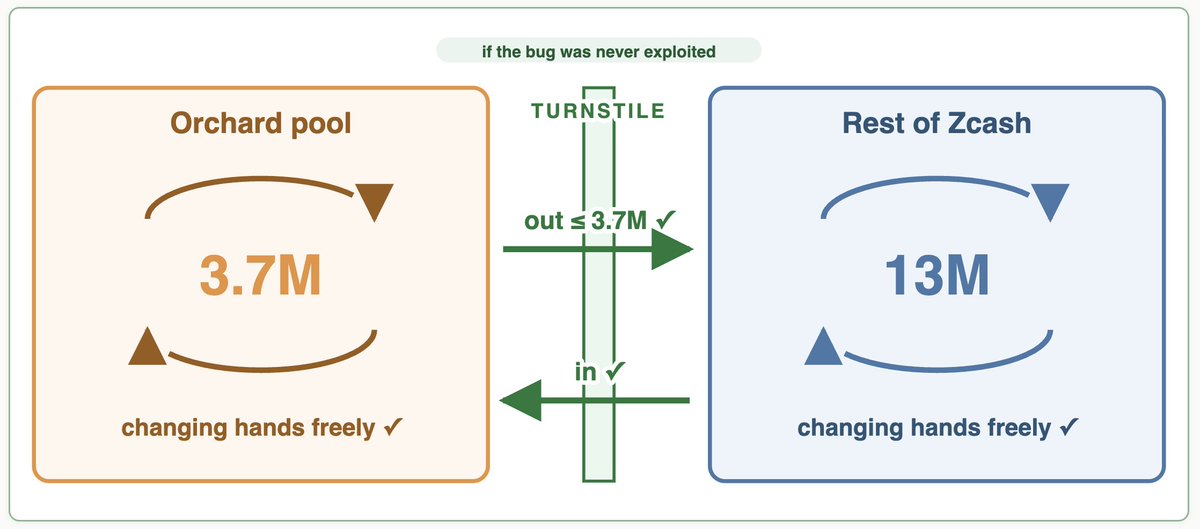


Conversely, if hackers have already used the vulnerability to create counterfeit tokens and transferred them into the pool, the existing withdrawal channels would cap the total withdrawal amount. The withdrawal limit would equal the total amount of legitimate tokens initially deposited. In this scenario, if counterfeit tokens are withdrawn first, some users' legitimate assets might not be fully recovered.
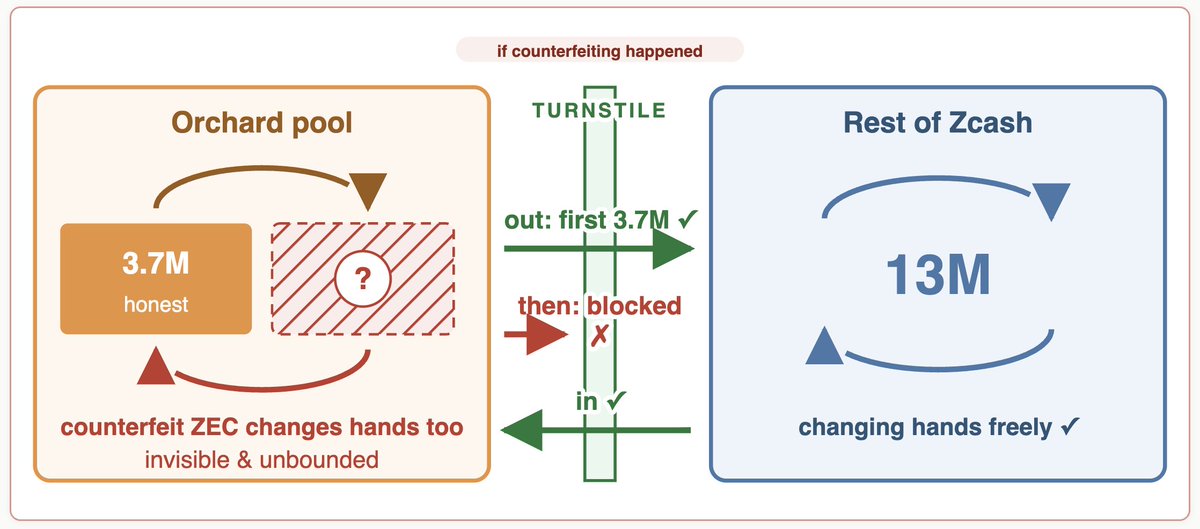


We consider the likelihood of this extreme scenario to be low. If users still have concerns, they can move their assets out of the Orchard pool. However, before doing so, it's important to understand the potential risks of different withdrawal methods:


  • Transferring to a transparent address (t-address): The transfer amount and time will be fully public, and the assets will become publicly associated with that address, completely losing privacy.
  • Transferring to the Sapling shielded pool: The transfer amount and time will still be recorded, but it won't link the assets to a specific address or transaction history, offering better privacy than transparent addresses. Note that Sapling relies on a trusted setup ceremony completed in 2018, which itself carries additional security considerations.
  • Wallets: Among mainstream self-custody wallets, currently only YWallet and Zkool support the Sapling pool.
  • Other wallets or custodial platforms: There may also be risks of operational errors, software faults, platform risk controls, and other unexpected issues.


Overall, these risks are manageable. Combined with the assessment that "the vulnerability was most likely not exploited," keeping assets in the original shielded wallet is a prudent choice. If users can ensure operational safety, withdrawing assets is also a viable option. Users should decide based on their individual circumstances.


Can Users Independently Verify That Zcash's Total Supply Has Not Been Inflated?


Currently, this is not possible. Due to the existence of this vulnerability, ordinary users cannot independently verify whether the total token supply within the shielded pools has been inflated.
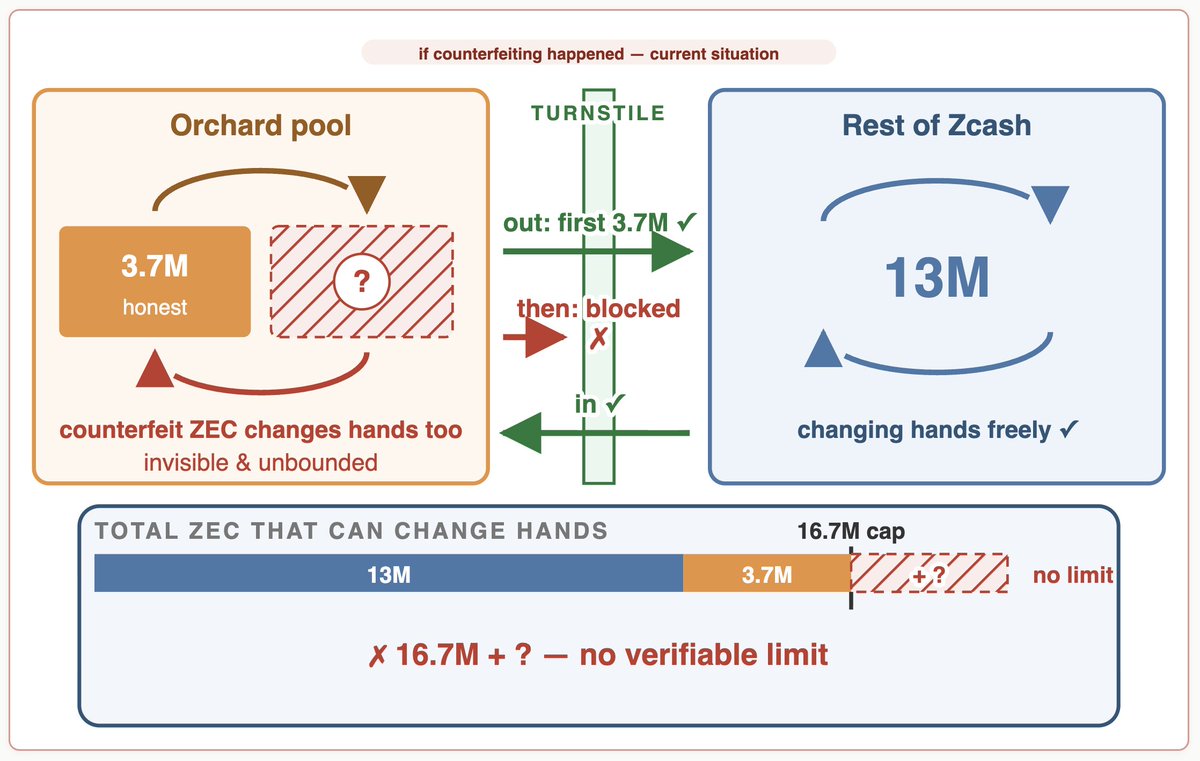


However, the planned Ironwood network upgrade will address this issue. The logic is as follows:
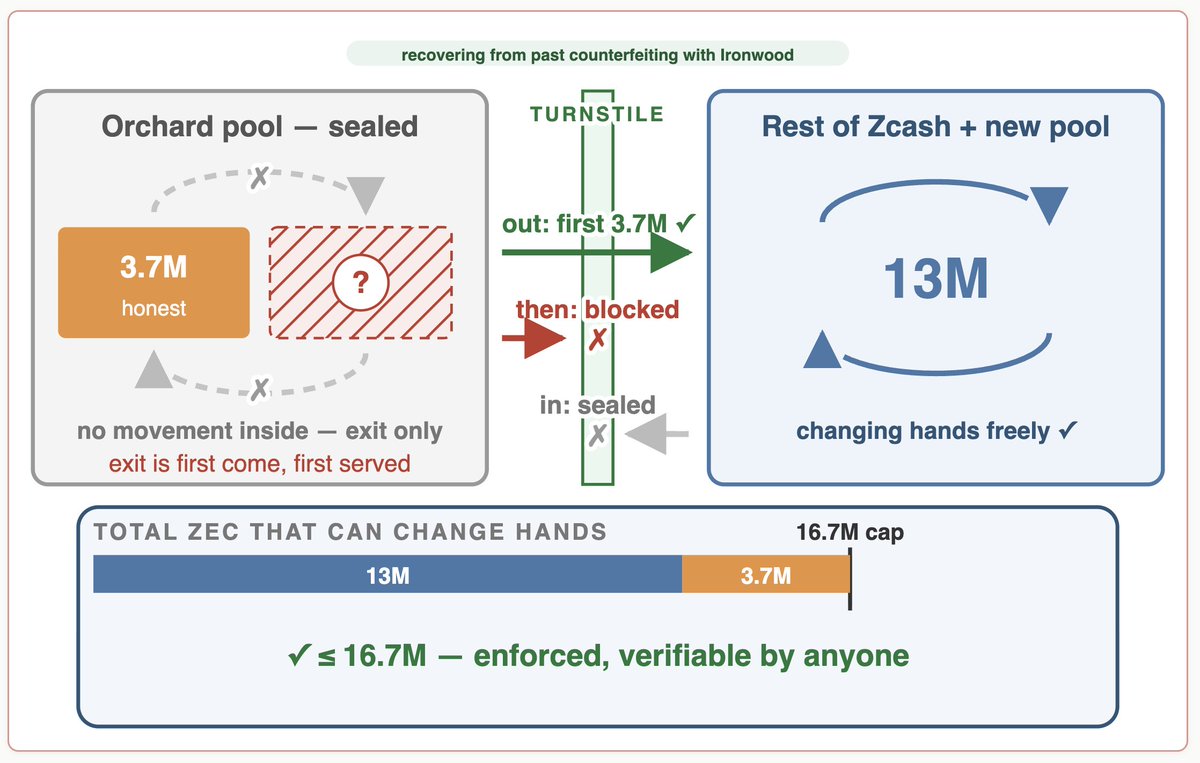


This upgrade will permanently close the Orchard pool, disallowing new asset deposits. Tokens within the pool will no longer be able to move internally; all assets can only be withdrawn through the original channels. The total withdrawal amount from these channels strictly equals the amount of legitimate tokens originally deposited, fundamentally preventing any excess outflow of tokens.


After the upgrade is complete, anyone running a node will be able to verify that the total token supply is compliant. Even if counterfeit tokens were created in the past, they will no longer be able to circulate within the Orchard pool, artificially inflating the total supply. Users won't need to speculate about the actions of hackers or other users; the protocol itself will guarantee that token over-issuance cannot occur.


This point is crucial. Zcash's long-term credibility is built on users' ability to independently verify the total token supply. The Ironwood upgrade will restore this capability to users.


How to Confirm the Project Has No Other Token Forgery Vulnerabilities?


At this stage, we cannot give an absolute answer, but we have reason to believe no similar vulnerabilities currently exist.


Shielded Labs, in collaboration with several teams, conducted a comprehensive review of the Zcash protocol, specifically searching for token forgery vulnerabilities. During this process, the team also utilized Anthropic's not-yet-publicly-released Mythos AI model for auxiliary detection. We will publish a follow-up article detailing the process and results of this review.


To date, the team has not discovered any new forgery vulnerabilities. This review assembled experienced technical personnel, professional security teams, and advanced AI analysis tools, which further strengthens our confidence that there are currently no undisclosed high-risk vulnerabilities of the same type.


Simultaneously, we are collaborating with partners like the Tachyon project to conduct additional inspections, further strengthening our security defenses. Related progress will also be announced later.


Summary


This Orchard vulnerability raises four core questions: whether the vulnerability was exploited, whether legitimate assets can be withdrawn, whether the total token supply can be verified, and whether other forgery vulnerabilities exist.


Based on the current investigation results, we assess that the likelihood of the vulnerability being exploited previously is low. Therefore, user assets are safe, and the total token supply currently remains normal. After repeated inspections by multiple independent teams, we are increasingly confident that the project currently has no other undiscovered forgery vulnerabilities.


However, one point is unavoidable: currently, users cannot independently verify the total token supply. The upcoming network upgrade will completely solve this problem. After the upgrade, the Orchard pool will be permanently closed, allowing users to independently verify the total token supply without needing to judge whether token forgery has ever occurred.


Trend Kriptolar

İlgili Sorular

QWhat are the four key questions raised by the Orchard security vulnerability?

AThe four key questions are: 1) Has the vulnerability been exploited? 2) Can legitimate user assets stored in Orchard be withdrawn normally? 3) Can users independently verify that the total Zcash supply has not been artificially increased? 4) How can we confirm there are no other similar token counterfeiting vulnerabilities in the project?

QWhat is the primary reason why the authors believe the Orchard vulnerability likely hasn't been exploited?

AThe authors believe exploitation is unlikely primarily because the vulnerability was discovered through proactive investigation by Shielded Labs using specialized AI detection tools, not due to a public exposure. They argue that exploiting it requires deep expertise and that typical cryptocurrency attackers would likely have cashed out already, leaving detectable traces, which haven't been observed.

QHow does the planned Ironwood network upgrade aim to restore users' ability to verify the Zcash supply?

AThe Ironwood upgrade will permanently close the Orchard pool, preventing new deposits and internal transfers. All assets can only be withdrawn via the original channels, whose total withdrawal amount is strictly capped at the amount of legitimate tokens originally deposited. This prevents any excess tokens from leaving the pool, allowing anyone running a node to verify the total supply compliance.

QWhat risks do users face if they choose to transfer their assets out of the Orchard pool?

ATransferring to a transparent address (t-address) reveals the amount, timing, and links the assets to that address, losing all privacy. Transferring to the Sapling pool offers better privacy but relies on a 2018 trusted setup ceremony, which introduces its own security considerations. Additionally, users may face risks from operational errors, software bugs, or platform restrictions when using wallets or custodial services.

QWhat measures have been taken to search for other potential token counterfeiting vulnerabilities in Zcash?

AShielded Labs, in collaboration with other teams, conducted a comprehensive audit of the Zcash protocol specifically for token counterfeiting vulnerabilities. They utilized advanced tools including an unreleased AI model from Anthropic called Mythos. So far, no new such vulnerabilities have been found, increasing confidence that no other high-risk, undisclosed vulnerabilities of this type exist.

İlgili Okumalar

7 Months After the Collapse of Huiwang, Southeast Asia's Escrow Platforms Undergo a Major Reshuffle

Following the collapse of Huione Pay—dubbed the "Alipay of Southeast Asia"—seven months ago, the region's underground financial guarantee platform sector is undergoing a significant reshuffle. This power vacuum has been swiftly filled by emerging platforms such as XinBi, Tiger/Navigator, JinBei (renamed JinBo), Dali/Tiancheng, and FullyLight. These platforms, operating largely via Telegram and offering services like escrow for illicit transactions, have absorbed the vast user base and markets left behind by Huione. While positioning themselves as "trust intermediaries," their primary clientele consists of networks involved in online scams, money laundering, illegal gambling, and even human trafficking. For instance, the Tiger/Navigator platform explicitly provides "escrow" services for kidnapping-for-ransom operations ("强押车交易"). Data underscores the immense scale: Huione alone processed over $103 billion in cryptocurrency payments and facilitated over $31 billion through its escrow market before its downfall, linking it to Cambodia's notorious Prince Group. Since its collapse, competitors have seen explosive growth. For example, the XinBi platform has accumulated over $1.6 billion in total USDT revenue, while platforms like NewPay, OkPay (under Dali), and FullyLight Wallet collectively processed over $4.8 billion in USDT in a single year. This ecosystem thrives in regions like Cambodia and Myanmar, where regulatory gaps allow these platforms to act as critical financial infrastructure for sprawling cybercrime industries, from scam compounds to online casinos. The article concludes that the moniker "Southeast Asian Alipay" is a misnomer, obscuring the platforms' fundamental role in enabling serious criminal enterprises rather than representing legitimate financial innovation.

Odaily星球日报19 dk önce

7 Months After the Collapse of Huiwang, Southeast Asia's Escrow Platforms Undergo a Major Reshuffle

Odaily星球日报19 dk önce

The Changing Landscape: What Are Crypto VCs Experiencing?

Title: The Shifting Landscape of Crypto Venture Capital The era of dedicated crypto venture capital funds is undergoing a significant transformation. Once essential for navigating the sector's complexity and high risk, these specialized funds are now facing an identity crisis as the market matures. This shift mirrors historical patterns in other specialized investment classes like cleantech and SPACs, where initial information advantages dissipate as technologies become mainstream and integrated into existing industry frameworks. The article argues that crypto is reaching a critical inflection point, transitioning from a "building phase" to an "integration phase." Major players like Stripe, BlackRock, and Visa now engage with crypto not for its novel mechanics but as a foundational financial infrastructure. Their needs—regulatory compliance, banking partnerships, distribution channels—align with traditional fintech, a domain easily understood by large, generalist funds like Sequoia and Founders Fund. This evolution creates a "barbell effect" within the VC landscape. On one end are massive, diversified platforms that can incorporate crypto as one vertical among many. On the other are small, nimble funds focused on niche, experimental projects. The middle ground—medium-sized dedicated crypto funds—is being squeezed out. Their typical fund size makes it impossible to generate sufficient returns solely from early-stage crypto bets, yet they cannot compete with giants for later-stage deals. Consequently, leading crypto-native firms like Paradigm and Framework Ventures are expanding into AI, robotics, and other sectors, driven partly by LP pressure for better returns amid a broader VC DPI crisis. Others, like Dragonfly and a16z, have narrowed their crypto focus predominantly to financial infrastructure like stablecoins, reframing the sector's core narrative. For crypto entrepreneurs, this consolidation presents challenges. While generalist funds offer larger checks and broader resources, crypto projects now compete fiercely with AI for attention and capital within these firms. Furthermore, the long-term, non-commercial foundational work that built the ecosystem—funded by dedicated crypto VCs—is less likely to attract generalist capital focused on direct returns. The conclusion is that "crypto investor" as a standalone category is becoming obsolete, akin to "internet investor." Crypto is becoming a baseline infrastructure layer. The future will see a barbell structure: large-scale growth financing handled by generalist funds, while pioneering, speculative projects are funded by small, specialized vehicles. The dedicated crypto funds of the 2017-2021 boom, which incubated core infrastructure, are giving way to this new, bifurcated reality.

Foresight News36 dk önce

The Changing Landscape: What Are Crypto VCs Experiencing?

Foresight News36 dk önce

As Consensus Accelerates, What Are Young Investors Betting On?

Title: As Consensus Forms Faster, What Are Young Investors Betting On? In the rapid evolution of tech investment, a new generation of young investors is navigating a landscape where AI, robotics, commercial aerospace, and quantum computing are advancing simultaneously. Traditional investment logic based on financial models is giving way to a need for deep technical understanding and the ability to act before industry consensus forms. An analysis of trends from the "WAIC FUTURE TECH" list of young investment leaders reveals key shifts in focus. The first major trend is the movement of AI from the digital screen into the physical world. Investment is shifting from large language models and chatbots towards embodied AI, robotics, AI hardware, and edge computing. While demonstrations generate excitement, the real challenge lies in achieving scalable, reliable, and cost-effective delivery in complex real-world environments like factories and logistics. Success depends not just on algorithms but on the integration of sensors, actuators, and control systems. Second, the competitive focus for large models is moving beyond raw capability toward building an "intelligence flywheel." The goal is to create self-reinforcing systems where user interaction generates data, improving the model, which in turn enhances the user experience and attracts more engagement. Companies that successfully embed AI into workflows to create these closed-loop systems can build lasting value that isn't easily erased by the next model upgrade. Third, facing a potential bottleneck in high-quality human-generated data, investors are looking at new underlying technologies. Reinforcement learning and self-play, as demonstrated by AlphaGo Zero, offer paths for AI to generate its own experience. Scientific foundation models, which aim to build general AI capabilities for fields like life sciences and materials discovery, represent a non-consensus direction that could unlock new frontiers of knowledge and data. Finally, in deep-tech areas like quantum computing, commercial aerospace, and space-based infrastructure, patient capital is essential. These fields have long, uncertain development and validation cycles involving complex engineering, supply chains, and regulations. Investment here requires a long-term view, focusing on foundational team capabilities and the eventual emergence of market demand, even if commercial returns are distant. Collectively, these trends illustrate how young investors are adapting to a new era. They are learning to make earlier, technically-informed judgments, balance hype with real-world viability, and provide the patient capital needed to build the deep-tech foundations of the future.

marsbit1 saat önce

As Consensus Accelerates, What Are Young Investors Betting On?

marsbit1 saat önce

İşlemler

Spot

Popüler Makaleler

ZEC Nasıl Satın Alınır

HTX.com’a hoş geldiniz! Zcash (ZEC) satın alma işlemlerini basit ve kullanışlı bir hâle getirdik. Adım adım açıkladığımız rehberimizi takip ederek kripto yolculuğunuza başlayın. 1. Adım: HTX Hesabınızı OluşturunHTX'te ücretsiz bir hesap açmak için e-posta adresinizi veya telefon numaranızı kullanın. Sorunsuzca kaydolun ve tüm özelliklerin kilidini açın. Hesabımı Aç2. Adım: Kripto Satın Al Bölümüne Gidin ve Ödeme Yönteminizi SeçinKredi/Banka Kartı: Visa veya Mastercard'ınızı kullanarak anında Zcash (ZEC) satın alın.Bakiye: Sorunsuz bir şekilde işlem yapmak için HTX hesap bakiyenizdeki fonları kullanın.Üçüncü Taraflar: Kullanımı kolaylaştırmak için Google Pay ve Apple Pay gibi popüler ödeme yöntemlerini ekledik.P2P: HTX'teki diğer kullanıcılarla doğrudan işlem yapın.Borsa Dışı (OTC): Yatırımcılar için kişiye özel hizmetler ve rekabetçi döviz kurları sunuyoruz.3. Adım: Zcash (ZEC) Varlıklarınızı SaklayınZcash (ZEC) satın aldıktan sonra HTX hesabınızda saklayın. Alternatif olarak, blok zinciri transferi yoluyla başka bir yere gönderebilir veya diğer kripto para birimlerini takas etmek için kullanabilirsiniz.4. Adım: Zcash (ZEC) Varlıklarınızla İşlem YapınHTX'in spot piyasasında Zcash (ZEC) ile kolayca işlemler yapın.Hesabınıza erişin, işlem çiftinizi seçin, işlemlerinizi gerçekleştirin ve gerçek zamanlı olarak izleyin. Hem yeni başlayanlar hem de deneyimli yatırımcılar için kullanıcı dostu bir deneyim sunuyoruz.

628 Toplam GörüntülenmeYayınlanma 2024.12.12Güncellenme 2026.06.02

ZEC Nasıl Satın Alınır

Tartışmalar

HTX Topluluğuna hoş geldiniz. Burada, en son platform gelişmeleri hakkında bilgi sahibi olabilir ve profesyonel piyasa görüşlerine erişebilirsiniz. Kullanıcıların ZEC (ZEC) fiyatı hakkındaki görüşleri aşağıda sunulmaktadır.

活动图片












