Zcash surges 20% after breakout – ZEC traders, watch THIS for next move

ambcrypto2026-03-17 tarihinde yayınlandı2026-03-17 tarihinde güncellendi

Özet

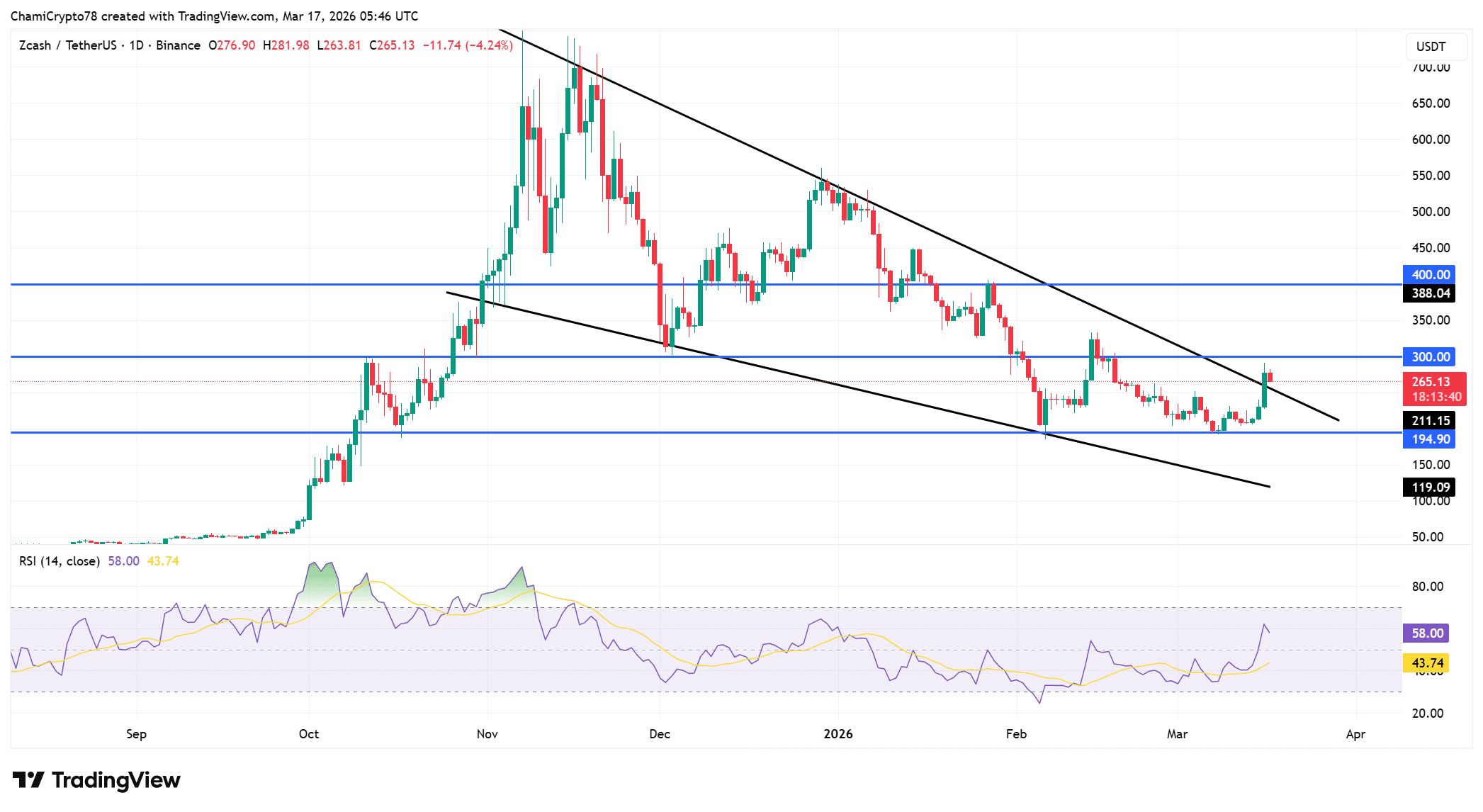
Zcash (ZEC) surged over 20% in 24 hours, breaking out of a descending wedge pattern and signaling a potential bullish shift. The price moved from the $194.90 support level toward the $300 resistance zone, with RSI strengthening to 58, indicating growing buying interest without overbought conditions. However, underlying metrics present mixed signals: Spot Taker CVD remains sell-dominant, suggesting persistent selling pressure, and the funding rate is negative (-0.032%), reflecting heavy short positioning. This sets the stage for potential short squeezes and increased volatility near key resistance. While the breakout shows strength, the sustainability of the rally depends on overcoming layered resistance and resolving conflicting market dynamics.

Zcash has surged over 20% in 24 hours as trading volume rises over 76%, reflecting a sharp increase in participation and aggressive positioning.

This expansion in activity signals renewed interest after a prolonged decline. Zcash [ZEC] has pushed upward from the $194.90 support zone, showing buyers stepping in with conviction.

However, underlying metrics still present mixed signals that require careful interpretation.

While price continues climbing, structural resistance remains nearby, which could influence short-term direction.

Breakout from wedge signals recovery push for Zcash

Zcash has broken out of a descending wedge, shifting its short-term structure toward bullish territory.

This breakout follows a sustained compression phase where price respected lower highs within the wedge formation.

After rebounding from $194.90, the price has advanced toward the $300 resistance zone, which now acts as the immediate barrier.

However, the broader trendline from previous highs still looms above, suggesting that upside continuation must overcome layered resistance.

The breakout itself indicates improving market strength, yet the proximity to resistance introduces friction.

As a result, price now tests a critical decision zone where continuation or rejection could define the next directional phase.

RSI has climbed toward 58, reflecting strengthening buyer activity without entering overbought territory.

This positioning suggests that buying pressure has increased steadily rather than accelerating into exhaustion.

Earlier, RSI remained suppressed during the downtrend, which aligned with weakening ZEC price action.

Now, the shift toward neutral-bullish levels highlights improving sentiment among participants.
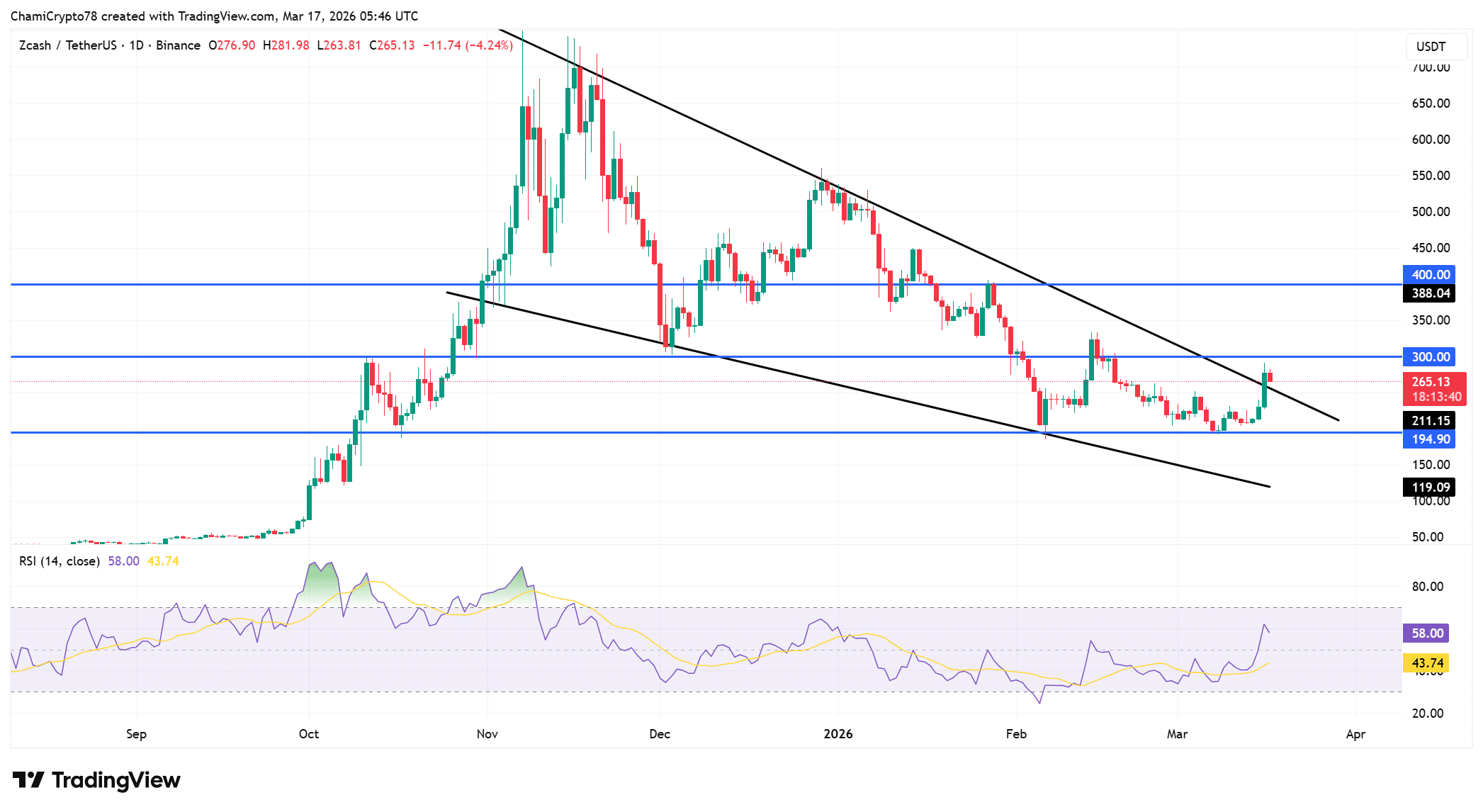
Source: TradingView

Sell-dominant CVD signals hidden pressure

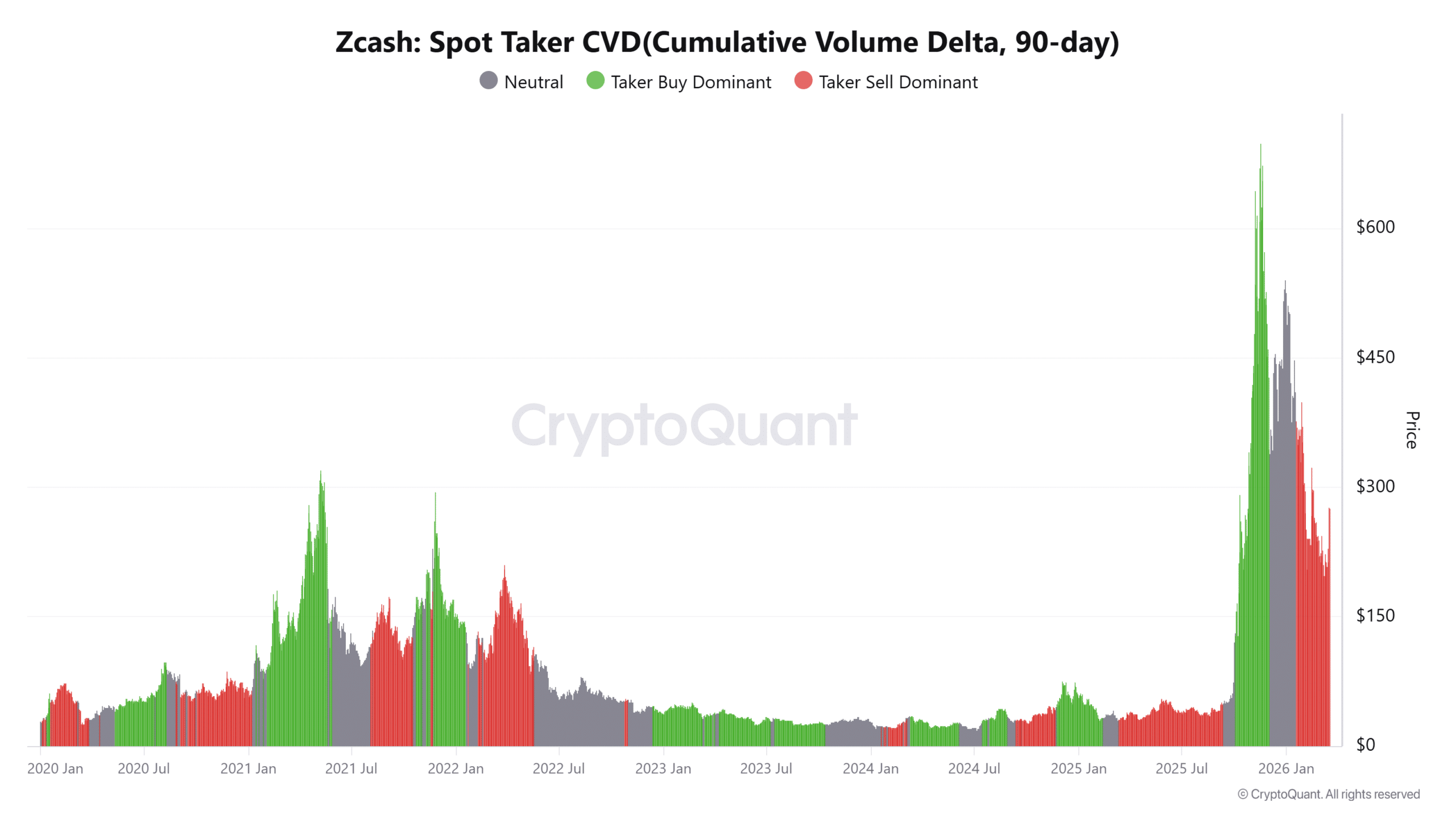
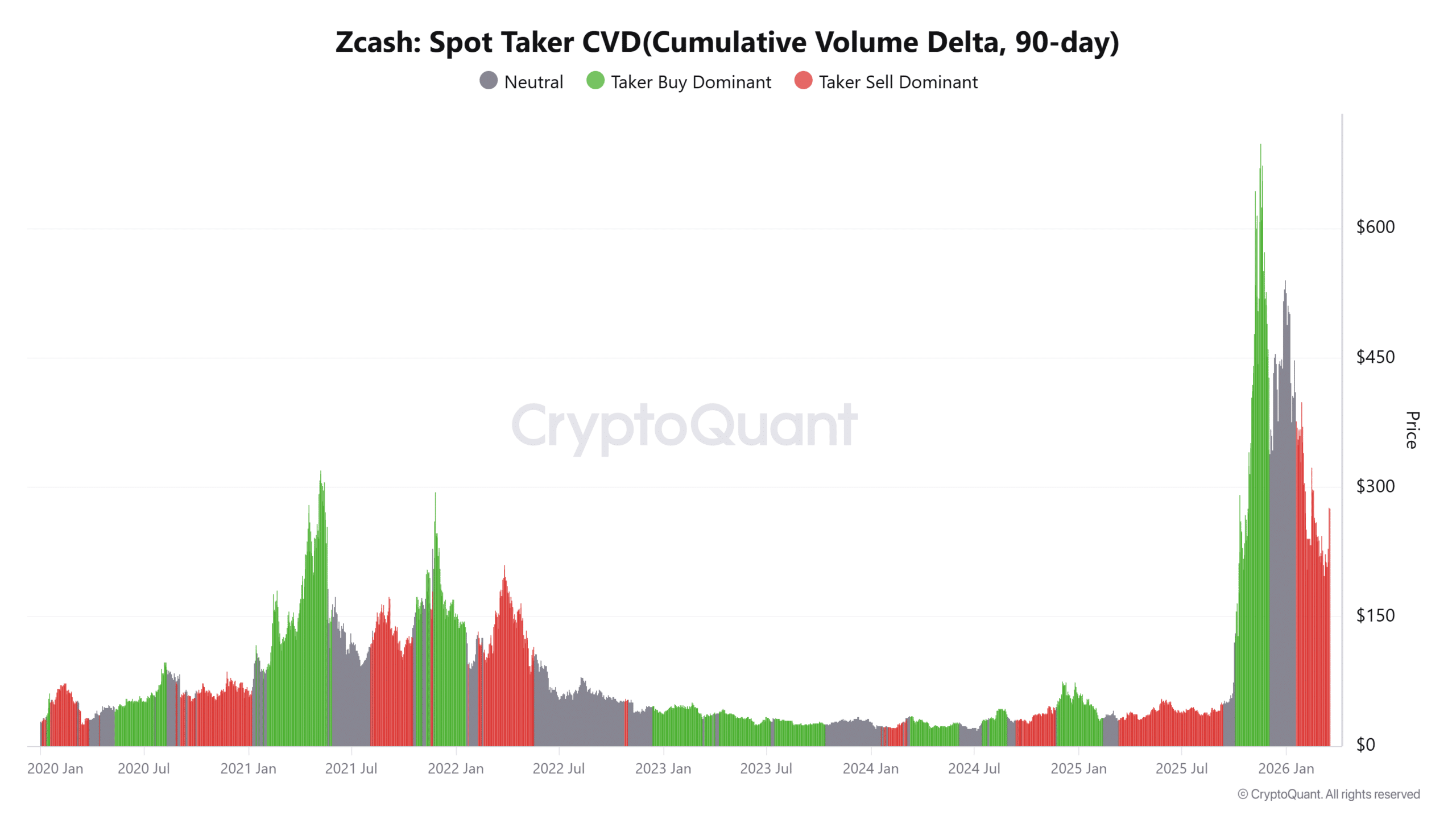
At the time of writing, Spot Taker CVD over the 90-day period remained sell-dominant, indicating that market sell orders have continued to outweigh buy orders despite the recent rally.

This divergence creates an important contrast between visible price strength and underlying order flow dynamics.

While price has moved upward, aggressive sellers have maintained influence in the broader structure.

However, such conditions can also reflect absorption, where buyers gradually take supply without immediate price collapse.

This dynamic suggests that the rally may not rely purely on organic demand.

Instead, it highlights a complex interaction between accumulation and distribution, which introduces uncertainty around the sustainability of the current move.
Negative funding reveals crowded short positioning on Zcash

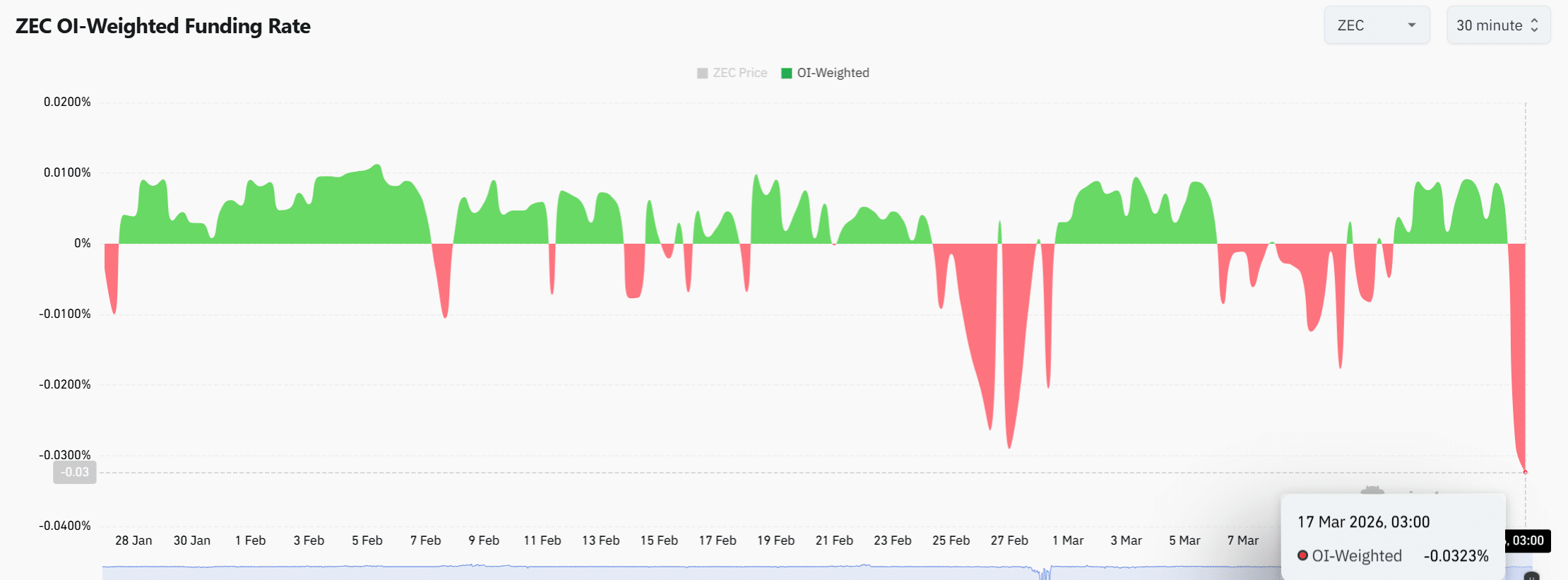
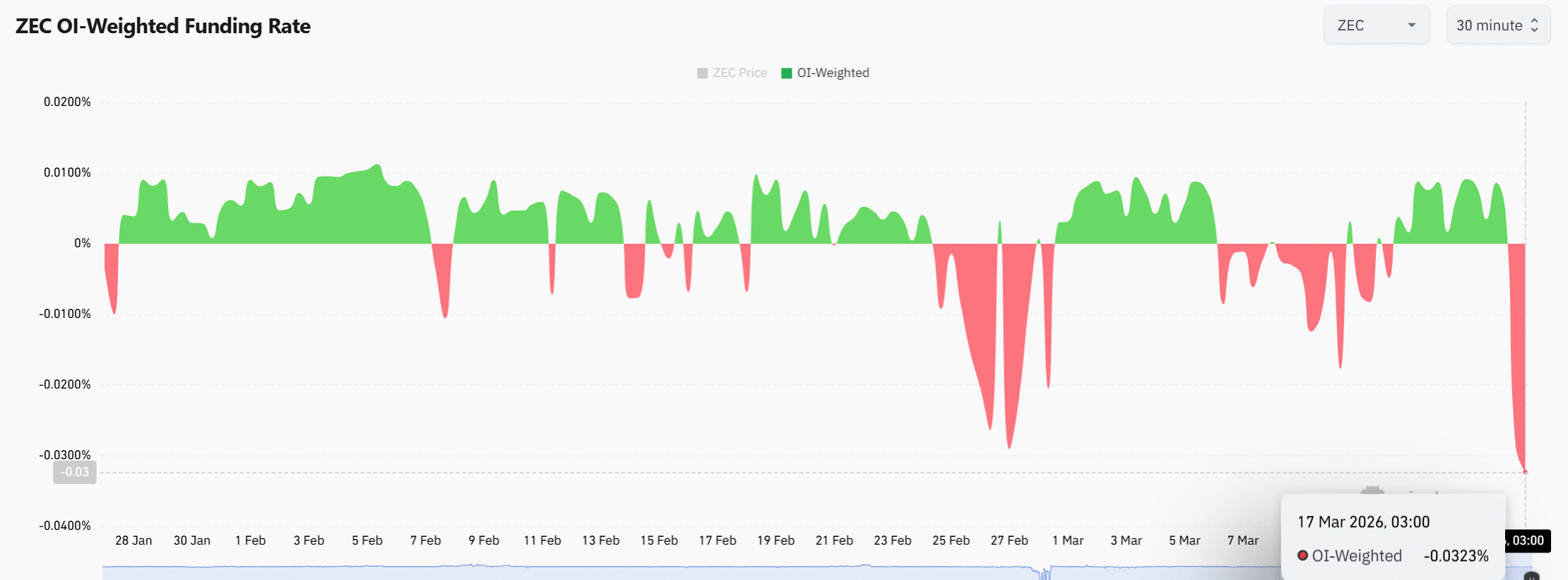
OI-Weighted Funding Rate has dropped to approximately -0.032%, signaling that short positions dominate the Derivatives market.

This shift reflects growing bearish positioning even as price trends upward in the short term. When funding turns deeply negative, it often indicates that traders expect downside continuation.

However, this imbalance can create conditions for sharp upside moves if shorts begin to unwind. As the price approaches the $300 resistance zone, this positioning becomes increasingly relevant.

A continued upward push could force short liquidations, amplifying volatility. Therefore, the derivatives landscape currently supports heightened price sensitivity around key resistance levels.
Source: CoinGlass

Zcash’s rally showed clear strength after breaking out of the descending wedge, supported by rising RSI and strong volume expansion.

However, persistent sell pressure in Spot Taker CVD and heavy short positioning introduces conflicting signals beneath the surface.

While short squeezes could extend upside moves, the $300 resistance remains a decisive barrier, meaning the rally would likely continue with volatility rather than a smooth trend.


Final Summary

  • Zcash showed an improving structure, but resistance pressure could still challenge continuation despite current breakout strength holding firm.
  • Short positioning imbalance may drive volatility higher, potentially extending gains while increasing risk of sharp reversals near resistance.


İlgili Sorular

QWhat was the percentage surge in Zcash's price and the increase in trading volume mentioned in the article?

AZcash surged over 20% in 24 hours, and its trading volume rose over 76%.

QFrom which key support level did ZEC price rebound, and what is the immediate resistance it is approaching?

AZEC rebounded from the $194.90 support level and is now approaching the $300 resistance zone.

QWhat does the negative OI-Weighted Funding Rate of approximately -0.032% indicate about market positioning?

AIt indicates that short positions dominate the derivatives market, reflecting growing bearish positioning among traders.

QWhat technical pattern did Zcash break out of, and what does this breakout signal?

AZcash broke out of a descending wedge pattern, which signals a shift in short-term structure toward bullish territory.

QAccording to the article, what two underlying metrics present mixed signals despite the price rally?

AThe Spot Taker CVD, which remains sell-dominant, and the negative funding rate, which indicates heavy short positioning, present mixed signals.

İlgili Okumalar

How Many Tokens Away Is Yang Zhilin from the 'Moon Chasing the Light'?

The article explores the intense competition between two leading Chinese AI companies, DeepSeek and Kimi (Moon Dark Side), and the mounting pressure on Yang Zhilin, the founder of Kimi. While DeepSeek re-emerged after 15 months of silence with its powerful V4 model—boasting 1.6 trillion parameters and low-cost, long-context capabilities—Kimi has been focusing on long-context processing and multi-agent systems with its K2.6 model. Yang faces a threefold challenge: technological rivalry, commercialization pressure, and investor expectations. Despite Kimi’s high valuation (reaching $18 billion), its revenue heavily relies on a single product with low paid conversion rates, while DeepSeek’s strategic silence and open-source influence have strengthened its market position and valuation prospects, now targeting over $20 billion. Both companies reflect broader trends in China’s AI ecosystem: Kimi aims for global influence through open-source contributions and agent-based advancements, while DeepSeek prioritizes foundational innovation and hardware independence, notably shifting to Huawei’s chips. Their competition is seen as vital for China’s AI progress, with the gap between top Chinese and U.S. models narrowing to just 2.7% on the Elo rating scale. Ultimately, the article argues that this rivalry, though anxiety-inducing for leaders like Zhilin, is essential for driving innovation and solidifying China’s role in the global AI landscape.

marsbit4 saat önce

How Many Tokens Away Is Yang Zhilin from the 'Moon Chasing the Light'?

marsbit4 saat önce

TechFlow Intelligence Bureau: ChatGPT Helps Amateur Mathematician Crack 60-Year-Old Problem, CFTC Sues New York Regulator Over Coinbase and Gemini

An amateur mathematician, with the assistance of ChatGPT, has solved a combinatorial mathematics puzzle originally proposed by Hungarian mathematician Paul Erdős in the 1960s. This marks another milestone in AI-aided mathematical research, demonstrating the evolving capabilities of large language models in formal reasoning. In other AI developments, OpenAI introduced a new privacy filter tool for enterprise API usage, automatically screening sensitive data. Meanwhile, the Qwen3.6-27B model achieved 100 tokens per second on a single RTX 5090 GPU using quantization, significantly lowering the cost barrier for local AI deployment. In crypto and Web3, the U.S. CFTC sued New York’s financial regulator, challenging its oversight of Coinbase and Gemini—a first-of-its-kind federal-state regulatory clash. Following a vulnerability, KelpDAO and major DeFi protocols established a recovery fund. Tether froze $344 million in assets linked to Iran’s central bank upon U.S. Treasury request, highlighting the centralized control risks in stablecoins. Separately, Litecoin underwent a 3-hour chain reorganization to undo a privacy-layer exploit. In the U.S., former President Trump invoked the Defense Production Act to address power grid bottlenecks affecting AI data centers and dismissed the entire National Science Board, raising concerns over research independence. A retail trader gained 250% on a $600k Intel options bet amid AI-related speculation. Xiaomi announced its first performance electric vehicle, targeting rivals like Tesla. Meanwhile, iPhone users reported devices automatically reinstalling a hidden app daily, suspected to be MDM-related. A Chinese securities report noted that A-share institutional crowding has reached its second-longest streak since 2007, signaling high valuations and potential style rotation. The day’s developments reflect a dual narrative: AI is enabling unprecedented individual breakthroughs, while centralized power structures—whether governmental or corporate—are becoming more assertive, underscoring that decentralization is as much a political-economic challenge as a technical one.

marsbit4 saat önce

TechFlow Intelligence Bureau: ChatGPT Helps Amateur Mathematician Crack 60-Year-Old Problem, CFTC Sues New York Regulator Over Coinbase and Gemini

marsbit4 saat önce

İşlemler

Spot
Futures

Popüler Makaleler

ZEC Nasıl Satın Alınır

HTX.com’a hoş geldiniz! Zcash (ZEC) satın alma işlemlerini basit ve kullanışlı bir hâle getirdik. Adım adım açıkladığımız rehberimizi takip ederek kripto yolculuğunuza başlayın. 1. Adım: HTX Hesabınızı OluşturunHTX'te ücretsiz bir hesap açmak için e-posta adresinizi veya telefon numaranızı kullanın. Sorunsuzca kaydolun ve tüm özelliklerin kilidini açın. Hesabımı Aç2. Adım: Kripto Satın Al Bölümüne Gidin ve Ödeme Yönteminizi SeçinKredi/Banka Kartı: Visa veya Mastercard'ınızı kullanarak anında Zcash (ZEC) satın alın.Bakiye: Sorunsuz bir şekilde işlem yapmak için HTX hesap bakiyenizdeki fonları kullanın.Üçüncü Taraflar: Kullanımı kolaylaştırmak için Google Pay ve Apple Pay gibi popüler ödeme yöntemlerini ekledik.P2P: HTX'teki diğer kullanıcılarla doğrudan işlem yapın.Borsa Dışı (OTC): Yatırımcılar için kişiye özel hizmetler ve rekabetçi döviz kurları sunuyoruz.3. Adım: Zcash (ZEC) Varlıklarınızı SaklayınZcash (ZEC) satın aldıktan sonra HTX hesabınızda saklayın. Alternatif olarak, blok zinciri transferi yoluyla başka bir yere gönderebilir veya diğer kripto para birimlerini takas etmek için kullanabilirsiniz.4. Adım: Zcash (ZEC) Varlıklarınızla İşlem YapınHTX'in spot piyasasında Zcash (ZEC) ile kolayca işlemler yapın.Hesabınıza erişin, işlem çiftinizi seçin, işlemlerinizi gerçekleştirin ve gerçek zamanlı olarak izleyin. Hem yeni başlayanlar hem de deneyimli yatırımcılar için kullanıcı dostu bir deneyim sunuyoruz.

509 Toplam GörüntülenmeYayınlanma 2024.12.12Güncellenme 2025.03.21

ZEC Nasıl Satın Alınır

Tartışmalar

HTX Topluluğuna hoş geldiniz. Burada, en son platform gelişmeleri hakkında bilgi sahibi olabilir ve profesyonel piyasa görüşlerine erişebilirsiniz. Kullanıcıların ZEC (ZEC) fiyatı hakkındaki görüşleri aşağıda sunulmaktadır.

活动图片