Zcash Founder Says Ironwood Will Verify ZEC Supply On Day One

bitcoinist2026-06-10 tarihinde yayınlandı2026-06-10 tarihinde güncellendi

Özet

Zcash founder Zooko Wilcox states that the proposed Ironwood upgrade will allow users to independently and immediately verify the correctness of ZEC's circulating supply from its first day of activation. This addresses community concerns following a remediated Orchard vulnerability, shifting focus from proving past counterfeiting to enabling trustless, real-time supply verification. Ironwood will deactivate the old, shielded Orchard pool for new transactions, requiring funds to pass through a turnstile accounting mechanism to enter the new pool. This design, according to Wilcox, will "snuff out" any potential excess ZEC above the legitimate 4.5 million ZEC in Orchard, ensuring the total supply aligns with the known 16 million ZEC (eventually 21 million). Users running a full node can thus verify supply soundness without relying on trust in developers or assumptions about past events. While Wilcox personally believes no counterfeiting occurred, Ironwood is designed to function regardless. If excess ZEC attempts to exit the old pool, the turnstile will block it, both protecting the supply and potentially revealing any past exploit. The upgrade aims to provide definitive, trustless assurance about the current supply state.

Zcash founder Zooko Wilcox says the proposed Ironwood upgrade will give users immediate, trustless verification that ZEC’s circulating supply is sound from the first block of activation. His comments address a central concern in the Zcash community following the disclosure of a recently remediated Orchard vulnerability: whether users can verify the supply without relying on developers, auditors, or post-hoc assumptions.

In a post on X and a follow-up discussion on the Zcash Community Forum, Wilcox argued that Ironwood’s purpose is not primarily to prove whether counterfeiting ever occurred inside Orchard. Instead, he framed the upgrade as a way to make the current circulating supply independently verifiable by any user running a full node.

“When Zcash Ironwood activates, you will immediately, on Day 1 of Ironwood, gain trustless verification from your own full node that the actual supply of Zcash is correct,” Wilcox wrote, referring to “16M ZEC now, 21M ZEC eventually.”

Zcash Ironwood To Enable Trustless Supply Checks

The distinction matters because the Orchard pool is shielded. That privacy property is central to Zcash’s design, but it also complicates the question of whether a past soundness bug could have been exploited without leaving the kind of public trace visible in a transparent ledger. Wilcox’s response is to separate two issues that have become conflated in the debate: whether counterfeit coins were ever created, and whether the current supply can be verified as sound after Ironwood.

“This appears to be super confusing to almost everyone, because they are confusing two different things: No counterfeit coins were created. The current supply is sound,” Wilcox wrote. “These are different things! I’m prioritizing the second one.”

Under the Ironwood proposal, the old Orchard pool would effectively be prevented from continuing as an active internal circulation venue. Transactions creating new outputs in the old Orchard pool would be rejected, meaning funds could no longer keep moving privately inside that pool after activation. Instead, funds would have to exit through Zcash’s turnstile accounting mechanism before entering the new Ironwood pool.

That turnstile is the key to the argument. It tracks how much ZEC legitimately entered and exited a pool and blocks attempts to move out more than the amount that entered. According to Wilcox, that means users do not need to wait for every Orchard user to migrate, nor rely on game-theoretic assumptions about how a hypothetical attacker might behave.

“And what I said above — that you will immediately gain that trustless, local verification of the soundness of the Zcash supply — is true regardless of whether or not there are any counterfeit coins in the Orchard pool,” he wrote. “How is this possible!? Because Ironwood will, on Day 1, in the first block that activates Ironwood, snuff out any excess ZEC in the Orchard pool.”

Wilcox specified the relevant threshold as the amount “legitimately part of the supply of ZEC in the Orchard pool,” which he put at 4.5 million ZEC. Any excess ZEC above that would be unable to remain economically useful under the new rules, because it could not continue circulating within the old Orchard pool or escape into another pool beyond the turnstile limit.

“It will snuff out any excess ZEC immediately, trustlessly, and globally,” he added. “It will snuff out any excess ZEC regardless of whether there actually is any excess ZEC. If there isn’t, then all Ironwood does is give you the ability to prove to yourself that there isn’t.”

Wilcox said he personally believes there is no counterfeit ZEC, citing reasons he said he had previously given. But he emphasized that Ironwood is designed to remove the need for trust in his assessment, or in any other individual’s judgment. In his forum post, he laid out two possible worlds: one in which an unlimited amount of counterfeit ZEC was created inside Orchard before the vulnerability was closed, and one in which it was not. In both, he argued, Ironwood should allow users to verify on Day 1 that no more than 16 million ZEC is currently circulating.

The proposal may also produce evidence over time about whether Orchard was ever exploited. If no excess ZEC attempts to leave the old pool as users migrate, that would support the view that no counterfeiting occurred. If excess ZEC does try to leave, the turnstile should reject it, preserving the circulating supply while exposing that counterfeiting had taken place.

At press time, ZEC traded at $
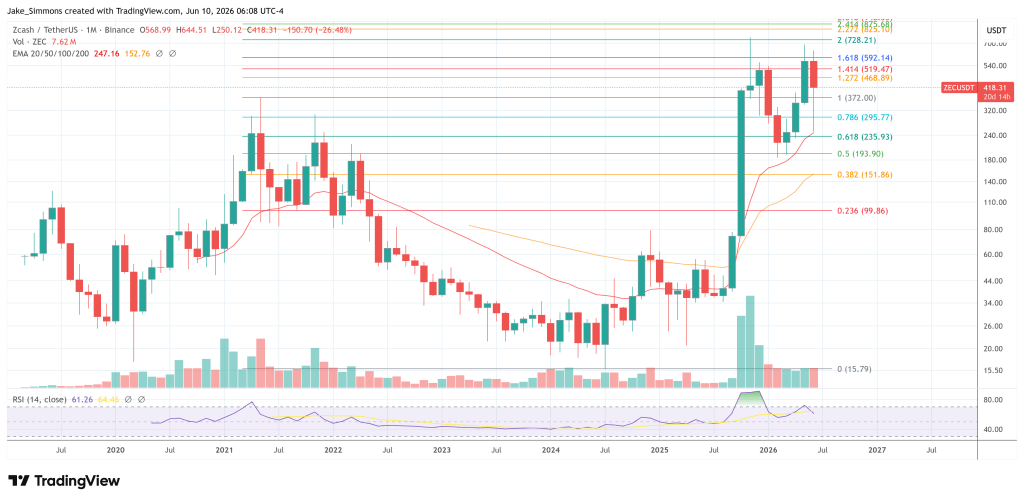
ZEC remains above the prior all-time high, 1-month chart | Source: ZECUSDT on TradingView.com

Trend Kriptolar

İlgili Okumalar

Conversation with Co-founder of Hyperdash: Why is Hyperliquid Still Severely Undervalued?

Interview Summary with Hanson Birringer, Co-founder of Hyperdash: Why Hyperliquid Remains Undervalued In an interview on *The Rollup*, Hanson Birringer, Co-founder and Chief Revenue Officer of Hyperdash—a trading data analytics platform for Hyperliquid—shared his investment thesis on the Hyperliquid ecosystem. He described Hyperliquid as a pure play on three key crypto super-trends: perpetual contracts, real-world assets (RWAs), and stablecoins. The platform is an open-source, decentralized, and high-performance financial system uniquely positioned to bridge traditional institutional capital with decentralized finance. Birringer highlighted Hyperliquid's leadership in perpetual DEX trading and its recent innovation of RWA perpetual contracts. He emphasized the significance of USDC becoming a core quoting asset, which, by allocating 90% of its backend yield from assets like US treasuries to a protocol buyback fund, creates substantial, programmatic buy pressure for the Hype token. He addressed regulatory challenges, noting that Hyperliquid's policy team is actively engaging with US regulators like the CFTC to establish clear rules for decentralized venues. Once achieved, regulated brokers could route orders directly to Hyperliquid's backend, tapping into its low-cost liquidity layer. Regarding revenue, Birringer was optimistic, citing the immense size of traditional financial markets. Even capturing a small fraction of global trading volume in products like RWA perpetuals could lead to exponential growth for the protocol. The recently launched Grayscale Hyperliquid ETF, seeded by their SPV (Hyper Holdings Global), provides a compliant on-ramp for institutional investors drawn to the clear "cash flow + token buyback" model. Finally, he discussed Hyperdash's acquisition of Imperator, enhancing its data and node infrastructure to serve both retail traders and traditional asset managers. His bullish case rests on Hyperliquid's potential to provide unprecedented global access to dollar-based capital markets. He struggled to articulate a bear case, seeing the long-term trends of internet adoption and financial inclusion as powerful tailwinds.

marsbit44 dk önce

Conversation with Co-founder of Hyperdash: Why is Hyperliquid Still Severely Undervalued?

marsbit44 dk önce

DeepSeek V4 'Full-Blooded Edition' Leaked, Could Be Released As Early As Tomorrow

The highly anticipated full release of DeepSeek V4 is imminent, expected to launch as early as tomorrow after nearly three months of waiting. A select group has already received access to the GA (General Availability) beta, which includes two versions: DeepSeek V4 Flash and DeepSeek V4 Pro. Early testers report that V4's overall performance is close to the level of Opus 4.8, with coding capabilities rivaling GPT-5.6 Sol. Its agent abilities are significantly enhanced, and 3D/SVG generation has improved notably. While it may not surpass the recently released Kimi K3 in performance, its expected price point is significantly lower. The official release will introduce a new "peak/off-peak" pricing model for its API. For example, deepseek-v4-pro will cost $0.87 per million output tokens during standard times and $1.74 during peak hours. The flash version is even more aggressive at $0.28/$0.56 per million tokens, with cached input tokens priced extremely low at $0.0028. This makes V4 a strong contender in terms of cost-effectiveness, potentially offering Opus-level capabilities at a fraction of the cost, continuing DeepSeek's reputation as a "price disruptor" in the AI market. Initial demos showcasing V4's capabilities have begun circulating, including generated 3D simulation games, HTML games blending elements of Minecraft and No Man's Sky, and classic games like a "Cut the Rope" clone. The final GA version is set to replace the older deepseek-chat and deepseek-reasoner models, which will be retired on July 24th.

marsbit52 dk önce

DeepSeek V4 'Full-Blooded Edition' Leaked, Could Be Released As Early As Tomorrow

marsbit52 dk önce

WEEX Labs Weekly Observation: The 'Power Restructuring' of AI Infrastructure and the 'Deep Dive Movement' into the Real Economy

WEEX Labs Weekly Review: AI Infrastructure's "Power Restructuring" and the "Deep Dive" into the Real Economy Mid-July 2026 marks a pivotal shift in the global AI industry. The allocation of computing power is transferring from cloud giants to compute resource owners, while the core value of AI is solidifying around its penetration into physical industry, moving beyond the race for model parameters. The era of fragmented model development is over, replaced by a capital-intensive, integrated chain driven by hard tech. Key developments this week include Meta's planned entry into the cloud computing market with "MetaCompute." This move by social media giants with massive GPU clusters challenges traditional cloud providers like AWS, integrating compute, models, and data into one-stop services, which will squeeze smaller rental providers and shift enterprise focus towards underlying model ecosystems. Chinese foundational models like DeepSeek-V4 and Tencent's Hy-3 are pushing towards "utility" status through open-source releases and extreme cost reductions via MoE architectures. This lowers entry barriers for enterprises, allowing them to focus resources on private deployment and deep business integration. Embodied intelligence, particularly humanoid robots, is transitioning from lab demos to real-world factory applications, driven by policies promoting large-scale, practical deployment in logistics and manufacturing. The value focus is shifting from spectacle to stable industrial data and real operational efficiency. Global governance, through forums like WAIC, is evolving from theoretical ethics to practical operational frameworks for "Sovereign AI," raising geopolitical compliance barriers and making auditability and data sovereignty core design requirements from the outset. WEEX Labs Insights: The current transformation shows AI's prosperity is deeply embedding into the fabric of global manufacturing. Strategic recommendations include: 1) leveraging open-source models for private, proprietary knowledge bases; 2) maintaining cloud provider diversity to avoid vendor lock-in from integrated model ecosystems; and 3) seeking opportunities in the "embodied infrastructure" supporting robots, such as data collection, industrial simulation, and factory AI adaptation services.

marsbit1 saat önce

WEEX Labs Weekly Observation: The 'Power Restructuring' of AI Infrastructure and the 'Deep Dive Movement' into the Real Economy

marsbit1 saat önce

Is WEEX TradFi Reliable? What You Should Know Before Your First Trade of U.S. Stock Tokens

In recent years, cryptocurrency users have expanded their focus beyond Bitcoin and Ethereum to include popular traditional financial (TradFi) assets like Nvidia, Apple, and Tesla stocks. This shift raises key questions: What do these TradFi assets represent on crypto trading platforms? How do they differ from traditional stock ownership? And how can users assess the reliability of platforms offering such products? TradFi products, such as those offered by WEEX TradFi (including NVDA, MSFT, AAPL, TSLA, and QQQ tokens), are blurring the lines between crypto and traditional markets. They allow users to trade based on the price movements of traditional assets within a familiar digital asset trading environment. However, it's crucial to understand that trading a "stock token" is not equivalent to owning the actual stock. Users are participating in price speculation, not gaining shareholder rights like dividends or voting. A key feature of these products is 7x24 trading, offering flexibility beyond traditional market hours. While convenient, this also introduces unique risks, such as potential liquidity gaps and volatility when underlying markets are closed. For users evaluating TradFi products, reliability hinges on transparency and risk management. Critical factors include understanding the product mechanism, how prices track the underlying assets, and the associated risks—especially when using leverage. Popular stocks and indices are still subject to company performance, macroeconomic shifts, and sector trends. Ultimately, TradFi represents a new gateway connecting crypto users to global markets. The future points toward integrated trading environments where the distinction between "crypto investor" and "traditional investor" fades. For newcomers, a platform's reliability stems not from promises, but from a clear understanding of the product, a comprehensive view of risks, and informed judgment of the platform's capabilities.

marsbit1 saat önce

Is WEEX TradFi Reliable? What You Should Know Before Your First Trade of U.S. Stock Tokens

marsbit1 saat önce

İşlemler

Spot

Popüler Makaleler

ZEC Nasıl Satın Alınır

HTX.com’a hoş geldiniz! Zcash (ZEC) satın alma işlemlerini basit ve kullanışlı bir hâle getirdik. Adım adım açıkladığımız rehberimizi takip ederek kripto yolculuğunuza başlayın. 1. Adım: HTX Hesabınızı OluşturunHTX'te ücretsiz bir hesap açmak için e-posta adresinizi veya telefon numaranızı kullanın. Sorunsuzca kaydolun ve tüm özelliklerin kilidini açın. Hesabımı Aç2. Adım: Kripto Satın Al Bölümüne Gidin ve Ödeme Yönteminizi SeçinKredi/Banka Kartı: Visa veya Mastercard'ınızı kullanarak anında Zcash (ZEC) satın alın.Bakiye: Sorunsuz bir şekilde işlem yapmak için HTX hesap bakiyenizdeki fonları kullanın.Üçüncü Taraflar: Kullanımı kolaylaştırmak için Google Pay ve Apple Pay gibi popüler ödeme yöntemlerini ekledik.P2P: HTX'teki diğer kullanıcılarla doğrudan işlem yapın.Borsa Dışı (OTC): Yatırımcılar için kişiye özel hizmetler ve rekabetçi döviz kurları sunuyoruz.3. Adım: Zcash (ZEC) Varlıklarınızı SaklayınZcash (ZEC) satın aldıktan sonra HTX hesabınızda saklayın. Alternatif olarak, blok zinciri transferi yoluyla başka bir yere gönderebilir veya diğer kripto para birimlerini takas etmek için kullanabilirsiniz.4. Adım: Zcash (ZEC) Varlıklarınızla İşlem YapınHTX'in spot piyasasında Zcash (ZEC) ile kolayca işlemler yapın.Hesabınıza erişin, işlem çiftinizi seçin, işlemlerinizi gerçekleştirin ve gerçek zamanlı olarak izleyin. Hem yeni başlayanlar hem de deneyimli yatırımcılar için kullanıcı dostu bir deneyim sunuyoruz.

621 Toplam GörüntülenmeYayınlanma 2024.12.12Güncellenme 2026.06.02

ZEC Nasıl Satın Alınır

Tartışmalar

HTX Topluluğuna hoş geldiniz. Burada, en son platform gelişmeleri hakkında bilgi sahibi olabilir ve profesyonel piyasa görüşlerine erişebilirsiniz. Kullanıcıların ZEC (ZEC) fiyatı hakkındaki görüşleri aşağıda sunulmaktadır.

活动图片