Zcash Developer Rift: Entire ECC Team Walks Out Of Bootstrap

bitcoinist2026-01-09 tarihinde yayınlandı2026-01-09 tarihinde güncellendi

Özet

The entire Electric Coin Company (ECC) team behind Zcash has left the nonprofit Bootstrap, citing a governance breakdown. ECC CEO Josh Swihart stated the team was constructively discharged by a majority faction of the board (Zaki Manian, Christina Garman, Alan Fairless, and Michelle Lai), making their work untenable. The ECC team will form a new company but will continue building on Zcash, stressing the protocol itself is unaffected. Zcash founder Zooko Wilcox reassured users the network remains secure and operational. Bootstrap's board responded that the dispute was not about Zcash's mission but about legal and fiduciary obligations as a nonprofit. They were negotiating a deal involving Zashi and argued the proposed structure introduced legal and political risks to the ecosystem. The conflict caused ZEC's price to drop by 13%.

The entire Electric Coin Company (ECC) team behind privacy coin Zcash has left Bootstrap, a nonprofit created to support the token, after what ECC CEO Josh Swihart described as a governance breakdown that made the team’s work untenable. Swihart said the team will form a new company and continue building on Zcash, while stressing that the protocol itself is unaffected.

A Zcash Civil War In The Making?

In a statement posted to X, Swihart said that “over the past few weeks, it’s become clear that the majority of Bootstrap board members ... have moved into clear misalignment with the mission of Zcash,” naming Zaki Manian, Christina Garman, Alan Fairless, and Michelle Lai, which he referred to collectively as “ZCAM.”

Swihart framed the departure as a response to employment changes imposed by the board majority. “Yesterday, the entire ECC team left after being constructively discharged* by ZCAM,” he wrote. “In short, the terms of our employment were changed in ways that made it impossible for us to perform our duties effectively and with integrity.”

The exit represents a sharp escalation in tensions inside one of the support structures surrounding Zcash, a network that has historically relied on a small number of specialist organizations to fund and coordinate development. Swihart did not provide specific details on the governance actions or employment terms at issue, but portrayed the split as a defensive move to protect Electric Coin Company’s ability to execute its mandate.

“We’re founding a new company, but we’re still the same team with the same mission: building unstoppable private money,” Swihart said. He emphasized that “the Zcash protocol is unaffected,” adding that the decision was “simply about protecting our team’s work from malicious governance actions that have made it impossible to honor ECC’s original mission.”

Zooko Wilcox, the founder of Zcash said the conflict does not involve him or Shielded Labs, also sought to separate the organizational dispute from the operational status of the network. “Big drama in one (or two now?) of the many Zcash support orgs,” he wrote on X, before offering reassurance to users.

“The Zcash network is open source, permissionless, secure, and private, and nothing that happens in this conflict can change that,” Zooko said. “You can safely continue to use Zcash.”

In a second point, Zooko offered a character reference for the board members named by Swihart, highlighting how personal trust and long-running working relationships can factor into ecosystem governance disputes. “I’ve worked closely with Alan Fairless, Zaki Manian, and Christina Garman for more than 10 years, through many intense and difficult situations, and with Michelle Lai for about 5 years,” he wrote. “Based on my experiences, I believe them all to be people of exceptionally high integrity.”

Bootstrap Board Responds

[UPDATE:] After Swihart’s post, Bootstrap’s board issued its own statement tying the dispute to governance and legal constraints around a proposed transaction involving Zashi, describing the fallout as a disagreement over structure rather than over Zcash’s underlying mission. “We are saddened by this outcome and respect the contributions of those who have chosen to depart,” the board wrote, before adding that “it’s important to clarify the nature of the disagreement.”

Bootstrap said it was formed as a 501(c)(3) public-benefit nonprofit with “specific legal and fiduciary obligations” governing how assets, intellectual property, and transactions can be structured. According to the board, it had been discussing “external investment and alternative structures to privatize Zashi,” while working with legal counsel to ensure any path forward complied with US nonprofit law and preserved the long-term Zcash mission.

“There is nothing wrong with for-profits,” the statement said, adding that a well-executed effort could bring “a large amount of outside capital into making Zcash and privacy great and user-friendly,” but emphasizing that “Bootstrap/ECC’s nonprofit constraints are real.”

The board warned that the most recent version of the proposed deal could create legal and political risk for the broader ecosystem, arguing it “introduces new vulnerabilities for politically-motivated attacks on Zcash.” It cited the possibility of donor lawsuits and even an unwinding scenario in which “Zashi would have to be transferred back to ECC,” framing those tail risks as a threat not just to the parties involved but to “the entire Zcash ecosystem.”

In that context, the statement cast the standoff as a compliance issue: “This is not a disagreement about Zcash’s mission, which remains unchanged,” the board wrote. “It is about compliance with the legal and fiduciary obligations of a 501(c)(3), and about the moral imperative of ensuring Bootstrap’s assets remain dedicated to the mission they were meant to serve.”

At press time, the ZEC price was strongly affected by the drama, trading at $408.57.
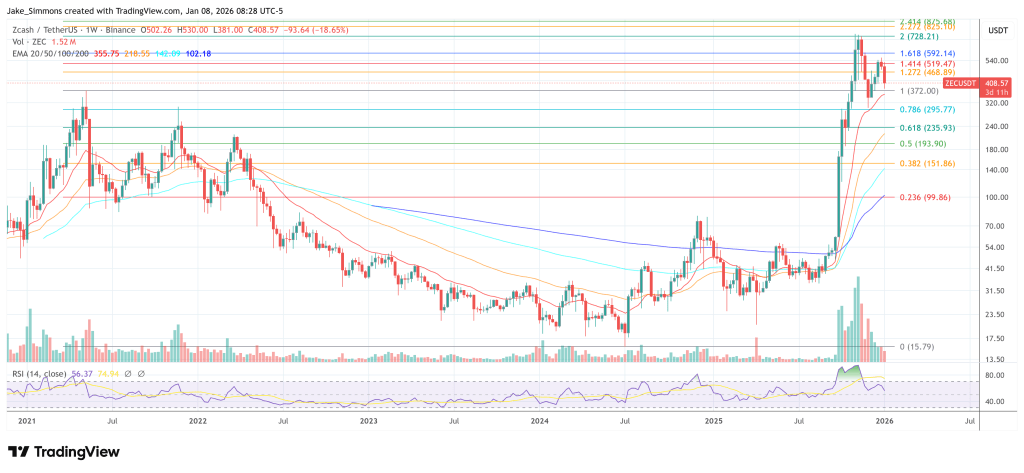
ZEC price crashes by 13%, 1-week chart | Source: ZECUSDT on TradingView.com

İlgili Okumalar

When Doing Cryptocurrency Payment, the First Thing is Licenses, What is the Second?

When launching a crypto payment business, obtaining the necessary licenses is the crucial first step. However, the second, and arguably more critical, step is designing a comprehensive operational framework that forms a coherent business loop. This loop must be clearly understood and executable by all stakeholders: banks, payment partners, exchanges, on-chain analytics providers, regulators, and your internal team. Many projects mistakenly believe a single license permits all operations. Licenses merely grant entry; they don't define how the specific business functions. The real challenge lies in detailing every aspect of the workflow. This involves clarifying the customer base, the flow of fiat and crypto assets, the settlement process, and establishing clear lines of responsibility for risks like AML compliance, sanctions screening, chargebacks, and regulatory inquiries. A robust framework must answer seven core questions: Who are the clients and merchants? Who collects fiat and crypto? Who handles conversion and custody? And who is ultimately accountable for compliance and risk management? Projects often fail not from a lack of licensing, but during due diligence when they cannot convincingly explain these operational details. Therefore, beyond securing licenses, the priority must be constructing a closed-loop system. This system ensures the business model is transparent, risks are managed, responsibilities are delineated, contracts are aligned, and the entire process is comprehensible to partners and regulators. The true competitive edge in crypto payments lies not in acquiring a license quickly, but in integrating licensing, banking, compliance, and operations into a sustainable and executable whole.

marsbit20 dk önce

When Doing Cryptocurrency Payment, the First Thing is Licenses, What is the Second?

marsbit20 dk önce

Arthur Hayes Analysis: AI Bubble Nears Burst, Crypto Market Faces Short-Term Pressure

Arthur Hayes argues that the current AI market is a bubble poised to burst, which will exert downward pressure on the crypto market in the near term. The core trigger is rising oil prices due to the US-Iran conflict and a blockade of the Strait of Hormuz. Higher energy costs directly increase the operational expenses of AI data centers, squeezing profit margins for companies like Google, Anthropic, and OpenAI. Hayes predicts that persistent inflation from high oil prices will force Trump, in a bid to win the November election, to turn public sentiment against the AI industry. He may propose regulations and taxes on data centers and AI companies to appeal to voters concerned about costs and job displacement. Such political rhetoric could shatter market confidence. Furthermore, the market is unlikely to healthily absorb the massive concurrent IPOs of SpaceX, Anthropic, and OpenAI, which together seek valuations in the trillions. The combination of soaring energy costs, overwhelming equity supply, and negative political pressure will puncture the AI bubble. Hayes notes that nearly all new USD liquidity since 2022 has flowed into AI, leaving crypto like Bitcoin behind. When the AI bubble bursts, liquidity will contract sharply, pulling down all risk assets, including cryptocurrencies. In response, Hayes's fund, Maelstrom, has sold all AI-related stocks and non-core cryptocurrencies. It maintains core positions in Bitcoin and Ethereum while increasing exposure to energy sector equities, betting on rising oil and gas prices. He expects Bitcoin to bottom after the AI-led market decline, before rallying again with future monetary easing.

Foresight News34 dk önce

Arthur Hayes Analysis: AI Bubble Nears Burst, Crypto Market Faces Short-Term Pressure

Foresight News34 dk önce

To C, To B, and the Next Big Thing Called To A

After To C and To B, the Next Wave is To A: Serving AI Agents In a recent quarterly earnings call, Meituan's Wang Xing introduced a new concept: To A (To Agent), signifying that future business services will increasingly target AI Agents as primary clients, not just consumers or merchants. This shift implies that internet giants must now consider how to make their services more appealing for AI Agents to recommend, fundamentally altering traditional distribution logic. This "To A era" is prompting an unusual trend of alliances among major tech companies. Unlike previous competitive battles, firms like Meituan, Tencent, JD.com, Huawei, OPPO, and OpenAI are rapidly forming partnerships. The reason is strategic: as AI Agents become the primary user interface, handling tasks from a single command (e.g., "Book a Japanese restaurant for tomorrow"), the risk for platforms is being bypassed entirely. Companies are positioning themselves within this new value chain. Three primary strategies are emerging: 1. **Super-Entry Points + Service Providers:** Platforms like Tencent's Yuanbao, WeChat, and ChatGPT aim to be the first-stop Agent, integrating various services (food delivery, shopping, travel) from partners like Meituan and JD.com. 2. **Apps as Callable Services:** Companies like Meituan, JD.com, and Uber are ensuring their core services remain accessible and callable by external Agents, shifting from front-end apps to back-end capabilities. 3. **System-Level Agent Entry Points:** Smartphone makers (Huawei, Honor, OPPO) are leveraging their OS-level AI assistants to control the initial user command, redistributing it to relevant service apps. While alliances offer mutual benefit—entry points gain service capabilities, and service providers gain traffic—inherent conflicts of interest exist. A dominant Agent platform could eventually attempt to connect directly with suppliers (restaurants, hotels), bypassing current aggregators like Meituan or Ctrip. Other unresolved challenges include the potential for Agent recommendations to become a new form of paid ranking and unclear accountability for faulty recommendations. The current rush to form alliances is a defensive move by service providers to secure their position before the landscape solidifies. In this To A-driven restructuring, the greatest risk is not losing the race but failing to hear the starting gun.

marsbit43 dk önce

To C, To B, and the Next Big Thing Called To A

marsbit43 dk önce

The More Lifelike the Robot, the More Terrifying? Unveiling the 'Uncanny Valley Effect' in the Era of Humanoid Robots

As humanoid robots become increasingly lifelike, they confront a significant psychological barrier known as the "Uncanny Valley Effect," a concept proposed by Japanese roboticist Masahiro Mori in 1970. This phenomenon describes a dip in human comfort and acceptance when robots appear almost, but not perfectly, human. Minor imperfections in facial expressions, eye movements, or skin texture trigger a subconscious sense of unease, as the brain detects something trying, yet failing, to mimic a person. Examples range from the controversial human-like robot Sophia to animated characters in films like *The Polar Express*. The effect poses a key design challenge for robotics companies. Some, like Boston Dynamics, avoid it entirely by creating highly capable but visibly mechanical robots. Others, like Hanson Robotics, push for greater human likeness despite the risk. For consumer robots, especially in homes, most manufacturers opt for stylized or clearly mechanical designs to ensure broader acceptance. While the Uncanny Valley remains a powerful force, its impact may diminish over time through technological advancements that achieve near-perfect realism or through generational familiarity as people grow accustomed to interacting with humanoid machines. Ultimately, navigating this psychological frontier requires as much understanding of human perception as of robotics technology itself.

marsbit43 dk önce

The More Lifelike the Robot, the More Terrifying? Unveiling the 'Uncanny Valley Effect' in the Era of Humanoid Robots

marsbit43 dk önce

İşlemler

Spot
Futures
活动图片





