ZachXBT flags USDC freeze – Why 16 exchange wallets were hit

ambcrypto2026-03-26 tarihinde yayınlandı2026-03-26 tarihinde güncellendi

Özet

ZachXBT's investigation revealed that USDC issuer Circle froze at least 16 exchange-linked hot wallets on March 23, 2026, disrupting transactions across bridges and settlements. These compliance actions, which extended beyond intended targets, raised concerns about systemic reliability and targeting accuracy. The number of blacklisted USDC addresses has grown to 596, reflecting deeper regulatory integration. This has shifted USDC's role from neutral infrastructure to a controlled settlement layer. Consequently, USDC outflows declined 0.9% weekly, with liquidity rotating toward USDT, which now holds 58.29% dominance. The incident exposed centralized control risks, fragmenting trust and reshaping stablecoin capital allocation.

Stablecoins anchored market liquidity, with total supply near $315.85 billion and USD Coin [USDC] accounting for about $78.7 billion.

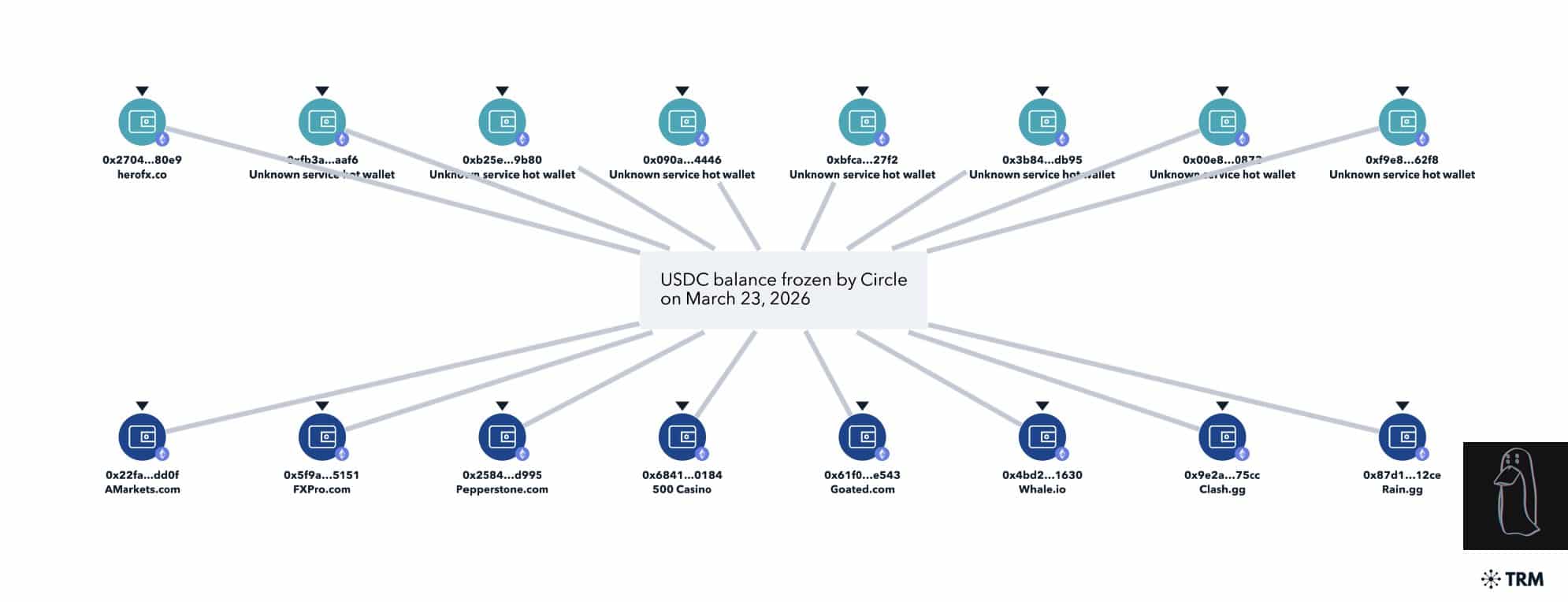
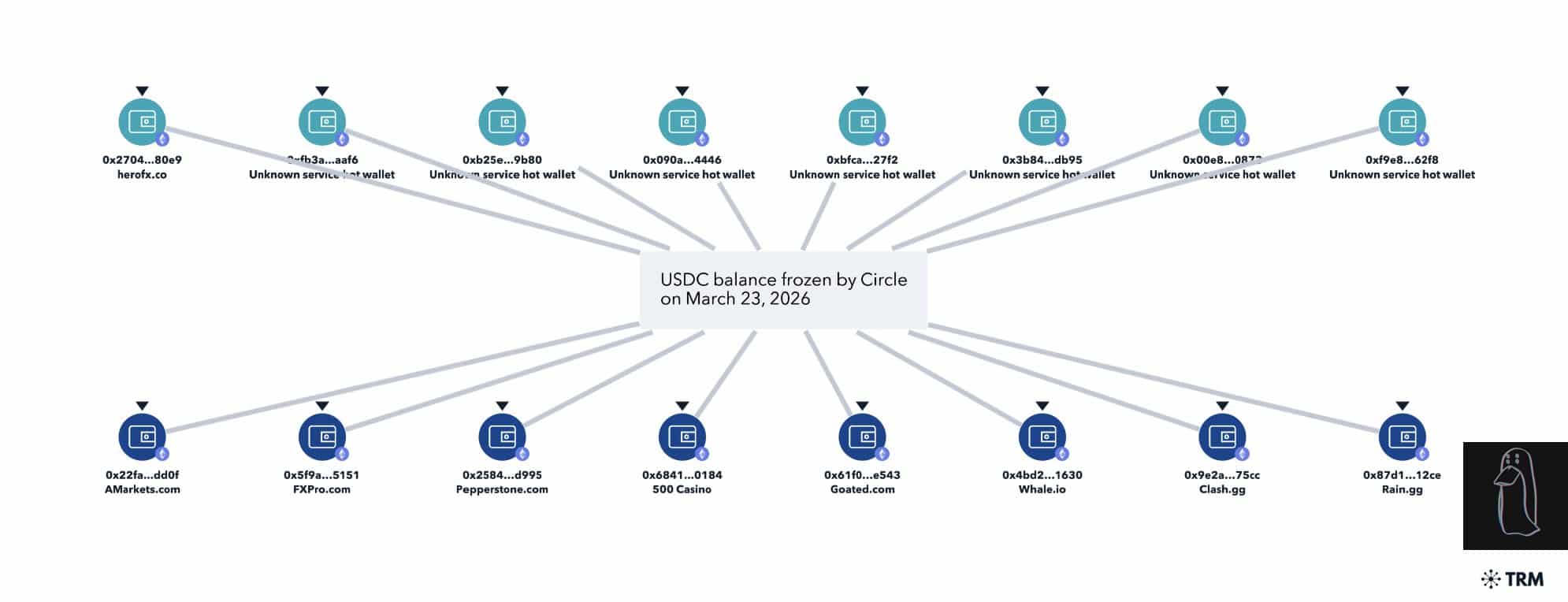
USDC wallet freezes drew scrutiny after on-chain investigator ZachXBT flagged multiple exchange-linked wallets affected on the 23rd of March 2026.

However, recent USDC wallet freezes disrupted that expectation, as compliance actions extended beyond intended targets. Reports suggested at least 16 unrelated hot wallets were frozen, disrupting transactions across bridging and settlement flows.

That shift set up a broader concern. Focus moved from isolated enforcement to systemic reliability risks.

This raised a key question: Why were operational exchange wallets affected?

USDC wallet freezes spill into exchange and bridge flows
Source: ZachXBT/ X

ZachXBT noted that several frozen wallets showed normal operational activity, raising concerns around targeting accuracy.

Reports suggested that exchange-linked hot wallets were flagged alongside intended addresses, extending the impact beyond enforcement targets.

Circle later reversed some freezes, including the Goated wallet, indicating a correction rather than a final decision.

That sequence showed how compliance actions can misfire when applied across interconnected wallet systems.

USDC blacklist count hits 596 as compliance tightens

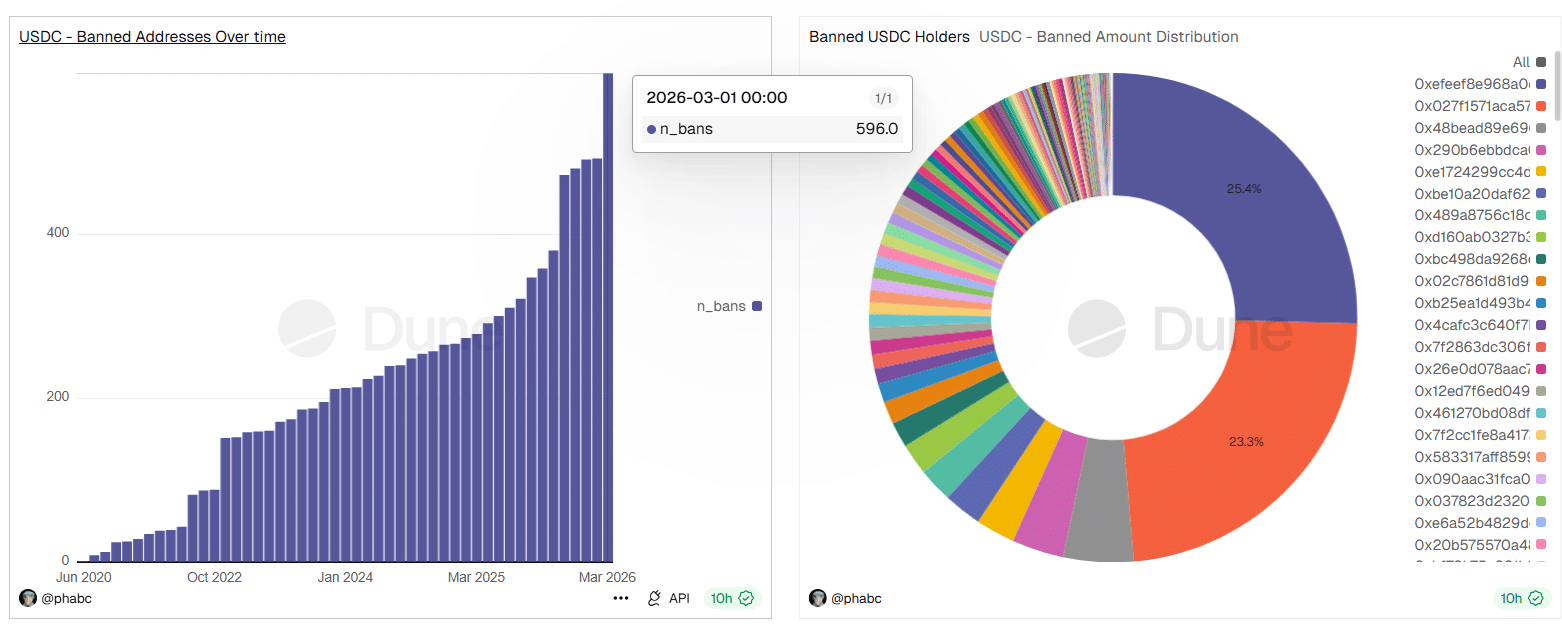
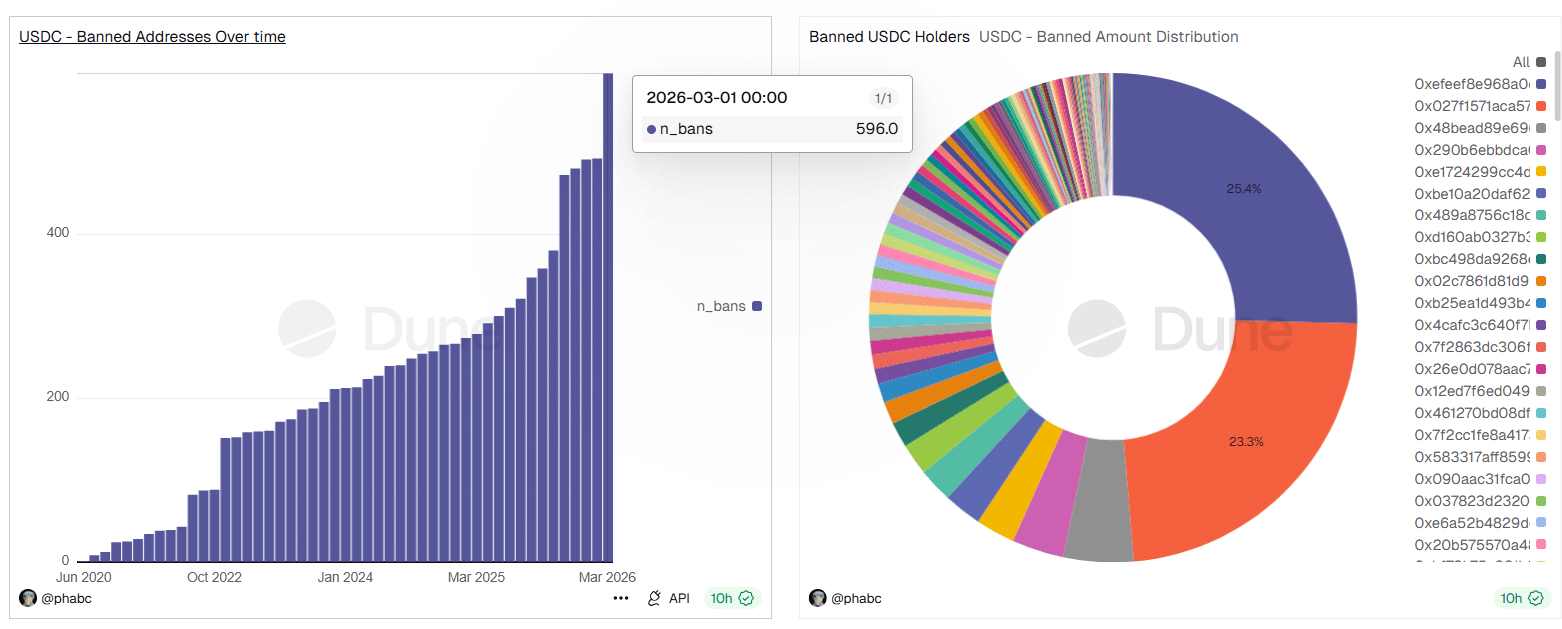
USDC’s control structure became clearer as enforcement activity increased across the network. Blacklisted addresses reached 596, reflecting steady growth rather than isolated actions.
Source: Dune

That move aligned with deeper regulatory integration into stablecoin infrastructure, rising from near zero levels in 2020.

On top of that, distribution data showed concentration among a few large holders. This amplified the impact of each freeze.

When key wallets were affected, liquidity disruptions extended beyond individual users into broader market flows. That explained settlement failures across exchanges and bridges.

This left traders focused on a structural shift. USDC operated less like neutral infrastructure and more like a controlled settlement layer.

USDC outflows drive liquidity shift toward USDT dominance

The market reaction showed a subtle shift beneath stable price action. USDC held near $78.7 billion, yet declined 0.90% weekly, signaling selective capital movement.

At the same time, total stablecoin supply rose 0.04%, showing funds rotated rather than exited.

By contrast, Tether [USDT] expanded its lead to 58.29% dominance at $184.1 billion, absorbing redirected liquidity.

That move reflected a search for perceived stability rather than a rejection of stablecoins entirely.

Confidence remained, yet behavior shifted. Partial reversals exposed operational strain, while unintended freezes raised concerns around exposure.
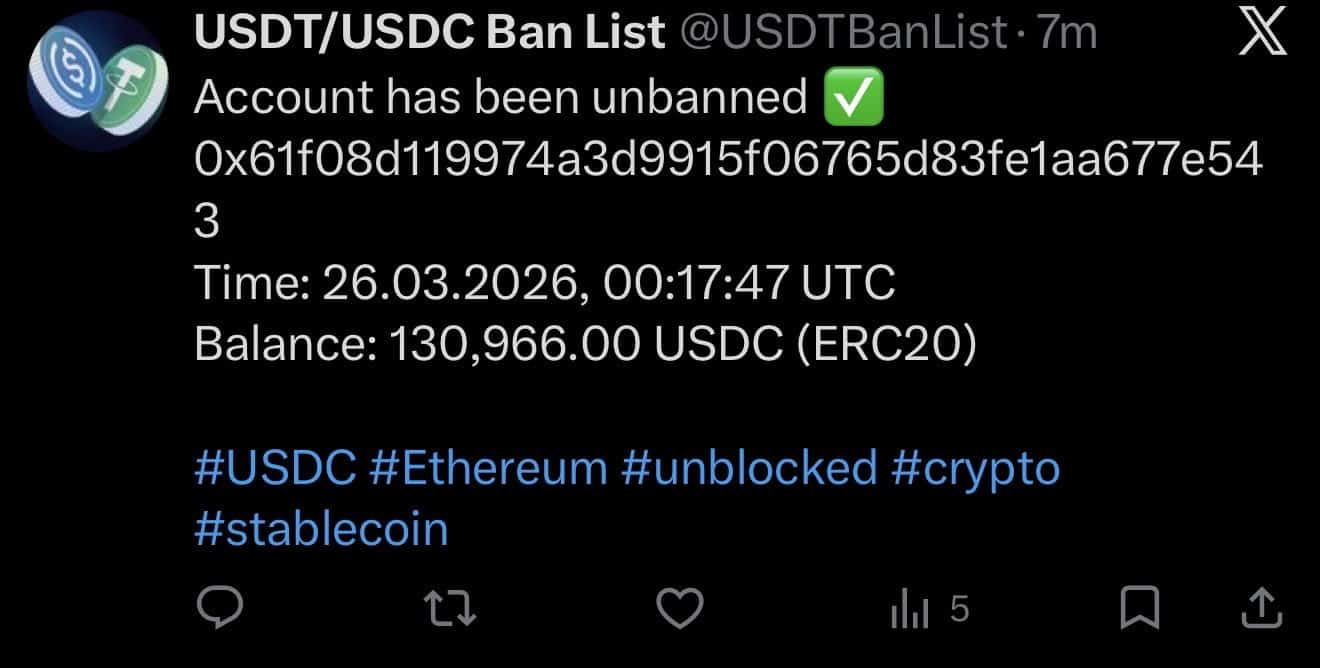
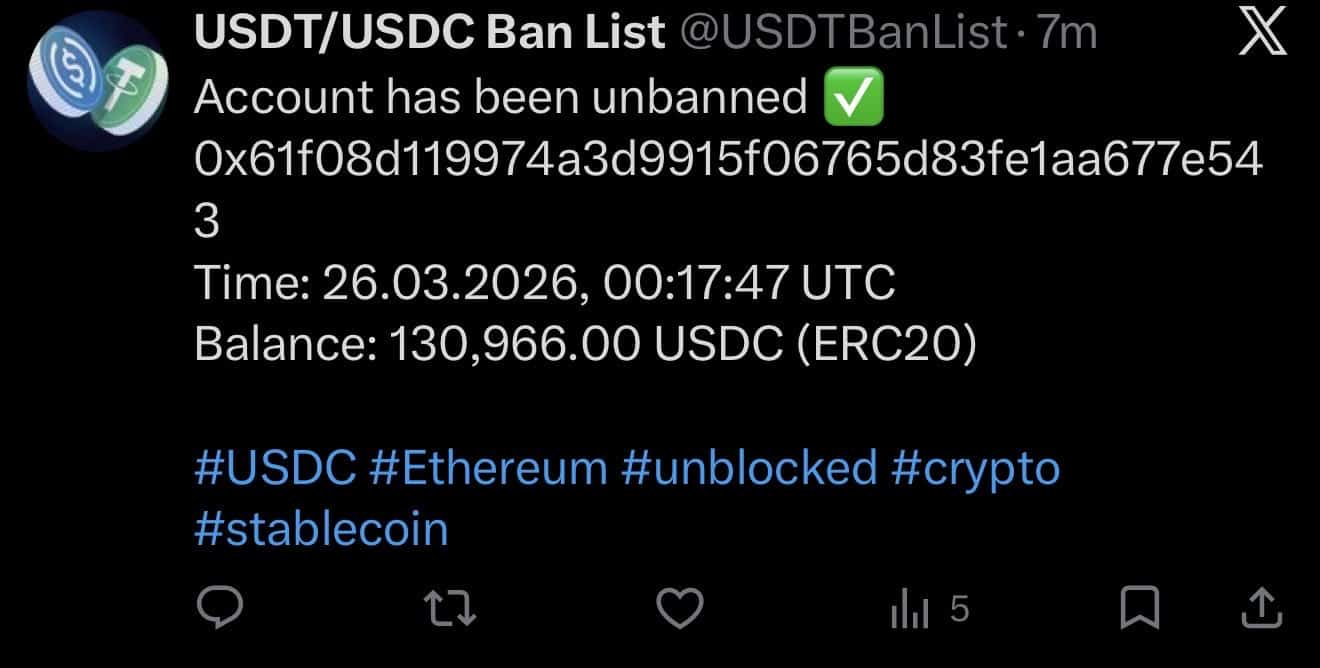
Source: X

This implied trust weakened at the margins, which could fragment liquidity and reshape capital allocation across stablecoin ecosystems.


Final Summary

  • USD Coin [USDC] freezes expose centralized control risks, with rising blacklists and failed settlements weakening neutrality and shaping liquidity flows.
  • Tether [USDT] absorbs rotation with 58% dominance, signaling trust shifts rather than exits, as stablecoin liquidity fragments across ecosystems.


İlgili Sorular

QWhat did on-chain investigator ZachXBT report regarding USDC wallet freezes on March 23, 2026?

AZachXBT flagged multiple exchange-linked wallets that were frozen, noting that several showed normal operational activity, which raised concerns about targeting accuracy.

QHow many exchange hot wallets were reportedly frozen in the USDC compliance action, and what was a key consequence?

AAt least 16 unrelated hot wallets were frozen, disrupting transactions across bridging and settlement flows and extending the impact beyond the intended enforcement targets.

QWhat was the total number of blacklisted USDC addresses mentioned in the article, and what does this reflect?

AThe number of blacklisted addresses reached 596, reflecting a steady growth in enforcement activity and deeper regulatory integration into stablecoin infrastructure.

QHow did the market react to the USDC freezes in terms of capital movement between stablecoins?

AWhile the total stablecoin supply increased slightly by 0.04%, USDC saw a 0.90% weekly decline in supply, with liquidity rotating toward Tether (USDT), which expanded its dominance to 58.29%.

QWhat broader concern did the USDC freezes raise about the nature of the stablecoin's operation?

AThe freezes raised concerns that USDC is operating less like neutral infrastructure and more like a controlled settlement layer, weakening trust and potentially fragmenting liquidity across ecosystems.

İlgili Okumalar

Anthropic Starts Poaching Scientists? $27K Weekly Onsite Stipend to Fix Claude's Expert-Level Errors

Anthropic has launched a new STEM Fellow program, offering $3,800 per week for a three-month, in-person residency in San Francisco. The role targets experts from science, technology, engineering, and mathematics (STEM) fields—machine learning experience is helpful but not required. Instead, Anthropic values scientific judgment and a willingness to learn quickly. Fellows will work with Claude models and internal tools under the guidance of an Anthropic researcher. Example projects include a materials scientist identifying errors in Claude’s reasoning or a climate scientist integrating atmospheric modeling software with Claude. The goal is to have experts "tell Claude where it's wrong" and improve its scientific capabilities. This initiative is part of Anthropic’s broader strategy to strengthen its scientific ecosystem, following earlier programs like the AI Safety Fellows and AI for Science programs. The company acknowledges that current AI models, while powerful, still produce high-confidence errors and lack end-to-end research autonomy. The program aims to embed domain expertise directly into model development, turning scientists into "high-level reviewers" for AI. Anthropic CEO Dario Amodei has previously emphasized AI’s potential to accelerate scientific breakthroughs, particularly in biology and healthcare. The company believes that the next phase of AI competition will depend not on scaling parameters, but on integrating human expertise to refine model accuracy and reliability.

marsbit27 dk önce

Anthropic Starts Poaching Scientists? $27K Weekly Onsite Stipend to Fix Claude's Expert-Level Errors

marsbit27 dk önce

On the Eve of X Money's Launch, Musk Dismantles the Referee First

"X Money Launches After Dismantling Regulator: Musk's 9-Day Power Play" In February 2025, a team from the "Department of Government Efficiency" (DOGE), led by Elon Musk, entered the Consumer Financial Protection Bureau (CFPB) headquarters. Shortly after, the CFPB was effectively dismantled—its funding frozen, activities suspended, and nearly 90% of staff laid off. This move came just nine days after X announced a partnership with Visa and as X Money prepared to launch. The article contrasts this with the decade-long regulatory battles faced by companies like Coinbase and PayPal. Coinbase spent over $75 million in political contributions and endured a major SEC lawsuit to operate legally. PayPal complied with strict state and federal rules for its stablecoin PYUSD, including 100% reserve requirements and monthly audits. However, Musk’s approach was different. After the CFPB introduced a rule placing large digital payment apps under federal oversight, Musk tweeted "Delete CFPB." Within months, the rule was revoked by Congress. Meanwhile, DOGE operatives gained "god-tier" access to CFPB databases, potentially obtaining sensitive competitive information from rivals like Apple, Google, and PayPal. The article also highlights a "suspicious exemption clause" in the GENIUS Act, which allows private companies like X to issue stablecoins with fewer restrictions. Senator Elizabeth Warren questioned whether Musk, who was a senior presidential advisor during the Act’s drafting, influenced this clause. X Money offers a 6% APY on deposits, despite FDIC warnings that stablecoin users are not insured. As X Money launches to 600 million monthly users, the article questions the fairness of a system where Musk can bypass regulations that others spent years and millions to comply with. The dismantling of the CFPB and the alleged regulatory advantages raise concerns about the future of equitable rule-making in the U.S. financial system.

marsbit36 dk önce

On the Eve of X Money's Launch, Musk Dismantles the Referee First

marsbit36 dk önce

İşlemler

Spot
Futures
活动图片