YZi Labs Invests of Tens of Millions, CZ as Advisor: How to Earn Genius Points?

Odaily星球日报2026-01-14 tarihinde yayınlandı2026-01-14 tarihinde güncellendi

Özet

An article titled "YZi Labs Invests Tens of Millions, CZ as Advisor: How to Earn Genius Points?" reports on a major investment in the decentralized exchange Genius. YZi Labs has invested tens of millions of dollars, and former Binance CEO CZ will serve as an advisor. Genius is a privacy-focused DEX supporting spot, perpetual contracts, and copy trading across over 10 blockchains, including BNB Chain and Solana. It aims to offer a CEX-like experience with self-custody and has processed over $60 million in testnet volume. CZ and Genius's team clarified that Genius is not a direct competitor to Aster, another YZi Labs portfolio project, but rather a trading terminal that enables cross-chain token access with privacy features. The article provides a step-by-step guide for users to interact with the platform and earn GP points through trading and referrals. A recommended "low-cost points strategy" involves trading the USDC-USDT pair to minimize volatility impact, executing larger trades to reduce gas fee ratios, and spinning a daily bonus wheel after reaching $10,000 in trading volume. Users can also earn additional rewards through referrals and social tasks. The platform is currently in a test phase, with a public testnet for its privacy protocol planned for Q2 2026.

Original | Odaily Planet Daily (@OdailyChina)

Author | Asher (@Asher_ 0210)
Last night, a blockbuster news rocked the community—YZi Labs has invested "tens of millions of dollars" in DEX Genius, and CZ will also personally join as an advisor.

Odaily Planet Daily is here to give you the first look at Genius, a step-by-step guide to interacting with Genius, and the current interaction strategy based on personal testing.

Project Introduction
Genius is a privacy-centric decentralized exchange (DEX) offering spot, perpetual contracts, and copy trading, supporting over 10 public chains including BNB Chain and Solana. Its goal is to become an on-chain alternative to Binance—bringing the speed, liquidity, and privacy experience of a CEX on-chain while remaining fully self-custodial and non-custodial (users hold their private keys). The platform has already processed over $60 million in trading volume during its testing phase and plans to launch a public test of its privacy protocol in Q2 2026. Back in October 2024, Genius announced the completion of a $6 million seed funding round led by CMCC Global, with participation from Cadenza Ventures, AVA Labs, Arca, Flow Traders, and other institutions.

In response to the community's view that "YZi Labs' investment in Genius is bearish for Aster," CZ posted on X, stating, "Genius is a trading terminal connected to exchanges, not a competitor to Aster."

Additionally, Genius's CMO Ryan also addressed a similar question in the community—"What's the difference between Aster and Genius? Why would YZi Labs invest in another project doing Perp DEX?" Ryan stated, "I think both are important; Aster is a very important perpetual exchange. I believe YZi Labs' motivation for investing in Genius is to enable everyone to access any token on any chain (and soon, privately)."
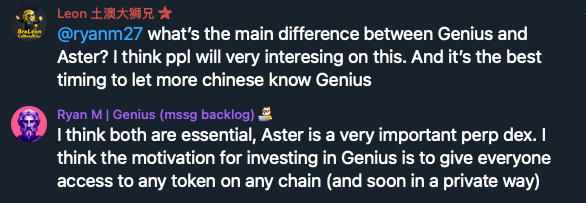
Genius CMO Ryan discusses the relationship between Aster and Genius

It's clear that both CZ and the Genius team believe Genius and Aster have different positioning and are not in direct competition.

Step-by-Step Guide

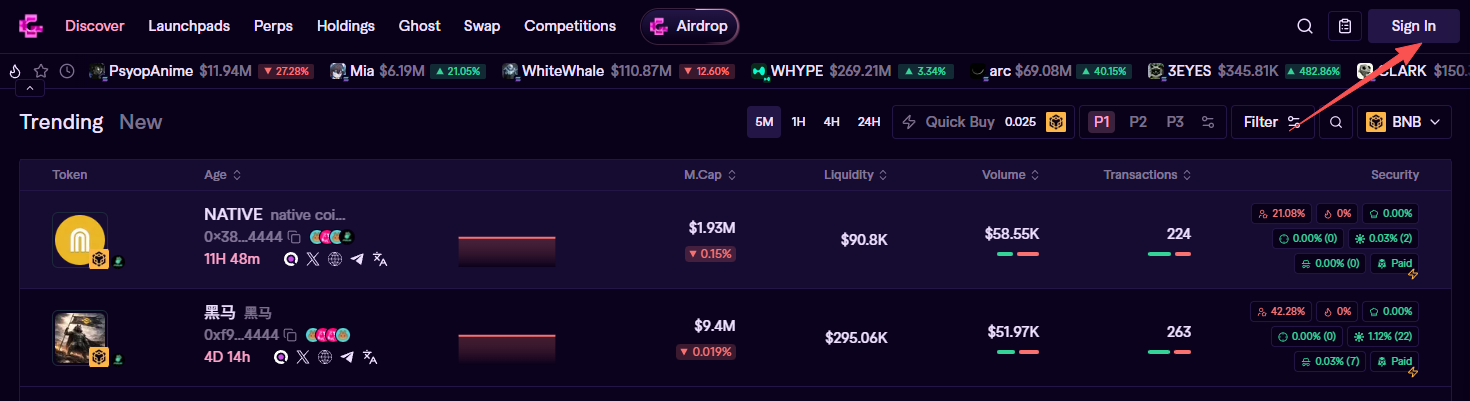
STEP 1. Go to the official website (Link: https://www.tradegenius.com/ref/NY8SYH). Using this referral link gives you 500 GP points. Click "Start Trading," then click "Sign In" at the top to log in with your wallet.
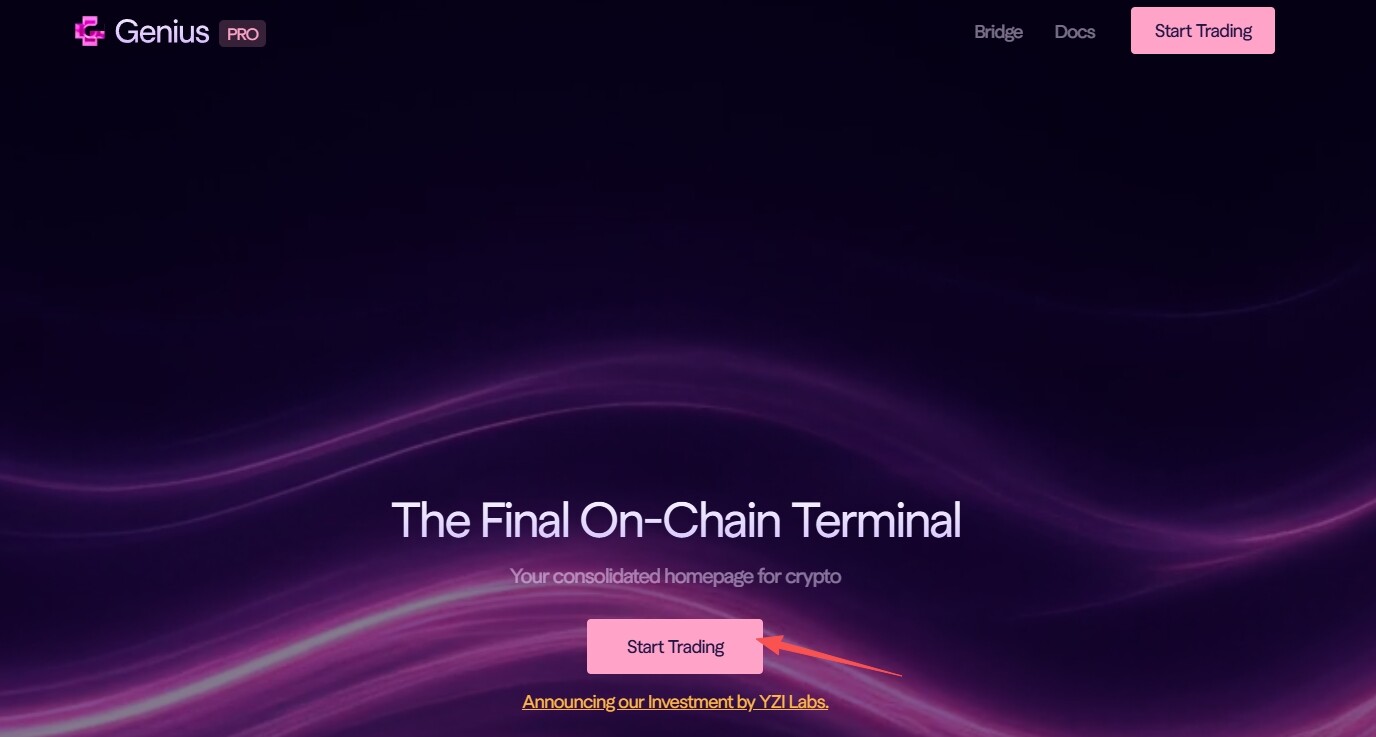
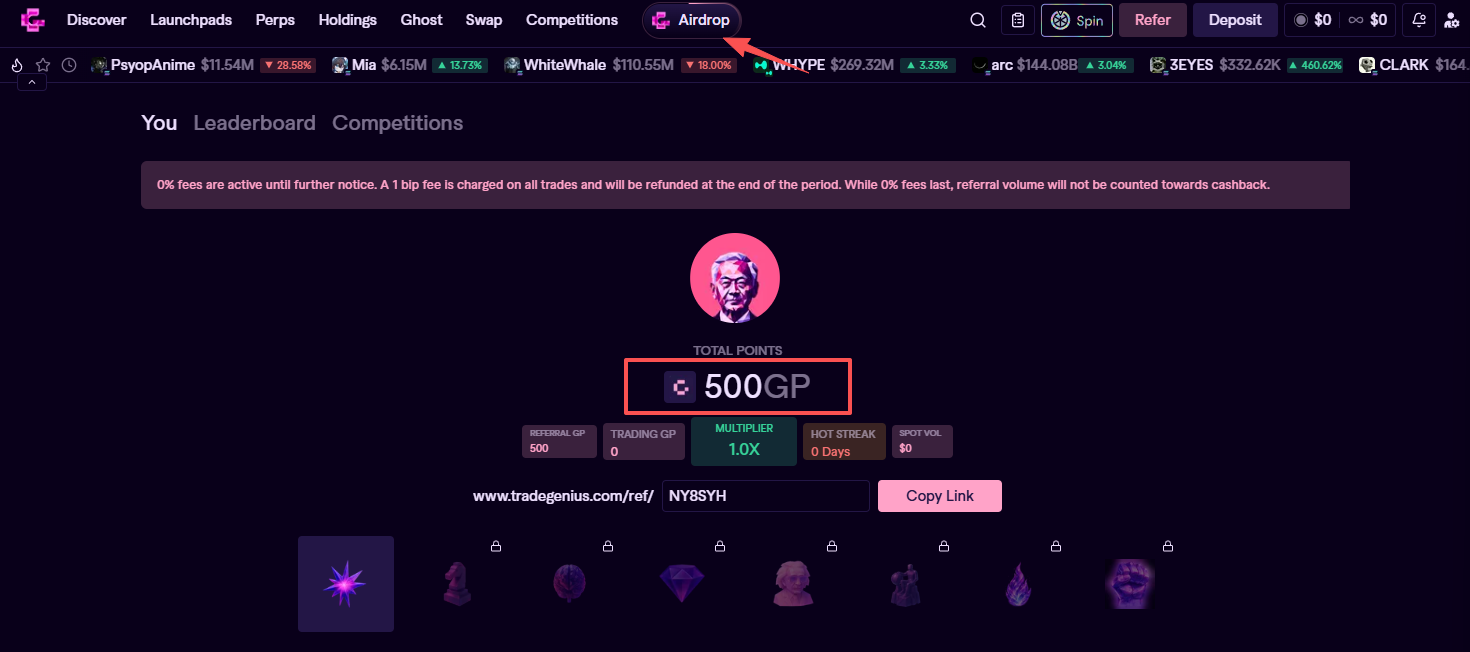
STEP 2. Click on "Airdrop" at the top to see your current GP points and personal referral link.
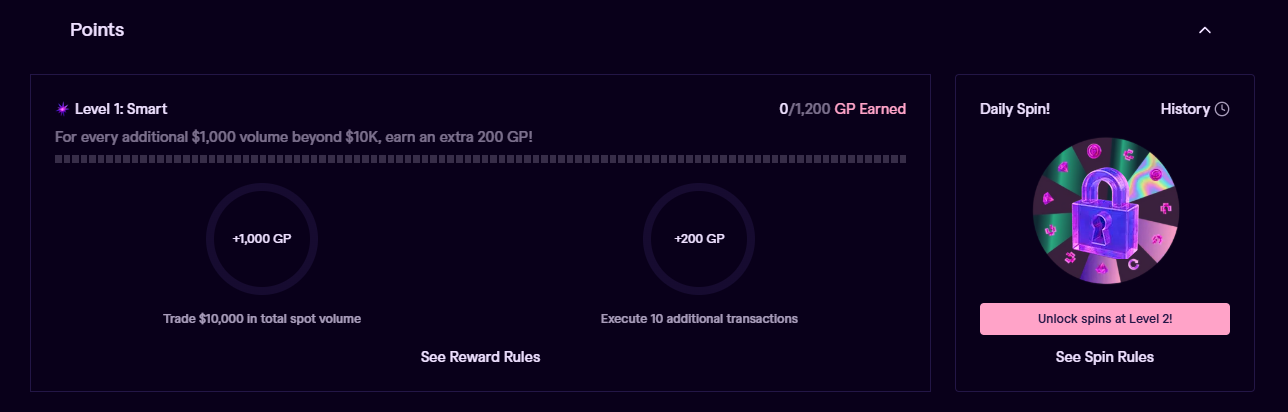
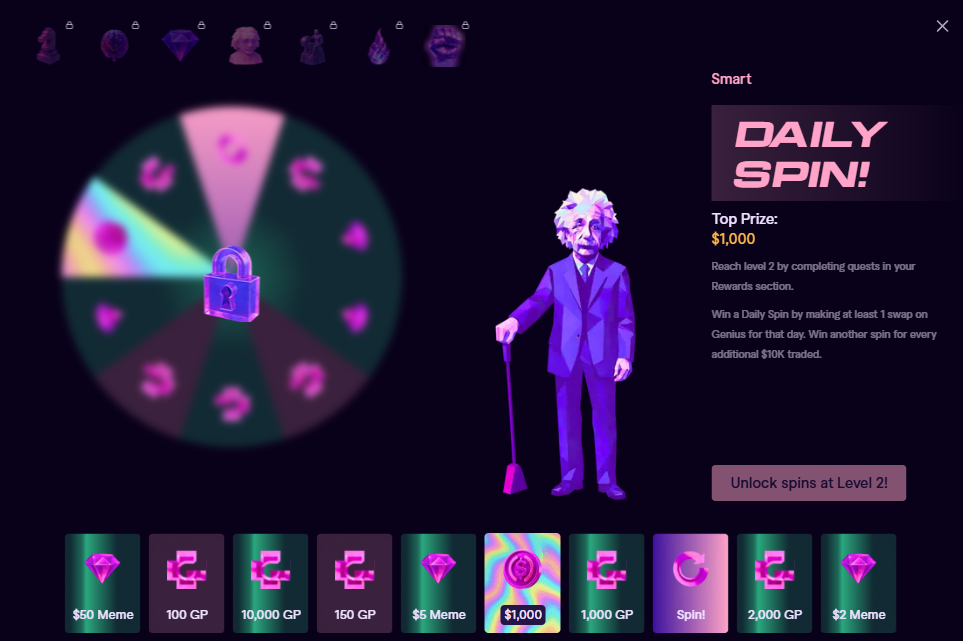
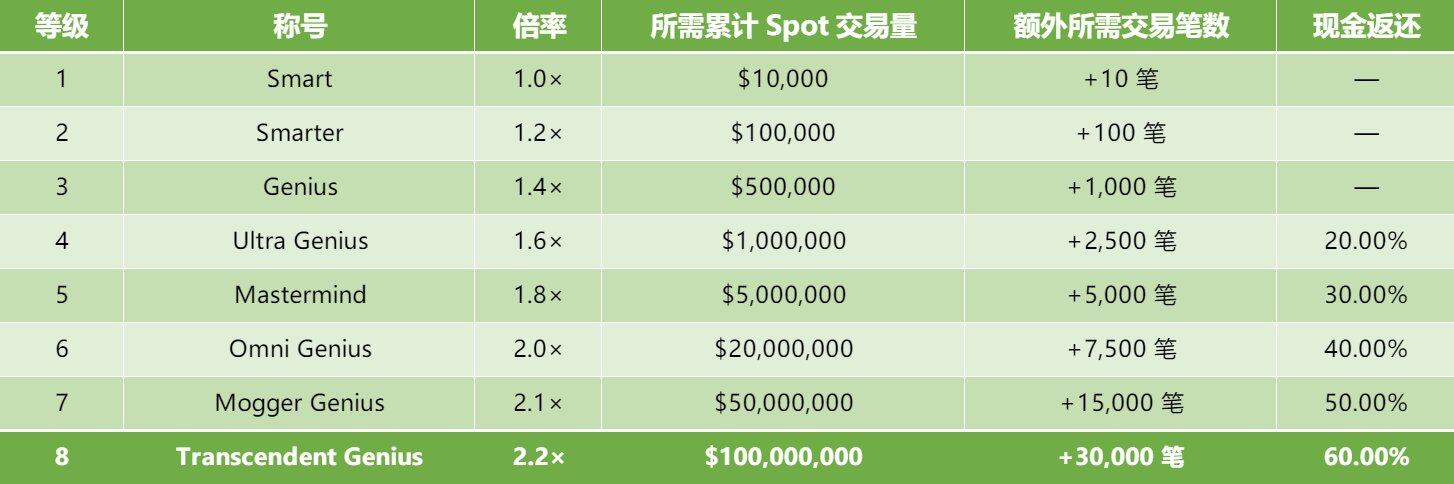
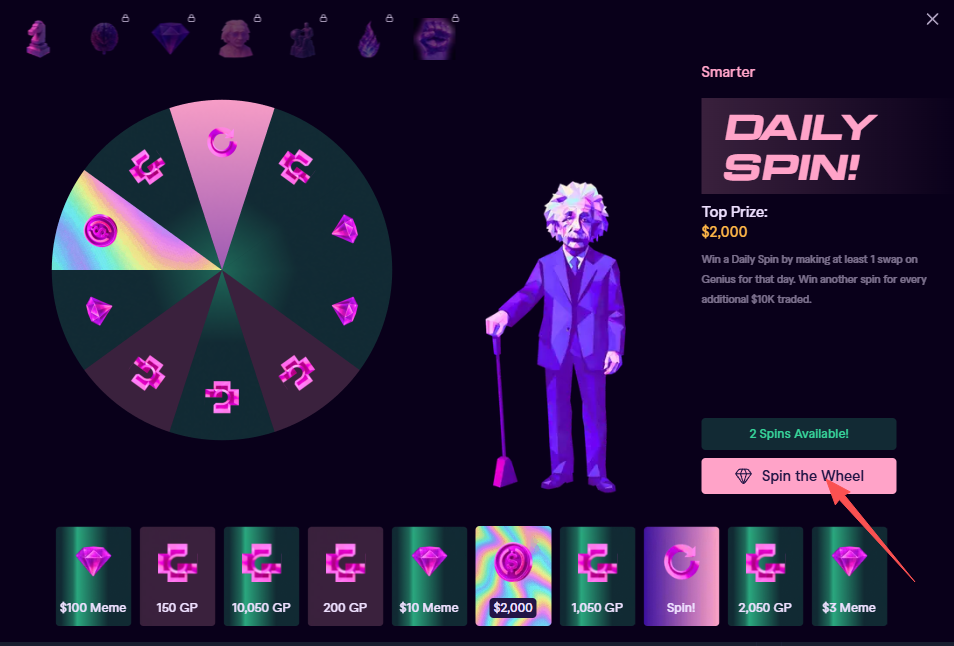
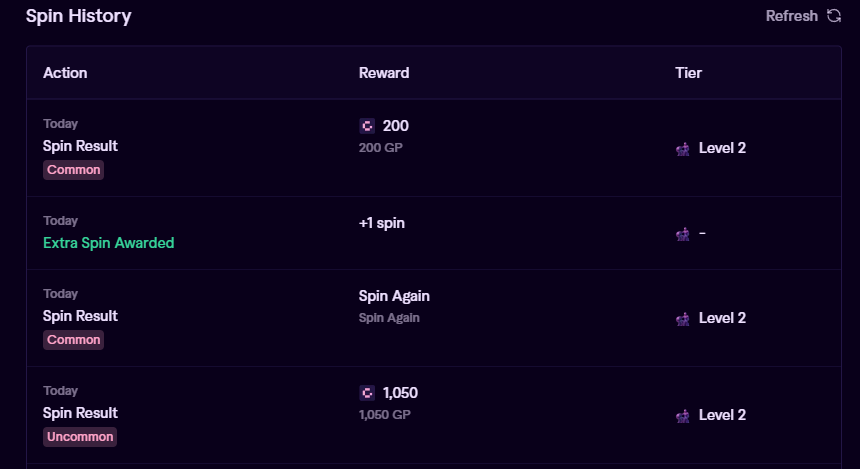
STEP 3. Under the "Airdrop" section, first is "Points." Accumulate $10,000 in trading volume to get 1200 GP points. After exceeding $10,000, every additional $1000 in trading volume earns 200 GP points. Additionally, trading at least once daily gives you one free spin on the wheel. Every additional $10,000 in trading volume grants an extra spin, with no upper limit.
Other rules for earning points through trading:

  • Users earn 1 GP point for every $100 in spot trading volume / $1000 in perpetual contract trading volume;
  • Trade consecutively for 7 days to earn a win streak multiplier (resets after one day without trading);
  • Base multiplier and win streak multiplier apply to user's spot and perpetual contract trading (referral points not included).
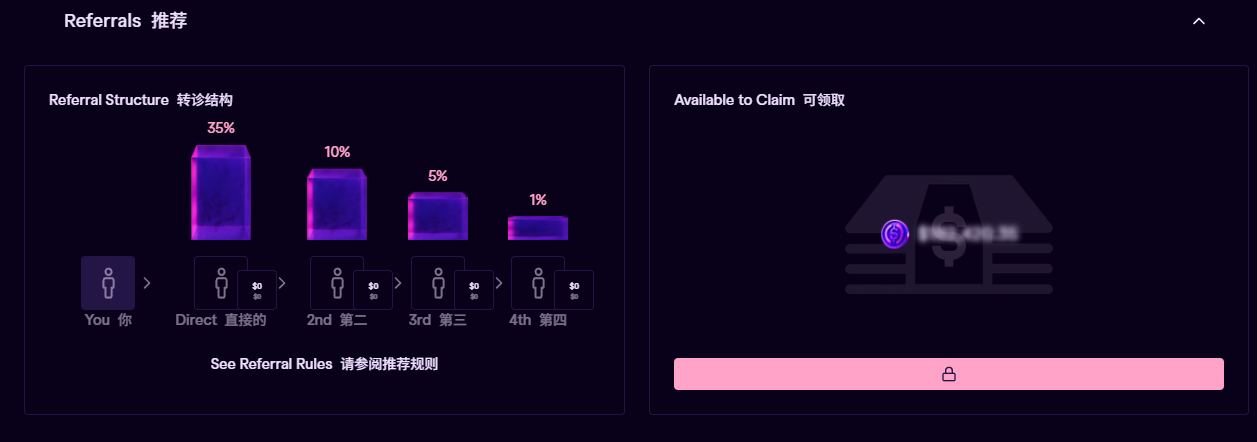
STEP 4. Under the "Airdrop" section, next is "Referrals." Invite friends to earn more GP points.
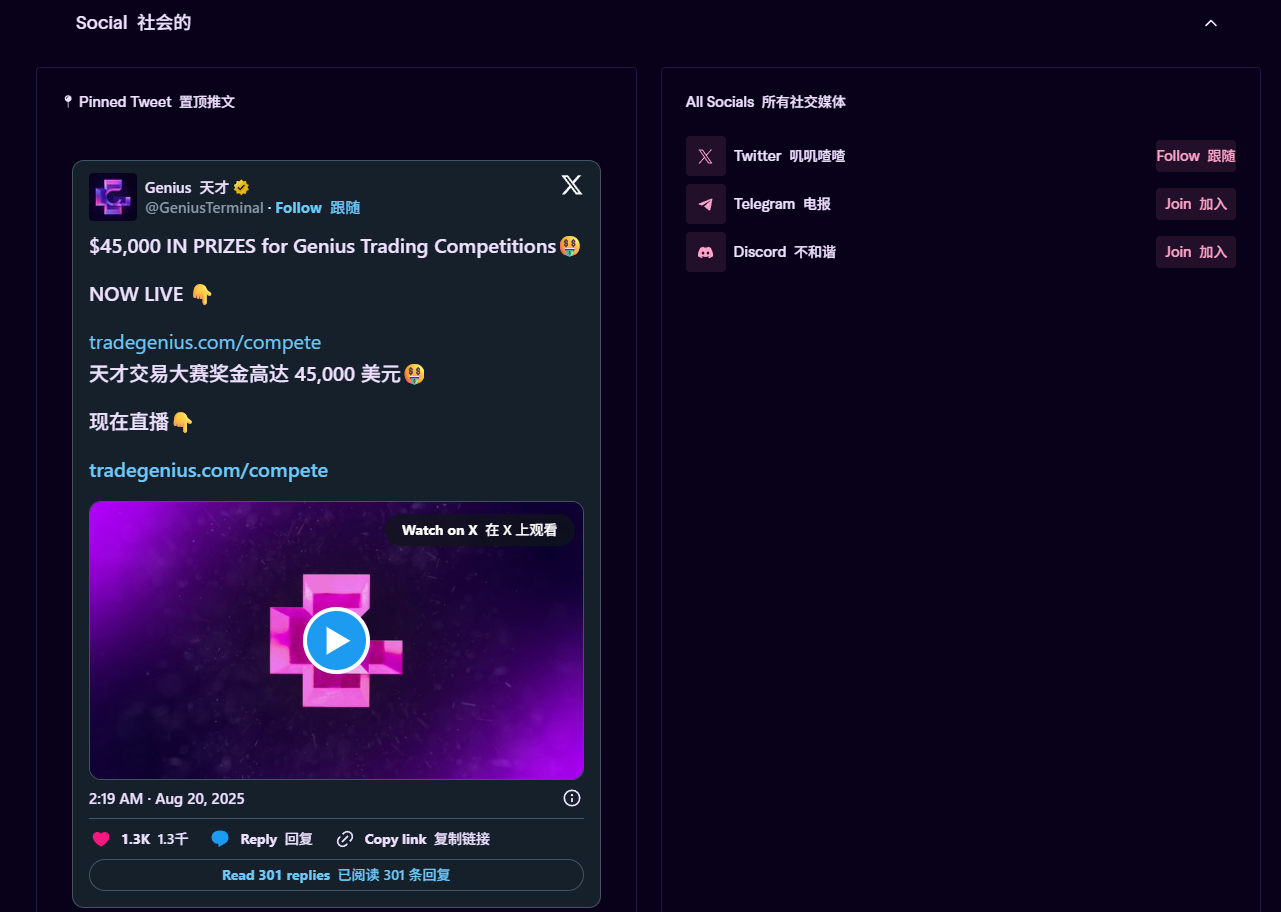
STEP 5. Under the "Airdrop" section, lastly is "Social" (the "Token Rewards" section is not yet open, skip for now), which contains official social media information.
STEP 6. Click on "Deposit" at the top. Supports deposits of EVM, Solana, and SUI assets. Official recommendation is to send ETH or USDC.

Current "Basic Income Points Earning" Strategy Sharing

Based on actual interaction, I've summarized a "basic income points earning" strategy. The specific operational思路 is as follows:

1、To minimize wear and tear from token price fluctuations, choose spot trading for USDC-USDT.
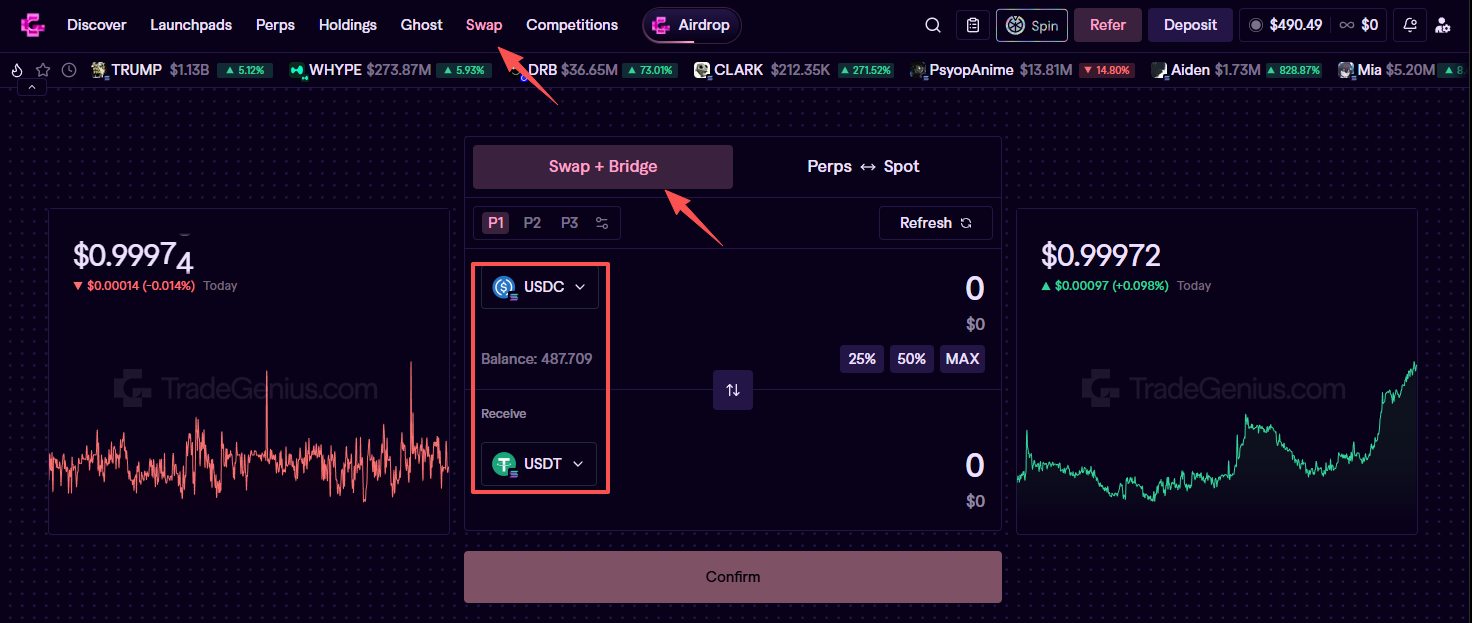
2、Try to make the single transaction amount larger. The Gas fee paid for a test transaction of $400 and $100 is almost the same, as shown below.
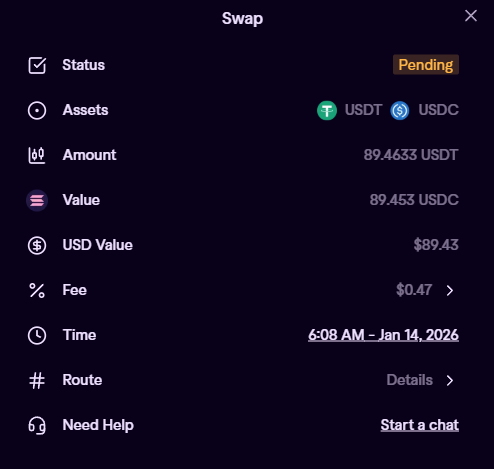
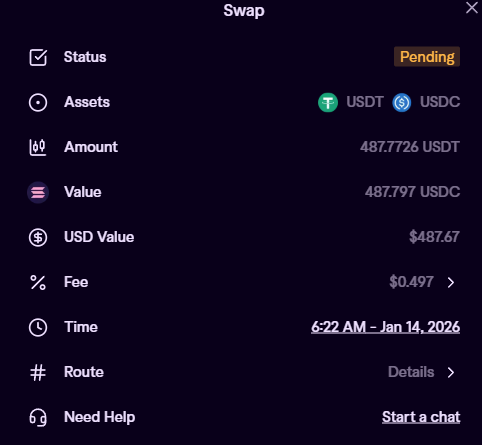
3、Once you unlock the wheel spin by reaching $10,000 in trading volume, just make one trade per day to qualify for the spin. There's no need to "frantically increase trading volume."
İlgili Sorular

QWhat is Genius and what is its primary focus?

AGenius is a privacy-focused decentralized exchange (DEX) that offers spot trading, perpetual contracts, and copy trading. It supports over 10 blockchains, including BNB Chain and Solana, and aims to provide a chain-based alternative to centralized exchanges like Binance by combining CEX-like speed, liquidity, and privacy with self-custody and non-custodial features.

QWhy did CZ and YZi Labs invest in Genius, and how is it different from Aster?

ACZ and YZi Labs invested in Genius because it is a trading terminal that connects to exchanges, not a direct competitor to Aster. Genius focuses on enabling access to any token on any chain, soon with privacy features, while Aster is primarily a perpetual contract exchange. The investments and advisory role highlight the complementary rather than competitive nature of the two projects.

QHow can users earn GP points on the Genius platform?

AUsers can earn GP points by trading: 1 GP point for every $100 in spot trading volume or $1000 in perpetual contract volume. Additional points come from a 1200 GP bonus for reaching $10,000 in cumulative trading volume, with 200 GP for every additional $1,000. Daily trading grants a spin-the-wheel chance, and more spins are earned per $10,000 in trading. Inviting friends via a personal link also rewards points.

QWhat is the recommended 'low-cost points earning' strategy mentioned in the article?

AThe recommended strategy to minimize costs while earning points is to: 1) Trade the USDC-USDT pair to reduce price volatility wear. 2) Execute larger single transactions (e.g., $400 instead of $100) to optimize gas fees, which are similar for both amounts. 3) Reach $10,000 in trading to unlock the daily spin-the-wheel feature, then only trade once daily to maintain the spin opportunity without excessive volume.

QWhat are the steps to start using Genius platform and earn the sign-up bonus?

ATo start using Genius and earn the 500 GP sign-up bonus: 1) Visit the official website via an invite link (e.g., https://www.tradegenius.com/ref/NY8SYH). 2) Click 'Start Trading' and then 'Sign In' to connect a wallet. 3) Navigate to the 'Airdrop' section to view points and your referral link. 4) Deposit assets like ETH or USDC via supported chains (EVM, Solana, SUI). 5) Begin trading to accumulate points and bonuses.

İlgili Okumalar

Annual Salary of Millions Competing for Electricians, Meta Rushes to Open Its Own Technical School

The AI boom is facing an unexpected bottleneck: a severe shortage of skilled construction workers and electricians. As tech giants like Meta, OpenAI, and Alphabet race to build massive data centers—such as OpenAI's $16 billion "Stargate" project—they are hitting a critical labor wall. The U.S. needs an estimated 130,000 more electricians, 240,000 construction workers, and 150,000 supervisors by 2030 for AI infrastructure alone, but tens of thousands of electrician jobs go unfilled each year. While AI companies offer high premiums, with electricians earning up to $280,000 annually, worker scarcity still causes massive losses—delays on a single project can cost $14.2 million per month. The complexity of building AI data centers, which require immense power (equivalent to powering hundreds of thousands of homes), sophisticated electrical systems, and advanced liquid cooling solutions, demands highly skilled technicians who are in short supply. To combat this, companies are investing heavily in training. Meta has committed $115 million to a free training school offering tuition, housing, and stipends, targeting 5,000 new workers. OpenAI is partnering with unions to secure skilled labor. These efforts are paying off, with a significant rise in Gen Z interest in trade schools over college. However, the power demands are staggering. AI data centers are driving a rapid surge in electricity consumption, projected to account for up to 12% of U.S. power use by 2028 and raising costs for consumers. Furthermore, the construction boom is project-based, leading to a potential future glut of trained workers once building peaks, which could depress wages industry-wide. The race for AI supremacy now depends as much on skilled hands as on advanced chips.

marsbit9 dk önce

Annual Salary of Millions Competing for Electricians, Meta Rushes to Open Its Own Technical School

marsbit9 dk önce

OpenAI No Longer Sells Its Most Expensive Model for Profit

OpenAI is shifting its business strategy away from promoting its most expensive, flagship models for every task. Recent price cuts—80% for GPT-5.6 Luna and 20% for Terra—signal a deeper change: the company now actively advises users that many tasks don't require the most powerful model. Instead, OpenAI recommends a tiered approach: use the high-end GPT-5.6 Sol for complex planning and analysis, then delegate execution to cheaper models like Luna. This mirrors moves by Anthropic, which recently launched Claude Opus 5 at half the price of its top model, Fable 5. Both companies are de-emphasizing flagship models as primary revenue drivers, using them instead for brand prestige and technological showcases. The industry is entering a "mass-market" phase, similar to automotive, where high-volume, cost-effective models handle daily operations and drive scale. OpenAI's price reductions are partly enabled by AI models themselves optimizing underlying code and infrastructure, creating a self-reinforcing cycle of efficiency gains and cost reduction. Competition is shifting from "who is smartest" to "who offers the best value." The goal is no longer selling individual models but fostering widespread API adoption and ecosystem lock-in. By making AI calls cheap and ubiquitous, companies like OpenAI aim to become the indispensable, utility-like infrastructure powering automated workflows—the "water and electricity" of software, quietly embedded everywhere.

marsbit9 dk önce

OpenAI No Longer Sells Its Most Expensive Model for Profit

marsbit9 dk önce

Will the Fed Definitely Raise Interest Rates in September? How Will Crypto and U.S. Stocks Withstand the Pressure?

The market's expectation for a September Fed rate hike surged dramatically in early August, jumping from under 50% to over 80% within a week. This shift followed a contentious July FOMC meeting, where a 9-3 vote to hold rates revealed growing dissent from hawkish members advocating for an immediate hike to combat persistent inflation. The primary catalyst for this repricing is rising oil prices, driven by renewed geopolitical tensions around the Strait of Hormuz, which threaten global supply. Energy costs directly influence inflation metrics, making the upcoming July CPI report (due August 12th) a critical data point. If it shows inflation reaccelerating, the probability of a September hike will solidify. For Bitcoin and crypto assets, this is typically bearish news. Bitcoin continues to behave as a high-beta, liquidity-sensitive risk asset. A rate hike raises the opportunity cost of holding non-yielding assets and could drive capital toward money markets, pressuring crypto prices in the short term. However, historical patterns suggest that if a hike is perceived as the end of a tightening cycle rather than the start, any negative price impact may be brief. U.S. stocks, particularly crypto-linked equities like Coinbase and growth-oriented tech stocks, are also vulnerable. Higher rates increase discount rates in valuation models, putting pressure on high-multiple companies. This coincides with a pivotal tech earnings season where investor focus has shifted from massive AI capital expenditure to tangible revenue and cash flow generation. Companies with negative cash flow and weak growth narratives could face heightened volatility if borrowing costs rise in September. In summary, a September Fed hike has evolved into a mainstream market scenario. Key factors to watch are oil prices, the July CPI report, and Fed communications, which will determine the final decision and its impact on volatile crypto and equity markets.

marsbit20 dk önce

Will the Fed Definitely Raise Interest Rates in September? How Will Crypto and U.S. Stocks Withstand the Pressure?

marsbit20 dk önce

İşlemler

Spot
活动图片





