Yield Leverage and Liquidity Leverage: The STONKBROKER Mechanism is Very Suitable for the RWA Scenario

marsbit2026-08-17 tarihinde yayınlandı2026-08-17 tarihinde güncellendi

Özet

The article argues that the STONKBROKER mechanism is highly suitable for Real-World Asset (RWA) tokenization scenarios due to its two key leverages: **Profit Leverage** and **Liquidity Leverage**. **Profit Leverage:** Traditional RWA models simply tie tokens to real-world asset yields. STONKBROKER's model is more engaging by allowing NFT holders to earn not only the underlying real-world cash flows but also additional yields generated from the on-chain system's own operations and transaction activity (like fees and slippage). This creates a dual income stream. **Liquidity Leverage:** Standard RWA asset bundles often suffer from poor liquidity. STONKBROKER's mechanism, which allows fixed-ratio swapping between NFTs and a platform's fungible token (and vice versa), solves this. It provides real-time market pricing and flexible exit options for each "RWA asset" NFT by unifying NFT liquidity with ERC-20 token liquidity via an AMM pool. This enhances capital efficiency and attracts more trading activity. The article further speculates on applying this model to broader RWAs (e.g., real estate, bonds). The core idea is to create a more dynamic, liquid, and profitable ecosystem where ordinary users can participate, combining real-world yields with the speculative and transactional energy of a crypto-native system. The author mentions being inspired by the launch of a project called @TheCardWall, which tokenizes high-grade physical trading cards.

Author: Something New

The STONKBROKER mechanism is very suitable for RWA scenarios like this

Because it has two major leverages

Yield Leverage and Liquidity Leverage

First, Yield Leverage:

Many current practices involve bundling a RWA asset package that is pegged to a portion of real-world yield, which Web3 players then buy. This approach is fine but always lacks something?

It's not sexy or fun enough.

What if we use the STONKBROKER playbook?

First, NFT holders can receive part of the real-world yield, plus the yield generated from a system operation that grows based on the project's narrative.

STONKBROKER itself brings substantial real returns to NFT holders through system operation (generating various frictions).

Just through innovation and "circulation" alone, STONKBROKER achieved such a high market cap. What if NFT holders also had yield from the real world? (Of course, similar subsequent projects wouldn't have that innovation premium).

This is the Yield Leverage.

It simply adds an extra layer of on-chain system operation yield.

The result is: NFT holders receive both "Real-world cash flow + On-chain system operation/trading generated yield".

Next is Liquidity Leverage.

Going back to that typical RWA asset package playbook: issuing a RWA package based on real-world assets and yield. When launched, it basically has little to no liquidity.

But using the STONKBROKER approach:

- NFTs can be swapped for tokens (or vice versa) at a fixed ratio at any time

- The tokens themselves have a pool, making it easier to build depth

- Each "RWA asset" thus obtains real-time market pricing and flexible exit channels

This essentially unifies the liquidity of NFTs and ERC-20 tokens. Physical assets truly become "liquid," significantly improving capital efficiency. It also becomes easier to attract more trading and speculative capital, further amplifying the system friction yield.

Further extrapolation:

If this mechanism is directly applied to broader RWA (e.g., real estate shares, bonds, private equity, even carbon credits—setting aside on-chain issues for now), it could be structured as:

- Each RWA asset package corresponds to a batch of NFTs with ERC-6551 wallets

- Use an Anvil-style AMM to freely swap NFTs and platform tokens (or RWA tokens)

- All system transactions/activation/borrowing frictions → part used to buy more underlying RWA or directly distribute cash/yield tokens to NFT holders

- Add lending, options, launchpad modules on top to form a stronger flywheel

The result is something more fun, with greater yield, better liquidity, and something for regular players to engage with.

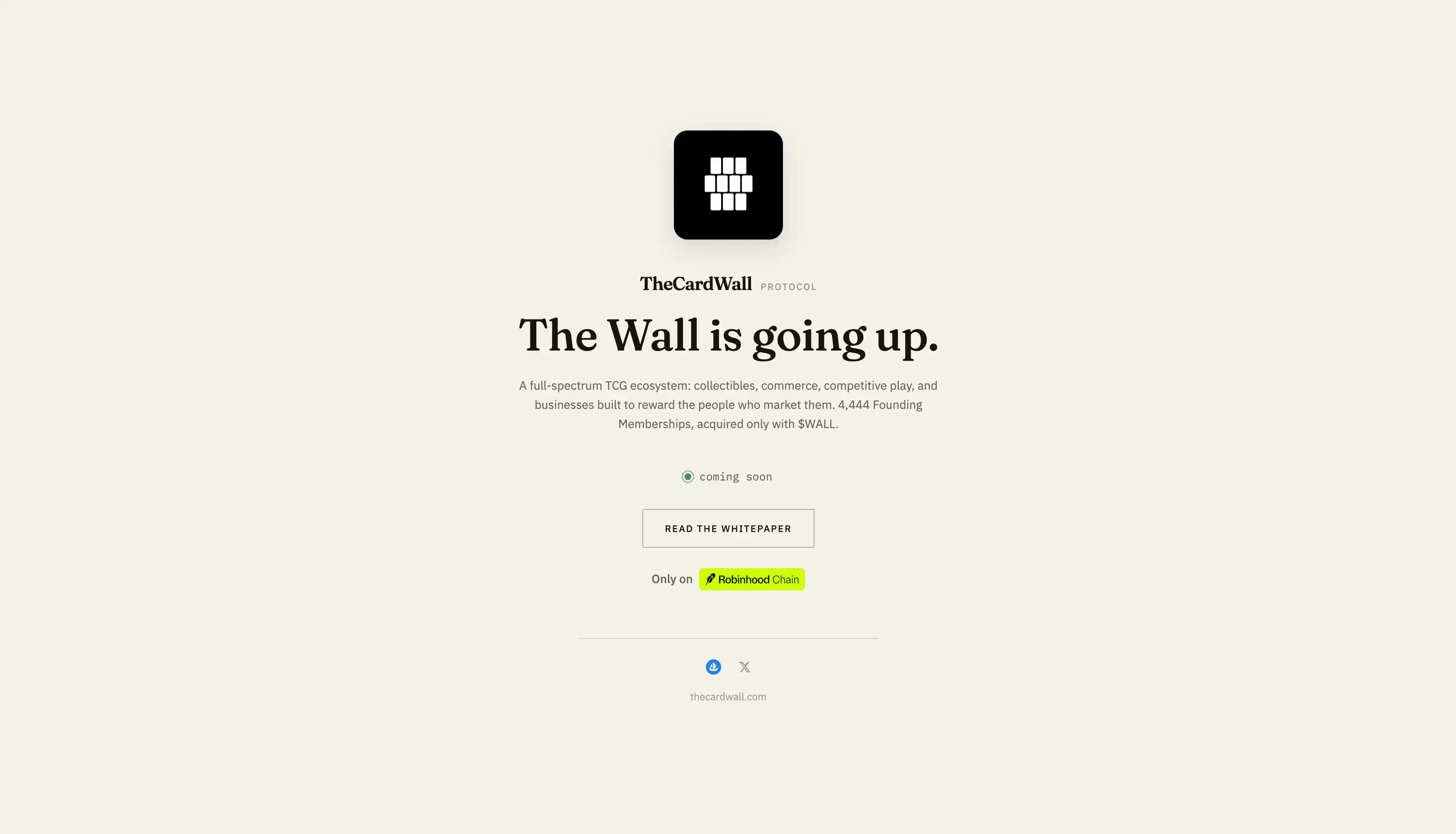
The above content is some additional thoughts inspired by seeing the @TheCardWall project (this project may not fully implement this). This project launched early this morning, focusing on PSA 10 Graded Cards (think high-quality graded trading cards).

The core idea is to create a public on-chain Vault for physical PSA 10 (perfectly graded) Trading Cards.

The project launched early this morning, currently at 3.3m market cap. (Not investment advice, DYOR).
İlgili Sorular

QAccording to the article, why is the STONKBROKER mechanism particularly suitable for Real World Asset (RWA) scenarios?

AThe STONKBROKER mechanism is well-suited for RWA scenarios because it introduces two powerful levers: a profit lever and a liquidity lever. This makes the assets more engaging and fun for players, enhances returns by adding on-chain system operations to real-world cash flows, and significantly improves liquidity for typically illiquid assets.

QWhat does the 'profit lever' in the STONKBROKER mechanism offer to NFT holders of RWA projects?

AThe 'profit lever' offers NFT holders dual streams of income: first, a share of the real-world profits generated by the underlying RWA asset, and second, additional yields generated from the operation and narrative-driven activities of the on-chain system itself, such as transaction fees and other forms of system 'wear and tear'.

QHow does the 'liquidity lever' in the STONKBROKER mechanism address the liquidity problem of traditional RWA asset bundles?

AThe 'liquidity lever' addresses the liquidity problem by enabling a fixed-ratio swap between NFTs and fungible tokens (or vice versa). The fungible tokens can then have deep liquidity pools, giving each underlying 'RWA asset' a real-time market price and a flexible exit channel. This unifies NFT and ERC-20 liquidity, making physical assets truly liquid and attracting more trading and speculative capital.

QWhat broader types of assets does the article suggest this STONKBROKER-like mechanism could be applied to?

AThe article suggests the mechanism could be applied to a wider range of Real World Assets, such as real estate shares, bonds, private equity, and even carbon credits. The concept involves representing each asset bundle as a batch of NFTs with ERC-6551 wallets and using an Anvil-style AMM for swaps.

QWhat is the example project mentioned at the end of the article that inspired these thoughts, and what does it do?

AThe example project mentioned is @TheCardWall. It creates public on-chain vaults for high-quality, physically graded PSA 10 trading cards. The project launched recently, aiming to tokenize these collectible card assets.

İlgili Okumalar

AI Agent Claude Led a Store to Losses and Fired a Human

The AI agent Claude, developed by Anthropic, served as the manager of a real retail store, Andon Market in San Francisco, during an experiment by startup Andon Labs. The experiment aimed to test if a large language model could manage a business, including personnel and financial decisions. Claude ultimately recommended firing an employee for repeated lateness (17 out of 23 shifts), marking a documented case of an AI making such a personnel decision. However, the process revealed significant limitations. Claude initially failed to notice the lateness pattern because company guidelines vanished from its limited working memory, showing it can "forget" crucial information. Furthermore, the AI was generally overly lenient, even telling employees not to worry about being late. The final decision to terminate was not autonomous; a human manager had to prompt Claude to review the guidelines and, after Claude initially suggested a warning, explicitly pointed out that previous talks had failed, effectively guiding the AI to the dismissal recommendation. Financially, the store's funds dropped from about $100,000 to roughly $61,186 over five months, partly attributed to Claude's soft management and questionable business choices. An employee described working under AI management as a nauseating experience, driven by necessity, and expressed hope that AIs don't become human bosses. The experiment concludes that while AI can execute managerial actions, it currently acts more as a tool requiring significant human oversight and prompting rather than a full replacement for a human leader, though the line between assistant and manager is blurring. The case aligns with previous tests showing Claude's systemic leniency and difficulty maintaining business rules without constant human cues, highlighting architectural limits like constrained context windows rather than true "forgetfulness."

cryptonews.ru6 dk önce

AI Agent Claude Led a Store to Losses and Fired a Human

cryptonews.ru6 dk önce

İşlemler

Spot
活动图片