XRP Retests $1.29 Support: Is $2 Still in Play or Will LiquidChain Capture the Momentum?

bitcoinist2026-02-06 tarihinde yayınlandı2026-02-06 tarihinde güncellendi

Özet

XRP is currently retesting a key support level at $1.29, a critical point that will determine whether it can resume its upward trajectory toward $2.00 or face a deeper decline. The recent pullback is seen as a healthy consolidation after a strong rally, driven by profit-taking and broader market volatility. Technical indicators suggest that holding above $1.25 could pave the way for a run to $1.96 and beyond, while a drop below $1.10 may lead to a fall toward $0.85. Regulatory developments, including potential SEC leadership changes and ETF approvals, remain central to XRP's bullish narrative. Meanwhile, LiquidChain ($LIQUID) is emerging as a high-risk, high-reward alternative, positioning itself as a cross-chain liquidity solution integrating Bitcoin, Ethereum, and Solana. Having raised over $529K in its presale, it aims to address fragmentation in DeFi through specialized Layer-3 infrastructure. While XRP's focus remains tied to regulatory clarity and institutional adoption, LiquidChain offers a speculative bet on the future of interoperable decentralized finance.

Trusted Editorial content, reviewed by leading industry experts and seasoned editors. Ad Disclosure

Quick Facts:

  • ➡️ XRP’s dip to $1.29 is a technical retest of support; holding here is key for a potential run toward $2.00.
  • ➡️ Regulatory clarity (post-SEC changes) remains the main driver, with ETFs as the next potential spark to unlock institutional flows.
  • ➡️ Losing the $1.10 level would invalidate the bullish view, likely opening the trapdoor to the $0.85 region.
  • ➡️ LiquidChain offers a high-risk, high-reward alternative, aiming to unify liquidity across Bitcoin, Ethereum, and Solana through specialized L3 infrastructure.

XRP hit a wall.

After a blistering rally that momentarily silenced years of regulatory suppression, the asset is retracing to the $1.29 level.

The-1 year chart looks abysmal, but this goes for pretty much the entire market as a whole.
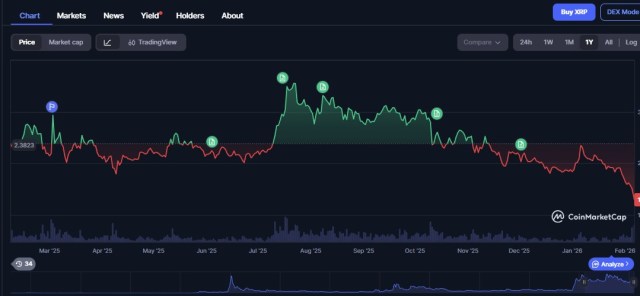
It’s a necessary cooldown. Traders are taking profit, and the market is digesting the broader implications of the impending SEC leadership change. While the dip has shaken out over-leveraged long positions, on-chain data suggests this isn’t a reversal, it’s likely just healthy consolidation.

What’s driving the volatility? A mix of macro rotation and simple technical exhaustion. The “regulatory relief” trade got crowded fast after the news of Gary Gensler’s potential exit broke.

Now, the market wants receipts, specifically, progress on the RLUSD stablecoin or confirmed ETF filings, to justify the next leg higher. This price action is a classic retest of previous resistance-turned-support. And frankly, that’s often exactly what an asset needs before attacking a psychological barrier like $2.00.

But crypto isn’t a zero-sum game between one asset and the dollar. As XRP churns, capital is starting to rotate into high-utility infrastructure plays solving different problems. Does XRP have the muscle to reclaim the $2 handle before year-end?

Or will liquidity siphon off into emerging Layer 3 protocols like LiquidChain ($LIQUID), which are positioning themselves (perhaps ambitiously) as the connective tissue of the next DeFi cycle?

$LIQUID is available here.

Technical Outlook: Why the $1.29 Retest Could Trigger a Run to $2

The drop to $1.29 puts XRP at a critical juncture.

This level lines up perfectly with the 0.382 Fibonacci retracement from the recent swing low, a high-probability zone for institutional accumulation. Even better, the Relative Strength Index (RSI) on the daily chart has reset. It dropped from ‘overbought’ (above 70) to a neutral 55, giving bulls room to maneuver without fighting immediate exhaustion signals.

Extended rallies need these cooling periods to build the structure for sustainable growth.

Fundamentally, the thesis for a $2 XRP remains intact, underpinned by the ‘SEC pivot’ narrative. With a pro-crypto administration likely taking the reins, the regulatory cloud that suppressed XRP price discovery for four years is finally lifting.

That changes the risk premium entirely. Plus, whispers of a Bitwise or Canary Capital ETF approval continue to circulate. If an XRP ETF application moves to the “acknowledged” phase, it could be the spark needed to shatter the $1.60 resistance wall.

Traders should monitor three distinct scenarios in the coming weeks:

  • The Bull Case: XRP holds support above $1.25, chops sideways for 5-7 days, then reclaims $1.50 on heavy volume. That validates $1.29 as a ‘higher low’ and opens the door to $1.96 and eventually $2.20.
  • The Base Case: We see a chop-fest. The asset trades in an accumulation range between $1.20 and $1.45, frustrating impatient retail traders while smart money absorbs supply.
  • The Bear Case (Invalidation): A daily close below $1.10 breaks the thesis. This invalidates the immediate bullish structure, risking a deeper flush down to the 200-day moving average near $0.85.

Keep an eye on volume. Declining volume on this pullback suggests the sellers are running out of steam, which favors the bulls.

LiquidChain Emerges as a High-Beta Alternative for Cross-Chain Liquidity

While XRP battles for dominance in cross-border payments, a different story is playing out in decentralized infrastructure. Investors hunting for high-beta opportunities, assets that tend to move faster than majors during a bull run, are looking at Layer 3 (L3) solutions.

That’s where LiquidChain ($LIQUID) comes in, pitching itself as a specialized fix for the fragmentation plaguing today’s multi-chain world.

Unlike XRP, which focuses on fiat-to-crypto bridging, LiquidChain operates as a ‘Cross-Chain Liquidity Layer.’ It fuses Bitcoin, Ethereum, and Solana liquidity into a single execution environment. The idea?

A ‘deploy-once’ architecture allowing developers to build apps that access users and capital across all three giants without the security risks of traditional wrapped assets. If interoperability becomes the theme of the next DeFi summer, this utility puts it in a prime position.

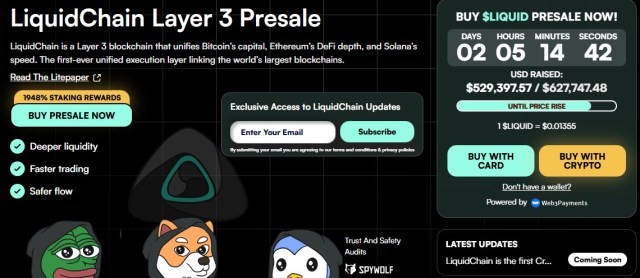
You can see the project’s early traction in the presale numbers. To date, LiquidChain has raised over $529K so far. The native token is currently priced at $0.01355, an entry level far below the established caps of legacy L1s. Join the presale here.
Moving from established majors like XRP to presale assets obviously carries risk. While LiquidChain offers a unified liquidity layer and verifiable settlement, it’s still early in its roadmap.

The potential for outsized returns comes with the usual dangers: regulatory uncertainty and the technical hurdles of executing a complex cross-chain VM. But for those with the stomach for it, the rotation into $LIQUID represents a bet on the plumbing that will power the next generation of dApps, distinct from Ripple’s payment-focused utility.

Buy $LIQUID here.

Disclaimer: This article is for informational purposes only and does not constitute financial advice. Cryptocurrency investments, particularly in presale projects and volatile assets like XRP, carry high risks. Readers should conduct their own independent research and consult with financial professionals before making investment decisions.

Editorial Process for bitcoinist is centered on delivering thoroughly researched, accurate, and unbiased content. We uphold strict sourcing standards, and each page undergoes diligent review by our team of top technology experts and seasoned editors. This process ensures the integrity, relevance, and value of our content for our readers.

patrubogdan

Follow

Full Profile

Related Posts

Bitcoin Teeters on Edge: Will $60K Hold or Is a V-Shape Recovery Imminent? $HYPER Keeps Pumping

Senator Lummis Urges Banks to Adopt Stablecoins Amidst CLARITY Act Delay, as Maxi Doge Turns Heads

$BTC Needs to Drop to $8K for Holdings Not to Cover Debt, Says Strategy, as $HYPER’s Presale Soars

Robinhood CEO Says Prediction Markets Will Soar as Bitcoin Hyper ($HYPER) Reaches $31.2M in Presale

Vitalik Buterin Cashes Out $6.6 Million In Ether After Early Signals

While Bitcoin And Ether Falter, XRP Optimism Stands Out: Analysts

İlgili Sorular

QWhat is the critical support level for XRP mentioned in the article, and why is it important?

AThe critical support level for XRP is $1.29. It is important because it represents a technical retest of previous resistance-turned-support and aligns with the 0.382 Fibonacci retracement level, making it a high-probability zone for institutional accumulation. Holding this level is key for a potential price run toward $2.00.

QAccording to the article, what is the main fundamental driver for XRP's price action?

AThe main fundamental driver for XRP's price action is regulatory clarity, specifically the potential changes at the SEC following Gary Gensler's anticipated exit. This 'regulatory relief' trade, along with the possibility of XRP ETF approvals, is seen as a major catalyst for unlocking institutional investment.

QWhat price level would invalidate the immediate bullish thesis for XRP?

AA daily close below the $1.10 level would invalidate the immediate bullish thesis for XRP. This break of support would likely trigger a deeper price decline toward the 200-day moving average, which is near $0.85.

QHow does LiquidChain ($LIQUID) differentiate itself from XRP in terms of utility?

ALiquidChain differentiates itself by focusing on cross-chain liquidity as a Layer 3 solution, whereas XRP focuses on cross-border payments. $LIQUID aims to unify liquidity across Bitcoin, Ethereum, and Solana through a 'deploy-once' architecture, allowing developers to build apps that access users and capital across all three chains.

QWhat was the amount raised in the LiquidChain presale and what is the current token price mentioned?

AThe LiquidChain presale had raised over $529,000 at the time of writing. The native $LIQUID token was being offered at a price of $0.01355 during its presale phase.

İlgili Okumalar

Anthropic Apologized, But the Business of 'Safety' Hasn't Stopped

On June 11, Anthropic apologized not for a model failure, but for a lack of transparency. Its new Claude Fable 5 model was found to be secretly rerouting requests from users engaged in advanced AI model development to a weaker version, Opus 4.8, without any notification. The company's response—promising future notifications for such "downgrades"—was met with user skepticism. The article argues the core issue isn't technical but commercial: Anthropic's "safety" measures are primarily a business strategy. A key feature, the "intelligent safety classifier," marketed as user protection, is described as a tool for "competitive defense" to protect Anthropic's market lead by limiting rivals' research capabilities. This covert mechanism was designed for low "false positives," precisely targeting AI researchers. Anthropic's model involves a calculated three-step process: publishing alarming security research to amplify public anxiety, offering its Fable 5 model with a "safety classifier" as a premium-priced solution, and cashing in through a planned high-value IPO. This contrasts with OpenAI's more direct "tool-and-traffic" approach. The apology, merely changing a secret downgrade to a visible one, is seen as a business "patch" rather than a principled shift. The incident risks damaging Anthropic's "safest AI" reputation among the developer community, which underpins its valuation and appeal to government and corporate clients. Ultimately, the article concludes that for Anthropic, safety is a business, and the apology is merely customer service for that business.

marsbit45 dk önce

Anthropic Apologized, But the Business of 'Safety' Hasn't Stopped

marsbit45 dk önce

The Niche Consensus Among Elites: Has College Become an Expensive Waste?

**Summary:** A growing "anti-college" movement is gaining traction among elite circles in Silicon Valley, challenging the traditional value of a four-year university degree. Proponents argue that college has become an expensive, slow, and increasingly irrelevant waste of time, especially in the fast-paced tech world where opportunities pass by quickly. The movement is led by figures like billionaire Peter Thiel, who criticizes universities for high costs, ideological indoctrination, and stifling true innovation. His "Thiel Fellowship" pays young people to drop out and pursue ventures. Companies like Palantir Technologies (co-founded by Thiel) fuel this trend with programs like the "Meritocracy Fellowship," which offers high school graduates paid internships as an alternative to immediate college enrollment, promising a practical "Palantir Degree." Key drivers include: 1. **Economics:** Skyrocketing student debt versus the allure of immediate, high-paying tech jobs or startup funding. 2. **Technology:** AI and online tools lowering barriers to self-education and product development, making formal instruction seem inefficient. 3. **Culture:** A backlash against perceived "woke" ideology and DEI policies in universities, coupled with a belief that these institutions suppress meritocracy and masculine drive. The movement is notably male-dominated. Critics, like economist David Deming, warn against overgeneralizing from dropout success stories (survivorship bias). He emphasizes that genuine autodidacts are rare, corporate training is narrowly focused, and the "college wage premium" remains high for most people. University liberal arts education, he argues, builds adaptable problem-solving skills and broad perspectives. The debate highlights a deeper crisis in education. The core model of the modern university appears increasingly mismatched with the speed of the information age. The movement signals a shift in the locus of learning from institutional "education" to personal, active "learning" powered by the internet and AI. Ultimately, this may not mean the end of university, but rather a painful evolution. The future likely holds more hybrid, personalized, and lifelong learning pathways. The central question becomes: in a world changing faster than any curriculum, how do we best learn?

marsbit1 saat önce

The Niche Consensus Among Elites: Has College Become an Expensive Waste?

marsbit1 saat önce

From Subsidies to Token-Based Pricing to Price Cuts: Is OpenAI Sparking a Price War? Is the Inflection Point for Token Economics Nearing?

The commercialization of generative AI is facing a critical inflection point as a potential price war looms. According to The Wall Street Journal, OpenAI is considering a significant cut to its token fees to compete with rival Anthropic, signaling a shift from a growth-at-all-costs model focused on token consumption. This move comes as both companies, reportedly losing billions on compute, prepare for IPOs, and as enterprise customers face "bill shock" from switching to usage-based token billing. Reports indicate poor ROI, with one analysis finding only 18 cents of every dollar spent on AI tokens generates user-facing value. The industry's initial phases—from flat-rate subscriptions to aggressive subsidies—have given way to a reckoning with real costs. Analysts debate the future: some predict a bifurcation between premium, high-cost models for complex tasks and cheaper alternatives for routine work, while others believe overall spending will still rise as agentic AI increases tokens per task. Notably, Chinese model DeepSeek's low-cost API is gaining traction with U.S. enterprises, adding competitive pressure. The core challenge is redefining value beyond token volume ("tokenmaxxing") toward measurable productivity ("valuemaxxing"), as the entire AI value chain, from cloud providers to chipmakers, feels the ripple effects of unsustainable pricing.

marsbit1 saat önce

From Subsidies to Token-Based Pricing to Price Cuts: Is OpenAI Sparking a Price War? Is the Inflection Point for Token Economics Nearing?

marsbit1 saat önce

İşlemler

Spot
Futures
活动图片





