XRP Ledger Hits No. 4 In RWA Rankings In Less Than A Year

bitcoinist2026-05-22 tarihinde yayınlandı2026-05-22 tarihinde güncellendi

Özet

The XRP Ledger has rapidly risen to fourth place in RWA.xyz's network rankings for tokenized real-world assets in less than a year, now holding a total distributed RWA value of $4.1 billion. This positions XRPL behind only Canton, Ethereum, and Provenance, and ahead of networks like BNB Chain and Solana. The ledger's 30-day growth rate of 45.97% is the highest among the top ten, starkly contrasting with declines seen on other major networks. RippleX highlighted this as one of the fastest-growing RWA ecosystems, now hosting a diverse range of tokenized assets including US Treasuries, money market funds, and commercial paper. While Canton dominates the sector with an 83.73% market share ($313.6 billion), XRPL's ascent signals its emergence as a notable player in the competitive institutional tokenization market. Broader sector data shows distributed asset value at $33.87 billion, with US Treasury debt as the largest tokenized category at $15.3 billion.

XRP Ledger has moved into fourth place on RWA.xyz’s network rankings, according to RippleX, marking a rapid climb for the blockchain in the tokenized real-world asset sector. The move puts XRPL behind Canton, Ethereum and Provenance by total distributed RWA value, while placing it ahead of BNB Chain, zkSync Era, Solana, Stellar and Avalanche.

XRP Ledger Jumps To No. 4 In RWA Rankings

RippleX framed the milestone as one of the faster growth stories in tokenized assets. “In less than a year, XRP Ledger has climbed from the top 10 to #4 on the @RWA_xyz league table, making it one of the fastest-growing RWA ecosystems in the space,” the team wrote on X.

“Today, XRPL is home to a growing range of tokenized financial assets onchain, from US Treasuries and money market funds to commercial paper, structured credit, and more. Bringing assets onchain is an important milestone. Expanding what those assets can enable across financial markets is part of the broader opportunity ahead, and one the XRP community is building toward together,” Ripple added.

The RWA.xyz data places XRP Ledger at $4.1 billion in total distributed RWA value, with 302 listed RWAs and a 1.09% market share. The network’s 30-day growth rate stands out sharply among the top ten, rising 45.97% over the period. That compares with declines of 4.92% for Canton, 4.37% for Ethereum and 4.36% for BNB Chain, while Provenance rose 6.37%, Solana climbed 8.24%, Stellar gained 11.33% and Avalanche increased 39.29%.

Canton remains the dominant network in the table by a wide margin, with $313.6 billion in total value and an 83.73% market share. Ethereum ranks second with $19.0 billion and a 5.08% share, followed by Provenance with $18.0 billion and 4.80%. XRP Ledger’s fourth-place position therefore does not yet imply parity with the largest RWA networks by value, but it does show that XRPL has become a visible venue in an increasingly competitive institutional tokenization market.
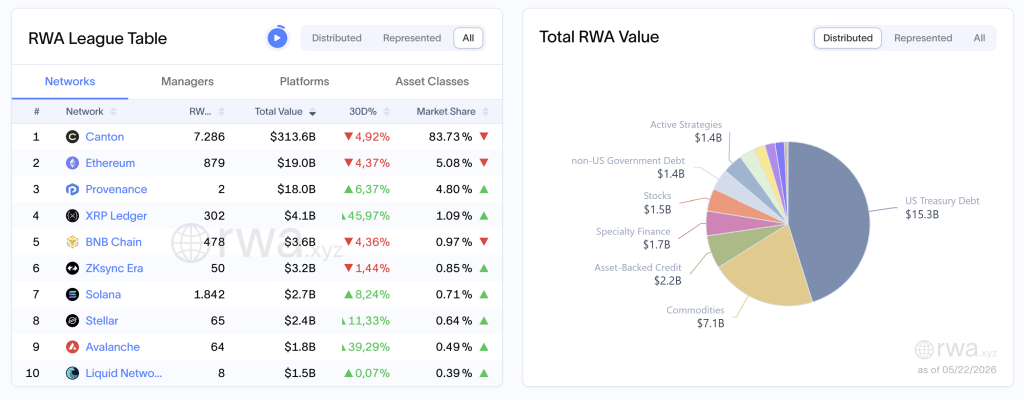
RWA ranking by networks | Source: X RWA.xyz

The broader market data from RWA.xyz shows the sector continuing to expand unevenly. Distributed asset value stood at $33.87 billion, up 1.77% over 30 days, while represented asset value was listed at $340.04 billion, down 2.98% over the same period. Total asset holders reached 800,067, up 8.04% from 30 days earlier. Stablecoin figures were substantially larger, with total stablecoin value at $305.08 billion and total stablecoin holders at 256.21 million.
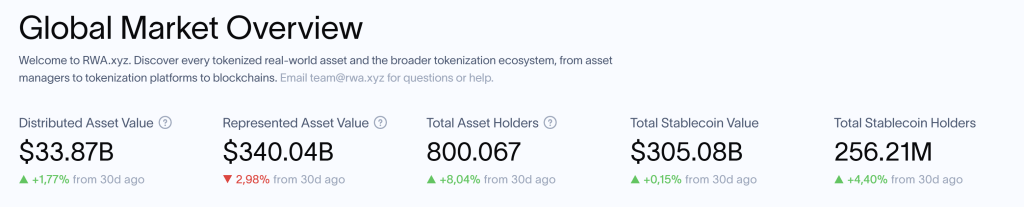
RWA globals market overview | Source: X RWA.xyz

The composition of distributed RWA values also shows where tokenization activity is currently concentrated. US Treasury debt accounted for $15.3 billion, the largest category shown, followed by commodities at $7.1 billion. Asset-backed credit stood at $2.2 billion, specialty finance at $1.7 billion, stocks at $1.5 billion, non-US government debt at $1.4 billion and active strategies at $1.4 billion.

At press time, XRP traded at $1.3596.
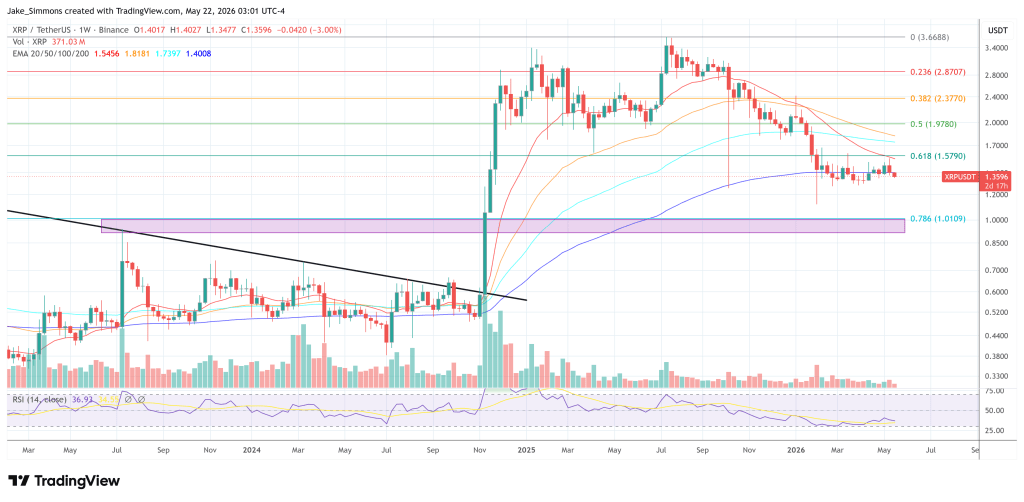
XRP bulls must break the 0.618 Fib, 1-week chart | Source: XRPUSDT on TradingView.com

İlgili Sorular

QAccording to the article, what position did XRP Ledger achieve in RWA.xyz's network rankings and what is its total distributed RWA value?

AXRP Ledger achieved the 4th position in RWA.xyz's network rankings, with a total distributed RWA value of $4.1 billion.

QWhat does RippleX highlight as one of the key characteristics of XRP Ledger's rise in the RWA rankings?

ARippleX highlights that XRP Ledger is one of the fastest-growing RWA ecosystems, having climbed from the top 10 to #4 in less than a year.

QHow does XRP Ledger's 30-day growth rate in distributed RWA value compare to other top networks like Ethereum and Canton?

AXRP Ledger's 30-day growth rate was a sharp increase of 45.97%. In contrast, Ethereum declined by 4.37% and Canton declined by 4.92% over the same period.

QWhat are the two largest categories of tokenized Real-World Assets by distributed value, according to the broader market data from RWA.xyz?

AThe two largest categories are US Treasury debt at $15.3 billion and commodities at $7.1 billion.

QDespite being ranked #4, why does the article state that XRP Ledger does not yet have parity with the largest RWA networks?

AIt does not have parity because the top networks like Canton, Ethereum, and Provenance have significantly larger total values and market shares. For example, Canton has $313.6 billion and an 83.73% share, while XRP Ledger has $4.1 billion and a 1.09% share.

İlgili Okumalar

Will the Next Crypto Bull Run Start with On-Chain Trading of SpaceX?

This article presents a scenario-based forecast for the crypto industry from 2026 to 2029, arguing that the next major cycle will be driven not by technological narratives but by legal access to real-world assets. The author predicts that by mid-2026, pre-IPO perpetual contracts for top private companies like SpaceX, OpenAI, and Anthropic on platforms like Hyperliquid will become the primary gateway for accessing quality assets, as most crypto-native tokens fail to capture real value. The much-hyped AI x Crypto intersection largely fails except for prediction markets, which thrive on betting on AI model supremacy. By 2027, public blockchain foundations are forced to choose between catering to retail speculation or building compliant infrastructure for institutions, with many opting for the latter. Growth in stablecoins and tokenized private credit/equity hits a "triple ceiling" due to regulatory and political uncertainty rather than market demand. The pivotal shift is forecast for 2028. A major liquidation event in pre-IPO perpetuals exposes the structural flaw of synthetic markets lacking a real underlying asset anchor. In response, regulatory changes finally allow the public solicitation of private securities resales to verified accredited investors. This creates a legitimate secondary market for real company equity, which then becomes the core asset class of the new bull market, relegating synthetic perps to a niche role. By 2029, the industry becomes "boring" but foundational. Tokens without claims on real cash flows or assets cease trading. Stablecoin growth is steady but politically capped. Crypto infrastructure fades from view as it gets absorbed into traditional finance backends. The article's central thesis is that the key bottleneck for crypto's next phase is legal and regulatory channels for real asset ownership, not technology.

marsbit24 dk önce

Will the Next Crypto Bull Run Start with On-Chain Trading of SpaceX?

marsbit24 dk önce

The Value Distribution of Stablecoins

**Summary: The Value Distribution of Stablecoins** The article argues that stablecoins are evolving from mere trading tools into broader channels for dollar access. It divides the stablecoin ecosystem into four layers to analyze how value is distributed: 1. **Issuance Layer:** Mints stablecoins, holds reserve assets, and captures the spread between reserve yield and user costs (e.g., Tether, Circle). This layer currently earns the largest profit margin. 2. **Infrastructure Layer:** Connects stablecoins to the traditional financial system, handling fiat on/off-ramps, banking integration, compliance (KYC/AML), and asset management (e.g., Bridge, BVNK). This is the "unglamorous" but critical work, building the essential bridges between crypto and real-world finance. 3. **Acquiring/Distribution Layer:** Integrates stablecoins into merchant systems, manages payment flows, and provides enterprise financial software (e.g., Stripe, Coinbase). They act as the access point for businesses. 4. **Application Layer:** The end-users and businesses that ultimately use stablecoins for payments, settlements, or as a store of value. They benefit from convenience but have little pricing power. The core thesis is that while the issuance layer currently dominates profits, the often-overlooked **infrastructure layer holds significant long-term potential**. The real challenge and barrier to mass adoption is not the on-chain transfer of stablecoins (which is simple), but the complex "last mile" integration into existing business workflows, banking systems, and regulatory frameworks across different countries. Companies in this layer are currently in a "land grab" phase, investing heavily to build networks, secure bank partnerships, and establish compliance pathways. While their position is currently pressured by the profitable issuers above and distribution platforms below, the article suggests that if stablecoins become a default financial rail for businesses, the infrastructure providers who have done the hard work of integration will ultimately gain strong pricing power and become entrenched, essential players.

marsbit7 saat önce

The Value Distribution of Stablecoins

marsbit7 saat önce

The Value Distribution of Stablecoins

The Value Distribution of Stablecoins The article argues that stablecoins are evolving from a mere trading tool into a broad "dollar channel." It analyzes the industry's value chain through four layers: 1. **Issuance Layer (e.g., Tether, Circle):** The top layer that mints stablecoins, holds reserve assets, and captures the thickest interest rate spread. 2. **Infrastructure Layer (e.g., Bridge, BVNK):** Connects stablecoins to the traditional financial system, handling critical but complex "dirty work" like fiat on/off-ramps, banking integration, compliance (KYC/AML), and cross-border settlement. 3. **Acquiring/Distribution Layer (e.g., Stripe, Coinbase):** Embeds stablecoins into merchant systems, manages payment flows, and integrates with enterprise software. 4. **Application Layer:** End-users and businesses that ultimately use stablecoins for payments, settlement, or storing value. The author posits that while the issuance layer currently captures the most profit, the most overlooked and potentially critical layer is infrastructure. The core challenge for stablecoin adoption isn't the on-chain transfer (which is simple), but bridging the gap between blockchain and the real-world financial system. This involves solving practical problems for businesses: fiat conversion, reconciliation, tax handling, and user onboarding. Infrastructure companies are currently in a difficult "land-grab" phase—building networks, securing banking relationships, and achieving compliance country-by-country. They face pressure from both the profitable issuance layer above and distribution platforms below. However, the author suggests this layer is building a crucial moat. Once stablecoins become a default business rail, the infrastructure players who have done the hard work of integration may gain significant, durable value and pricing power.

链捕手7 saat önce

The Value Distribution of Stablecoins

链捕手7 saat önce

İşlemler

Spot
Futures

Popüler Makaleler

4 Nasıl Satın Alınır

HTX.com’a hoş geldiniz! 4 (4) satın alma işlemlerini basit ve kullanışlı bir hâle getirdik. Adım adım açıkladığımız rehberimizi takip ederek kripto yolculuğunuza başlayın. 1. Adım: HTX Hesabınızı OluşturunHTX'te ücretsiz bir hesap açmak için e-posta adresinizi veya telefon numaranızı kullanın. Sorunsuzca kaydolun ve tüm özelliklerin kilidini açın. Hesabımı Aç2. Adım: Kripto Satın Al Bölümüne Gidin ve Ödeme Yönteminizi SeçinKredi/Banka Kartı: Visa veya Mastercard'ınızı kullanarak anında 4 (4) satın alın.Bakiye: Sorunsuz bir şekilde işlem yapmak için HTX hesap bakiyenizdeki fonları kullanın.Üçüncü Taraflar: Kullanımı kolaylaştırmak için Google Pay ve Apple Pay gibi popüler ödeme yöntemlerini ekledik.P2P: HTX'teki diğer kullanıcılarla doğrudan işlem yapın.Borsa Dışı (OTC): Yatırımcılar için kişiye özel hizmetler ve rekabetçi döviz kurları sunuyoruz.3. Adım: 4 (4) Varlıklarınızı Saklayın4 (4) satın aldıktan sonra HTX hesabınızda saklayın. Alternatif olarak, blok zinciri transferi yoluyla başka bir yere gönderebilir veya diğer kripto para birimlerini takas etmek için kullanabilirsiniz.4. Adım: 4 (4) Varlıklarınızla İşlem YapınHTX'in spot piyasasında 4 (4) ile kolayca işlemler yapın.Hesabınıza erişin, işlem çiftinizi seçin, işlemlerinizi gerçekleştirin ve gerçek zamanlı olarak izleyin. Hem yeni başlayanlar hem de deneyimli yatırımcılar için kullanıcı dostu bir deneyim sunuyoruz.

389 Toplam GörüntülenmeYayınlanma 2025.10.20Güncellenme 2026.06.02

4 Nasıl Satın Alınır

Tartışmalar

HTX Topluluğuna hoş geldiniz. Burada, en son platform gelişmeleri hakkında bilgi sahibi olabilir ve profesyonel piyasa görüşlerine erişebilirsiniz. Kullanıcıların 4 (4) fiyatı hakkındaki görüşleri aşağıda sunulmaktadır.

活动图片