XRP Ledger Hard Fork In 8 Days? Upgrade Deadline Sparks Network Split Debate

bitcoinist2026-05-19 tarihinde yayınlandı2026-05-19 tarihinde güncellendi

Özet

The XRP Ledger community is debating whether the mandatory v3.1.3 software upgrade constitutes a hard fork, with critics warning that nodes not updated before the May 27 deadline will be cut off from the network. The update includes a critical fix amendment, which, according to network rules, will automatically activate after a set period. Early data showed a majority of nodes had not upgraded, sparking concerns about a potential network split. Proponents argue the process is not a contentious fork but a standard "amendment blocking" security feature designed to protect network integrity by isolating outdated software. They emphasize that responsible node maintenance is required, and the mechanism ensures all participants correctly interpret transaction rules. Infrastructure experts also note that raw node counts may overstate the risk, as many inactive or non-critical nodes could update last-minute. The debate centers on governance and the operational health of the decentralized network.

The XRP Ledger community is debating whether an approaching v3.1.3 upgrade amounts to a hard fork after infrastructure operators warned that nodes failing to update before the fix amendment activates will no longer be able to communicate with the network.

The dispute erupted after XRPL validator operator Vet said version 3.1.3 of rippled had been available for more than a week, with 40% of the network upgraded at the time of his post (May 18). He warned that the fix amendment included in the release would become active in nine days and that “every node that hasn’t been updated to 3.1.3 will be unable to communicate to the network.”

In a later update, RippleX head of engineering J. Ayo Akinyele said 44% of the XRPL network had upgraded and urged node operators to move quickly, adding: “Only 8 days left before the fix amendment activates — don’t be left out!”

XRPL Hard Fork Debate Heats Up

According to XRPL.org, rippled is the reference server implementation of the XRP Ledger protocol. The 3.1.3 release introduces the fixCleanup3_1_3 amendment, a package of fixes for NFTs, Permissioned Domains, Vaults and the Lending Protocol. Because of the importance of those fixes, XRPL.org said the amendment’s default vote is set to “Yes.”

The “hard fork” framing came from critics who argued that, as of the early upgrade figures, a majority of network nodes were still on the path to being cut off. X user ScamDaddy wrote: “The XRPL will hard fork in 9 days. As of this moment, 60% of the network will be forked off.” The post then turned the argument into a governance challenge: “But who’s to say 3.1.3 should be XRP mainnet, Ripple? Vet? 60% is the majority after all!”

That framing drew pushback from XRPL community members who argued the mechanism is better understood as amendment blocking, not an accidental or contentious chain split. XRPL’s amendment system uses validator voting to approve protocol changes that affect transaction processing. According to XRPL.org, an amendment passes if it receives more than 80% support from trusted validators for two weeks, after which the change applies permanently to future ledger versions.

The technical consequence for outdated servers is still material. XRPL.org says amendment blocking is a security feature intended to protect data accuracy when old software no longer understands the active rules of the network. Servers running earlier versions without the amendment code cannot determine ledger validity, submit or process transactions, participate in consensus, or vote on future amendments; upgrading to a newer rippled version unblocks them.

Daniel Keller, Chief Technology Officer (CTO) for Eminence, a blockchain infrastructure company that runs a Full History Node for the XRP Ledger, argued that raw node counts may overstate the operational risk. “The only question is: how many of them actually matter to XRPL operations?” he wrote. “How many are abandoned? How many would just update a few hours late? How many are actually relevant infrastructure?”

Keller framed the cutoff as maintenance discipline rather than a decentralization failure: “Decentralisation does not mean dead weight gets carried. Running a node is a responsibility, not a participation trophy. If you can’t maintain infrastructure, you should get filtered out. That is network hygiene.”

Krippenreiter made a similar case, saying the negative connotation around “forking” can obscure XRPL’s design. “Forking has a negative connotation because it sounds like the network is less secure because of it, when in reality, at least on the XRP Ledger, the amendment block mechanism itself, ironically, is a security feature,” he wrote. “It is a security mechanism so that no transaction data or rules on XRPL are interpreted wrongly by any node that didn’t already update.”

At press time, XRP traded at $1.38.
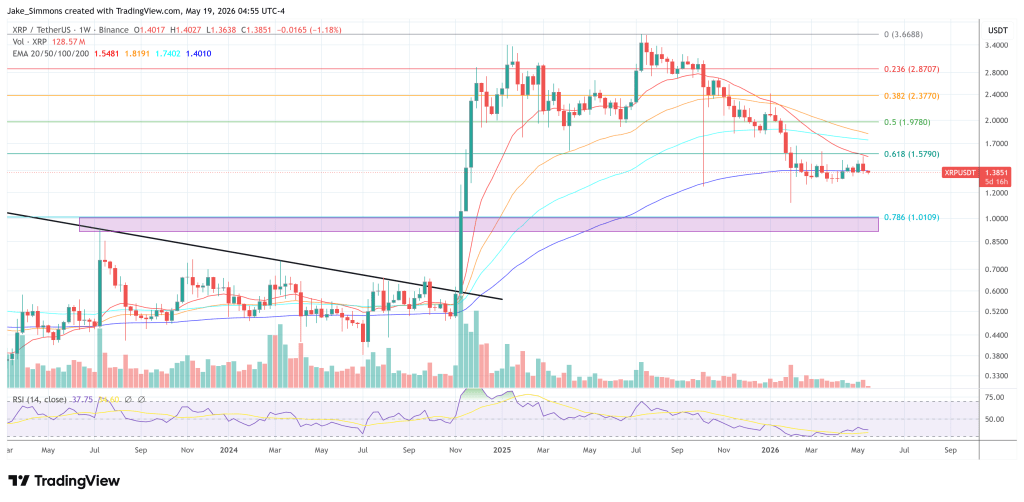
XRP bulls must break the 0.618 Fib, 1-week chart | Source: XRPUSDT on TradingView.com

İlgili Sorular

QWhat is the main debate in the XRP Ledger community regarding the v3.1.3 upgrade?

AThe debate is over whether the approaching v3.1.3 upgrade constitutes a hard fork that could split the network, or if it is better understood as a standard amendment blocking process, which is a security feature to protect data accuracy.

QWhat happens to nodes that fail to update to rippled version 3.1.3 before the fix amendment activates?

ANodes that have not been updated to version 3.1.3 will be unable to communicate with the network. They cannot determine ledger validity, submit or process transactions, participate in consensus, or vote on future amendments.

QWhat is the purpose of the fixCleanup3_1_3 amendment included in the rippled 3.1.3 release?

AThe fixCleanup3_1_3 amendment is a package of fixes for NFTs, Permissioned Domains, Vaults, and the Lending Protocol on the XRP Ledger.

QAccording to critics, why was the situation framed as a 'hard fork'?

ACritics framed it as a 'hard fork' because, based on early upgrade figures, a majority (60%) of network nodes were on a path to being cut off, which they argued could create a governance challenge about which chain should be considered the mainnet.

QHow do defenders of the process, like Daniel Keller, view the potential cutoff of outdated nodes?

ADefenders like Daniel Keller view the cutoff as necessary maintenance discipline and 'network hygiene,' arguing that decentralization does not mean carrying 'dead weight.' Running a node is a responsibility, and outdated infrastructure that cannot be maintained should be filtered out.

İlgili Okumalar

DAT Failure? Listed Companies Betting on HYPE Floating Profit of $12.5 Billion

Several public companies that adopted a "HYPE Treasury" strategy—holding significant reserves of the HYPE token from the Hyperliquid ecosystem—have achieved substantial paper gains, collectively exceeding $1.25 billion. This contrasts with the reported struggles of MicroStrategy's flagship BTC treasury strategy. The article profiles three such HYPE-focused treasury companies: 1. **Hyperliquid Strategies Inc. (PURR):** The largest holder, with approximately 22.3 million HYPE tokens valued at ~$1.636 billion, resulting in an unrealized gain of ~$1.22 billion. It has fully transitioned from a biotech firm to a dedicated crypto treasury, adding staking and validator operations to enhance returns. 2. **Hyperion DeFi (HYPD):** Holds around 2 million HYPE tokens (~$147 million value) with a gain of ~$49.4 million. It is deeply integrated into the Hyperliquid ecosystem, running a major validator node and building DeFi products for additional yield. 3. **Lion Group Holding (LGHL):** A smaller holder with ~194,000 HYPE tokens (~$14.14 million value), maintaining a long-term commitment to the token. The success of these HYPE treasuries is attributed not only to the token's significant price appreciation but also to active on-chain participation through staking, validation, and ecosystem integrations, creating a compounding "flywheel" effect. The article posits that while MicroStrategy's BTC strategy faces challenges, HYPE treasuries may offer a more sustainable model through deeper protocol engagement, with potential for further growth if HYPE's price rises as predicted by some analysts.

marsbit3 dk önce

DAT Failure? Listed Companies Betting on HYPE Floating Profit of $12.5 Billion

marsbit3 dk önce

DAT Failing? Listed Companies Betting on HYPE Have Floating Profits of $12.5 Billion

Facing a potential need to sell Bitcoin to pay dividends amid a $12.5B quarterly net loss, the crypto treasury strategy pioneered by Strategy appears strained. In contrast, public companies that adopted a similar strategy by betting on the HYPE token are seeing massive gains, with collective unrealized profits exceeding $1.25 billion. Three key HYPE treasury companies are highlighted: 1. **Hyperliquid Strategies Inc. (PURR):** The largest holder, with approximately 22.3 million HYPE tokens valued at ~$1.636 billion, resulting in ~$1.22 billion in unrealized gains. It has fully transitioned from a biotech firm to a native crypto treasury, focusing on staking and ecosystem participation via validator operations. 2. **Hyperion DeFi (HYPD):** Holds about 2 million HYPE tokens (~$147M value) with ~$49.4M in gains. It is deeply integrated into the Hyperliquid ecosystem, running a top validator node and building DeFi products to generate additional yield. 3. **Lion Group Holding (LGHL):** A smaller player holding ~193,775 HYPE tokens (~$14.14M value), maintaining a long-term holding strategy alongside other crypto assets. The article argues that HYPE treasuries have an advantage over Bitcoin-based ones like Strategy's. Their success stems not just from price appreciation but from active on-chain participation—staking, earning validator rewards, and engaging with ecosystem protocols—creating a compounding "flywheel" effect. With Hyperliquid dominating the on-chain perpetuals market and HYPE's tokenomics encouraging buys and burns, these treasuries are positioned to benefit further if HYPE's price rises as some predict. While the original Bitcoin treasury strategy isn't declared a failure, the current narrative highlights the outsized success of early movers into the HYPE ecosystem.

Odaily星球日报7 dk önce

DAT Failing? Listed Companies Betting on HYPE Have Floating Profits of $12.5 Billion

Odaily星球日报7 dk önce

Comics Illustration: Helping You Understand China's New Regulations on Outbound Investment

Summary: Understanding China's New Regulations on Overseas Investment The State Council has announced new regulations on overseas investment, effective July 1, 2026. The core message is not a prohibition on international investment, but a call for both companies and individuals to operate with strong regulatory awareness. Here are the key points: 1. **Scope is Broad:** The rules apply not only to companies but also to other organizations and individual residents. 2. **Definition of Investment is Wide:** It encompasses not just capital transfers but also asset contributions, obtaining equity or rights, financing, providing guarantees, and direct or indirect acquisition of rights related to overseas entities or assets. 3. **Companies Must Plan Comprehensively:** Beyond simple ownership charts, firms need clear plans covering the investing entity, required approvals or filings, fund transfer paths, and compliance with technology, data, and security reviews. 4. **Individuals Should Prioritize Compliance:** Before focusing on returns, individuals must first assess their eligibility, understand legal channels for capital outflow, know what they are acquiring, and identify responsible parties in case of issues. 5. **Penalties are Significant:** Violations can result in fines and potentially restrictions on future overseas investment activities. In essence, overseas investment remains possible, but it must be approached with regulatory compliance as a fundamental priority, not solely based on commercial opportunity. *Note: This is a general informational summary and does not constitute legal advice or investment recommendations.*

marsbit21 dk önce

Comics Illustration: Helping You Understand China's New Regulations on Outbound Investment

marsbit21 dk önce

Nvidia Rack Disassembly Reveals New Growth Opportunity, MLCC Value Surges 182%

Supply bottlenecks in AI infrastructure have expanded to fundamental hardware components like multilayer ceramic capacitors (MLCCs), crucial for stabilizing power and filtering noise in AI servers. Both Goldman Sachs and Morgan Stanley highlight MLCCs as entering a historic "volume-price dual increase" supercycle driven by AI. Goldman forecasts the AI server MLCC market to surge over fourfold from ~$1.4B in FY2025 to ~$5.8B in FY2030, a 34% CAGR. The core driver is a structural supply-demand imbalance. While AI server demand is projected to grow ~4.3x by 2030, industry capacity expands at only ~10% annually, constrained by internal production of equipment and materials. This is compounded by strong demand from electric vehicles. The shortage is evident, with lead times for high-end MLCCs exceeding 20 weeks. The price cycle has officially begun. Japanese leaders Murata and Taiyo Yuden have raised prices by 15-35% for AI server and automotive MLCCs since April, citing material costs. Japan's April export data confirms the trend, with MLCC export value up 28% year-over-year. Profit leverage is significant: Goldman estimates a mere 5% price increase could boost Murata's FY2027 operating profit by ~13% and Taiyo Yuden's by up to 37%. Morgan Stanley's teardown of Nvidia's upcoming Vera Rubin AI rack reveals another catalyst: the MLCC value per rack has skyrocketed 182% from the previous generation to ~$4,320, highlighting the component's growing importance. With demand set to massively outstrip constrained supply, and price increases just starting, analysts position MLCCs at the beginning of a major, prolonged upcycle.

marsbit21 dk önce

Nvidia Rack Disassembly Reveals New Growth Opportunity, MLCC Value Surges 182%

marsbit21 dk önce

A 134% Surge, 75 P/E Ratio: Why Is the Market Paying Up for Murata's 'Zero Growth'?

Murata Manufacturing, the world's largest passive components maker, saw its stock price surge 134% over the past year and hit a record high on May 28th, despite reporting nearly zero growth in operating profit for its latest fiscal year. This has pushed its valuation to a P/E ratio of approximately 75x. The disconnect is driven by a fundamental market re-rating. The catalyst was a late-May meeting where management upgraded the AI investment cycle outlook to "lasting until around 2030" and noted that demand for its components is roughly double its supply capacity, with customers prioritizing securing volume over price. While Murata's revenue grew only 5.0% and operating profit stagnated at ¥281.8 billion for the fiscal year ending March 2026, its guidance for the current fiscal year projects a 34.8% jump in operating profit to ¥380 billion. This sharp growth is underpinned by expectations that its AI/data center-related revenue will nearly double from ¥170 billion to ¥325 billion, becoming a key pillar of its business. Analysts highlight that this growth stems not from broad price hikes but from a shift towards higher-value, cutting-edge MLCCs for AI servers, where Murata holds over 70% market share. The market is now pricing Murata not as a cyclical component maker but as a critical "AI pick-and-shovel" supplier with structural pricing power. However, the high valuation also carries risk if future AI demand or quarterly guidance falls short of the elevated expectations.

marsbit44 dk önce

A 134% Surge, 75 P/E Ratio: Why Is the Market Paying Up for Murata's 'Zero Growth'?

marsbit44 dk önce

İşlemler

Spot
Futures
活动图片





