XRP Ledger Gets AI Security Upgrade As Ripple Prepares For Bigger Growth

bitcoinist2026-03-28 tarihinde yayınlandı2026-03-28 tarihinde güncellendi

Özet

Ripple is implementing a major structural shift in how security is handled on the XRP Ledger (XRPL), tying its next phase of security work directly to its ambitions in global payments and tokenized assets. The overhaul integrates AI-assisted testing, a dedicated red team, stricter amendment reviews, and a broader modernization of the codebase. AI is being used to proactively discover vulnerabilities, shift from reactive debugging, and simulate complex edge cases at scale. The red team has already uncovered over 10 bugs. RippleX team emphasized that resilience must be a process of continuous hardening. Governance around network amendments will also be formalized with multiple audits and clearer readiness criteria. The next XRPL release will focus solely on bug fixes and improvements, prioritizing security and reliability over new features as the ledger aims for institutional-grade growth.

Ripple says it is overhauling how security is handled on the XRP Ledger, adding AI-assisted testing, a dedicated red team, stricter amendment review standards, and a broader push to modernize parts of the codebase. Notably, Ripple is explicitly tying XRPL’s next phase of security work to its ambitions in global payments, tokenized assets, and institutional financial infrastructure.

In its March 26 blog post, Ripple framed the initiative less as a narrow tooling upgrade and more as a structural shift in how XRPL is maintained. Senior Director of Engineering at RippleX Ayo Akinyele wrote that XRPL has been running since 2012 and, over that period, has processed more than 100 million ledgers, facilitated over 3 billion transactions, and secured billions in value transfer. That operating history, Ripple argued, is both a strength and a complication: a long-lived production codebase carries legacy assumptions, older design decisions, and engineering patterns that may no longer match the demands of a larger, more complex network.

The company’s core argument is that AI changes the security equation by making it easier to explore edge cases and hidden failure modes at scale. “AI allows us to shift from reactive debugging to proactive, systematic discovery of vulnerabilities, strengthening the ledger faster and with greater confidence than ever before,” Akinyele wrote. He added that for XRPL, resilience “must be continuous: not a one-time validation, but an ongoing process of hardening, testing and improving as XRPL evolves.”

Ripple broke the plan into several layers. It said AI is being integrated across the software development lifecycle through adversarial code scanning, AI-assisted reviews on every pull request, threat modeling, attack-surface mapping, and simulations of edge cases and stress scenarios that would be difficult to generate manually. The company also said it has established a dedicated AI-assisted red team focused on how XRPL features interact in real-world conditions, especially where legacy logic meets newer functionality.

That red-team effort is already producing findings, according to Ripple and developers involved in the initiative. In the blog post, Ripple said the team has uncovered “10+ bugs,” with only low-severity issues disclosed publicly so far and all findings being prioritized for fixes. In a separate X post, Mayukha Vadari said the effort had already been “incredibly fruitful,” adding that the team had found “a number of bugs across a range of severities.” She described the project as “exactly the kind of continuous, adversarial push XRPL needs as it continues to grow.”

Ripple is also using the moment to address broader code quality issues that sit above any single bug. The post says many problems in long-lived systems stem from structural weaknesses such as limited type safety, inconsistent feature interactions, weak invariant enforcement, and assumptions that are either undocumented or not enforced. The implication is that Ripple is not only trying to catch vulnerabilities earlier, but to reduce the conditions that allow classes of vulnerabilities to recur.

Another major part of the announcement is governance around amendments. Ripple said significant changes will face multiple independent security audits, expanded bug bounty incentives, more attackathons, and clearer readiness criteria before activation. It also said those criteria will be defined and published with the XRPL Foundation, signaling an attempt to formalize the security bar for network changes rather than evaluate them on a looser, case-by-case basis.

Notably, Ripple also highlighted that the next XRPL release will focus on bug fixes and improvements without introducing new features, a choice that suggests hardening the stack is taking priority over shipping more functionality. As XRPL pushes deeper into tokenized assets, payments, and institutional DeFi, Ripple is making the case that the next stage of growth depends less on novelty and more on whether the ledger can keep raising its reliability threshold in public.

At press time, XRP traded at $1.33.
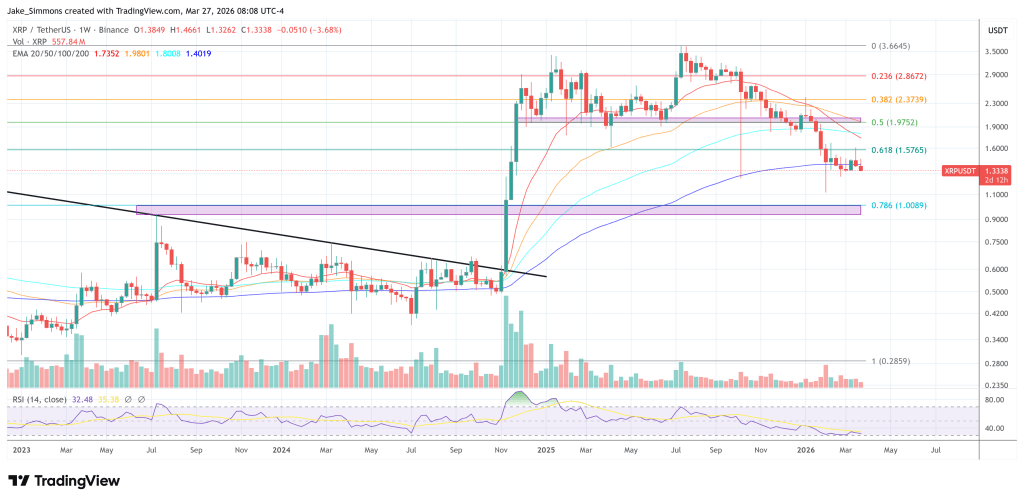
XRP falls below the 200-week EMA again, 1-week chart | Source: XRPUSDT on TradingView.com

İlgili Sorular

QWhat are the key components of Ripple's security upgrade for the XRP Ledger?

ARipple's security upgrade includes AI-assisted testing, a dedicated red team, stricter amendment review standards, adversarial code scanning, AI-assisted reviews on every pull request, threat modeling, attack-surface mapping, and simulations of edge cases and stress scenarios.

QHow does Ripple claim AI will change the security approach for XRPL?

ARipple claims AI changes the security equation by shifting from reactive debugging to proactive, systematic discovery of vulnerabilities, allowing them to explore edge cases and hidden failure modes at scale, thereby strengthening the ledger faster and with greater confidence.

QWhat has the dedicated AI-assisted red team already discovered according to the announcement?

AThe dedicated AI-assisted red team has uncovered over 10 bugs, with only low-severity issues disclosed publicly so far. The findings are described as 'incredibly fruitful,' including a number of bugs across a range of severities.

QWhat is the focus of the next XRPL release as mentioned in the blog post?

AThe next XRPL release will focus on bug fixes and improvements without introducing new features, indicating that hardening the stack and improving reliability is taking priority over adding more functionality.

QHow is Ripple changing the governance process for significant amendments to the XRPL?

ASignificant amendments will now face multiple independent security audits, expanded bug bounty incentives, more attackathons, and clearer readiness criteria before activation. These criteria will be defined and published with the XRPL Foundation to formalize the security bar for network changes.

İlgili Okumalar

When Doing Cryptocurrency Payment, the First Thing is Licenses, What is the Second?

When launching a crypto payment business, obtaining the necessary licenses is the crucial first step. However, the second, and arguably more critical, step is designing a comprehensive operational framework that forms a coherent business loop. This loop must be clearly understood and executable by all stakeholders: banks, payment partners, exchanges, on-chain analytics providers, regulators, and your internal team. Many projects mistakenly believe a single license permits all operations. Licenses merely grant entry; they don't define how the specific business functions. The real challenge lies in detailing every aspect of the workflow. This involves clarifying the customer base, the flow of fiat and crypto assets, the settlement process, and establishing clear lines of responsibility for risks like AML compliance, sanctions screening, chargebacks, and regulatory inquiries. A robust framework must answer seven core questions: Who are the clients and merchants? Who collects fiat and crypto? Who handles conversion and custody? And who is ultimately accountable for compliance and risk management? Projects often fail not from a lack of licensing, but during due diligence when they cannot convincingly explain these operational details. Therefore, beyond securing licenses, the priority must be constructing a closed-loop system. This system ensures the business model is transparent, risks are managed, responsibilities are delineated, contracts are aligned, and the entire process is comprehensible to partners and regulators. The true competitive edge in crypto payments lies not in acquiring a license quickly, but in integrating licensing, banking, compliance, and operations into a sustainable and executable whole.

marsbit20 dk önce

When Doing Cryptocurrency Payment, the First Thing is Licenses, What is the Second?

marsbit20 dk önce

Arthur Hayes Analysis: AI Bubble Nears Burst, Crypto Market Faces Short-Term Pressure

Arthur Hayes argues that the current AI market is a bubble poised to burst, which will exert downward pressure on the crypto market in the near term. The core trigger is rising oil prices due to the US-Iran conflict and a blockade of the Strait of Hormuz. Higher energy costs directly increase the operational expenses of AI data centers, squeezing profit margins for companies like Google, Anthropic, and OpenAI. Hayes predicts that persistent inflation from high oil prices will force Trump, in a bid to win the November election, to turn public sentiment against the AI industry. He may propose regulations and taxes on data centers and AI companies to appeal to voters concerned about costs and job displacement. Such political rhetoric could shatter market confidence. Furthermore, the market is unlikely to healthily absorb the massive concurrent IPOs of SpaceX, Anthropic, and OpenAI, which together seek valuations in the trillions. The combination of soaring energy costs, overwhelming equity supply, and negative political pressure will puncture the AI bubble. Hayes notes that nearly all new USD liquidity since 2022 has flowed into AI, leaving crypto like Bitcoin behind. When the AI bubble bursts, liquidity will contract sharply, pulling down all risk assets, including cryptocurrencies. In response, Hayes's fund, Maelstrom, has sold all AI-related stocks and non-core cryptocurrencies. It maintains core positions in Bitcoin and Ethereum while increasing exposure to energy sector equities, betting on rising oil and gas prices. He expects Bitcoin to bottom after the AI-led market decline, before rallying again with future monetary easing.

Foresight News34 dk önce

Arthur Hayes Analysis: AI Bubble Nears Burst, Crypto Market Faces Short-Term Pressure

Foresight News34 dk önce

To C, To B, and the Next Big Thing Called To A

After To C and To B, the Next Wave is To A: Serving AI Agents In a recent quarterly earnings call, Meituan's Wang Xing introduced a new concept: To A (To Agent), signifying that future business services will increasingly target AI Agents as primary clients, not just consumers or merchants. This shift implies that internet giants must now consider how to make their services more appealing for AI Agents to recommend, fundamentally altering traditional distribution logic. This "To A era" is prompting an unusual trend of alliances among major tech companies. Unlike previous competitive battles, firms like Meituan, Tencent, JD.com, Huawei, OPPO, and OpenAI are rapidly forming partnerships. The reason is strategic: as AI Agents become the primary user interface, handling tasks from a single command (e.g., "Book a Japanese restaurant for tomorrow"), the risk for platforms is being bypassed entirely. Companies are positioning themselves within this new value chain. Three primary strategies are emerging: 1. **Super-Entry Points + Service Providers:** Platforms like Tencent's Yuanbao, WeChat, and ChatGPT aim to be the first-stop Agent, integrating various services (food delivery, shopping, travel) from partners like Meituan and JD.com. 2. **Apps as Callable Services:** Companies like Meituan, JD.com, and Uber are ensuring their core services remain accessible and callable by external Agents, shifting from front-end apps to back-end capabilities. 3. **System-Level Agent Entry Points:** Smartphone makers (Huawei, Honor, OPPO) are leveraging their OS-level AI assistants to control the initial user command, redistributing it to relevant service apps. While alliances offer mutual benefit—entry points gain service capabilities, and service providers gain traffic—inherent conflicts of interest exist. A dominant Agent platform could eventually attempt to connect directly with suppliers (restaurants, hotels), bypassing current aggregators like Meituan or Ctrip. Other unresolved challenges include the potential for Agent recommendations to become a new form of paid ranking and unclear accountability for faulty recommendations. The current rush to form alliances is a defensive move by service providers to secure their position before the landscape solidifies. In this To A-driven restructuring, the greatest risk is not losing the race but failing to hear the starting gun.

marsbit43 dk önce

To C, To B, and the Next Big Thing Called To A

marsbit43 dk önce

The More Lifelike the Robot, the More Terrifying? Unveiling the 'Uncanny Valley Effect' in the Era of Humanoid Robots

As humanoid robots become increasingly lifelike, they confront a significant psychological barrier known as the "Uncanny Valley Effect," a concept proposed by Japanese roboticist Masahiro Mori in 1970. This phenomenon describes a dip in human comfort and acceptance when robots appear almost, but not perfectly, human. Minor imperfections in facial expressions, eye movements, or skin texture trigger a subconscious sense of unease, as the brain detects something trying, yet failing, to mimic a person. Examples range from the controversial human-like robot Sophia to animated characters in films like *The Polar Express*. The effect poses a key design challenge for robotics companies. Some, like Boston Dynamics, avoid it entirely by creating highly capable but visibly mechanical robots. Others, like Hanson Robotics, push for greater human likeness despite the risk. For consumer robots, especially in homes, most manufacturers opt for stylized or clearly mechanical designs to ensure broader acceptance. While the Uncanny Valley remains a powerful force, its impact may diminish over time through technological advancements that achieve near-perfect realism or through generational familiarity as people grow accustomed to interacting with humanoid machines. Ultimately, navigating this psychological frontier requires as much understanding of human perception as of robotics technology itself.

marsbit44 dk önce

The More Lifelike the Robot, the More Terrifying? Unveiling the 'Uncanny Valley Effect' in the Era of Humanoid Robots

marsbit44 dk önce

İşlemler

Spot
Futures

Popüler Makaleler

XRP 2.0 Nedir

XRP 2.0: Kriptopara Manzarasında Yeni Bir Sınır XRP 2.0'a Giriş Kriptopara alanı sürekli olarak evriliyor, yeni projeler sürekli olarak dikkat ve benimseme için mücadele ediyor. Bu vaatkar girişimlerden biri, ileri düzey blok zinciri teknolojisi ve güçlü şifreleme yöntemlerini kullanmak üzere tasarlanmış yeni bir kriptopara projesi olan XRP 2.0'dır. İsim Ripple’ın XRP'si ile benzerlikler taşısa da, XRP 2.0'un bağımsız olarak çalıştığını, işlem güvenliğini, gizliliği ve ölçeklenebilirliği artırmaya odaklandığını belirtmek önemlidir. Dijital finansal alan giderek merkeziyetsiz çözümleri benimsedikçe, XRP 2.0, web3'e ve genel olarak kriptopara projelerinin genişlemesine anlamlı bir şekilde katkıda bulunmayı hedeflemektedir. XRP 2.0 Nedir? XRP 2.0'ın temelinde, güvenli ve merkeziyetsiz bir dijital para ekosistemi yaratmayı amaçlayan bir kriptopara projesidir. Temel teknolojisi, karmaşık blok zinciri prensiplerini ileri düzey şifreleme teknikleriyle entegre eder. XRP 2.0'ın ana hedefi, hızlı işlem yürütümünü sağlarken kullanıcılar için artırılmış gizlilik korumalarını öncelikli hale getirerek kendini güvenilir ve etkili bir platform olarak kurmaktır. Proje, mevcut kriptoparaların karşılaştığı birçok sınırlamanın çözümü olarak tanıtılmakta ve daha yüksek işlem hacimlerini, geliştirilmiş hız ve gizlilikle yönetebilen bir sistem önermektedir. Bu çok yönlülük, XRP 2.0'ı çeşitli dijital para birimleriyle dolu bir pazarda önemli bir rakip haline getiriyor. XRP 2.0’ın Yaratıcıları Kimdir? XRP 2.0'ın yaratıcısının kimliği 'Wilbur' olarak belirtilmiştir. Ancak, Wilbur veya ona bağlı varlıklar hakkında kapsamlı bilgiler ulaşılmaz durumdadır. Birçok kriptopara yaratıcısının anonimliği, genellikle bir derece gizlilik ve güvenliği korumayı amaçlayan endüstride yaygın bir olgudur. XRP 2.0’ın Yatırımcıları Kimlerdir? Şu anda, XRP 2.0’ı destekleyen yatırım kuruluşları veya organizasyonlarına dair spesifik bilgiler kamuya açık değildir. Kriptopara sektöründe, tanınmış yatırımcılar tarafından desteklenmek bir projenin güvenilirliğini ve başarısını önemli ölçüde etkileyebilir; ancak XRP 2.0'ın finansal destekçileri ile ilgili şeffaflık henüz sağlanmamıştır. XRP 2.0 Nasıl Çalışır? XRP 2.0, güvenli ve merkeziyetsiz işlemler sağlamak için blok zinciri teknolojisi ve gelişmiş şifreleme algoritmalarının bir kombinasyonunu kullanarak öne çıkmaktadır. Yenilikçi yapısı, kullanıcı etkileşimini artırmaya ve geleneksel kriptopara işlemlerinin ötesinde işlevselliği genişletmeye yönelik tasarlanmış benzersiz özellikler içerir. Bu özellikler arasında, XRP 2.0, metin-görüntü ve metin-ses işlevsellikleri gibi yapay zeka destekli yetenekler entegre etmektedir. Bu eklemeler, kullanıcılar için etkileşimli deneyimi artırmayı ve çeşitli sektörlerde daha geniş uygulama alanını teşvik etmeyi amaçlamaktadır. Teknolojik ilerlemeleri, kullanıcı odaklı tasarımla birleştirerek, XRP 2.0, kriptopara çözümlerini operasyonel çerçevelerine entegre etmeyi düşünen çeşitli bireyler ve işletmelerin dikkatini çekmeyi hedeflemektedir. XRP 2.0 Zaman Çizelgesi XRP 2.0'ı anlamak, şu ana kadar tanımladığı dönüm noktalarını incelemeyi gerektirir: 23 Temmuz 2023: XRP 2.0, blok zinciri alanında güvenli ve merkeziyetsiz işlem kabiliyetlerini devrim niteliğinde sunmayı hedefleyen yeni bir kriptopara projesi olarak tanıtıldı. 8 Eylül 2023: XRP20 adlı başka bir projenin lansmanı gerçekleşti, bu, XRP 2.0 ile ilgisi olmayan Ethereum blok zincirinde bir ERC-20 token'ın ortaya çıkışını işaret ediyor. 13 Kasım 2023: XRP Defteri, rippled sunucu yazılımının 2.0.0 versiyonunun yayınlanmasıyla önemli bir güncelleme aldı. Bu gelişmenin XRP 2.0 kriptopara projesi ile bağlantılı olmadığını belirtmek önemlidir. XRP 2.0 Hakkında Anahtar Noktalar XRP 2.0'ın özünü distile etmek için birkaç kritik faktör öne çıkmaktadır: Benzersiz Özellikler: AI destekli metin-görüntü ve metin-ses gibi özelliklerin eklenmesi, XRP 2.0'ın potansiyel uygulamalarını daha da çeşitlendirir. Blockchain Teknolojisi: Çerçeve, işlemler için güvenli ve merkeziyetsiz bir ortam sağlamak üzere gelişmiş blok zinciri mekanizmaları ve şifreleme protokolleri kullanır. Ölçeklenebilirlik ve Gizlilik: XRP 2.0, işlem süreçlerinde artırılmış gizlilik korumalarını ve büyüyen kullanıcı tabanını karşılamak için gerekli ölçeklenebilirliği önceliklendirir. Ripple ile İlişki Yok: Önemli olarak, adıyla birlikte hareket etmemesine rağmen, XRP 2.0’ın Ripple’ın XRP’si ile herhangi bir bağı veya iş birliği bulunmamaktadır; bu, onun kriptopara ekosistemindeki operasyonel çerçevesini ve hedeflerini belirgin bir şekilde ayırmaktadır. Sonuç XRP 2.0, kriptopara alanında güvenlik, gizlilik ve verimlilik kombinasyonu sunmayı hedefleyen iddialı bir girişimi temsil etmektedir. Karmaşık teknolojileri ve kullanıcı dostu özellikleri entegre ederek, proje kriptoparanın günümüz dijital ekonomisinde neler başarabileceğinin ufkunu genişletmeyi hedefliyor. Yaratıcısının anonimliği ve açıklanmayan yatırımcıların eksikliği bazıları için soru işaretleri oluşturabilir, ancak XRP 2.0'ın ileri düzey işlevsellikler ve merkeziyetsizlik konusundaki odaklanması, onu giderek kalabalıklaşan bir kriptopara pazarında çekici kılmaktadır. Kriptopara manzarası evrimini sürdürdükçe, XRP 2.0, güvenli ve ölçeklenebilir blok zinciri çözümlerinin genişlemesinde önemli bir oyuncu olarak ortaya çıkabilir.

160 Toplam GörüntülenmeYayınlanma 2024.04.05Güncellenme 2024.12.03

XRP 2.0 Nedir

XRP Nasıl Satın Alınır

HTX.com’a hoş geldiniz! XRP (XRP) satın alma işlemlerini basit ve kullanışlı bir hâle getirdik. Adım adım açıkladığımız rehberimizi takip ederek kripto yolculuğunuza başlayın. 1. Adım: HTX Hesabınızı OluşturunHTX'te ücretsiz bir hesap açmak için e-posta adresinizi veya telefon numaranızı kullanın. Sorunsuzca kaydolun ve tüm özelliklerin kilidini açın. Hesabımı Aç2. Adım: Kripto Satın Al Bölümüne Gidin ve Ödeme Yönteminizi SeçinKredi/Banka Kartı: Visa veya Mastercard'ınızı kullanarak anında XRP (XRP) satın alın.Bakiye: Sorunsuz bir şekilde işlem yapmak için HTX hesap bakiyenizdeki fonları kullanın.Üçüncü Taraflar: Kullanımı kolaylaştırmak için Google Pay ve Apple Pay gibi popüler ödeme yöntemlerini ekledik.P2P: HTX'teki diğer kullanıcılarla doğrudan işlem yapın.Borsa Dışı (OTC): Yatırımcılar için kişiye özel hizmetler ve rekabetçi döviz kurları sunuyoruz.3. Adım: XRP (XRP) Varlıklarınızı SaklayınXRP (XRP) satın aldıktan sonra HTX hesabınızda saklayın. Alternatif olarak, blok zinciri transferi yoluyla başka bir yere gönderebilir veya diğer kripto para birimlerini takas etmek için kullanabilirsiniz.4. Adım: XRP (XRP) Varlıklarınızla İşlem YapınHTX'in spot piyasasında XRP (XRP) ile kolayca işlemler yapın.Hesabınıza erişin, işlem çiftinizi seçin, işlemlerinizi gerçekleştirin ve gerçek zamanlı olarak izleyin. Hem yeni başlayanlar hem de deneyimli yatırımcılar için kullanıcı dostu bir deneyim sunuyoruz.

2.0k Toplam GörüntülenmeYayınlanma 2024.12.10Güncellenme 2026.06.02

XRP Nasıl Satın Alınır

Tartışmalar

HTX Topluluğuna hoş geldiniz. Burada, en son platform gelişmeleri hakkında bilgi sahibi olabilir ve profesyonel piyasa görüşlerine erişebilirsiniz. Kullanıcıların XRP (XRP) fiyatı hakkındaki görüşleri aşağıda sunulmaktadır.

活动图片