XRP Gets A Wall Street Wrapper: Evernorth CEO Teases Q1 2026 Nasdaq IPO

bitcoinist2026-01-16 tarihinde yayınlandı2026-01-16 tarihinde güncellendi

Özet

Evernorth CEO Ashish Birla announced the company is preparing for a Q1 2026 IPO on Nasdaq, positioning it as a simplified way for institutions to gain exposure to XRP without handling custody, compliance, or security directly. Birla cited favorable regulation and growing institutional demand as key reasons for the timing. The firm’s equity will serve as a proxy for XRP investment, allowing investors to buy public stock instead of holding the digital asset. Evernorth plans to actively manage its XRP treasury, generate yield, and support ecosystem development. At the time of reporting, XRP was trading at $2.07.

Evernorth CEO Ashish Birla said the firm is preparing for a Q1 2026 IPO on Nasdaq, pitching the listing as a simplified, public-markets route for institutions to gain exposure to XRP without building the custody, compliance, and security stack themselves.

Speaking on Nasdaq’s Live from MarketSite on Jan. 15 with host Kristina Ayanian, Birla framed the planned offering as a response to what he described as growing institutional readiness and a shifting regulatory backdrop. Ayanian said: “Evernorth is gearing up for a Q1 2026 IPO.”

Birla responded: “I’ve been waiting for this moment for a long time. I’ve been in blockchain since 2013,” Birla said. “The timing couldn’t be more perfect. We have the right kind of regulation. We have the right kind of administration and institutions are ready to adopt.”

XRP Gets A Wall Street Wrapper

At the center of Evernorth’s pitch is the XRP treasury strategy, which Birla described as “the digital asset underpinning Evernorth’s digital asset treasury.” In Birla’s telling, Evernorth’s equity is meant to function as an exposure vehicle for investors who prefer traditional market rails over direct token custody.

“Prior to Evernorth ... you would have to go in, you know, custody digital assets on your own. You would have to worry about compliance. You’d have to worry about security,” he said. “But a large lion’s share just wants to buy a public stock. So we made it as easy as buying a public stock. And we’ll figure that stuff out for you.”

Birla also suggested Evernorth intends to brand that exposure explicitly through its stock identity, referring to “XRPN as the Evernorth stock,” and repeating that the proposition is to “just buy the stock ... and we’ll take care of all that heavy lifting for you.” For investors, the value proposition is less about novel financial engineering than operational outsourcing: Evernorth claims it can package custody, compliance, and blockchain participation behind a public equity wrapper.

The executive tied the timing of Evernorth’s public-market push to what he described as rising demand for regulated exposure. Asked about “XRP ETFs ... making a big splash,” Birla said the category had seen “a record breaking last few weeks,” arguing that it signaled appetite from traditional investors. “That shows that there is the demand from the public markets to gain exposure to XRP,” he said, adding that Evernorth intends to go beyond simple spot exposure by supporting the broader ecosystem.

That “beyond” hinges on yield generation and active treasury management. Birla said Evernorth expects to “be generating yield as well on the XRP asset,” and that the proceeds would be recycled into the treasury: “We’ll use [it] to go and buy more of the digital asset for the treasury. So we’ll be actively out there.” He positioned the company as an active participant in product development on-chain, saying Evernorth will “help develop that XRP ecosystem, help bring financial products to the blockchain.”

Pressed on what separates durable “digital asset treasury” strategies from the rest, Birla emphasized scale and activity. “One, you have to have scale. And Evernorth as of today is by far the largest XRP digital asset treasury out there,” he said. The second criterion, he argued, is avoiding a purely passive posture. “They can’t be passive. They have to be active stewards of helping the ecosystem flourish and develop,” Birla said, adding that he plans to continue “helping the XRP ecosystem develop” and that Evernorth could “generate yield for the for the treasury as well.”

For prospective institutional buyers and public-market investors, the message was blunt: the company sees the last missing piece as capital access, and it is building a listed vehicle around it. “You’ve got regulation, you’ve got the products, and now you’ve got institutional capital,” Birla said. “I think timing is right to adopt blockchain for financial products.”

At press time, XRP traded at $2.07.
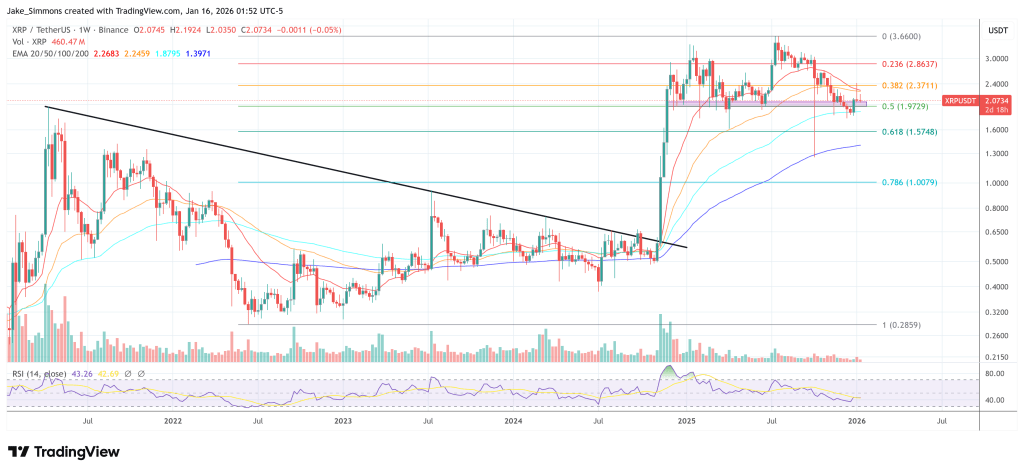
Bulls needs to reclaim the 0.382 Fib, 1-week chart | Source: XRPUSDT on TradingView.com

İlgili Sorular

QWhat is the planned timeline for Evernorth's IPO on Nasdaq, and what is the core value proposition for investors?

AEvernorth is planning its IPO for Q1 2026. The core value proposition is to provide institutional investors with a simplified, public-markets route to gain exposure to XRP without having to manage the complexities of direct custody, compliance, and security themselves.

QAccording to CEO Ashish Birla, what are the two key factors that make the timing perfect for Evernorth's public-market push?

ABirla stated that the timing is perfect due to the 'right kind of regulation,' the 'right kind of administration,' and that 'institutions are ready to adopt' blockchain-based financial products.

QHow does Evernorth intend to go beyond simple spot exposure to XRP for its investors?

AEvernorth plans to go beyond simple spot exposure by actively generating yield on its XRP assets and recycling the proceeds to buy more for its treasury. The company also aims to be an active participant in developing the XRP ecosystem and bringing financial products to the blockchain.

QWhat two criteria did Birla emphasize as essential for a durable 'digital asset treasury' strategy?

ABirla emphasized that a durable strategy requires scale, noting Evernorth is the largest XRP treasury, and that the treasury cannot be passive; it must be an active steward that helps the ecosystem flourish and develop.

QWhat specific stock ticker did Birla refer to when describing Evernorth's equity as an exposure vehicle for XRP?

ABirla referred to the Evernorth stock as 'XRPN' and pitched it as a way for investors to gain exposure to XRP by simply buying the public stock.

İlgili Okumalar

Dialogue with Jia Hang | Looking Back at Two Decades of Chinese Payment Going Global

**Summary: A Conversation with Jia Hang on Two Decades of China's Payment Globalization** Jia Hang, a veteran with over twenty years in payments, reflects on China's attempts to build a global payment network through three key phases: UnionPay (card networks), Alipay+ (digital wallets), and now, stablecoins. His journey began at UnionPay International, aiming to establish China's card network abroad. While successful in following Chinese tourists ("where Chinese go, UnionPay goes"), it struggled to achieve true global scale. The core lesson: card networks like Visa/Mastercard's unassailable advantage isn't just technical standards, but their deeply entrenched **governance and profit-sharing models** that create powerful network effects. Competing as the "same species" is nearly impossible. At Ant Group, he led Alipay+, a strategy to bypass card networks by interconnecting local e-wallets worldwide. While innovative, it faced a similar ceiling. Mobile QR payments and card swipes were essentially **the same species competing for the same pie**, lacking a disruptive value proposition for users or a sustainable new incentive model to replace the card networks' established flywheel. Today, at Singapore's DCS, Jia focuses on stablecoin-based payments. He argues stablecoins represent a fundamental shift. They are not competing with Visa for consumer payments but challenging the **traditional banking and account system for value movement**. Products like "U Cards" (stablecoin-linked payment cards) are transitional, leveraging existing card networks for acceptance while building new rails. The real potential lies in stablecoins enabling seamless, low-cost global value transfer, potentially reorganizing the financial infrastructure around **accounts rather than cards**. Jia believes stablecoin adoption for local retail payments, cross-border transactions, and as high-yield savings vehicles is becoming irreversible. This could gradually reduce reliance on traditional fiat channels, especially in regions with weak currencies or capital controls. The quest for the "next global payment network" continues, now centered on whether stablecoins can successfully bridge Web2 and Web3, establish new governance, and create compelling user value beyond mere cost reduction.

marsbit9 dk önce

Dialogue with Jia Hang | Looking Back at Two Decades of Chinese Payment Going Global

marsbit9 dk önce

Circle's Stock Price Plunges 76%, Hong Kong Dollar Stablecoin Set to Launch Within Two Weeks

Circle's stock price has plunged approximately 76% from its 2023 peak, reflecting a major market revaluation. Despite this, Circle President Heath Tarbert emphasized the company's focus on long-term execution and its dominant position with USDC's $73 billion circulation across 34 blockchains. The competitive landscape is intensifying. A new consortium-backed stablecoin, Open USD, is attempting to challenge incumbents by sharing reserve yields with partners. More significantly, Visa's new stablecoin platform, initially supporting Open USD while also being compatible with USDC, could erode Circle's network effects. In response, Circle is expanding into real-world payments through partnerships like the one with Japan's JCB. Separately, Tether (USDT) faces a two-year compliance window under new U.S. regulations, requiring it to adjust its reserve composition away from assets like Bitcoin and loans towards cash and U.S. Treasuries. Meanwhile, in Hong Kong, Standard Chartered-backed fintech firm Dian Dian is poised to launch a licensed HKD-pegged stablecoin (HKDAP), moving the industry into a phase where the real test is integrating licensed stablecoins into actual payment flows and corporate treasury systems. The sharp decline in Circle's stock underscores a broader shift: the stablecoin market is moving from a winner-takes-all dynamic to a multi-player competitive arena where execution, compliance, and real-world utility are becoming paramount.

marsbit10 dk önce

Circle's Stock Price Plunges 76%, Hong Kong Dollar Stablecoin Set to Launch Within Two Weeks

marsbit10 dk önce

Amidst Capital's Encirclement, Decentralization is the Sole Defense for Public Blockchains

In a landscape dominated by power and profit motives, the author argues that decentralization is not merely one desirable feature among many in blockchain design—it is the singular, non-negotiable defense against corporate and capital capture. The article adopts a Machiavellian, realist perspective on human institutions, positing that businesses will inevitably attempt to co-opt any valuable network to protect their profits and dominance. While external attacks like 51% forks are often discussed, the greater existential risk is internal capture—the gradual erosion of a protocol’s neutrality by vested interests, as seen historically with platforms like Visa and Google. The piece critiques permissioned chains, highly centralized “permissionless” layer-1s, and layer-2s without sufficient decentralization (e.g., single sequencers) as inherently vulnerable. These compromised systems, promoted by established financial players, are framed as delaying tactics to stifle truly open networks that threaten existing high-fee, inefficient business models. Real-world examples, such as closed enterprise consortiums that exclude competitors, illustrate how such systems cement oligopolies rather than foster innovation. The author concludes that while decentralized protocols like Ethereum are imperfect and costly to operate, they represent the only viable long-term equilibrium. In a market where value naturally flows to the most secure and neutral settlement layer, only maximally decentralized public blockchains can resist being subsumed by capital and powerful incumbents.

Foresight News20 dk önce

Amidst Capital's Encirclement, Decentralization is the Sole Defense for Public Blockchains

Foresight News20 dk önce

Who Decides the Rules of Bitcoin? BIP-110 Ignites Governance Debate

Bitcoin's governance is once again at the center of a heated debate, this time ignited by BIP-110, the "Reduced Data Temporary Softfork." This proposal aims to curb non-monetary data (like inscriptions and Runes) by introducing seven new consensus-layer restrictions over a year, such as limiting new output scripts to 34 bytes and restoring the OP_RETURN cap to 83 bytes. The controversy stems from BIP-110's fundamental shift: it moves the battle against "spam" from node relay and miner policies to the consensus layer, rendering currently valid transactions invalid. Supporters, arguing that default policy governance has failed (highlighted by Bitcoin Core v30's relaxation of OP_RETURN limits), see this as necessary to protect node resources and Bitcoin's monetary focus. Opponents, led by figures like Michael Saylor and Adam Back, warn it dangerously centralizes governance. Saylor listed 110 reasons against it, criticizing its low 55% miner activation threshold and potential for chain splits. Back emphasized Bitcoin's "permissionless" ethos, arguing no single group should impose value judgments via consensus rules. Further complicating matters, technical critiques suggest BIP-110 may be technically circumventable, and a "BlockSlop" vulnerability in its upgrade path poses a consensus risk. The debate has drawn in diverse stakeholders: miners (with pools like Ocean signaling support and Foundry polling clients), node operators (like Bitcoin Knots), and new players like corporate treasury holder MicroStrategy (Saylor), whose market influence adds a novel dimension. Ultimately, BIP-110 acts as a governance stress test, exposing the unresolved question: who decides Bitcoin's rules? It pits the authority of miners, node operators, developers, and capital holders against each other, with each side claiming to defend Bitcoin's core principles of neutrality and security.

marsbit37 dk önce

Who Decides the Rules of Bitcoin? BIP-110 Ignites Governance Debate

marsbit37 dk önce

İşlemler

Spot
活动图片