XRP Dev Predicts Market Cap To Hit $300 Billion Soon, What Would The Price Be?

bitcoinist2026-02-17 tarihinde yayınlandı2026-02-17 tarihinde güncellendi

Özet

A pseudonymous XRP Ledger developer and analyst known as Bird has projected that XRP's market capitalization will soon surge to $300 billion. This would represent a significant increase of over 239% from its current valuation of approximately $88.38 billion. Based on XRP's circulating supply of 60.91 billion tokens, this market cap would translate to a price of around $5 per token—a 271% increase from its current trading price of $1.47. Bird's technical analysis, shared on X, includes a TradingView chart indicating a potential breakout after a prolonged period of selling pressure. The chart uses Fibonacci extension levels, with the 1.618 level aligning with the $300 billion target. While this is a highly optimistic forecast, some members of the crypto community have expressed that even this projection is too low, believing XRP could eventually reach a multi-trillion dollar valuation. The prediction reflects growing optimism despite recent market downturns.

A new technical projection is circulating in the crypto market after pseudonymous analyst and XRP Ledger (XRPL) developer Bird forecast a sharp rise in the cryptocurrency’s market capitalization. The analyst predicts that the altcoin could soon reach a valuation of $300 billion, accompanied by a significant price increase from current levels.

XRP Market Cap Forecasted To Surge To $300 Billion

In a post on X, Bird boldly declared that a “$300 billion XRP market cap is coming very soon.” The assertive forecast clearly shows his strong confidence in the token’s near-term growth potential, suggesting a major increase from current levels and reflecting growing optimism around the token despite recent price swings and a broader market downtrend.

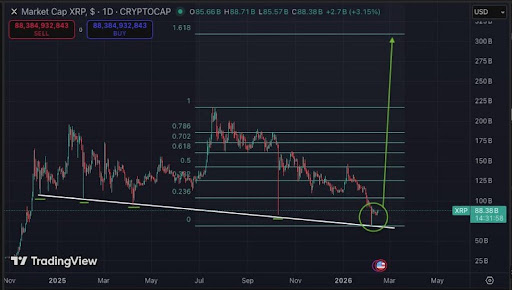
Bird’s forecasts were accompanied by a detailed TradingView chart illustrating a potential breakout scenario for XRP’s market capitalization. At the time of the analysis, its valuation stood at $88.38 billion. Technical levels on the chart highlight a prolonged downturn stretching from early 2025 into early 2026. Additionally, a descending white trendline can be seen connecting multiple lower lows, indicating sustained selling pressure over several months.
Source: Chart from Bird on X

The most recent price action shows the market cap revisiting a long-term support zone between $100 billion and $80 billion, an area circled on the chart to emphasize its significance. Fibonacci retracement and extension levels are plotted from a price swing high to a major now, marking key levels at 0.236, 0.382, 0.5, 0.618, 0.702, 0.786, 1, and 1.618.

The 1 level aligns near the $225 billion region, while the 1.618 extension points above toward Bird’s projected $300 billion market cap. The chart illustrates a large upward green arrow extending from $88.38 billion valuation at the time of the analysis toward $300 billion, representing an increase of more than $211 billion. This suggests that Bird expects its valuation to skyrocket by more than 239%.

Price At A $300 Billion Market Cap

Analysts calculate XRP’s price by dividing its market capitalization by its circulating supply. Based on its current circulating supply of approximately 60.91 billion tokens and a projected market cap of $300 billion, this would imply a price increase to approximately $5 per token. At the time of writing, the cryptocurrency is trading near $1.47, meaning a surge to this level would represent a rally of approximately 271%.

Although $5.45 is a big jump from present lows, many in the crypto community have expressed dissatisfaction with the bullish projection. Some say it’s too low, voicing out frustration and criticizing XRP’s slow price growth over the past decade.

Others believe the altcoin is still undervalued at a $300 billion market cap, with some members projecting that the cryptocurrency’s valuation could eventually reach trillions of dollars.

XRP trading at $1.47 on the 1D chart | Source: XRPUSDT on Tradingview.com

İlgili Sorular

QWhat is the projected market cap for XRP as predicted by the developer Bird?

ABird predicts that XRP's market cap will reach $300 billion very soon.

QHow much would the price of XRP be if it reaches a $300 billion market cap?

ABased on the current circulating supply of approximately 60.91 billion tokens, the price would be around $5 per token.

QWhat is the current market cap of XRP as mentioned in the analysis?

AAt the time of the analysis, XRP's market cap was $88.38 billion.

QWhat percentage increase does the $300 billion market cap represent from the current valuation?

AA $300 billion market cap would represent an increase of more than 239% from the $88.38 billion valuation at the time of the analysis.

QHow are some members of the crypto community reacting to the $300 billion market cap projection?

ASome community members expressed dissatisfaction, believing the projection is too low, and think XRP is still undervalued, with some projecting it could eventually reach a valuation in the trillions of dollars.

İlgili Okumalar

In-Depth Report on the On-Chain Lending Market: When Off-Chain Credit Meets On-Chain Liquidation

The on-chain lending market has evolved from a peripheral DeFi niche into core financial infrastructure. As of early 2026, total value locked (TVL) in on-chain lending protocols has reached $64.3 billion, accounting for 53.54% of total DeFi TVL, making it the largest and most mature vertical within decentralized finance. Aave dominates the sector with approximately $32.9 billion in TVL, commanding nearly half of the market—a leadership position that is unlikely to be challenged in the foreseeable future. However, the path of on-chain lending forward is not without risk. Liquidation cascades, credit defaults, and cross-chain vulnerabilities remain systemic threats hanging over the industry. At the same time, a deeper structural transformation is underway: on-chain lending is shifting from a “leverage tool for crypto-native users” to a “compliant gateway for institutional capital”. The scale of RWA (Real World Asset) lending has surpassed $18.5 billion, with U.S. Treasuries and government securities increasingly serving as core collateral. Institutional capital inflows are reshaping both the user base and risk appetite of the sector. This report systematically analyzes the evolution of on-chain lending definitions, competitive dynamics, core risks, and future trends, providing a comprehensive industry outlook for investors and trade practitioners. Key findings suggest that the “one dominant player with several strong challengers” structure will persist in the short term, while fixed-rate lending, compliant collateral, and institutional credit underwriting will define the next phase of competition. For investors focused on DeFi infrastructure, three key opportunity tracks stand out, namely, the Aave ecosystem (Morpho, Spark), RWA lending protocols (Ondo, Maple) and fixed-rate innovation (Notional, Pendle).

HTX Learn41 dk önce

In-Depth Report on the On-Chain Lending Market: When Off-Chain Credit Meets On-Chain Liquidation

HTX Learn41 dk önce

Fu Peng's First Public Speech in 2026: What Exactly Are Crypto Assets? Why Did I Join the Crypto Asset Industry?

Fu Peng, a renowned macroeconomist and now Chief Economist at New火 Group, delivered his first public speech of 2026 at the Hong Kong Web3 Festival. He explained his perspective on crypto assets and why he joined the industry, framing it within the context of macroeconomic trends and financial evolution. Fu emphasized that crypto assets are transitioning from an early, belief-driven phase to a mature, institutionally integrated asset class. He drew parallels to the 1970s-80s, when technological advances (like computing) revolutionized traditional finance, leading to the rise of FICC (Fixed Income, Currencies, and Commodities). Similarly, current advancements in AI, data, and blockchain are reshaping finance, with crypto assets becoming part of a new "FICC + C" (C for Crypto) framework. He noted that institutional capital, including traditional hedge funds, avoided early crypto due to its speculative nature but are now engaging as regulatory clarity emerges (e.g., stablecoin laws, CFTC classifying crypto as a commodity). Fu predicted that 2025-2026 marks a turning point where crypto becomes a standardized, financially viable asset for diversified portfolios, akin to commodities or derivatives in traditional finance. Fu defined Bitcoin not as "digital gold" in a simplistic sense but as a value-preserving, financially tradable asset. He highlighted that crypto's future lies in regulated, institutional adoption, moving away from retail-dominated trading. His entry into crypto signals this maturation, where traditional finance integrates crypto into mainstream asset management.

marsbit1 saat önce

Fu Peng's First Public Speech in 2026: What Exactly Are Crypto Assets? Why Did I Join the Crypto Asset Industry?

marsbit1 saat önce

Justin Sun Sues Trump Family: What $75 Million Bought Was Only a Blacklist

Justin Sun, founder of Tron, has filed a lawsuit in federal court against World Liberty Financial (WLF), alleging he was made the "primary target of a fraudulent scheme" after investing $75 million. Sun claims the investment secured him an advisor title and WLFI tokens, which were later frozen by WLF, causing "hundreds of millions in losses." The dispute began in late 2024 when Sun's investment helped revive WLF's struggling token sale, which ultimately raised $550 million. Shortly after, the SEC dropped its lawsuit against Sun following Donald Trump's inauguration. However, relations soured when Sun refused WLF's demands for additional funding. In August 2025, WLF added a "blacklist" function to its smart contract, allowing it to unilaterally freeze tokens. Sun's holdings, worth approximately $107 million, were frozen, and he was threatened with token destruction. The lawsuit highlights WLF's structure, which directs 75% of token sale profits to the Trump family, who had earned $1 billion by December 2025. WLF's CEO is Zach Witkoff, son of U.S. Middle East envoy Steve Witkoff. The project faces scrutiny for opaque operations, including a controversial loan arrangement on the Dolomite platform, co-founded by a WLF advisor. Despite Sun's history with the SEC, the case underscores centralization risks within DeFi, as WLF controls governance and holds powers to freeze assets arbitrarily. Sun's tokens remain frozen as legal proceedings begin.

marsbit2 saat önce

Justin Sun Sues Trump Family: What $75 Million Bought Was Only a Blacklist

marsbit2 saat önce

İşlemler

Spot
Futures
活动图片





