X Personally Terminates InfoFi Incentive Model, The Era of 'Mouth Farming' Comes to an End

Odaily星球日报2026-01-16 tarihinde yayınlandı2026-01-16 tarihinde güncellendi

Özet

X, the platform formerly known as Twitter, has officially terminated the API access for InfoFi applications that reward users for posting, effectively ending the "post-to-earn" model. This decisive move, announced by X product lead Nikita Bier, targets what the company identifies as a primary source of AI-generated spam and low-quality replies flooding the platform. The policy shift immediately impacted several prominent InfoFi projects. Tokens like KAITO and COOKIE experienced significant double-digit price drops. Projects such as Cookie DAO's Snaps platform have ceased operations, while Kaito has shut down its Yaps incentive program and is pivoting to a new, more traditional creator marketing model called Kaito Studio. X's core objection was not to the content itself, but to the fundamental structure of external, unpermissioned incentives directly driving platform engagement. This model was seen as compromising content quality and, crucially, undermining X's sovereignty over its own content ecosystem and user experience. The platform emphasized that it does not need the revenue generated from these API fees. The event signals a major recalibration, forcing InfoFi projects to either retreat to a pure data/tooling role or completely reinvent their business models to align with platform policies. The era of easily farming rewards for social media posts ("嘴撸时代") is over, as content control is firmly reclaimed by the platform itself.

Original | Odaily Planet Daily (@OdailyChina)

Author | Ethan (@ethanzhang_web3)

Last night, a product update from X's official channels caused quite a stir within the InfoFi community.

At 22:39 on January 15th, platform X announced the revocation of API access permissions for InfoFi applications, immediately affecting multiple apps reliant on "posting incentives." As the API was cut off, some projects announced the suspension of related functions or adjustments to their business directions. InfoFi-related tokens saw significant declines, with multiple InfoFi-related tokens (KAITO, COOKIE) recording double-digit percentage drops in a short period. Community members offered a rather straightforward summary – "The era of 'mouth farming' is over."
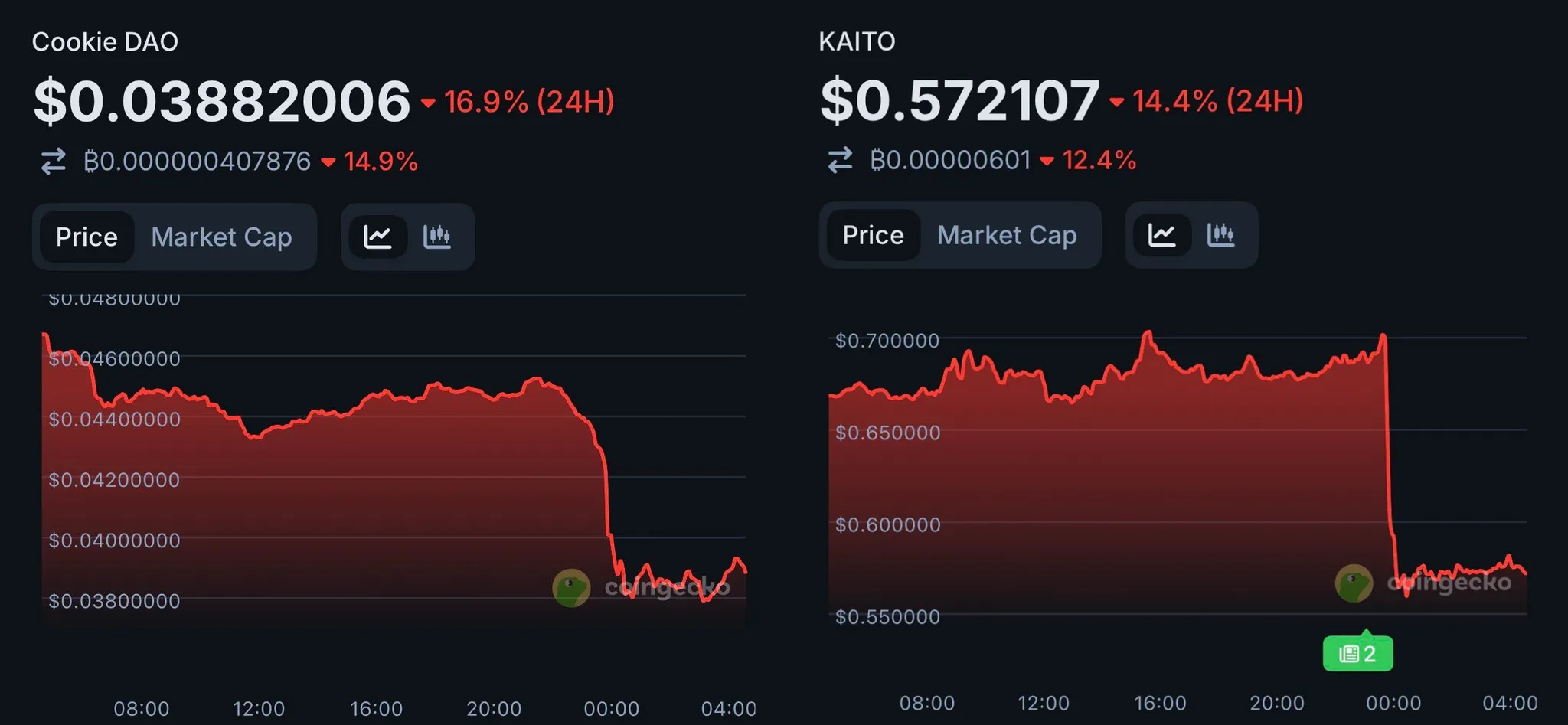
The strong reaction from InfoFi-related applications and tokens indicates that the impact of this change far exceeds a routine rule adjustment. It has altered the operational foundation of related applications and triggered a chain reaction in the market. This is not a minor tweak but a clear statement from X regarding a specific category of application models.

What Happened: X Formally Rejects the InfoFi Incentive Model

This time, X did not leave much room for explanation for InfoFi.

X's Product Lead, Nikita Bier, posted on the platform stating that X is revising its developer API policy and will no longer allow any applications that "reward users for posting on X" to continue accessing the API. In his statement, these applications were directly labeled as infofi and identified as a primary source of the recent AI spam content and reply pollution on the platform.
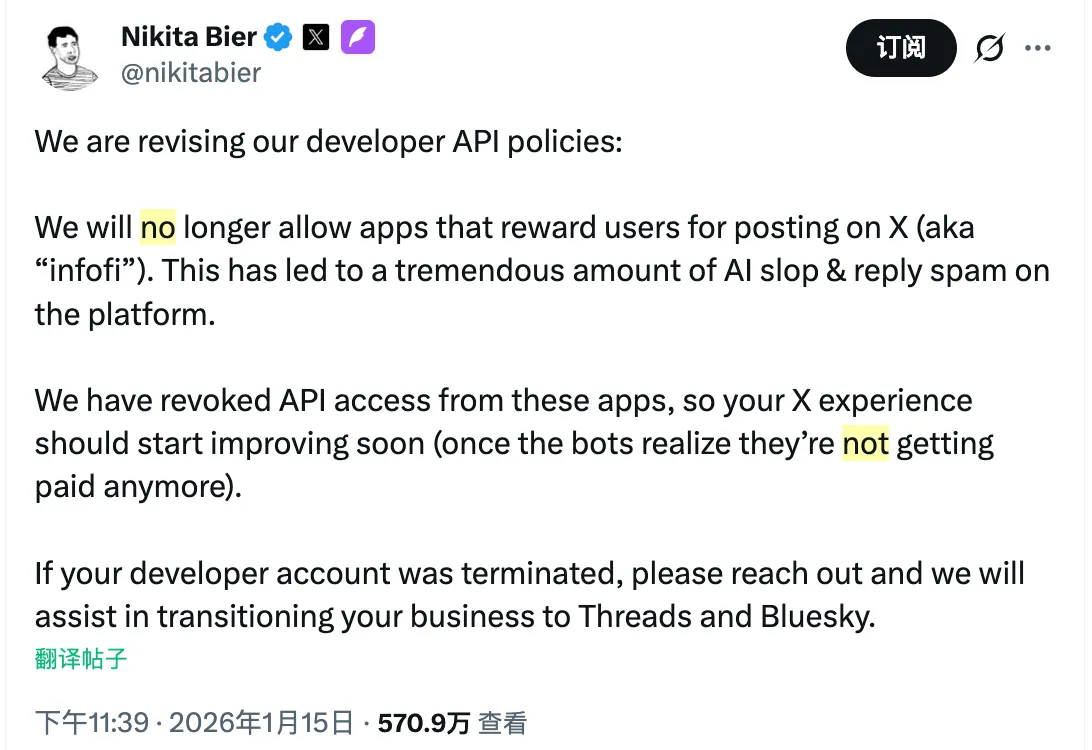
Unlike the "announce first, observe later" approach of previous platform governance, X's action this time was quite direct – API access permissions for related InfoFi applications have been revoked. The official reason given is also not complicated: external incentive mechanisms are driving a flood of task-oriented, templated content into the information feed, severely impacting the platform experience. X believes that once bots realize "there's no more money to be made from posting," the content environment will quickly self-correct.

It is worth noting that Nikita Bier specifically added a rather weighty statement: InfoFi applications had previously paid millions of dollars for API access, but X does not need this revenue.

This statement itself almost serves as a qualitative judgment on InfoFi's business model. Judging from the execution force and official wording, this adjustment is not targeting individual projects abusing the API but is rather a clear and unavoidable negative answer from X regarding the core InfoFi model of "external incentives directly intervening in platform content production."

The "aftermath solution" offered by X's official channels for teams whose developer accounts were terminated is equally telling: the platform will assist their business transition to Threads and Bluesky. In other words, X did not attempt to reform or absorb this incentive mechanism but clearly chose to remove it entirely from its own ecosystem.

What's Being Rejected is Not Content, But InfoFi's Incentive Path

If we only look at the official statement, this adjustment might seem like routine governance targeting AI spam content. But in the context of InfoFi, this reason is clearly insufficient to explain X's resolute stance.

The key issue might not be "whether the content has value," but rather who produces the content and why. The core logic of InfoFi is to directly drive users to perform actions like posting, replying, and interacting on the platform through external token or point incentives. While this model确实 boosts activity in the short term, it also rapidly alienates content production into "task execution." Posting is no longer about expressing opinions but a necessary step to claim rewards.

When the incentive itself is detached from the platform's governance system, the platform inevitably loses control over the motivation and quality of content. InfoFi applications don't care if a reply adds informational value; they only care if it meets the conditions for "settlement." For X, this means the information feed is being taken over by an external economic system.

From this perspective, AI spam is a consequence, not the cause. What truly crosses X's bottom line is the structural problem of "a third-party incentive layer being directly embedded into the platform's content distribution system." Once this model is tacitly approved, the platform's content order, recommendation logic, and even user relationships will gradually be influenced by the incentive designers.

This also explains why X, in this adjustment, left almost no room for InfoFi to reform. It implies that, in X's judgment, InfoFi is not an ecological participant that needs correction but rather a content production path that is no longer permitted to exist.

It is also why this API purge is an active reclamation of X's content sovereignty: when external incentives conflict with the platform experience, X chooses to cut off the former rather than cede control of the information feed.

From "Shutdown" to "Restructuring": The Collective Pivot of InfoFi Projects

X's API revocation did not remain at the policy level; it quickly triggered a chain reaction on the InfoFi project side.

According to Odaily Planet Daily's understanding, the first to provide a clear response was Cookie DAO. After communicating with the X team regarding the API and usage policy, the team announced the official shutdown of the Snaps platform and the termination of all ongoing creator incentive activities. Cookie stated bluntly in the announcement that this was a "difficult and sudden" decision, but the出发点 was not to abandon InfoFi but to ensure its data layer and core products remain compliant.
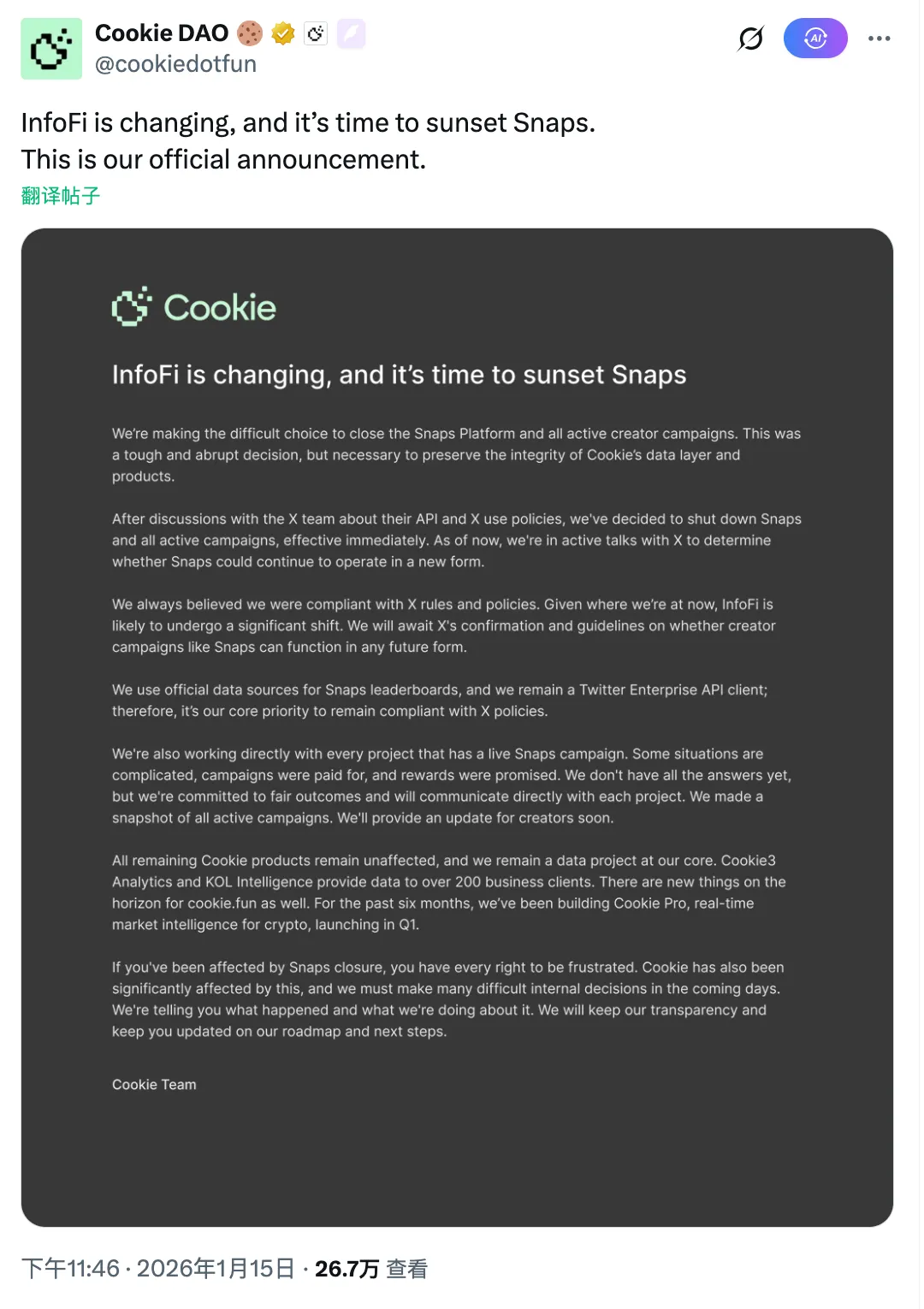
Judging from the wording, the shutdown of Snaps seems more like a passive choice to mitigate losses under the impact of the event. On one hand, Cookie emphasized that it always uses official data sources and remains an enterprise-level API client of X; on the other hand, the team also clearly stated that InfoFi is undergoing structural changes, and whether Snaps can exist in a "new form" still depends on further guidance from X. This wording itself reveals high uncertainty about the sustainability of the original incentive model.

In contrast, Kaito's adjustment appears more proactive. Kaito announced the cessation of Yaps and the incentive leaderboard, simultaneously launching a new Kaito Studio, explicitly bidding farewell to the "open, permissionless incentive distribution" path. According to the official statement, Kaito Studio will be closer to a traditional tiered marketing platform, where brands select creators for collaboration based on established criteria, covering platforms extending from X to YouTube, TikTok, and other social channels.
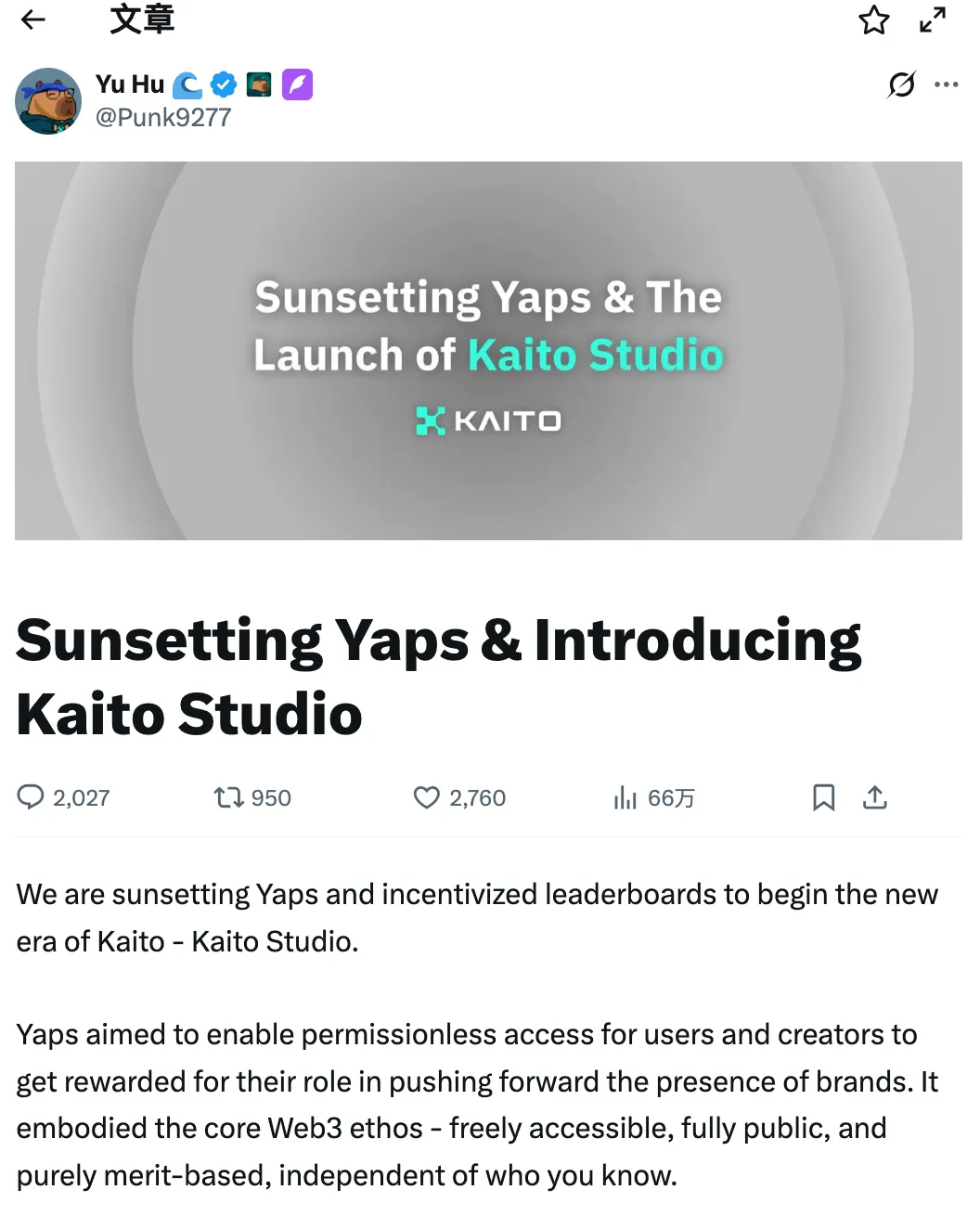
In explaining the reason for the pivot, Kaito did not avoid the problems of the InfoFi model itself. It pointed out that even after continuously raising thresholds and introducing screening mechanisms, low-quality content and刷量行为 (brushing/artificial inflation) were still hard to avoid; after communicating with X, the team also agreed that a "completely permissionless incentive distribution system" no longer meets the common needs of the platform, brands, and creators. Reading between the lines, it can be inferred that the end of Yaps is an active abandonment of the original InfoFi路线 (path).

But in any case, looking at both events together, a clear trend emerges: as the platform layer clearly tightens interface and incentive boundaries, InfoFi projects either choose to pause激进玩法 (aggressive playstyles) and return to data and tool attributes, or simply restructure their business logic, moving closer to models more akin to traditional marketing and content cooperation.

Currently, although token prices have fluctuated, a "collective collapse" of InfoFi projects has not yet occurred. What is certain is that the set of strategies reliant on platform APIs, driving posts and interactions directly through external incentives, can hardly continue to operate.

Conclusion: The Era of 'Mouth Farming' Ends, But InfoFi's Problems Remain

Judging from the reactions of the InfoFi projects, this change is not simply a "ban" or a "failure." Whether it's Cookie returning to its data layer positioning or Kaito pivoting to a Studio model closer to traditional marketing, it indicates that: InfoFi has not disappeared; it just can no longer exist in the form of "in-platform incentive arbitrage."

The so-called "end of the mouth farming era" does not mean the end of content being quantified or influence being priced, but rather the end of that open incentive path reliant on APIs, where the act of posting and replying itself was the settlement object. Against the backdrop of platforms reasserting sovereignty, the marginal space for this model is rapidly shrinking.

As for migrating to Threads or Bluesky, it seems more like a buffer solution than an answer itself. The real question is whether future InfoFi can find an irreplaceable value position without taking over the platform's content production rights.

X is just the first platform to explicitly press the button, but the signal it sends is clear enough: Content sovereignty is returning to the platforms.


İlgili Sorular

QWhat was the main announcement made by X that impacted the InfoFi community?

AX revoked API access for InfoFi applications that rewarded users for posting on the platform, effectively ending the 'post-to-earn' incentive model.

QWho is Nikita Bier and what role did they play in this update?

ANikita Bier is X's Product Lead who announced the revision of the developer API policy, stating that applications incentivizing users to post on X would no longer be allowed API access.

QWhat reason did X provide for revoking API access from InfoFi applications?

AX cited that these applications were a major source of AI-generated spam and low-quality content, which degraded the platform's user experience.

QHow did InfoFi-related tokens like KAITO and COOKIE react to the news?

AInfoFi-related tokens such as KAITO and COOKIE experienced significant price drops, with some falling by double digits shortly after the announcement.

QWhat alternative platforms did X suggest for affected InfoFi applications?

AX suggested that affected InfoFi applications transition their operations to Threads and Bluesky as alternative platforms.

İlgili Okumalar

Borrowing Money from a Hundred Years Later, Building Incomprehensible AI

Tech giants like Alphabet, Amazon, Meta, and Microsoft are undergoing a radical financial transformation due to AI. Their traditional "light-asset, high-free-cash-flow" model is being dismantled by staggering capital expenditures on AI infrastructure—data centers, GPUs, and power. Combined 2026 guidance exceeds $700 billion, a 4.5x increase from 2022, causing free cash flow to plummet (e.g., Amazon's fell 95%). To fund this, they are borrowing unprecedented sums through long-dated, multi-currency bonds (e.g., Alphabet's 100-year bond). The world's most conservative capital—pensions, insurers—is now funding Silicon Valley's most speculative bet. This shift makes these companies resemble heavy-asset industrials (railroads, utilities) rather than software firms, threatening their premium valuations. Historically, such infrastructure booms (railroads, fiber optics) followed a pattern: genuine technology, overbuilding fueled by competitive frenzy, aggressive debt financing, and a crash triggered by financial conditions—not technology failure. The infrastructure remained, but many original builders and financiers did not survive. The core gamble is a "time arbitrage": using cheap debt today to build scale and lock in customers before AI capabilities commoditize. They are betting that AI revenue will materialize before debt comes due. Their positions vary: Amazon is under immediate cash pressure; Meta's path to monetization is unclear; Alphabet has a robust core business buffer; Microsoft has the shortest path from infrastructure to revenue. The contract is set: the most risk-averse global capital has lent its time to Silicon Valley, awaiting a future that is promised but uncertain.

marsbit31 dk önce

Borrowing Money from a Hundred Years Later, Building Incomprehensible AI

marsbit31 dk önce

The 'VVV' Concept Soars 9x in Half a Year, The New AI Narrative on Base Chain

"The article explores the 'VVV' concept as the new AI-focused narrative within the Base ecosystem, centered around the token $VVV of the privacy-focused, uncensored generative AI platform Venice, led by crypto veteran Erik Voorhees. Venice has seen significant growth in 2026, with its API users surging, partly attributed to exposure from OpenClaw. The platform now boasts over 2 million total users and 55,000 paid subscribers. Correspondingly, the $VVV token price has risen over 9x this year. Key to its performance are tokenomics designed for value accrual: reduced annual emissions, subscription revenue used for buyback-and-burn, and a unique staking mechanism. Staking $VVV yields $sVVV, which can be used to mint $DIEM tokens. Each staked $DIEM provides a daily $1 credit for using Venice's API services, creating tangible utility. The article also highlights other tokens associated with the 'VVV' narrative. $POD, the token of distributed AI network Dolphin (which co-developed Venice's default AI model), saw a massive price surge. $cyb3rwr3n, a project for a Venice credit auction market, gained attention due to perceived connections to Venice's team despite official denials. Finally, $SR of robotics platform STRIKEROBOT.AI rose after announcing a partnership with Venice for robot vision-language model development. Overall, the 'VVV' ecosystem combines AI platform growth, deflationary tokenomics, and innovative utility mechanisms, driving significant investor interest and price action in related tokens."

marsbit40 dk önce

The 'VVV' Concept Soars 9x in Half a Year, The New AI Narrative on Base Chain

marsbit40 dk önce

Anthropic and OpenAI Have Single-Handedly Severed the Logic of Pre-IPO Stock Tokenization

The pre-IPO stock token market is experiencing significant turmoil following strong statements from AI giants Anthropic and OpenAI. Both companies have updated their official policies, declaring that any transfer of their company shares—including sales, transfers, or assignments of share interests—without prior board approval is "invalid" and will not be recognized in their corporate records. This means buyers in such unauthorized transactions would not be recognized as shareholders and would have no shareholder rights. A major point of contention is the use of Special Purpose Vehicles (SPVs), which are legal entities commonly used by pre-IPO token platforms to pool investor funds and indirectly acquire shares from employees or early investors. The companies explicitly state they do not permit SPVs to acquire their shares, and any such transfer violates their restrictions. They warn that third parties selling shares through SPVs, direct sales, forward contracts, or stock tokens are likely engaged in fraud or are offering worthless investments due to these transfer limits. This stance directly threatens the core model of many pre-IPO token platforms, which rely on SPV structures. The announcement revealed additional risks within this model, such as complex "SPV-within-SPV" layering that obscures legal transparency, increases management fees, and creates a chain reaction risk of invalidation. Following the news, tokens like ANTHROPIC and OPENAI on platforms like PreStocks fell sharply (over 20%). The market reaction highlights a divergence: while asset-backed pre-IPO tokens plummeted, purely speculative pre-IPO futures contracts, which are bilateral bets on future IPO prices with no claim to actual shares, remained relatively stable as they are unaffected by the transfer restrictions. The industry is split on the implications. Some believe the fundamental logic of pre-IPO token trading is broken if leading companies reject SPV-held shares, potentially causing a domino effect. Others, like Rivet founder Nick Abouzeid, argue that buyers of such unofficial tokens always knowingly accepted the risk of non-recognition by the company. The statements serve as a stark risk warning and a corrective measure for a market where valuations for some AI-related pre-IPO tokens had soared to irrational levels, far exceeding recent funding round valuations.

marsbit1 saat önce

Anthropic and OpenAI Have Single-Handedly Severed the Logic of Pre-IPO Stock Tokenization

marsbit1 saat önce

Anthropic and OpenAI Personally Sever the Logic of Pre-IPO Crypto-Stocks

The pre-IPO token market has been rocked by strong statements from Anthropic and OpenAI. Both AI giants have updated official warnings, declaring that any sale or transfer of their company shares without explicit board approval is "invalid" and will not be recognized on their corporate records. This directly targets Special Purpose Vehicles (SPVs), the common legal structure used by pre-IPO token platforms. These platforms typically use an SPV to acquire shares from employees or early investors, then issue blockchain-based tokens representing a claim on the SPV's economic benefits. Anthropic and OpenAI's position means that if an SPV's share purchase lacked authorization, the underlying asset could be deemed worthless, nullifying the token's value. Anthropic explicitly warned that any third party selling its shares—via direct sales, forwards, or tokens—is likely fraudulent or offering a valueless investment. The crackdown highlights risks in the popular SPV model, including complex multi-layered "Russian doll" SPV structures that obscure legal ownership, add fees, and concentrate risk. If one layer is invalidated, the entire chain could collapse. Following the announcements, tokens like ANTHROPIC and OPENAI on platforms like PreStocks fell sharply (over 20%). In contrast, purely speculative pre-IPO prediction contracts remained stable, as they involve no actual share ownership. The move is seen as a corrective measure amid a market frenzy where some pre-IPO token valuations (e.g., Anthropic's token hitting a $1.4 trillion implied valuation) far exceeded recent official funding rounds. Opinions are split: some believe this undermines the core logic of pre-IPO token trading if top companies reject SPVs, while others argue buyers always assumed this legal risk when accessing unofficial channels. The statements serve as a stark warning and a potential catalyst for market de-leveraging and clearer boundaries.

Odaily星球日报1 saat önce

Anthropic and OpenAI Personally Sever the Logic of Pre-IPO Crypto-Stocks

Odaily星球日报1 saat önce

İşlemler

Spot
Futures

Popüler Makaleler

ERA Nasıl Satın Alınır

HTX.com’a hoş geldiniz! Caldera (ERA) satın alma işlemlerini basit ve kullanışlı bir hâle getirdik. Adım adım açıkladığımız rehberimizi takip ederek kripto yolculuğunuza başlayın. 1. Adım: HTX Hesabınızı OluşturunHTX'te ücretsiz bir hesap açmak için e-posta adresinizi veya telefon numaranızı kullanın. Sorunsuzca kaydolun ve tüm özelliklerin kilidini açın. Hesabımı Aç2. Adım: Kripto Satın Al Bölümüne Gidin ve Ödeme Yönteminizi SeçinKredi/Banka Kartı: Visa veya Mastercard'ınızı kullanarak anında Caldera (ERA) satın alın.Bakiye: Sorunsuz bir şekilde işlem yapmak için HTX hesap bakiyenizdeki fonları kullanın.Üçüncü Taraflar: Kullanımı kolaylaştırmak için Google Pay ve Apple Pay gibi popüler ödeme yöntemlerini ekledik.P2P: HTX'teki diğer kullanıcılarla doğrudan işlem yapın.Borsa Dışı (OTC): Yatırımcılar için kişiye özel hizmetler ve rekabetçi döviz kurları sunuyoruz.3. Adım: Caldera (ERA) Varlıklarınızı SaklayınCaldera (ERA) satın aldıktan sonra HTX hesabınızda saklayın. Alternatif olarak, blok zinciri transferi yoluyla başka bir yere gönderebilir veya diğer kripto para birimlerini takas etmek için kullanabilirsiniz.4. Adım: Caldera (ERA) Varlıklarınızla İşlem YapınHTX'in spot piyasasında Caldera (ERA) ile kolayca işlemler yapın.Hesabınıza erişin, işlem çiftinizi seçin, işlemlerinizi gerçekleştirin ve gerçek zamanlı olarak izleyin. Hem yeni başlayanlar hem de deneyimli yatırımcılar için kullanıcı dostu bir deneyim sunuyoruz.

412 Toplam GörüntülenmeYayınlanma 2025.07.17Güncellenme 2025.07.17

ERA Nasıl Satın Alınır

Tartışmalar

HTX Topluluğuna hoş geldiniz. Burada, en son platform gelişmeleri hakkında bilgi sahibi olabilir ve profesyonel piyasa görüşlerine erişebilirsiniz. Kullanıcıların ERA (ERA) fiyatı hakkındaki görüşleri aşağıda sunulmaktadır.

活动图片