X Offers $1 Million Reward for Great Articles: What Kind of Content Actually Got Paid?

marsbit2026-02-04 tarihinde yayınlandı2026-02-04 tarihinde güncellendi

Özet

X announced a $1 million prize for the best long-form Articles on its platform, with eligibility limited to U.S. users, requiring 1,000+ word original English content. The final prize pool doubled to $2.15 million. The winner, @beaverd (9k followers), received $1 million for an investigative piece on Deloitte's misuse of $74 billion in government contracts, supported by a self-built database. Second place ($500k) went to @KobeissiLetter (70k followers) for a tactical guide on trading during Trump-era tariff cycles. Dan Koe, whose earlier viral article inspired the contest, won a $250k "Creator Choice" award for a piece on focus and productivity, despite having the highest engagement but lower U.S. premium user exposure. Key insights: content scarcity outperformed follower count, all winners provided unique data or frameworks, and no traditional media won—highlighting X's push for native, in-depth content to retain users and train AI models like Grok.

Author: David, Deep Tide TechFlow
In mid-January, X announced a $1 million reward for the best-performing long-form Articles on its platform.

Elon Musk personally confirmed the announcement. The rules were simple: limited to US users, original English articles over 1000 words, ranked primarily based on exposure among US paid users.

You might recall that just a few days before this content incentive program was launched, personal growth blogger Dan Koe published an article titled "How to fix your entire life in 1 day," which garnered 170 million impressions, becoming the best-performing Article in X's history.

X clearly saw the traffic potential of long-form content and quickly followed up: lowering the threshold for the Articles feature, adjusting the algorithm to prioritize long-form content over short posts, and announcing the million-dollar征文大奖 (essay contest大奖).

A two-week competition period, with tens of thousands of participants.

Results were announced on February 4th. The total prize money was $2.15 million, more than double the initial promise. $1 million for the champion, $500,000 for the runner-up, plus a $250,000 "Creator Choice" award and four $100,000 honorable mentions.

The winning situation is roughly as follows:
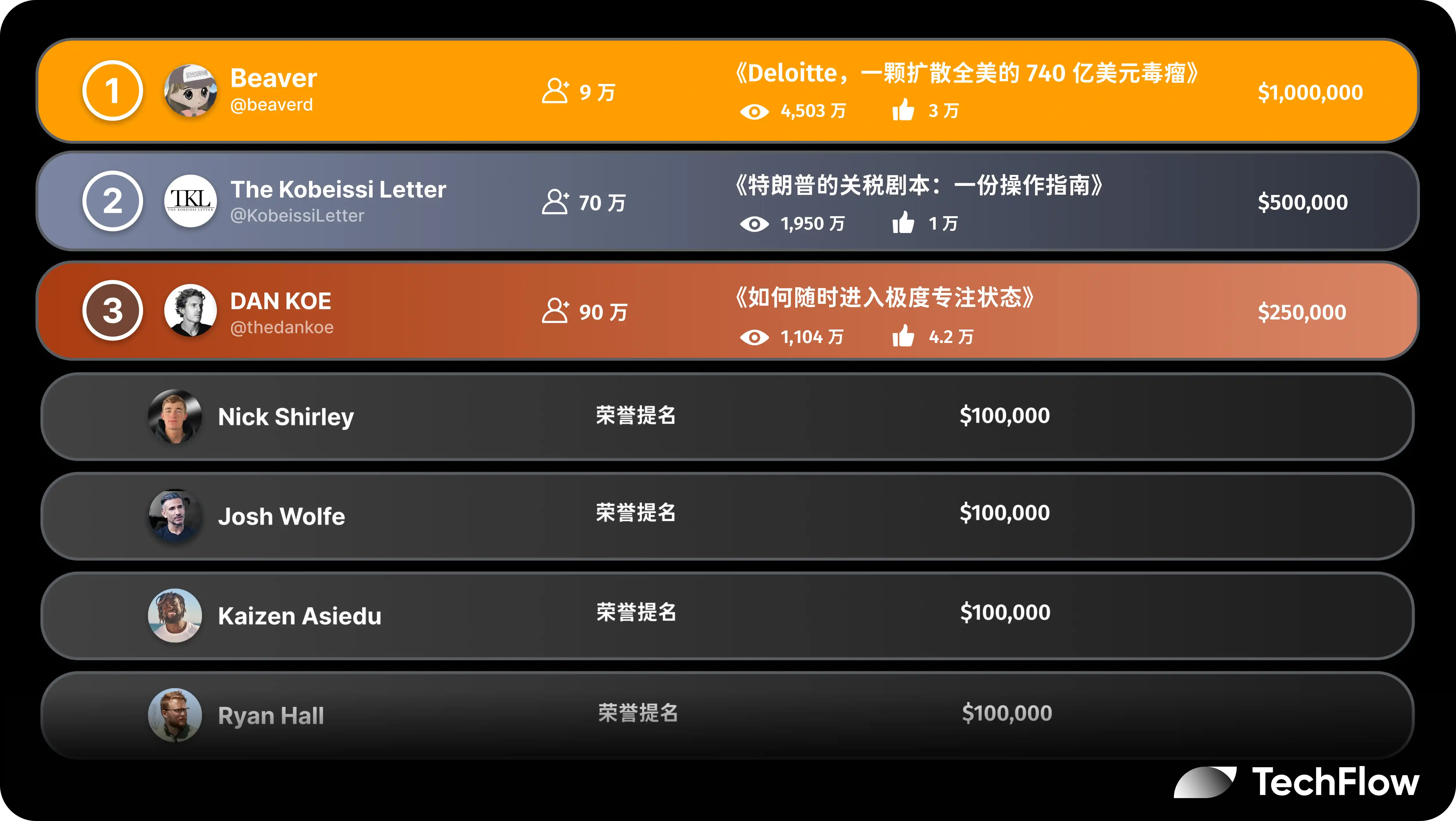
You can see Dan Koe is on the list again. However, his previous article on how to repair your life in one day had 170 million impressions, but the champion of this creation contest only had 45 million.

Viral hits are hard to come by, but the winning articles are still worth analyzing.

🏆 Champion: A 90k-follower "small account" takes $1 million with a self-built database

The champion @beaverd's article title translates to "Deloitte, a $74 Billion Cancer Spreading Across America." It's about the well-known consulting firm Deloitte.

This account currently has "only" 90,000 followers, which is relatively small compared to the other winners, and it has no media organization or any endorsement beyond the blue check verification.

The topic he wrote about doesn't touch on any trending buzzwords either, but it exposes a rather controversial issue: how Deloitte secured $74 billion in contracts from federal and state governments and then botched the projects.
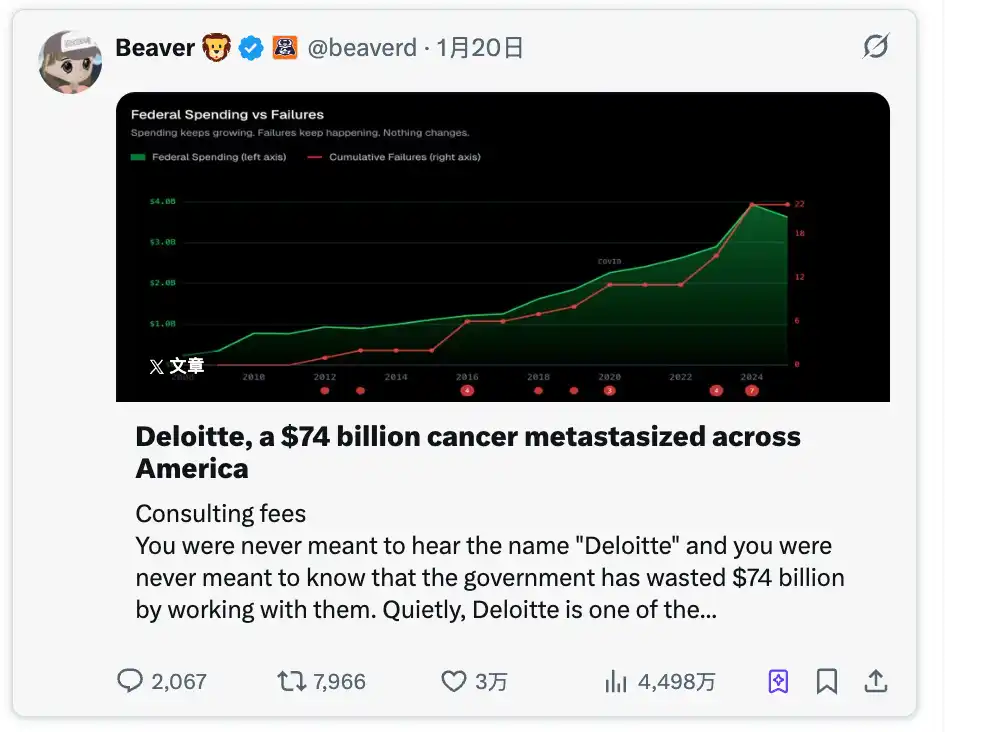
Portal is here

Clicking in, you'll find this person really put in the work.

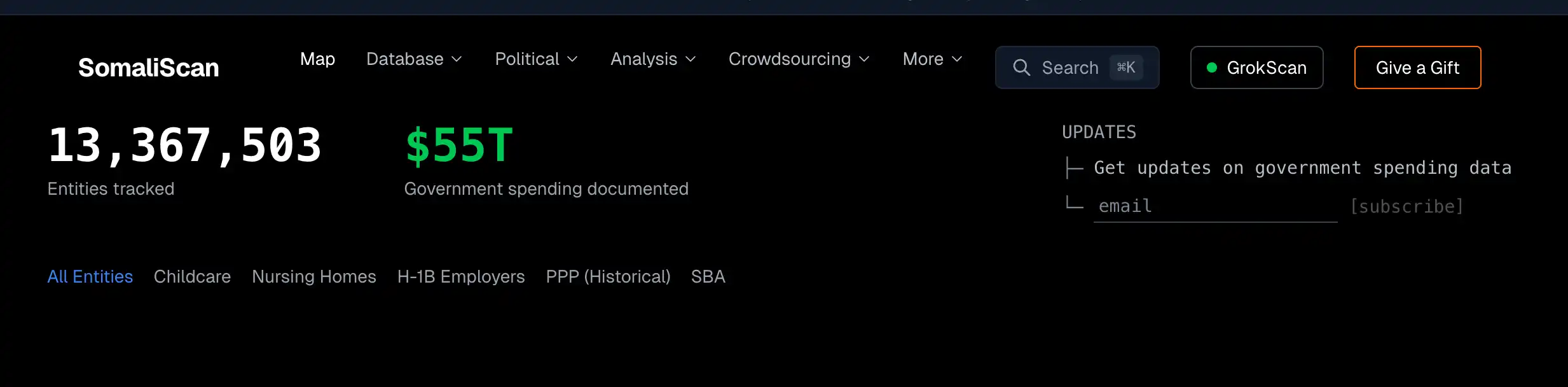
He built his own website called somaliscan.com, scraping millions of government invoice data entries, cross-referencing audit reports and system failure records line by line.

Then, using this first-hand data, he told a series of shocking stories: California's unemployment benefits system defrauded of $32 billion, Tennessee's Medicaid system崩溃 (collapsed) leading to 250,000 children losing coverage, a court信息化改造 (IT modernization) project burning through $1.9 billion and ending up abandoned... covering 25 states in total.
He also dug up the revolving door between Deloitte executives and government officials, specifying who jumped from Deloitte to which department and then approved which contracts back to Deloitte, listing names and amounts clearly.

One person built his own database, did his own research, and earned $1 million.

🥈 Runner-up: A 700k-follower finance macro account teaches you how to profit from tariff panic

The runner-up @KobeissiLetter is a familiar face in the macro finance circle, with 700,000 followers, long focused on US economic policy and market volatility.

What he did in this article is also very direct: he拆解 (deconstructed) Trump's tariff playbook into a repeatable trading framework, titled "Trump's Tariff Playbook: An Operational Guide."

Since Trump often acts unpredictably, liking to announce extreme policies and threaten other countries but not always fully following through, Wall Street summarized this pattern as TACO, an acronym for Trump Always Chickens Out.

TACO describes a recurring pattern:

Trump announces aggressive tariffs → market plummets → a few days later he backs down or delays → market rebounds.
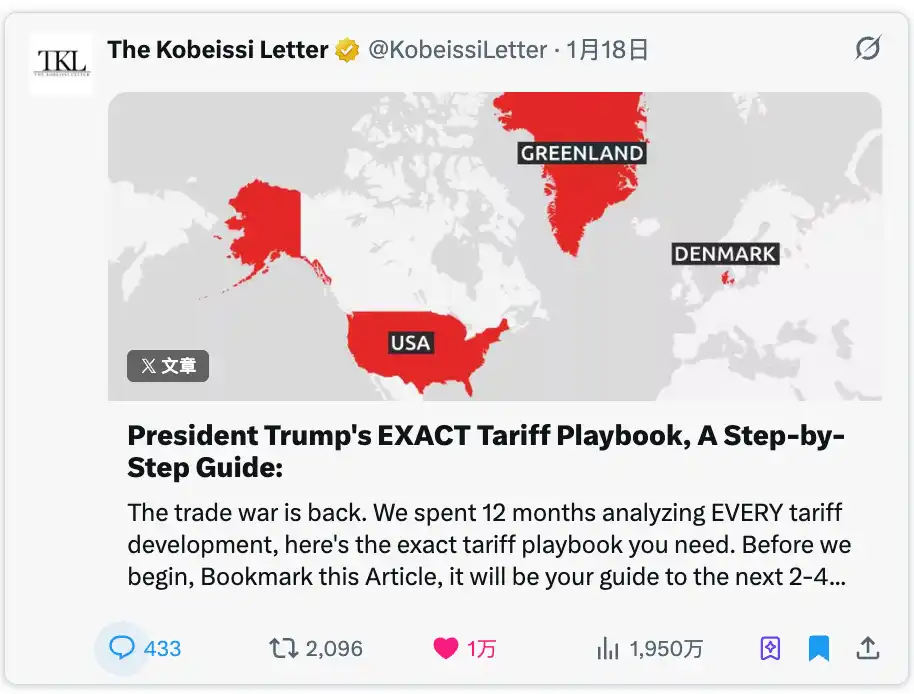
Portal

What KobeissiLetter's article did was turn TACO from a joke into an operational manual with timestamps. Using tariff events from the past 12 months as samples, he拆出 (deconstructed) a complete cycle template for you to follow and trade according to the time periods.

For example, the White House releases消息 (news)制造恐慌 (creating panic) on the weekend,抄底资金 (bargain-hunting funds) enter mid-week,缓和信号 (easing signals) are released the next weekend, some agreement is reached within 2 to 4 weeks. Simultaneously, he would follow up (持续跟帖) at each step, telling you which stage it's at now, making it more like a serialized pre-research post.

He also provided practical methods, such as watching the US 10-year Treasury yield. If this number breaks 4.60%, Trump will likely让步 (concede).

For the paid users on X who follow macro and trading, this stuff is right up their alley.

It doesn't discuss whether tariffs are good or bad, nor does it make moral judgments. It just tells you what actions to take at what point next time this playbook is used, to make money.

🥉 Third Place: DAN KOE with the most likes, familiar life methodology

Dan Koe's参赛文章 (contest entry) "How to Enter a State of Deep Focus Anytime" received 42,000 likes, 8,681 reposts, the highest interaction data among all entries. But the exposure was only 11.04 million, less than a quarter of the champion's.

What X gave him wasn't strictly third place; it was a separately established "Creator Choice" award worth $250,000.

This is understandable. Dan Koe is "the person who inspired this competition." His viral article with 170 million impressions in early January directly showed X how high the traffic ceiling for long-form content could be.
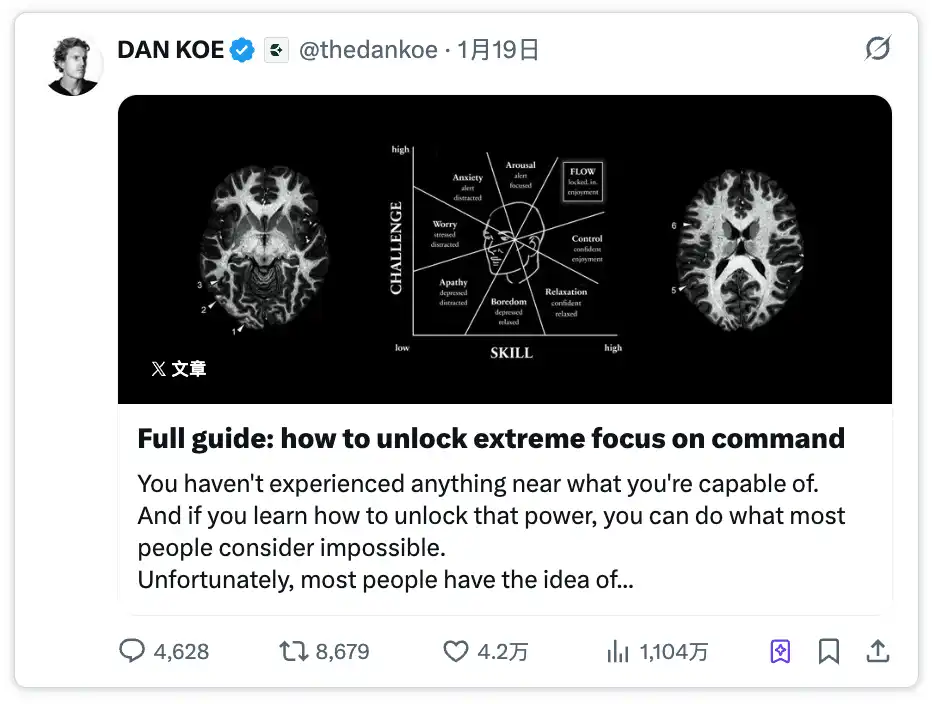
Portal

No need to introduce the article itself too much; it's still that set of life growth methodologies. It大致是讲 (roughly talks about) how to gain focus, citing neuroscience and flow state concepts for support and depth.

Actually, this piece had the best interaction data, but according to the core competition rule "exposure among US paid users," it didn't rank at the top.

Why did the article with the best interactions have lower exposure? This misalignment will be discussed later.

Honorable Mentions: $100k ×4

Nick Shirley, Josh Wolfe, Kaizen Asiedu, and Ryan Hall each received a $100,000 incentive. Their accounts cover public policy, geopolitics, history, and public safety, respectively.

Among them, Josh Wolfe is the co-founder of Lux Capital, a well-known venture capitalist, who also announced he would donate the prize money equally to four charities.

Since the original post did not list the specific articles by these four individuals, and due to time and energy constraints, we did not conduct further investigation. Everyone is welcome to supplement this information.

Some In-Depth Observations

Some patterns visible from these competition results:

  • The article with the most likes had only a quarter of the champion's exposure

The most counterintuitive data from this competition is definitely Dan Koe's.

42,000 likes, 8,681 reposts, 4,627 comments – the three interaction metrics were the highest overall. But the exposure was only 11.04 million, less than a quarter of champion @beaverd's. And @beaverd's likes were 30,000, fewer than Dan Koe's.

If you've done social media operations, this data feels别扭 (awkward). Generally, higher interaction should lead the algorithm to promote it more, resulting in greater exposure.

But X's competition calculation wasn't total exposure; it was "US paid user homepage timeline exposure." This metric excluded non-US users, non-paying users, and visits from search and personal profiles.

Dan Koe writes about personal growth, an audience naturally more global, with many non-US followers. @beaverd wrote about how US taxpayer money was wasted by Deloitte, an audience naturally concentrated in the US. Under the same algorithm recommendation mechanism, the "geographic concentration" of the content determined the level of this metric.

  • 90k followers beat 900k followers, content scarcity > follower base

Champion @beaverd had 90k followers before the competition. Runner-up @KobeissiLetter had 700k followers. Dan Koe had 900k followers.

If follower count determined exposure, the ranking should be reversed. But the actual results show that in X's Articles recommendation logic, the weight of follower base is far less than imagined.

@beaverd won because he had something others didn't; content scarcity played a key role.

This is completely different from traditional traffic logic. Big accounts rely on follower存量 (stock) and posting frequency, but in an algorithm-dominated distribution environment, "whether you have exclusive content" is more important than "how many followers you have."

  • You need to build your own content "hardware"

Stepping back, the topics of these three winning articles are completely unrelated: one investigates government contracts, one teaches you to trade tariff waves, one talks about how to focus.

In any content platform's categorization system, they wouldn't appear on the same list. But they share a common point: each has its own independent "hardware," meaning you need a narrative framework.

@beaverd's hardware is a self-built database scraping government data; KobeissiLetter's hardware is a trading framework backtested over 12 months; and Dan Koe's hardware is a six-chapter methodology blending neuroscience and psychology, although it might seem profound, it's actually common knowledge.

None of the winning articles were pure opinion pieces. They all required long篇幅 (length) to carry the information load, which is precisely the reason for the existence of the X Articles format.

Another noteworthy fact: Among the eight awardees, there wasn't a single traditional media outlet.

All are independent creators. This isn't to say traditional media didn't participate, but in this competition format, personal accounts反而更有优势 (actually had more advantage).

Institutional media content is usually published on their own websites, with only links and summaries on social media. But Articles require the full content to be published on X, which is an awkward move for media accustomed to off-site引流 (traffic diversion).

What is X really buying for $2.15 million

Returning to the platform itself.

X initially promised a $1 million incentive but ended up giving out $2.15 million. During the competition, it also made a series of supporting moves: expanding the Articles feature from creator accounts to all paid users, adjusting the algorithm to increase the recommendation weight of long-form content, changing the scoring method to "US paid user homepage exposure."

At such a high cost, the most direct reason is certainly that X needs original long-form content on its platform.

In the past, long content on X mostly relied on external links – Substack, Medium, personal blogs. Users click and jump away, leaving reading time and interaction data elsewhere. The goal of Articles is to keep this content on-site, allowing users to read from start to finish without leaving X.

Going deeper, X has Grok. Large language model training requires high-quality long-text data, and the vast majority of content on X is 280-character short tweets. If Articles can continuously attract creators to produce in-depth long-form content, this content becomes training material for Grok.

Finally, paid user value.

The competition rules limited the metric to "US paid user homepage exposure," directly telling creators that their content should serve paid users.

This is using creators' content to support the paid system, making paid users feel "the money I spent is worth it because I can see deep content on the homepage that I can't see elsewhere."

From a content creator's perspective, we feel the era of pure opinion might be turning a page.

This trend also applies to creators in the crypto circle. The crypto industry doesn't lack opinions; countless people on X every day喊单 (shill), predict prices, comment on regulation.

But few can自建 (build their own) on-chain data analysis tools like @beaverd, or拆解 (deconstruct) market cycles into repeatable trading playbooks like KobeissiLetter.

Maintaining scarcity and independence, producing consistently, is actually a very professional job, and also very rewarding and positive-feedback work.

We also hope to see more content from the Chinese circle appear on the list in the future.

İlgili Sorular

QWhat was the total prize money awarded in X's long-form article competition, and how did it compare to the initial announcement?

AThe total prize money awarded was $2.15 million, which was more than double the initially announced $1 million.

QWho won the $1 million grand prize, and what was the key factor that contributed to their article's success?

AThe grand prize was won by @beaverd. The key factor was the article's unique and scarce content, which was based on an original, self-built database analyzing millions of government invoices to expose how Deloitte mismanaged $74 billion in contracts.

QWhat specific metric did X use to rank the articles in the competition, and why did the article with the highest engagement (Dan Koe's) not have the highest exposure?

AX ranked articles based on 'exposure in the home timeline of US-based Premium subscribers.' Dan Koe's article had lower exposure by this metric because his audience is more global, while this metric excluded non-US and non-paying users, favoring content with a highly concentrated US audience.

QAccording to the article, what is one of the deeper reasons X is investing in its Articles feature and this competition?

AOne deeper reason is to generate high-quality, long-form text content to serve as training data for its large language model, Grok.

QWhat common characteristic did the winning articles share, according to the author's analysis?

AThe winning articles all had their own independent 'hardware' or narrative framework, such as a unique database, a tested trading model, or a multi-chapter methodology. None were purely opinion pieces.

İlgili Okumalar

US Government Suddenly Halts Anthropic's Strongest Model, "Quasi-IPO Stock Price" Plunges 3.7% Overnight

U.S. Government Halts Anthropic's Top AI Models, 'Pre-IPO' Price Drops 3.7% On June 12, the U.S. government ordered Anthropic to shut down access to its two most powerful AI models, Claude Fable 5 and Claude Mythos 5, citing national security concerns. The directive, issued by the Department of Commerce, required Anthropic to block access for all foreign nationals, leading the company to disable the models globally for all users. Anthropic strongly opposed the move, arguing the government's basis was a "narrow jailbreak vulnerability" and warning that applying such a standard industry-wide would effectively halt all frontier model deployments. The news impacted Anthropic's implied valuation in speculative markets. The Anthropic perpetual contract on Hyperliquid fell approximately 3.7% to around $1,627, down from highs above $1,800 following the models' release. Unauthorized tokenized products linked to Anthropic on Solana also saw significant declines. The models, launched just days earlier on June 9, represented a major capability leap for Anthropic. Fable 5 was its first public release of a "Mythos"-tier model above its flagship Claude Opus. The shutdown creates an ironic situation for Anthropic, a company founded on "AI safety" principles, and adds uncertainty to its ongoing IPO preparations. The company is actively engaging with regulators to resolve what it calls a "misunderstanding" and restore service.

marsbit19 dk önce

US Government Suddenly Halts Anthropic's Strongest Model, "Quasi-IPO Stock Price" Plunges 3.7% Overnight

marsbit19 dk önce

SpaceX IPO Creates Trillion-Dollar Billionaire: Musk's Wealth Equals Half of Crypto Market

SpaceX's record-breaking IPO has propelled Elon Musk to become the first modern billionaire with a personal net worth exceeding $1 trillion, reaching $1.11 trillion according to Bloomberg. This staggering wealth surpasses the total market capitalization of all cryptocurrencies excluding Bitcoin and equals roughly half of the entire crypto market's value. The milestone highlights extreme wealth concentration and the significant devaluation of the altcoin market, whose total cap has nearly halved since late 2025 as capital flows into large tech stocks. SpaceX's Nasdaq debut saw its valuation hit $2.2 trillion, with shares soaring from a $135 offer price to close at $161. Its first-day trading volume of $85 billion set a new global IPO record. Musk owns 42% of the company. Despite his wealth dwarfing the altcoin sector, Musk maintains deep ties to digital assets. He personally holds Bitcoin, Ethereum, and Dogecoin, while his companies, SpaceX and Tesla, collectively hold over 30,000 Bitcoin, ranking among the top corporate BTC holders globally. His acquisition and integration of financial data tools into X (formerly Twitter) further connect his ecosystem to the markets. Ultimately, Musk's trillion-dollar status underscores the immense wealth controlled by tech founders, though this fortune remains largely tied to volatile stock prices rather than liquid assets.

Foresight News26 dk önce

SpaceX IPO Creates Trillion-Dollar Billionaire: Musk's Wealth Equals Half of Crypto Market

Foresight News26 dk önce

Hardcore First Look | Ocean Embodied Intelligence Company 'Shihang Intelligence' Secures Record-Breaking 1 Billion in Funding, Zhu Xiaohu, Temasek Place Bets

Breaking News | Ocean Embodied Intelligence company "Shihang Intelligent" secures a record-breaking 1 billion RMB (approximately 10 billion yuan) in Series A financing, with investment from Zhu Xiaohu and Temasek. Author: Qiu Xiaofen | Editor: Yuan Silai Ocean Embodied Intelligence company "Shihang Intelligent" has completed its Series A funding round, raising over 1 billion RMB. This marks the largest single funding round in the global marine robotics field to date. Investors include upstream momentum funds from chip companies "Moore Thread" and "Kunlunxin," Singapore's state-owned investment platform Vertex Growth, and listed company Dyneo, among others. Existing investors like GSR Ventures (whose founder Zhu Xiaohu has invested for the fifth time), Vertex Ventures China, Hua Ying Capital, and Long Capital also significantly increased their investments. Founder and CEO Chen Xiaobo, a 1989-born alumnus of Harbin Engineering University, is a long-time expert in underwater robotics. He received the National Defense Science and Technology Progress Award at age 28 (the youngest recipient) and led the development of China's first commercial underwater cleaning robot. The funds will be used for core technology R&D, global market expansion, and building the industry chain ecosystem to scale the application of marine robots in complex underwater scenarios. The ocean is considered one of the most challenging environments for robotics due to low light, high turbidity, complex currents, limited communication, high pressure, and corrosion. "Shihang Intelligent" focuses on developing core underlying technologies for marine robots, covering six key systems: power, control, sensing, navigation, sealing, and deployment. Its robots are capable of operating at depths from 0 to 10,000 meters with full degrees of freedom, performing complex maneuvers, autonomous navigation, and multi-robot collaboration. Applications include ship cleaning, underwater security, offshore wind power, marine ranching, and seabed inspection. The company's order value for the first half of 2026 alone has exceeded 1 billion RMB. Its "Orca Robot" is used by major shipping companies and has performed maintenance on over a thousand large vessels. In April of this year, the company launched its ocean embodied large model "Cangqiong CEORION." Unlike traditional remote-controlled or pre-programmed robots, this model integrates environmental perception, task understanding, and action generation into a single end-to-end architecture. Trained on millions of hours of commercial operation data and simulation data, it covers 12 major underwater operation scenarios. In simulations, it achieved over 90% task success rate and over 70% zero-shot adaptation capability to unseen environments. A built-in physics reasoning module reduces collision risk by 80%, enabling autonomous operation even with weak or no communication. Recently, "Shihang Intelligent" was selected as a core technology partner for Singapore's Maritime and Port Authority national hull inspection and cleaning program. These advancements indicate marine robotics is moving from pilot projects to scaled applications, with real-world operations generating valuable data to continuously improve robot capabilities. CEO Chen Xiaobo stated the company will continue investing in core marine robotics technology, the embodied intelligence model, and global application scenarios to expand into more high-risk, high-difficulty, and high-value underwater operations.

marsbit52 dk önce

Hardcore First Look | Ocean Embodied Intelligence Company 'Shihang Intelligence' Secures Record-Breaking 1 Billion in Funding, Zhu Xiaohu, Temasek Place Bets

marsbit52 dk önce

Three Months, 35 Billion Yuan: Investors Rush to Grab the OpenAI of the Physical World

Investors flock to a physical AI startup as the race for the "OpenAI of the physical world" heats up. Ji Jia Shi Jie (GigaWorld), a company dedicated to developing Artificial General Intelligence (AGI) for the physical world, has raised 3.5 billion RMB (approximately $490 million) in just three months, according to a report from investment media outlet Touzijie. The latest B2 funding round of 1 billion RMB attracted a wide range of top-tier investors, including sovereign wealth funds, industrial capital, and financial institutions. This brings the total funding for the young company, now valued over 10 billion RMB, to 3.5 billion RMB across three recent rounds. The company is led by Huang Guan, a post-90s Tsinghua University PhD with extensive experience in AI, autonomous driving, and entrepreneurship. Its core innovation is a "dual-pyramid" system comprising a five-layer data pyramid (from internet videos to real-world robot data) and a three-layer algorithm pyramid focused on world simulation, action alignment, and reinforcement learning. This system underpins its key models: the "World Action Model" (e.g., GigaBrain series for robot control) and the "World Generation Model" (e.g., GigaWorld series for simulating and understanding the physical world). Its models have reportedly achieved top rankings in global robotics benchmarks. Ji Jia Shi Jie argues that while current digital AGI excels in information processing, the next frontier is physical AGI—systems that can understand and interact with the real world. The company believes the field is approaching its "GPT-3 moment," a key inflection point in capability scaling. To achieve this, the company is pursuing a dual-market strategy. For the consumer (C) market, it launched the "SeeLight" brand and its S1 general-purpose humanoid robot, which has secured initial orders for deployment in real homes. For the business (B) market, it focuses on industrial automation with its Maker series robots, having signed agreements for large-scale deployment in factories, and its DriveDreamer world model for autonomous driving, which is already in use with over 30 automakers and tech companies. The report concludes that by bridging the gap between digital intelligence and physical action, Ji Jia Shi Jie aims to unlock a new wave of productivity, ultimately bringing physical AGI into everyday life.

marsbit1 saat önce

Three Months, 35 Billion Yuan: Investors Rush to Grab the OpenAI of the Physical World

marsbit1 saat önce

What's the Connection Between Pinduoduo's Huang Zheng and Blockchain?

This text explores the unexpected connection between Pinduoduo founder Colin Huang and blockchain, as suggested in his article *Turning Capitalism Upside Down*. Huang argues Pinduoduo's core business is about managing "uncertainty." He posits that wealth flows to the rich because they absorb life's uncertainties (e.g., illness, job loss) that devastate the poor, who pay a premium for certainty through insurance or stable prices. Pinduoduo's model attempts a "reverse insurance": by aggregating consumer demand via group-buying and flash sales, it creates a large, predictable order for manufacturers. This certainty allows factories to remove risk premiums, passing savings back as lower prices, thus partially reversing the wealth flow. The key obstacle, Huang notes, is that an individual's buying intent is an unreliable promise. He then asks if blockchain is the natural solution for this "reverse insurance." The text elaborates that blockchain, through smart contracts with binding deposits, could transform casual intent into a costly-to-break, enforceable commitment. This replaces interpersonal trust with coded rules, making promises credible, pricable, and resistant to fraud. Finally, the author draws a parallel to Bitcoin, framing two paths to creating certainty: the "Pinduoduo path" of aggregating decentralized will into scale, and the "Bitcoin path" of locking rules into immutable code. Both sacrifice something—personal freedom or system flexibility—to manufacture trust and predictability.

链捕手2 saat önce

What's the Connection Between Pinduoduo's Huang Zheng and Blockchain?

链捕手2 saat önce

İşlemler

Spot
Futures
活动图片





