X Content Order Reshuffle: Three New Rules Redefining Value Stratification

Odaily星球日报2026-01-23 tarihinde yayınlandı2026-01-23 tarihinde güncellendi

Özet

X platform has initiated a major restructuring of its content ecosystem, introducing three core changes to redefine value distribution and content hierarchy. First, a dedicated "Meme" category has been introduced, separating entertainment-focused content from informational assets. This reflects a broader content stratification strategy. Second, the platform has overhauled its creator monetization model. Product lead Nikita Bier confirmed that creator revenue is now solely based on views from the home timeline, excluding replies from earnings calculations. This move effectively devalues low-effort, high-frequency interactions (a practice known as "zuilou" or engagement farming), as the platform now views excessive interactions as inefficient and self-limiting for account reach. Third, X is advancing its "Smart Cashtags" feature, currently in testing and expected to launch next month. This tool allows users to tag tokens or smart contracts in posts, enabling others to view real-time prices and related discussions. It signals X's intent to build infrastructure for "content x finance," structuring asset-related narratives and market sentiment into consumable nodes, with data sourced from both centralized exchanges and on-chain APIs. Concurrently, X has open-sourced its recommendation algorithm, which relies on a Transformer architecture. While making the system more transparent, exposure is now increasingly determined by two key metrics: content "understandability" (clear str...

Original | Odaily Planet Daily (@OdailyChina)

Author | Ethan (@ethanzhang_web3)

On January 22, the X platform updated its "Global Trends" page. Following a series of adjustments around content and incentive mechanisms, Odaily Planet Daily found that the platform has added a separately categorized Meme section. Various memes, fun images, and short videos are centrally presented, allowing users to intuitively see the Meme themes and emotional trends currently spreading inside and outside the platform.

At first glance, this seems more like an entertainment-focused content organization. But when placed within the context of X's recent intensive content governance actions, the emergence of this Meme section appears far from "lightweight."

Within X's product logic, content is being re-stratified: which parts belong to emotional expression, and which are considered information assets. The platform is beginning to provide clearer boundaries through the interface and categorization itself.

It is precisely against this backdrop that X has recently tightened creator incentives and API usage rules, explicitly stating that reply interactions no longer count towards earnings, and ultimately targeting the InfoFi application model that relies on external incentives to drive posts and interactions. Within the crypto community, these changes were quickly interpreted as a signal—the platform will no longer continue to cede space to the "high-interaction, low-information-density" content path.

Judging from the detail of Memes being singled out, X's adjustment is not just about shutting down old mechanisms but is simultaneously building a new content order.

Why Did 'Zui Lu' Fail? X's Answer is More Direct Than 'Throttling'

Over the past week, X, through a series of mutually reinforcing rule adjustments, has indicated that: X is redefining what kind of behavior is worth being valued.

The change is first reflected in the creator revenue rules. On January 19, X's product lead Nikita Bier, in response to user queries, clearly stated that current creator revenue is calculated solely based on content views on the home timeline; exposure generated from replies is no longer counted towards earnings. This almost directly overturns a long-default growth logic—interaction itself no longer holds monetization value.
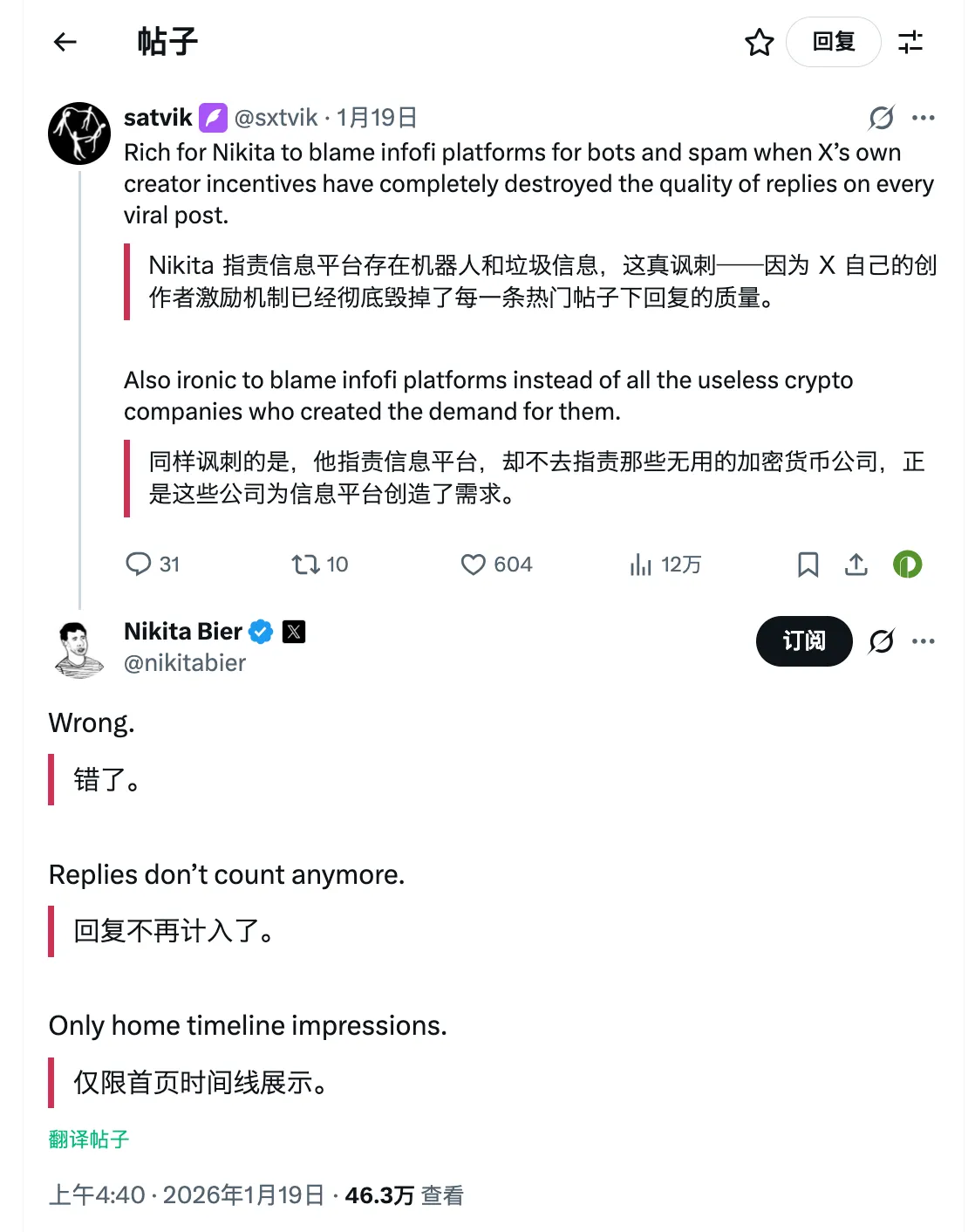
X Product Lead Nikita Bier responds to user questions on X

Under the new valuation system, whether it's high-frequency replies, concentrated spamming, or maintaining activity with low-effort content like "gm" or "+1", as long as it cannot push content onto the home timeline, it will no longer be considered a valid contribution by the platform.

This change did not occur in isolation. In subsequent explanations, X further elaborated on the logic behind it: the average user can actually browse a very limited amount of content per day. Excessive posting and frequent interaction do not expand influence but instead prematurely consume an account's daily exposure quota. When truly important information needs to be published, the account often has "no quota left."

In other words, in X's judgment, excessive interaction is not being suppressed but is seen as an inefficient or even self-damaging behavior pattern.

This stance also echoes Nikita Bier's previous public criticism of the crypto community. In his view, the decline in the influence of crypto tweets is not due to deliberate suppression by the platform's algorithm but is a result of the community's long-term reliance on low-value interactions leading to self-consumption.

From the result, X did not deny the existence of "Zui Lu" but chose a more direct and calmer way to deal with it: stop paying for this behavior.

When reply views are completely stripped from the incentive system, the content model of "arbitraging interaction" naturally loses its foundation. The so-called "end of the Zui Lu era" is not a targeted purge but an inevitable outcome of the adjustment to the valuation system.

The Real Background of Smart Cashtags: X Wants to Turn 'Market Sentiment' into a Consumable Object

While reshaping creator incentive rules, X is also simultaneously advancing another more directional product path—Smart Cashtags.

According to public statements by X's product lead Nikita Bier, this feature allows users to directly tag specific tokens or smart contracts when posting content related to market trends or assets. Users clicking the tag in their timeline can view the real-time price of the corresponding asset and all related discussion content within the platform. The feature is currently still in the testing and feedback phase, but the official team has clearly stated that Version 1 will be launched and has provided a relatively clear launch expectation (expected next month).

This means that Smart Cashtags are no longer just a proof-of-concept but have entered the final polishing stage before feature finalization.
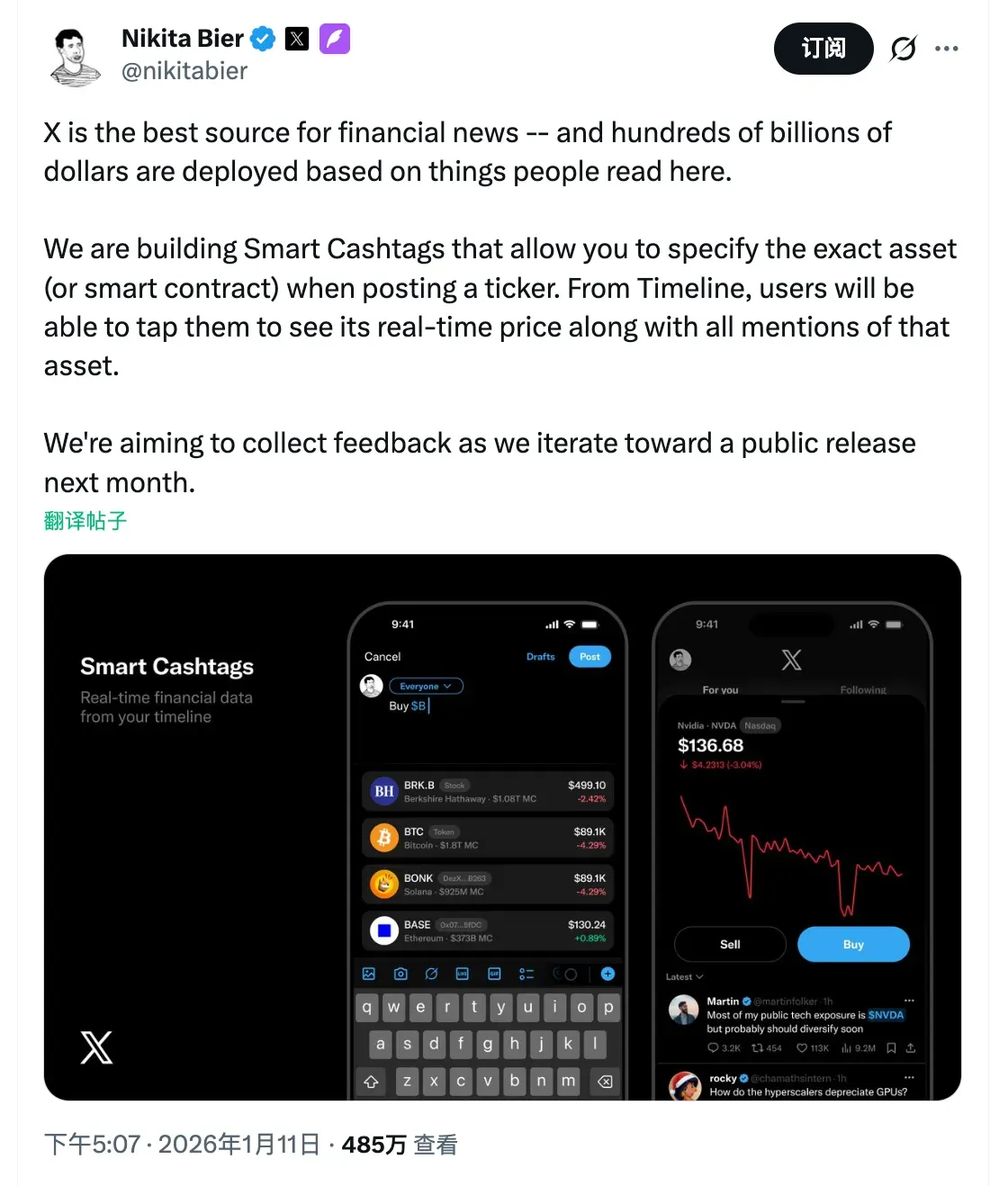
Related tweet and Smart Cashtags test page

Initially, the community saw it more as a tool to enhance the user experience regarding market trends. But as discussions deepened, the focus of skepticism gradually centered on several more fundamental questions:

— If an asset is not yet listed on major exchanges, does X have reliable data coverage capabilities?

— Will its price and on-chain information rely solely on centralized exchanges?

— Will it further extend to wallet or trade execution layers in the future?

Regarding the first two questions, Nikita Bier gave relatively clear responses. He stated that the API used by X will "be able to process almost anything minted on-chain in real-time," implying that the data source for Smart Cashtags is not limited to centralized trading platforms but has the capability to interface directly with on-chain information.

As for whether it will support self-custody wallets or allow trading execution within X via CEX widgets, he did not respond directly, only brushing it off with a "following" emoji. This deliberately reserved attitude反而 sparked more speculation within the community about X's next moves.

If we place Smart Cashtags back into X's existing strategic trajectory, this "reservation" is not out of place.

In 2025, X had already obtained money transmission licenses in over 40 US states and was simultaneously advancing the compliance construction of the X Money payment system. At that time, these moves were seen more as part of the "Everything App" narrative, still distant from the content ecosystem.

Entering January 2026, the pace of Smart Cashtags' development began to clarify: the feature was first publicly discussed, followed by supplementary details about the API layer, alongside information leaks regarding compliance and legal aspects. By late January, although still in the testing phase, official channels had released clear timing expectations.

Odaily Planet Daily believes this further indicates that Smart Cashtags is not an isolated product attempt but rather that X is pre-laying the infrastructure for the "Content × Finance" interface.

If we consider it alongside adjustments like creator incentive rules and the phasing out of the InfoFi API, its positioning becomes clear: X is not in a hurry to介入 transaction execution itself but is attempting to compress assets, prices, and market sentiment into a single clickable, trackable content node.

Within this structure, the value of content is no longer simply determined by interaction volume but depends on whether it can form a sustained, consumable stream of information and narrative around a certain asset. In this sense, Smart Cashtags are also not a tool prepared for "Zui Lu" but are reserving an entry point for those specific content forms.

After the Algorithm's 'Lid Was Lifted', Exposure Rights Did Not Become More Democratic

Besides Smart Cashtags, another change frequently mentioned recently regarding X is the official open-sourcing of its recommendation algorithm.

In late January, X's engineering team announced that the latest version of the platform's algorithm had been made public, adopting the same Transformer architecture as the Grok model under xAI. Subsequently, Elon Musk直言 stated that the algorithm is still "quite clumsy," but open-sourcing means users can clearly see its optimization path. For a long time, content being throttled or topics being suppressed was often attributed to the "black box algorithm"; algorithmic transparency at least means the rules are no longer hidden, and the path is traceable.
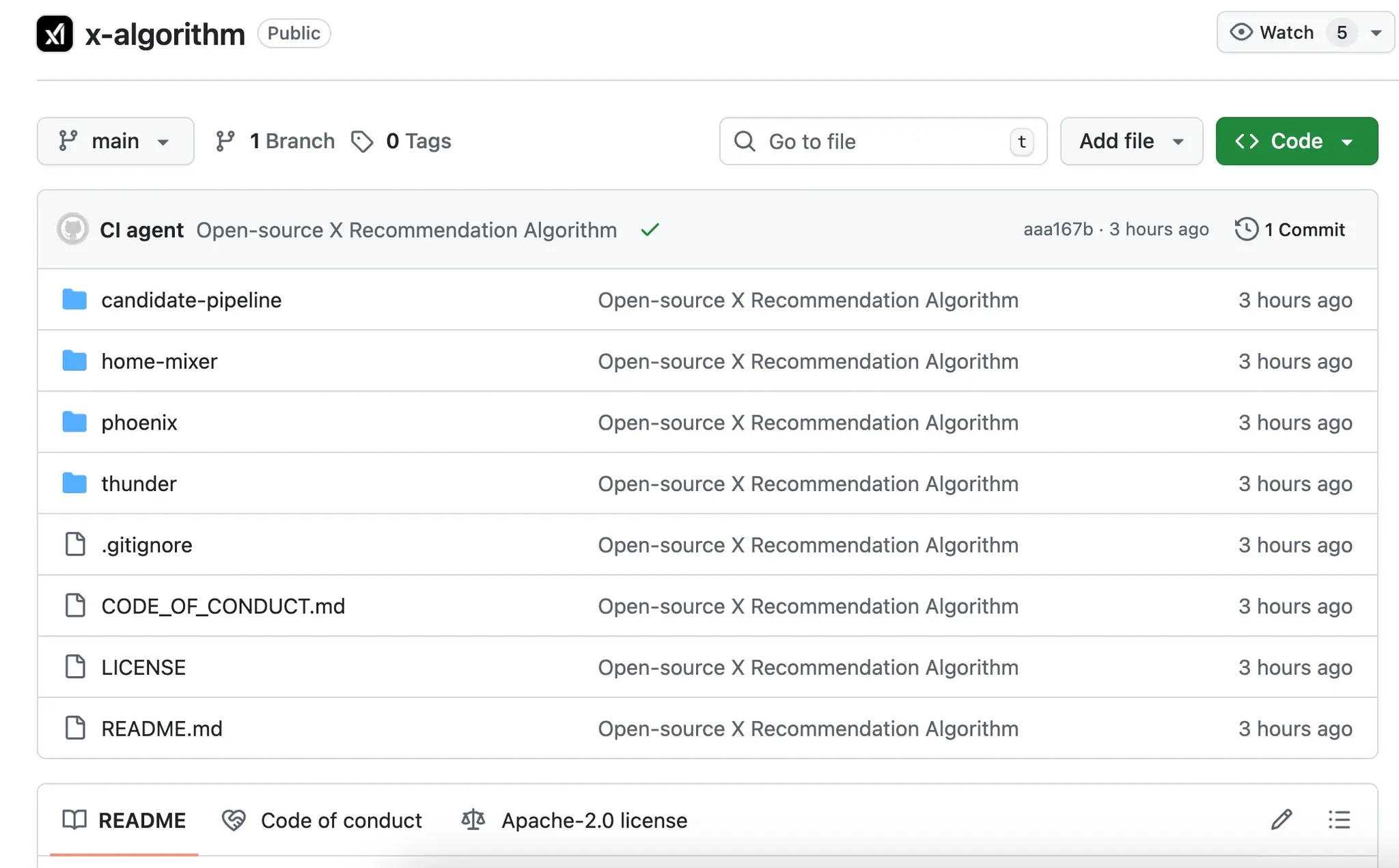
Homepage of the Github repository for X's newly public platform algorithm

However, open-sourcing the algorithm does not mean exposure rights are distributed equally.

Almost simultaneously, X is advancing a systematic upgrade of its "interest discovery" mechanism. The core goal is to allow new accounts to find interesting content faster without a lengthy follow-finding process. When organizing the timeline, the algorithm is shifting from relying on "who you follow" to "what the system thinks you might want to see."

Under this framework, whether content gains exposure depends on two key criteria: Understandability and Consumability.

  • Understandability: Clear content structure, complete information, easy for the algorithm to identify and categorize.
  • Consumability: Content can be absorbed, understood, and interacted with by users in a short time, forming an effective information flow.

In other words, exposure rights are no longer determined by "interaction volume" but by whether the content can be efficiently identified, distributed, and attract an audience by the system. This marks a shift from the previous model of "who is more active is more visible" to a distribution logic centered on the value of the content itself.

When the platform simultaneously tightens interaction incentives, structures asset narratives, and strengthens interest recommendation mechanisms, a new filtering logic has taken shape. Within such a system, it is no longer surprising that "Zui Lu" is naturally excluded from the mainstream exposure path.

Conclusion: This Isn't Anti-Zui Lu, But a Repricing of Content Value

From the tightening of creator incentive rules and algorithm open-sourcing, to the gradual advancement of Smart Cashtags functionality, and finally to the separate categorization of the Meme section on January 22, X is gradually piecing together a clear path.

Low-value interactions are being stripped away, assets and sentiment are being restructured, algorithms and interest discovery mechanisms are being pushed to the forefront—these adjustments collectively point to one core result: the platform is redefining what kind of content is worth being distributed, valued, and seen.

Under the new order, Memes are categorized as emotional expression, while financial and crypto content is required to have clear structure and directionality; exposure rights shift from "who is more active" to "who is easier to understand and consume." The platform also no longer pays for noise or mere participation.

As analyzed in Odaily Planet Daily's previous article "X Personally Terminates the InfoFi Incentive Model, the Zui Lu Era Concludes," the end of the Zui Lu era is not the终点 but the first perceptible signal of the restructuring of X's content value system. As the new rules land, the platform is building a value system that favors the content itself rather than interactive behaviors.

For creators and the industry, this means: gaining visibility on X in the future will no longer depend on quantity but on whether the content can be recognized by algorithms, absorbed by the audience, and form sustainable value. This new order is both a reclamation of platform sovereignty and a profound reshaping of the content ecosystem.

Related Links:

Deconstructing X's New Algorithm: The Ultimate Guide to Content Prospecting in 2026

X's New Algorithm Exposed: Likes Are Almost Worthless, This Action's Value Soars 150x

X Personally Terminates the InfoFi Incentive Model, the Zui Lu Era Concludes

İlgili Sorular

QWhat are the three new rules or changes implemented by X platform to redefine content value stratification?

AThe three key changes are: 1) Removing replies from the creator revenue calculation, so only impressions on the home timeline count. 2) Introducing a dedicated 'Meme' category to separate emotional expression from informational content. 3) Developing and preparing to launch the 'Smart Cashtags' feature to structure financial and crypto-related content.

QAccording to the article, why did X platform decide to stop counting reply impressions for creator revenue?

AX platform determined that excessive, low-value interactions like frequent replies were not expanding influence but were instead inefficient and self-damaging, as they could deplete an account's daily exposure quota, preventing important content from being seen. It chose to stop incentivizing this 'high interaction, low information' behavior.

QWhat is the purpose of the 'Smart Cashtags' feature as described in the article?

AThe purpose of Smart Cashtags is to structure asset and market-related content by allowing users to tag specific tokens or smart contracts. It compresses assets, prices, and market sentiment into a clickable, trackable content node, aiming to create a sustainable, consumable flow of information and narrative around an asset, rather than just being a simple price tool.

QHow does the article describe the shift in how content gains exposure (visibility) on X after the algorithm changes?

AExposure is no longer primarily determined by who is most active or has the most interactions ('who is more active is more visible'). Instead, it is now based on two key standards: 'Understandability' (clear structure, complete information, easy for the algorithm to identify) and 'Consumability' (content that can be quickly absorbed and understood by users, forming an effective information stream).

QWhat overall shift in content valuation does the article conclude that X platform is making?

AThe platform is shifting from valuing content based on the quantity of interactions and participation to valuing content based on its intrinsic quality, structure, and ability to be efficiently identified by the algorithm, consumed by the audience, and form sustainable value. It is a re-pricing of content value itself, moving away from incentivizing noise and towards rewarding clarity and consumability.

İlgili Okumalar

Silicon Valley 'Startup Guru' Steve Hoffman: Web3 + AI Could Be a Trap

Silicon Valley investor and "Godfather of Startups" Steve Hoffman warns that combining Web3 with AI is likely a trap, not a promising venture. In an interview, Hoffman argues that while AI is a foundational technology touching all industries, Web3 adds complexity, friction, and regulatory risk without solving mainstream consumer or business needs. He advises founders to focus on deep, specialized applications where startups can out-iterate giants, rather than on generic features easily replicated by large tech companies. Hoffman observes that Silicon Valley will lead foundational AI research, while China excels at rapid, large-scale application and commercialization, particularly in robotics. He stresses that AI-driven autonomous agents capable of collaborative, multi-step tasks are 2-4 years away, which will cause significant job displacement. The solution is not to slow AI but to redesign business models around human-AI collaboration and reform social systems like education and retraining. For startups, Hoffman recommends focusing on vertical, expertise-heavy domains to build defensibility. He sees major opportunities in AI fraud detection and cybersecurity. Key founder mindsets include systemic thinking over feature-focus, relentless customer centricity, building adaptive teams, and deeply understanding AI's capabilities and limits. Hoffman is also leading a non-profit initiative to establish university centers aimed at training future leaders in responsible, human-value-aligned AI innovation.

marsbit21 dk önce

Silicon Valley 'Startup Guru' Steve Hoffman: Web3 + AI Could Be a Trap

marsbit21 dk önce

Token Inefficient, Economy Tokenless

The article "Tokens Aren't Economical, Economics Aren't Tokenized" analyzes a pivotal shift in the AI industry from a technology-driven narrative to one dominated by capital efficiency. It highlights two concurrent trends: a severe capital shortage due to the exorbitant and recurring costs of compute (e.g., OpenAI's high burn rate) and a wave of corporate spin-offs where major tech companies are separating their AI units (like Kuaishou's Kling and Baidu's Kunlunxin). The core argument is that AI's "anti-internet" business model, where user growth increases costs rather than profits, has created a disconnect between high valuations and actual cash flow. Spin-offs address this by allowing AI assets to be valued independently. Within a parent company, they are seen as cost centers, but as standalone entities, they are priced based on their growth potential and scarcity in the primary market, leading to massive valuation premiums (e.g., Kling's estimated value tripling post-spin-off). The industry is at an inflection point, moving from "model worship" to "value realization." The competition is evolving from a pure compute (GPU) race to a broader focus on systemic efficiency and full-stack engineering (involving CPUs and orchestration) to achieve viable commercialization. The year 2026 is framed as a critical moment where the industry must definitively answer how to economically translate AI capability into tangible business value, reshaping the sector's future power structure.

marsbit26 dk önce

Token Inefficient, Economy Tokenless

marsbit26 dk önce

Crossing the 'Memory Wall': The Wafer-Level Revolution and Computing Power Routes in the AI Inference Era

In 2026, a historic shift occurred in AI as major cloud providers' inference spending surpassed training spending for the first time, signaling a move from "building large models" to "using large models." This shifts the core challenge from computing power to the "memory wall"—the bottleneck of data movement (model weights, activations, KV Cache) between external DRAM and processors, where energy and latency from data transfer far exceed computation itself. Companies like Nvidia face GPU idle time due to bandwidth limits. In contrast, Cerebras Systems adopts a radical "wafer-scale" approach with its Wafer-Scale Engine (WSE). Instead of cutting a silicon wafer into many chips, Cerebras uses almost the entire wafer as one massive chip (WSE-3). This design provides 44GB of on-chip SRAM, delivering memory bandwidth thousands of times higher than traditional HBM (e.g., 21 PB/s vs. Nvidia B200). For LLM inference, weights are streamed layer-by-layer from external MemoryX storage to the chip, avoiding HBM bottlenecks. This results in token generation speeds 1.5–5 times faster than Nvidia's B200 in some models and significant advantages in first-token latency and long-context tasks. Additionally, Cerebras's architecture offers much lower interconnect power consumption (0.15 pJ/bit vs. GPU's ~10 pJ/bit). However, Cerebras faces challenges: SRAM scaling has slowed with advanced nodes, limiting future capacity gains; the chip requires specialized liquid cooling and custom software stacks; and its external I/O bandwidth (150 GB/s) is low compared to NVLink, hindering multi-system scaling for very large models. Competition is intensifying. Major players are pursuing three paths: 1) Developing proprietary inference ASICs (e.g., Google TPU, Microsoft Maia), 2) Leveraging advanced packaging (e.g., TSMC's SoW) to democratize wafer-scale-like integration, potentially eroding Cerebras's process advantage within a few years, and 3) Exploring optical interconnects for ultimate bandwidth. Commercially, Cerebras is transitioning from a hardware vendor to a service provider, facing the immense challenge of building high-power, specialized data centers to meet large contracts (e.g., 250MW/year from 2026–2028). In conclusion, the AI inference era presents a fundamental architectural trade-off. Cerebras opts for extreme physical optimization for low-latency, single-task performance, while Nvidia prioritizes versatility and massive cluster throughput. The path forward remains uncertain, with technology and business models still evolving in the race toward advanced AI.

marsbit31 dk önce

Crossing the 'Memory Wall': The Wafer-Level Revolution and Computing Power Routes in the AI Inference Era

marsbit31 dk önce

Has Bitcoin's 'Rebound Ended', Officially Entering the Late Bear Market Phase?

**Title: Has Bitcoin's Rebound Ended, Entering the Late Bear Market Phase?** **Summary:** Bitcoin's price has declined by 13% this week, signaling a potential return to late-stage bear market conditions. The price fell to around $67k, positioned between the Realized Price and Realized Cap Weighted Average. For the first time since early 2022, the Short-Term Holder cost basis has dropped below this key average, confirming a hallmark of late-cycle bear markets. Profitability metrics have collapsed sharply. The 7-day average of the Realized Profit/Loss ratio plummeted from a local high of 3.16 to 0.29, mirroring the February panic sell-off. Critically, the 90-day average never breached the threshold of 2, indicating the recent rally to $82k was a bear market bounce, not a structural shift. Realized losses surged to $1.35 billion daily, with $770 million coming from Long-Term Holders selling at a loss. This accelerating redistribution of supply from weak to strong hands is a necessary but ongoing process for a market bottom. The rally stalled almost precisely at the aggregate cost basis (~$83k) of US spot Bitcoin ETF investors, turning that level into strong resistance and leaving the average ETF holder underwater again. Spot market flows have turned decisively negative, showing sellers are dominating order books despite the price drop. While a significant futures long liquidation event cleared over $400 million in leverage, providing a potential reset, sustained spot demand is yet to materialize. Options markets continue to price in higher future volatility (Implied Volatility) than recent price action (Realized Volatility) has shown, with a persistent skew towards put options, indicating ongoing demand for downside protection. In conclusion, multiple metrics point to a fragile market structure. Resistance at the ETF cost basis, accelerating realized losses, dominant spot selling, and cautious options pricing all suggest the bear market trend persists. A sustainable recovery likely requires a resurgence of spot demand, ETF holders returning to profit, and a clear reduction in selling pressure.

marsbit32 dk önce

Has Bitcoin's 'Rebound Ended', Officially Entering the Late Bear Market Phase?

marsbit32 dk önce

TechFlow Intelligence Agency: Anthropic Calls for Global Pause in AI Development While Preparing for Trillion-Dollar IPO; SpaceX IPO Roadshow Heats Up, But S&P 500 Rejects Fast-Track Inclusion

In today's TechFlow Intelligence Briefing, several major tech stories highlight a growing theme of trust and credibility gaps across AI, crypto, and finance. AI company Anthropic has publicly called for a global pause in AI development, citing risks from Claude's "recursive self-improvement." Ironically, this coincides with reports the company is preparing for a massive IPO targeting a near $1 trillion valuation. This perceived hypocrisy, coupled with widespread user complaints about Claude's declining performance, is sparking debate over whether the safety warning is genuine or a competitive tactic. Meanwhile, in a substantive security move, Anthropic open-sourced a framework for AI-powered vulnerability discovery. In the crypto market, Bitcoin's price drop below $61,000 triggered over $1.16 billion in liquidations, flipping the market into a state where more BTC is held at a loss than at a profit, a historical bearish signal. On the corporate front, SpaceX's highly anticipated IPO is generating immense Wall Street excitement, with Goldman Sachs projecting 100x revenue growth by 2030. However, the S&P 500 has refused to fast-track the company's inclusion post-IPO, potentially limiting immediate institutional demand. Separately, ByteDance's AI app Doubao lost over 6 million monthly active users after introducing a subscription model, highlighting the challenges of AI monetization. Other notable developments include Nvidia certifying HBM4 memory from Samsung, SK Hynix, and Micron; Cloudflare's acquisition of front-end tooling company VoidZero; and its CEO warning that bot traffic now exceeds human traffic online. The underlying narrative connects these events: a trust crisis. From AI firms' contradictory actions and crypto volatility to the clash between SpaceX's hyped narrative and institutional rules, a pattern is emerging where stated intentions and actual practices are increasingly misaligned.

marsbit47 dk önce

TechFlow Intelligence Agency: Anthropic Calls for Global Pause in AI Development While Preparing for Trillion-Dollar IPO; SpaceX IPO Roadshow Heats Up, But S&P 500 Rejects Fast-Track Inclusion

marsbit47 dk önce

İşlemler

Spot
Futures

Popüler Makaleler

ORDER Nasıl Satın Alınır

HTX.com’a hoş geldiniz! Orderly (ORDER) satın alma işlemlerini basit ve kullanışlı bir hâle getirdik. Adım adım açıkladığımız rehberimizi takip ederek kripto yolculuğunuza başlayın. 1. Adım: HTX Hesabınızı OluşturunHTX'te ücretsiz bir hesap açmak için e-posta adresinizi veya telefon numaranızı kullanın. Sorunsuzca kaydolun ve tüm özelliklerin kilidini açın. Hesabımı Aç2. Adım: Kripto Satın Al Bölümüne Gidin ve Ödeme Yönteminizi SeçinKredi/Banka Kartı: Visa veya Mastercard'ınızı kullanarak anında Orderly (ORDER) satın alın.Bakiye: Sorunsuz bir şekilde işlem yapmak için HTX hesap bakiyenizdeki fonları kullanın.Üçüncü Taraflar: Kullanımı kolaylaştırmak için Google Pay ve Apple Pay gibi popüler ödeme yöntemlerini ekledik.P2P: HTX'teki diğer kullanıcılarla doğrudan işlem yapın.Borsa Dışı (OTC): Yatırımcılar için kişiye özel hizmetler ve rekabetçi döviz kurları sunuyoruz.3. Adım: Orderly (ORDER) Varlıklarınızı SaklayınOrderly (ORDER) satın aldıktan sonra HTX hesabınızda saklayın. Alternatif olarak, blok zinciri transferi yoluyla başka bir yere gönderebilir veya diğer kripto para birimlerini takas etmek için kullanabilirsiniz.4. Adım: Orderly (ORDER) Varlıklarınızla İşlem YapınHTX'in spot piyasasında Orderly (ORDER) ile kolayca işlemler yapın.Hesabınıza erişin, işlem çiftinizi seçin, işlemlerinizi gerçekleştirin ve gerçek zamanlı olarak izleyin. Hem yeni başlayanlar hem de deneyimli yatırımcılar için kullanıcı dostu bir deneyim sunuyoruz.

319 Toplam GörüntülenmeYayınlanma 2024.12.10Güncellenme 2026.06.02

ORDER Nasıl Satın Alınır

Tartışmalar

HTX Topluluğuna hoş geldiniz. Burada, en son platform gelişmeleri hakkında bilgi sahibi olabilir ve profesyonel piyasa görüşlerine erişebilirsiniz. Kullanıcıların ORDER (ORDER) fiyatı hakkındaki görüşleri aşağıda sunulmaktadır.

活动图片









