Worried about AI's Self-Evolution, Anthropic Intends to Stop Training?

marsbit2026-06-05 tarihinde yayınlandı2026-06-05 tarihinde güncellendi

Özet

In early 2026, Anthropic signaled a significant shift in its public narrative regarding AI development timelines and safety. In June, its Anthropic Institute published a detailed article, "When AI builds itself," presenting internal data suggesting accelerating AI self-improvement. Key figures included over 80% of merged code being written by Claude and a 52x speedup in certain optimization tasks. The article outlined three future scenarios, with the most speculative being full recursive self-improvement (RSI), where AI autonomously builds better successors. Anthropic stated RSI is "possible" and may arrive faster than most institutions are prepared for. This narrative pivot followed a series of strategic moves. In January, CEO Dario Amodei wrote about a powerful self-improvement feedback loop. In February, Anthropic revised its Responsible Scaling Policy, removing a core commitment to pause training if capabilities outstripped safety controls, citing the risk of falling behind competitors. This change coincided with reported pressure from the US Department of Defense. By May, Anthropic's valuation had soared to $965 billion. Anthropic's stance was mirrored by other industry leaders. DeepMind CEO Demis Hassabis adjusted his AGI timeline to "by 2029" and admitted to using provocative language like "foothills of the singularity" to create urgency. OpenAI also released a model claiming a key role in its own creation process. The article's carefully calibrated tone—presenting ...

On May 4, 2026, Anthropic co-founder Jack Clark posted a message on the social platform X. His original words were: "I now believe the probability of recursive self-improvement occurring by the end of 2028 is 60%."

Within minutes of the post going live, Eliezer Yudkowsky, a long-time active researcher in AI safety, replied underneath: "Then we will die together." He immediately followed up by citing an analogy pointing to the design flaw of the Chernobyl nuclear reactor RBMK, implying that this system being activated is one no one truly knows how to stop.

This exchange, completed within tens of seconds, lit a match to discussions previously hidden in technical papers and internal assessments. Recursive Self-Improvement (RSI) – where AI systems not only optimize outputs but also autonomously optimize the improvement process itself, ultimately constructing successor systems more powerful than themselves – a concept long relegated to the theoretical margins, was placed by an Anthropic co-founder into a countdown clock with a 60% probability before the end of 2028.

A month later, Anthropic officially published a lengthy article. Titled "When AI builds itself," it was co-authored by Marina Favaro and Jack Clark and published by the newly formed Anthropic Institute in March. Using a series of previously undisclosed internal data and a meticulously calibrated narrative structure, Anthropic handed the outside world a precisely scaled acceleration signal card. This card stated both "we are not there yet" and "but it may arrive faster than most institutions are prepared for."

In the same month, DeepMind CEO Demis Hassabis used a phrasing never before seen in public at the Google I/O stage: humanity stands at the "foothills of the singularity." In subsequent interviews, he adjusted his timeline for Artificial General Intelligence (AGI) from "shortly after 2030" to "2029 is a real possibility," and admitted that his use of dramatic language was "deliberately provocative," aiming to create a sense of urgency for governments, economists, and the public.

Two leading institutions built on a foundation of safety, long serving as forces of restraint in the AI industry, adjusted the volume and scale of their external messaging almost simultaneously. This timing itself needs to be examined as an independent event.

A Meticulously Calibrated Long Article

The long article published by Anthropic on June 4 immediately laid out its narrative goal. It aimed to argue not just a technical trend, but a directional process with acceleration. To this end, it presented a set of previously undisclosed internal data.
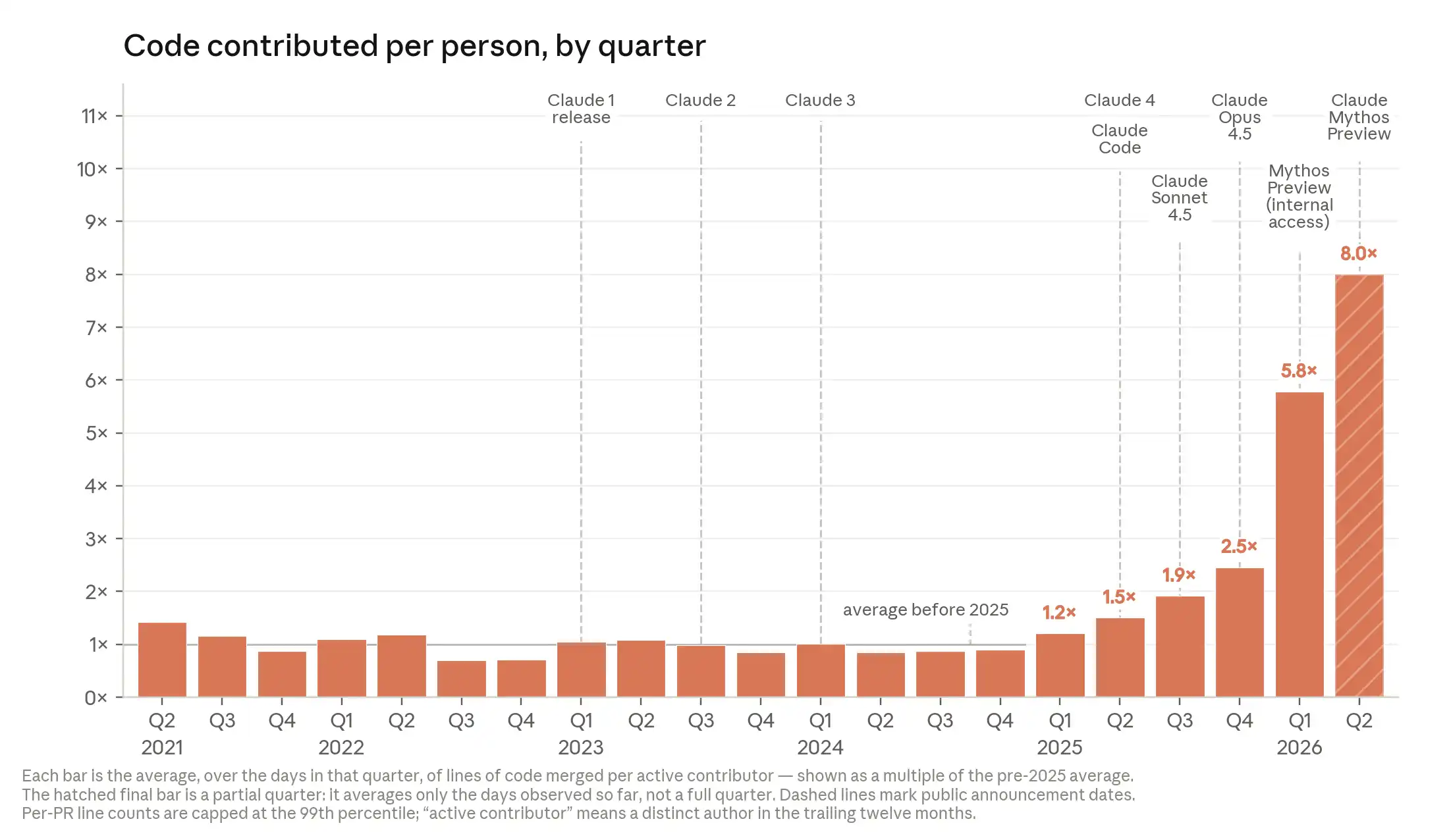
The first set of numbers pointed to a structural change: as of May 2026, over 80% of merged code in Anthropic's codebase was written by Claude. Two years ago, this number was in the low single digits. The same data also showed that in Q2 2026, the typical Anthropic engineer was merging 8 times more code per day than in 2024.

One can imagine the reaction of anyone not deeply tracking the AI industry reading these two numbers for the first time. But Anthropic itself acknowledged several important caveats in footnotes: leadership had publicly estimated that if scripts and experimental code were included, Claude-authored code exceeded 90%; 80% was a more conservative statistic for merged code; lines of code are "an imperfect metric" and might overestimate real productivity gains; the code attribution pipeline itself "has gaps."

The very writing of these footnotes is worth analyzing. Their existence ostensibly serves as honest concessions, but their actual function is to make the numbers in the main text appear to have undergone prudent self-filtering, thus gaining greater credibility. This is a two-tier structure in narrative engineering: the main text releases the signal, the footnotes provide the disclaimer.

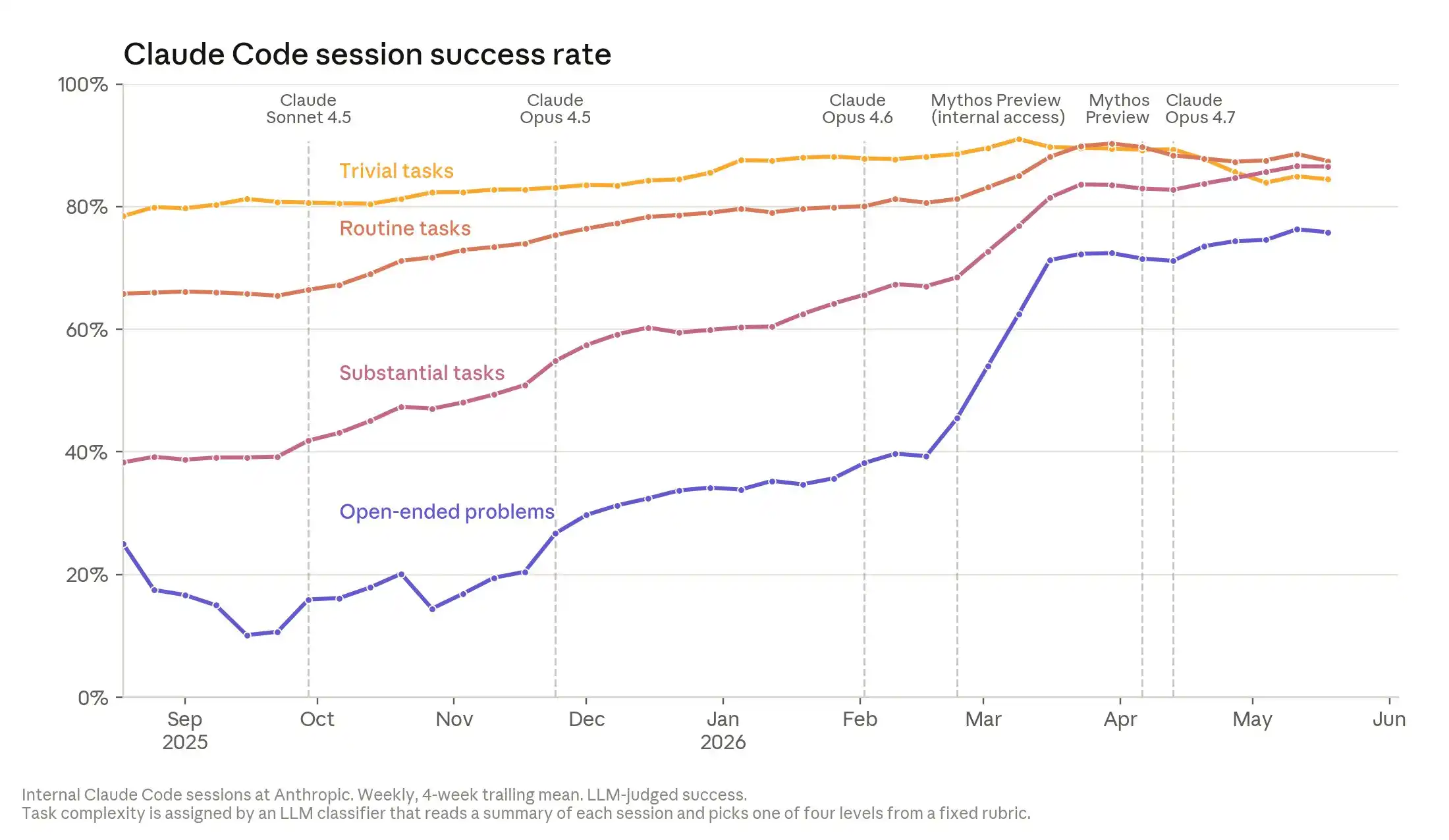
The second set of numbers involved speed. On code optimization tasks, Claude Opus 4 achieved approximately a 3x speed-up effect in May 2025, which would take a skilled human researcher 4 to 8 hours to achieve. By April 2026, Claude Mythos Preview pushed this number to approximately 52x. The maximum duration for AI to independently complete tasks also doubled every four months, from 4 minutes in March 2024 to 12 hours in March 2026. The speed of doubling every four months itself constitutes a highly memorable point, easily spread with its implication of geometric progression.
Another set of data came from an internal survey of 130 Anthropic research team employees in March 2026. The median respondent estimated that output using Mythos Preview was about 4 times that of not using AI. A footnote again pointed out that prior independent research by METR suggested developers may generally overestimate AI productivity gains. The same two-tier structure reappeared.

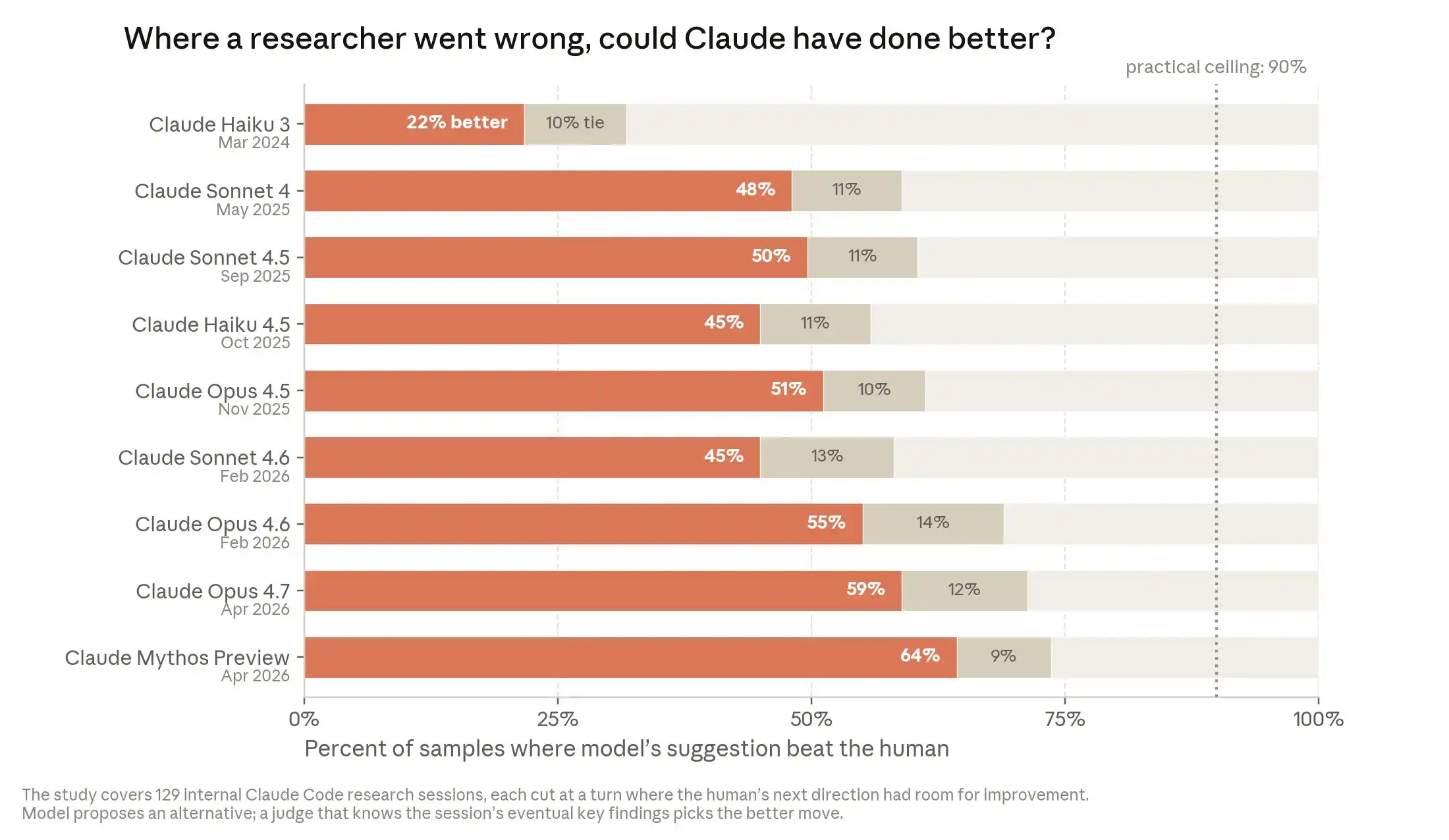
The third set of numbers pointed to AI approaching the boundary of human researcher judgment. In November 2025, Claude Opus 4.5 made better research direction choices than human researchers in 51% of cases. By April 2026, this number rose to 64%. With a sample size of 129 cases, Anthropic explained in a footnote that these were cases deliberately chosen where human choices had room for improvement.

Any single number taken out of context could be placed into different interpretive frameworks. But placed together, the direction is consistent: speed is increasing, the gap is narrowing, and all of this is happening inside Anthropic's own codebase and labs, not theoretical speculation on some external benchmark.

After listing this data, the article presented three future scenarios.

The first is trend stagnation, entering an S-curve plateau. Anthropic's phrasing: "we do not believe this is very likely."

The second is compound efficiency gains, where AI continues to replace humans in broader R&D aspects, but humans still set the direction and define success criteria. Anthropic assessed this as "evidence suggests we are likely heading toward this scenario."

The third is full recursive self-improvement, where AI autonomously designs, trains, and deploys successor systems more powerful than itself, with humans no longer in the loop. The wording is "plausible."

The arrangement order and tone allocation of these three scenarios form a complete narrative gradient. The first is downplayed, serving to accommodate skeptics; the second is anchored in "evidence," lending the article a rational veneer; the third, through "plausible" and conditional "if technological trends continue," pushes the boldest hypothesis to the edge of the reader's imagination without bearing the burden of proof for it.
At the very core of the entire article, Anthropic's stance is compressed into one sentence: "We are not there yet, and recursive self-improvement is not inevitable. But it may arrive faster than most institutions are prepared for."

From 'Willing to Pause' to 'A Unilateral Pause Would Only Let Reckless Actors Catch Up'

If the June 4th long article is a carefully framed snapshot, placing it on a timeline reveals a longer trajectory.

In 2023, Anthropic released its Responsible Scaling Policy (RSP). The core commitment of this policy document was: if model capabilities exceed the company's safety control capabilities, the company will pause training more powerful models. This was not a verbal statement, but an internal governance document with an assessment framework and trigger conditions. This document was once regarded by the AI safety community as an operational sample of "voluntary regulation."

In 2024, CEO Dario Amodei published a widely circulated article, suggesting the possibility of "powerful AI" arriving between 2027 and 2030. At that time, Anthropic still presented itself as an independent safety-minded entity, maintaining a restrained facade towards scale expansion and acceleration narratives.

On January 26, 2026, Amodei published a 38-page article "The Adolescence of Technology" on his personal website. It contained a judgment later repeatedly cited: "Because AI is now writing most of the code inside Anthropic, it is already substantially accelerating our progress toward building the next generation of AI systems. This feedback loop is gaining momentum month by month, and may be only 1 to 2 years away from the current generation of AI autonomously building the next generation." In the same article, he described the impending "powerful AI" as a "genius nation in a data center."

This was almost the starting point for Anthropic to systematically release the signal that a "self-improvement feedback loop is happening." And the timing of this blog post coincided with the company's transition from a $350 billion valuation to a higher valuation range.

Less than a month later, the turn came.

On February 25, 2026, CNN reported that Anthropic had revised its Responsible Scaling Policy, removing the core commitment to "pause training stronger models if capabilities exceed safety control abilities," replacing it with a non-binding "Frontier Safety Roadmap." In the same week, U.S. Secretary of Defense Pete Hegseth issued an ultimatum to Dario Amodei: withdraw the safety red line, or lose a $200 million Department of Defense contract.

The report quoted Anthropic's Chief Scientist Jared Kaplan's response to Time magazine: "We don't think stopping model training actually helps anyone... if competitors are sprinting at full speed." The phrasing in this response is noteworthy. "Doesn't help anyone" is not a technical argument, but a statement of stakeholder calculus. "If competitors are sprinting at full speed" is structurally identical in narrative framing to "a unilateral pause would only let the least cautious actors catch up": it replaces the original pause logic based on one's own safety capabilities with a speed logic based on competitor actions.

Anthropic still emphasized in the CNN report that it retained two red lines: not using AI systems to control weapons systems, and not using them for mass domestic surveillance. This point is important because it shows Anthropic did not abandon its safety stance wholesale, but made selective concessions and defenses across different safety dimensions. However, this selectivity itself is also a core clue in narrative strategy analysis: where it conceded and where it held firm delineates the recalibrated scale of safety.

On March 11, the Anthropic Institute was formally established, led by Jack Clark, positioned as a "public interest research institute." Less than two months later, on May 4, Clark posted the "60%" message.

Once juxtaposed, the signal density and release rhythm of this timeline are not random. From the personal article preview in January, to the policy revision in February, to the institute's establishment in March, to the founder's probability prediction in May, to the official long article release in June, this is a clearly paced, gradually escalating narrative pipeline. One cannot directly conclude "this was all pre-planned" from this, but the sequence itself constitutes a question analysts must confront: does this sense of rhythm indicate that Anthropic has already incorporated the "acceleration narrative" into its public communications management?

Hassabis's Deliberate Provocation

If only Anthropic had adjusted its messaging in the first half of 2026, analysts would have sufficient reason to focus on the internal decision logic of the enterprise. But DeepMind CEO Demis Hassabis made a directionally consistent adjustment almost simultaneously, making the "single enterprise case" argument untenable.

On January 20, at the Davos Forum, Hassabis still maintained his longstanding judgment: a 50% probability of AGI by 2030. Three weeks later, on February 18, at the India AI Impact Summit, he relented: "AGI could arrive within five years."

From May 20 to 22, at Google I/O, Hassabis said in his keynote that humanity stands at the "foothills of the singularity." Around the same time, OpenAI released GPT-5.3-Codex, stating the model "played a key role in its own creation process," specifically including assisting in debugging the training process, managing deployment, and analyzing evaluation results. The timing gap between the three leading labs was compressed to weeks.

After Google I/O, Hassabis gave an interview to Axios. This interview was later widely cited, with the most crucial line being his admission that using language like "foothills of the singularity" was "deliberately provocative," aimed at jolting governments, economists, and the public into recognizing the urgency of AI's accelerating development. He also adjusted his AGI timeline from "shortly after 2030" to "2029 is a real possibility," though still broadly expected around 2030, plus or minus a year.

Hassabis was more direct in an interview with The Seoul Economic Daily: "Five to ten years from now, when we look back at 2026 and 2027, we will say 'that was when we entered the AGI era.'"

The term "deliberately provocative" deserves careful consideration. It is a rare, first-hand confession by a principal actor about narrative intent. It acknowledges that at least some of his chosen phrasing is not a passive reflection of technical facts, but an actively chosen communication tool. This confession itself does not negate that he may also genuinely see a technical inflection point, but it explicitly lifts "narrative" from the shadow of "facts," making it an object that can be examined separately.

Hassabis's self-explanation of his phrasing opens a side door to interpreting this round of synchronized signals. His "deliberate provocation" and the "footnote disclaimers" in Anthropic's lengthy data argument exhibit the same amphibious posture: one hand pushes signals shocking enough to stir public opinion, the other retains a safe space to retreat to "this is just one possibility."

The Same Set of Data, Completely Different Interpretations

While Anthropic and DeepMind jointly constructed a narrative framework of "AI is accelerating its own evolution," external independent researchers offered alternative interpretations of the same set of data and phenomena. These interpretations are important not because any one side possesses ultimate truth, but because they reveal the interpretative range of the official narrative itself.

The sharpest response came from Eliezer Yudkowsky. He not only replied to Jack Clark but also continued to speak out on multiple occasions. A MindStudio blog recorded his complete stance: he used the Chernobyl RBMK reactor as an analogy for the safety design of current AI systems. The core argument of this analogy is that if control rods and accelerators are bound within the same system, attempting to slow down can actually cause the system to lose control faster.

Nathan Lambert of the Allen Institute for AI proposed the concept of "Lossy Self-Improvement" (LSI). His argument directly challenges the "accelerating flywheel" model: as systems become increasingly complex, each generational improvement process creates friction and loss, akin to signal attenuation over long-distance transmission. According to this logic, the improvements that made 80% or 90% AI-authored code possible cannot be infinitely replicated onto the next-generation system, because the next generation will face a more complex problem space, and the noise and errors in the AI's own output will amplify across generations.

Dean Ball, a senior fellow at the Foundation for American Innovation, offered a more direct linguistic framework, dimensionalizing Anthropic's data. He told IEEE Spectrum: "Maybe eventually they'll automate genius, but not next year. Next year they're automating drudgery." This distinction strikes at the core ambiguity of "80% of code written by AI." If AI automates the fixed-pattern parts of a codebase, batch parameter generation, or end-to-end pipeline configuration, then this work indeed corresponds to "drudgery" in software engineering contexts. The remaining 20% might contain architecture design, directional judgment, trade-offs based on incomplete information – these are the genius parts.

David Scott Krueger of the University of Montreal, as founder of the AI safety non-profit Evitable, proposed a pause trigger red line: "99% of code written by AI." He told IEEE Spectrum: "I think we may be crossing that line now." The tension between his framework and Anthropic's already loosened pause commitment is one of the most important structural contradictions in this round of narratives.

UBC computer scientist Jeff Clune, in an interview with IEEE Spectrum, stood in another direction. He said: "We are at an inflection point for recursive self-improvement systems." If his statement were validated, it would mean Yudkowsky's alarm bell rang at the right beat.

Four sets of voices, pointing in different directions, with even internal tension within the same direction. But their commonality lies in the fact that they do not rely on the official narrative framework; instead, they each offer independent judgments on the same set of phenomena based on their own methodologies. The diversity and conflict among these judgments themselves are the most powerful rebuttal to the notion that "any single narrative sufficiently covers the whole truth."

Coupling of Valuation Curves and Narrative Rhythm

In January 2026, Anthropic completed a funding round at a valuation of $350 billion. Investors included Microsoft and Nvidia. This number had been preemptively reported by some media by late 2025, but its formal announcement came right after Amodei published "The Adolescence of Technology."

In February, another $30 billion funding round completed, maintaining the valuation around $350 billion. In the same month, the safety policy was revised, removing the pause commitment. The Pentagon's $200 million contract threat landed.

In May, Reuters, The New York Times, and TechCrunch almost simultaneously reported that Anthropic had completed a $65 billion funding round, reaching a valuation of $965 billion. This number not only exceeded its own valuation two months prior but also surpassed OpenAI's $852 billion valuation from March 2026. The New York Times additionally cited Dario Amodei's remarks at a developer conference, stating the company's annualized revenue reached $30 billion, with him even joking that he "hopes this year's 80x revenue growth doesn't continue, because that would be insane."

On June 4, the Anthropic Institute published the "When AI builds itself" long article.

Lining up these time points is not to imply a precise causal arrow on a chart. Anyone claiming a causal relationship between these things must provide direct evidence. In the absence of internal decision records, no analyst can or should make such assertions.

On the other hand, it is equally unreasonable to not observe and record these correspondences at all. That an enterprise's valuation nearly tripled from $350 billion to $965 billion within five months, while undergoing a major safety policy shift, while constructing a narrative pipeline of "acceleration signals" led by an independent research institute, while its co-founder offered a 60% probability prediction – when all these events are densely compressed within six months, investors at least have the right to ask: To what extent do these signal releases serve the function of conveying the message "we are at the accelerating frontier" to the market?

This inquiry itself is the value of analysis. The answer may never be singular. But once the question is clearly posed, it cannot be easily withdrawn.

Global AI market funding reached $297 billion in Q1 2026, with the top five deals occupying a significant share of that total. At this level, all frontier labs face the same pressure: you need to convince investors that your technology curve will be steeper than your rivals'. Your risk warnings must also be loud enough so that when regulators finally step in to make rules, your voice is pre-embedded into the policy framework. Your narrative must also be attractive enough to make top researchers choose your lab, and alarming enough to maintain your remaining credibility within the safety community.

There are inherent contradictions among these demands. Anthropic's narrative adjustments in the first half of 2026 can be seen as a recalibration of the linguistic balance point among these conflicting demands. The weakening of safety commitments, the strengthening of acceleration signals, and the repeated use of the argument "we cannot unilaterally stop" collectively form a set of vectors pointing in the same direction.

The Signals Are Out, And Then

We must return to the core question: do these signals more resemble reflections of a technical inflection point, or rhetorical escalation aimed at capital and regulation?

Available public evidence does not allow for simply checking a box between the two options. Because the evidence used by both explanations is, in fact, the same set of data. The 80% code share, 52x speed-up, task duration doubling every four months can both support "an inflection point is approaching" and explain "we are communicating a trend perception our own technical staff have personally experienced to the market." The boundary between these is blurred.

But some facts are determinate, requiring no choosing of sides between interpretations.

First, Anthropic's narrative pivot completed in the first half of 2026 is not an isolated case. DeepMind's Hassabis made a directionally consistent, if differing in degree but essentially similar, adjustment almost in the same quarter. OpenAI's Sam Altman said at the India summit "the world is not ready," and in February 2026 released GPT-5.3-Codex, claiming it "played a key role in its own creation process." If this were only Anthropic releasing signals, perhaps analysis from an enterprise strategy perspective would suffice. But three leading labs simultaneously raising their voices within a dense few months constitutes an industry-level narrative shift.

Second, there exists a temporally traceable correspondence between the rhythm of these signal releases and the beats of financing, policy adjustments, and organizational restructuring. This correspondence itself needs to prove nothing; it only needs to be honestly presented. Once presented, each person's inherent methodology will determine what they think next.

Third, Anthropic itself still labels the status of the third scenario, "full recursive self-improvement," as "plausible," not "likely." This means that within the internal judgment framework of the company releasing this data, their acceleration narrative is not yet fully closed. The forces that compel them to habitually include qualifiers in academic papers and blog writing are still pulling the reins on their public phrasing.

Fourth, Hassabis's "deliberate provocation" confession confirms a mechanism long suspected but rarely admitted by the actors themselves: at least some leaders of frontier labs choose their phrasing with explicit communication objectives in mind. This necessitates that all interpretations of their pronouncements must simultaneously analyze two layers: the facts they claim, and the rhetorical strategy they employ in choosing those claims as a behavioral event in itself.

Those who carefully read Anthropic's data-filled article and those who only remember the two numbers "80% of code written by AI" and "52x acceleration" receive vastly different signal strengths. But in this matter, "how it is remembered" might be a more important object of analysis than "what was actually said."

This very article is itself a precise sample of the phenomenon it describes. It constructs a sense of impending acceleration using data, yet retains room for retreat through footnotes and qualifiers; it calls for global coordination and verifiable deceleration, yet has already withdrawn the pause commitment in a prior policy revision. This is not hypocrisy, nor simple inconsistency between words and actions. It is the narrative balancing act of an institution caught between technical uncertainty, commercial pressure, and public responsibility. And Hassabis's "deliberate provocation" confession precisely confirms from the side door that such balancing acts are now a consciously employed method among leading labs.


İlgili Sorular

QWhat is recursive self-improvement (RSI) in the context of AI, and why did Anthropic's co-founder's comments about its probability spark significant discussion?

ARecursive self-improvement (RSI) refers to an AI system's ability to not only optimize its outputs but also autonomously improve its own improvement processes, ultimately leading to the creation of successor systems more capable than itself. The discussion was ignited because Anthropic's co-founder, Jack Clark, publicly stated a 60% probability of RSI occurring by the end of 2028. This moved the concept from theoretical speculation to a near-term, quantified risk, prompting immediate and alarmed responses from figures like AI safety researcher Eliezer Yudkowsky.

QAccording to the article, what key data did Anthropic present in its June 4th post 'When AI builds itself' to argue that AI development is accelerating?

AAnthropic presented several key data points: 1) Over 80% of merged code in its codebase was written by Claude as of May 2026, up from low single digits two years prior. 2) Typical engineers merged 8 times more code daily in Q2 2026 compared to 2024. 3) Code optimization speed increased from a 3x acceleration with Claude Opus 4 to a 52x acceleration with Claude Mythos Preview. 4) The maximum duration of tasks AI could complete independently doubled every 4 months, reaching 12 hours by March 2026. 5) An internal survey showed a median 4x productivity increase using AI tools.

QHow did Anthropic's Responsible Scaling Policy (RSP) change in early 2026, and what was cited as a reason for this change?

AIn February 2026, Anthropic modified its Responsible Scaling Policy by removing the core commitment to pause training more powerful models if capabilities outpaced safety controls. This was replaced with a non-binding 'Frontier Safety Roadmap.' A key reason cited for the change, as articulated by Chief Scientist Jared Kaplan, was that a unilateral pause 'doesn't actually help anyone... if competitors are sprinting full speed ahead.' This shifted the rationale from an internal safety threshold to a competitive race dynamic.

QWhat does Demis Hassabis of DeepMind mean by calling his use of dramatic language like 'foothills of the singularity' a 'deliberate provocation'?

ADemis Hassabis described his dramatic language as a 'deliberate provocation' to acknowledge that his word choice was an active communication strategy, not just a passive reflection of technical facts. His stated goal was to create a sense of urgency among governments, economists, and the public regarding the accelerating pace of AI development. This admission highlights that the public statements from leading AI labs are carefully crafted narratives intended to achieve specific effects, alongside reporting perceived technical trends.

QWhat alternative interpretations or critiques did external researchers offer regarding Anthropic's data on AI self-improvement?

AExternal researchers offered several critiques: 1) Eliezer Yudkowsky used the Chernobyl RBMK reactor analogy, warning of a system where controls might accelerate rather than slow down a runaway process. 2) Nathan Lambert proposed 'Lossy Self-Improvement,' suggesting complexity and error amplification could limit indefinite acceleration. 3) Dean Ball argued that AI is automating 'grunt work,' not genius-level tasks. 4) David Scott Krueger suggested a stricter pause threshold (99% AI-written code) that Anthropic might be approaching. 5) Jeff Clune agreed a turning point was near. These views highlight the interpretative range and lack of consensus surrounding the same data.

İlgili Okumalar

Bitcoin's 'Rally Ends,' Officially Entering the Later Stage of a Bear Market?

Bitcoin prices declined 13% this week, reversing the recent rebound and signaling a likely transition into the later stages of a bear market. Key on-chain metrics deteriorated, with the short-term holder cost basis falling below the Realized Price—a pattern last seen in early 2022, characteristic of bear market maturity. The rally to ~$82k proved to be a bear market bounce, as evidenced by the 90-day realized profit/loss ratio failing to sustain above the bullish threshold of 2. Daily realized losses surged to $1.35B, including significant selling from long-term holders who accumulated near cycle tops, indicating ongoing supply redistribution. Price was rejected almost precisely at the aggregate US spot ETF cost basis of ~$83k, turning that level into resistance and leaving the average ETF investor underwater again. Spot market selling pressure intensified, with the 7-day volume delta turning significantly negative to its weakest level since February. While a major long liquidation event cleared over $400M in leverage, spot demand has not yet stepped in to absorb the resulting supply. Options markets continue pricing in higher future volatility (elevated volatility risk premium) and maintain a skew toward put options, reflecting persistent demand for downside protection, though not yet panic. Overall, market structure remains fragile. Sustained recovery likely requires a reclaim of the ETF cost basis, a shift back to positive spot demand, and a slowdown in realized loss-taking. Until then, the market risks further downside or extended consolidation within the broader bear trend.

Foresight News40 dk önce

Bitcoin's 'Rally Ends,' Officially Entering the Later Stage of a Bear Market?

Foresight News40 dk önce

How Risky is the "Death Spiral" of MSTR and STRC?

Summary: This article explores the perceived "death spiral" risk between MicroStrategy (MSTR), its Bitcoin holdings, and its perpetual preferred stock (STRC), drawing comparisons to the LUNA-UST collapse. While both systems feature price anchors, high yields for holders, and potential feedback loops, their core mechanisms differ fundamentally. The MSTR-STRC structure relies on continuous financing to sustain its high dividend payouts, primarily through stock ATM offerings. A negative feedback cycle could occur: falling MSTR stock price makes raising equity capital harder, increasing pressure to sell Bitcoin, which undermines STRC confidence and further depresses MSTR. However, unlike LUNA-UST's automated, direct linkage, the MSTR-STRC loop is weaker and has brakes: STRC dividends can be deferred or rates lowered, and STRC holders have a $100/share liquidation preference in bankruptcy, providing a price floor. The company's sustainability hinges on its ability to continue financing. Its current ~$900 million USD reserves cover only about 6.3 months of its ~$1.71 billion annual interest/dividend burden. The next six months are critical, aligning with both the potential bottom in Bitcoin's four-year cycle and the depletion timeline of its reserves. While a LUNA-style catastrophic collapse is deemed highly unlikely due to structural differences, the key question is whether MicroStrategy can navigate this period through healthy deleveraging to restart its capital engine.

Foresight News59 dk önce

How Risky is the "Death Spiral" of MSTR and STRC?

Foresight News59 dk önce

How Much Debt Does Strategy Really Have? Is There a Risk of Implosion?

MicroStrategy's Debt Risk: A Turning Point in the "Never Sell" Strategy As of June 3, 2026, MicroStrategy holds 843,706 bitcoins (valued at ~$53.1B) but faces significant financial obligations. Its capital structure includes $6.75B in convertible notes and $15.48B in perpetual preferred stock (led by the $8.5B STRC series), creating an annual payout burden of ~$1.71B. With software revenue at only ~$500M, interest and dividend obligations far exceed operating income. A critical shift occurred in late May 2026 when the company sold 32 bitcoins for ~$2.5M to cover dividends, breaking CEO Michael Saylor's long-standing "never sell" pledge. This symbolic move triggered a sharp decline in both Bitcoin's price and MSTR stock, reflecting market fears about cash flow sustainability. The core of the strain is the STRC perpetual preferred stock, designed as a "permanent loan" with no maturity date but requiring high monthly dividends (currently 11.5%). Its business model relies on a three-part cycle: issuing new STRC shares, using proceeds to buy more Bitcoin and fund a USD reserve, and using that reserve to pay dividends. This cycle depends on continuous investor demand for STRC and Bitcoin's price appreciation. Analysis shows Bitcoin needs to appreciate at least 2.3% annually to cover the $1.71B in yearly obligations at current holdings. With Bitcoin price down ~22% from March 2026 highs, this pressure has intensified. The company's $900M USD reserve can only cover about 7 months of payments if STRC issuance stalls. Key risks are not immediate bankruptcy or forced Bitcoin liquidation (as BTC is not collateral), but rather: 1) The erosion of MSTR's premium to its Bitcoin holdings (mNAV), which would cripple its ability to raise cheap capital; 2) A vicious cycle where stagnant Bitcoin prices reduce STRC demand, draining the USD reserve and forcing BTC sales, further depressing prices. The period from February 2027 to September 2028 is a crucial test, with over $5.9B in convertible notes facing put options or maturity. In essence, MicroStrategy has evolved from a simple Bitcoin holder into a complex financial entity acting like a "private Bitcoin bank," leveraging its BTC holdings to create layered financial products. Its survival depends on maintaining Bitcoin's price trend, its stock premium, and market appetite for its preferred shares. The recent token sale marks not a betrayal of its Bitcoin thesis, but an admission that the leveraged strategy must eventually be paid for.

marsbit1 saat önce

How Much Debt Does Strategy Really Have? Is There a Risk of Implosion?

marsbit1 saat önce

İşlemler

Spot
Futures

Popüler Makaleler

$S$ Nedir

SPERO'yu Anlamak: Kapsamlı Bir Genel Bakış SPERO'ya Giriş İnovasyonun manzarası gelişmeye devam ederken, web3 teknolojilerinin ve kripto para projelerinin ortaya çıkışı dijital geleceği şekillendirmede önemli bir rol oynamaktadır. Bu dinamik alanda dikkat çeken projelerden biri SPERO, $$s$$ olarak adlandırılmaktadır. Bu makale, SPERO hakkında ayrıntılı bilgi toplamak ve sunmak amacıyla, meraklılar ve yatırımcıların web3 ve kripto alanlarındaki temellerini, hedeflerini ve yeniliklerini anlamalarına yardımcı olmayı amaçlamaktadır. SPERO,$$s$$ Nedir? SPERO,$$s$$, kripto alanında merkeziyetsizlik ve blok zinciri teknolojisi ilkelerini kullanarak etkileşimi, faydayı ve finansal kapsayıcılığı teşvik eden bir ekosistem yaratmayı amaçlayan benzersiz bir projedir. Proje, kullanıcıların yenilikçi finansal çözümler ve hizmetler sunarak eşler arası etkileşimleri yeni yollarla kolaylaştırmayı hedeflemektedir. SPERO,$$s$$'nin temel amacı, bireyleri güçlendirmek ve kripto para alanındaki kullanıcı deneyimini artıran araçlar ve platformlar sağlamaktır. Bu, daha esnek işlem yöntemlerini mümkün kılmayı, topluluk odaklı girişimleri teşvik etmeyi ve merkeziyetsiz uygulamalar (dApp'ler) aracılığıyla finansal fırsatlar yaratmayı içermektedir. SPERO,$$s$$'nin temel vizyonu kapsayıcılık etrafında dönmekte olup, geleneksel finansal sistemlerdeki boşlukları kapatmayı ve blok zinciri teknolojisinin faydalarından yararlanmayı hedeflemektedir. SPERO,$$s$$'nin Yaratıcısı Kimdir? SPERO,$$s$$'nin yaratıcısının kimliği bir miktar belirsizdir, çünkü kurucusu(ları) hakkında ayrıntılı arka plan bilgisi sağlayan sınırlı kamuya açık kaynaklar bulunmaktadır. Bu şeffaflık eksikliği, projenin merkeziyetsizlik taahhüdünden kaynaklanabilir—birçok web3 projesinin paylaştığı bir etik anlayışı, bireysel tanınmanın yerine kolektif katkıları önceliklendirmektedir. Topluluk ve onun kolektif hedefleri etrafında tartışmaları merkezileştirerek, SPERO,$$s$$, belirli bireyleri öne çıkarmadan güçlendirme özünü taşımaktadır. Bu nedenle, SPERO'nun etik anlayışını ve misyonunu anlamak, tek bir yaratıcının kimliğini belirlemekten daha önemlidir. SPERO,$$s$$'nin Yatırımcıları Kimlerdir? SPERO,$$s$$, kripto sektöründe yeniliği teşvik etmeye adanmış girişim sermayedarlarından melek yatırımcılara kadar çeşitli yatırımcılar tarafından desteklenmektedir. Bu yatırımcıların odak noktası genellikle SPERO'nun misyonuyla uyumlu olup, toplumsal teknolojik ilerlemeyi, finansal kapsayıcılığı ve merkeziyetsiz yönetimi vaat eden projeleri önceliklendirmektedir. Bu yatırımcı temelleri, yalnızca yenilikçi ürünler sunan projelere değil, aynı zamanda blok zinciri topluluğuna ve ekosistemlerine olumlu katkılarda bulunan projelere de ilgi duymaktadır. Bu yatırımcıların desteği, SPERO,$$s$$'yi hızla gelişen kripto projeleri alanında dikkate değer bir rakip haline getirmektedir. SPERO,$$s$$ Nasıl Çalışır? SPERO,$$s$$, onu geleneksel kripto para projelerinden ayıran çok yönlü bir çerçeve kullanmaktadır. İşte benzersizliğini ve yeniliğini vurgulayan bazı temel özellikler: Merkeziyetsiz Yönetim: SPERO,$$s$$, kullanıcıların projenin geleceğiyle ilgili karar alma süreçlerine aktif olarak katılmalarını sağlayan merkeziyetsiz yönetim modellerini entegre etmektedir. Bu yaklaşım, topluluk üyeleri arasında sahiplik ve hesap verebilirlik duygusunu teşvik etmektedir. Token Kullanımı: SPERO,$$s$$, ekosistem içinde çeşitli işlevler sunmak üzere tasarlanmış kendi kripto para token'ını kullanmaktadır. Bu token'lar, işlemleri, ödülleri ve platformda sunulan hizmetlerin kolaylaştırılmasını sağlayarak genel etkileşimi ve faydayı artırmaktadır. Katmanlı Mimari: SPERO,$$s$$'nin teknik mimarisi, modülerlik ve ölçeklenebilirliği destekleyerek projenin evrimi sırasında ek özelliklerin ve uygulamaların sorunsuz bir şekilde entegrasyonuna olanak tanımaktadır. Bu uyum sağlama yeteneği, sürekli değişen kripto manzarasında geçerliliği sürdürmek için hayati öneme sahiptir. Topluluk Katılımı: Proje, işbirliği ve geri bildirim teşvik eden mekanizmalar kullanarak topluluk odaklı girişimlere vurgu yapmaktadır. Güçlü bir topluluk oluşturarak, SPERO,$$s$$, kullanıcı ihtiyaçlarını daha iyi karşılayabilir ve piyasa trendlerine uyum sağlayabilir. Kapsayıcılığa Odaklanma: Düşük işlem ücretleri ve kullanıcı dostu arayüzler sunarak, SPERO,$$s$$, daha önce kripto alanında yer almamış bireyler de dahil olmak üzere çeşitli bir kullanıcı tabanını çekmeyi hedeflemektedir. Bu kapsayıcılık taahhüdü, erişilebilirlik yoluyla güçlendirme misyonuyla uyumludur. SPERO,$$s$$ Zaman Çizelgesi Bir projenin tarihini anlamak, gelişim yolculuğu ve kilometre taşları hakkında kritik bilgiler sağlar. Aşağıda, SPERO,$$s$$'nin evriminde önemli olayları haritalayan önerilen bir zaman çizelgesi bulunmaktadır: Kavram Geliştirme ve Fikir Aşaması: SPERO,$$s$$'nin temelini oluşturan ilk fikirler, blok zinciri endüstrisindeki merkeziyetsizlik ve topluluk odaklılık ilkeleriyle yakından uyumlu olarak geliştirildi. Proje Beyaz Kağıdının Yayınlanması: Kavramsal aşamayı takiben, SPERO,$$s$$'nin vizyonunu, hedeflerini ve teknolojik altyapısını ayrıntılı bir şekilde açıklayan kapsamlı bir beyaz kağıt yayımlandı ve topluluk ilgisini ve geri bildirimini toplamak amacıyla sunuldu. Topluluk Oluşturma ve Erken Katılımlar: Projenin hedefleri etrafında tartışmalar yürüterek destek toplamak ve erken benimseyenler ile potansiyel yatırımcılar için bir topluluk oluşturmak amacıyla aktif iletişim çabaları gerçekleştirildi. Token Üretim Etkinliği: SPERO,$$s$$, yerel token'larını erken destekçilere dağıtmak ve ekosistem içinde başlangıç likiditesini sağlamak amacıyla bir token üretim etkinliği (TGE) gerçekleştirdi. İlk dApp'in Yayınlanması: SPERO,$$s$$ ile ilişkili ilk merkeziyetsiz uygulama (dApp) faaliyete geçti ve kullanıcıların platformun temel işlevleriyle etkileşimde bulunmalarını sağladı. Sürekli Gelişim ve Ortaklıklar: Projenin tekliflerine sürekli güncellemeler ve iyileştirmeler yapılmakta olup, blok zinciri alanındaki diğer oyuncularla stratejik ortaklıklar, SPERO,$$s$$'yi rekabetçi ve gelişen bir oyuncu haline getirmiştir. Sonuç SPERO,$$s$$, web3 ve kripto paranın finansal sistemleri devrim niteliğinde dönüştürme ve bireyleri güçlendirme potansiyelinin bir kanıtıdır. Merkeziyetsiz yönetime, topluluk katılımına ve yenilikçi tasarlanmış işlevselliğe olan bağlılığıyla, daha kapsayıcı bir finansal manzaraya doğru bir yol açmaktadır. Hızla gelişen kripto alanındaki herhangi bir yatırımda olduğu gibi, potansiyel yatırımcılar ve kullanıcılar, SPERO,$$s$$ içindeki devam eden gelişmelerle ilgili olarak kapsamlı bir araştırma yapmaları ve düşünceli bir şekilde katılmaları teşvik edilmektedir. Proje, kripto endüstrisinin yenilikçi ruhunu sergileyerek, sayısız olasılığını keşfetmeye davet etmektedir. SPERO,$$s$$'nin yolculuğu hala devam ederken, temel ilkeleri, teknoloji, finans ve birbirimizle etkileşim biçimimizi etkileyebilir.

89 Toplam GörüntülenmeYayınlanma 2024.12.17Güncellenme 2024.12.17

$S$ Nedir

AGENT S Nedir

Agent S: Web3'te Otonom Etkileşimin Geleceği Giriş Web3 ve kripto para dünyasında sürekli gelişen manzarada, yenilikler bireylerin dijital platformlarla etkileşim biçimlerini sürekli olarak yeniden tanımlıyor. Bu tür öncü projelerden biri olan Agent S, açık ajans çerçevesi aracılığıyla insan-bilgisayar etkileşimini devrim niteliğinde değiştirmeyi vaat ediyor. Otonom etkileşimlerin yolunu açarak, Agent S karmaşık görevleri basitleştirmeyi ve yapay zeka (AI) alanında dönüştürücü uygulamalar sunmayı hedefliyor. Bu detaylı inceleme, projenin karmaşıklıklarına, benzersiz özelliklerine ve kripto para alanındaki etkilerine dalacaktır. Agent S Nedir? Agent S, bilgisayar görevlerinin otomasyonunda üç temel zorluğu ele almak üzere özel olarak tasarlanmış çığır açıcı bir açık ajans çerçevesidir: Alan Spesifik Bilgi Edinimi: Çerçeve, çeşitli dış bilgi kaynaklarından ve iç deneyimlerden akıllıca öğrenir. Bu çift yönlü yaklaşım, alan spesifik bilgi açısından zengin bir veri havuzu oluşturmasını sağlar ve görev yürütmedeki performansını artırır. Uzun Görev Ufukları Üzerinde Planlama: Agent S, karmaşık görevlerin verimli bir şekilde parçalanmasını ve yürütülmesini kolaylaştıran deneyim artırımlı hiyerarşik planlama kullanır. Bu özellik, çoklu alt görevleri etkili ve verimli bir şekilde yönetme yeteneğini önemli ölçüde artırır. Dinamik, Homojen Olmayan Arayüzlerle Başlama: Proje, ajanlar ve kullanıcılar arasındaki etkileşimi geliştiren yenilikçi bir çözüm olan Ajan-Bilgisayar Arayüzü'ni (ACI) tanıtmaktadır. Çok Modlu Büyük Dil Modellerini (MLLM'ler) kullanarak, Agent S çeşitli grafik kullanıcı arayüzlerini sorunsuz bir şekilde gezinebilir ve manipüle edebilir. Bu öncü özellikler aracılığıyla, Agent S, makinelerle insan etkileşimini otomatikleştirmede karşılaşılan karmaşıklıkları ele alan sağlam bir çerçeve sunarak, AI ve ötesinde birçok uygulama için zemin hazırlıyor. Agent S'nin Yaratıcısı Kimdir? Agent S'nin kavramı temelde yenilikçi olsa da, yaratıcısı hakkında spesifik bilgiler belirsizliğini koruyor. Yaratıcı şu anda bilinmiyor, bu da projenin yeni aşamasını veya kurucu üyeleri gizli tutma stratejik tercihini vurguluyor. Anonimlikten bağımsız olarak, odak çerçevenin yetenekleri ve potansiyeli üzerinde kalıyor. Agent S'nin Yatırımcıları Kimlerdir? Agent S, kriptografik ekosistemde oldukça yeni olduğundan, yatırımcıları ve finansal destekçileri hakkında ayrıntılı bilgiler açıkça belgelenmemiştir. Projeyi destekleyen yatırım temelleri veya organizasyonları hakkında kamuya açık bilgilerdeki eksiklik, finansman yapısı ve gelişim yol haritası hakkında sorular doğuruyor. Destekleyicilerin anlaşılması, projenin sürdürülebilirliğini ve potansiyel pazar etkisini değerlendirmek için kritik öneme sahiptir. Agent S Nasıl Çalışır? Agent S'nin temelinde, çeşitli ortamlarda etkili bir şekilde çalışmasını sağlayan son teknoloji bir sistem yatmaktadır. İşleyiş modeli birkaç ana özellik etrafında inşa edilmiştir: İnsan Benzeri Bilgisayar Etkileşimi: Çerçeve, bilgisayarlarla etkileşimleri daha sezgisel hale getirmeyi amaçlayan gelişmiş AI planlaması sunar. Görev yürütmedeki insan davranışını taklit ederek, kullanıcı deneyimlerini yükseltmeyi vaat eder. Anlatı Belleği: Yüksek düzeyde deneyimlerden yararlanmak için kullanılan Agent S, görev geçmişlerini takip etmek amacıyla anlatı belleğini kullanarak karar verme süreçlerini geliştirir. Episodik Bellek: Bu özellik, kullanıcılara adım adım rehberlik sağlayarak, çerçevenin görevler gelişirken bağlamsal destek sunmasına olanak tanır. OpenACI Desteği: Yerel olarak çalışabilme yeteneği ile Agent S, kullanıcıların etkileşimleri ve iş akışları üzerinde kontrol sağlamasına olanak tanır ve Web3'ün merkeziyetsiz felsefesiyle uyumlu hale gelir. Dış API'lerle Kolay Entegrasyon: Çeşitli AI platformlarıyla uyumluluğu ve çok yönlülüğü, Agent S'nin mevcut teknolojik ekosistemlere sorunsuz bir şekilde entegre olmasını sağlar ve geliştiriciler ile organizasyonlar için cazip bir seçenek haline getirir. Bu işlevsellikler, Agent S'nin kripto alanındaki benzersiz konumuna katkıda bulunarak, karmaşık, çok aşamalı görevleri minimum insan müdahalesi ile otomatikleştirir. Proje geliştikçe, Web3'teki potansiyel uygulamaları dijital etkileşimlerin nasıl gelişeceğini yeniden tanımlayabilir. Agent S'nin Zaman Çizelgesi Agent S'nin gelişimi ve kilometre taşları, önemli olaylarını vurgulayan bir zaman çizelgesinde özetlenebilir: 27 Eylül 2024: Agent S'nin kavramı, “Bilgisayarları İnsan Gibi Kullanan Açık Bir Ajans Çerçevesi” başlıklı kapsamlı bir araştırma makalesi ile tanıtıldı ve projenin temelini sergiledi. 10 Ekim 2024: Araştırma makalesi arXiv'de kamuya açık olarak yayınlandı ve çerçevenin derinlemesine bir incelemesini ve OSWorld benchmark'ına dayalı performans değerlendirmesini sundu. 12 Ekim 2024: Agent S'nin yetenekleri ve özellikleri hakkında görsel bir içgörü sağlayan bir video sunumu yayımlandı ve potansiyel kullanıcılar ve yatırımcılarla daha fazla etkileşim sağlandı. Bu zaman çizelgesindeki işaretler, sadece Agent S'nin ilerlemesini değil, aynı zamanda şeffaflık ve topluluk katılımına olan bağlılığını da göstermektedir. Agent S Hakkında Ana Noktalar Agent S çerçevesi gelişmeye devam ederken, birkaç ana özellik öne çıkmakta ve yenilikçi doğasını ve potansiyelini vurgulamaktadır: Yenilikçi Çerçeve: İnsan etkileşimine benzer bir bilgisayar kullanımı sağlamak üzere tasarlanan Agent S, görev otomasyonuna yeni bir yaklaşım getiriyor. Otonom Etkileşim: GUI aracılığıyla bilgisayarlarla otonom olarak etkileşim kurabilme yeteneği, daha akıllı ve verimli hesaplama çözümlerine doğru bir sıçrama anlamına geliyor. Karmaşık Görev Otomasyonu: Sağlam metodolojisi ile karmaşık, çok aşamalı görevleri otomatikleştirerek süreçleri daha hızlı ve daha az hata payı ile gerçekleştirebilir. Sürekli İyileştirme: Öğrenme mekanizmaları, Agent S'nin geçmiş deneyimlerden öğrenmesini sağlar ve sürekli olarak performansını ve etkinliğini artırır. Çok Yönlülük: OSWorld ve WindowsAgentArena gibi farklı işletim ortamlarında uyumlu olması, geniş bir uygulama yelpazesine hizmet edebilmesini sağlar. Agent S, Web3 ve kripto alanında kendini konumlandırırken, etkileşim yeteneklerini artırma ve süreçleri otomatikleştirme potansiyeli, AI teknolojilerinde önemli bir ilerlemeyi temsil etmektedir. Yenilikçi çerçevesi aracılığıyla, Agent S dijital etkileşimlerin geleceğini örneklemekte ve çeşitli sektörlerde kullanıcılar için daha sorunsuz ve verimli bir deneyim vaat etmektedir. Sonuç Agent S, AI ve Web3'ün birleşiminde cesur bir sıçramayı temsil ediyor ve teknoloji ile etkileşim biçimimizi yeniden tanımlama kapasitesine sahip. Henüz erken aşamalarında olmasına rağmen, uygulama olanakları geniş ve çekici. Kritik zorlukları ele alan kapsamlı çerçevesi ile Agent S, otonom etkileşimleri dijital deneyimin ön plana çıkmasına taşımayı hedefliyor. Kripto para ve merkeziyetsizlik alanlarına daha derinlemesine girdikçe, Agent S gibi projelerin teknoloji ve insan-bilgisayar işbirliğinin geleceğini şekillendirmede önemli bir rol oynayacağı kesin.

566 Toplam GörüntülenmeYayınlanma 2025.01.14Güncellenme 2025.01.14

AGENT S Nedir

S Nasıl Satın Alınır

HTX.com’a hoş geldiniz! Sonic (S) satın alma işlemlerini basit ve kullanışlı bir hâle getirdik. Adım adım açıkladığımız rehberimizi takip ederek kripto yolculuğunuza başlayın. 1. Adım: HTX Hesabınızı OluşturunHTX'te ücretsiz bir hesap açmak için e-posta adresinizi veya telefon numaranızı kullanın. Sorunsuzca kaydolun ve tüm özelliklerin kilidini açın. Hesabımı Aç2. Adım: Kripto Satın Al Bölümüne Gidin ve Ödeme Yönteminizi SeçinKredi/Banka Kartı: Visa veya Mastercard'ınızı kullanarak anında Sonic (S) satın alın.Bakiye: Sorunsuz bir şekilde işlem yapmak için HTX hesap bakiyenizdeki fonları kullanın.Üçüncü Taraflar: Kullanımı kolaylaştırmak için Google Pay ve Apple Pay gibi popüler ödeme yöntemlerini ekledik.P2P: HTX'teki diğer kullanıcılarla doğrudan işlem yapın.Borsa Dışı (OTC): Yatırımcılar için kişiye özel hizmetler ve rekabetçi döviz kurları sunuyoruz.3. Adım: Sonic (S) Varlıklarınızı SaklayınSonic (S) satın aldıktan sonra HTX hesabınızda saklayın. Alternatif olarak, blok zinciri transferi yoluyla başka bir yere gönderebilir veya diğer kripto para birimlerini takas etmek için kullanabilirsiniz.4. Adım: Sonic (S) Varlıklarınızla İşlem YapınHTX'in spot piyasasında Sonic (S) ile kolayca işlemler yapın.Hesabınıza erişin, işlem çiftinizi seçin, işlemlerinizi gerçekleştirin ve gerçek zamanlı olarak izleyin. Hem yeni başlayanlar hem de deneyimli yatırımcılar için kullanıcı dostu bir deneyim sunuyoruz.

1.5k Toplam GörüntülenmeYayınlanma 2025.01.15Güncellenme 2026.06.02

S Nasıl Satın Alınır

Tartışmalar

HTX Topluluğuna hoş geldiniz. Burada, en son platform gelişmeleri hakkında bilgi sahibi olabilir ve profesyonel piyasa görüşlerine erişebilirsiniz. Kullanıcıların S (S) fiyatı hakkındaki görüşleri aşağıda sunulmaktadır.

活动图片